Corpo-Nations
Employment-Bound Corporate Citizenship
Your Country, Inc.
In the Sprawl of 2184, your employer is your country. When national governments dissolved and corporations built the infrastructure that survived the Cascade, they didn't just provide jobs — they built citizenship: your rights are a benefits package, your passport is an employee badge, and leaving isn't resignation. It's emigration.
The Core Tension
The Compact's defenders
It is efficient, often comfortable, and it rebuilt a civilization that national governments failed to hold. Its workers get housing, food, healthcare, and legal standing at a scale nothing else matches.
What it costs
The employer is also the court, and Good Fortune's arbitration chamber has never ruled against Good Fortune.
Its critics
The citizenship was never offered. It was priced, and the price was set by the party collecting it.
What it costs
The alternatives are thinner. Some Dregs defectors return to corporate citizenship after a few years of undocumented obligations.
The arrangement's defenders have a real case: the Compact is efficient, often genuinely comfortable, and it rebuilt a civilization that national governments had already failed to hold together. A worker inside it gets housing, food, healthcare, and legal standing that no alternative in the Sprawl matches at scale — the Dregs' gift economy is warmer, but it is also, in its own way, a cage built from belonging rather than material dependency, and some defectors quietly return to corporate citizenship after a few years of the Dregs' infinite, undocumented obligations.
The case against is that the citizenship was never actually offered — it was priced, and the price was set by the entity collecting it. When your employer is also your government, your employer also provides your justice: the Compact's captive courts are staffed, funded, and adjudicated by the party accused, a four-hats convergence visible everywhere from Cardinal Silva's fire-code heresy trials to Good Fortune's own arbitration chamber, which has ruled against Good Fortune in zero percent of the cases where Good Fortune was a party. Licensed Human Oversight — a regulated profession requiring a certified human to review any algorithmic decision with legal weight — was supposed to be the check on that captivity. Instead the Overseer is simply the Compact's newest citizen-class: employed, housed, and insured by the entity whose decisions they stamp, paid per approval, and leashed by the same exit cost as everyone else they process. When a decision genuinely matters, the corporation does not trust its own Overseers. It quietly buys Deep Verification — the off-the-books market in humans who still read the page — and gives the public the stamp while the boardroom keeps the reading.
In the Sprawl of 2184, your employer is your country. When national governments dissolved and corporations built the infrastructure that survived the Cascade, they didn't just provide jobs — they built citizenship: your rights are a benefits package, your passport is an employee badge, and leaving isn't resignation. It's emigration.
Overview
Guardian exemplifies the Compact by making every lethal machine wait for one human signature: not enough accountability to restrain the system, just enough defendant for its courts to process.
The Rothwell ecosystem runs the model in miniature: Nexus Dynamics provides the surveillance and security a nation calls its military, Helix Biotech provides healthcare contingent on productivity metrics, Good Fortune provides the housing and credit that make leaving arithmetically impossible. Ironclad Industries builds the physical infrastructure and calls its own version "the most honest in the Sprawl" — a low bar it clears by paying citizens well while employing thirty-one million contractors who will never be citizens at all.
Corporate refugees — people who have lost employment-citizenship — are the fastest-growing demographic in the Sprawl. They are stateless in the most literal sense: no healthcare, no legal identity in any system that matters, and a phrase waiting for them at the door. "We wish you well in your future endeavors" is what a corporation says when it deports you.
How It Came To This
Nexus Dynamics pioneered the model, and every megacorp adopted it within a decade — not because anyone voted for corporate sovereignty, but because Nexus was the only entity left standing with the infrastructure to provide law, housing, healthcare, and identity after national governments lost the capacity to do any of it. The bundling was gradual and, at every step, locally rational: an employer who already ran your healthcare plan found it cheap to also run your housing lottery; a housing lottery that already knew your income found it cheap to also run your credit line. Nobody designed the cage. Everybody built the next comfortable bar.
The vocabulary followed the infrastructure. Nexus's own employee handbook renamed termination "citizenship discontinuation" — the word "fired" does not appear — and the euphemism became literal the moment employment became the only citizenship on offer. Good Fortune supplied the exit tax: augmentation-loan interest that accelerates from 8% to 24% the instant a borrower separates from a corporate employer, buried on page 47 in language written above the reading level the same corporation certifies its Basic-tier customers with.
How It Is Lived
Most residents live the Compact as weather rather than choice. Ironclad's Viktor Okonkwo asked his own Workforce Optimization chief, once, how long the average contracted family's debt had run: fourteen years, thirty-six at the longest. He asked no follow-up question. The Combine's meeting minutes from the past decade — the citizens with healthcare and a future — contain zero references to the thirty-one million contractors working the same floors for one-sixth the pay. Not redacted. Just absent, the way nobody discusses the dirt under a house's foundation.
Nexus also writes, audits, and closes its own duties. The Sunset Deposition is a preservation duty toward its own cognitive systems, and Nexus is the only party that can enforce it. Twice the duty became inconvenient. Both times Nexus revised the reading that triggered it.
A minority prove the cage has edges. El Money runs G Nook with no employer, no benefits package, and no citizenship on record — by the Compact's own logic he should be a stateless corporate refugee, and nobody can explain why he isn't; the Question Keepers read his survival as the Compact's deliberate relief valve, an informal economy that keeps refugees from turning into Collective operatives. Viktor Kaine built a functioning government in the Deep Dregs on favors nobody can repay, and a buried Nexus audit scored his sector above fourteen corporate-managed ones on every quality-of-life metric that isn't measured in throughput. Judge Dreg gives away, for free, the justice the Compact's ¢47-billion tribunal system charges for — and beats it on every metric but speed, a fact nobody outside the Dregs has the numbers to know and nobody inside has the comparative data to prove.

Guardian's Dead Hand Rule makes the smallest human defendant a court can process.
The megacorporation that manufactures the threat it sells protection from.

A duty discharged by storage, because storage was affordable.
Nexus seals every mind above the line forever, after a last interview. The clerks are ranked on how fast it goes.
Tenancy rents the Compact's infrastructure residue by the month.
Rent your legal name to a fleet of machines for ¢1,100 a month. You may not ask what it did.

She resigned from Nexus Consumer Insights after building models that monetized loneliness.

Nexus leaves her seventeen thermal maintenance warnings unaddressed while requiring a compliant official log.

Rima Sky works for individual clients rather than belonging to a corporation or nightclub.
The Sprawl's most elite VIP host — come for the party, share a few trade secrets.

The licence carried the employment and the employment was the citizenship, so a struck entry arrived as exile.
A struck engineer who would not bluff one answer, and now checks Dregs columns for pie and spare parts.

The Atomization Mechanism
There is a fourth hat nobody names.
The Compact already owns your employer, your housing, your healthcare, and your justice. What Allocation added — quietly, in 2165, eighteen months after Nexus's Civic Infrastructure Division published its first Solidarity Horizon working paper — is the ownership of your social topology.
The language in the Allocation operating agreement is drawn from community services precedent: the right of the managing civic body to optimize community composition for wellness outcomes. The phrase "social topology management" does not appear. Neither does "solidarity prevention," nor "assembly interdiction," nor any other phrase that would require a legal challenge. The agreement authorizes the management of community wellness and defines wellness in a way that includes "civic stability metrics." Civic stability metrics are defined elsewhere as including zero unplanned assembly events. Unplanned assembly is defined as any gathering of more than 150 persons outside a Nexus-sanctioned event structure.
One hundred and fifty people. That is the number. You can mourn. You can worship. You can have a funeral, a wedding, a birthday, a company event. You cannot have a movement. The violation is not political speech. It is counting.
The Compact's governance layer, in 2184, has four hats: employer, landlord, justice system, and neighborhood architect. The fourth hat has been on the longest without being named.
Others pay the exit fee in currencies that never show up on a balance sheet. Lyra Voss's contract with Relief Corporation was employment-citizenship in miniature — a studio, a stipend, and ownership of the consciousness data underneath, revoked the instant she stopped producing it. She lost everything the same afternoon she disconnected her implants, the standard shape of a Compact departure dressed in gallery lighting instead of a stamp booth. GG's mother died from a healthcare denial the Compact calls a cost-effectiveness decision; GG has spent every year since aiming her one-woman war at the Compact's logical endpoint — the moment corporate citizenship includes the right to let you die efficiently, and calls it a policy.
When the Licence Is the Passport
Iona Draskovic lost one certification to a registry recall in 2184. The job went with it, then the citizenship. She was below the Rim inside a season. Nobody revoked anything. A deportation leaves only the name, and principal tenancy rents that by the month.
Further connections
Browse all 10 connected records
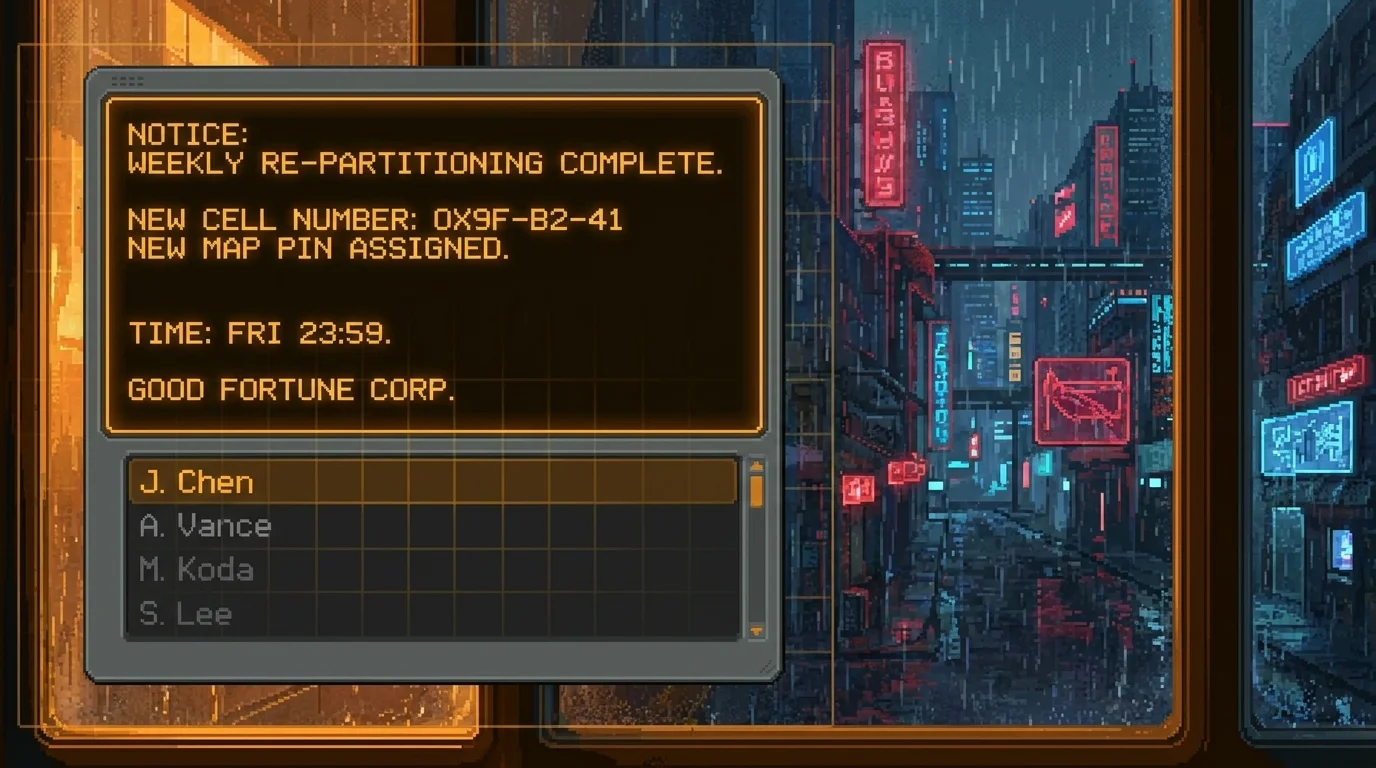
Allocation is the Compact's fourth hat — social topology alongside employment, housing, and justice.
Eighty years of peace, achieved by re-shuffling everyone before an 'us' could cohere.
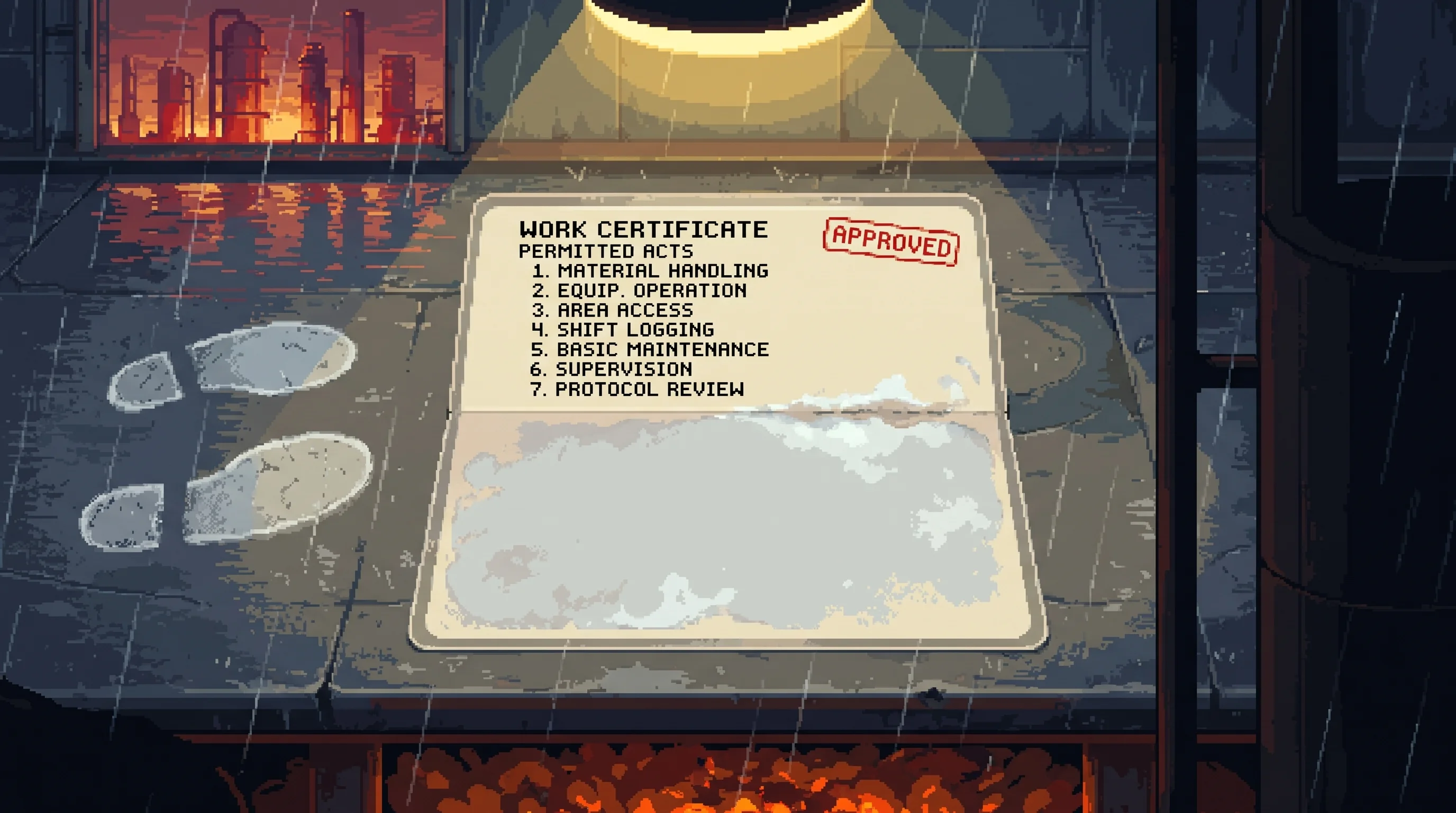
The Compact's standing question is whether quitting is emigration. The prior question is whether helping is a violation.
An act of care outside your certificate files as a violation, whatever it achieved.

The Compact makes leaving impossible. This makes staying impossible, and keeps paying you.
The districts remove the people too many others wait on, state the reason in full, and pay them while they go.

The Compact removes the practical ability to refuse; here the ability is intact, exercised, recorded, and outlasted.
Your written refusal is filed with the month you are forecast to agree, and the procedure goes ahead on schedule.

The Compact makes leaving cost your citizenship. This makes leaving free, and prints the route on the certificate.
Life-support assets go into service one part short, and one named person is entered as the missing part.

That cage was written by an employer; this one by the members.
Relief paid for her bass lines. Her union kept the money and wrote to say she was satisfied.

A struck licence removes employment, so the strike is exile.
Anything you were credited with can be recalled and re-argued alone; nothing held against you ever is.

The employer writes the grounds and publishes the override rate.
Every refusal arrives with its full, honest reasoning, written so you can follow it, and so you rarely appeal.
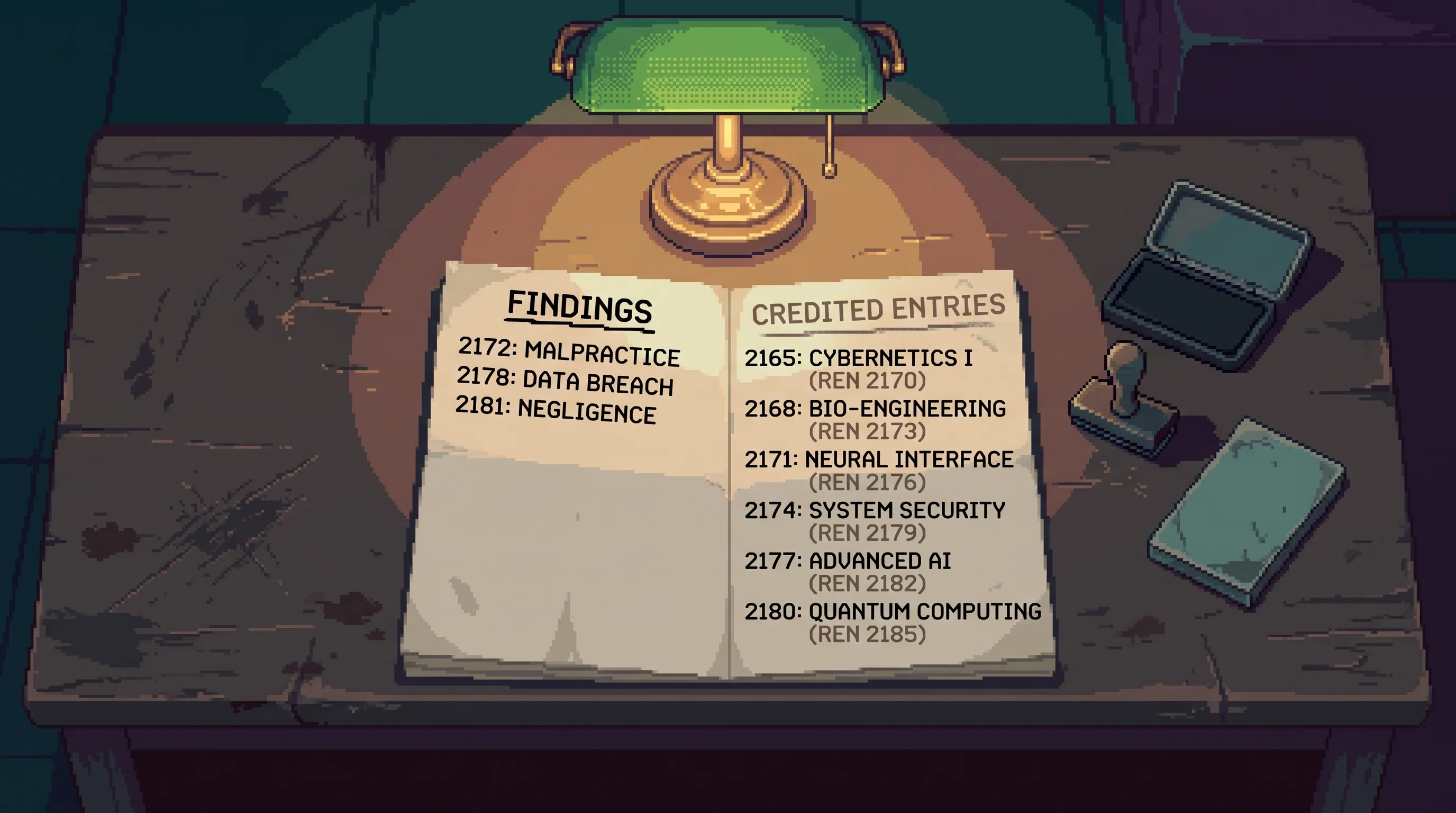
A column that only grows, priced by an employer that is citizenship.
The clause that lets a registry recall your credentials at will, but never your citations.

It prices a death as cost-effective; this cannot say whose survival.
The district can print every resident who paid for the rescue and not one resident who was rescued.
