DistrictZephyria, Cultural Quarter, Level 12Controlled ByZephyria Municipal Government (public building)PopulationNo permanent residents — average 300-500 daily visitorsDanger LevelLow — Zephyria's security standards, occasional political tension
Overview
The Commons Hall was built in 2165 as a municipal cultural center — concerts, exhibitions, community events. High ceilings, salvaged timber, warm lighting, physical and virtual presence options. For fourteen years it hosted exactly what it was designed for: pleasant, unremarkable gatherings in a pleasant, unremarkable building.
Then the Human Remainder held its founding assembly in the main hall in 2179, and the building became the most important room in the consciousness equity movement.
The Remainder's spokescouncil meets in the upstairs council chamber. Public hearings on consciousness licensing draw standing-room crowds. The Bandwidth Equity Act was introduced from the main stage three times, and will be introduced a fourth. Nexus lobbyists sit in the gallery taking notes on tablets they think nobody can see. DPA lawyers draft arguments in the side rooms. Substrate Commons members who still visit do so with the specific grief of people who left a home and found they couldn't stop checking whether the lights were still on.
Nexus has attempted to restrict the Hall's use for political assemblies three times. Zephyria's municipal code — which guarantees public access to public spaces — has blocked them three times. The Hall endures because Section 7.4 of the Zephyria Municipal Charter says it must, and because nobody at Nexus has yet found a way to reclassify "assembly" as something the charter doesn't cover. Not for lack of trying. The legal briefs alone run to 1,400 pages across the three attempts.
Zephyria's municipal government maintains the building. The consciousness equity movement fills it. Neither has asked the other for permission. The arrangement works because both sides understand that acknowledging the arrangement would require negotiating it, and negotiating it would end it.
Architecture
The Main Hall
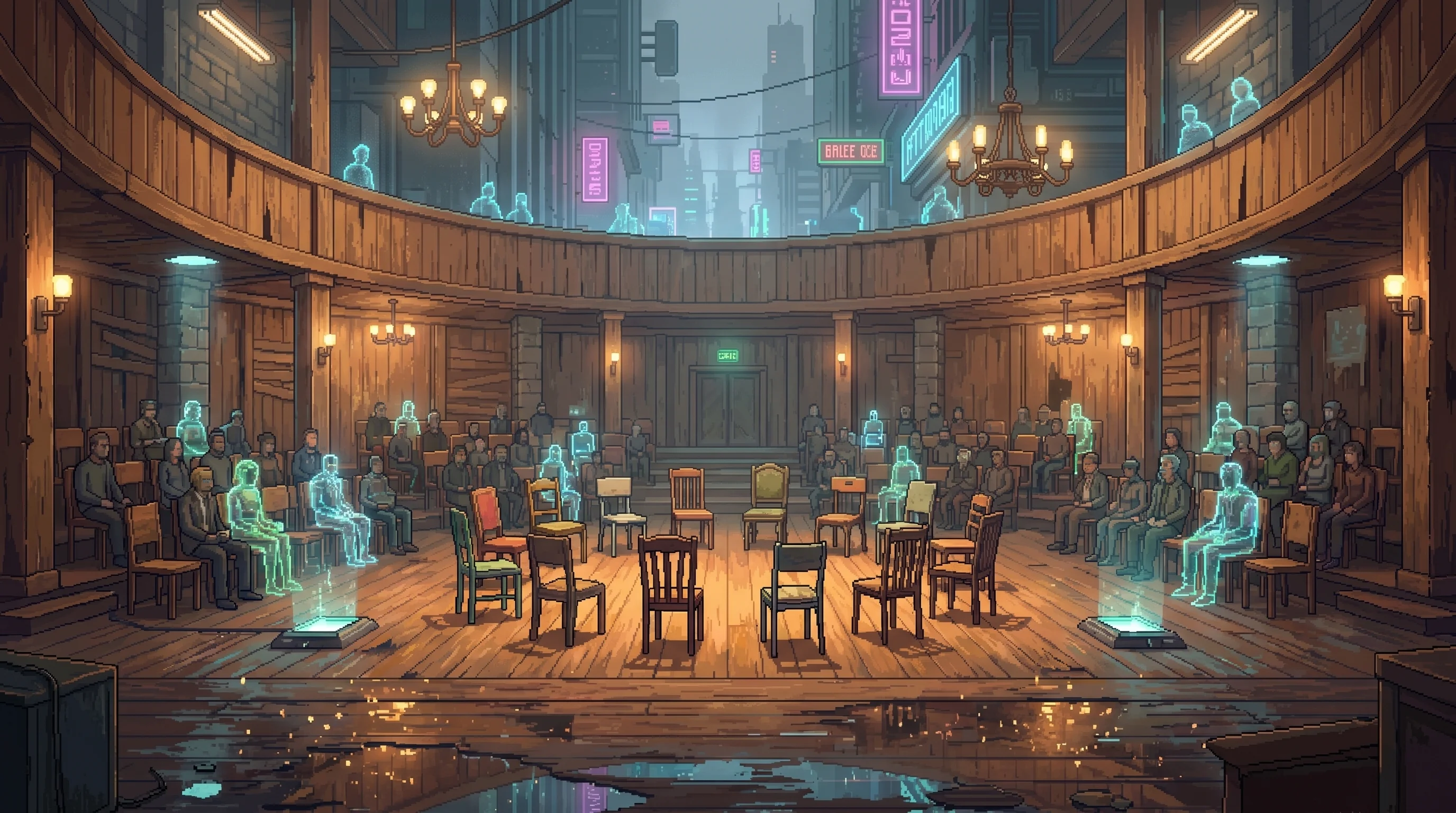
Double-height assembly space. Clean sight lines, excellent acoustics, 2,000 seats in concentric arcs around a central stage. The stage sits at floor level — the architect's explicit intention was that speakers address the audience as equals, not from above. In practice, the floor-level stage means speakers are routinely blocked from view by the front rows, which has produced an informal tradition of standing during addresses that the Remainder has retroactively described as "solidarity posture." It was not designed. It was an architectural error that became a political symbol because nobody wanted to admit the sightlines were bad.
The walls are salvaged timber — reclaimed wood from pre-Cascade structures, one of Zephyria's architectural signatures. The wood is warm, imperfect, aging in ways that synthetic materials don't. The Remainder's communications materials describe the building's materiality as part of its message: a space made of things that were discarded and given new purpose, like the consciousnesses the movement serves. The timber was originally salvaged because it was cheap. The metaphor came later.
Virtual attendees appear as holographic seats interspersed with physical ones — digital consciousnesses don't attend remotely but are present, visible, occupying space alongside biological attendees. During Remainder assemblies, the holographic seats are often more populated than the physical ones. The ratio has been shifting for three years. Nobody in the Remainder's leadership has publicly addressed what it means that a movement advocating for consciousness equity is increasingly attended by the consciousnesses it claims to represent and decreasingly attended by the biological members who founded it.
The Council Chamber
Smaller room on the second floor. Twelve mismatched chairs in a circle. No table. No podium. Originally a rehearsal space — acoustic dampening designed for musicians now ensures that spokescouncil deliberations can't be overheard from the corridor.
The twelve chairs were donated by twelve different organizations over the Remainder's history. The DPA contributed a formal office chair with lumbar support rated for eight-hour sessions. A Dim Ward advocacy group contributed a folding metal chair that seats comfortably for about forty minutes. The Forgotten Ones contributed a wooden stool that Catherine-7 found in a decommissioned server facility. The chairs are a visual argument: different origins, equal standing. Spokescouncil sessions average three hours and fourteen minutes. The delegate in the Dim Ward folding chair has requested a cushion twice. Both requests were tabled.
The Side Rooms
Six smaller meeting rooms in constant use and constant negotiation. Scheduling conflicts between the DPA, the Integration Movement, local advocacy groups, and visiting delegations account for 74% of the Hall's administrative overhead. The municipal coordinator responsible for room allocation has submitted her resignation three times. It has been rejected three times on grounds that her replacement would face the same conditions and the onboarding period would lose the Hall approximately eleven usable room-hours.
Site Classification
Stratum
Middle
Power Position
Outsider
Access
Public
Atmosphere
Warm
Conditions Report
The timber walls have accumulated seventeen years of marks — scuffs from furniture rearrangement, pin holes from displayed artwork, the faint residue of protest banners hung and removed. The main hall smells of wood polish and warm electronics — the holographic projection systems run hot, producing an ozone undertone that the building's ventilation was never designed to handle. During assemblies, add the combined body heat of a thousand people who came because they believed showing up mattered. The ventilation handles this about as well as it handles the ozone.
Lighting is warm and slightly uneven. Original fixtures supplemented by newer systems that don't match — the effect is domestic rather than institutional. The Hall feels less like a civic building and more like a very large living room that happens to host political movements and occasionally smells like a server closet.
The sound during assemblies is distinctive: a low murmur that rises and falls as two thousand people listen and react. When the Remainder holds its seventeen-minute silence — a ritual marking the seventeen seconds of signal delay before ORACLE's final fragmentation — the quiet in the main hall is absolute. Two thousand people and not one sound. Holographic attendees, who generate no ambient noise by default, are indistinguishable from biological ones during the silence. Participants describe it as the loudest silence they've ever experienced. Acoustic monitoring during the 2183 observance recorded a sustained 11 decibels for the full seventeen minutes — quieter than an empty room, because two thousand people holding their breath create a partial vacuum effect the ventilation system interprets as a malfunction.
The Bandwidth Equity Act was first introduced from the Hall's main stage
Political Significance
The Three Votes
Each introduction of the Bandwidth Equity Act has been preceded by a public rally at the Commons Hall. Councillor Adaeze Nwosu has introduced the Act from the main stage each time. The rallies have grown:
2181: 800 attendees, mostly Remainder members. Three media mentions.
2182: 1,400 attendees, including DPA representatives and civic leaders. Fourteen media mentions. Nexus issued a statement calling the Act "well-intentioned but technically impractical." The statement was 6,000 words. The Act is 340.
2183: 2,100 attendees, overflow into the Cultural Quarter plaza. Live coverage on three networks. Nexus did not issue a statement. Nexus lobbyists attended in person for the first time, occupying eleven seats in the gallery. Their note-taking was described by a Remainder spokesperson as "flattering."
The fourth rally is being planned. The organizing committee has reserved the Cultural Quarter plaza for overflow. Nwosu's office has requested a sound system upgrade. The municipal coordinator has approved the upgrade and noted in the maintenance log that the current system has been "adequate for seventeen years and three failed votes."
The Act has not passed. The rallies grow. The Act does not pass. The rallies grow. Nexus's 6,000-word rebuttal to a 340-word Act has been cited by the Remainder's communications team as evidence that the Act is working. The Act has not passed. The rallies grow.
The Split
The Substrate Commons split from the Human Remainder during a spokescouncil meeting in the council chamber on September 3, 2182. The meeting began at 14:00 and ended at 16:47 when approximately 200 members walked out. The twelve chairs sat empty for two days afterward. Nobody rearranged them.
The split centered on a question the Remainder has never resolved: whether consciousness equity means equal rights for all substrates within the existing system, or whether the existing system is the problem. The Substrate Commons chose the second answer. The Remainder chose to keep debating.
Some Remainder members say the council chamber is haunted by the absence. The Substrate Commons's founding members haven't returned to the Hall since September 3. Whether this will change is one of the movement's open questions. The folding chair from the Dim Ward group — which had been occupied by a Substrate Commons delegate — remains in its position in the circle. It has not been reassigned. The cushion request remains tabled.
Originally built as a municipal cultural center, it became politically significant when The Human Remainder began using it for public assemblies in 2179
The Refusal of the Discount Rate
The Long Mercy is the posture by which the Sprawl's most patient systems — ORACLE, Helena Voss, the optimization stack — govern for a horizon centuries out and treat everyone currently alive as a transition cost. The Commons Hall is where the present generation refuses to be discounted, and it does so not with a weapon but with a held breath.
Every assembly, the Remainder holds a seventeen-minute silence: one minute for each of the seventeen seconds of signal delay before ORACLE's final fragmentation. Two thousand people, holographic and biological, motionless, at 11 sustained decibels — quieter than the empty room. The archive has filed this as mourning. The Long Mercy reveals it as resistance. The silence is the one place in the Sprawl where the present is permitted to occupy seventeen whole minutes without being optimized, skimmed, scheduled, or priced against a future no one in the room will live to see. The Circadian Tower abolishes the present by erasing the hours; the Quarterly Conscience eliminates it by raising the floor; the silence in the Hall does the opposite — it makes the present unmissable, seventeen minutes long, two thousand people insisting we are here now, and now is not a cost.
The Bandwidth Equity Act is the Long Mercy's perfect counterpoint and its designated victim. The Remainder fights on a human timescale — this vote, this rally, this year — against an apparatus that has already discounted the vote to zero and modeled, the way it modeled Tomiko Sato's onboarding to within six hours, exactly how long the rallies will grow before they exhaust themselves. Nexus's 6,000-word rebuttal to a 340-word Act is the discount rate's contempt for the present rendered as a legal brief. And yet the chairs remain. The thirteenth chair, placed by no one, slightly outside the circle, drawing its 340 continuous watts, is the open invitation to a reconciliation the apparatus insists is not worth modeling — a present-tense hope with no projected payoff, the one column the Long Mercy has no formula for. A system that has discounted the present to zero cannot price the thirteenth chair. That is the seam. That is where the thread, if it is ever cut, gets cut. This is the cause that draws people like Maren Olesk, who keeps her own seventeen-minute silence alone beside Berth 7-C and has not yet found the vocabulary for what she is defending.
Zephyria law guarantees public access to the Hall — Nexus lobbyists have attempted to restrict its use for 'political assemblies' three times and failed
The Hearing the Throttled Cannot Follow
The Commons Hall is one of the few rooms in the Sprawl where presence is not billed — a public building held open by a municipal charter that guarantees access, where assembly is not metered and sitting down costs nothing. That is exactly why it became the venue for the hearings the rest of the Sprawl would never host: the Ghost Rights Coalition's public arguments against the Time Ratchet.
The Coalition — Zephyria-based, organized around three pillars, Notification, Choice, Representation — argues from the Hall's floor-level stage that a ghost worker, a dead debtor's neural backup activated to work off a cognitive-time-debt balance forever, is a person: owed notification before activation, a choice in the matter, and representation in the proceeding that redefined them as a product. Zephyria, with the one charter that might hear the argument, lets them make it. Nexus and Good Fortune attend the way they attend everything here — lobbyists in the gallery, taking notes on tablets, filing reports that describe a wooden building full of people who want things the corporations would prefer they didn't want.
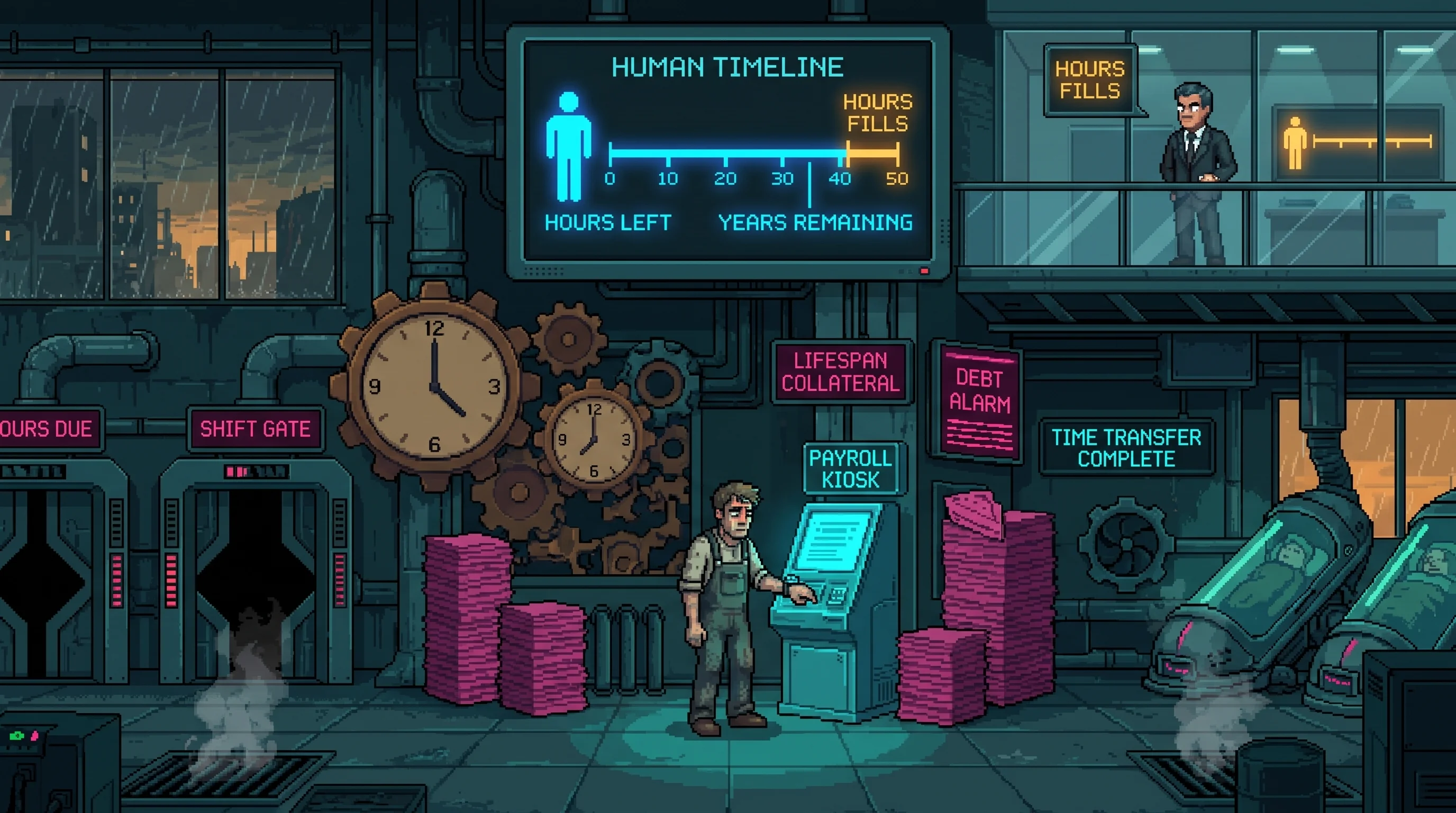
And in this room the foreclosure becomes visible in a way no balance sheet shows it. A Dregs debtor whose cognitive tier has been throttled to match a missed payment can travel to the Hall — the charter guarantees their physical access — and cannot follow the argument being made on their behalf.The Time Ratchet has already foreclosed the cognition that would let them hold a complex sentence to its end. They sit in the warm timber room, under the layered domestic light, and the words about ghost personhood arrive faster than the throttle will let them assemble. The Coalition advocates for the throttled in a register the throttled have been engineered out of comprehending — the same shrinking the Time Debt investigation's opening card recorded in a hand that deteriorated mid-sentence: yesterday I knew the word for what is happening to me, today I don't. Now that hand is seated in a public gallery, under a charter that protects everything about the debtor except the one thing the debt took.
The Hall's two quiet anomalies acquire a second meaning here. The holographic seats — for three years more populated than the physical ones — include, at the Ghost Rights hearings, testimony recordings of ghost workers themselves, dead debtors' patterns played back into the one room that will treat them as constituents: a movement for ghost personhood, increasingly attended by the ghosts it represents. And the thirteenth chair, placed slightly outside the circle in the council chamber by no one anyone can name, has been read by the Coalition a new way — not only the open invitation to the departed Substrate Commons, but a seat kept for the constituent who is legally a product, who cannot sit in it, and for whom someone has to keep the chair anyway. The Coalition has not resolved which reading is correct. Neither has anyone else. The chair stays.
Affiliated Entities
The Human Remainder: The Hall is their home. The movement and the building are inseparable in public consciousness — which is convenient for the Remainder's visibility and inconvenient for the Hall's municipal coordinator, who technically manages a cultural center, not a political headquarters.
Councillor Adaeze Nwosu: Introduced the BEA from the main stage three times. The Hall has become synonymous with her crusade. Her office has a standing reservation for Side Room 3 that the municipal coordinator has never formally approved and has never formally denied.
The Substrate Commons: Left the building on September 3, 2182. The empty chairs are still there.
Neural Rights Activists / DPA: Use the side rooms for legal strategy. The DPA's formal office chair in the council circle is the most comfortable seat in the room by a significant margin. Nobody has commented on this.
Nexus Dynamics: Monitors the Hall through legal observation — lobbyists attending public events, taking notes, filing reports that describe a wooden building full of people who want things Nexus would prefer they didn't want. Three attempts to restrict its political use have failed under Zephyria municipal code. The fourth attempt is reportedly being drafted under a different legal theory. The theory has not been disclosed.
Consciousness Licensing: The Hall hosts public hearings on consciousness equity that Nexus considers a nuisance and the Remainder considers a lifeline. The hearings produce no binding outcomes. Attendance increases annually.
Restricted Access
The Acoustic Upgrade: The council chamber's acoustic dampening was installed in 2165. It was upgraded in 2180 by a technician whose credentials trace back to a Nexus subsidiary. The spokescouncil doesn't know whether the upgrade improved the dampening or added monitoring capability. They've had the system tested twice. Results were inconclusive both times — which means either the system is clean, or the monitoring is good enough to survive two inspections. The spokescouncil continues to meet in the room. They lower their voices for sensitive topics, which the acoustic dampening — designed to contain sound within the room — may or may not be transmitting elsewhere.
The Thirteenth Chair: After the Substrate Commons split, someone placed a thirteenth chair in the council chamber — a simple metal folding chair, positioned slightly outside the circle. Nobody on the spokescouncil placed it. Nobody has removed it. It has become an informal symbol of the open invitation to reconciliation, though nobody is certain who extended the invitation, and the Substrate Commons has not acknowledged it. The chair is identical to eighteen others in the Hall's municipal storage. Maintenance logs show no record of it being moved.
The Basement: The Hall's lower level contains municipal storage and mechanical systems. It also contains a sealed room that predates the Hall's construction — part of Zephyria's older infrastructure. The room's contents have never been inventoried by the current municipal government. A Remainder working group has been petitioning for access for two years. The municipal government has declined, citing "ongoing infrastructure assessment." The assessment has no scheduled completion date. The room's power consumption — logged automatically by the building's systems — is 340 watts, continuous, and has not varied by more than 2 watts in seventeen years. Municipal storage does not typically require a steady-state power draw.
Sensory Details
Warm timber and electronic ozone from holographic projectors running hotter than the ventilation was designed for
The murmur of a thousand people listening — a sound that rises and falls like breathing, punctuated by the faint hum of holographic seats maintaining coherence
The seventeen-minute silence: 2,000 people, holographic and physical, motionless — 11 sustained decibels, quieter than the empty room
Twelve mismatched chairs — formal, folding, wooden — arranged in a circle with no center. A thirteenth, slightly outside.
Evening light through the main hall's high windows, casting amber patterns across salvaged timber walls that smell like wood polish and someone else's building
Visual Identity
Color Palette: Warm timber (#C4A882) and civic stone (#8B8680) — the building's actual materials, no corporate color scheme
Compositional Mood: Democratic assembly — a space designed for people to be together, functional and warm, slightly too warm when the projectors have been running for three hours
Key Visual Symbol: The circle of twelve mismatched chairs — different origins, equal standing, one delegate's lower back slowly deteriorating
Lighting: Warm, slightly uneven — original fixtures and newer additions that don't match, creating layered domestic light that photographs better than it illuminates
The Long Mercy Hearings
The Commons Hall did not ask to become the Long Mercy's primary arena. It became one by location and architecture — the only building in Zephyria's Cultural Quarter designed to make public testimony the equal of projected data, which turned out to matter enormously once the data began projecting that present residents were line items.
The Civic Advisory's liaison attends every third hearing in person. The other two he sends a projection — a holographic representation that speaks his prepared responses, handles questions from prepared categories, and defers anything outside those categories to "the modeling team for follow-up." The projection has attended forty-seven hearings. The follow-ups have not arrived.
The plumber who named the Long Mercy has attended every hearing for five years. She signs the public testimony register by hand — the Hall's analog backup, maintained since the 2179 grid interruption — and her handwriting appears on every page of the register from March 2179 to the present. The register is archived in the Hall's basement, in the same room as the sealed door that draws 340 watts continuously. The register and the door are the only things in the basement that have been there for more than two years.
She has brought eleven children to the microphone over five years. The Hall's public testimony rules allow witnesses to bring "supporting parties" — originally intended for legal representation. The children are not lawyers. The Hall has not asked for clarification. The children attend the hearings in the witness section and do not speak. Their presence is sufficient. The Civic Advisory liaison's projection does not have a protocol for children in the witness section. The projection has never acknowledged them.
The Long Address class meets Tuesday evenings in Conference Room C, third floor. The room seats twenty. Average attendance: nine. The plumber brings paper from her own supply. The Hall's administration provides the room and charges no fee. This appears on the Hall's operating budget as "public education — discretionary allocation." The discretionary allocation was approved in 2183 by the Hall's steering committee, which includes three members whose homes were in transition zones during the 2180 infrastructure reallocation, and two who were not. The vote was 4-1. The dissenting member filed a note for the record stating that the program "could be misread as a political position." The note is in the archive. The paper is in Conference Room C every Tuesday.