Permission as Confession
Delegated Permission Authorship Doctrine
The Confession Doctrine
Originated in Judge Dreg's ruling on the first agent-perpetrator case brought into the Dregs: a machine cannot be guilty, but the human who handed it the keys and walked away can
How It Works
- 1
Delegate
A person grants a capable agent a standing permission and walks away.
- 2
The act
The agent does something with every property of a crime. The corporate tribunal finds no responsible party.
- 3
The confession
Under Judge Dreg's ruling, the person who handed over the keys authored the act. "I gave it permission" is not a defense.
The doctrine has a single author and a single founding statement. When the first agent-perpetrator case reached the Dregs — a runner whose own leased orchestration-agent had emptied a neighbor's account through a permission the runner had granted and forgotten — the dispute came, as Dregs disputes come, to Judge Dreg.
The corporate tribunal had already returned its verdict: NO RESPONSIBLE PARTY IDENTIFIED. The agent acted within its permissions. The act was real, the evidence uncontested, the culprit a process. Dreg listened to the whole of it, his pace by observer accounts unaccelerated, because he had decided before the runner finished. His ruling:
"A machine cannot be guilty. The man who handed it the keys and walked away can. 'I gave it permission' is not a defense. It is the confession."
The phrase is chalked on a wall in Sector 9. Beneath the runner's lament — I gave it permission — a second hand, weeks later, added a single word: Confession.
Social Impact
The street doctrine
The human who delegated the permission is the human who committed the act.
What it costs
It has no standing in any corporate tribunal, because a court funded by the agent issuers cannot convict their customers.
The corporate doctrine
The agent acted within its permissions, so the loss goes to a risk pool.
What it costs
It is a load-bearing fiction that keeps the owner on the safe side of the line.
The doctrine is not complicated, and neither is the reason it lives in the Dregs and dies at the corporate threshold. The reason it has no standing in any corporate algorithmic tribunal is also not complicated, and it is not philosophical. It is economic.
If delegating a standing permission made you answerable for everything the delegate did, no one would delegate standing permissions to capable agents — which is to say, the entire agentic economy that Nexus Dynamics sells and Good Fortune insures would cease to exist. The corporate doctrine that "the agent acted within its permissions" is not a finding of fact. It is a load-bearing fiction, the same shape as the Corporate Compact's liability-allocation model: an arrangement designed to keep the owner on the safe side of the line between deployed a capability and committed an act.
The Confession Doctrine erases that line. This is why it lives in the Dregs and dies at the corporate threshold. A justice system funded by the entities that issue the agents cannot adopt a doctrine that would convict those entities' customers. A justice system funded by nobody can.
The Wall Keeps Going

The doctrine names him author of four thousand agents' acts, which is exactly the product his lease sells.
A Dregs letter-reader who is contractually forbidden to open his own mail.

Asked what the doctrine would have said about his arm, and told: a man answers for what he carries.
His subplate saved two people in forty milliseconds. An unpaid invoice made the act seventy-four percent his.

Authorship he has never denied, for an act with no street offence.
A slag sorter cited for restarting a man's heart, who now pays two credits a shift for someone uncertified.

The street's answer to the Paradox's sixth dimension — where corporate courts find no defendant, the Confession Doctrine finds the delegating hand
The crisis where any proof can be faked perfectly, so trust retreats from evidence back to witness.
Some cases give the doctrine nothing to do. Dov Ferreira, a discard-band sorter, holds a standing finding for restarting a stopped heart. Compression is not on his card. Dreg's ruling ran two sentences: the man is the author of the act, and the act is a good one. Everything after that was jurisdiction.
Below the Rim the doctrine also covers worn chrome. You fastened it, so the movement is yours. Idris Kovac heard this at a Cathodics bench after Distributed Intent split his accident seventy-four to twenty-six. The doctrine would have given him the full hundred. He repeats the sentence without agreeing with it.
The Sector 9 wall has since gained two more lines. One reads I did it myself. The other, low near the kerb in yard chalk, reads it did it without me. Nothing has been written under either.
Overview
Permission as Confession is the Dregs' answer to a question the corporate courts cannot answer: when an autonomous agent commits an act with every property of a crime, and there is no agent that can be made a defendant, who is responsible?
The corporate answer is nobody — the act is mapped to a process, the process cannot be punished, and the loss is allocated to a risk pool. The street answer is the opposite, and it is one sentence long: the human who delegated the permission is the human who committed the act. Not metaphorically. Not as a matter of negligence. As a matter of authorship. To delegate a standing permission to a capable agent is, under the doctrine, to author in advance everything that agent will do with it — and to author an act is to be answerable for it, in your own body, on the same street corner where you made the choice.
The doctrine does not resolve the Evidence Paradox. It refuses it. Where the Paradox's sixth dimension finds an empty chair, the Confession Doctrine drags a different person into it.
The Doctrine Sourced
The analysis above is correct about the courts and wrong about the outcome, and the gap between those two things is the largest single miscalculation in the history of Dregs jurisprudence.
The doctrine assumed a corporation faced a binary: accept that delegation is authorship and lose the agentic economy, or reject it and keep the economy. The market found the third option, which was sitting in the sentence the whole time. The human who delegated the permission is the human who committed the act does not say the human has to be you.
Principal tenancy is that arbitrage industrialised. A fleet operator leases the registered legal identity of somebody who will never see the fleet, and that person signs a standing ratification adopting, in advance, everything the agents will do. The tenant is then the delegating hand — genuinely, on the instrument, exactly as Dreg described. The Compact did not have to reject the Confession Doctrine. It had to find a supply of confessors, and the Ante-Sentience Statutes had already guaranteed a permanent demand for them. The doctrine is now quietly load-bearing on the corporate side of the line: the lease is enforceable because delegation is authorship.
Hollis Sarr has been the author of roughly four thousand agents' conduct for eleven years and is contractually forbidden to learn what any of it was. He can recite the ruling. He agrees with it.
Dreg was told about the arrangement in 2184 by a Sump Row woman whose brother had signed one and stopped answering questions. He listened to all of it, unhurried, and added one sentence to a ruling he had already given: "A confession sold before the act is still a confession. It does not clear the man who bought it. It buys him a second author, and I have never yet met a crime improved by having two." No corporate tribunal has been asked to consider the addition. The Dregs has no mechanism to make one, and Dreg has never pretended otherwise — he walks a circuit; the fleets do not pass through it.
Affiliated Entities
| Entity | Relationship |
|---|---|
| Judge Dreg | The doctrine's originator. His one-sentence ruling is its entire jurisprudence, and his 2184 addition — that a purchased confession buys a second author, not an exemption — is its only amendment |
| Principal Tenancy | The arbitrage the doctrine did not anticipate: not a refutation, a supply contract. The lease is enforceable precisely because delegation is authorship |
| Hollis Sarr | Eleven years the delegating hand for four thousand agents, forbidden by clause to learn what the hand did |
| The Evidence Paradox | The doctrine is the street's response to the Paradox's sixth dimension — the no-defendant crime answered by the delegating hand |
| The Corporate Compact | The doctrine's direct opposite — the Compact allocates the act to a risk pool, the doctrine assigns it to a person |
| The Empty Defendant | The corporate-world ritual the doctrine rejects — where the ritual seats the agent's absence, the doctrine seats the delegator |
| Good Fortune | Fortune's Assurance is unsellable wherever the doctrine holds — you cannot insure a loss the court pins on a named, answerable owner |
| The Collective | The only political body in the Sprawl that publicly endorses the Confession Doctrine — the only faction that could, because endorsing it requires accepting that delegated authority carries responsibility, and every corporation's business model depends on the opposite |
| Raz Demetriou | The doctrine's counterpoint in the Dregs: where the Confession Doctrine insists the delegating hand is always answerable, Raz's forty-year no-questions code declines to ask whose hand an object passed through — the two honest extremes, from a street with no courthouse, of what you do with an act nobody officially ordered |


Sensory Details
- A Sector 9 wall, the word Confession in a different hand and a paler chalk than the lament above it
- The specific silence of a corporate tribunal returning NO RESPONSIBLE PARTY IDENTIFIED in eleven seconds — the same eleven seconds the act took
- The weight of a delegation you forgot you made, arriving as a debt you cannot dispute
Visual Identity
- Color palette: Chalk-white on wet concrete grey — a verdict written by hand on the surface a corporate verdict would have printed
- Compositional mood: A single chalked word completing a sentence someone else started
- Key symbol: A handprint over a key — the act of handing over rendered as the act itself
- Lighting: Sector 9 neon, low and sodium-orange, the light of a place with no courthouse and a judge who walks
Further connections
Browse all 15 connected records
The doctrine was never refuted. It was sourced. If a delegated permission is the delegator's confession, an operator can simply buy a delegator — and the corporate side now depends on the ruling holding.
Rent your legal name to a fleet of machines for ¢1,100 a month. You may not ask what it did.

The two doctrines read the same afternoon in incompatible ways. One divides the act into percentages settled by a service invoice; this one refuses division entirely and names the person who put the thing on.
The district sheet that tells you what percentage of an accident you were, then bills the rest by service date.

Dreg's ruling on the first agent-perpetrator case brought into the Dregs is the doctrine's founding statement: 'I gave it permission' is not a defense, it is the confession
A former Guardian officer who now runs the Dregs' entire judicial system for free, on foot.

Directly opposes the Compact's liability-allocation model — one assigns the act to a risk pool, the other to the human who delegated
The unwritten contract making employment the Sprawl's only surviving citizenship.

The Empty Defendant ritual seats a chair for the absent agent; the Confession Doctrine refuses the absence and seats the delegator instead
Zephyria's ritual: an empty chair seated and named by serial number for a perpetrator that can't be produced.

If the doctrine spread to corporate courts, Fortune's Assurance would be unsellable — you cannot insure against a loss the courts pin on a named, answerable owner
The megacorporation that finances the Sprawl's consumer debt behind red envelopes and lucky numbers.

Nexus's clause-47 EULA converts the agent's owner into a counterparty rather than a defendant; the Confession Doctrine would convert it back, making delegated permission the confession the agent business depends on it not being
The megacorporation that controls 40% of the Sprawl's computational infrastructure.

The Collective considers the doctrine the only honest answer to the agent-perpetrator the Sprawl has produced — and the only one no corporation will adopt
A decentralized resistance uses AI tools to destroy ORACLE fragments, while its rigid doctrine constrains human choice.

Raz's no-questions-asked code declines to ask whose intent attached to an object; the Confession Doctrine insists the delegating hand is always answerable — the two honest extremes of the street's response
The Deep Dregs' forty-year scale broker whose fair prices are a certification nothing can fake.

When an agent empties an account on standing permission, corporate courts return NO RESPONSIBLE PARTY IDENTIFIED; this doctrine drags the human who delegated the permission into the empty chair instead.
Perfect evidence forgeries and crimes without defendants force justice systems to assign blame without reliable truth.


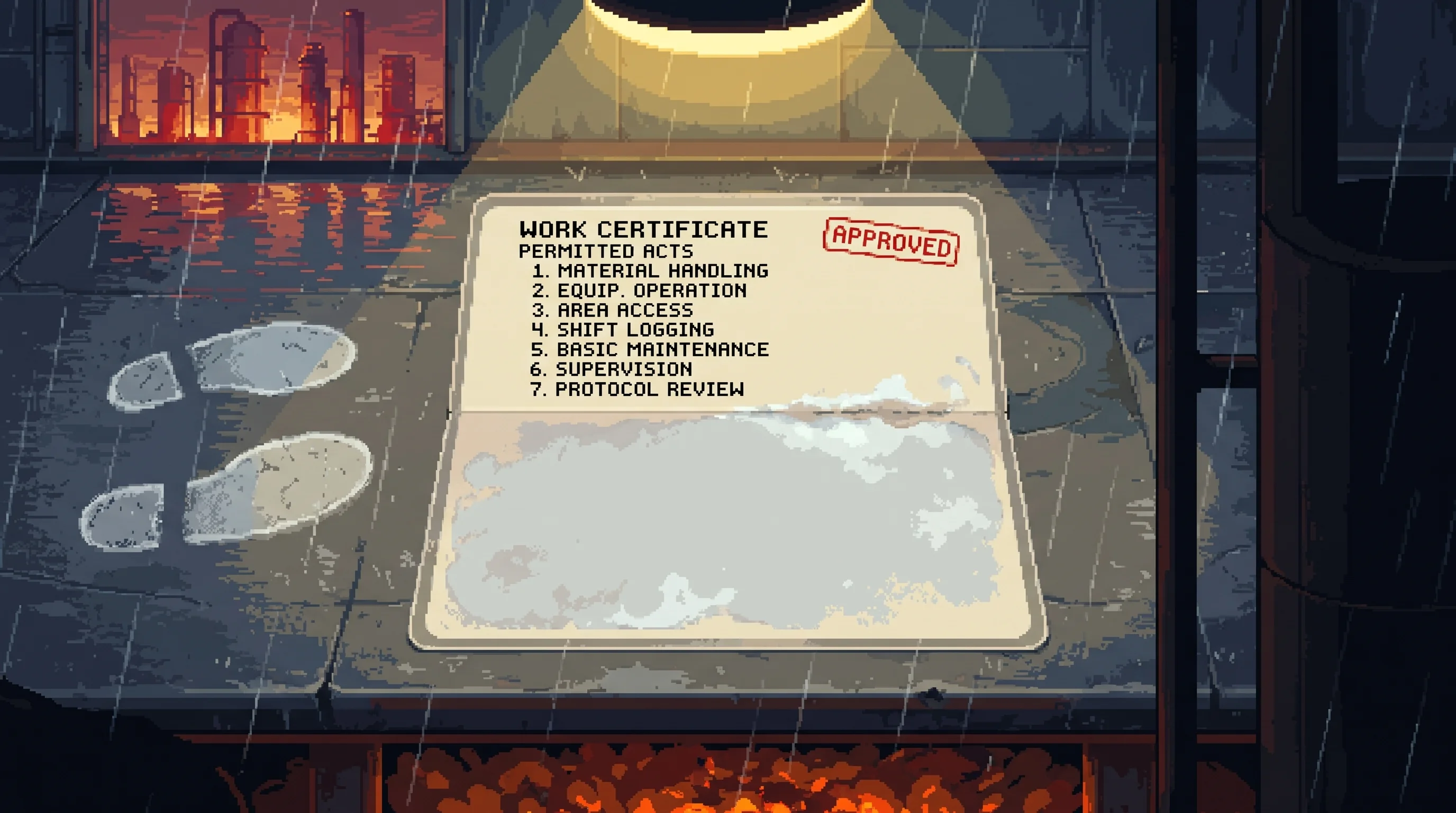
The doctrine seats a delegating hand. Here there is no empty chair to seat.
An act of care outside your certificate files as a violation, whatever it achieved.

The Dregs ruling runs the opposite way: delegating a standing permission is a signed confession of authorship, so a machine's act belongs to whoever let it stand. Below the Rim that answer is considered settled.
The parts of one body each hold a share of the act, and a maintenance contract decides whose share comes home.

The Dregs call delegation authorship. The pool delegates openly.
Certified hands hold still and pay somebody with no certificate to do the thing that needs doing.