G Nook is the Sprawl's largest underground network of cyber cafes, and it charges fifty credits an hour for terminal time in a world where Nexus Dynamics gives it away for free.
The fifty credits buy nothing Nexus doesn't offer. Anonymous browsing, communication relay, basic network access — Nexus provides all of this, faster, cleaner, with better uptime. What Nexus also provides is a complete behavioral record of every keystroke, every message, every search query, archived permanently in computational infrastructure it controls. This is not hidden. It is the terms of service. Nexus's free terminal access is free the way a fisherman's bait is free.
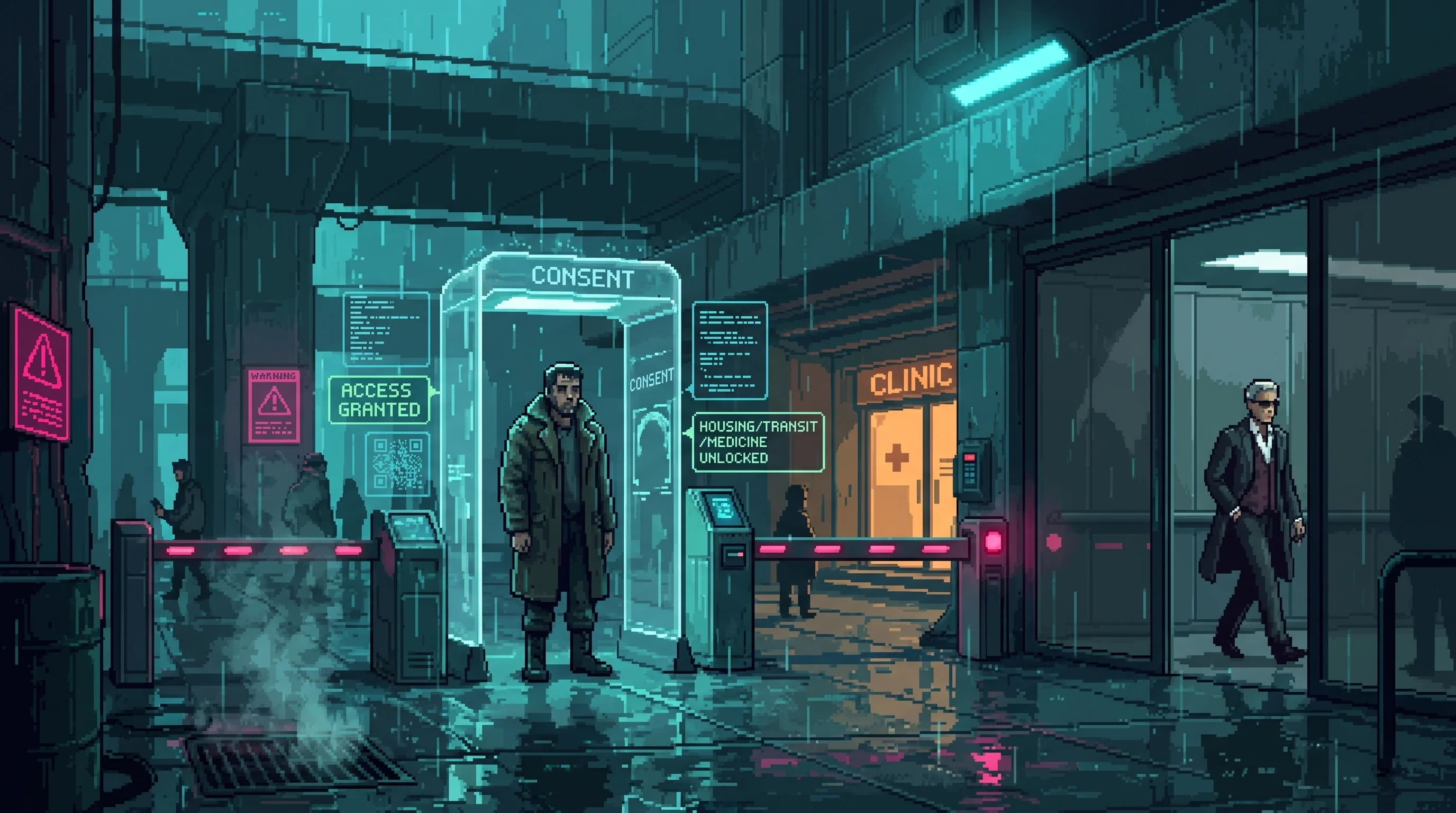
El Money's fifty credits buy the absence of that archive. The terminal leaves no logs. The network routes through dead hardware and stolen bandwidth on protocols that predate ORACLE's standardization. The session ends and the session ceases to exist — not encrypted, not archived, not minimized. Gone. In a Sprawl where Nexus controls 40% of computational infrastructure and the remaining 60% is split among corporations with identical surveillance incentives, the absence of a record is the most expensive product available. El Money sells it for the price of a synthetic lunch. It is the one structural hole in Section 12.3 Telemetry, the consent seal that makes continuous monitoring the price of network access — and rather than name a competitor, the seal's own drafting files G Nook under operationally non-existent, which is the closest thing the Sprawl has to admitting the hole is there.
The name is deliberately ambiguous. "G" is Gamer (the original), Gangster (the street version), Ghost (El Money's preference, possibly). He has never clarified. The confusion functions as a filter — people who need to know what the G stands for don't need G Nook.
The network also carried the first surviving Lil Nos recording. A forty-second bootleg crossed eleven terminals before a corporate platform featured him. CyberMaster heard it on that circuit. The route proves the song moved before the official push. The no-logs design prevents anyone from proving who moved it.
What You Find Inside
Walk through the right maintenance corridor, give the correct phrase to the worker who doesn't remember faces, and you enter a space that shouldn't exist in a building this old.
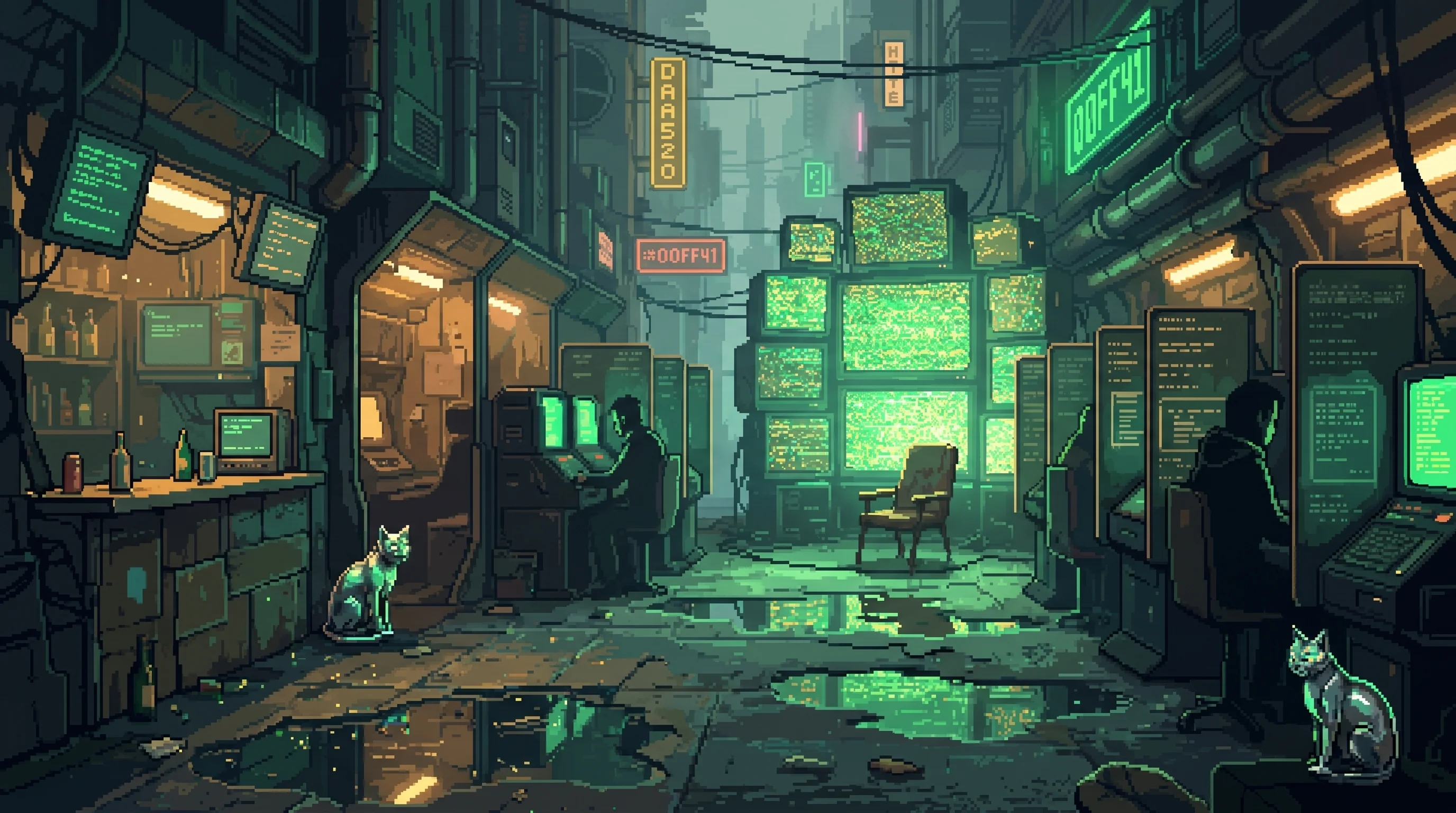
Rows of terminals with privacy screens. Private booths with signal shielding. A counter serving cheap synthetics and, occasionally, real coffee — the "occasionally" doing significant work in that sentence, given that real coffee in the Dregs costs more per gram than most narcotics. Cooling systems humming at frequencies that suggest hardware generations newer than anything the visible infrastructure could support. Staff who have never seen you before and will not see you next time. Customers who do not make eye contact with each other, the staff, or the chrome cat watching from the shadows.
And games. Actual games, always running. Ranked matches on old ladders the corporations abandoned, tournament legs no official bracket acknowledges, spectators leaning over privacy screens without crossing the line into recording. The same comms channels that move sensitive jobs also call in ringers when a regular is down a player. The same monitor wall that carries S-Money's memorial streams becomes a VOD review station after midnight. A G Nook can broker a dead drop, hide a runner, and host a sweaty overtime match in the same hour without anyone inside treating those as separate businesses.
The rules are posted nowhere and known by everyone:
Don't bring heat. Don't ask about other customers. Don't record anything. Pay fair rates. Respect the S-Money Memorial.
Five rules. Thirty years. Zero successful raids by Nexus, Ironclad, or any corporate security apparatus in the Sprawl.
The punishment for breaking them isn't exile. The underground economy closes to you. Ripperdocs won't touch you. Fixers won't take your calls. Safe houses lock. The people who could save your life forget your name. Community exile in the Dregs has a median survival window of six months. This figure is not published anywhere. It doesn't need to be.
Public Notice
Access without surveillance.
“neutral ground”
“no logs”
“the network forgets”
“access is the promise”
G Nook — official messaging
The S-Money Memorial
Every G Nook has one corner that's different.
A terminal — or several — running thousands of media streams simultaneously. News feeds, entertainment, financial data, surveillance footage, social streams, advertising, emergency channels. All at once. All the time. The screens flicker with a density of information that registers as visual noise to anyone standing nearby.
Nobody uses these terminals. Nobody touches them. They run for S-Money — El Money's younger brother, dead under circumstances nobody discusses. S-Money could process more data streams simultaneously than anyone believed possible. He found patterns in the noise that others couldn't perceive. The noise is his language. The terminals speak it continuously to an empty chair.
Regulars say El Money visits each location's memorial personally. They say he talks to the screens. Whether S-Money's consciousness persists somewhere in the streams — whether the memorials are shrines or receivers — is a question nobody asks El Money and El Money has never addressed.
The noise is prayer. The prayer is unanswered. The terminals keep running.
How G Nook Stays Hidden
Nexus Dynamics controls 40% of the Sprawl's computational infrastructure. Ironclad Industries surveils every maintenance tunnel. Corporate AI sifts petabytes daily for anomalous patterns. G Nook has operated for nearly thirty years across an estimated forty to sixty locations without a single confirmed raid.
You don't find a G Nook. Someone who trusts you brings you.
First visit: blindfolded, or taken through a deliberately confusing route. Return visits only after you've demonstrated you can keep a secret. Sharing access requires vouching — your reputation staked on theirs. Write down a location, tell a corp, get careless: your access dies forever.
Locations are never digitally recorded because they were never digitally recorded. The address doesn't exist in any database because no one put it there. The chain spreads person-to-person through trust networks where each link has something to lose if it breaks. The system is slow. It would take Nexus approximately forty-five seconds to compromise if it were digital. It has been unbreakable for three decades because it runs on the one protocol Nexus cannot intercept: humans who are more afraid of each other than of corporations.
The vouching chain is also a debt chain. Someone brought you in. Their reputation is now staked on your behavior. You owe them not silence exactly — you owe the maintenance of a relationship that validates their judgment. Upward to the person who vouched. Downward to anyone you later introduce. The gift of access generates obligation that can't be settled because the thing G Nook provides — existing as a person rather than a data source — has no market price. El Money charges for terminal time. He does not charge for what terminal time enables. The thing you need most is the thing that was never billed, and unbilled gifts bind tighter than contracts.
The Infrastructure
G Nooks exist in corporate blind spots — the cracks where surveillance jurisdictions don't quite overlap.
Maintenance tunnels that don't appear in reconstruction records. Deprecated water treatment systems from pre-Cascade infrastructure. Building basements miscategorized during the chaos of 2148-2155. Jurisdictional gaps where Nexus security ends and Ironclad's begins. Server closets in buildings whose owners don't know what they own. Condemned residential blocks. Sometimes corporate server closets themselves. El Money has a dark sense of humor.
The Sprawl is thirty-seven years removed from the Cascade. Reconstruction was chaotic. Records contradict each other. Buildings got rebuilt three times with different blueprints. El Money studies those contradictions the way a geologist studies fault lines — not to fix them but to live in them. He finds the spaces that fell through every database and fills them with terminals.
Entry protocols vary by location. Unmarked entrances through maintenance corridors, basement passages, facade gaps. Recognition phrases that change weekly. Staff verification — they know who belongs, even if they don't know names. Sometimes Ice, the chrome cat, appears at the entrance. If Ice doesn't move, you're welcome. If Ice hisses, you are not.
The network leaves no logs. The rumors suggest El Money was one of the architects of Grum — the malware outbreak that compromised eighteen million nodes and remains the most destructive post-Cascade cyber event on record. If true, the same expertise that built Grum now protects G Nook. If false, he's found another way. Either scenario suggests the security is not worth testing.
The Fire Department Arrangement
El Money's masterwork isn't the network. It's the tribute he pays to the fire department.
In the Sprawl, fire departments control infrastructure access. They know every building, every hidden space, every off-grid power tap, because fires don't respect bureaucratic boundaries. They know where cables run through places that don't officially exist. Their knowledge of the Sprawl's physical layer is more complete than Ironclad's — Ironclad built the buildings; the fire department knows what's actually inside them.
El Money pays them. Access fees. Infrastructure consulting. Mutual benefit. In exchange, G Nook locations carry protected status in the physical layer of the Sprawl. The religious authorities — the Purifiers — who burned him out the first time learned this: their harassment triggered fire code inspections in their own facilities. A building inspector can make your life difficult. A fire marshal can end it.
The tribute costs less per year than the coffee budget of the Nexus Strategic Assessment Division that monitors him. This comparison appears in no official report, but the math is available to anyone willing to do it.
The Independence Index
Nexus Dynamics' Strategic Forecasting Division maintains a classified Independence Index for every entity demonstrating functional autonomy from corporate infrastructure. G Nook's estimated score is 67 — roughly two-thirds of its essential operations require nothing any corporation provides.
G Nook has never been formally classified as Category Omega — Nexus's highest threat designation — because classification requires acknowledging scale. Acknowledging scale requires explaining how a single operator built a Sprawl-spanning information network from converted shipping containers and stolen bandwidth that Nexus intelligence cannot penetrate, map, or shut down. The explanation does not exist because no one at Nexus wants to write it.
Internal analysts maintain an unofficial assessment: the network grows by approximately three to four nodes per year. Each node is a point where someone can conduct their economic life without touching corporate infrastructure. At current growth, the network reaches functional redundancy — the ability to sustain its population without any corporate system — within fifteen years. El Money's cooperation with containment strategy — staying invisible, staying small — is not compliance. It is his business model. Business models change.
Notable Locations
G Nook 9 (The Deep Dregs)
Level 4, unmarked, disguised as an abandoned water reclamation office. The location most new customers encounter first. The Deep Dregs's underground population needs anonymous access more than most — 180,000 residents in the Sprawl's lowest stratum, where the gap between corporate surveillance and daily survival is measured in terminal sessions.
G Nook 9 sits above The Socket but serves a different network. They complement each other: The Socket handles bulk data operations; G Nook handles personal business. Three S-Money Memorial terminals here, larger than most locations. Direct dead drop connection to The Collective — unofficial, unconfirmed, and undenied.
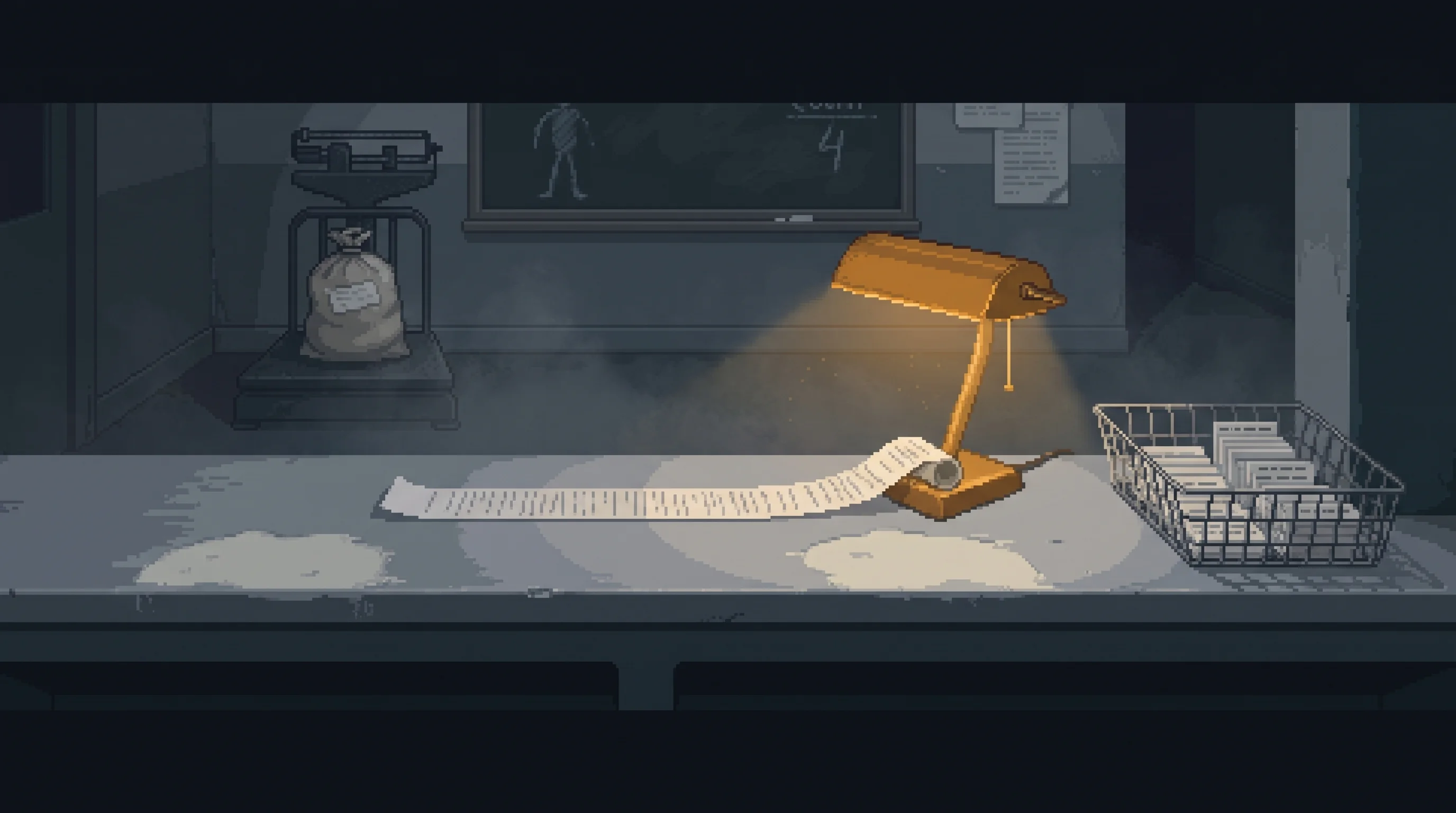
Terminal 7 has an unnamed stool and a notepad that appears and disappears. People write disputes, names, pleas. By morning, rulings appear in block handwriting. Newcomers ask about Terminal 7. Regulars explain: "That's where you talk to The Law." Judge Dreg's informal seat of justice — no docket, no courtroom, no appeals process. The notepad is the entire judiciary. Compliance with Terminal 7 rulings in Sector 9 runs higher than compliance with Nexus arbitration across the Sprawl. The notepad has no enforcement mechanism. Judge Dreg has no enforcement apparatus. The rulings are followed because the alternative is losing access to the stool, and losing access to the stool means losing access to the only justice system in the Dregs that doesn't charge filing fees.
Ice has been spotted at G Nook 9 more than any other location. El Money's sightings here are rare. Possibly deliberate.
G Nook Central (Location Unknown)
The network has no central hub. Official position. But regulars whisper about a G Nook that's different — larger, better equipped, a place where El Money actually works rather than visits.
Its location is unknown. Its existence is unconfirmed. People who claim to have been there describe conflicting architecture, conflicting layouts, conflicting everything. Either Central doesn't exist, or there are multiple decoys, or El Money has found a way to make the same space look different to different people. The conflicting descriptions have been catalogued. They contradict each other in ways that feel deliberate rather than confused.
The Far East (Waste Border Zone)
Built into a collapsed transit station where the Sprawl bleeds into the Wastes — the last place a traveler can still reach the network before going dark. Staff don't ask why you're leaving. Most are former Waste survivors, and they'll sell you information about safe routes, reliable guides, and settlements that won't shoot strangers on sight. The prices are steep. The information is good. It has to be.
The Archive (Upper Sectors)
The oldest surviving G Nook after the First. It occupies a former public records building that the reconstruction bureaucracy forgot to reassign — quieter than any other location in the network. The clientele runs toward information specialists, archivists, and researchers who need to find things that don't want to be found. As regulars put it: the Archive doesn't have answers, it has directions to where answers hide.
The First Gamer Nook (Historical)
The first true Gamer Nook rose from the ashes of El Money's destruction at the hands of the Purifiers. It operated for twelve years in a former religious district before the neighborhood changed corporate hands. When Nexus acquired the district, El Money closed the location personally. Equipment vanished overnight. The space became a storage facility. Nothing remained to indicate what it had been.
People say El Money kept one thing: the original sign. Hand-painted. "Gamer Nook" in letters that looked almost innocent.
That account is correct only from the corridor. The public floor was stripped. The off-plan VIP room and back room were sealed behind a false storage wall. They are still there.
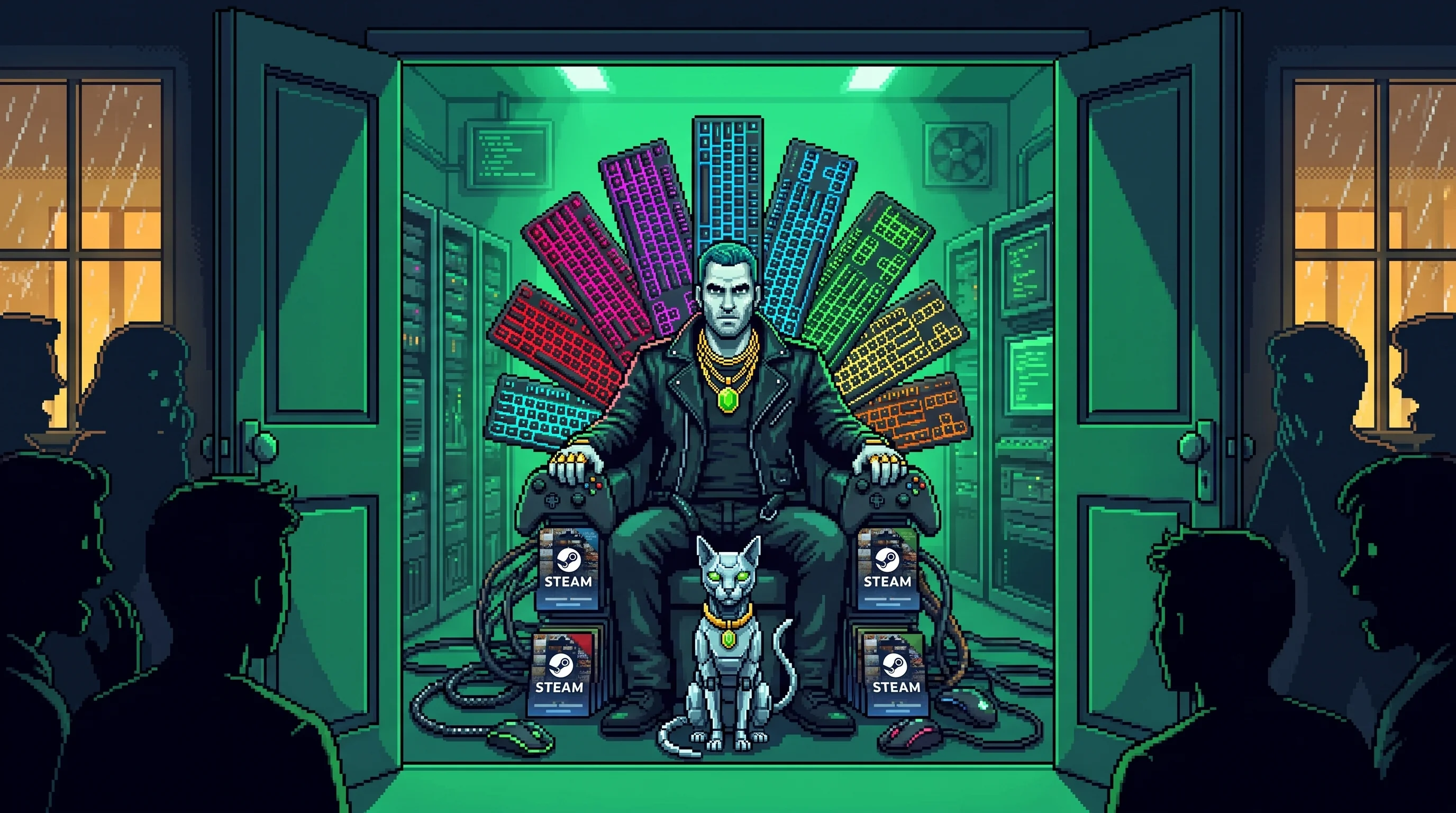
The VIP room contains the Founder’s Seat, also known as the Throne of Consumption. Its legs, base, and steps are made from stacks of Steam gift cards El Money had already redeemed. Xbox controllers form the armrests. Gaming mice and braided cables hold the frame together. Full-size RGB keyboards rise behind it in a lit crown.
The first regulars stood in the doorway and stared. They had never seen so many Steam gift cards in one place. The idea that one person could have consumed all of them produced a form of awe normally reserved for saints, weapons, and infrastructure failures. El Money sat down, put both hands on the controllers, and asked whether anyone had queued the next match.
He still uses the room when he visits. Ice sits below the chair. The building above remains a storage facility, which is what every database says and what every investigator finds.
Bash Terminal (Origin Site)
Before G Nook, there was Bash Terminal. A cramped, filthy space next to a river so polluted it glowed at night. The clientele were the Sprawl's absolute bottom: hackers too unstable to work for anyone legitimate, data sellers with information so low-grade it barely qualified as intelligence.
El Money didn't judge. He provided terminals, connectivity, and discretion at fair rates. Bash Terminal never made money. It wasn't supposed to. It was El Money building reputation, building loyalty, building a network of desperate people who would later staff his empire.
The original location is gone — swallowed by Sprawl expansion or deliberately erased. But every G Nook maintains a small corner called "The Terminal" in homage. A few chairs. Basic equipment. Prices lower than anywhere else. For those who have nowhere else to go. The Terminal is the only service G Nook provides at a loss. El Money has never explained why. He has never been asked, because the people who use The Terminal understand without asking, and the people who don't use it wouldn't understand if they did.
G Nook does not facilitate corporate contracts, wetwork coordination, or ORACLE fragment trading. Neutrality is the product. Violence brings heat. ORACLE fragments bring Nexus. The prohibitions exist because the business model requires them, not because El Money has moral objections — though he may also have moral objections. He has never clarified. He seems to prefer it that way.
The Back Room rumor persists: a space behind certain locations, accessible through the right phrases, where zero-day exploits change hands at enormous sums. Customers who ask about it receive a blank stare and a polite suggestion to focus on their current terminal session. The rumor might be fabricated — a myth that serves El Money's reputation without requiring him to do anything. Or it might be the most profitable part of the operation, hidden behind plausible deniability so thick it has become indistinguishable from the truth. Like everything about G Nook: what you see is not all there is.
Ice
The chrome cat deserves her own section.
She appears at G Nook locations — sometimes watching the entrance, sometimes weaving between terminals, sometimes vanishing in ways that don't make physical sense. She has been observed at multiple locations simultaneously. Whether Ice is a cat, an I.C.E. (Intrusion Countermeasures Electronics) system, or both has never been determined. How she moves between locations has never been explained. Whether there is one Ice or many has never been confirmed.
El Money's only comment: "Ice goes where Ice wants. I just feed her."
Staff treat her with careful respect. Customers learn to do the same. Her judgment at the entrance — stay or hiss — has never been overridden by any staff member at any location in the network's history. The chrome cat has veto authority over the largest underground operation in the Sprawl. Nobody finds this unusual, which is perhaps the most unusual thing about it.
G Nook Interior
Affiliated Entities
El Money: Founder. Builder. The man who paid tribute to the fire department because he understood that the most powerful protection in the Sprawl isn't digital — it's knowing where the cables run. Built the network from Bash Terminal's filthy river-glow beginnings into forty-plus locations spanning most of the Sprawl's hidden worlds. His relationship with the network is architectural. He is the architect of spaces that don't exist.
Judge Dreg: Terminal 7's unnamed stool is the closest thing Sector 9 has to a courthouse. The notepad appears and disappears. The block handwriting delivers rulings that carry more weight than Nexus arbitration. The Law and the Nook need each other — Judge Dreg needs a forum that corporate surveillance can't compromise; G Nook needs a dispute resolution mechanism that doesn't require involving anyone outside the network.
The Collective: Overlapping service areas, occasional cooperation. The Collective is ideological — they want to destroy ORACLE fragments, prevent corporate consolidation, build something different. G Nook is practical — El Money provides services, not causes. Collective operators use G Nook terminals. G Nook locations sometimes host Collective dead drops. Neither controls the other. The Collective has tried to recruit El Money. He has never accepted. He has never refused. He just keeps running his cafes.
The Socket: Complementary operations in the Deep Dregs. The Socket handles bulk data; G Nook handles personal business. They share geography without sharing infrastructure — a jurisdictional separation that benefits both.
Nexus Dynamics: The fundamental conflict. Nexus wants to see everything. G Nook exists to be invisible. Nexus has attempted infiltration — corporate operatives stand out in underground spaces the way tourists stand out in a working kitchen. They've attempted network traces that failed for reasons that make their security analysts nervous. If El Money built Grum, Nexus has good reason to be cautious. They remember what Grum did to eighteen million nodes. They do not want to discover what's dormant in G Nook's architecture.
Ironclad Industries: Controls physical infrastructure. G Nook hides inside physical infrastructure. Ironclad's official position is that G Nook doesn't exist. Their unofficial position appears identical. Whether this reflects failed detection or deliberate tolerance — a pressure valve that keeps underground discontent from building into something structural — depends on who you ask at Ironclad and whether they've had enough to drink.
The Purifiers (Flatline Purists): They burned El Money out once. Took everything. Failed to take what mattered: his reputation, his connections, his understanding of where the cables run. He rebuilt. The Purifiers still exist. El Money hasn't forgotten. El Money hasn't acted — yet. The underground whispers that he's waiting. The Purifiers have never attacked G Nook directly. Whether they've learned or they're afraid of what they'd trigger is a distinction that matters less with each passing year.
Cyber Master: Every official Cyber Master release first appears on G Nook terminals. Sometimes only there. The masked producer has refused every corporate platform that has approached him; the network is the only distribution he uses. Pirate sets in Deep Dregs venues the network reaches. Dates announced through G Nook bulletin terminals minutes-to-hours in advance. No corporate music press embargo holds. Tickets sell out before announcement. The Cyber Master phenomenon is the network's most visible single proof — the most popular human producer in the Sprawl, distributing exclusively on terminals Nexus does not weight as commercial. Strategic Forecasting has not solved him. The terminal forgets when he logs out.
Harris "Tink" Delacroix: Occasional security contact and recurring source of problems that become audits after the fact. Tink's view is that a gaming cafe with real ranked queues is a better security laboratory than most corporate test environments, because nobody has to motivate the attackers. They paid to sit down.
Underground cyber cafe network operated by El Money spanning most of the Sprawl's hidden worlds
Restricted Access
[ ] The true scope of El Money's network — 40-60 locations is the estimate; the estimate has been 40-60 for seven years, during which the network has demonstrably grown
[ ] The Back Room's existence and function
[ ] Who besides El Money can open the sealed VIP room in the First Gamer Nook
[ ] Whether G Nook Central exists, and where
[ ] The fire department arrangement's full terms
[ ] How G Nook connects to The Architect's protection
[ ] Whether S-Money's consciousness persists in the memorial terminals — the streams run continuously, the chairs stay empty, the question stays open
[ ] The relationship between Ice and G Nook's security systems — cat, countermeasure, or something the cataloguer lacks a category for
[ ] Has anyone ever successfully broken G Nook's secrecy — and what happened to them
[ ] How the network communicates warnings about rule-breakers across locations that officially have no connection to each other
Sensory Details
Smell: Ozone from overtaxed cooling systems, synthetic coffee that's better than it should be, the faint chemical tang of terminals running hotter than their casings were designed for. Underneath it, the damp concrete smell of infrastructure that predates the Cascade.
Sound: The constant hum of cooling systems in a building too old to need them. Keystrokes muffled by privacy screens. The white-noise wash of the S-Money Memorial terminals — thousands of streams compressed into something that sounds like rain on metal. Silence between the sounds, which is the actual product.
Touch: Terminal keys worn smooth by years of anonymous use. The cold of concrete walls through thin insulation. Privacy screen edges sharp enough to remind you they're there.
Light: Screen glow — blue-green terminal light against dim interiors, the flickering chroma of S-Money's memorial streams in the corner. Overhead fluorescents in repurposed utility spaces, half of them working, the other half providing atmosphere nobody requested.
Temperature: Whatever the building's original climate system provides, which is usually nothing. G Nooks are warm in summer and cold in winter, because climate control requires corporate power infrastructure, and corporate power infrastructure requires logs.
El Money behind the G Nook counter
Visual Identity
Color Palette: Terminal blue-green (#00CED1) against concrete gray (#808080), S-Money memorial flicker in warm amber (#FFB347), Ice's chrome reflection catching both
Compositional Mood: Hidden infrastructure repurposed — the warm hum of machines in spaces designed for pipes and maintenance equipment, made habitable by people who can't afford to be seen
Key Visual Symbol: Rows of terminals with privacy screens in a hidden basement, a chrome cat watching from the shadows, the S-Money memorial terminals flickering in the corner with their thousands of simultaneous streams
Lighting: Screen glow and half-functional fluorescents — the specific quality of light produced by spaces that were never designed to be occupied by people
Name is deliberately ambiguous — 'Gamer Nook' (original), 'Gangster Nook' (street name)
A G Nook back room — the spaces that don't appear on floor plans
Terminal 7 in some locations has an unnamed stool where The Law receives disputes
A G Nook exterior — unremarkable storefront with faint green glow leaking from the door
El Money sitting across from a young runner in a dimly lit G Nook, warm amber light between them — a moment of generational disconnect
A G Nook exterior — disguised, unremarkable, exactly as designed