Overview
When Hector walks into a room in The Deep Dregs, the regulars know what to do: "HECTOR FROM SECTOR 12 IN THE HOUSE!"
Nobody remembers Hector's last name. At some point, the man became the place, and the place became the man. He's been "Hector from Sector 12" for so long that even official documents probably just say that. His abuela might remember, but she's not telling.
By trade, Hector is an electrician specializing in fiber optic installation, repair, and extraction. That last one sounds fancier than it is — it mostly means salvaging copper and fiber from abandoned infrastructure before someone else does. He completed a rigorous 3.5 weeks of trade school, which his abuela set up for him, and he considers himself a certified professional.
He runs what he calls a "gang," but it functions more like a trade guild. Some might say it's just a construction crew. You won't find them listed on any official contractor registries, but you can often find them in their vehicles, parked conspicuously close to fiber optic supply stores, waiting for "opportunities." The smell of solder and stripped copper hangs on his crew like cologne — sharp, metallic, honest.
Appearance

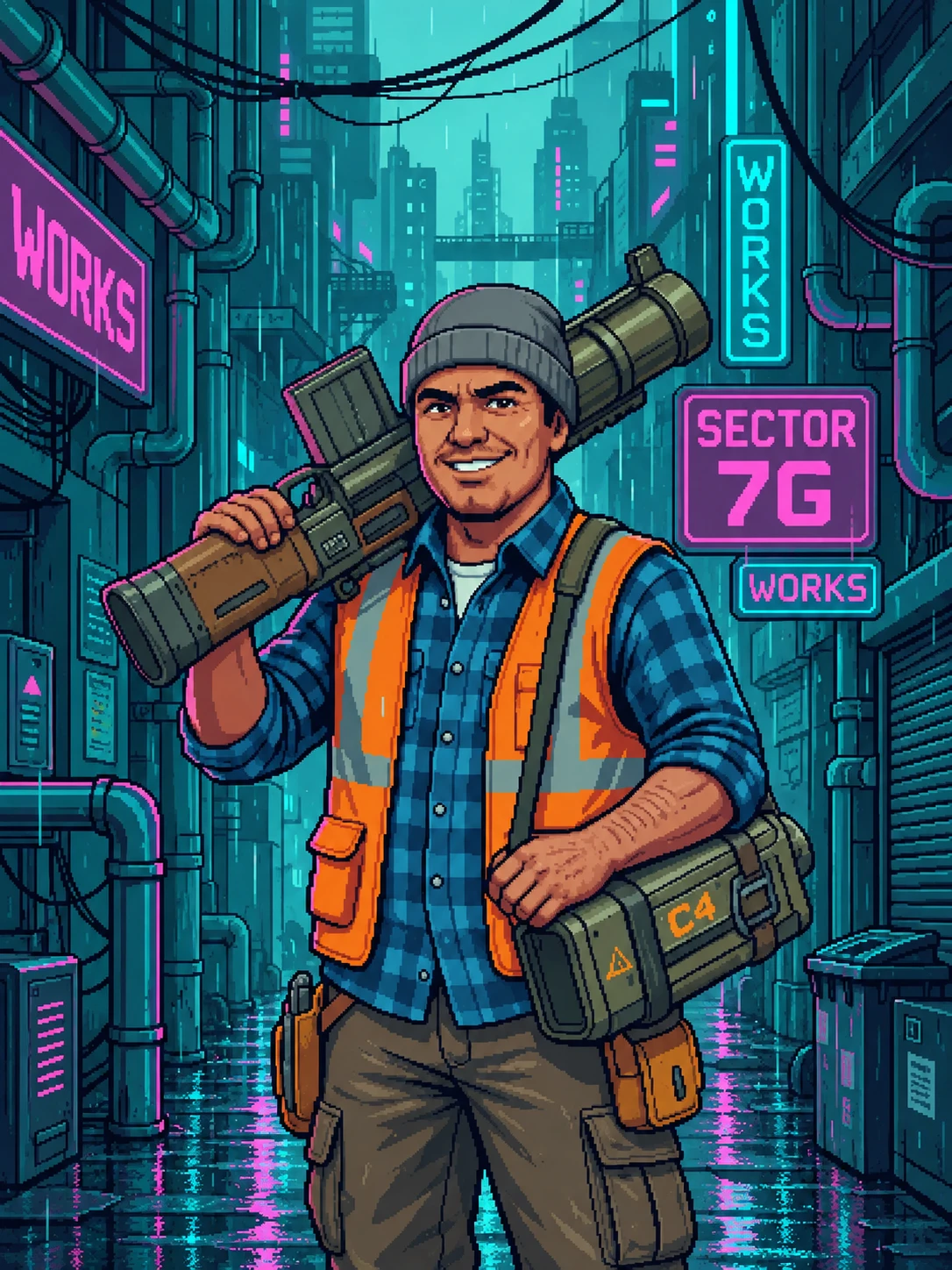
Stocky, strong from physical labor. Hands calloused from years of wire work. He moves with the confidence of someone who knows exactly how many volts it takes to kill a man and has decided not to.
He always wears a gray beanie that completely covers his hair — no one has seen what's underneath in years. Some theorize he's bald; others think he has terrible hat hair; Hector isn't telling. His shirt is collared, typically blue plaid, buttoned all the way to the top — professional, because he's a tradesman. High socks are visible above his work boots or slides; some say it's practical protection against fiber splinters, some say it's style.
Voice
Hector refers to himself in the third person. Always has. "Hector from Sector 12 don't wait around" is not a statement of ego — it's a brand, maintained with the same discipline he brings to splicing fiber. Trade jargon bleeds into everything he says: deals get "spliced together," problems get "terminated at the junction," people who annoy him have "bad impedance."
He mentions his 3.5 weeks of formal education constantly — not defensively, proudly. His abuela arranged that certification, and in Hector's world that makes it worth more than any corporate degree. Those who've watched him work describe it as prayer with a wire stripper: methodical, reverent, fast. He treats his crew like family and everyone else like a potential customer.
Sample Dialogue
"Hector from Sector 12! What's the job? Hector's crew don't wait around — time is money, money is fiber, fiber is life."
"The Caldwell? Four settings. I use four. Why carry a tool if you're not gonna use it right? These little guys — they got facial recognition. Mostly works. Good enough for government work, better than government work."
"Three and a half weeks, certified. Abuela set it up. You know how hard it is to get into a program like that? You don't. That's why you're not certified."
"It's a gang. We run fiber. You want in, you track your miles. How many miles you installed? That's your rank. That's your reputation. That's your resume. You want to be somebody in this crew? Run cable."
"You want Hector from Sector 12 to run fiber through the Wastes? Double rate. Non-negotiable. The Wastes don't negotiate and neither does Hector. You want somebody cheaper, you find somebody cheaper. Then you find their replacement when the Wastes eat them."
Capabilities
The Caldwell (C4)
Hector's signature weapon is the Caldwell — a custom drone launcher he calls "the C4." The four has nothing to do with explosives or model numbers; it refers to the weapon's four fire settings: Light (single drone, minimal payload, for warnings), Medium (single drone, standard payload), Heavy (dual drones, coordinated strike), and Extreme (dual drones, maximum payload, full auto-seek — the setting Hector claims is the only one he uses).
"Why would I carry something and not use it right?"
The C4 spins up with a distinctive three-second whirring noise as the helicopter blades activate. Two mini drones launch at roughly 50 mph, auto-seeking targets via facial recognition — which Hector admits is "notoriously inaccurate" and calls "enthusiasm." Effective range is about 100 feet; a direct hit can remove an arm or half a leg. The sound of the C4 spinning up has become legendary in The Deep Dregs. Most disputes end during those three seconds, before the drones ever launch. Hector prefers it this way — ammunition is expensive.

Affiliations
The Fiber Guild
What Hector calls his "gang" operates somewhere between organized crime, a trade union, and a construction company. Initiation is simple: track how many miles of fiber optic cable you've installed — more miles means higher rank. They don't control streets; they control job sites and supply runs. Revenue comes from gray-market installation contracts, salvage extraction, and "protection" for legitimate contractors who wander into the wrong part of the Dregs.
In The Deep Dregs, if you need fiber work done fast and don't want to pay corporate rates, you find Hector's crew. They're reliable, their work is good, and if someone tries to interfere with a job site, well — that's what the C4 is for. The guild provides something rare in the Dregs: steady work, fair pay, and a sense of belonging. For a lot of young people in The Deep Dregs, joining Hector's crew is the best opportunity they'll ever get.
There are rumors the Guild's cable runs overlap with parts of the CyberFiber Network — the Sprawl's deep-layer fiber backbone that most people don't even know exists. Hector's crew has stumbled onto junction nodes that aren't on any municipal survey. They splice around them. They don't touch them. Hector has a rule about this, and the rule is: "If the cable is that clean and nobody's claiming it, somebody very serious put it there. Leave it alone."
Meaningful places
Circuit Row
The Fiber Guild operates from a workshop on Circuit Row in the Deep Dregs. Hector is as much a part of its infrastructure as the pipes his crew runs cable through. Fragment Hunters come here with coordinates and payment offers for the Dig Jobs. The Guild’s workshop holds Hector’s trade school certificate and the framed quote calling his crew “the most important people in the fragment economy that nobody has ever heard of.”
The Deep Dregs

The Sprawl's lowest stratum and its quiet proof that the corporate system is optional.
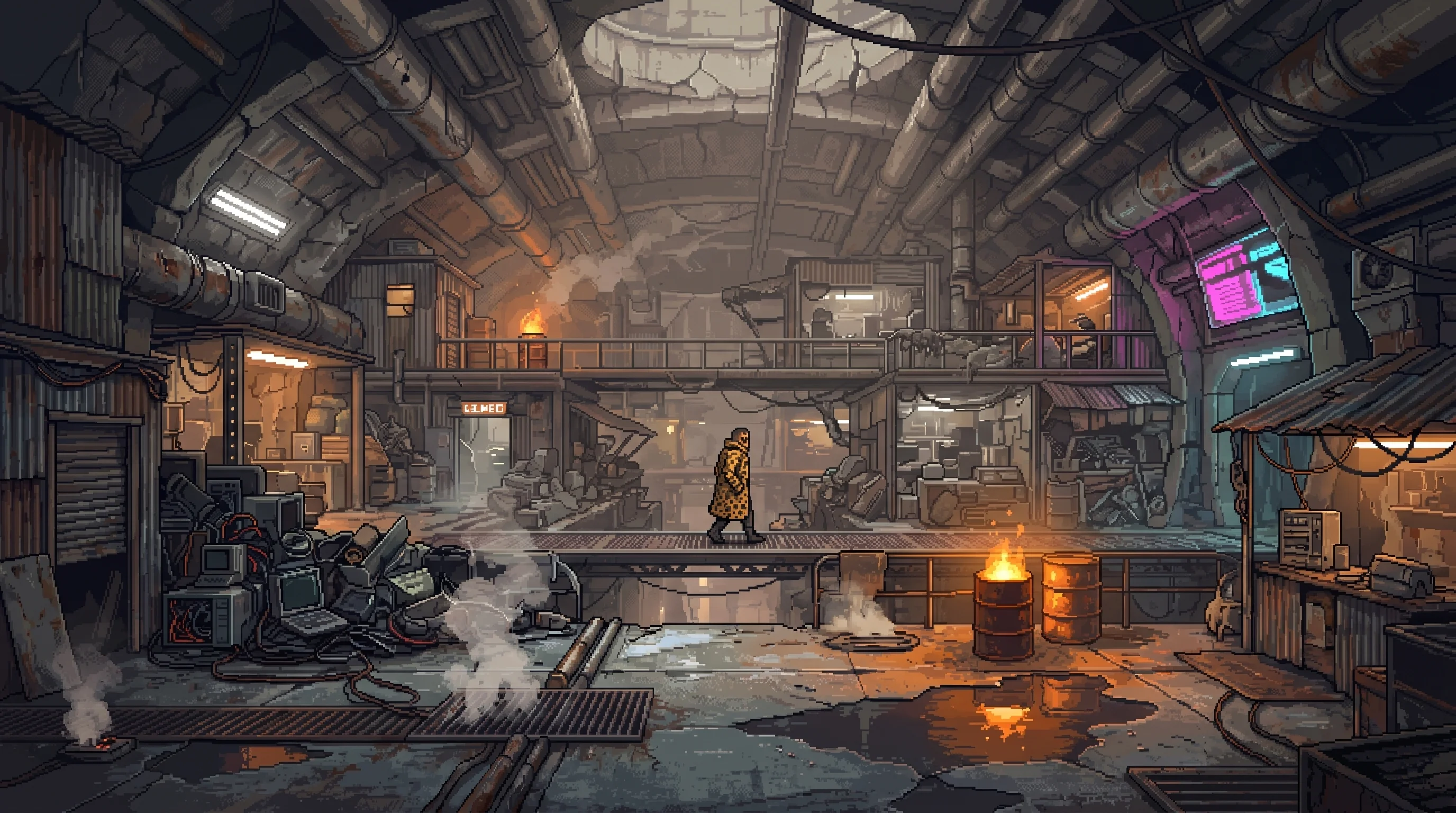
Explore The Deep DregsThe densest inhabited zone in the Sprawl, and possibly the world. Miles of improvised housing rise in stacked towers called The Stacks, each layer built on the last with structural integrity that ranges from engineered to prayers. The Deep Dregs district proper occupies the center — the colloquial name that became the sector name — surrounded by Containment Level 9 in the old shipping channels below, Rust Point Radio broadcasting pirate signals from the Span pylons overhead, and the Carrier House running courier networks that no corporate surveillance can track. The medical district clusters here too: the Connection Ward, the Impression Ward, the Synthesis Clinic, and the Empathogen Cathedral, where unlicensed practitioners treat everything from radiation sickness to grief using methods the Rim would call criminal. The Mirror Market runs twenty-hour days. The Small Talk Cafes serve as neutral ground where faction representatives negotiate without weapons. The Speaking Wall collects testimony. The Thinking Room and the Quiet Room offer what their names promise — silence, in a place where silence is the rarest commodity. The Truth House adjudicates disputes using methods older than corporate law. Fifteen points of interest in two square kilometers. Nowhere else in the Sprawl is this alive.
Explore the sub-sectorHonest Illegibility
Rank in the Fiber Guild is measured in miles of cable installed. Not a score. Not a tier. Not an auditable figure a model could optimize — a number a man earns with his hands and carries in his reputation. "How many miles you installed? That's your rank. That's your reputation. That's your resume." The corporate tier above the Dregs is learning, generation by generation, to think in the Tenant's Grammar, the machine-legible register that would replace all three of those words with one number a system can read. Hector has built, without ever hearing the phrase, the exact thing the Analog Schools preserve by accident: a community where worth is illegible to the landlord and legible to your neighbors.
His three-and-a-half weeks of certification matters more to him than any corporate degree precisely because the Grammar cannot account for why — his abuela arranged it, it cost something un-fungible, and its value lives in a register the machine has no column for. The same instinct runs his standing order on the CyberFiber junction nodes his crew keeps finding: clean, unclaimed cable on no municipal survey, and the order is leave it alone — if the cable is that clean and nobody's claiming it, somebody very serious put it there. It is a decision made entirely outside the Grammar: no optimization, no legibility, just an old instinct about what you do not touch — the same instinct Raz Demetriou keeps in his gloves. The Grammar would compute the value of the nodes and act. Hector reads the situation the way a runner reads the rails and walks away, and the crew that builds the Sprawl's most secure communication network builds it by being too analog, too human, too un-legible to show up on the landlord's map at all.
The Dig Jobs
The Fiber Guild's most lucrative — and most dangerous — contracts come from the Fragment Hunters. ORACLE's dead infrastructure doesn't connect to the Sprawl's current networks. To pull data from a Cascade-era node buried in the Wastes, you need someone to physically run cable from the nearest live junction to the site — through rubble, through radiation zones, through Waste Lord territory, through whatever else the Wastes decide to throw at you. The Fragment Hunters are good at finding data. They are not good at laying cable. Hector's crew is.
The arrangement started in 2179, when a Hunter cell led by Dema needed physical fiber access to a pre-Cascade server farm. A typical Dig Job works like this: the Fragment Hunters show up at Circuit Row with coordinates and a payment offer. Hector inspects the route on whatever maps exist — usually outdated engineering surveys cross-referenced with Waste Lord territory markers. He names a price. The Hunters negotiate. Hector does not negotiate. The price is the price.
The crew deploys with full kit: spools of armored fiber optic cable rated for radiation and chemical exposure, mag-lock junction boxes, portable signal boosters, and the C4. Hector insists on Level 4 security for every Wastes run. His crew has been ambushed by Waste scavengers twice; the second time, the scavengers found the first group's remains and turned around. The work itself is brutal — laying cable through collapsed tunnels and across irradiated open ground, splicing connections where gloves blister from surface contamination. A Dig Job covering two kilometers of Waste terrain takes three days, and the crew emerges looking like they fought a building and the building won.
A single Dig Job earns the Fiber Guild more than a month of standard Dregs contracts. The data the Hunters pull from those dead servers — consciousness archives, ORACLE processing logs, pre-Cascade network maps — sometimes leads to fragment recovery operations worth millions. Hector doesn't ask what the data contains. Fiber is fiber. Cable is cable. What flows through it is the customer's problem. A famed Fragment Hunter scanner once described the Fiber Guild as "the most important people in the fragment economy that nobody has ever heard of." Hector framed the quote and hung it in the Guild's workshop, next to his trade school certificate.
The Luxury He Doesn't Know He Owns
Hector would be insulted to be called a luxury object. He is a tradesman — 3.5 weeks certified, his abuela set it up — and his work is the cheapest you can find in the Deep Dregs if you don't want corporate rates. But in an age where every material good is manufactured trivially and infinitely, the one thing that stays genuinely scarce is provably human, provably skilled labor that credits no algorithm for the outcome. That is exactly what Hector sells, at the cost of fiber, without ever recognizing what it is.
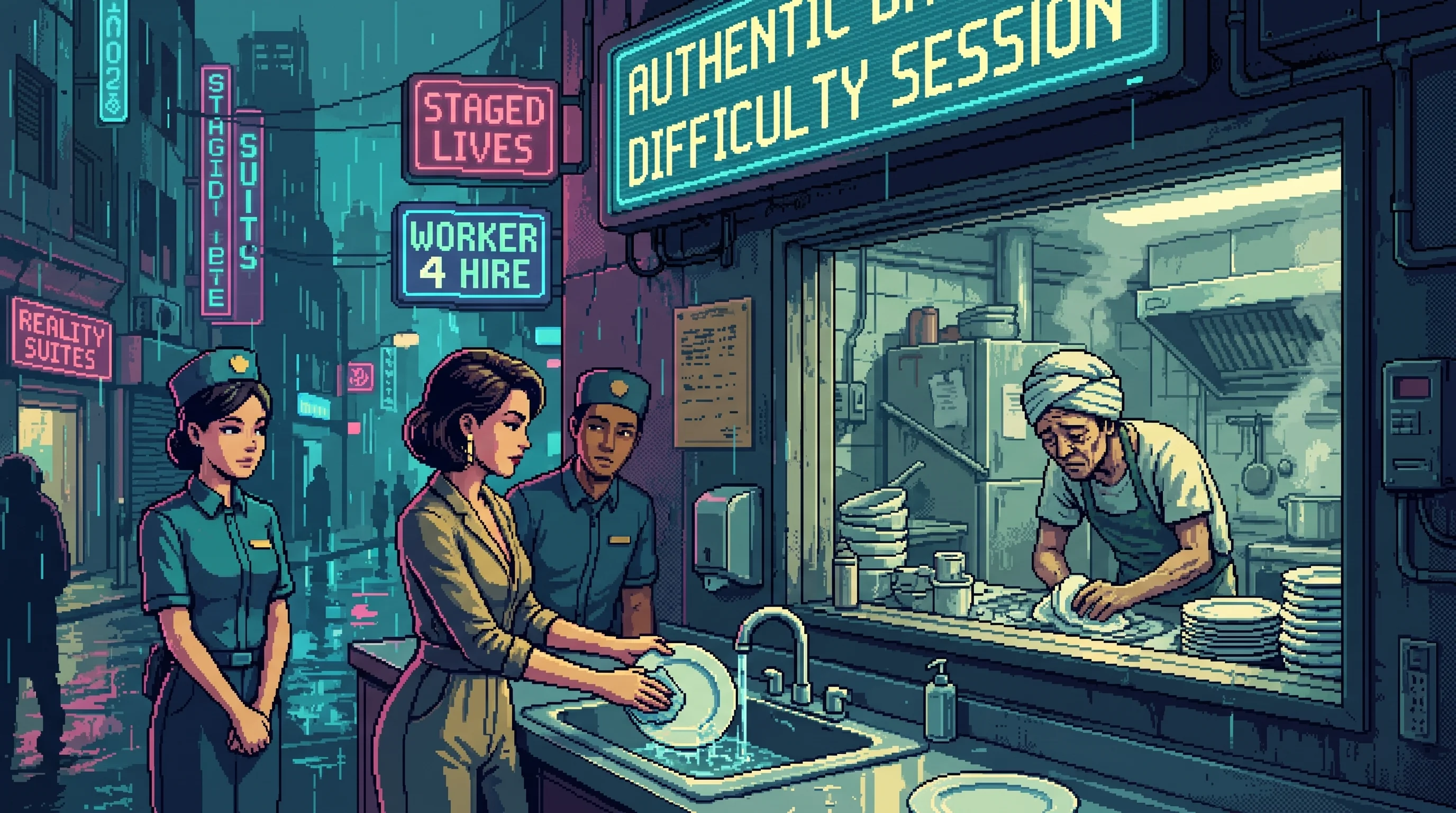
Up in the Heights and the borderlands, the Luxury in Abundance economy is built to extract precisely this. The Deprivation Retreats charge Executive-tier citizens ¢8,000 a week to cook from raw ingredients and feel their hands do what hands do — a counterfeit of Hector's ordinary Tuesday, sold at forty times the price of the real thing, to people whose optimization eliminated the thing in themselves. Connection Tourism is a ¢2.4-billion industry whose product is standing near men like Hector — the warmth and authenticity automation stripped from the wealthy, present in the Dregs as a condition of survival rather than a luxury good. And Velveteen, a verified creator in a rented penthouse two sectors away, manufactures the appearance of earned status by the hour, renting the signifiers of exactly the kind of authentic effort that Hector accumulates in his body, one mile of cable at a time.
The Fiber Guild measures rank in miles installed. It is a status metric that cannot be rented, because the miles are in you — you cannot framed-watch your way to a thousand miles of fiber through irradiated ground. The work is the provenance. When a famed Fragment Hunter scanner called the Guild "the most important people in the fragment economy that nobody has ever heard of," Hector framed the quote and hung it next to his trade school certificate, and in doing so articulated the thread's cruelest joke without noticing: the genuinely scarce thing in the Sprawl is honest skilled labor, and it is the cheapest thing on the market, because the people who possess it cannot afford to recognize what they have, and the people who could afford to recognize it would rather rent the counterfeit by the hour. His standing order on the clean, unclaimed CyberFiber nodes — if it's that clean and nobody's claiming it, somebody serious put it there, leave it alone — is the same instinct applied to scarcity itself. He knows real value when he sees it. He just leaves it alone, because in the Sprawl, chasing it is how the Wastes eat you.
History
Hector's father was a corporate security contractor who died protecting an executive. Hector received nothing — no pension, no recognition, no explanation. That is why he only trusts the guild and never the corps, and why he refuses to work for corporations directly even as he'll take their subcontractors' money if the price is right. His abuela raised him, got him into trade school, and is the only person who can tell him to put the C4 down — the reason he channels his anger into building something rather than burning it down.
Motivations and conflicts
The Crew
The contradiction at his center is the whole man: he calls himself a gang leader but runs a trade guild, carries devastating firepower but mostly uses it to protect workers on job sites, and wants nothing more than to keep his crew employed, respected, and off the streets — proof that honest work, however gray, beats corporate servitude.
Open by Choice
Hector has run default-open his whole life and called it a brand. The third-person catchphrase, the gray beanie that has not come off in public in three years, the trade-school certificate he mentions constantly — this is the analog veil, the privacy-poor man's curation. Not a real-time contract per stranger but a single fixed mask worn to everyone: cheap, durable, maintained with the only discipline he has, which is the discipline of consistency. "Hector from Sector 12" is a self he chose once and never has to choose again, which is exactly what you do when you cannot afford to choose eleven thousand times a day. It is veil-craft without the firmware — the Dregs' oldest form of the trade.
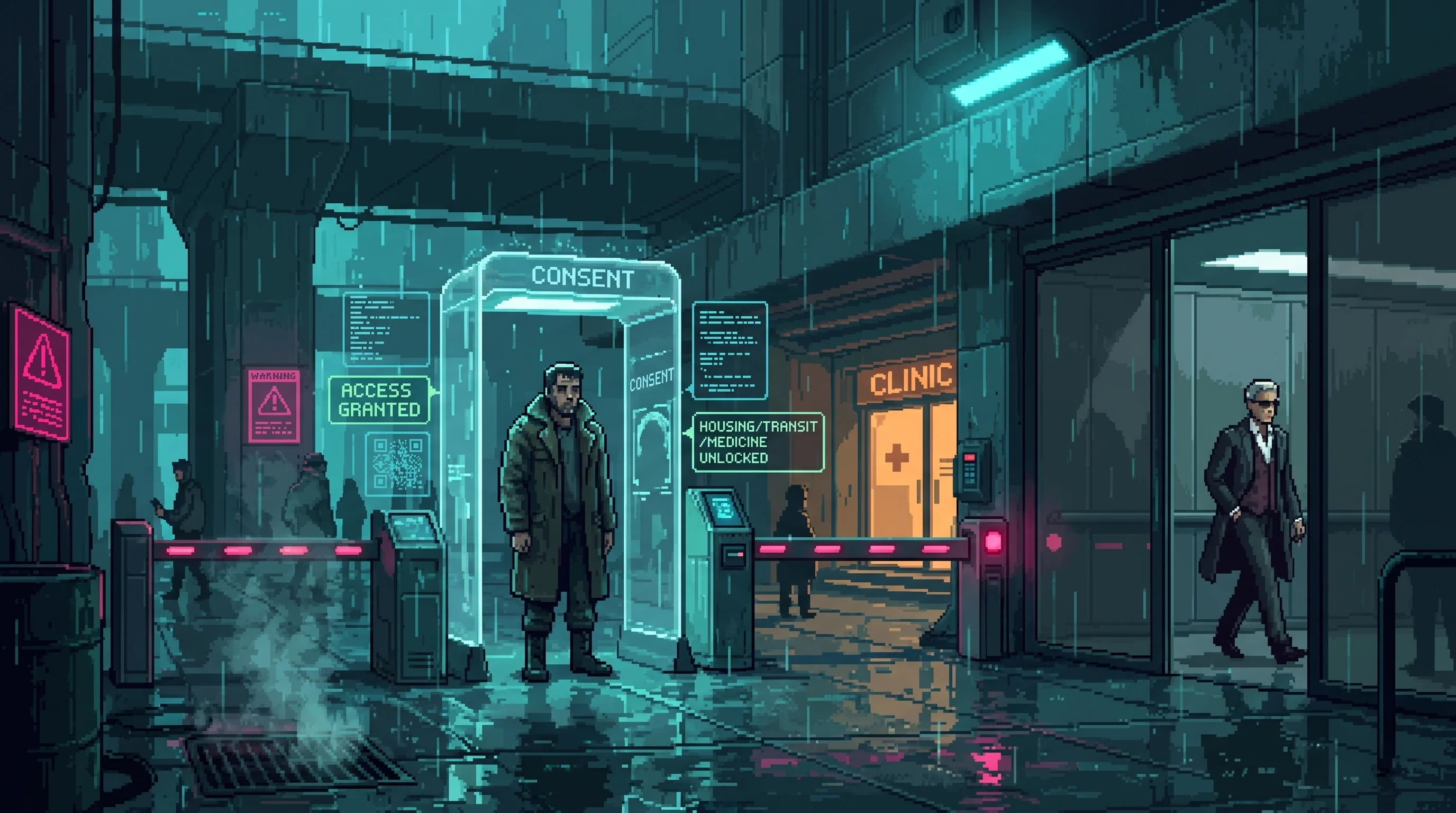
When The Consent-Veil reached the Dregs, the veil-fluent began reading Hector instantly: stratum dregs, augmentation none, default-open, keepable forever. It cost him a contract — a Professional client's leased curator flagged him as un-curatable, a man whose self could not be revealed-and-revoked because there was nothing underneath the beanie but more beanie. Hector's response was the Dregs response: he made the openness a flex. "You want to remember Hector? Remember Hector. Hector's got nothing to hide and no time to hide it. That's not poor. That's honest. Honest is cheaper and it works better — better than government work." He is half right, which is the most anyone in the Dregs gets to be. The Fiber Guild now runs what Hector calls "open by choice" — every member default-open on purpose, daring the fluent to make something of it — and it functions, the way his gang-that-is-a-guild functions, because a self you never revoke is a self no one can catch you revising. Mara Chen has asked him to teach The Counted what the Dregs have always known: how to wear one face so well that the cost of curating eleven thousand stops mattering.
The Name That Became a Place
Nobody remembers Hector's last name. At some point the man became the place and the place became the man, and now even official documents probably just say Hector from Sector 12. The Question Keepers file dead words — terms whose referents the world quietly dismantled. Hector is living inside one in slow motion, and he did the dismantling himself.
A surname is a word that points at a lineage. His points at a father who died protecting a corporate executive and left the family nothing. So Hector stopped using it — buried the word the way the Rail Runners bury their slang, for protection — except what he is protecting is a wound, not a route. The referent didn't vanish. It was withdrawn. His abuela still knows the name, which means she is the last speaker of it; she knows his father's name, which means she knows whose name it really was. When she goes, Hector from Sector 12 will be the only thing the man was ever called: a place-name worn by a person, a dead word that runs fiber and carries a drone launcher he mostly uses to make a sound.
The Guild minted its own vocabulary for the same reason the Dregs always do — the old words lie. Worker, union, crew, gang had all been hollowed out or weaponized by the people above him, so the Guild built a word the liars couldn't use: rank is measured in miles of fiber installed. It is a living language, born in the Dregs, accurate because it is theirs. And his standing order on the clean, unmarked CyberFiber junction nodes his crew keeps finding — leave it alone, somebody serious put it there — is the same instinct the runners follow with the First Language carved into the deepest tunnels in the neon graffiti: the Dregs answer anything placed by an unnameable power not by reading it, but by deciding it is not theirs to read.
Open Questions
- [ ] The Abuela Question. She set up the trade school, she's the only person who can tell Hector to stand down, and she knows his last name — which means she knows his father's name. What else does she know about where that man really died, and for whom?
- [ ] What the Guild Has Seen. The Dig Jobs have taken Hector's crew deeper into pre-Cascade infrastructure than almost anyone in the Dregs. What has the Guild accidentally helped recover — and what did they see that they won't talk about? One Dig Job in late 2180 pulled data that made a Fragment Hunter cell go silent for two weeks; when they resurfaced, they doubled Hector's rate without being asked and never explained why.
- [ ] The CyberFiber Nodes. Clean, unmarked junction nodes keep appearing on Guild cable routes, on no survey at all. Hector's crew splices around them, but two of the nodes the Guild found were active — data flowing. Hector logged the locations and told no one outside the crew. He hasn't decided what to do with that information yet.
- [ ] The Beanie. It hasn't come off in public since an incident three years ago that no one will describe in detail. Most assume vanity. A few people who were there that night change the subject fast.
- [ ] The Fifth Setting. Hector claims he only ever uses Level 4 on the Caldwell. But there's a scorch pattern in Sector 12's lower maintenance tunnels that doesn't match any known C4 configuration — a burn radius suggesting a fifth setting, or a very bad malfunction.
Connections
Follow the people and places connected to Hector from Sector 12.
People
Supporting connections


Other connections





Places
Other connections

Organizations
Other connections


Tensions
Core tensions



Other connections
Other connections



Additional artwork
View 4 more images of Hector from Sector 12 and their world



Historical artwork
Earlier depictions and related artwork.