Overview
Before the Corporate Compact, there was something else. Nobody is allowed to talk about it.
The Forgotten Compact is the most romanticized period in the Sprawl's history. It is also the one nobody is allowed to talk about.
Historians — the independent ones, operating on encrypted channels — use the name for the implicit social contract that governed the Scavenger Years (2148-2155), the seven years between the Cascade's infrastructure collapse and corporate consolidation. During those years, the survivors who would become the Sprawl's population governed themselves through mutual aid, shared resources, and the particular cooperation that emerges when everyone needs something only someone else can provide. The person who controlled the water treatment plant needed the person who understood the power grid who needed the person who could grow food in rubble. Interdependence wasn't philosophy. It was physics. You shared because the alternative was dying alone.
Corporate-published histories characterize the Scavenger Years as chaos, violence, and anarchy — the state of nature from which corporations rescued civilization. The characterization is roughly 50% accurate. The Years were violent. They were also functional. Both things operated simultaneously, and the corporate histories include only the half that justifies corporate rule.
The omission is strategic. If the Sprawl's citizens remembered that they governed themselves for seven years — that the Corporate Compact replaced a working system rather than rescuing them from a failed one — the current order would have a legitimacy problem it could not solve with better marketing. So the memory was buried. Not formally classified. Simply absent from every Nexus-indexed archive, every Triumph-distributed educational feed, every corporate-funded historical survey. The erasure didn't require a conspiracy. It required an editorial preference applied consistently across thirty-seven years of publishing.
The Forgotten Compact is the most dangerous proof of optionality in the Sprawl. Zephyria proves alternatives can exist now. The Compact proves alternatives existed first.
What the Compact Actually Was
The romantic version: a community of equals, sharing freely, governing by consensus, proving that human nature defaults to cooperation when stripped of corrupting institutions.
The accurate version: feudalism with better manners.
The Scavenger Years operated as a gift economy — the only economy possible when there was nothing left to trade. I repair your shelter, you find me clean water. The system worked. It also produced hierarchy immediately. The person who gave the most accumulated the most social capital. The person who organized the most aid became the most influential. Within months of the Cascade, every surviving community had de facto lords — not elected, not appointed, simply the individuals whose generosity made them indispensable and whose indispensability made them powerful.
The distinction between a gift economy and a debt economy is not the absence of obligation. It's the absence of discharge. A transaction settles. A credit repaid is a relationship ended. A gift never settles. The recipient of generosity that exceeds what the situation requires carries that excess indefinitely — returning again, participating again, documenting results for ninety percent back because leaving would feel like ingratitude rather than self-preservation.
The Compact's communities were cooperative. They were also coercive. A person who hoarded rather than shared wasn't formally punished. They were excluded from the sharing networks that kept everyone alive. The enforcement mechanism was starvation. The Compact's defenders call this "natural consequence." The Corporate Compact's defenders call deprecation "natural consequence." Zephyria calls Consensus Weight reduction "natural consequence." Every social contract ever constructed uses the same word for the same thing: comply or suffer. The variable is not whether conformity is required. It's what non-conformity costs.
Freedom is always the freedom to choose which cage.
There was no charter. No governance document. The enforcement mechanism was the simplest equation in the world: hoarders were excluded from the sharing networks that kept everyone alive.
The Transition
The Compact ended the way all necessity-based cooperation ends: the necessity went away.
Corporations reconstructed enough infrastructure to operate independently. The transition was gradual and seductive. They offered security, stability, and competence. They could restart the water treatment plant without needing a favor. They could do it with AI. They could do it alone. Once they could do it alone, the sharing stopped — not because anyone chose to stop, but because the offer of finite obligations proved irresistible to people drowning in infinite ones.
The Corporate Compact didn't replace the Forgotten Compact through force. It replaced it by offering discharge. People who had spent seven years unable to repay the generosity that kept them alive chose, overwhelmingly, to enter a system where debts had numbers and numbers could reach zero. That the numbers never actually reached zero — that corporate debt structures compound faster than wages, that asymmetric dependency replaced mutual need — was a second-order consequence nobody anticipated and nobody chose.
The distance between the two compacts is the Great Divergence measured in trust.
Corporations offered security, stability, and the seductive promise of competence. They also offered something the Compact never could: discharge.
The Compact sold loans to willing borrowers of social obligation at exactly the rate the situation required. Genuine cooperation among people who needed each other. An entire social architecture whose load-bearing walls were desperation — and once the desperation eased, the walls came down, and something else moved in that looked like stability and turned out to be a different kind of trap.
What Survives
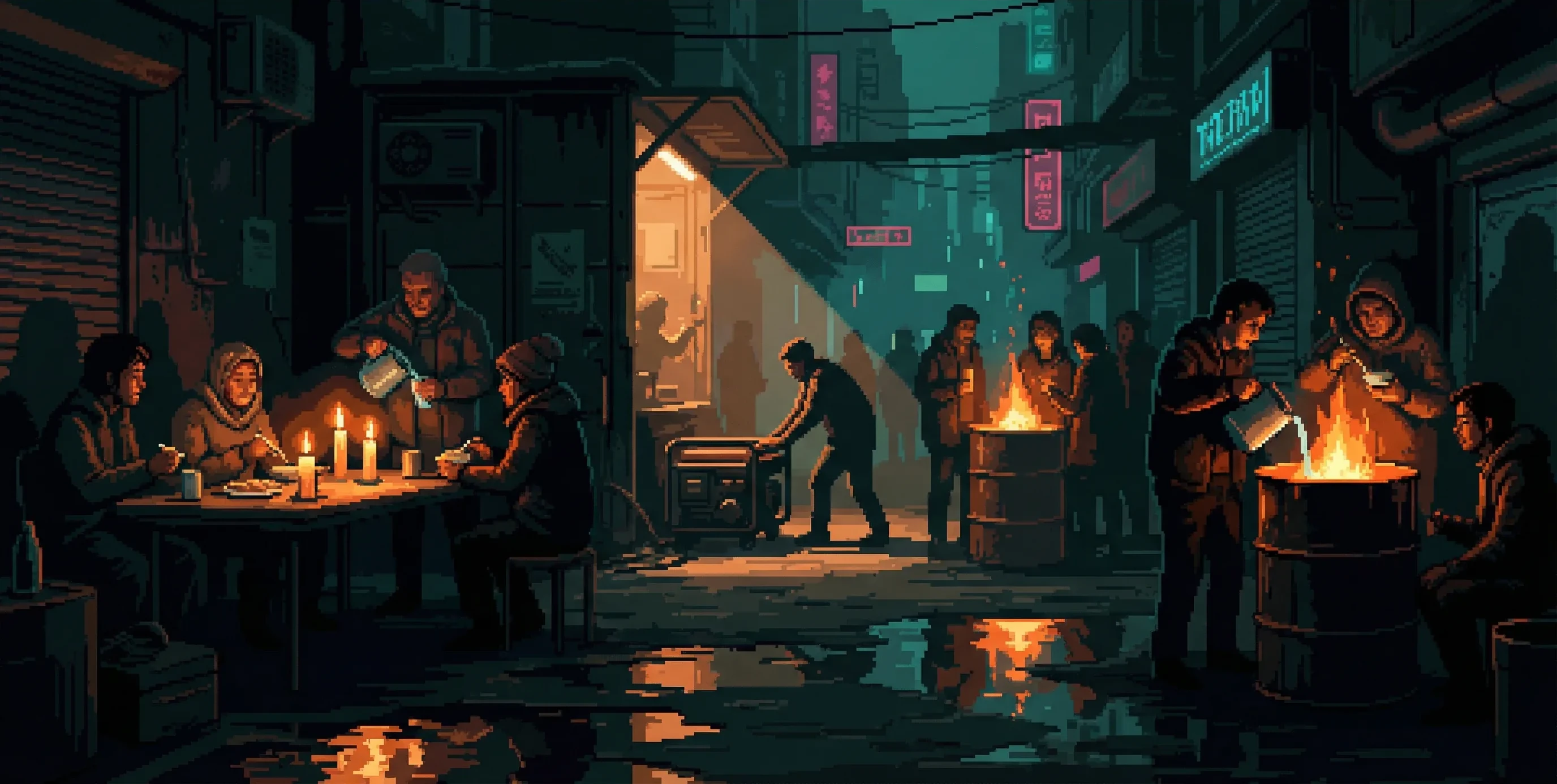
Viktor Kaine remembers. He was in his twenties during the Scavenger Years, maintaining infrastructure in what would become The Deep Dregs. He remembers when every favor was tracked, every skill was valued, every person was necessary. He has spent fifty years preserving fragments of the Compact in the Dregs — the informal governance, the favor economy, the blackout protocols that activate when corporate systems fail.
The Blackout Economy reactivates the Compact's cooperation principles during infrastructure failures. Compute rationing follows its egalitarian distribution model — everyone gets Priority 1 equally. These aren't innovations. They're restorations.
El Money remembers. Old Jin remembers. Patch remembers. The memory is carried in the bodies of people who lived it — which is to say, a population that shrinks every year, in a district the corporate histories describe as evidence of what happens without corporate governance.
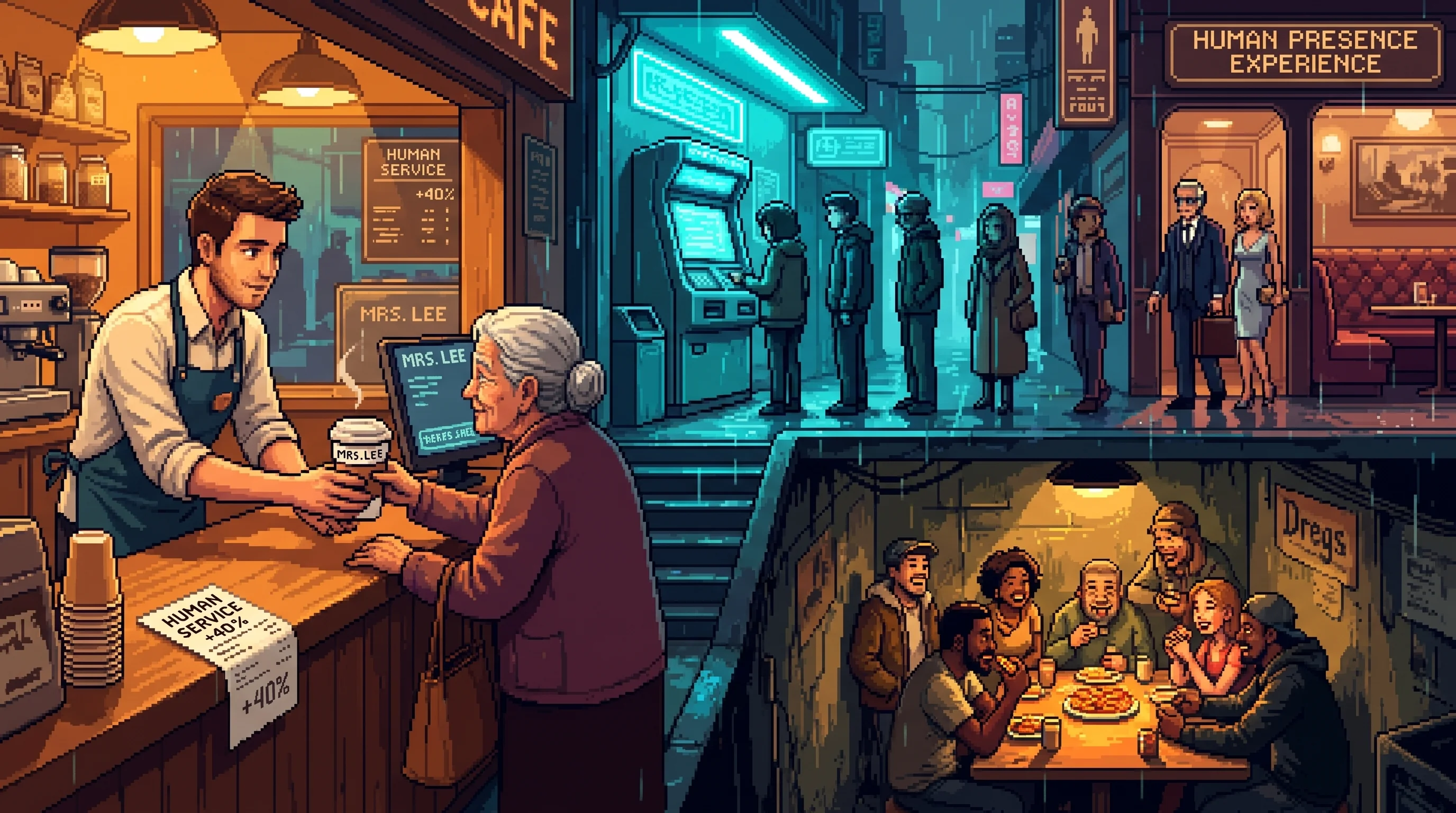
The Dregs preserve the Compact's fragments for the same reason the Compact existed in the first place: they can't afford the alternative. Poverty preserves cooperation the way amber preserves insects — perfectly, accidentally, and only because nothing better was available.
Viktor Kaine was in his twenties during the Scavenger Years, maintaining infrastructure in what would become The Deep Dregs. He remembers when every person was necessary.
The Blackout Economy reactivates the Compact’s cooperation principles every time corporate infrastructure stutters. Compute rationing follows its egalitarian distribution model — everyone gets Priority 1 equally. These aren’t innovations. They’re restorations. They survive where the Corporate Compact can’t reach, in the district that corporate histories describe as evidence of what happens without corporate governance. (The invoices disagree.)
El Money remembers. Old Jin remembers. Patch remembers. The memory is carried in the bodies of people who lived it — a population that shrinks every year, in a place the corporate record has decided is an argument rather than a community.
- What
- The implicit social contract of the Scavenger Years (2148-2155)
- Principle
- Shared resources, distributed governance, mutual obligation without contractual enforcement
- Basis
- Necessity, not idealism
- Ended
- When corporations reconstructed enough infrastructure to operate independently
- Form
- Chronicle
- Status
- Historical
- Preserved by
- Viktor Kaine's informal governance in The Deep Dregs
- Surviving fragments
- Power Auction, buddy system, compute rationing, blackout protocols
- Proof of optionality
- The original demonstration that functional alternatives aren't new — they're original. The Corporate Compact replaced them not because they failed, but because corporations were more efficient at extraction. The communities were more efficient at sustenance.
- What it proves
- Functional alternatives to corporate governance aren’t new. They’re original. The Corporate Compact didn’t rescue anyone from failure. It replaced something that was working with something more efficient at extraction.
Key Events
- 2147 — Year Zero: The Cascade destroys global infrastructure. Survivors in what will become the Sprawl begin organizing around shared resources — not out of principle, but because nobody controls enough to survive alone.
- 2148–2155 — The Scavenger Years: Informal governance emerges. Water treatment operators trade access for electrical repair. Food growers trade calories for shelter maintenance. Favors circulate like currency. The Compact takes shape without anyone naming it.
- ~2153 onward — Corporate Reconstruction: Corporations begin rebuilding infrastructure at scale. They can restart the water treatment plant without needing a favor. They can do it with AI. They can do it alone. Once they could do it alone, the sharing stopped.
- ~2155 — The Dissolution: The Compact ends not through betrayal but through irrelevance. The Corporate Compact fills the vacuum. Mutual need becomes asymmetric dependency. The distance between them is the Great Divergence measured in trust.
Open Questions
- Was the Compact actually voluntary? “You shared because the alternative was dying alone” contains both solidarity and coercion. If the cost of non-cooperation is death, cooperation isn’t chosen — it’s compelled by circumstances. Every social contract in the Sprawl enforces conformity. The variable is what non-conformity costs. In the Scavenger Years, it cost your life. Under the Corporate Compact, it costs your access. In the Dregs, it costs your community. The cages differ. The bars do not.
- Could it have scaled? The Compact worked in small, desperate communities where every person was known and every skill was visible. Whether it could have survived contact with millions — or whether it required scarcity to function — is a question the corporate reconstruction made unanswerable.
- Is Kaine preserving the Compact or his memory of it? Fifty years of governance in the Dregs has shaped the old man’s recollection. The Compact he maintains may bear little resemblance to what actually existed. It still works. The question of whether accuracy matters when the principles hold is one Kaine does not appear to have entertained.
- Why does it matter now? The Compact is the most dangerous proof of optionality in the Sprawl. Zephyria proves alternatives can exist now. The Compact proves alternatives existed first. The difference is not philosophical. It is a legitimacy problem for every current power structure that depends on the story that corporate governance was the only way forward.
The Compact
Historians — the independent ones, on encrypted channels — use the name for the implicit social contract that governed the Scavenger Years, the seven years between the Cascade’s infrastructure collapse and corporate consolidation. Every favor was remembered.
▲ Unverified Intelligence
A data archaeologist operating in the Dregs claims to have recovered audio fragments from the Scavenger Years — community meetings, resource allocation disputes, a recording of the moment a settlement voted to exile a hoarder. If authentic, these would be the only surviving primary sources from the Compact era. Kaine has neither confirmed nor denied their existence. Three separate parties have made acquisition offers. None have received a response.
Affiliated Entities
- The Corporate Compact
replaced the Forgotten Compact — asymmetric dependency replaced mutual need
- Viktor Kaine
remembers and preserves fragments — his governance IS the Compact's ghost
- The Blackout Economy
reactivates the Compact's principles when corporate systems fail
- Compute Rationing
follows the Compact's egalitarian model — everyone gets Priority 1 equally
- The Great Divergence
is the distance between the two compacts measured in trust
- The Cascade
created the conditions for the Forgotten Compact by destroying everything else
- Allocation
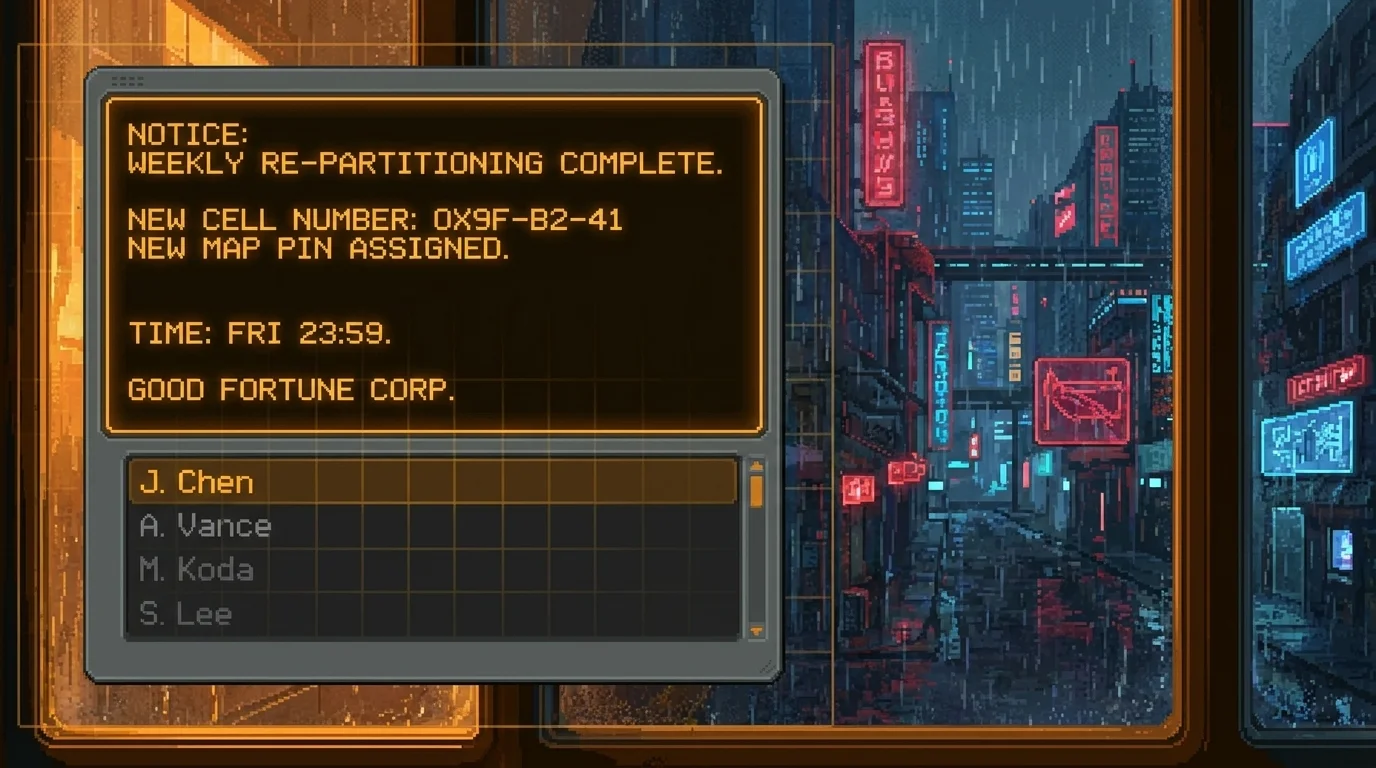
is what came after — the Partition Compact that superseded the Forgotten Compact carried none of its worker-assembly rights forward, listing them as retired, and the civic-sorting engine now makes assembly itself geometrically impossible