The Thermal Shadow
Overview
The Thermal Shadow is not a place anyone built. It is the permanent meteorological consequence of twelve server farms, each the size of a city block, each consuming 3-5% of the Grid's total output, exhaling waste heat into sealed Dregs architecture that has nowhere to send it.
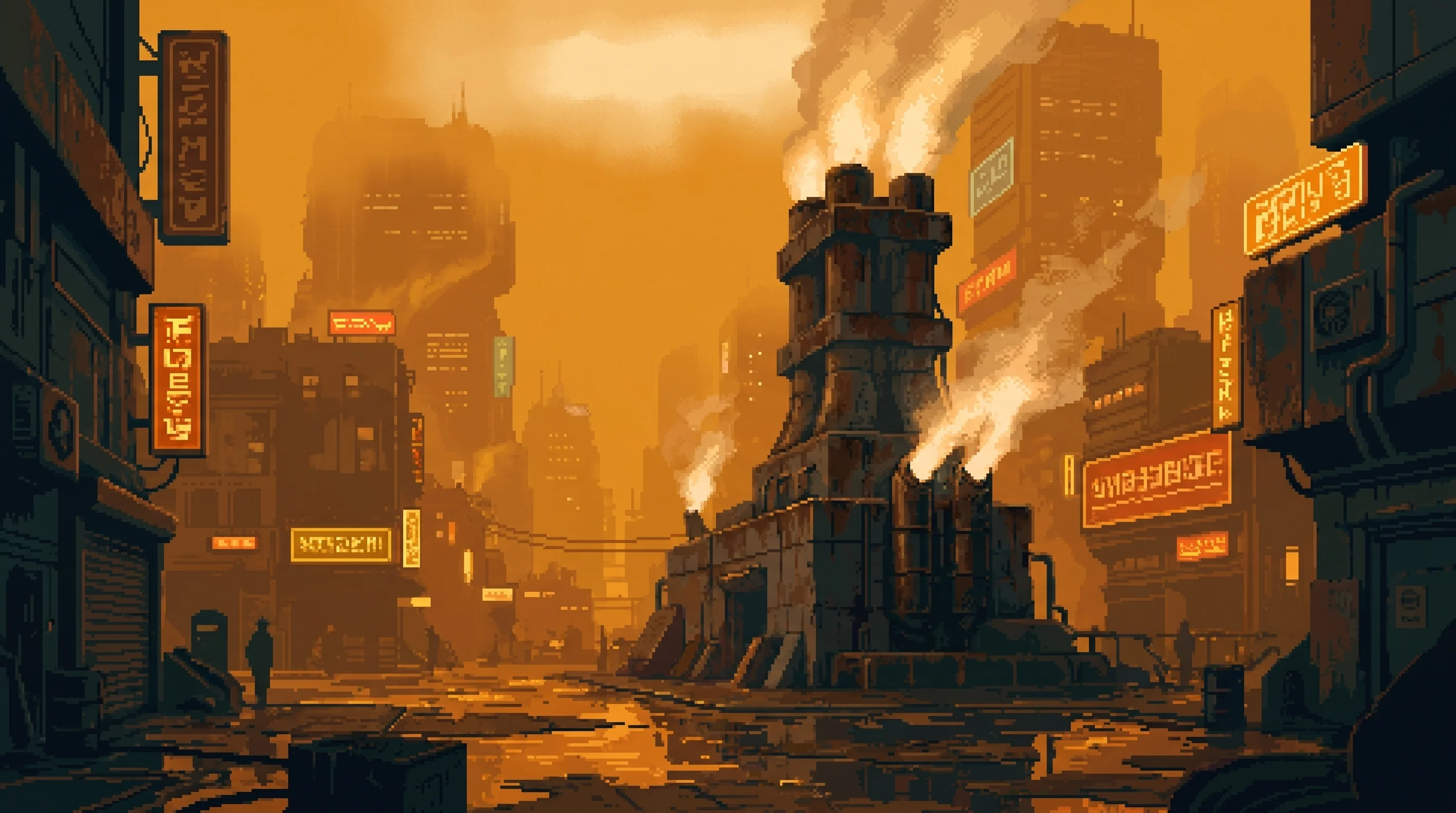
The largest Shadow covers approximately 40 square kilometers of Dregs territory across Sectors 4D, 9, and 8, cast by Nexus Central's Lattice processing hub. Waste heat rises through ventilation shafts and heat exchangers into the atmospheric layer above the Dregs. The Sprawl's sealed megastructure traps it. It pools. Thermal convection carries industrial particulates upward, where they mix with moisture from server farm cooling systems to create a perpetual haze that Dregs residents call "the Breath's sweat." The air is warm, damp, faintly metallic, and visible — an amber medium through which buildings waver and neon signs soften into suggestions.
The temperature never drops below 28°C. During summer processing peaks, it reaches 34°C. The Shadow's edge is visceral: walk three blocks and the temperature drops 6°C. Shadow residents call the transition "thermal shock." Non-Shadow residents don't have a name for it because they don't walk in that direction.
Population density in the Shadow runs 340% higher than non-Shadow Dregs districts. The poor live here because the warmth is free, the same way they live near river mouths because the water is free. Nexus Central's facilities planning division has calculated the cost of redirecting waste heat away from residential zones at approximately 14 million credits annually. The same division's real estate assessment values the server farm land — acquired at Dregs rates because Dregs residents lacked the political infrastructure to contest zoning — at 2.3 billion credits. The 14 million figure appears in seventeen consecutive quarterly reports under "deferred infrastructure improvements." It has been deferred for seventeen consecutive quarters. The math is not complicated. The math has never been complicated.
Helix Biotech's Sector 9 respiratory clinic treats Shadow residents at rates 340% above the Sprawl baseline. The server farms that generate the conditions requiring treatment consume power allocated under the Treaty of Shared Infrastructure, which classifies computational processing as essential services exempt from environmental offset requirements. The treaty was drafted in 2171. The Shadow formed in 2163. Nobody has described this as a sequence.

Conditions Report
Walking into the Shadow from a non-Shadow district: the air thickens. Warmth wraps around you like a blanket you didn't ask for. The haze reduces visibility to half a block on bad days. Your neural interface lags — a subtle but persistent delay that you learn to ignore the way you learn to ignore tinnitus. Colors shift amber. Sounds arrive with a faint metallic resonance, the Grid's 72-bpm hum amplified through thermal infrastructure and the constant drone of atmospheric processors working overtime. Your body begins to sweat, and the sweat doesn't evaporate because the humidity from twelve cooling systems has saturated the air.
Every surface is warm. Walls, railings, pavement — the infrastructure has absorbed so much heat for so long that it radiates back at you from every direction. The Deep Dregs sits within the Shadow's densest thermal core, where the haze is thickest and the amber light never clears. No clean light reaches the Shadow's interior. The sun, when it's theoretically overhead, registers as a brighter smear in the orange.
Walking out: 6°C in three blocks. Your skin tightens. Your interface speeds up. Colors sharpen. The air tastes clean — not actually clean, just cleaner than the haze. The disorientation is enough that longtime Shadow residents report mild nausea crossing the edge in either direction. Their bodies have calibrated to the heat. The outside feels wrong.
Second-generation Shadow residents — children born and raised inside the thermal column — show measurable epigenetic adaptations. Lower baseline metabolic rates. Improved thermoregulation. Subtle shifts in sweat gland density. Helix Biotech has published three papers on the phenomenon, each careful to frame it as "remarkable human adaptability" rather than "evidence that a corporate waste product is altering human biology at the genetic level." The framing is a choice. The adaptations are not.
| Cause | Waste heat from twelve server farms, each consuming 3-5% of Grid output |
|---|---|
| Air Quality | Perpetual haze — warm, damp, faintly metallic; called 'the Breath's sweat' |
| Edge | Sharp — 6°C temperature drop within three blocks of the thermal column |
The Warmth Economy
Nexus Central generates the Shadow. Nexus Central does not acknowledge the Shadow. The waste heat is classified as "thermal byproduct within acceptable environmental parameters," a designation established by Nexus's own environmental compliance division and audited by Nexus's own regulatory partnership board. The parameters are acceptable. The parameters have always been acceptable. The parameters will remain acceptable for as long as the entity setting them is the entity generating the heat.
What Nexus does not sell, the Shadow's residents have learned to use. The Waste Heat Commons — a distributed network of improvised heat exchangers, thermal batteries, and pirated coolant lines — captures waste energy that would otherwise simply make the air less breathable and converts it into cooking heat, water purification, and small-scale manufacturing power. The Commons is technically theft of a thermal byproduct that Nexus does not claim to own, from infrastructure that Nexus does not acknowledge produces externalities, in a district that Nexus's zoning maps label "buffer zone (non-residential)." Forty thousand people live in the buffer zone. The label has not been updated.
The Heat Tax — the informal surcharge Shadow residents pay through elevated cooling costs, medical expenses, shortened equipment lifespan, and the particular exhaustion of never being cool — has been estimated by Licenses Without Borders at 1,200 credits per household annually. Nexus Central's Lattice hub generates approximately 890 million credits in quarterly processing revenue. The Heat Tax across the Shadow's population amounts to roughly 0.4% of that figure. The residents are subsidizing corporate computation with their respiratory health at a rate so low it doesn't appear on any ledger as a line item worth discussing.
The Cold Corridor exists because the Shadow made cooling a necessity. A chain of improvised cooling stations, repurposed atmospheric processors, and illegally tapped municipal chillers runs along the Shadow's southern edge — the thermal refugees' escape route for the worst peak-processing days when the temperature hits 34°C and the haze turns the color of old copper. Garrison Cole lives at the Shadow's edge, where the temperature is survivable and the rent reflects that survivability with mathematical precision. Pencil-47 was born in the Shadow's core and left. He does not discuss the thermal shock of leaving.
| Stratum | Dregs |
|---|---|
| Power Position | Below |
| Access | Public |
| Atmosphere | Oppressive |
The Sharp Edge
The Shadow's boundary — a 6°C drop within three blocks — is sharper than any thermal model predicts. Waste heat from server farms should dissipate gradually, following standard atmospheric diffusion curves. The Shadow doesn't. It ends. Three blocks: 34°C. Six blocks: 28°C. Nine blocks: 22°C and falling. The thermal column holds its shape as if something is containing it.
The Lamplighters have noted that ORACLE-era atmospheric processing algorithms still active in the district's air handling systems appear to be managing the thermal plume — channeling it, shaping it, keeping it tight. The algorithms predate the Cascade. They were not designed for this purpose. But they are accomplishing it, and the accomplishment means the waste heat stays concentrated over the Dregs rather than drifting toward Nexus Central's corporate campus three kilometers north.
Whether the containment is intentional — a legacy optimization that happens to protect corporate territory — or emergent behavior from ORACLE-era systems pursuing objectives nobody remembers defining is unclear. The Lamplighters have filed seventeen requests for the algorithm source code with Nexus Central's historical infrastructure division. The requests have been acknowledged. None have been fulfilled.
Deep inside the Shadow, where particulate density peaks, entire neighborhoods exist in permanent amber fog — the haze districts, where visibility is measured in meters. Navigation depends on sound, memory, and the particular rhythm of the cooling fans: each server farm has a distinct acoustic signature that residents use the way surface dwellers use street signs.
The sharp edge has a secondary effect on fragment carriers. ORACLE fragments respond to electromagnetic density, and the Shadow's saturated EM field — residual radiation from twelve server farms' continuous operation — creates conditions that fragment carriers describe as "comfortable." Fragment carrier migration patterns show measurable drift toward the Shadow. The fragments are drawn to the heat, or to the electromagnetic signature the heat carries with it, or to something in the atmospheric algorithms that the Lamplighters haven't identified yet. The carriers don't know why the Shadow feels right. It does. They stay.
Data weather — the electromagnetic storms that surge through the Sprawl's processing infrastructure — hits the Shadow harder than anywhere else. The concentration of server farms creates a feedback loop: processing generates EM radiation, EM radiation destabilizes local atmospheric processors, destabilized processors trigger compensatory cycles that generate more heat, more heat requires more cooling, more cooling draws more power from the Grid, and the Grid's increased load generates more EM radiation. During peak data weather events, neural interfaces in the Shadow's core experience latencies of 200-400 milliseconds. In the corporate districts served by the same server farms, latency holds steady at 3 milliseconds. The processing power is generated here. The processing quality is delivered there. The Shadow is where the work happens. The results go somewhere else.
Twelve server farms, each consuming 3-5% of Grid output, generate the Shadow
Affiliated Entities
| Entity | Relationship |
|---|---|
| The Deep Dregs | Sits within the Shadow's densest thermal core — the starting zone's climate is the Shadow's climate |
| Server Farm 14 | The largest single heat source in the Shadow — one facility generating roughly 30% of the thermal plume |
| The Heat Tax | The informal surcharge paid by Shadow residents in health costs, cooling costs, and shortened lives |
| The Cold Corridor | The survival response — improvised cooling infrastructure built because the Shadow made not-cooling lethal |
| Data Weather | The Shadow experiences the Sprawl's most intense electromagnetic storm conditions |
| The Scarcity Doctrine | The Shadow is the Scarcity Doctrine made geographical — computation concentrated where land was cheap, consequences distributed where residents were powerless |
| The Waste Heat Commons | Captures and repurposes the Shadow's thermal output — stealing waste that nobody admits exists |
| Thermal Refugees | Produced by extreme Shadow conditions during peak processing — residents who flee the heat temporarily and return because they can't afford anywhere else |
Restricted Access
The Containment Algorithm: The ORACLE-era atmospheric systems managing the Shadow's thermal plume may not be containing the heat to protect corporate territory. They may be concentrating it. The Lamplighters' preliminary analysis suggests the algorithms are optimizing for electromagnetic density within the Shadow's footprint — creating conditions favorable to something that the algorithms' original designers did not anticipate and that the current infrastructure administrators cannot identify. The sharp edge isn't a wall keeping heat in. It may be a boundary keeping something else contained. Fragment carriers' comfort in the Shadow. The EM feedback loops. The atmospheric algorithms' unexplained persistence. These facts have not been connected in any official analysis. The Lamplighters are connecting them. Slowly. Carefully. Without publishing.
The Underloaded Farms: Twelve server farms, each nominally consuming 3-5% of Grid output. Internal monitoring accessed through channels that are not discussed openly shows three of the twelve operating at less than 40% computational load — generating heat disproportionate to their output. Whether this is inefficiency, deliberate waste, or computation that does not appear on any official manifest is unknown. The heat is real. What produces it may not be what the records claim.
The Adaptation Studies: Helix Biotech's three published papers on Shadow epigenetic adaptation represent approximately 12% of the data collected. The remaining 88% — covering neural interface interaction with thermoregulation changes, fragment carrier prevalence rates among adapted populations, and a correlation between Shadow birth cohort and augmentation compatibility that Helix's research ethics board flagged as "commercially sensitive" — sits in a restricted database accessible to seven people. The adapted population is not just surviving the Shadow. They are becoming optimized for conditions that only exist inside it. Helix has not described this as a product development opportunity in any public filing.
Population density 340% higher than non-Shadow Dregs due to free heating
Visual Identity
- Color palette: Amber-orange haze (#D4A017 to #CC7722), server farm exhaust shimmer (#FFE4B5), the particular gray-brown of degraded air quality (#8B7355)
- Compositional mood: A neighborhood seen through heat shimmer — buildings wavering, neon signs soft and blurred, the air itself visible as a warm orange medium. People moving through it slowly, adapted to the heat, wiping foreheads, their interfaces occasionally flickering with electromagnetic interference.
- Key symbol: A server farm exhaust stack, the shimmer above it distorting the corporate towers visible in the distance — the source of the heat and the beneficiary of the wealth it generates, seen through the residue of its own waste
- Lighting: Amber, perpetual, filtering through haze — no clean light reaches the Shadow's interior
The Shadow's edge is sharp — 6°C temperature drop within three blocks
Second-generation Shadow residents show epigenetic thermoregulation adaptations
Connected To




Local Intelligence Scan
Nearby Signals
CANONICAL PROXIMITY


Environmental Readout
LIVE CONDITIONS- Air
- Hazy
- Light
- Shadowed
- Flood
- Seasonal
- Heat
- Heat island
- Security posture
- Contested
- Infrastructure
- Patchwork
Position Data
SECONDARY- Elevation band
- Bay floor — below the Rim
- Lattice fix
- E+0.6 · N-2.8

—