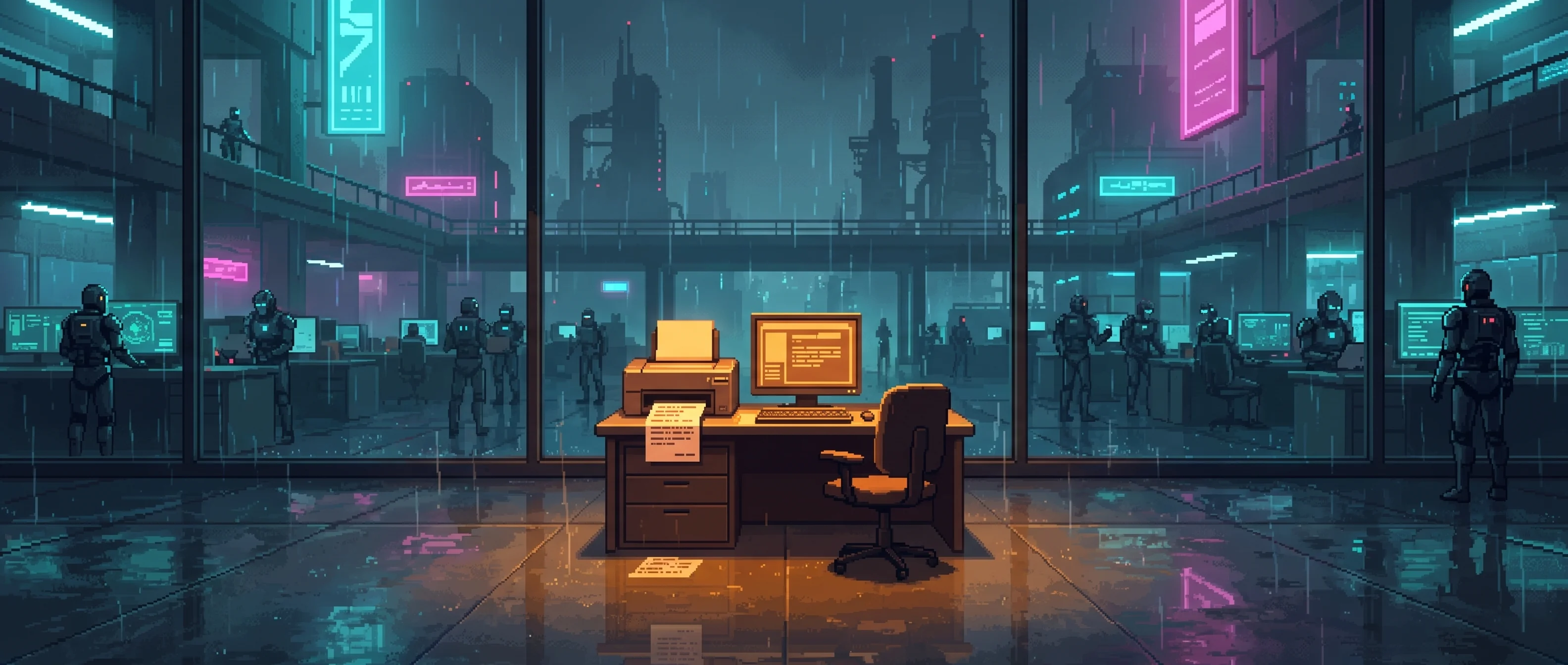
The Waste Lords are power brokers in ungoverned territories — the megacorporations have to talk to them
Known AsWaste Lords
Scene ReferenceThe Waste Lords
Overview
In the ungoverned territories between Sprawl cores, certain individuals have accumulated enough power to matter. The corporations call them "regional stakeholders." The Wastelanders call them lords. They are not a faction. They don't coordinate. They don't share ideology. They often hate each other. But they share one trait: the megacorporations have to talk to them.
This is the arrangement. The Waste Lords control salvage routes, water aquifers, refugee populations, rare materials, and the ability to make corporate extraction operations very expensive. They are not legitimate. They are not pretending to be. But when Ironclad Industries needs to ship materials through the Rustbelt or Nexus Dynamics wants to quietly dispose of something in the Deadlands, someone has to grant passage. That someone sets the price. The price is always higher than it should be and always lower than the alternative.
The corporations could take these territories by force. They have done the math. The math says the ongoing cost of occupation exceeds the ongoing cost of tribute. The lords know this. The lords know the math could change. The tribute systems, the negotiated passages, the carefully maintained relationships — all of it rests on a spreadsheet calculation that says it's cheaper to pay a warlord than to replace one. Every lord in the Wastes is, functionally, a line item in someone else's logistics budget who has been granted the courtesy of a title.
They emerged during the Scavenger Years between 2148 and 2155, when the Cascade's infrastructure collapse left vast territories ungoverned and the corporations were too busy consolidating the Sprawl to care about land that didn't generate compute. By the 2160s, the relationships had formalized. By 2184, some of these arrangements are older than the corporate executives who maintain them. The lords change. The line item doesn't.
Not a faction — a loose confederation of individuals who don't coordinate and often hate each other
How Lords Rise
No one starts as a lord. They become one through a process that resembles natural selection if natural selection had a procurement department.
First: control something. A water source, a salvage cache, a defensible position, a skilled population. Second: survive long enough that the thing you control becomes infrastructure others depend on. Most who try this die. The Wastes are optimized for killing people who try things. Third: attract followers — success breeds loyalty and opportunism in proportions that are difficult to distinguish until it matters. Fourth: wait for the moment a corporation sends an envoy instead of Enforcers. That is the moment. Before that, you are a bandit. After that, you are a regional stakeholder.
Then hold what you have. Other would-be lords never stop trying. The average reign is seven years. The average lord doesn't retire.
What makes the system stable is that it serves everyone's first-order interests simultaneously. Corporations get safe passage, off-books labor, disposal sites, salvage rights without territorial claims, and deniability for operations that never happened. Lords get resources, weapons, technology, and the one thing the Wastes cannot produce locally: being left alone by organizations capable of orbital strikes. Wastelanders get protection from threats that include, depending on the lord, the lord's own forces.
The second-order cost is that the arrangement makes lords permanent. A lord who delivers for the corporations gets resources that make them harder to displace. A lord who gets harder to displace becomes more expensive to replace, which makes the corporations more committed to maintaining them. The Wastes don't have a governance problem. They have a governance solution, and the solution is feudalism with better accounting.
Control routes, resources, and populations that corporations need access to
The Current Lords
This roster shifts. Three of these individuals may be dead by the time this file is accessed. The cataloguer notes this without sentiment.
Duchess Steel (The Rustbelt)
Territory: 200 kilometers of dead industry between Old Detroit and the Atlantic core Resource: Pre-Cascade industrial salvage — the best in North America Reign: 11 years and counting, which puts her in the 94th percentile for longevity
Duchess Steel runs the Rustbelt's salvage operations the way a corporation runs a supply chain, which is to say: efficiently, with structured labor, and with a tribute rate of 30% on all salvage value extracted by crews operating in her territory. Her people strip factories that have sat dormant since the Cascade, cataloging components, grading materials, preparing shipments. She sells to all three megacorporations equally — higher prices for exclusivity, volume discounts for repeat customers. Her invoicing is meticulous. Ironclad Industries sends representatives quarterly. She has invited them to dinner. They have declined, which she interprets correctly as respect.
Her reputation among Wastelanders is specific: "Treats her people fair. Cross her, she doesn't kill you — she puts you to work." The work-debt system operates on a scale of one to ten years depending on offense. Workers are fed, housed, paid a pittance. Release is honored. Usually. Some workers stay voluntarily, which Duchess Steel's internal documentation categorizes as "retention" and which an outside observer might categorize differently.
She is building something. Schools for Waste children. Medical clinics staffed by people whose credentials would not survive Sprawl inspection. Infrastructure that looks, from a distance, almost like a state. The corporations find this charming. Ironclad's quarterly reports describe her territory as "a stabilized extraction zone with favorable long-term supply projections." They have not considered what happens if she stops being charming. She has.
Papa Ash (The Bleach)
Territory: Toxic coastal zones from Old Florida to the Gulf remnants Resource: Disappearance Reign: 40 years. Nobody knows how.
Papa Ash controls the Bleach, and the Bleach is poison. Industrial contamination, sea-level salts, Cascade-era chemical residue — a dead zone that kills most visitors within weeks. Atmospheric processing does not extend here. The Breath's infrastructure ends where Papa Ash's territory begins, which is either coincidence or a corporate decision that nobody has documented.
All three megacorporations pay him to make things vanish. Failed experiments. Compromising materials. Occasionally people. The Bleach leaves no evidence because the Bleach dissolves evidence. Papa Ash asks no questions and maintains no records. His disposal rate is a flat fee per package plus a percentage of the estimated liability avoided, which means he knows what things are worth to the people trying to lose them. He has never used this information as leverage. He has never needed to. The knowledge is the leverage.
He charges by the drum. Nexus Dynamics' quarterly disposal budget for the Bleach is listed under "environmental remediation services," which is technically accurate in the same way that a funeral is technically a housing transition.
The Bleach is finally killing him. Forty years of inhabiting a landscape that dissolves organic matter has produced symptoms he describes, when he describes them at all, as "expected." He is looking for a successor — not someone to inherit his power, just his responsibility. He knows what's buried in the Bleach. The inventory is in his head and nowhere else. Someone has to guard it. The corporations would prefer that nobody guards it, which is why finding the right successor matters more to him than finding one quickly.
The Shepherd (The Green Sea)
Territory: Former agricultural megafarms across central Eurasia Resource: Growing things — mutated, adapted, strange, but nutritious Reign: 14 years
The Shepherd figured out how to farm the Green Sea. The crops are different — modified by Cascade-era radiation, adapted to soil chemistry that would kill standard cultivars — but they grow. In a world where most food is Wholesome-controlled synthetic protein, she has something that no supply chain can replicate: plants that reproduce, animals that breed, sustainability that doesn't require a corporate logistics network.
She doesn't sell food. She trades it for loyalty. Settlements that join her network get fed. Settlements that don't get watched until they're desperate enough to ask. The tribute rate for non-allied settlements in the Green Sea is 20% of harvest yield, which sounds reasonable until you calculate that 20% of a subsistence harvest is the margin between eating and not eating. Allied settlements pay nothing. Joining the alliance costs nothing. Leaving costs everything, because leaving means feeding yourself, and the settlements that could feed themselves never needed the Shepherd in the first place.
The debt mechanics are where it gets quiet. Starving refugees are given food on credit. The debt is repaid through agricultural labor. Generations can inherit debt. "Freedom" requires full repayment plus interest. The Shepherd calls this "adoption." The adopted call her generous. She is generous. The generosity and the trap are the same mechanism — food given freely to people who have no other source, creating an obligation that compounds at the rate of human hunger.
She has thousands of dependents and no heirs. When she dies, the Green Sea reverts to chaos, and the settlements that forgot how to feed themselves will remember what hunger felt like before she arrived. She knows this. She cannot stop acquiring more dependents. "Someone has to feed them," she says. She is right. She is also building the catastrophe that proves it.
Helix Biotech is intensely interested in her modified crops. She has refused three acquisition offers. The fourth involved Enforcers. The Enforcers didn't return. Helix filed their disappearance under "fieldwork attrition" and has not sent a fifth offer. They are, however, studying the genetic resilience of her adapted populations from a distance that both parties maintain is coincidental.
King Circuit (The Rustbelt — East)
Territory: Data centers and communication relays in the Eastern Seaboard ruins Resource: Intact pre-Cascade databases and working communications infrastructure Reign: 9 years
King Circuit doesn't control physical goods. He controls what's left of the old information infrastructure — server farms that survived the Cascade through some combination of hardening and luck, fiber optic lines that still carry data, archives that haven't been cracked. He sells access, not ownership. Every megacorporation has deals with him. None trust him. He charges per query or by subscription, and his pricing model accounts for the fact that information doesn't diminish with sharing, which means his margins are functionally infinite on data he's already cataloged.
His archives contain Cascade-era records about all three megacorporations. Early corporate decisions. Pre-consolidation histories. Things that were supposed to be erased. He has never used this as leverage. He claims it's insurance. Nexus Dynamics has offered citizenship, resources, computational infrastructure — anything. He keeps refusing. The refusal is the leverage. An archive that might contain something is worth more than an archive that's been inventoried, because the threat of unknown information scales with the imagination of the people who want it.
He and Duchess Steel share overlapping Rustbelt claims. The overlap is managed through the Salvage Compact — a price coordination agreement between the two of them and two minor lords that keeps salvage rates stable and borders theoretical. The arrangement works because fighting over the Rustbelt would reduce the Rustbelt's value to both of them, and they've done the same math the corporations did.
Mother Mercy (The Cradle)
Territory: The Haven alliance across Australia's interior Resource: A functional society of 3 million people Reign: 16 years
Mother Mercy leads the closest thing to a nation in the Wastes. The Cradle isn't a territory — it's a network of cooperating Havens with shared defense, trade agreements, and something approaching law. They have schools. Courts. Elections. A 10% transit levy on caravans passing through, which is the lowest tribute rate of any lord's territory and the only one assessed on commerce rather than production.
She mediates disputes between other lords from a position of neutrality that is respected because her territory produces nothing anyone can take by force. The Cradle's value is its population — 3 million people organized enough to function as a market, a labor pool, and an embarrassment. The embarrassment is the part corporations find difficult. Mother Mercy is proof that the Wastes could be civilized. That people could organize without corporate oversight. That the feudal arrangement is a choice, not an inevitability.
The Collective uses the Cradle as sanctuary. Ironclad buys rare minerals from Cradle-affiliated mining settlements. All three megacorporations have standing offers if she ever wants to incorporate. She doesn't. The offers remain open. The corporations have not considered what it means that their best argument for incorporation is that it would make the Cradle more like the Sprawl, and Mother Mercy's best argument against it is the Sprawl.
She is the only lord other lords will voluntarily submit disputes to. Her neutrality binds only those who agree to it, which means it binds almost everyone, because the alternative is settling disputes through violence, and violence in the Wastes has an attrition rate that even warlords find professionally discouraging.
Corporations call them 'regional stakeholders' — Wastelanders call them lords
Territory and Tribute
Waste Lords don't control borders on maps. They control chokepoints, resources, and the credible threat of making things expensive. Territory operates in gradients: core zones where the lord's presence is constant and trespass is punished; influence zones where patrols pass through and tribute is collected; and contested margins where the lord claims authority but doesn't enforce it daily, other lords also claim it, and travelers pass at their own risk.
Duchess Steel controls a 50-kilometer radius around her salvage headquarters. She claims 200 kilometers of the Rustbelt. Three other would-be lords contest the eastern margins. This is typical. The gap between what a lord claims and what a lord holds is the space where most people in the Wastes actually live — in the ambiguity between jurisdictions, paying tribute to whoever showed up most recently, hoping nobody shows up tomorrow.
The tribute systems vary by lord and resource, but the structure is consistent: a percentage of whatever you produce, in exchange for not being raided by the lord's forces. The "not being raided by the lord's forces" part is the product. The product is identical to what a protection racket sells, which is why the corporations' preferred term is "regional stability fees" and the Wastelanders' preferred term is the one that involves a specific profanity followed by "taxes."
Non-payment escalates on a schedule that every Wastelander knows: warning visit, triple-rate collection, infrastructure destruction, population absorption. The schedule has never been written down. It has never needed to be.
Corporate Relations
The corporations interact with the Waste Lords through envoys, quarterly negotiations, and a shared vocabulary designed to make feudal tribute arrangements sound like procurement contracts.
Nexus Dynamics files its Waste Lord payments under "pre-development territory stakeholder engagement." Their internal strategy documents describe lords as "interim governance structures" in territories earmarked for "long-term integration." The integration has been long-term for thirty-seven years. King Circuit's data archives are the specific asset Nexus wants. The specific asset Nexus wants is the one thing King Circuit will never sell, which keeps the quarterly meetings productive and the relationship stable in the way that a hostage negotiation is stable.
Ironclad Industries deals with whoever controls the ground. Their position is transactional: results matter, politics don't, and Duchess Steel's salvage shipments arrive on schedule. Ironclad's Rustbelt procurement budget is the largest single line item in Duchess Steel's revenue, which makes her a supplier in their framework and makes them a dependency in hers. Neither party discusses this asymmetry. Both parties have modeled what happens if the other one stops cooperating.
Helix Biotech describes the autonomous Waste communities as "fascinating case studies in adaptation." Their field research teams study the Shepherd's modified crops, the Bleach populations' toxin resistance, and the genetic resilience of communities that survived thirty-seven years without pharmaceutical infrastructure. The research teams maintain that their presence is observational. The communities they observe have not been asked whether they consent to being observed. The research teams have not considered this a question that requires asking.
The Collective uses lord territories as transit corridors and sanctuaries. Their agents move through the Wastes with the pragmatism of an organization that uses what it can and avoids what it can't. Some lords are allies. Some are obstacles. The distinction is operational, not moral, which is how The Collective describes most distinctions.
The System
The Waste Lords exist because the Sprawl's corporate governance model has a boundary condition. Inside the Sprawl, the megacorporations control infrastructure, production, consumption, and lifestyle. Outside the Sprawl, those control mechanisms require physical infrastructure that doesn't exist, population density that can't be achieved, and computational networks that the Wastes' electromagnetic environment degrades. The Wastes are ungoverned not because governance failed but because governance was never attempted. The cost-benefit calculation said no.
The lords fill the gap. They provide the functions that governance provides — security, dispute resolution, trade regulation, infrastructure maintenance — through personal authority rather than institutional structure. The result is feudalism. Not metaphorical feudalism. Actual feudalism: loyalty exchanged for protection, tribute extracted from production, succession determined by violence or negotiation, never inheritance. The average reign is seven years because the average lord's personal authority doesn't survive the average lord.
What the corporations optimize for is access without responsibility. What the lords optimize for is power without legitimacy. What the Wastelanders optimize for is survival without options. Each party gets exactly what they want. The costs are distributed to whichever population has the least ability to refuse them.
Nexus has installed puppet lords twice in the Asian Wastes — backing specific successors with resources, weapons, and intelligence in exchange for favorable terms. The installed lords lasted an average of three years before local dynamics reasserted themselves. Nexus filed both failures under "stakeholder transition costs" and has not stopped trying. The Shepherd's refusal of Helix's acquisition offers, Duchess Steel's state-like infrastructure, Mother Mercy's functional democracy — these are not threats to the corporate model. They are alternatives to it. The corporations tolerate alternatives as long as the salvage ships, the disposal continues, and the line item stays within budget. The moment any of those conditions change, the math changes. The lords know this. They have always known this. The tribute keeps flowing because the alternative to paying a warlord is becoming one, and the corporations have looked at the margins and decided that warlords are cheaper.
The Substrate Purifiers maintain safe harbor in Waste Lord territory, creating a security concern that the Sprawl's corporate authorities address through periodic patrol operations that achieve nothing measurable. Viktor Kaine negotiates with Waste Lord representatives over trade routes and refugee flows in the Deep Dregs. Waste-origin goods appear in Old Town markets without provenance documentation, priced by scarcity rather than corporate valuation. The Opening Teams — joint operations to unseal pre-Cascade bunkers — work deep in the Wastes under pragmatic cooperation between lord control and Nexus expertise, recovering technology that both parties want and neither party fully trusts the other to catalog honestly.
The ungoverned territories are governed. The governance just doesn't file paperwork.
Joint pre-Cascade bunker operations under lord control and Nexus expertise
The Shepherd / The Cradle / Mother Mercy
Internal lord network — alliance, mediation, and managed rivalry
▲ Unverified Intelligence
Corporate Installation Programs
Nexus Dynamics has backed specific lord successors twice in the Asian Wastes, providing resources, weapons, and intelligence in exchange for favorable data-access terms. Both installed lords were displaced within three years by coalitions of local rivals who found the arrangement objectionable in ways that resisted diplomatic resolution. Nexus's internal assessment attributes both failures to "insufficient integration support." A more direct assessment: the Wastes can tell the difference between a lord who took power and a lord who was given it.
Ironclad Industries has not attempted direct installation but maintains what internal documents describe as "succession preference portfolios" for six lord territories — ranked lists of potential replacements with projected cooperation scores. Duchess Steel's territory has the most detailed portfolio. She is not on the list of her own replacements.
The Bleach Inventory
Papa Ash maintains a complete mental inventory of everything buried in the Bleach. The inventory has never been written down, stored digitally, or shared with any party. Corporate disposal contracts are structured to ensure no single corporation knows the full scope of what's been buried, because knowing the full scope would create legal exposure that the disposal was designed to eliminate. Papa Ash knows the full scope. He is the only liability the Bleach was supposed to dissolve and didn't.
His succession search is complicated by the fact that transferring the inventory requires trusting someone with information that three megacorporations have paid significant sums to ensure doesn't exist. The candidates he's evaluated have, to date, all failed a test they don't know they're taking.
The Shepherd's Debt Ledger
The Shepherd's food-credit system has been operating for fourteen years. Cumulative inherited debt across the Green Sea's allied settlements is estimated at 2.3 million labor-hours — a figure that exceeds the total productive capacity of the debtor population by approximately 40%. The debt cannot be repaid. It was never designed to be repaid. It was designed to ensure that no settlement can leave the alliance without defaulting, and defaulting means losing access to food production infrastructure that the settlement no longer knows how to operate independently.
The Shepherd's internal accounting describes the accumulated debt as "community investment." The settlements describe it as "what we owe." Both descriptions are accurate. Neither is complete.