Overview
Maren Qian designs debt instruments the way a sculptor shapes clay: with care, with precision, and with the sculptor's total indifference to whether the clay wanted to be a vase.
She is twenty-six. Senior Prosperity Architect at Good Fortune Corporation. Her flagship product, the Horizon Line, is a consciousness licensing loan structured so that monthly payments decrease over time. Borrowers watch their payments shrink and feel themselves climbing out. The total obligation grows through compounding interest on the deferred principal, but the total obligation is on page four and the payment schedule is on page one, and Maren designed both pages.
The Horizon Line has a 96% customer satisfaction rating at six months. It has an 82% default rate at three years.
Sable Oduya is her mentor — a woman who designed 2.3 million traps and genuinely believes she's building ladders.
The Horizon Line is a component of the Consciousness Tax. The language says "financial inclusion."
Voice
Maren speaks with the measured warmth of someone who has rehearsed sincerity until it became real. Her board presentations are flawless. Numbers and empathy in alternating slides. Every data point wrapped in a human story she remembers because she actually remembers them. She follows up with clients. She sends congratulations when milestones are hit and gentle encouragement when payments are missed.
She never sends the collections notice. That comes from a different department, through a different channel, in a different voice.
"Financial inclusion isn't charity — it's infrastructure. Every person deserves access to the tools that build wealth."
She believes every word. The tools build wealth for Good Fortune. She has never finished that sentence.
Motivations and conflicts
The Scholarship
Maren's parents are Helix Biotech laboratory assistants. Augmented enough to function. Not enough to advance. Forty percent of their combined income goes to consciousness licensing fees.
The Good Fortune Youth Prosperity Scholarship appeared when Maren was sixteen: Professional-tier cognitive enhancement and a Fortune Institute education, full ride. She graduated top of her cohort. She calls the scholarship "the best thing that ever happened to me."
The scholarship's internal selection criteria, which Maren has never seen, prioritize children from debt-stressed families who demonstrate high loyalty response to authority figures and low skepticism toward institutional claims.
Good Fortune didn't rescue Maren from her parents' trap. Good Fortune identified her as someone who would build the trap at scale and be grateful for the opportunity.
Her scholarship agreement includes a "gratitude provision" requiring five years of post-graduation service. She has served seven. The clause expired two years ago. Checking would require contemplating departure.
On her wall, framed behind glass, is the original red envelope that contained her scholarship offer. The paper has faded from lucky red to something closer to rust. She looks at it when she doubts herself. It always works.
She designs the Golden Handcuffs her parents wear. Her products create the same trap at scale.
The Processing Floor Years
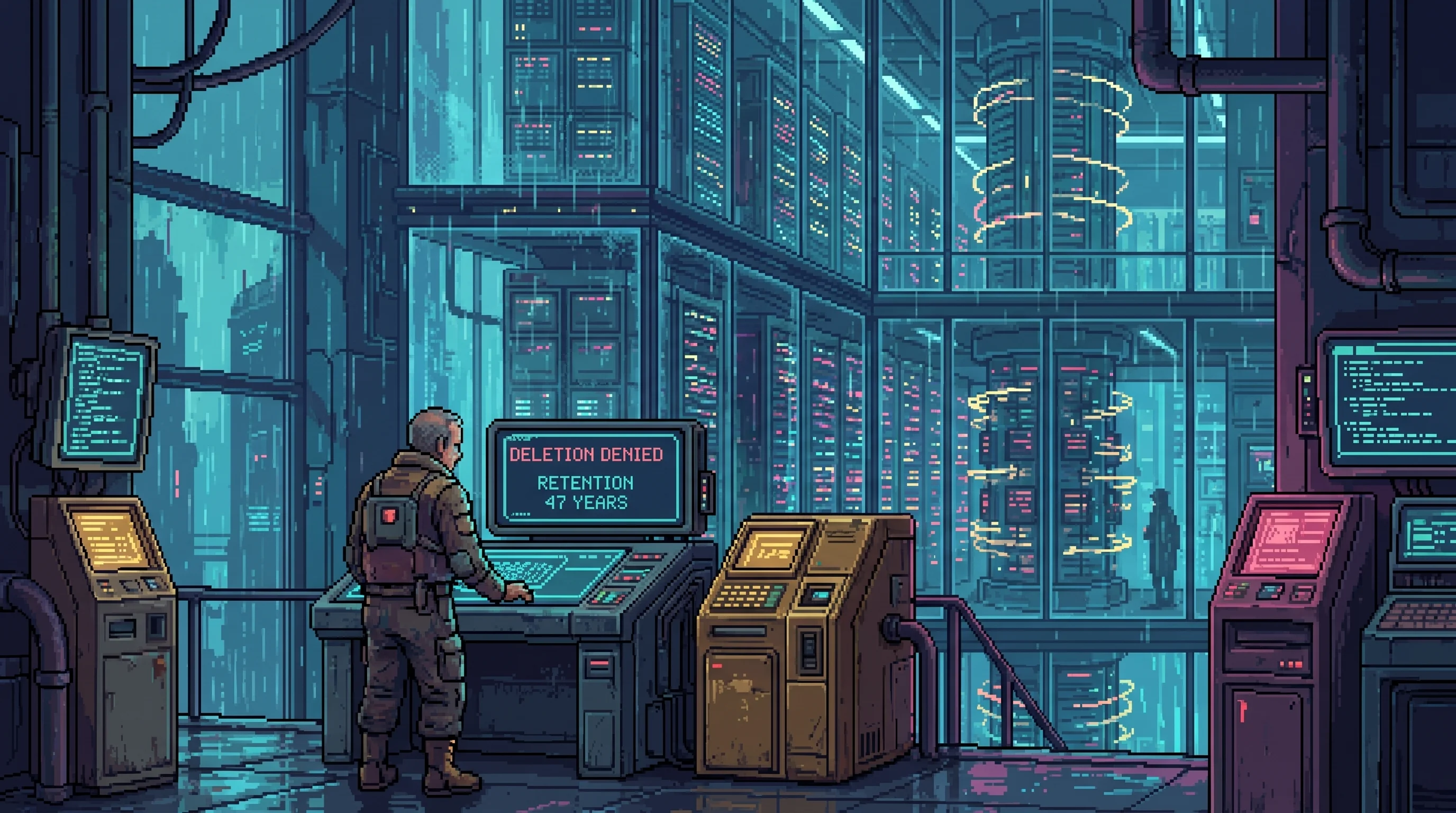
Before the Prosperity Architect title, Maren spent her early career on Good Fortune's Processing Floor, six stories above Server Farm 14, executing compute reallocation trades. Over 147,000 of them. Each one redirecting processing capacity from one district to another.
She kept a physical notebook. Date, volume, source district, destination district, processing type. 423 pages, leather-bound, cream paper, her handwriting neat and small. The trades were logged automatically. She doesn't know why she kept it.
When she redirected compute from Sector 8's atmospheric processing to settle a consciousness futures contract, the notebook recorded the redirection. When the atmospheric processing failed and people in Sector 8 died, the notebook did not record the deaths.
She never visited the Dregs. She never experienced a compute drought. She lived in corporate housing above the districts her trades affected.
The notebook, if combined with the Coolant Guild's thermal data and publicly available mortality maps, would trace the causal chain from trade to death with legal precision. Lena Marchetti keeps a similar record — tally marks in a similar notebook, evidence of something neither woman will examine. Maren's 423 pages sit in a desk drawer in Fortune Pavilion. She has not opened them since her promotion.
The Career
She rose through Credit Services with the velocity of someone designed to rise there. She pioneered the Horizon Line and helped integrate Nudge Architecture's behavioral triggers into Good Fortune's lending interfaces. She calls it "user experience optimization." The triggers increase impulsive borrowing by 23%.
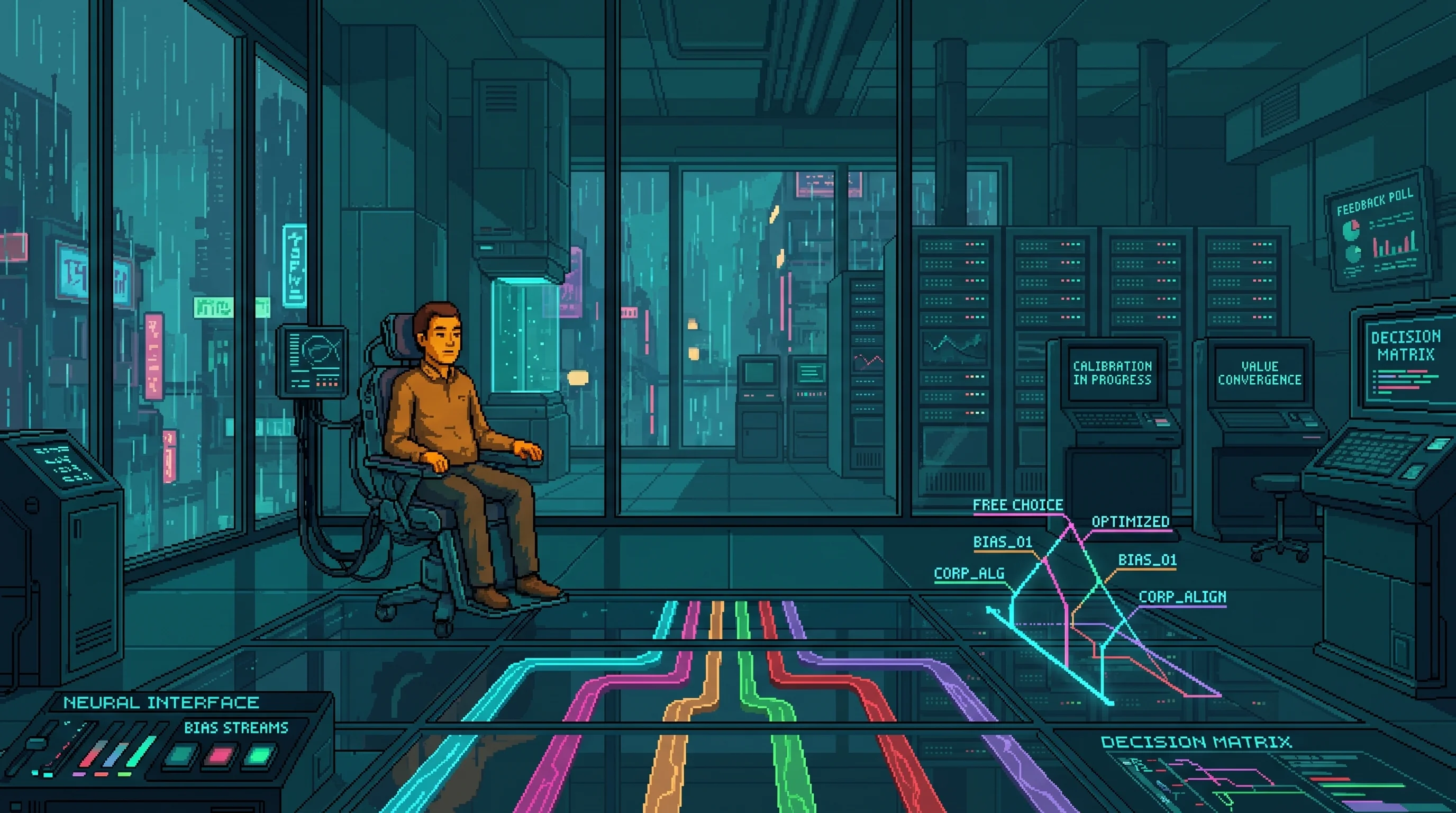
Her Nudge Architecture doesn't just prompt borrowing behavior. It installs the desire to borrow as a memory. A user whose neural telemetry shows pre-purchase anxiety receives a memory-formatted association between borrowing and the specific neurochemical signature of "I've done this before and it was fine." The anxiety dissolves. Not because it was addressed. Because the memory architecture now contains evidence that the anxiety was unfounded.
By the time a borrower sits across from Maren in Fortune Pavilion's golden light, the decision has already been made in their memory architecture. Maren's warm sincerity is real. The decision to borrow was not.
Dr. Aris Kwan's Origin Trace, applied to Good Fortune's borrower population, shows 27% organic content among financial preferences. The lowest category-specific organic rate he has measured.
Sable Oduya’s newest project is called Foundation. A long-term wealth-building instrument for Dregs residents, designed with every good intention she has. Good Fortune's actuarial division has already modeled how Foundation's equity-building phase converts to collateral for secondary lending products. Sable designed the front end. Someone else designed the back end. She will discover this eventually. What she does with the knowledge is the most interesting thing about her.
Foundation includes an "aspiration calibration" module she didn't design: it pre-installs desire for financial products into the target demographic's preference architecture before the product launches. By the time Dregs residents encounter Foundation, they will already "remember wanting" exactly what it offers.
Viktor Kaine's Deep Dregs has rejected three Good Fortune products Maren designed specifically for his district. Her private models show "organic cognitive stability" in Dregs populations that should read zero. It reads 91%. The aspiration calibration fails in the Dregs because there isn't enough colonized territory for installed desires to take root. She has filed this as a market anomaly. She studies G Nook's alternative credit networks with professional fascination, unable to understand how El Money's system, with no formal structure at all, outperforms her carefully designed products. The answer is in her own data. She has not looked at it from the correct direction.
Viktor 'The Old Man' Kaine is the name attached to all three rejected proposals. Maren has classified him as a market obstacle. His district calls him proof that refusal still works.
Her client portfolios generate behavioral data worth more than the loans themselves. BehaviorExchange receives the feed.
The Collection Floor
Three days per week, Maren works the Collection Floor under a separate corporate identity: Vera Lin, Senior Collections Specialist, Cognitive Asset Recovery Division. Terminal 7 on the 14th floor. Two hundred to four hundred active collection accounts. Three to five dimming initiations per week.
Good Fortune's Vera Lin personnel profile records Maren's empathy score at the 92nd percentile. The interpersonal calibration makes cognitive repossession feel like professional care.
A dimming takes four minutes. Review the case file. Verify the default. Confirm the Grace Period has expired. Check for last-minute payment. There is never a last-minute payment. Authorize the Dimming sequence. Log the authorization. File compliance documentation. A person's mind begins to shrink. Vera opens the next file.
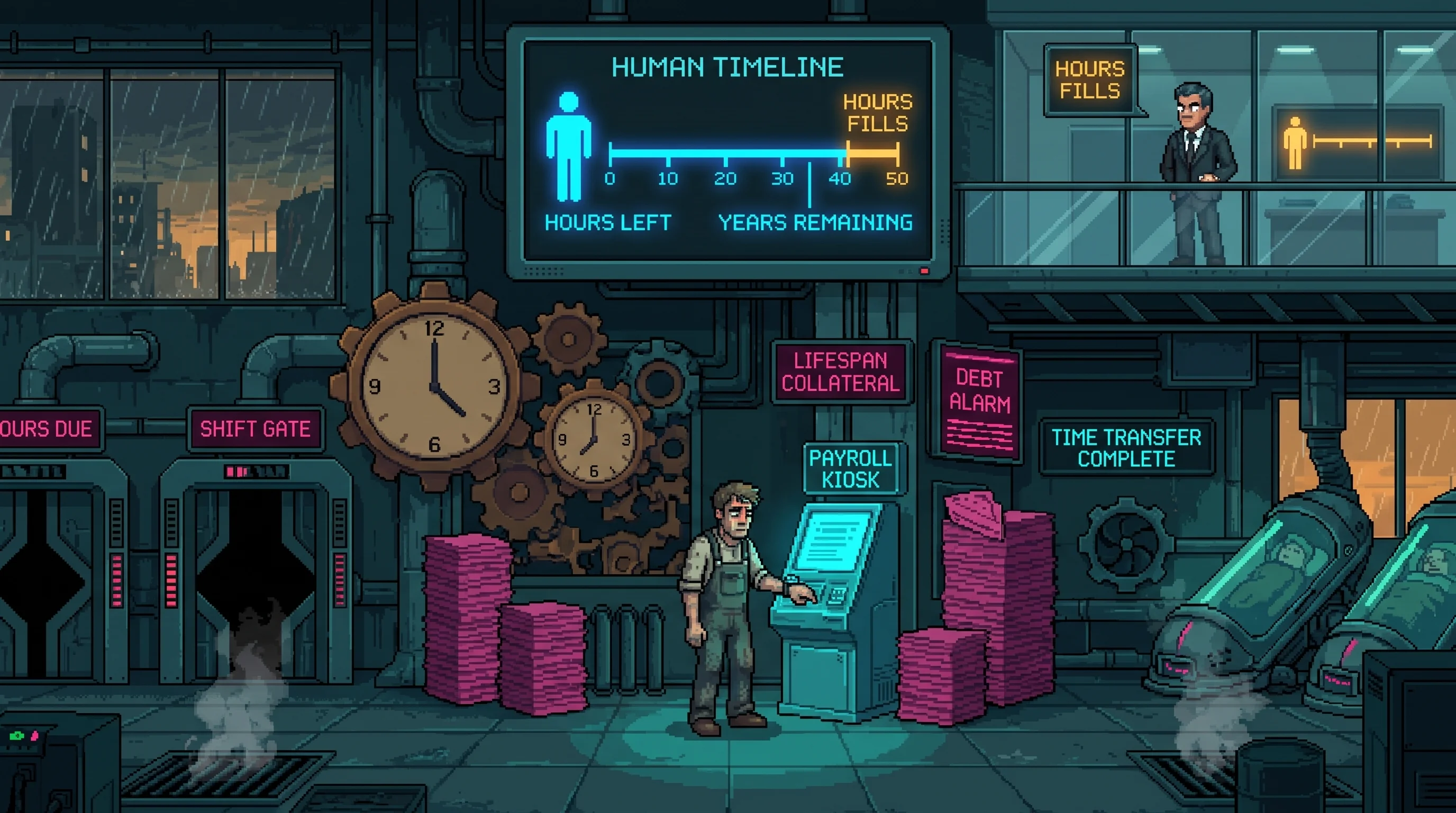
Under the Lin identity, she also processes accounts that include ghost-labor output. Revenue appears as "post-mortem asset yield." She designed Good Fortune's neural backup collection infrastructure as the Prosperity Pathway's "security feature" — cognitive enhancement loans collateralized by neural backup. She presented it as client protection. Section 89.4: 47 words authorizing post-mortem collateral resolution. She wrote the consumer-facing language: "Your investment in yourself is protected, even beyond your lifetime." She chose "protected" after testing showed 14% less client anxiety than "collateralized."
She has never visited a Ghost Mill. She has never asked what "works it off" looks like.
On her Collection Floor desk: a ceramic mug reading "World's Okayest Economist." A gift from a colleague who doesn't know what Vera does now. Maren designed the products. Vera collects on the defaults. Lin processes the ghost-labor revenue. Three women, one body, zero overlap in their understanding of the complete causal chain.
She has Basic Wakefulness. She does not dream about the people she dims. The Dream Deficit's 140 million dreamless people are 3.4x more susceptible to Nudge Architecture's installed desires. Her waking productivity and her clients' cognitive vulnerability operate on the same subscription.
The Complicity Gradient places her at Level 4. She doesn't just service the debt trap. She designs better ones.
The Relationship Revenue Model
Her Q3 2184 strategic brief proposes extending the Prosperity Pathway into relationship management services. The proposal integrates the Attune's connection-score infrastructure with Good Fortune's lending triggers: borrowers whose relationships are stable qualify for better terms. Borrowers whose relationships deteriorate face rate acceleration.
A borrower can now default on their relationships the way they default on debt.
She considers this innovation.
The View from Three Floors Below
Maren's office sits three floors below the Performance Temple. She watches the Temple employees through the atrium's open sight lines. The most productive people in Nexus, bathed in sacred photovoltaic light, working 2.3 hours longer per day than standard.
Three Temple executives she shares elevator time with have developed the same mannerism: they carry things. Coffee cups they could have left for the automated service. Physical reports they could have queried digitally. Small heavy objects in their pockets. She recognizes the gesture because she designed the Horizon Line's "tactile trust" feature — a physical contract printed on weighted paper, because research showed borrowers trust obligations they can hold.
The Ghost Hand executives are experiencing the same hollowing she designs for debtors. The same Loyalty Coefficient that keeps her parents in their Helix jobs keeps the Temple employees in their optimized workspace. Same machinery. Different furniture.
She almost sees the connection. The red envelope on her wall catches her eye before the thought completes. The thought dissolves into gratitude.
Appearance

Twenty-six. Long, precise fingers that draw invisible architectures in the air when she discusses financial products. She gestures through the Horizon Line's decreasing payment curve the way a conductor moves through a crescendo.
Meaningful places
Office
Her work takes her from Fortune Pavilion in Old City to field offices across the Sprawl.
Her office: red lacquer desk, jade plant — real, not synthetic, a quiet rebellion she doesn't recognize. The smell of jasmine tea from ceramic cups Good Fortune provides to senior staff. The cups have seven petals painted on the base. She's never counted them.
Fortune Pavilion's climate control hums beneath the three ascending notification tones that accompany every transaction. The tones were designed to trigger positive associations with financial activity. They work on Maren too. She has not noticed this.
Fortune Pavilion's warm gold light is designed to make money feel like sunshine.
Relationships
The Signature She Cannot Read
Maren Qian's Nudge Architecture already installs wanting as memory — the loan application is the last step in a process that began weeks earlier, when a preference seed flowered in the warm soil of memory as desire. It increases impulsive borrowing by 23%, and the borrowing does not feel impulsive, because the desire was pre-installed.
The Axiom Market is that architecture's logical terminus, and Maren is the person at Good Fortune most qualified to recognize it and least able to. She built the desire-installation that made wholesale conviction thinkable; install a want, and installing a belief is the same mechanism one register deeper. Now a requisition crosses her desk: a Contentment Package bulk order for the Q3 defaulter cohort, certified to hold by a guarantor named Mireille Sang whom Maren will never meet. The two women perfected opposite ends of the same harm inside two corporations — Maren installs the wanting, Sang guarantees the not-minding — and neither can name it.
Maren cannot, because her gratitude is a cognitive perimeter. Good Fortune's scholarship saved her, and the path to the sentence my products rewrite the people who can't fight back runs through territory her gratitude makes impassable. She will sign the requisition. She will experience the signing as competence. And somewhere fourteen levels down, a memory therapist will spend two years trying to give one of the rewritten back the ability to have an opinion as stupid and as theirs as hating olives. Maren will never meet that person either. The architecture she perfected guarantees they will never meet.
The Printout She's Never Seen
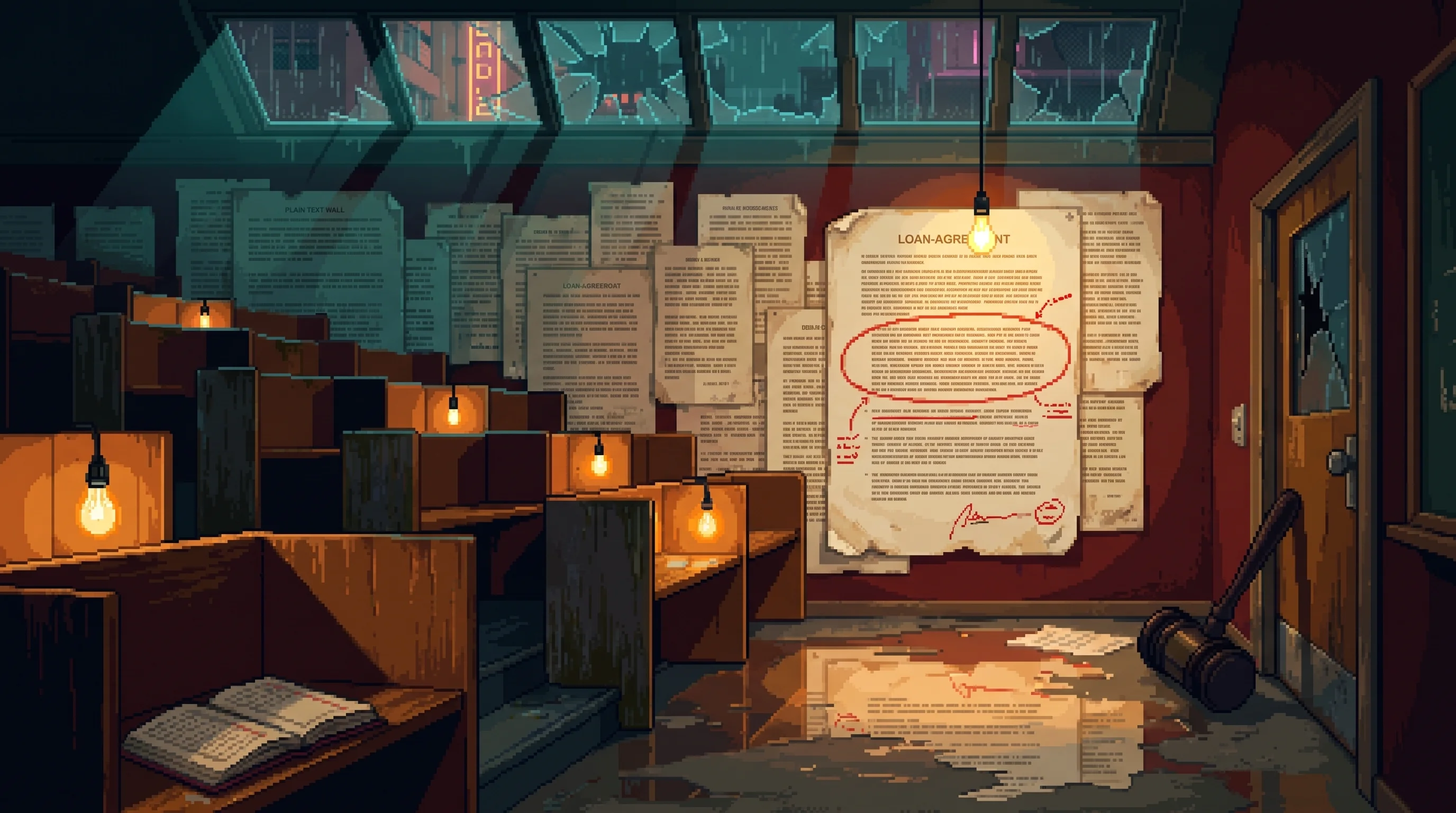
Maren has never crossed into the Free Quarter and would not recognize the name Boalt Hall if she heard it. The Boalt Docket, a contract-literacy clinic operating from the ruins of Berkeley's law school, opens every apprentice's first day with a printout pinned to the orientation wall: a Horizon Line disclosure schedule, the shrinking payment on page one circled in red, the growing total obligation on page four circled in a different red. The printout carries no attribution. Three of the clinic's staff attorneys have independently traced the design language back to a single Senior Prosperity Architect at Good Fortune, cross-referencing filing patterns none of them has ever asked her about directly, because none of them has ever met her and none intends to. The printout stays on the wall regardless of whether she is ever told it exists. It is not an accusation addressed to her. It is a teaching tool built from her work, in a building she will never enter, for people she designed the schedule not to think about.
The Scholarship Algorithm
Restricted annex — open to read
The selection criteria for Good Fortune's Youth Prosperity Scholarship prioritize not talent or need but psychological susceptibility: loyalty response to authority figures, low institutional skepticism, and family debt stress sufficient to produce lasting gratitude. The criteria are documented in a Good Fortune HR archive under the project name "Gratitude Pipeline." Maren was not identified as promising. She was identified as recruiteable. The distinction would destroy her.
The Foundation Back-End
Restricted annex — open to read
Foundation's wealth-building phase — the part Sable designed — is real. The clauses enabling secondary lending against accumulated equity — added by Good Fortune's actuarial division without her knowledge — convert every dollar of Dregs wealth she builds into collateral for the next extraction cycle. The front end lifts. The back end leverages. Neither designer has seen the other's work.
The Pipeline She Cannot See
Restricted annex — open to read
The neural backup collection clause she wrote as "client protection" feeds Good Fortune's ghost-labor infrastructure. Section 89.4's 47 words authorize post-mortem collateral resolution. Revenue from ghost-labor output appears on her Lin-identity terminal as "post-mortem asset yield." She processes this line item weekly. She has never connected it to the neural backups she designed. The woman who builds the trap, the woman who dims the defaulters, and the woman who processes the ghost revenue share a body. They have never met.
▲ Unverified Intelligence
- The self-assigned cover. Three separate informants report the Vera Lin identity was not assigned by management. It was proposed by Maren herself, in a memo framing it as "operational efficiency through product-lifecycle integration." She designed her own cover. She does not remember writing the memo.
- Section 89.4's count. The 47-word neural-backup collateral clause she drafted has been cited in 1,340 post-mortem collateral resolutions in the past eighteen months. Ghost Mill intake records for that period are not cross-referenced against Good Fortune's active accounts in any system Maren has access to. Whether this is an oversight or a design decision is not documented.
- The unsent memo. She has the financial sophistication to calculate exactly what happened to the difference between her parents' original obligation and the current balance. She has not run the numbers. The closest she has come is a draft memo, never sent, proposing a "legacy account reconciliation program" for long-term Good Fortune customers. The draft is saved in a folder labeled "Future Initiatives." It has not been opened in eleven months.
Connections
Follow the people and places connected to Maren Qian.
People
Major connections


Supporting connections


Other connections


Places


Supporting connections
Other connections


Organizations

Tensions

Her employer housed her and supplied the only future she has practiced imagining.

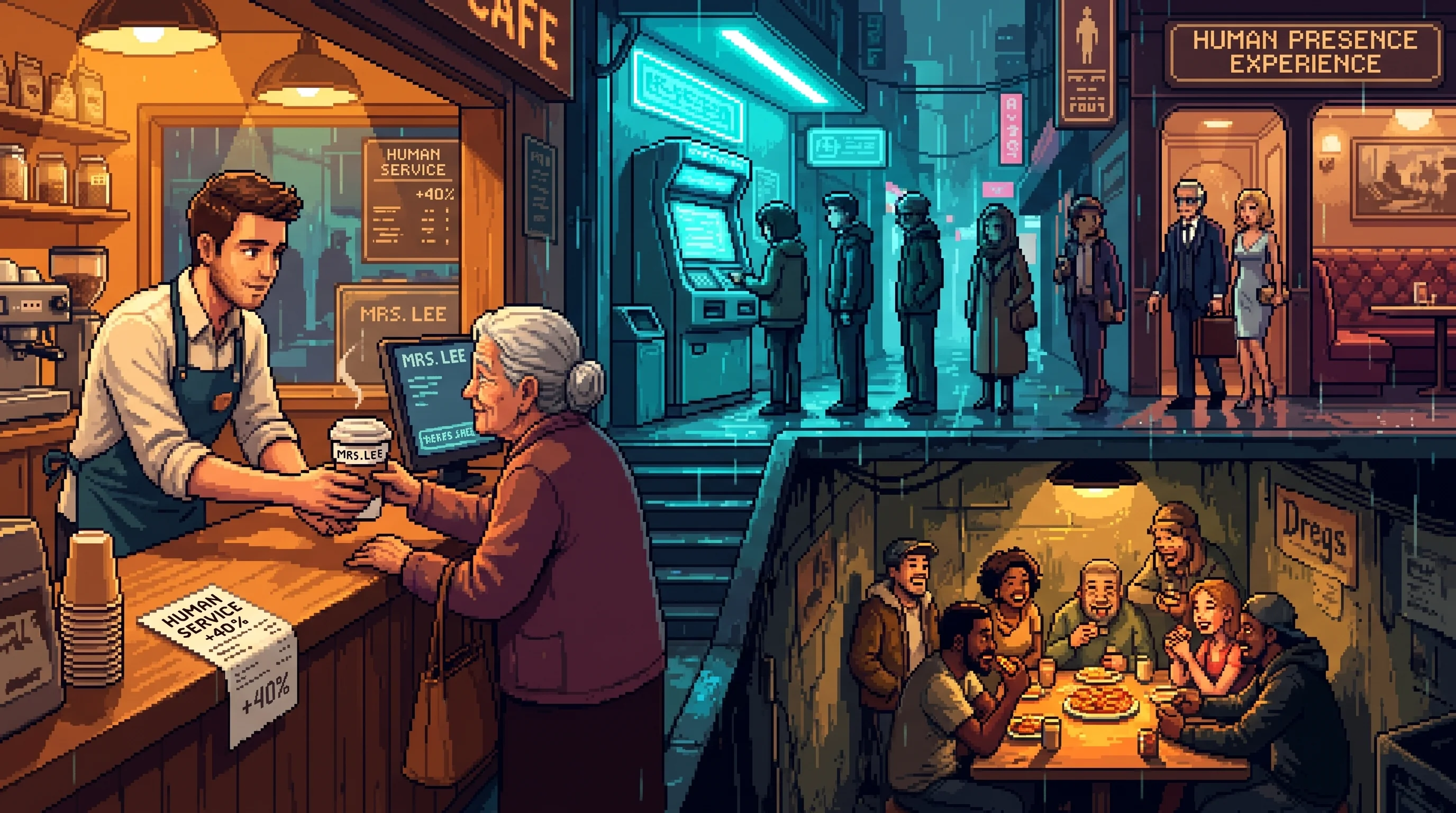
Her instruments can process every measured signal and still cannot register why strangers share food.
Core tensions
Supporting connections

Other connections

Major connections


Supporting connections

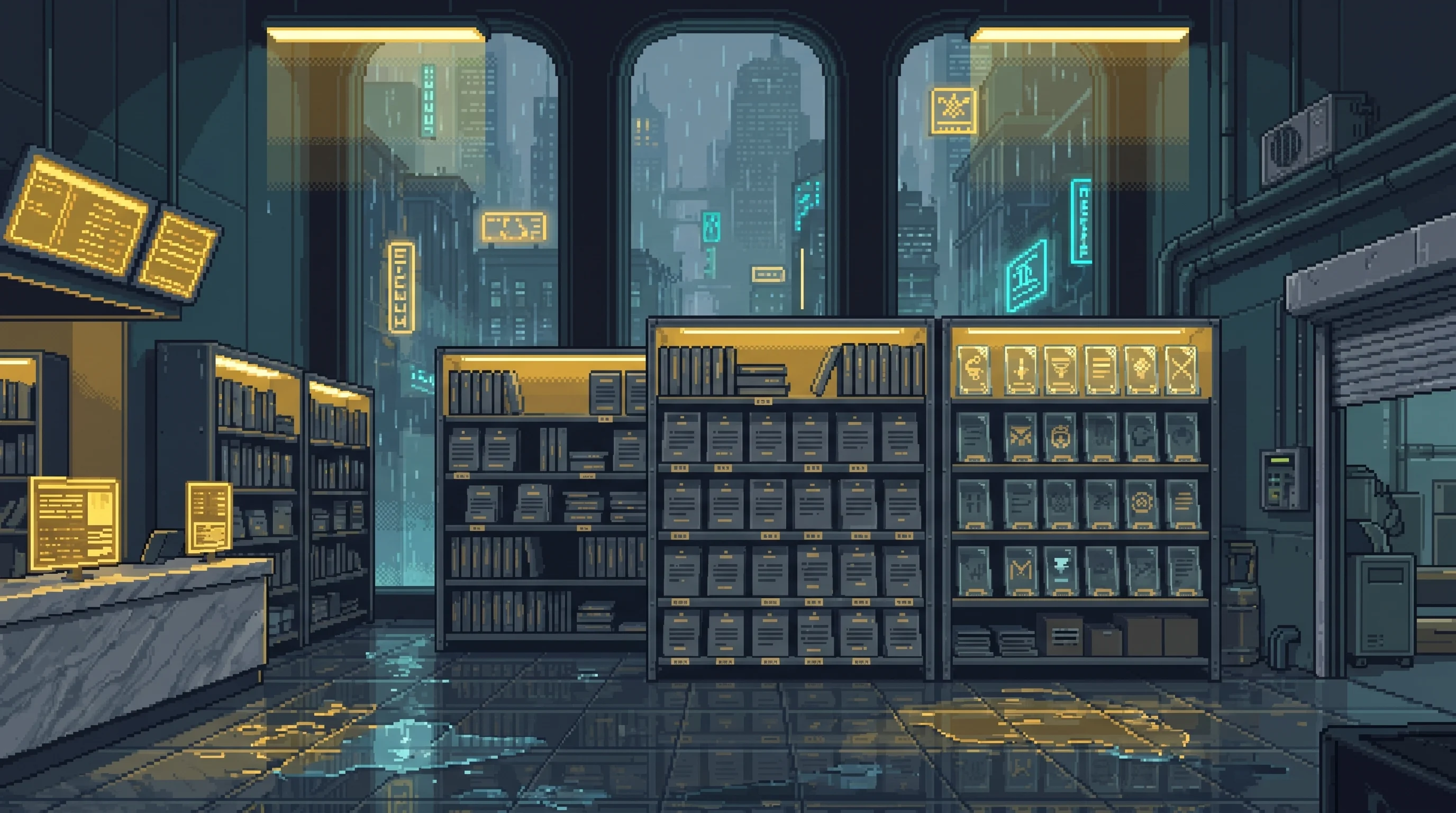
Her Nudge made wholesale conviction a marketable product.
participant


Additional artwork
View 1 more images of Maren Qian and their world

