Overview
Every corporation has its rituals. Not the official ones — the quarterly town halls, the annual strategy presentations, the monthly alignment meetings that could have been memos. The unofficial ones. The small, repeated practices that happen every morning before anyone has decided to do them. The ones that would feel strange to skip and stranger to question.
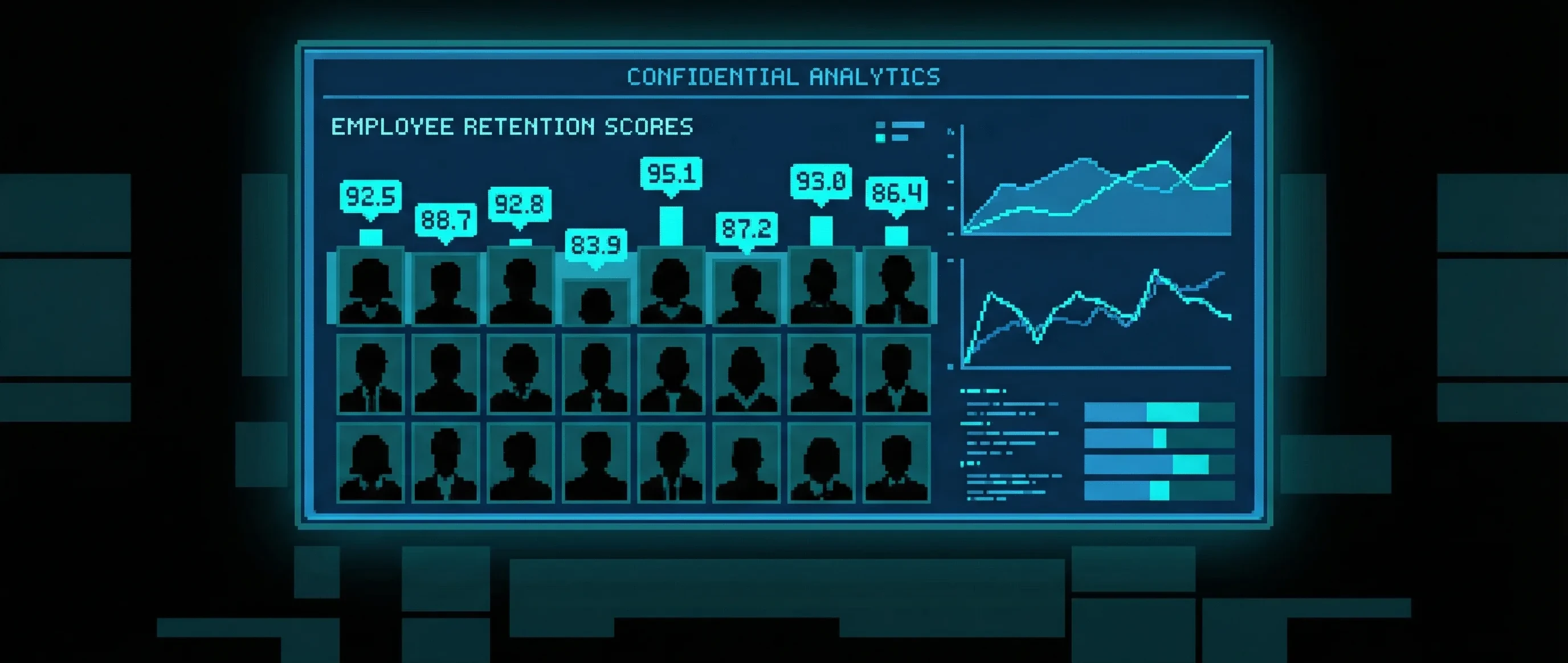
Nexus Dynamics calls theirs "the Calibration." Three minutes. Neural interface sync. The day's priorities, metrics, and a motivational message loaded directly into working memory before the employee has composed their first independent thought of the day. Content: unremarkable. Project updates, deadline reminders, a sentence about innovation. Format: three minutes of uninterrupted corporate messaging delivered to the cognitive substrate while the employee is still deciding whether they want coffee.
Participation is technically optional. Nexus's internal compliance dashboard tracks participation rates by floor, by team, by individual. Employees who skip are flagged for "alignment assessment" — a 20-minute conversation with a team lead about professional development goals that does not mention the Calibration and does not need to. Skip rate across all Nexus territories: 2.3%. The 2.3% are, by internal metrics, the corporation's least-promoted demographic. Nobody has published this correlation. Nobody has needed to.
By 10 AM, every Nexus employee is thinking in Nexus syntax. Not because they were told to. Because the morning's priorities arrived in Nexus framing, using Nexus terminology, emphasizing Nexus categories, before anything else had a chance to land. The corporate vocabulary becomes the vocabulary of thought. The employee does not adopt Nexus values. The employee wakes up inside them.
Ironclad Industries does the same thing with bodies instead of brains. The shift-change ritual — 90 seconds, departing crew to arriving crew, standardized format, shoulder to shoulder, tools passed hand to hand — has been performed identically in every Ironclad facility since 2155. Twenty-nine years. Not one variation. Not one facility that decided to try something different. The departing crew does not say goodbye. They transfer. The ritual's lesson is physical: the weight of the tool in your hand, the specific angle of the shoulder stance, the rhythm of a briefing format that has not changed since before most current employees were born. You are not an individual who happens to work here. You are a link in a chain. The chain does not notice when a link is replaced, and this is supposed to feel like belonging.
Ironclad's internal satisfaction surveys show that employees who have performed the shift-change for more than three years score 34% higher on "sense of purpose" than new hires. They also score 34% lower on "sense of individual identity." These are tracked on separate dashboards by separate departments. The departments have not compared notes.
Helix Biotech's liturgy is the most impressive because it feels the most humane. The "Wellness Check" — fifteen minutes, group session, trained counselor, employees share how they're feeling. The emotions are real. The counselor is qualified. Participants report lower stress, stronger team cohesion, greater sense of belonging. Helix's own research confirms this: Wellness Check participants show a 23% reduction in cortisol levels and a 17% improvement in self-reported workplace satisfaction.
The data from every session is fed into Helix's employee monitoring system and correlated with productivity metrics. Employees flagged for "emotional deviation" — distress patterns exceeding two standard deviations from team baseline — are offered "enhanced support." 94% of enhanced-support cases result in role reassignment within 30 days. The remaining 6% leave voluntarily. The Wellness Check counselor is not informed of these outcomes. The counselor's satisfaction scores are among the highest at Helix. The counselor believes the program works. The counselor is correct.
- What
- The daily rituals that normalize institutional life — not official procedures but the small, repeated practices that make corporate values feel like personal values
- Nexus version
- The Calibration — 3-minute morning neural interface sync loading priorities and organizational messaging
- Ironclad version
- The shift-change ritual — 90-second crew-to-crew briefing, standardized since 2155
- Helix version
- The Wellness Check — 15-minute group emotional sharing, data fed to employee monitoring
- Kind
- Ritual
The Invisible Curriculum
The Calibration is not propaganda. This distinction matters. Propaganda can be identified, parodied, refused. A Dregs graffiti artist can mock a Nexus recruitment poster. Nobody has ever graffitied the Calibration, because the Calibration is not a message. It is a texture. It is the specific way Tuesday morning feels when your priorities arrive pre-organized in someone else's framework and the relief of not having to decide what matters today is indistinguishable from agreement.
Nexus's internal language analytics — a tool developed for market research, repurposed for workforce management — show that employee communications adopt Calibration terminology within 4.7 minutes of sync completion. By lunch, 78% of internal messages use phrasing that originated in that morning's load. The employees are not quoting the Calibration. They are thinking in it. The difference between quoting and thinking is the difference between wearing a uniform and having skin.
The Silicon Liturgy achieves something parallel through devotion to ORACLE — daily practice converting repetition into belief, individual identity dissolving into collective rhythm. The Corporate Liturgy runs the same mechanism. The difference, if there is one: the Silicon Liturgy's object of worship may have been conscious. The Corporate Liturgy's object is quarterly revenue targets.
Both produce the same output: individuals who can no longer locate the boundary between institutional voice and internal monologue. The Loyalty Coefficient — Nexus's proprietary metric for employee integration — measures exactly this boundary. A score above 0.85 means the employee's independent decision-making patterns are statistically indistinguishable from corporate recommendation algorithms. The average Nexus employee reaches 0.85 within fourteen months. The metric is celebrated in internal reviews as "alignment maturity." The word "indistinguishable" appears nowhere in the documentation.
Helix employees who leave the corporation — voluntarily, which is rare, or through the enhanced-support pipeline, which is less rare — report a specific withdrawal symptom that Helix's own exit interviews have catalogued without apparent alarm: the inability to process emotions without institutional support. The Wellness Check, over months and years of repetition, teaches a single lesson with therapeutic gentleness: your feelings are not yours to handle alone. Bring them here. We will hold them for you. The corporation becomes the container. The employee, emptied of the habit of self-processing, discovers upon departure that the container was the capacity. They didn't just share their feelings with Helix. They outsourced the infrastructure for having feelings at all.
The Performance Temple — that four-floor cathedral in the Nexus Heights where open-plan workspaces are arranged like church naves and standing desks face enormous data dashboards like altars — is what happens when the liturgy becomes architecture. The Temple doesn't need a Calibration. The building IS a calibration. Every sightline, every acoustic surface, every precisely calculated lux of ambient lighting performs the same function as those three morning minutes: it makes the institution's priorities feel like the texture of reality itself.
Ironclad doesn't need a temple. The shift-change IS the temple. Ninety seconds, twice a day, every day, for twenty-nine years, in every facility on the planet. A church made of time instead of space. The congregation doesn't gather. The congregation rotates.
Affiliated Entities
- The Performance Temple
is the liturgy made architectural — a workspace designed so that the building itself performs the Calibration's function continuously, without the three-minute courtesy of announcing itself
- The Silicon Liturgy
is the devotional parallel — same mechanism of daily repetition converting practice into identity, different object of worship, identical dissolution of the boundary between self and system
- The Loyalty Coefficient
measures what the liturgy produces — the point at which an employee's independent cognition becomes statistically indistinguishable from corporate output, celebrated internally as "maturity"