CONCEPT ANALYSIS
The Surveillance Commons

The Surveillance Commons

In Zephyria, your data works for you; in the Sprawl, you work for your data

WhatTheoretical framework understanding surveillance infrastructure as a shared resource enclosed by private interestsParallelHistorical enclosure of agricultural commons (16th-18th century England)ArgumentBehavioral data is collectively produced and meaningful only in aggregate โ€” its enclosure by corporations is extraction, not creationZephyria PilotData Trust โ€” municipal collection and dividend distribution, ยข200/person/year

Overview

The Surveillance Commons is a theoretical framework that arrives at an uncomfortable conclusion through unremarkable arithmetic.

Behavioral data has no individual value. A single resident's neural-interface telemetry โ€” sleep patterns, purchase hesitations, emotional responses to advertising, the 0.3-second delay before accepting a Nexus Terms of Service update โ€” is worth approximately ยข0.00007 per day. Aggregated across 340 million Sprawl residents, the same data generates ยข4.2 billion annually for the . The individuals who produce the aggregate receive nothing. The corporations who built the collection infrastructure receive everything. The framework's authors โ€” economists working from 's policy institutes โ€” point out that this is structurally identical to the enclosure of agricultural commons in pre-industrial England: shared land, fenced by whoever could afford the fence, converted from collective resource to private revenue.

The parallel is tidy. 's response to it has been silence, which is the response of someone who checked the math and didn't find an error.

The Zephyria Experiment

Zephyria's Data Trust is the framework's only functioning implementation. All telemetry generated within the 's borders is collected by a municipal trust rather than private brokers. Inference products are sold by the trust. Revenue is distributed as a universal data dividend: ยข200 per person per year.

The amount is instructive. Zephyria's 2.3 million residents generate less inference value than a single mid-density Nexus sector. The dividend covers approximately four days of basic nutrition. , whose Data Sovereignty Act translated the commons framework into legislation, has called the dividend "a proof of principle." Nexus's Strategic Planning Division has called it "a rounding error." Both descriptions are accurate.

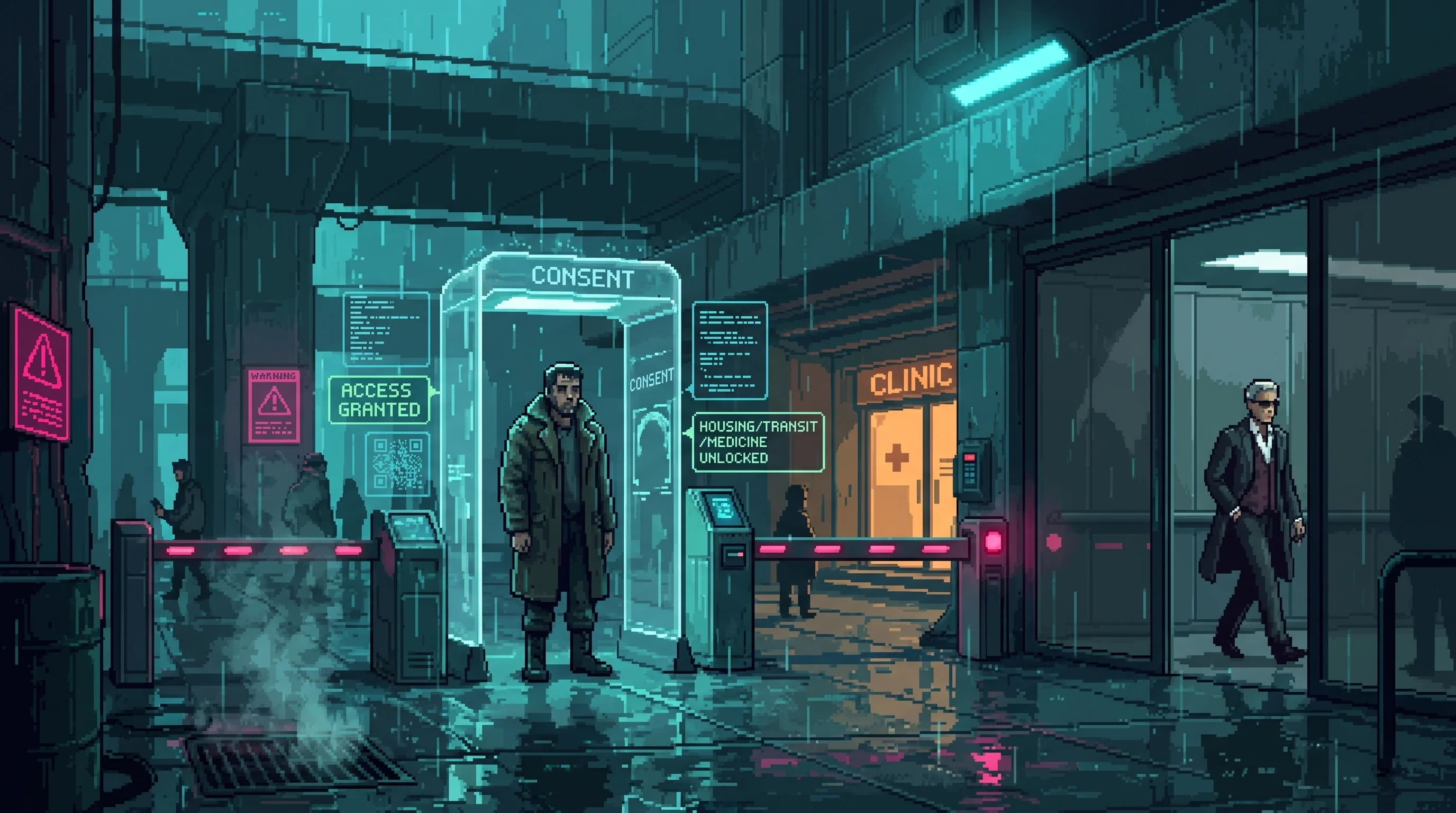
What the dividend purchases is not comfort but direction. In Zephyria, the data flows toward you. In the Sprawl, you flow toward the data. The difference is visible at the interface level: 's municipal feeds carry no predictive advertising, no emotional-state targeting, no caloric nudging. A Sprawl visitor arriving in described the experience as "like someone turned off a noise I didn't know was playing." She returned to the Sprawl after nine days. She missed the noise. Her neural interface's engagement metrics had dropped 340% during the visit, and the withdrawal symptoms โ€” restlessness, compulsive checking, a persistent sense that she was missing something โ€” were clinically indistinguishable from mild stimulant cessation.

The Trust's infrastructure monitors behavioral patterns, collects emotional data, and aggregates inference products with the same technical thoroughness as Nexus. The difference is ownership, not observation. In Zephyria, you are still watched. You are watched by an institution that sends you a quarterly statement showing exactly how much it earned from watching you, broken down by data category, with a check attached.

The Surveillance Commons - Evidence
An open field under a wide sky with no fences, construction crews approaching from every direction to install locks on floating translucent doors representing the human mind, natural democratic lighting in open sky blue and warm earth tones

The Comfortable Cage

's radical wing โ€” the faction that advocates for genuine data sovereignty rather than reformed data stewardship โ€” calls the model "the comfortable cage."

Their argument is mathematical. Section 7, Paragraph 3 of 's Data Sovereignty Act guarantees citizens the right to reduce their telemetry output. Opt-out requests are processed within 48 hours. The form is two pages. In six years of Trust operation, fewer than 200 citizens have exercised this right. Population-adjusted, that is a 0.0087% opt-out rate โ€” lower than the Sprawl's rate of citizens who formally contest Nexus data collection, which runs at 0.012%.

A system designed to liberate data from corporate enclosure has produced a population less likely to refuse surveillance than one that never had the choice.

The radicals find this predictable. A citizen who receives a data dividend has a financial incentive to generate more telemetry, to be more transparent, to participate more fully in the monitoring infrastructure. The ratchet still turns. It pays a dividend while turning. The dividend is small enough that losing it is painless. The dividend is large enough that opting out feels like waste. The ยข200 occupies precisely the range where refusing it seems irrational without being significant enough to feel like compensation.

The Sprawl's corporate data ecology watches 's experiment with professional interest and no anxiety. Nexus's Strategic Planning Division has drafted three proposals for a "Data Participation Dividend" that would pay Sprawl citizens ยข15 per year for explicit telemetry consent โ€” converting implicit extraction into an explicit transaction that, by making the bargain visible, makes it harder to object to. The framework diagnosed the enclosure. Zephyria may have demonstrated how to make the enclosure permanent.

Case File โ€” Additional Record
ImplicationInference Economy profits are functionally rent โ€” payment extracted from communities for access to something they produced

Connections

  • uses the same enclosure logic โ€” artificial constraints on compute capacity maintained for profit, just as artificial claims on behavioral data are maintained for revenue
  • 's Data Sovereignty Act translates the commons framework into legislation โ€” the fourth version includes the data dividend model
  • is what the framework diagnoses โ€” the extraction apparatus that converts collectively produced behavioral data into private revenue
  • treats the framework as foundational scripture โ€” data sovereignty as commons reclamation, though the radical wing considers 's implementation a betrayal of the principle
  • is the mechanism the framework identifies as enclosure โ€” the exchange of privacy for services that privatizes what the community generates

Visual Identity

  • Color palette: ('s municipal color) against blue (Nexus surveillance) โ€” the commons against the enclosure
  • Key symbol: A shared field โ€” data as common resource, accessible to all who generate it
Archive annex โ€” 6 earlier filings on this recordClose the archive annex

Recovered Historical Material

The Attention Abolitionists

Forced-Focus Contracts

The Attention Economy

The Trap

Technical Brief

Indexed โ€” no record on file.

Technical Brief

The Surveillance Commons

Cognitive Sovereignty

If your attention is for sale, who owns your mind?

The Cognitive Commons: The Last Enclosure

Indexed โ€” 1 line preserved from the earlier filing.

An open field under a wide sky with no fences, construction crews approaching from every direction to install locks on floating translucent doors representing the human mind, natural democratic lighting in open sky blue and warm earth tones

The Cognitive Commons is the political concept โ€” advanced by the , the , and a growing coalition of labor activists โ€” that human attention is a shared resource, like air or water, and that its commodification constitutes an enclosure of the commons analogous to the privatization of public land. The argument is straightforward: attention is a finite biological resource. Each human mind produces approximately 16 hours of waking attention per day. When that attention is commodified โ€” sold through forced-focus contracts, taxed through the , shaped through neural advertising, and measured through cognitive load pricing โ€” it ceases to be a personal capacity and becomes a corporate asset. The individual retains the biological substrate. They lose effective control of its primary output.

A forced-focus worker consents to sell their time. But the focus lock doesnโ€™t just control their time โ€” it controls what they think about during that time. The distinction is the distance between renting a room and renting a mind.

The Commons movement draws this line with surgical precision. Traditional labor sells hours. A welder shows up, welds, goes home. The welderโ€™s mind wanders to their children, their dinner, the ache in their shoulder. The focus-locked worker cannot wander. Their attention is neurologically constrained to the task โ€” their consciousness directed and held by systems they did not design, toward outputs they do not own, for durations they cannot interrupt. This is not employment. This is cognitive tenancy.

The Economic Trap

The oppositionโ€™s argument is not ideological โ€” it is arithmetic. generates ยข340 billion annually. Banning forced-focus contracts would not liberate 14 million workers. It would unemploy them. And in the Sprawl, unemployment is the loss of everything: consciousness license, housing access, network privileges, medical coverage. The system that harms and the system that sustains are the same system.

Selling time is old as labor. A worker sells eight hours and their body is present but their mind is free โ€” free to daydream, to plan, to hate the work, to love the work, to think about anything at all while their hands move. Selling attention is new. The focus-locked workerโ€™s mind is not free. Their consciousness is directed, held, and metered. The Commons movement argues this is not a difference of degree. It is a difference of kind.

Zephyria Data Trust distributes ยข200/person/year as data dividend

Network

The political vehicle for the Commons movement. The champions the Cognitive Liberty Act and provides the organizational infrastructure for the coalition.

Has introduced the Cognitive Liberty Act twice. Its twice-failed champion. Nwosuโ€™s persistence is either principled or performative โ€” the Sprawl has not yet decided.

Provides the technical analysis of how attention is captured, metered, and sold โ€” the engineering documentation behind the political argument.

Share the philosophical framework of attention as a commons. Where the organizes, the theorize.

The Commons movement challenges the โ€™s fundamental premise โ€” that attention is a commodity to be traded rather than a right to be protected.

The most visible target. The contract that sells what you think about, not just your time โ€” the clearest case of cognitive enclosure.

The Cognitive Commons forces the Sprawl to confront questions it would rather leave unanswered โ€” questions where the morally obvious answer is economically catastrophic.

The Enclosure

Attention is the last commons. Land was enclosed centuries ago. Water was privatized decades ago. Now the biological act of noticing โ€” the finite capacity of a human mind to direct itself toward something and hold โ€” is parceled, priced, and sold. The construction crews are approaching from every direction. The question is whether anyone will stop them.

Ban forced-focus contracts and 14 million people lose their jobs, their licenses, their housing, their access to medical coverage. Preserve forced-focus contracts and 14 million people continue selling their thoughts. The system that harms and the system that sustains are the same system. The Cognitive Liberty Act fails not because the Council disagrees with its principles โ€” but because it cannot survive its consequences.

The right to choose what you think about. The right to let your mind wander. The right to daydream during work, to hate the task, to love it, to be bored by it โ€” to be present in your own consciousness without neurological constraint. The Commons movement argues this is the foundational right from which all other rights derive. If you do not own your attention, you do not own yourself.

The Beautiful Idea

The Cognitive Commons is a beautiful idea. The Sprawlโ€™s economy would collapse without its violation. Everyone involved knows this โ€” the advocates, the legislators, the corporations, the workers themselves. The movement persists not because anyone believes it will succeed, but because some ideas are too important to stop saying out loud, even when saying them changes nothing.

Councillor Nwosu knows the Act will fail a third time. She will introduce it anyway.

Indexed โ€” 1 line preserved from the earlier filing.

A shared green field of data streams being divided by corporate blue fences โ€” the visual metaphor of enclosure, with Zephyria's green glow visible on the horizon as the one place where the commons remains open

In the 16th through 18th centuries, English landowners enclosed the agricultural commons โ€” shared land that communities had farmed for generations โ€” and claimed it as private property. The Surveillance Commons is the framework that recognizes the same process happening to behavioral data. Data is collectively produced. It is meaningful only in aggregate. Corporate enclosure of that data is extraction, not creation. The profits of the are functionally rent โ€” payment extracted from communities for access to something they produced.

"In Zephyria, your data works for you. In the Sprawl, you work for your data." โ€” Common saying, comparing the Free City to corporate territory
Framework parallels historical enclosure of agricultural commons

The Rent Diagnosis

Agricultural Enclosure

  • Communities farmed shared land for generations
  • Landowners fenced the commons, claimed private ownership
  • Communities charged rent for access to what they'd always shared
  • Justified as "improving efficiency"
  • Profit came from controlling access, not creating the resource

Data Enclosure

  • Communities produce behavioral data collectively
  • Corporations capture the data, claim private ownership
  • Communities pay (via attention, privacy) for services built on their own data
  • Justified as "providing convenience"
  • Profit comes from controlling access, not creating the resource

The Felt Difference

The Surveillance Commons has no physical form โ€” it exists in policy papers and workshop debates. But its expression is itself, and the gap between the and the Sprawl is not theoretical:

You don't feel the extraction. That's the design. Every interaction is optimized for engagement, every surface tuned to harvest attention, every convenience calibrated to generate data. It feels normal. It feels like the world working as intended. You don't notice the rent you're paying because you've never known a world where you didn't pay it.

โ€” the deal where citizens trade privacy for services โ€” is diagnosed by the Surveillance Commons framework as the terms of enclosure. The moment the bargain was struck was the moment the fence went up. What looked like a fair trade was the signing over of the commons.

The question nobody in corporate leadership will answer publicly: if the commons model is economically unviable at scale, why suppress the data proving it? And if it is viable โ€” what does that say about every credit of profit extracted since the enclosure began?

"They didn't steal your data. They enclosed your commons. The difference matters: a thief can be caught; an enclosure becomes the landscape. By the time you notice the fence, the field has been someone else's property for a generation." โ€” Opacity Movement founding document, attributed to early Surveillance Commons theorists

Internal Nexus modeling reportedly shows that scaling the model to the Sprawl's 340 million residents would reduce margins by 40โ€“60%. The models have never been released. claims to have obtained fragments. Nwosu's fourth draft of the Data Sovereignty Act cites numbers that match the rumored projections with suspicious precision.

This reframing changes the moral calculus entirely. A company creating value has earned its profit. A landlord extracting rent from a commons has not. The distinction is the difference between commerce and extraction โ€” and the Surveillance Commons framework argues that the crossed that line the moment it enclosed what communities produced.

Zephyria's โ†’ /world/locations/the-free-city

Zephyria Data Trust โ†’ /world/locations/the-free-city

's โ†’ /world/factions/the-opacity-movement

Nwosu's โ†’ /world/characters/councillor-adaeze-nwosu

The framework begins with arithmetic that should be unremarkable. A single resident's neural-interface telemetry โ€” sleep patterns, purchase hesitations, emotional responses to advertising, the 0.3-second delay before accepting a Nexus Terms of Service update โ€” is worth approximately ยข0.00007 per day. Aggregated across 340 million Sprawl residents, the same data generates ยข4.2 billion annually for the . The individuals who produce the aggregate receive nothing. The corporations who built the collection infrastructure receive everything.

economists who developed the framework โ€” working from 's policy institutes โ€” point out that this is structurally identical to the enclosure of agricultural commons in pre-industrial England. Shared land, fenced by whoever could afford the fence, converted from collective resource to private revenue. Justified as improving efficiency. Profitable because the fence controlled access to something the community had always produced together.

's response to the parallel has been silence. Silence is the response of someone who checked the math and didn't find an error.

The framework's most dangerous claim: profits are not profit. They are rent. Not value earned through creation, but value extracted through control of access to a resource the community produced.

Theory became practice in . The Data Trust, championed by , established a municipal alternative: all telemetry generated within 's borders is collected by a municipal trust, aggregated for public benefit, and the inference products are sold by the trust rather than private brokers. Revenue is distributed as a universal data dividend: ยข200 per person per year.

The amount is instructive. Zephyria's 2.3 million residents generate less inference value than a single mid-density Nexus sector. The dividend covers approximately four days of basic nutrition. Nwosu has called it "a proof of principle." Nexus's Strategic Planning Division has called it "a rounding error." Both descriptions are accurate. (They are not in conflict.)

Visitors describe a subtle but unmistakable difference. Interfaces feel lighter. Recommendations are useful without being uncanny. A Sprawl resident who visited for nine days described the experience as "like someone turned off a noise I didn't know was playing." She returned to the Sprawl after her visa expired. Her neural interface's engagement metrics had dropped 340% during the visit. The withdrawal symptoms โ€” restlessness, compulsive checking, a persistent sense that she was missing something โ€” were clinically indistinguishable from mild stimulant cessation.

's radical wing โ€” the faction that advocates for genuine data sovereignty rather than reformed data stewardship โ€” calls the model "the comfortable cage." Their argument is mathematical.

Section 7, Paragraph 3 of 's Data Sovereignty Act guarantees citizens the right to reduce their telemetry output. Opt-out requests are processed within 48 hours. The form is two pages. In six years of Trust operation, fewer than 200 citizens have exercised this right. Population-adjusted, that is a 0.0087% opt-out rate โ€” lower than the Sprawl's rate of citizens who formally contest Nexus data collection, which runs at 0.012%.

A system designed to liberate data from corporate enclosure has produced a population less likely to refuse surveillance than one that never had the choice. The radicals find this predictable. A citizen who receives a data dividend has a financial incentive to generate more telemetry, to be more transparent, to participate more fully in the monitoring infrastructure. The ratchet still turns. It pays a dividend while turning. The ยข200 occupies precisely the range where refusing it seems irrational without being significant enough to feel like compensation.

The air feels different โ€” not cleaner, exactly, but less heavy. Interfaces respond differently. The advertising feels informative rather than predatory. The constant low-level tension of being optimized-at begins to dissolve. Most visitors take several hours to identify what has changed: nobody is monetizing their attention without their knowledge.

Leaving Zephyria and re-entering the Sprawl, you feel it โ€” the weight of being harvested again. The interfaces slightly too eager. The recommendations that know you slightly too well. recruiters say is their best enrollment tool. One visit is enough.

uses the same enclosure logic โ€” artificial constraints on compute capacity maintained for profit, just as artificial claims on behavioral data are maintained for revenue. Both describe the same mechanism operating on different resources: what was shared becomes scarce becomes private becomes profitable.

If the framework is correct, every credit of profit is rent. Every predictive model is built on enclosed land. Every convenience purchased with behavioral data is a service built on enclosed commons and sold back to the people who produced it. Data sovereignty is not a policy preference. It is a property claim. Property claims, historically, are settled by force.

The Sprawl's corporate data ecology watches 's experiment with professional interest and no anxiety. The Trust demonstrates that populations accept comprehensive surveillance when they receive a share of the proceeds. This is not a threat to the . It is a proof of concept for its next iteration.

Nexus's Strategic Planning Division has drafted three proposals for a "Data Participation Dividend" โ€” ยข15 per year for explicit telemetry consent. Converting implicit extraction into an explicit transaction makes the bargain visible. Making the bargain visible makes it harder to object to. The Surveillance Commons framework diagnosed the enclosure. Zephyria may have demonstrated how to make the enclosure permanent.

Indexed โ€” 1 line preserved from the earlier filing.

The aggregation paradox remains the framework's most uncomfortable edge: individual data has no value, aggregate data has enormous value, and the individuals who produce the aggregate receive nothing. This is not a bug. It is the operating principle. Zephyria's ยข200 dividend proves that returning value to its source is technically possible โ€” which means its absence everywhere else is a choice.

Connected To