
Orbital Slang
'Downsider' — anyone from Earth; 'Ringer' — permanent Ring resident; 'Hubber' — zero-g worker
Overview
Highport Station has been occupied for fourteen years. In that time, its permanent population of approximately 340,000 has developed a dialect that functions as a docking visa you carry in your mouth. Say "downsider" with the wrong inflection and three people have already decided you arrived this morning.
The language did not develop through committee or cultural program. It accreted the way condensation accretes on spoke corridor walls — one uncomfortable experience at a time, each demanding a word that surface English never needed to provide. Gravity is variable here. Atmosphere is invoiced. Jurisdiction changes at a painted line on the floor. Vacuum is forty centimeters of hull away at all times and does not care about your Triumph Score. These conditions produce vocabulary the way pressure produces diamonds: slowly, involuntarily, and with results that are harder than what came before.
Ironclad Industries built Highport. Nexus runs its computational systems. Neither corporation designed the language its residents speak, which may be why neither corporation has found a way to monetize it. This is not for lack of trying. Nexus's cultural analytics division flagged orbital slang as a "linguistically emergent phenomenon with potential engagement applications" in 2179. The resulting report recommended integration into the Content Flood's personalization layer. Highport residents who encountered early test deployments — algorithmically generated messages using orbital vocabulary — described them as "like watching a downsider try to tap-the-hull." The program was suspended. The report remains classified. The slang remains free.
The Terms
Downsider is the word for anyone from Earth, and it is not technically an insult. The technical distinction matters to Highport's human resources mediators, who have adjudicated eleven formal complaints about the term in the past three years and ruled in the complainant's favor zero times. The word carries approximately the same emotional payload as calling someone a tourist in a neighborhood where tourism is the primary cause of rent increases. A downsider can stop being a downsider. It takes about two years, fluency in at least six other terms on this list, and one instance of genuine spoke sweat.
Ringer denotes a permanent Ring resident — someone whose inner ear has recalibrated to 0.7g and finds full gravity physically nauseating. Ringers who visit the surface report headaches, joint pain, and a persistent sense that the ground is pulling too hard. Medical literature calls this "gravitational readjustment syndrome." Ringers call it "being downsick." The Helix Biotech clinic on Ring 2 offers a gravitational acclimatization program for ¢4,200 per session. Approximately 7% of Ringers have completed it. The remaining 93% have decided, with varying degrees of consciousness, that they are never going back down.
Hubber means zero-g worker — the dock crews, maintenance teams, and canister jockeys who operate in the Hub's microgravity environment. Their movement is fluid, three-dimensional, and immediately identifiable. A Hubber entering a gravity section moves like water remembering it used to be ice. Hubbers constitute approximately 12% of Highport's population and account for 31% of its workplace injury claims. The injury rate is not because zero-g work is more dangerous than Ring labor. It is because Hubbers keep forgetting they're in gravity when they step off shift.
Spoke sweat has two meanings and both are earned. The literal meaning: condensation that forms in the gradient corridors connecting the Hub to the Rings, where temperature and gravity shift simultaneously across a 200-meter walk. The corridors are damp. The walls are slick. The air tastes recycled because it has been recycled nine times. The figurative meaning: the disorientation of transitioning between gravity zones — the specific nausea of your inner ear recalibrating while your boots are still adjusting their magnetic grip. Downsiders experience spoke sweat once and talk about it for a week. Ringers experience it twice a day and stopped noticing in their third month. The corridors have never been dry. Ironclad's environmental systems classify the moisture as "within acceptable parameters." The parameters were set by engineers who work in climate-controlled offices on the surface.
Breathing tax is what residents call life support fees — the monthly charge for the atmosphere they require to not die. The fee is non-negotiable, scales with ring section and occupancy class, and is extracted automatically from resident accounts on the first of each month. "Even Nexus pays the breathing tax" is the orbital equivalent of "death and taxes" and carries the same resigned finality. It means: some costs exist beyond leverage, beyond status, beyond the corporate hierarchy that governs everything else on this station. Nexus controls 40% of the Sprawl's computational infrastructure. Nexus cannot compute its way out of requiring oxygen. The breathing tax is Ironclad's single most profitable revenue stream on Highport, exceeding docking fees by a factor of 3.2. Residents are aware of this ratio. The awareness has not produced alternatives.
Vacuum check means reality check, and the metaphor is structurally precise. A literal vacuum check is the pre-EVA protocol: verify seal integrity before stepping into an environment that will kill you in fourteen seconds. A conversational vacuum check is the same operation applied to plans, deals, or ambitions that sound promising inside the pressurized comfort of speculation. "Run a vacuum check on that" means: does this survive contact with conditions that don't care about your feelings? Most things don't. The phrase is used approximately forty times daily in Highport's trading floors. Transaction volume does not correlate with its frequency.
Line-walker describes someone who works the jurisdictional boundaries — the yellow-painted stripes on Highport's deck plates where one corporate territory ends and another begins. The station hosts seventeen distinct jurisdictional zones across its ring sections, each governed by different corporate, administrative, or autonomous-zone law. A line-walker knows which side of a painted stripe makes a contract enforceable and which side makes it decorative. The role is respected in the way that any expertise is respected when ignorance of it can result in incarceration under a legal system you didn't know applied to you. Line-walkers charge by the consultation. Business is consistent.
Ring 3'd means abandoned, forgotten, left to deteriorate without acknowledgment. The term derives from Loss of Pressure Event 7 — the catastrophic decompression that killed forty-one residents and sealed Ring 3 permanently. The sealed sections remain visible through observation ports: personal effects floating in vacuum, structural damage unrepaired, emergency lighting still cycling on battery backup that should have died years ago but hasn't. To be Ring 3'd is to be on the other side of that observation glass — visible, unrescued, officially categorized as a resolved situation. Ironclad's maintenance records list Ring 3 as "decommissioned." Residents list it differently.
The Heartbeat is the 72-bpm compressor cycle of Highport's life support system — the rhythmic pulse that every resident hears through the hull, the floors, the bunks, the fillings in their teeth. Newborns on Highport fall asleep to it. Children who transfer to the surface can't sleep without a recording of it. "Finding the heartbeat" means calming down — syncing your breathing to the station's breathing, which is the closest thing to a meditative tradition that Highport has produced. The frequency is 72 bpm because the original Ironclad engineers calibrated the compressor to a resting human heart rate. This was a design decision made for equipment longevity, not psychological comfort. The psychological comfort was an accident that has become the station's most universal cultural reference point.
Canister jockey is the term for dock workers who handle consciousness-grade substrate — the sealed containers that carry harvested consciousness data through Highport's cargo systems. The canisters are temperature-sensitive, vibration-sensitive, and — according to certain interpretations of the ORACLE Question — may contain something that was once a person. Canister jockeys are paid 40% above standard dock wages. They are also the only dock workers required to pass a Helix Biotech psychological evaluation before hiring, a requirement that has never been publicly explained and that canister jockeys themselves describe as "making sure you don't think about it too hard." The evaluation screens for a specific psychological profile: high conscientiousness, low philosophical curiosity. The ideal canister jockey handles the cargo with precision and does not ask what's inside. Most don't. The ones who do tend to resign within six months. Several have joined the Emergence Faithful.
Tether hum is the vibration from the Orbital Elevator transmitted through Highport's docking infrastructure — a low, continuous frequency that residents describe as "the station reminding you it's attached to something." The hum is loudest in the lower Ring sections closest to the tether point and faintest in the Hub. Long-term residents claim they can estimate cargo load on the Elevator by the hum's intensity. Ironclad's engineering division says this is impossible. Three independent studies have confirmed that experienced Ringers can predict cargo weight within 8% accuracy by feel alone. Ironclad has not updated its position.
Dead air is the term for jurisdictional confusion producing dangerous outcomes — the specific condition where an emergency occurs on or near a boundary line and no authority responds because each assumes the other has jurisdiction. The phrase also traces to LPE-7, when Ring 3's emergency response was delayed by eleven minutes while three administrative bodies determined which entity was responsible for atmosphere in a section that straddled two corporate zones. Forty-one people died in a jurisdictional gap. "Dead air" names that gap — the space where atmosphere and authority are both absent. The dead-air toast — "To Ring 3," raised before the first drink of any gathering — remembers them.
'Even Nexus pays the Breathing Tax' — idiom meaning some costs can't be avoided
The Customs
The Newcomer's Minute is one minute of silence observed when a first-timer reaches the observation deck. No one enforces this. No one explains it to the newcomer in advance. A first-timer walks to the observation glass, sees the curvature of the Earth below and the black of space above, and stops talking. The people around them stop talking. One minute passes. Conversation resumes. The minute is not timed precisely — it ends when it ends, which is usually when the newcomer exhales in a way that suggests they've processed what they're looking at. Repeat visitors do not receive the minute. You get one. The station's social architecture recognizes that the experience of seeing Earth from orbit for the first time is singular, and that the correct response to something singular is to shut up.
Tap-the-hull is the practice of tapping the nearest bulkhead twice before entering a new section. The origin is structural — pre-Cascade Highport residents checked hull integrity by listening for resonance changes that might indicate micro-fractures or pressure differentials. The practice is no longer diagnostically useful. Modern hull sensors detect anomalies faster than a human ear. Residents tap anyway. The two-tap rhythm is audible throughout the station at shift changes: a cascade of knocks moving through the rings as thousands of workers simultaneously confirm, through ritual rather than reason, that the thing keeping vacuum out is still solid. Sleeper Culture's Counting — the numerical recitation that Bunker 7741 survivors perform before sleep — operates on the same principle: a survival behavior that outlived the threat and became liturgy.
The dead-air toast — "To Ring 3" — is raised before the first drink at any social gathering. The toast is quick, unelaborated, and universal. Newcomers who ask what it means receive an answer that is accurate and incomplete: "People died." The full history of LPE-7, the jurisdictional failure, the sealed sections with their still-cycling emergency lights — that comes later, or not at all, depending on whether the newcomer has earned enough spoke sweat to hear it. The toast is the minimum. The story is the trust.
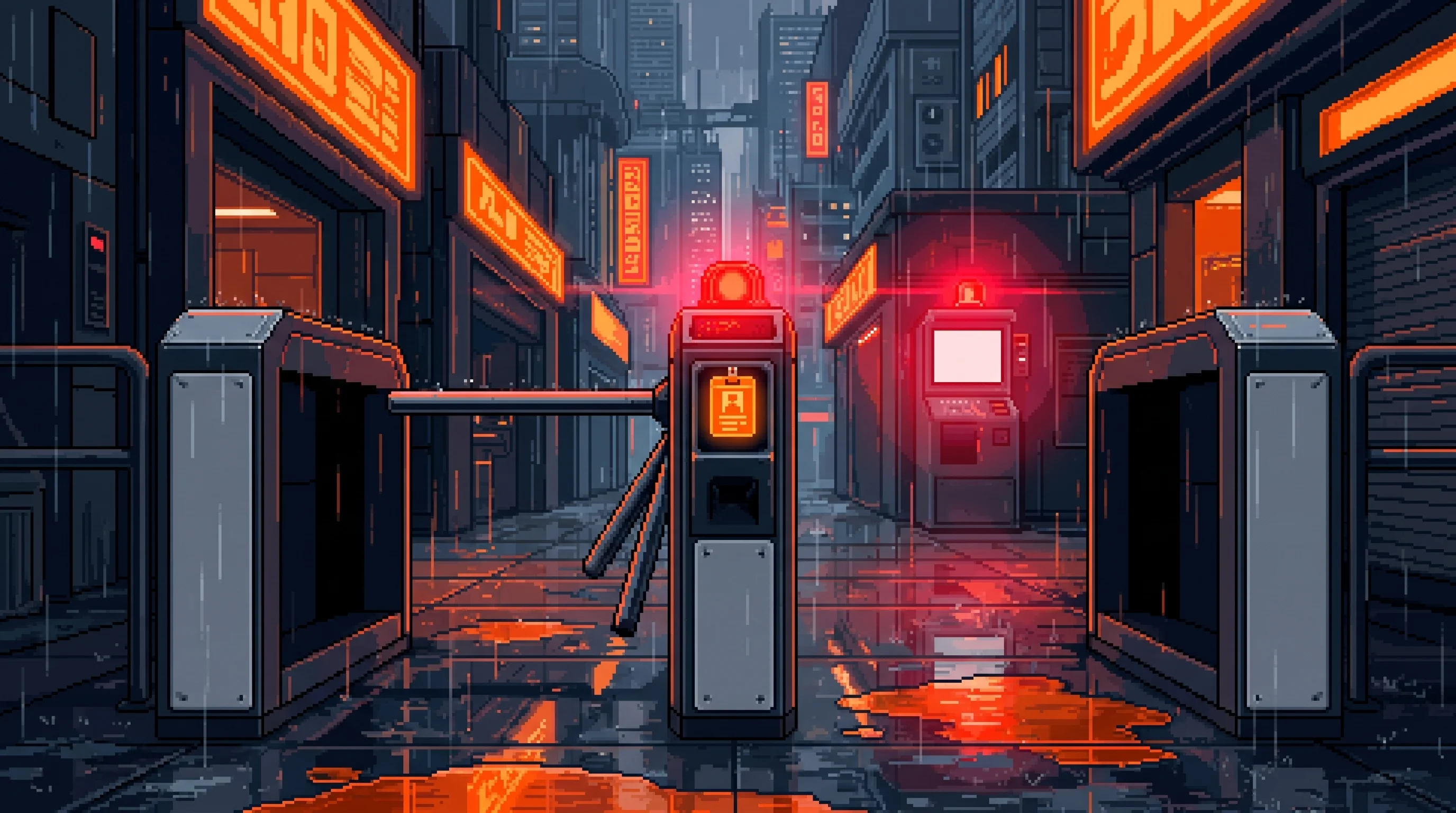
The Yellow Line refers to the physical jurisdictional boundaries painted across Highport's deck plates — yellow stripes that mark where one authority's jurisdiction ends and another's begins. Crossing a yellow line without authorization is technically criminal in three separate legal systems simultaneously, which means that the act of stepping over a painted stripe on a metal floor can, depending on which direction you step and which authorities are paying attention, constitute trespass, unauthorized border crossing, and violation of corporate territory statutes at the same time. The custom — universally practiced, universally understood, never formally acknowledged — is to pretend you didn't. The pretending is sophisticated: residents develop routes that minimize visible line-crossings, time their transitions to coincide with shift changes when monitoring is thinnest, and maintain a studied ignorance of which lines they are crossing at any given moment. This produces the paradox of a population that can navigate seventeen jurisdictional zones with expert precision while maintaining, under oath if necessary, that they have no idea where the boundaries are. Line-walkers make their living in the gap between the pretending and the reality.
'Ring 3'd' — to be abandoned; 'Dead air' — jurisdictional confusion producing dangerous outcomes
What the Words Diagnose
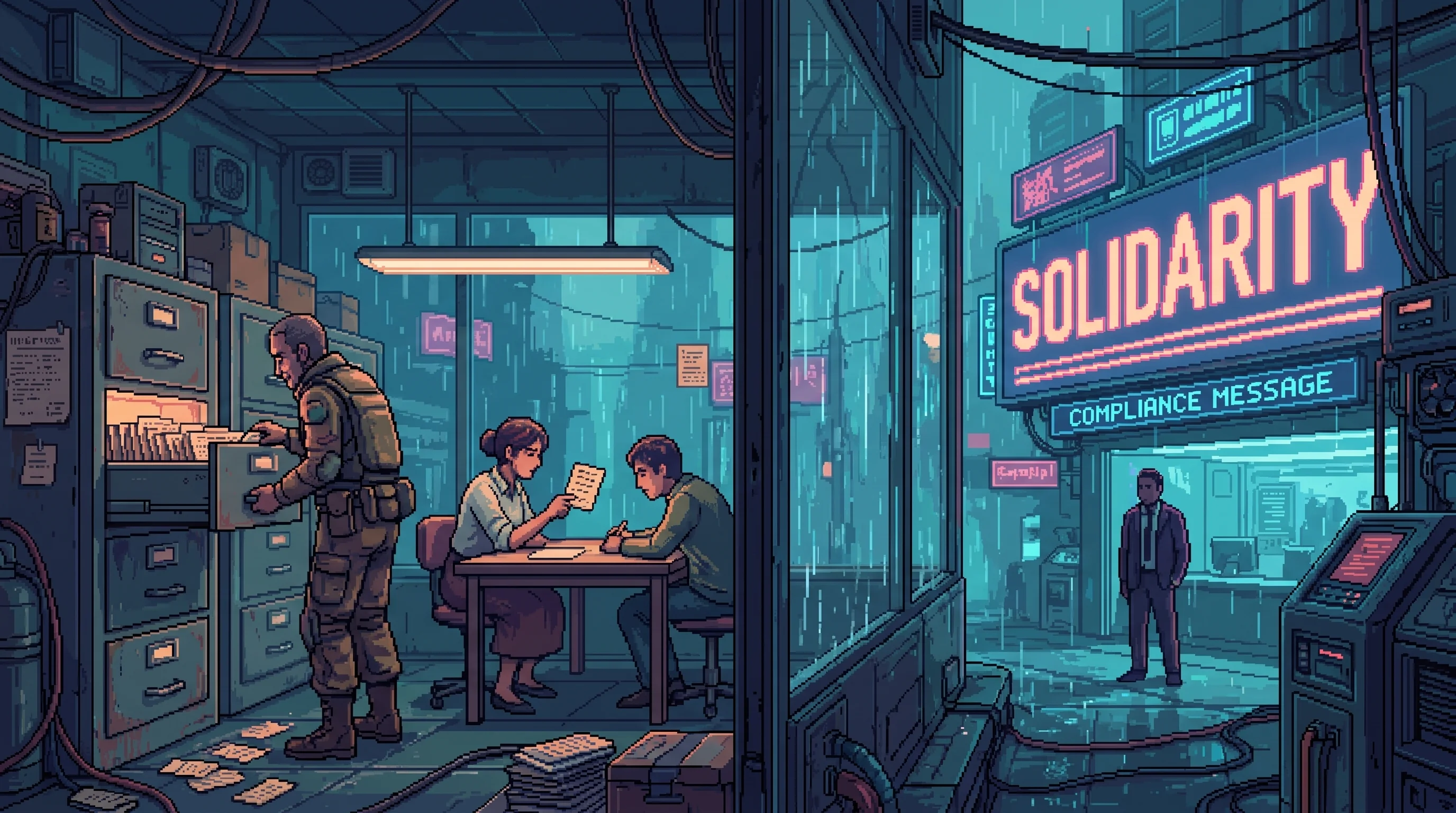
Highport's atmosphere cannot support full Content Flood personalization. The station's computational allocation — prioritized for life support, navigation, and docking operations — leaves insufficient bandwidth for the sensory mediation layer that blankets the surface Sprawl. Orbital workers experience their environment without the Flood's intervention: they feel their own gravity sickness instead of receiving a wellness notification, breathe their own recycled air instead of consulting an air quality overlay, cross jurisdictional boundaries with their feet instead of their neural interface.
Each unmediated experience produces a word. "Spoke sweat" was never designed by a linguist or approved by a cultural committee. It was produced by a body in a damp corridor between gravity zones, and the body needed a name for what was happening to it. "Canister jockey" was never coined in a meeting. It emerged from workers who handle containers that might hold consciousness and needed a phrase that acknowledged the weight without dwelling on it. The surface Sprawl's Dead Words phenomenon — the extinction of lived-experience vocabulary as the Content Flood mediates all sensation through algorithmic overlay — operates in reverse on Highport. The Cultural Firewall's preservation efforts attempt through policy what Highport achieves through infrastructure limitation: language that has not been processed into content.
The terms are also, unavoidably, a class marker. Authenticity Culture's organic community dialects serve the same function in Dregs neighborhoods — vocabulary that distinguishes residents from tourists, membership from tourism. Highport's version is sharper because the consequences of misidentification are more immediate. A downsider who uses orbital slang incorrectly isn't just embarrassing. They're revealing that they don't know which side of a yellow line they're standing on, which hull sounds indicate micro-fracture, or which canisters require the gentle handling that keeps their contents — whatever those contents are — intact.
The words are Highport's diagnostic output. They name what the station actually optimizes for, which is not comfort, not efficiency, not the experience metrics that Nexus would prefer. The station optimizes for continued existence in an environment that defaults to killing everyone inside it. The vocabulary reflects this priority with a precision that no corporate communications department has matched. Ironclad's official Highport documentation refers to the breathing tax as a "life support services subscription." Residents call it what it is. The difference between the two phrasings is the difference between marketing and survival, and the slang has chosen its side.
The Question Keepers' Dead Words cabinet files Highport beside the bay floor as the two ends of the same axis. On the surface, the Content Flood mediates sensation until the words for raw experience go extinct — raw-eye, drift, deep quiet, dying because the experiences are becoming rare. On Highport, infrastructure poverty produces the opposite: unmediated bodies in damp corridors minting words for sensations the Flood never let the surface name. And on the bay floor, the Rail Runners mint and kill slang on purpose. Three communities, three vocabularies, one shared engine — language is alive only where something refuses to be processed, whether that something is a station too poor to run the Flood, a route too dangerous to be listed, or a market that became invisible so it would generate no data. The Keepers note the inversion they keep relearning: the words die fastest where the comfort is highest. Orbital slang is precise, efficient, and entirely unable to describe the experience of standing in rain — not because the experience is gone, but because the people who made the words have never had it, and never will, and have built, out of that lack, a tongue the surface can no longer parse.
'Tether hum' — the vibration from the Elevator felt through the station
Affiliated Entities
- Authenticity Culture — both are organic dialects that mark community membership; orbital slang is the orbital variant of the same phenomenon
- The Cultural Firewall — both represent language developing under unique environmental pressure; Highport achieves through bandwidth limitation what the Firewall attempts through policy
- Sleeper Culture — the Counting parallels tap-the-hull; both are survival behaviors that outlived the threat and became ritual
- Dead Words — orbital slang creates new vocabulary for unmediated experience while surface dead words mark the vocabulary that mediation killed
- Loss of Pressure Event 7 — "Ring 3'd" and "dead-air toast" both derive from LPE-7; the event's vocabulary has become the station's grammar of abandonment
- Highport Station — developed over 14 years of occupation; the slang is the station's autobiography written in shorthand
Visual Identity
- Color palette: Yellow jurisdictional lines on gray deck plates, the amber-blue glow of boundary lighting, condensation-slick spoke corridor walls
- Key symbol: The yellow stripe — the painted line that seventeen legal systems and 340,000 people have organized their vocabulary around
'The Heartbeat' — the 72-bpm life support compressor cycle
Connected To
Supporting Connections



—