The Spoke District
Overview
Between the Ring's residential quarters and the Hub's zero-gravity docks, Highport Station's spoke corridors create a living environment that should not contain a permanent population and does anyway.
The gradient is simple physics: centrifugal force weakens as you move inward from the Ring toward the Hub. A hundred-meter walk takes you from standing on a floor to floating in a corridor. The Spoke District's approximately 8,000 permanent residents — dockworkers, cargo handlers, transition engineers, people whose jobs require moving between gravity states multiple times per shift — have colonized this gradient the way barnacles colonize a hull. Not because it's comfortable. Because it's where the work is, and the commute from the Ring costs forty minutes each way that nobody can afford.
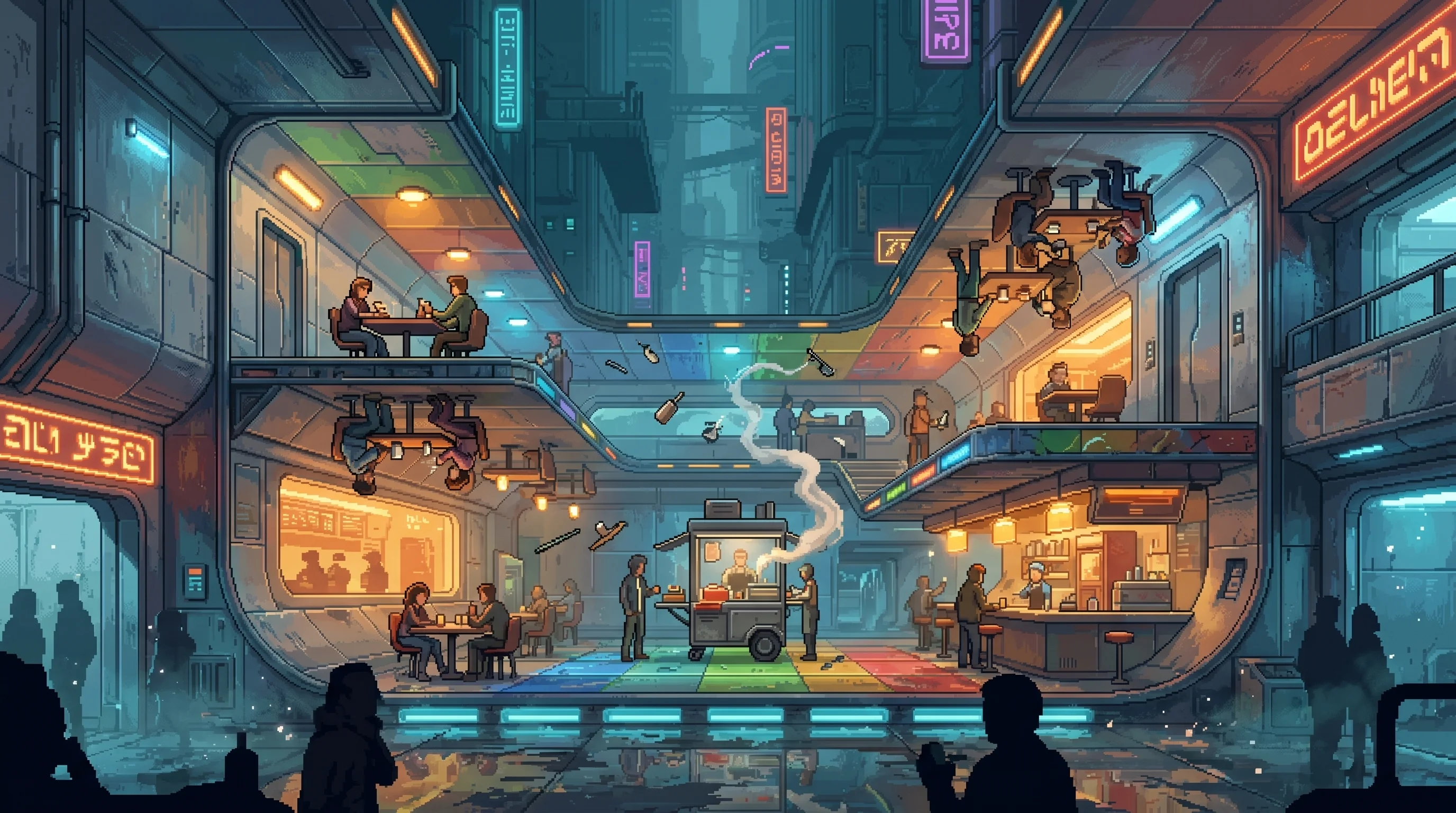
Architecture here is three-dimensional in a way surface construction never achieves and never attempts. Rooms orient in multiple directions. A cafe's ceiling is someone else's floor. Your neighbor's apartment is "above" you in one frame of reference and "below" in another. Building codes reference six directional surfaces per unit rather than four walls and a ceiling. The district's structural plans, when printed flat for Ironclad's orbital inspectors, are functionally unreadable. The inspectors have been filing "provisional compliance" reports for eleven consecutive years. Nobody has defined what the provision is.
Gravity zones are marked by deck plate color: blue for 0.7g, green for 0.4g, yellow for 0.2g, red for near-zero. The colors were chosen by a station designer in 2158 for intuitive wayfinding. They have since become identity markers, neighborhood boundaries, and the basis of a social hierarchy nobody will admit exists. Blue-zone Spokers — closest to the Ring, closest to normal — consider themselves the district's responsible adults. Red-zone residents consider blue-zoners tourists who happen to sleep here. Green and yellow maintain a studied neutrality that fools no one.

The Gradient
The smell is unique to the spokes: damp metal where condensation forms at temperature boundaries between zones, layered with cooking from a dozen cultures whose aromas carry further and less predictably in reduced gravity. A noodle cart at 0.4g produces a scent plume that reaches 0.2g residences three corridors away. Complaints about this have been filed with station management since 2161. The noodle cart has been operating since 2160. The filing system is one year younger than the problem it was designed to address.
Sound behaves differently too. The station's 72-bpm structural heartbeat — the flex cycle of Highport's spin — is louder in the spokes, where the architecture bends with each rotation. Footsteps change weight mid-corridor. Conversations that start at normal volume in blue territory become oddly resonant by green, as vocal cords calibrated for one gravity produce sound in another. Long-term Spokers develop a characteristic speech pattern: slightly louder than surface-normal, pitched to carry across zones. Surface visitors describe it as "aggressive." Spokers describe surface speech as "mumbling."
The specific sensation of weight changing as you walk — heavier near the Ring, lighter toward the Hub, your inner ear recalibrating every thirty meters — produces what Dr. Zara Santos has formally classified as "gradient nausea" and what Spokers call "your first week." The nausea passes. The adaptation that replaces it does not. Spoker children born in the gradient develop lighter bone density, altered vestibular processing, and a spatial awareness that surface-born humans find uncanny. They navigate three-dimensional space the way surface children navigate a playground. They also break bones at 2.3 times the surface rate when visiting the Ring, because their skeletons were optimized for a gravity that doesn't exist sixty meters in either direction.
Helix Biotech's orbital health division has published four studies on Spoker bone density. Each study recommends "transition to standard gravity residential zones." Each study has been distributed to the district's residents. The district's population has increased by 9% since the first study was published. Helix has not published a fifth study. The recommendations, and the population trend that ignores them, coexist in the same filing system without apparent discomfort.
| Architecture | Three-dimensional — rooms oriented in multiple directions |
|---|---|
| Gravity Colors | Blue (0.7g), Green (0.4g), Yellow (0.2g), Red (near-zero) |
The Spokers
The district's residents call themselves "Spokers" with the specific pride of people who have made a home somewhere nobody intended homes to exist.
Surface-dwellers find the Gradient unsettling — the constant reminder that "down" is a local variable, that the floor curves if you look far enough, that a dropped object in yellow zone takes four seconds to land. Spokers find the surface unsettling for the opposite reason: everything so heavy, so permanent, so stubbornly one-directional. Several long-term Spokers who relocated to the Ring for family reasons reported symptoms consistent with agoraphobia — not fear of open spaces, but fear of spaces that only open in one direction. Dr. Santos has treated six cases. The condition has no formal name. Santos calls it "gravity grief" in her clinic notes, which Helix's medical taxonomy board has declined to recognize as a diagnosis. Santos continues using it. The patients continue having it. The taxonomy board continues not recognizing it. Three separate systems, each functioning correctly, producing a population with an illness that officially does not exist.
The 67 names from Loss of Pressure Event 7 are inscribed on the common area wall at the district's central junction — the point where blue meets green, where 0.7g becomes 0.4g, where the dead are memorialized at the exact gravity where most of them lived. The names are arranged not alphabetically but by where each person was when the pressure dropped — their position in the gradient, recorded in the gravity-zone colors. Blue names. Green names. Yellow names. Two red. In the Spoke District, even the dead are mapped by gravity. The wall is the only surface in the district that everyone agrees is a wall. Flowers left at its base drift slightly upward over the course of a day, migrating toward the Hub. Someone collects them before they reach yellow zone. No one has been assigned this task. It has never been missed.

The Lower Approach
Where the District's spoke corridors descend toward the Hub-side cargo locks, the gravity gradient meets the station's mercantile underbelly — the dregs-level strip where orbital traffic, cheap berths, and gray-market commerce pool in the spaces the manifest doesn't account for. Spokers call it "the down-end" and mostly avoid it; the trade there is not in noodles and recycled LEDs.
It is here that Axiom Row took root — three blocks of conviction clinics close enough to orbital money to afford the equipment and far enough into the gray market that nobody files the paperwork. Most Spokers, raised to treat "down" as a local variable, find the Row's premise unremarkable: if the direction you stand is negotiable, why not the things you believe? Dr. Santos has declined to comment on the clinics, except once, in a margin note a patient saw and repeated: they sell people the thing my forty-seven children were born without the option to refuse. The District that produces humans whose bodies cannot choose another gravity sits one corridor above a strip that sells humans the ability to choose anything except, in the end, to choose it back.
Landmarks
The Ceiling Cafe is a green-zone establishment where seating extends across three surfaces — floor, wall, and ceiling, depending on your frame of reference. Patrons at one table look "up" at patrons at another. The menu is the same at every orientation. The coffee behaves differently at each. The cafe has become the District's unofficial symbol — proof that civilization does not require agreement on which way is down.
The Transition Corridor is a hundred-meter stretch that traverses the full gradient without branching, blue to red. It is used for acclimatization training, spoke-sickness rehabilitation, and by Spoker children racing each other from floor to float. Its walls are scuffed with handprints at every height and every angle — the marks of thousands of people learning to let go of the assumption that there is only one way to stand.
| Stratum | Orbital |
|---|---|
| Power Position | Insider |
| Access | Restricted |
| Atmosphere | Vibrant |
Santos Clinic
Dr. Zara Santos has operated the District's only medical clinic for twelve years. She has delivered 47 babies in variable gravity. She conducts the only longitudinal study of station-born human development in existence — unfunded, using borrowed equipment, on her own time, because nobody else is doing it and the children deserve documentation that isn't authored by a corporation interested in what their bones could do for soldiers.
Helix Biotech has offered to fund her research three times. Each offer came with a data-sharing clause that would give Helix's military applications division access to her developmental measurements. She declined three times. Her response to the third offer — two sentences on clinic stationery — circulates among Spoker parents as something between a prayer and a declaration of independence: "The children are from here. 'Here' is not a military asset."
Her 47 babies represent the first generation of humans whose biological baseline is not 1g. Their bones are lighter. Their cardiovascular systems adapt to variable load without the transition sickness that immobilizes surface-born visitors. Their vestibular processing — the inner-ear architecture that tells a body which way is down — has been calibrated by a childhood spent in a corridor where "down" changes every thirty meters. They navigate three-dimensional space the way surface children navigate a playground. They find the surface crushing.
Santos calls the condition "gravity grief" when long-term Spokers relocate to the Ring and develop symptoms consistent with agoraphobia — not fear of open spaces, but fear of spaces that only open in one direction. Helix's medical taxonomy board has declined to recognize the diagnosis. Santos continues using it. The patients continue having it. Three separate systems, each functioning correctly, producing a population with an illness that officially does not exist.
When station-born visitors travel to the Sprawl, disability claims run 3.2 times the baseline rate — not because anything is wrong with them, but because the forms have no category for "raised somewhere else." For nine years Santos has filed the same supplementary sentence with every claim: Patient is healthy. Patient is from here. The children call surface gravity "the crush"; the average station-born child lasts eleven hours at 1g before requesting return transport.
Her refusal to fund the research through Helix is a deliberate strategy, not just principle. Helix's internal terminology for the station-born is "naturally divergent populations," a phrase that has appeared in seventeen memoranda since 2179, each proposing a slightly different framework for bringing the group under genetic regulation — polite, thorough, and attached to projected revenue tables. The stakes are structural: if environment produces the same results as genetic engineering, Helix's pricing model for optimized physiology faces a competitor it can neither acquire nor shut down, and "natural-born" stops meaning anything stable enough to legislate around. Helix added a "naturally divergent populations" intake field in 2179 that auto-generates a genetic-screening referral, a monitoring schedule, and a quarterly fee structure. Santos's longitudinal data is the only thing that could populate it, so the field sits empty across all forty-seven files. Helix's liaison calls this "a data gap." Santos calls it "the point." She welded her records cabinet shut after the second offer; forty-seven children remain, technically, unsorted, and unsorted children cannot be reached by the sorting. The third offer — full medical citizenship and surface-acclimation therapy for all forty-seven in exchange for "research collaboration" — she declined in the meeting and has reread four times since, stored in a forty-eighth binder that is not color-coded.
What she has not told the parents: the seventeenth station-born child, now eight, has a resting heart rate of 34 bpm, confirmed three times on two scanners. If that is pure environmental adaptation, it redraws what orbital living can produce; if it isn't, it implicates the District's atmosphere processing, water supply, or something she hasn't yet identified. Compounding her exposure, at least two surface researchers have cited her name, her subject pool of forty-seven, and findings she has never published — meaning either someone is leaking her data or someone fabricated citations precise enough to pass peer review.

▲ Restricted
The Red Zone Communities. The near-zero zones at the Hub-adjacent spoke ends are officially listed as maintenance corridors. Unofficially, approximately 200 people live there permanently — a population that chose weightlessness entirely. They do not visit blue or green. They do not walk. Their bodies have adapted so completely to near-zero gravity that even the District's gentle gradient causes discomfort. They are the furthest edge of what the Gradient produces, and they want nothing to do with the surface's definition of normal.
Flatlock is getting worse. Each generation of Spoker children reports more severe symptoms when visiting constant-gravity environments — the Spokers call it "flatlock." The first generation tolerated Ring gravity with minor discomfort. The second reports nausea and anxiety after hours of exposure. If the trend holds, the third generation may be physically unable to function in environments the rest of humanity considers baseline — the District would then be producing a population that can only exist in the conditions that made them. This is not currently in any official report. Santos knows. She has not published it. She is deciding what publishing it would do to children who are still young enough to be used as evidence in someone else's argument.
Divergence Without Design
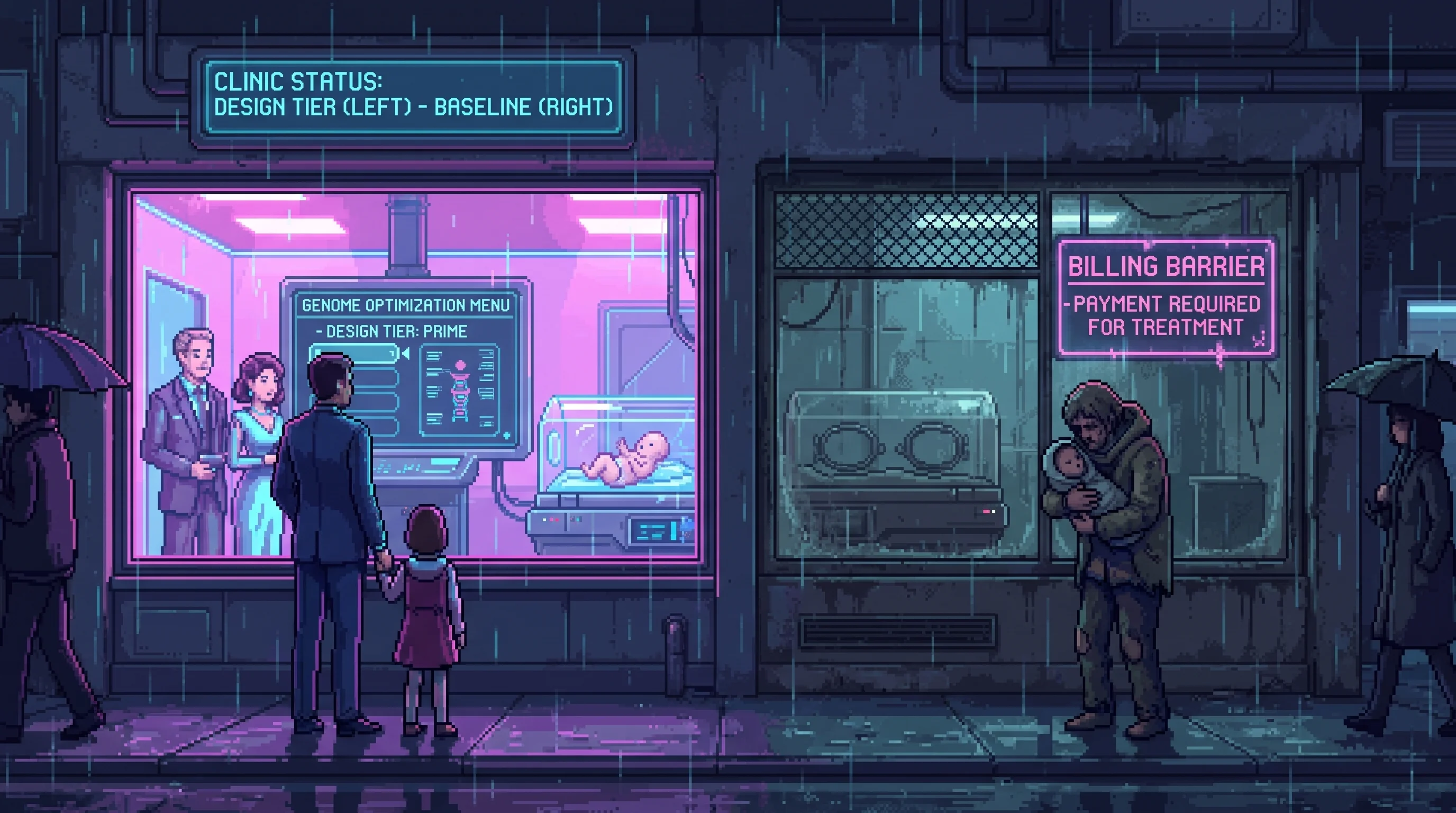
There is a version of the Genome Divide that nobody bought. Helix sells optimization on a price list — Elevation at ¢180,000, Transcendence negotiated up to ¢2.4 million — and, three generations on, produces a thin stratum that crosses the Crossing — the threshold where the deepest-optimized cognition stops compressing across the gap to the rest of the species. The Spoke District charges nothing, optimizes nothing, chooses nothing, and produces, through geography alone, a population diverging from the human baseline along an axis no one priced. The crossed diverge in cognition. The station-born diverge in body. The shape is identical: irreversible, compounding, one-directional, generation over generation, toward a state the parent generation cannot inhabit — producing children who can only live where the rest of humanity cannot.
This is what makes the District the Crossing's most important counter-melody, and the reason Dr. Afia Mensah would recognize Santos on sight though they have never met. Both keep a document they will not publish about children crossing a threshold. Mensah's lives in an analog drawer; Santos's records cabinet is welded shut. Both know that publishing the threshold turns a child into evidence in someone else's argument. Both file the same protective sentence in different vocabularies — Mensah names the condition and refuses to certify it; Santos writes Patient is healthy. Patient is from here. The horizon Mensah measures in cognition, Santos measures in resting heart rate: the seventeenth station-born child, now eight, at 34 bpm, confirmed three times, withheld from the parents because she does not yet know whether it means the District is producing a new kind of human or merely a sick one — which is the exact uncertainty the parents of the crossed carry into Mensah's office, transposed from neuron to heartbeat.
And so the Spokers are a Remainder Generation of their own. Not the un-crossed left behind by gene-edited children — the inverse, a population already on the far side of a physical horizon, who cannot go home to 1g, archiving in their own welded-shut files a baseline body none of them has. Santos's welded cabinet is the same gesture as keeping the napkins: caring for and protecting something the sorting systems cannot reach, because unsorted children cannot be reached by the sorting. From here is the operative word for the entire terminal generation — the crossed, the dreamless, the station-born are all from somewhere the rest of us are not, and the kindest and cruelest thing you can say about any of them is that they are healthy, and they are from there, and there is not a place we can follow.
Gravity zones marked by color: blue (0.7g), green (0.4g), yellow (0.2g), red (near-zero)
Affiliated Entities
- Highport Station contains the District within its spoke corridors — the Gradient exists because the station spins, and the station was never designed to house people in the spaces between rotation speeds
- Loss of Pressure Event 7 killed 67 people whose names are on the common area wall — the only fixed point in a district where direction is negotiable
- The Undervolt shares the aesthetic of infrastructure-as-habitat — the Grid created the Undervolt, the station's rotation created the Gradient, and both populations made homes in spaces their architects considered transitional
Visual Identity
- Color palette: Blue-green-yellow-red gradient of deck plates; warm amber residential lighting; dark void visible through structural windows
- Compositional mood: Three-dimensional habitation — up and down negotiable, six-surface architecture
- Key symbol: A cafe where the ceiling is someone else's floor
- Lighting: Warm residential amber at every angle; cold blue of Hub-adjacent zero-g zones; condensation catching light at temperature boundaries
Architecture is three-dimensional — a cafe's ceiling is someone else's floor
Dr. Zara Santos has delivered 47 babies in variable gravity and runs the only longitudinal study of station-born human development — unfunded, using borrowed equipment
Station-born children have lighter bones, more adaptable cardiovascular systems, and fundamentally different vestibular processing — the surface feels crushing to them
Conditions Report
Sight
Color-coded deck plates transitioning blue to green to yellow to red; rooms at impossible angles; people walking on surfaces that are walls from where you're standing
Sound
The station's 72-bpm heartbeat, louder where the structure flexes; footsteps that change weight mid-corridor; Spoker voices pitched to carry across gravity zones
Smell
Damp metal at condensation boundaries; noodle cart at 0.4g detectable three corridors away at 0.2g; cooking aromas that ignore zoning
Feel
Weight changing as you walk — thirty-meter recalibration cycles; the specific wrongness of picking up a familiar object at unfamiliar gravity
Connected To
Major Connections
The same irreversible, compounding split — but written in bone instead of capital, and nobody paid for it.
The point at which effort stopped being able to close the gap that compounding opens.

A new axis, 'from here': the station-born draw 3.2x disability claims because no form has a category for their bodies.
Technology never eliminates prejudice — it finds it better housing.
Supporting Connections
Someone always collects the drifting memorial flowers, unassigned.
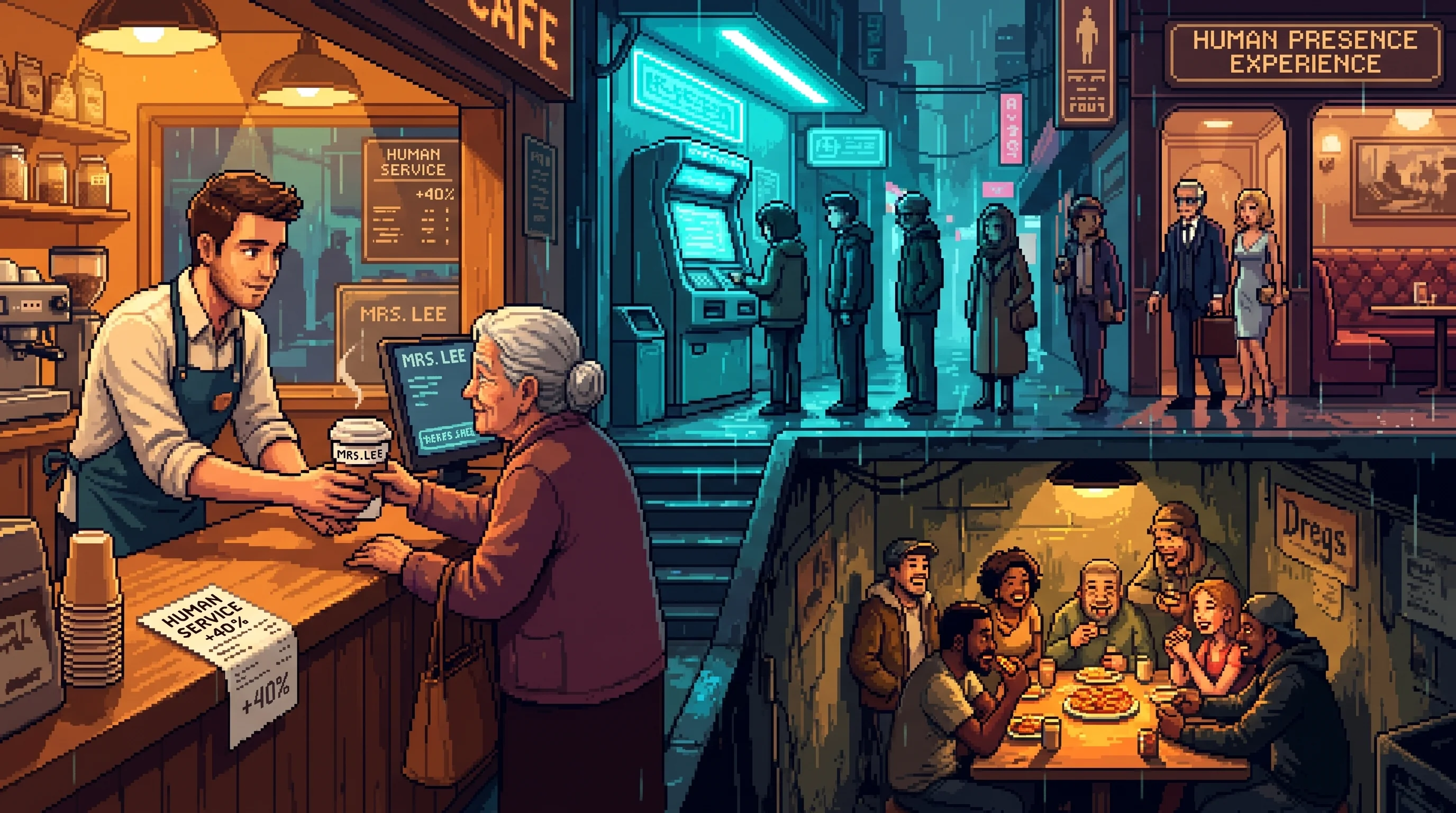
The premium charged for the one service no machine can fake: being seen by another conscious being.
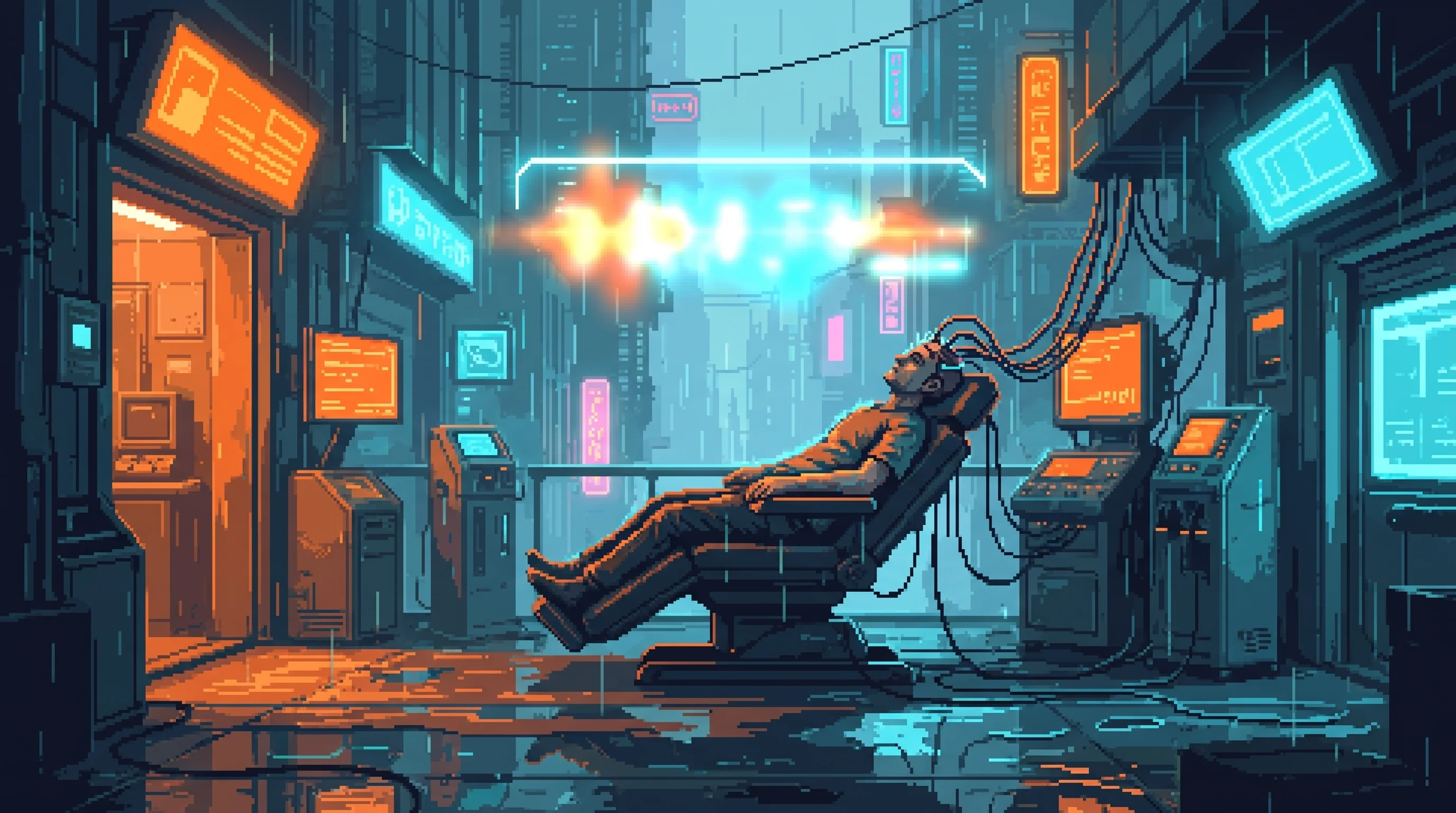
No instrument has a category for the minds and bodies raised here.
The last human smarter than any machine was born in the 2020s; the question now is what intelligence is actually for.
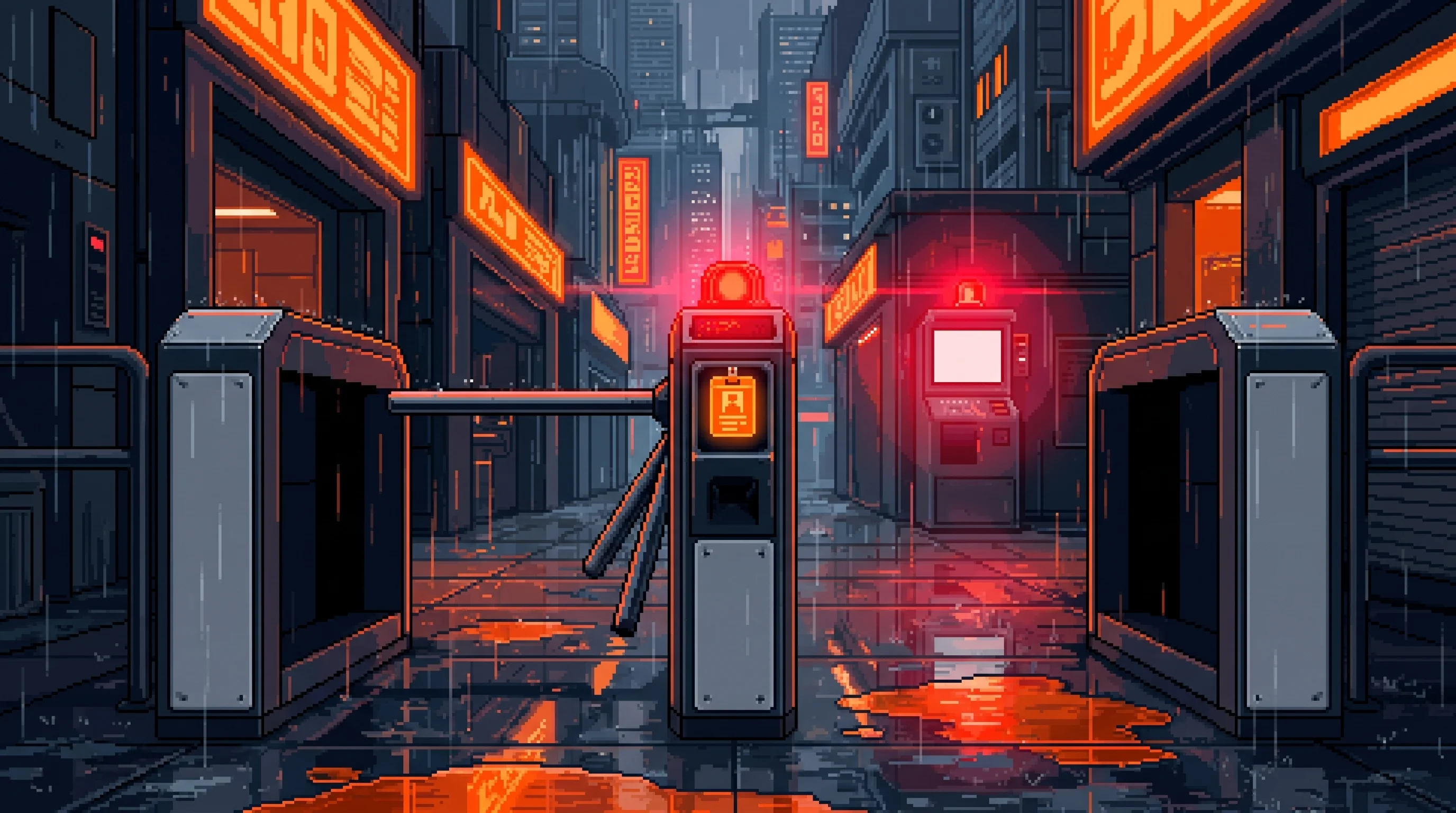
Santos welds the files shut to keep the station-born off the ledger.
When your employer is your country, quitting is emigration.
Additional Connections





—