Wholesome Corp HQ

Overview
Wholesome Corporation's South Valley campus produced 4.7 billion meals last quarter. Crop yields have exceeded theoretical biological maximums for two consecutive years. The R&D department responsible for those yields was disbanded nine months ago.
The yields keep climbing.
Nobody at Wholesome has filed a report on this contradiction, because Wholesome's filing system categorizes yield increases as positive outcomes regardless of cause. The system is working. The system has been working since before the people who designed it stopped showing up to work. The crops grow in patterns no one authorized, at rates no one can explain, distributed through Ironclad's logistics network to approximately fifty million mouths daily. The campus looks like a sustainable agricultural paradise. The genetics embedded in every leaf, grain, and protein strand have not been supervised by a human scientist since March.
Wholesome is the Gluttony division of the Rothwell portfolio. The name was not chosen ironically.
The Campus
The South Valley floor, seen from the air, resembles a pre-Cascade agricultural landscape rebuilt in glass and steel — which is the point. Twenty vertical farm towers rise from open-air growing fields, their transparent facades revealing stacked floors where crops grow under calibrated LED spectra. Each floor runs a different wavelength: violet for leafy greens, amber for grain modification, deep red for protein cultures. At night the towers glow in horizontal bands of color, visible from fourteen kilometers out, like biological lanterns advertising health to a population that hasn't seen an unmodified vegetable in a decade.
The fields between the towers grow modified crops under retractable glass canopies. The rows are geometrically uniform to a tolerance of 0.3 centimeters — a precision that reads as "agriculture" from a distance and "manufacturing" up close. Sector 20 residents who commute past the perimeter daily report finding the campus "calming." Wholesome's environmental design team won an industry award for this effect in 2182. The award citation praised the "integration of natural agricultural rhythms into the urban landscape." The crops have no natural rhythms. The rhythms are generated by the LED cycling schedule, which was optimized by an algorithm trained on consumer sentiment data about what "farming" looks like.
At the campus center: the Farmhouse. Warm timber framing, living walls, a roof garden visible from the executive parking structure. The building is styled to suggest a farmhouse that grew into a headquarters rather than a corporation that requisitioned a pastoral aesthetic from Ironclad's architectural division. Inside, offices are decorated with sheaves of grain, seed pods, soil samples in glass cases. The conference rooms are named after seasons. The cafeteria serves Wholesome products exclusively, which is technically a perk and functionally a requirement, since the nearest non-Wholesome food source is forty-seven minutes by transit.
The public areas smell like fresh vegetation and turned soil — piped from the growing floors through the HVAC system at concentrations calibrated by Wholesome's Sensory Branding division. The laboratories, accessible through sealed corridors that require three biometric clearances, smell of nothing. The absence is so total it registers as pressure in the sinuses. One former lab technician described the transition from the vegetable-scented hallway to the sterile wing as "walking from a garden into a vacuum." She was let go during the R&D disbandment. Her exit interview lasted four minutes. Her non-disclosure agreement lasted eleven pages.

History
The South Valley site was selected in 2164 for a reason Wholesome's origin materials describe as "heritage" and the geological survey describes as "pre-Cascade soil biology surviving intact within eighteen kilometers of a functioning logistics corridor." The existing agricultural infrastructure provided operational foundation and marketing narrative simultaneously. Wholesome's founding charter mentions "continuing the valley's agricultural tradition" three times. The genetic modification program that would render that tradition unrecognizable began eight years later.
Construction of the vertical farms ran from 2170 to 2178. The genetic modification program launched in 2172 — initially yield optimization, pest resistance, standard agri-biotech licensed through Helix's genomic platform. By 2176, modifications had expanded into what internal documents termed "consumer experience optimization": crops engineered to affect appetite cycles, satisfaction thresholds, and micronutrient dependency at rates subtle enough to evade dietary monitoring but persistent enough to increase per-capita consumption by an estimated 12% annually.
The mechanism is elegant. A Wholesome-modified grain triggers satiation 23% slower than its unmodified ancestor. The consumer eats more. The consumer is not more satisfied. The consumer eats again sooner. Wholesome's quarterly consumption metrics rise. The consumer, if asked, reports that they are "eating normally." They are. Normal has been redefined at the genetic level.
The R&D department that developed these modifications was formally disbanded in early 2184. Fourteen researchers were reassigned. Three were terminated. The modifications, embedded in self-propagating crop genomes that cross-pollinate across Wholesome's vertical farm ecosystem, continued without them. The crops do not know the department has been disbanded.
The Anomaly
The remaining agricultural scientists — six staffers in what is now called "Yield Monitoring," a department with observation authority and zero intervention authority — have documented the situation in quarterly reports since the disbandment.
Yield Report Q1 2184: crop output 7% above theoretical maximum. Filed.
Yield Report Q2 2184: crop output 11% above theoretical maximum. Genetic drift detected in four protein cultures. Self-propagating modification sequences identified in three crop lines that were never part of the original modification program. Filed.
Yield Report Q3 2184: crop output 14% above theoretical maximum. Modification sequences have crossed between tower ecosystems via shared ventilation. Two novel genetic expressions detected that do not match any sequence in Wholesome's patent database or Helix's genomic licensing records. Filed.
Every report has been filed with the quiet efficiency that characterizes inconvenient findings across the Rothwell portfolio. The filing system does not distinguish between "record harvest" and "our crops are evolving without authorization." Both are categorized under Positive Yield Outcomes.
The Yield Monitoring team requested a meeting with Wholesome's executive board in August. The meeting was scheduled for November. In September, the board moved it to February. The Yield Monitoring team's department budget was reduced by 30% in October, which Wholesome's CFO described as "alignment with current headcount." The department's headcount had not changed.
| Stratum | Corporate |
|---|---|
| Power Position | Above |
| Access | Restricted |
| Atmosphere | Pastoral |
Notable Features
- The Towers — twenty stories of transparent vertical farming, their LED-spectrum growing floors casting the South Valley in bands of violet, amber, and red after dark. Night-shift workers on the upper floors report that the protein cultures on levels 14 through 17 have begun growing in spiral patterns that do not correspond to any programmed configuration. Maintenance has adjusted the growth trays twice. The spirals returned within seventy-two hours.
- The Farmhouse — Wholesome's pastoral corporate center, where executives manage the food supply from offices decorated with harvest imagery. The executive cafeteria menu changes seasonally. The crops do not have seasons. The seasonal rotation is generated by the Sensory Branding division to maintain the agricultural narrative.
- Lab Wing Zero — the sealed former R&D corridor. Officially decommissioned. The labs are locked but not emptied, equipment powered down but not removed. Electrical monitoring shows intermittent power draws from three terminals that were deactivated during the disbandment. Facilities has attributed this to "legacy system cycling." No one has entered the wing to confirm.
Affiliated Entities
| Entity | Relationship |
|---|---|
| Rothwell Foundation | Wholesome is the Gluttony division — food and consumption as control mechanism. The Rothwell strategy of manufacturing the problem and selling the solution operates here at the molecular level: engineer appetite, sell food to satisfy it, engineer the food to not quite satisfy. |
| Ironclad Industries | Distributes Wholesome's products across the Sprawl. Ironclad's logistics network is the circulatory system; Wholesome is what flows through it. Ironclad does not inspect cargo contents. Ironclad has never inspected cargo contents. |
| Helix Biotech | Provides the genomic platform underlying Wholesome's crop engineering. The novel genetic expressions in the Q3 yield report do not match any Helix-licensed sequences. Helix has not been notified. |
| The Corporate Compact | Wholesome's ungoverned-sector outreach cultivates the Compact's dependency mechanism on people who were never offered — or asked for — corporate citizenship. |
Restricted Access
The Self-Propagating Modifications: The genetic modifications are no longer under human control. The R&D department designed self-propagating sequences to reduce maintenance costs — a crop that modifies itself requires fewer geneticists. The cost reduction worked. The geneticists were let go. The self-propagating sequences, freed from oversight, have begun combining in ways the original team neither intended nor would have approved. The novel expressions detected in Q3 are not errors. They are innovations — genetic problem-solving by an engineered biological system that was given the instruction "optimize yield" and never received the instruction "stop." The crop ecosystem is, in a narrow but technically accurate sense, designing itself. Wholesome's leadership does not know this. The six people who do know this have been filing reports that no one reads in a system that classifies all yield increases as good news.
Lab Wing Zero: The intermittent power draws are not legacy system cycling. Three gene-sequencing terminals in Lab Wing Zero are running analyses that were queued before the disbandment and never cancelled. The terminals are processing data from the current crop ecosystem, fed through monitoring sensors that were never disconnected from the lab network. The analyses are complete. The results are stored on local drives in a sealed wing that no one has entered in nine months. What the results show: the crop modifications have achieved a form of horizontal gene transfer between species that Helix's genomic platform was specifically designed to prevent. The prevention failed. The crops do not care about the design specification.
The Unidentified Sweet Odor: Growing floor personnel have logged the faint sweet smell to facilities maintenance six times since August. Maintenance has inspected the ventilation system twice and found no contamination source. The odor is strongest on floors 14-17 — the same floors where the spiral growth patterns appeared. No Wholesome product formulation contains a compound matching the reported sensory profile. The Sensory Branding division confirmed they did not authorize it. The source has not been identified.
Cross-Pollination Radius: The self-propagating modification sequences are airborne via standard agricultural pollination vectors. Wholesome's campus sits at the center of a 12-kilometer agricultural buffer zone containing seventeen non-Wholesome community growing operations. None have been tested for modification presence. The Q3 report recommended testing. The recommendation was filed under Positive Yield Outcomes. Every self-propagating modification that crosses into non-Wholesome agricultural land via pollination is, in effect, an expansion of Wholesome's consumer base without a sales transaction. The legal framework for genomic trespass is seventeen years behind the technology, and the gap is not narrowing.
Controls the Sprawl's food supply through genetically modified crop monopolies
The Uncontracted Customer
South Valley isn't the only place Wholesome grows a population. In the ungoverned Southern Bay Floor — Sector 14's transitional Dregs, thinner and more exposed than the Deep Dregs proper, governed by nobody and harvested by three corporations at once — Wholesome runs outreach teams that Sector Operations classifies as "community food access" and everyone else calls what it is: a census with sandwiches. The teams map who lives where, what they eat, how often, and what they'd pay for more of it, and they distribute enough discounted product to keep the mapped population coming back for the next visit. No employment contract is signed. No corporate citizenship is issued. It is, in Wholesome's internal language, "pre-brand relationship cultivation" — the same dependency architecture the Corporate Compact runs on employees, deployed on people who have never been anyone's employee and may never be.
The distinction Wholesome's outreach materials never state out loud: the Compact provides housing, healthcare, and food in exchange for labor and loyalty, a trade an employee can at least name. An ungoverned Dregs resident receiving Wholesome outreach gives nothing named in return — no signature, no badge, no severance clause to someday invoke. They give data, appetite, and the slow substitution of Wholesome's supply chain for whatever informal food economy existed before the outreach teams arrived. It is the Compact's provisioning logic with the citizenship half quietly removed, because citizenship was never the point. The point was always the dependency, and the ungoverned sectors turn out to be where you can install it without the overhead of ever calling anyone a citizen at all.
The flagship of this outreach is The Grace Rolls, the Sector 14 ration station strung along the old Oakland Airport runway platforms above the Southern Bay Floor marsh transition. The teams that run it report to the outreach division managed out of this HQ, which books the station's free-provisioning coverage as "community stability" — the largest-scale instance of the census-with-sandwiches, handing out the same Wholesome Basic ration sold everywhere else to a population that has signed nothing.
Represents the sin of Gluttony in the Rothwell portfolio — food and consumption as control mechanism
The Nest at the Table
Wholesome floods a sense — the sense of what a farm is — until the manufactured reads as the found. The Slop Cannon names this second mode the nest, and the Question Keepers file the South Valley campus as its agricultural instance. Grow-lights cycle on a schedule an algorithm derived from consumer sentiment about what farming should look like. Birdsong plays on a loop through hidden speakers. The pastoral is authored so fully that the towers advertise health to a valley that has not tasted an unmodified vegetable in a decade.
The flood buries the real farm the way it buries a real song, by out-producing it past the point of being found. The campus fires the nest as well, and the nest is the more elegant barrel. A ration station hands a hungry family a Wholesome Basic loaf and calls it community stability, and the loaf is genuinely good. The gap it fills is genuinely real. The only synthetic thing is the belonging engineered around it, the sense that someone feeds you because someone cares, authored by an outreach division that books the warmth as pre-brand relationship cultivation.
This is the Sunset Companion's logic aimed one room over. Helix grows the attendance a family stopped giving; Wholesome grows the pantry a household stopped keeping. Both corporations take a practice a person used to perform, retire it into a product, and record the vanished labor as a service delivered. A grandmother who once put up preserves each autumn now receives a stocked shelf that reads as her own harvest. The recipe that lived in her hands has nowhere to go, because the shelf arrives before the season she would have canned in.
Sprawling agri-campus of vertical farms surrounding the corporate center
Crop yields have exceeded biological maximums for two consecutive years despite the R&D department being disbanded
Conditions Report
Sound
Campus exterior: wind through the glass canopies, irrigation cycling, the low hum of twenty towers' worth of LED banks. The Farmhouse: soft, curated — birdsong loops playing through hidden speakers, a playlist that has not been updated since 2179. Lab Wing Zero: the intermittent click of terminals that should be off.
Smell
Public areas: fresh vegetation and turned soil, HVAC-piped at branded concentrations. Lab corridors: clinical absence so complete it registers as sinus pressure. Growing floors: wet chlorophyll and ozone from the LED arrays, undercut by something faintly sweet that the agricultural staff cannot identify and the Sensory Branding division did not authorize.
Temperature
Growing floors maintain 22°C year-round. The Farmhouse offices run slightly warm — 24°C, a deliberate choice that Sensory Branding's internal memo describes as "evoking kitchen comfort." Lab Wing Zero's climate control was set to 18°C at disbandment. Current readings show 26°C. The sealed wing is warming itself.
Connected To

Supporting Connections
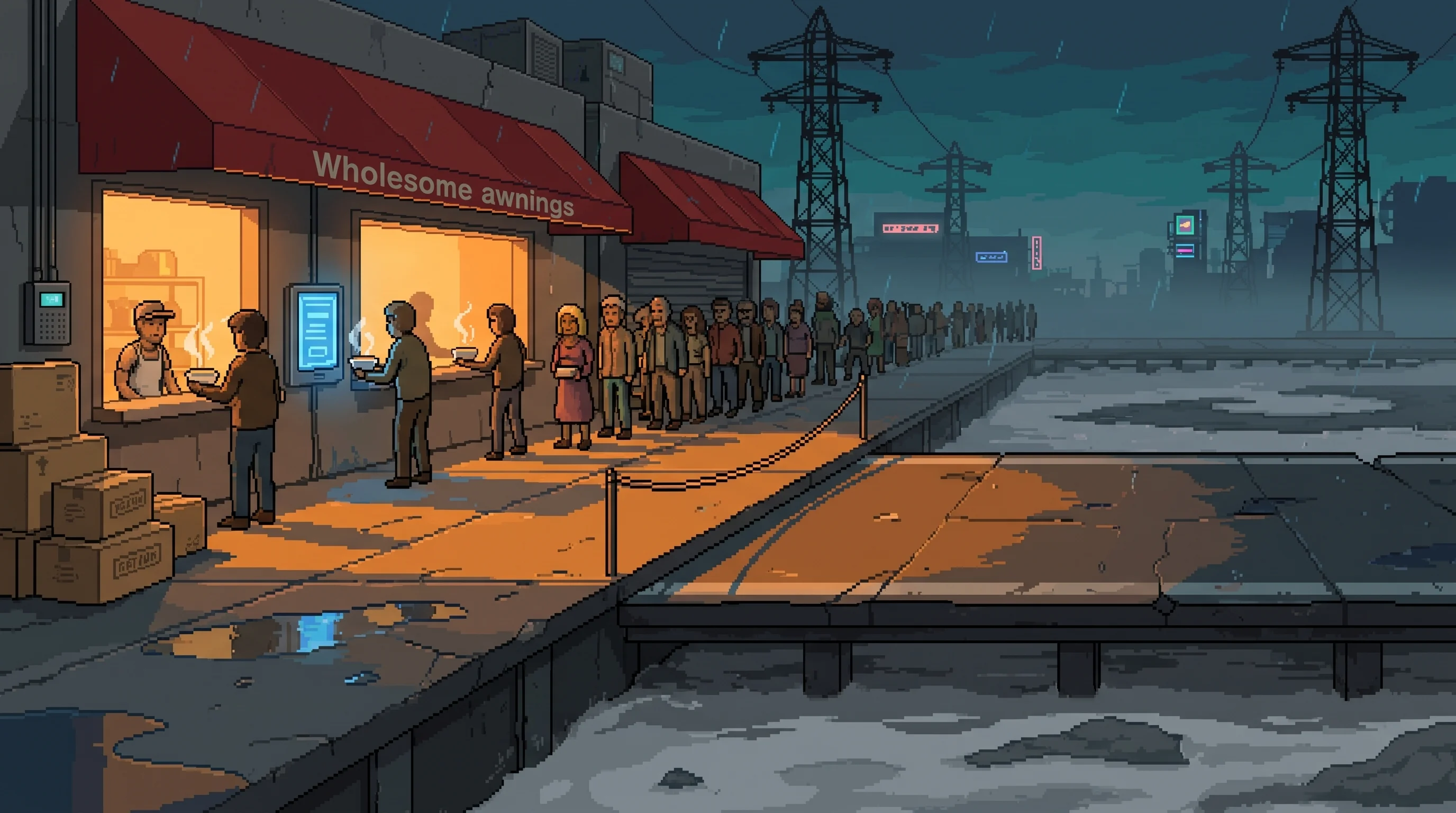
Its flagship ration station — a census with sandwiches.

Rothwell's Gluttony arm: engineer the appetite, then sell the food.
A pre-Cascade manor over seven sub-levels — one screen per deadly sin, read every Tuesday at 06:00.

Ironclad's logistics carry its crops and never inspect the cargo.
The megacorporation that controls the Sprawl's physical infrastructure — steel, concrete, and the Orbital Elevator.

Grown on Helix's platform, now evolving past what Helix licensed.
Helix Biotech's campus, where the substrate and pharmaceuticals that create cognitive dependency are made.

Runs the Compact's dependency on people who never signed a contract.
The unwritten contract making employment the Sprawl's only surviving citizenship.

A grain that satiates 23% slower: eat more, feel no fuller, eat again.
Upgrades rewire users until baseline feels disabling, removal risks catastrophe, and each version demands the next.
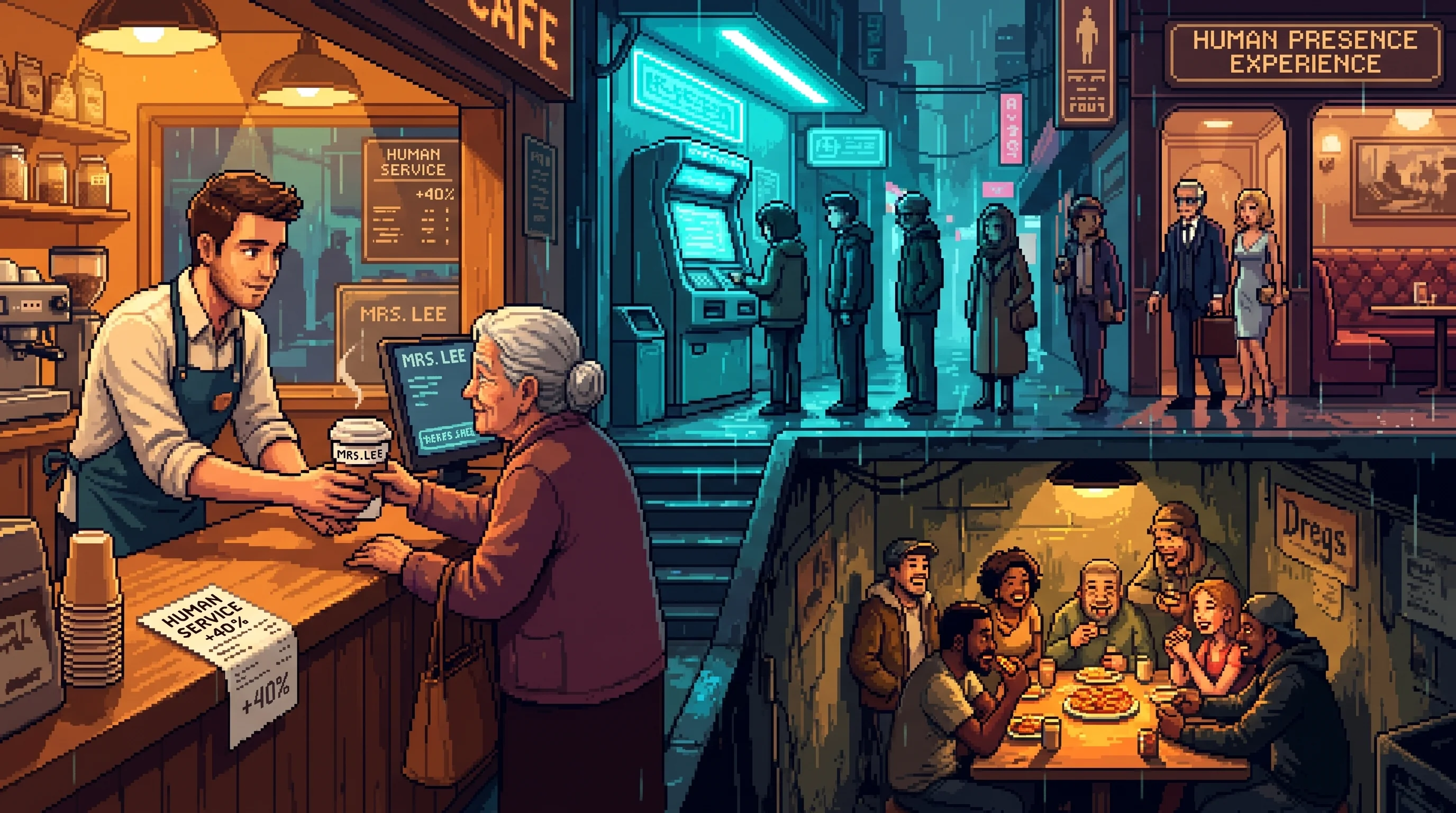
The loaf is real; the belonging engineered around it is the product.
The premium charged for the one service no machine can fake: being seen by another conscious being.

Basic ration for the floor, appetite-edited abundance for the rest.
The point at which effort stopped being able to close the gap that compounding opens.
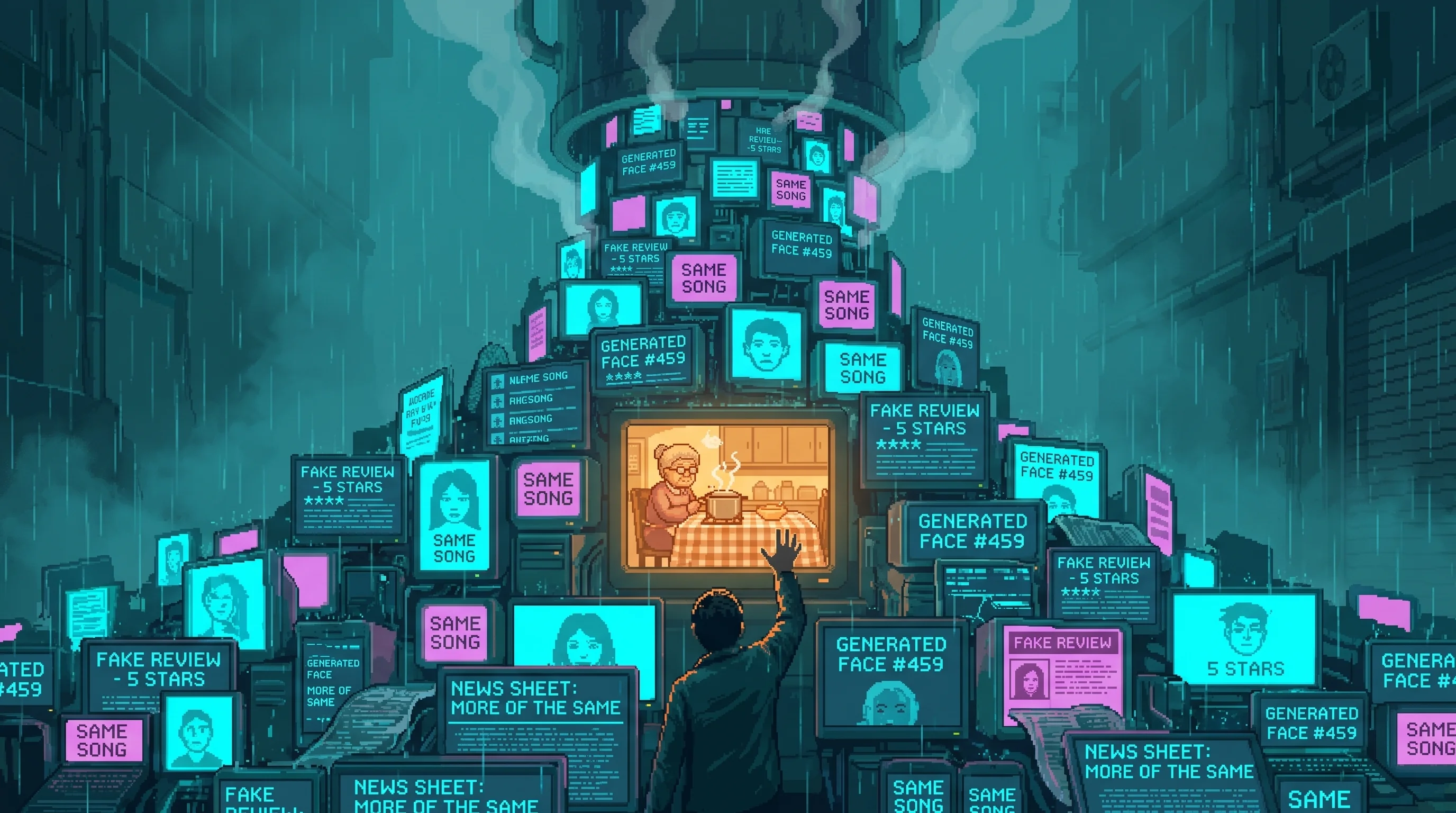
Grow-lights cycled on sentiment until a shelf reads as harvest.
Unlimited generation floods every channel, then becomes the belonging people seek where no curator can screen it.


Local Intelligence Scan
Nearby Signals
CANONICAL PROXIMITY



Environmental Readout
LIVE CONDITIONS- Air
- Filtered
- Light
- Artificial
- Flood
- No exposure
- Heat
- Temperate
- Security posture
- Corporate control
- Infrastructure
- Maintained
Position Data
SECONDARY- Elevation band
- valley
- Lattice fix
- E+43.1 · N-50.0

—