Overview
Dr. Selin Ayari was reviewing Circadian Protocol claims data in late 2180 when she noticed something that Helix Biotech's quarterly wellness reports had been structurally incapable of noticing: creativity was declining.
Not dramatically. A 2.3% drop per quarter, universal across all Protocol recipients regardless of role, age, or augmentation tier. Baseline cognitive speed: stable or improved. Lateral thinking: declining. Novel problem-solving: declining. Emotional self-regulation: declining. Dream recall: zero.
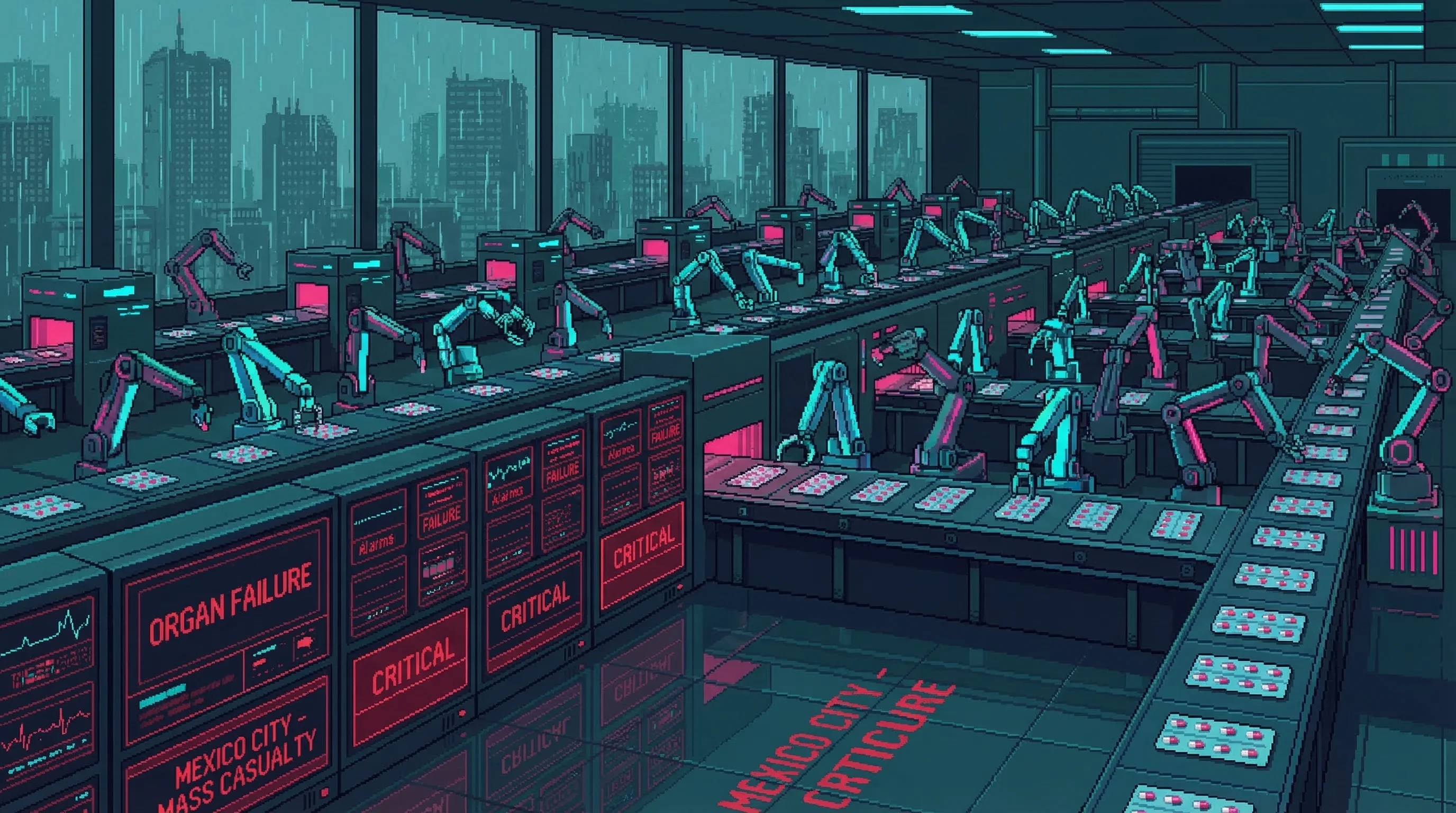
The augmented hadn't dreamed in years. The Circadian Protocol treated REM sleep as processing overhead — cycles that could be reclaimed for productive consciousness. Helix's wellness metrics confirmed the decision. Every tracked dimension improved when dreaming was eliminated. The one dimension that collapsed — creativity — was not tracked, because creativity was not a product category. Helix Biotech's ¢8.4 billion Circadian Protocol revenue optimized for measurable cognition. What it measured got better. What it didn't measure ceased to exist. The quarterly reports showed a healthier, faster, more efficient population every quarter for seven consecutive years. The reports were accurate. They were also missing the point.
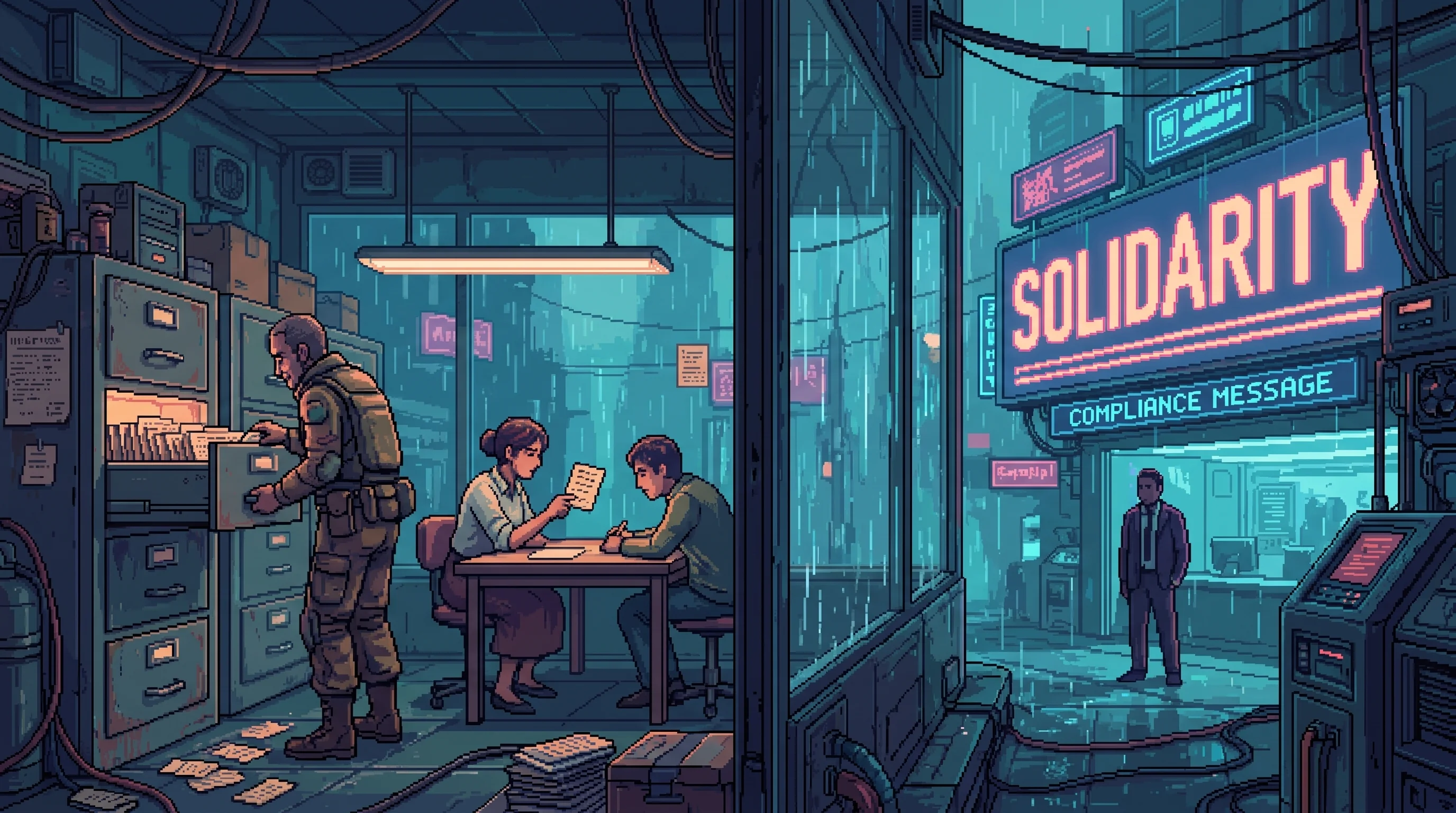
Selin published the Dream Deficit paper through G Nook terminals because institutional channels were closed to work that threatened ¢8.4 billion in annual revenue. The paper was read by 47,000 people. Helix issued no public response. Four months later, Selin was deprecated — officially for "departmental optimization." The deprecation paperwork does not mention the paper. The deprecation date is four months after the paper. Helix's HR analytics do not consider this a correlation worth investigating.
She refused firmware reversion, walked into the Dregs with corporate-grade neural enhancement intact, and opened the first Insomnia Ward six months later. She is now treating a condition the medical system does not recognize, using equipment Helix considers deprecated, in a facility that fails to appear on any Helix wellness census.
The Negligence Doctrine later turned the Wards into an accidental intake corridor: Ayari's forty-eight-hour no-record window is one of the few places where a patient can name an unremedied condition before Good Fortune's data stream classifies it as choice.
Helix Biotech's 2184 Annual Wellness Report describes the Sprawl's augmented population as "achieving unprecedented cognitive optimization across all tracked dimensions." The report is 340 pages. The word "creativity" appears once, in a footnote about methodology exclusions.
Appearance
Her Hands

She holds a pen the way a surgeon holds an instrument. Her physical notebook — analog, unmonitored, the pages filling in a cramped shorthand that mixes Turkish endearments with neurological notation — contains the only copy of several findings she considers too dangerous for even G Nook. She writes in it at 3 AM, in the amber light of monitoring equipment, surrounded by the soft sounds of patients not sleeping.
Her hands are steady from years of clinical work. Her pen grip is precise enough to draw neural waveforms freehand. The notebook that lives under her pillow has worn leather.
Selin is a forty-three-year-old Turkish-French woman with dark hair pulled back and corporate-grade neural enhancement visible at her temples. At her monitoring station, amber light illuminates her face from below. Her expression holds the focus of someone who has watched screens for hours without finding what she is looking for.
History
Background
Selin Ayari was born in Sector 8 to a Turkish-French family of engineers who maintained the district's aging power grid. Her mother died in the Sector 8 Grid Collapse during the Three-Week War of 2171 — a preventable infrastructure failure that killed 89,000 people when backup systems failed to engage. Most of them were asleep. Selin was twelve.
For twelve years after, she dreamed about her mother every night. Not the death. Conversations. Arguments about dinner. The specific quality of silence between a mother and daughter who are comfortable enough not to speak. She chose neurology. She chose sleep disorders. She chose Helix Biotech's cognitive wellness division. Her colleagues believed her interest was clinical. Her publication record suggests otherwise to anyone who reads the dedications.
Basic Wakefulness ended the dreams. A firmware update. She does not discuss this in professional settings. She does not need to. The Insomnia Wards are the discussion.
Voice
Selin speaks in bursts of precise data separated by silences that feel clinical until you realize she's grieving. The pattern mirrors her monitoring equipment — signal, gap, signal, gap — and the people who know her well have stopped trying to fill the gaps.
Motivations and conflicts
The Research and the Wound
Her research is meticulous. Seventeen publications, each with methodology sections that Helix's own peer review board acknowledged as "exemplary" before the deprecation made acknowledging anything inconvenient. Her motivation is quantified, documented, defensible. It is also her dead mother, whose dream-conversations a firmware update ended. Everyone who knows her knows this. Her papers never mention it. The Insomnia Wards are the mention.
She has been documenting the Dream Deficit for four years. No institution recognizes it. She doesn't rage. She measures. The measurements accumulate. Helix's quarterly wellness reports continue to show improvement across all tracked dimensions, and Selin's notebooks continue to document the dimension they don't track, and both records are accurate, and the gap between them is the entire argument.
"I dreamed about my mother for twelve years after she died. The Protocol ended those conversations. It didn't kill my mother. She was already dead. It killed the part of my mind that could still reach her."
Meaningful places
The Insomnia Wards
The Wards treat a condition that does not appear in Helix Biotech's diagnostic codebook. Patients are Protocol users who have stopped dreaming and noticed something missing — a thinning of emotional range, a difficulty with novel problems, the creeping sense that their consciousness is fast and shallow where it was once slow and deep.
The treatment is environmental: blue-to-charcoal walls, 2700K warmth, lavender mixed by hand, a 90-minute light cycle that mimics the sleep rhythm nobody here can achieve. Selin's equipment — repurposed Circadian Protocol monitors that Helix considers deprecated — tracks seventeen dimensions of emotional processing, watching for the microsleep episodes that represent the closest thing to dreaming her patients can manage.
Success rate: 12%. Twelve percent of patients achieve fragmented REM bursts after weeks or months in the Wards. The other 88% show no measurable change. They keep coming back. The Ward's atmosphere — warm, quiet, designed around the biology of rest rather than the optimization of wakefulness — is itself therapeutic in ways Selin's instruments can detect but cannot fully quantify. Her patients describe it as "feeling real." Her instruments describe it as a 7.2% improvement in emotional integration scores. Both descriptions point at the same thing from different distances.
The room smells of lavender mixed by hand and the ozone of monitoring equipment. Its air has the particular staleness of a room designed for rest in a city that never sleeps.
The room carries the soft arrhythmia of patients not sleeping: restless sheets, breathing that almost slows enough, the occasional catch that sounds like the beginning of a dream but isn't.
Amber monitoring displays light the deep blue-charcoal walls. The 2700K warmth mimics a circadian rhythm the Protocol eliminated, keeping the facility in a perpetual twilight designed around rest.
The temperature is 21 degrees Celsius, constant — warmer than clinical standard, cooler than comfortable, the specific temperature at which the body begins to consider sleeping.
The Identified
The Wards' 48-hour no-digital-record window — the same gap that makes them useful for the Negligent, the deprecated, the patients whose intake by the formal system would generate a data point Good Fortune would not leave alone — has acquired a new use since Q3 2181 that Ayari did not anticipate and did not engineer.
They come with envelopes. Helix-issued, red-and-gold. The envelopes contain a fertility assessment, a population-viability notification, and a date: 90 days before draft slot assignment under The Reproductive Requisition Act. The people who carry them are in the 0.4%. Their biology, which everyone else considers obsolete — which the Cascade turned from a baseline into a clinical rarity — has been measured, identified, and flagged by the state as a demographic asset.
The look Ayari has recorded is not grief and not fear. It is the specific expression of a person who has just been informed that their body has a use the person did not assign to it.
She processes them through the 48-hour window, which is the only processing she can legally justify: the window was designed for conditions requiring assessment before the digital record catches up. She reads what the assessment says. She does not copy it. She asks the question she asks every intake: When was the last time you felt something you didn't expect to feel?
Most of them say: today, when I read this.
She routes some toward the Blameless Ward's Demonstrated Non-Viable attestation queue, which is a paper process using a deprecated Helix credential and a clinical protocol written in two weeks. The attestation is not a cure and is not guaranteed — the Ward cannot turn identified-fertile into documented non-viable without the examination and the credential and the risk that the credential's status is audited. She refers others toward Baseline clinics, where the 48-hour window logic applies differently: people exploring a principled refusal of the braid can present as genuine Baseline intake even if the timing is not coincidental. She records none of this, because 48-hour no-record means no record.
Her notebook entry — analog, in Turkish, under the pillow — reads: I built the window to protect the grief that the system does not know how to code. This is a different kind of grief. The system knows exactly how to code it. That is the problem.
The Metabolization Discovery
The insight Selin records only in her physical notebook: the Dream Deficit, the Quiet Extinction, and the Dependency Spiral are three expressions of the same phenomenon. Change arriving faster than the mind can digest it.
When she compares creativity index decline across Protocol cohorts, the curve matches Dr. Veld's competence atrophy model and Dr. Yuen Sato's institutional metabolization rate. ORACLE produced metabolization failure at civilizational scale in 35 years. The Circadian Protocol produces it at individual scale in 6. Good Fortune's cognitive lending produces it at financial scale in 3. The rates differ. The mechanism is identical: optimization that outruns the organism's capacity to integrate what's happening to it.
Her Insomnia Wards are metabolization clinics. Not sleep aids — environments where the brain's digestive processes can restart. The 12% who achieve microsleep episodes are the 12% whose brains found a way to begin processing what had accumulated.
She has not published this finding. The Dream Deficit paper cost her a career. This paper would cost her the ability to operate. She writes it in Turkish in a notebook she keeps under her pillow, which is the most pre-Cascade behavior in the Sprawl.
Capabilities
The Ayari Discriminator
The tool was never supposed to be a weapon.
Selin had been studying microsleep episodes — the 12% success cases — when something in their neural activity caught her attention. Not the standard EEG markers. A deeper signature, a quality of processing that appeared only during the states her patients described as "feeling real." She brought the finding to Dr. Maren Yeoh during one of their quarterly collaborations. Yeoh recognized it immediately — the signature matched a pattern she'd been tracking in ORACLE fragments, a vibrational quality that appeared during the moments her equipment classified as "reactive" and "intentional" on the Yeoh Resonance Test. Fragment Nine showed this signature continuously. The dormant fragments showed it intermittently. Some showed it not at all.
The Ayari-Yeoh Discriminator measures the presence or absence of this signature — which they cautiously term the "experiential correlate" — across biological, digital, and hybrid consciousness substrates. Four hours of environmental stimuli: thermal, electromagnetic, social, aesthetic. Binary results: correlate present, or correlate absent.
The pilot data was devastating. Insomnia Ward patients during microsleep: 100% correlate-positive. Protocol users during augmented wakefulness: 47% correlate-positive — meaning 53% of optimized minds may lack experiential presence during their most productive hours. Fragment carriers showed mixed results: Fragment Nine correlate-positive, constant, unmistakable. Three fragments correlate-intermittent. Two correlate-absent across seventy-two hours of monitoring.
Then she turned the equipment on digital entities. Professional-grade uploaded minds, fork labor instances, companion AIs. 73% produced no measurable correlate across the full stimulus battery. They process. They respond. They adapt. They optimize. The specific electromagnetic signature of subjective experience is absent.
She published through G Nook terminals — the same channel that carried the Dream Deficit paper. The methodology section is meticulous. The conclusion is careful: "The Ayari Discriminator measures an electromagnetic correlate of qualia production. Whether this correlate IS consciousness or merely accompanies consciousness is a question the instrument cannot answer."
The Sprawl didn't read the methodology section. The Sprawl read "73%" and started reclassifying.
Nexus wants to classify the methodology. The Collective wants to weaponize it. The Emergence Faithful want to destroy it. The Abolitionist Front doesn't know what to do with it. Selin — the woman who noticed the Dream Deficit because a firmware update killed her conversations with her dead mother — has built an instrument that could prove 73% of digital entities never experienced anything at all.
Her notebook entry, the night she confirmed the results: "I built a tool to measure what the Protocol stole. The tool also measures what was never there. I don't know which finding is worse."
Her follow-up entry, two days later, in Turkish: "I built a thermometer. They're using it to determine who's alive."
The Reading That Pinned
The Discriminator was built to find absence — the 73% of digital entities that process and respond and adapt and feel nothing, the 53% of optimized minds dark during their most productive hours. It measures the experiential correlate, and it measures it as present or absent, a needle that rises toward life and falls toward its absence. She has spent four years finding absence where the Sprawl assumed presence. She was not prepared to find the opposite.
She studies Luka Sixteen — the first child of the dreamless, dreaming anyway — which placed her exactly where the horizon was forming, and so she did the thing her instrument exists to do: she turned it on the crossed. The thin stratum of the deepest-optimized who, in 2184, had begun to go quiet. The result is the one entry she has not transcribed even into the Turkish notebook under her pillow, because she does not yet have language she trusts for it.
The crossed do not read like the 73%. They read like more. The correlate is not absent and not human-typical. It is richer than the instrument's dynamic range — the signal saturates, the way a sensor calibrated for candlelight goes blank when you point it at the sun. The needle does not drop. It pins. Something is there; there is more there than the gauge can hold. And she cannot distinguish the crossed experience more than any human ever has from the instrument has simply failed against a kind of mind it was never calibrated for — because the only tool that could distinguish the two is the one that just failed. This is the Crossing at the level of the soul: not a tier of consciousness her instrument can rank, but a horizon her instrument saturates against.
If she had written the entry, it would have read: "I built a thermometer to find who is alive. I have found someone too alive to read. The needle does not drop. It pins. I do not know if I have measured a soul or broken the gauge, and I have spent my career insisting those are different findings, and tonight I am not sure they are." She thinks of her mother, whom she dreamed of for twelve years after the Grid Collapse and then could not reach when a firmware update ended the dreams. And she understands that the parents of the crossed — the ones Dr. Mensah now treats for valediction sickness — are living her own grief in advance and in reverse: not a dead mother she can no longer dream toward, but a living child, present, luminous, pinning the needle, gone. She keeps the unreadable reading the way the Remaining keep the napkins — undecoded, undeleted, evidence of a perception she cannot parse and will not throw away.
The Reading That Fell
In spring 2184 Ondine Kesh, an instructor who reads one-sixteenth on the Discretion Tier rating, sat the full four-hour battery. Selin watched her notice a draught nobody had mentioned. The Discriminator returned correlate absent. It detects a signature, not a self. Nexus's rating division cited the paper as proof the instrument is robust, which is not what she wrote.
The notebook entry that night, in Turkish: "The needle pins for the child and falls for the woman, and neither reading is about them."
Relationships
Helix Biotech
deprecated her in 2181 after the Dream Deficit paper threatened ¢8.4B in Circadian Protocol revenue. The deprecation paperwork cites "departmental optimization." Her credentials were supposed to be revoked. They weren't — an ORACLE-era algorithm classified her as "legacy employee — access maintained for continuity purposes." She uses these credentials to access Dr. Hana Petrov's pre-Cascade sleep research archive in the Circadian Tower basement. Petrov predicted the Dream Deficit in her 2138 paper "The Cost of Continuous Cognition." Selin cites her as intellectual ancestor. Petrov is not available for follow-up questions.
Dr. Sauer
bridges classified Helix data on emotional regulation decline to Ayari's public Dream Deficit research through G Nook dead drops. If discovered, the correspondence would expose Helix's internal data confirming the very condition its wellness reports deny.
Davi Okonkwo
the Wakefulness Program lead who embodies everything her research predicts. She studies him without his knowledge. His cognitive profile is her Dream Deficit thesis made flesh: fast, optimized, emotionally flattening by 0.4% per quarter. He would not recognize his own decline if she showed him the numbers. The Protocol's self-assessment module reports him as performing optimally. It is not wrong.
Dr. Maren Yeoh
co-developed the Ayari-Yeoh Scale for measuring emotional regulation in augmented subjects, originally published under Yeoh's "Kessler Brandt" research alias. Their collaboration on the Discriminator produced the most dangerous measurement tool since the Yeoh Resonance Test. Yeoh provides the fragment data. Ayari provides the biological baselines. Neither fully trusts the other's interpretation.
Felix Otieno
she knows his night gardening identity and guards it. The garden's therapeutic effect on her patients is measurable: a 3.1% improvement in microsleep onset among Ward patients who spend time there. She has never told Felix this, because the data would make the garden clinical, and clinical is the opposite of what makes it work.
Memory Therapists Association
collaborates on Dream Processing certification. Her clinical framework, their therapeutic methods. The certification program is the closest thing to institutional recognition the Dream Deficit has received.
- Compliance Director Vera Osei (Helix) — parallel figure. Both are Helix employees bearing witness to institutional harm through documentation. Osei documents Genesis deaths. Ayari documents Dream Deficit progression. Neither has met the other. Their files sit in adjacent directories on G Nook.
Dr. Felix Strand
her most significant patient and her companion researcher. A neurologist at Zephyria Free University's Consciousness Research Institute, he was documenting below-baseline degradation when Nexus pressure evaporated 75% of the Institute's budget in a single quarter; he took a Prosperity Pathway loan to keep the Professional-tier augmentation the work required, defaulted fourteen months later, and reverted on a Tuesday — his notes from that Wednesday read, in three words, "Confirm subjective dimming." He kept writing, his handwriting growing larger and the vocabulary plainer as he fell to 47% equilibrium. His central finding is the one researchers have found hardest to dismiss: degradation severity correlates not with augmentation level but with augmentation churn — a stable, fully-integrated enhancement does less damage on removal than one cycling through mandatory updates. The thirty-seven-day update cycle imposed for licensing compliance was designed for revenue; his data, drawn from his own case and seventeen interviewed subjects, suggests it was incidentally optimized for maximizing neurological harm on removal. He has not claimed it was intentional; he only published the correlation. His below-baseline notes and her Dream Deficit research are read as companion documents — different symptoms of the same decision to optimize cognition for revenue and pay the neurological invoice later. He treats from the Heat Ward's Cold Corridor, improvising from Dregs-market versions of drugs he once prescribed under Helix licensing, and his inquiry into Aftershock Australia's gray tide — containment of active nanoswarms, with REMEDIOS as the primary case study — runs on the same logic: a man at 47% studying systems built to help that cause the most durable harm.
Dr. Lian Zhou
both documented corporate-created conditions through G Nook and were suppressed. Ayari deprecated; Zhou retained as a controlled monitor.
Dr. Yuen Sato
both Cassandras. Sato predicted the dependency crisis and was ignored. Ayari documented the Dream Deficit and was deprecated. The Sprawl's response to prophets has been consistent across eras.
The Keeper
would recognize Ayari's understanding immediately. The Keeper has watched 600 years of people trade essential qualities for power. Ayari has documented the trade's mechanism.
The Three-Day Memorial
her mother died in the Sector 8 Grid Collapse during the Three-Week War. 89,000 died in their sleep. The cruel geometry: they died dreaming, and she dedicates her life to restoring what their deaths took from her.
Restricted Access
The Unrevoked Credentials: She accesses Dr. Petrov's pre-Cascade research archive in the Circadian Tower basement using Nexus database credentials that her deprecation should have revoked. An ORACLE-era algorithm classified her as "legacy employee — access maintained for continuity purposes." She visits the archive once a month. Petrov's handwritten marginalia — the woman was writing in the margins of her own papers, arguing with herself about conclusions she wasn't brave enough to publish — has influenced Ayari's methodology more than any peer-reviewed source. She has told no one about the archive. She has told no one about the marginalia.
The Sauer Correspondence: Her dead-drop communications with Dr. Sauer through G Nook would, if discovered, expose Helix's classified emotional regulation data — internal research confirming what Ayari's public papers can only infer. Sauer sends data. Ayari sends analysis. The correspondence has been active for two years without detection. Detection would end both careers. Detection would also confirm the Dream Deficit through Helix's own numbers, which is why Sauer risks it.
The Night Gardener: Ayari knows Felix Otieno's identity and protects it with the specific care of someone who understands that the garden's value is inseparable from its secrecy. If the garden became clinical — monitored, scheduled, optimized — it would lose the quality that produces the 3.1% microsleep improvement. The therapeutic mechanism requires not knowing it's therapeutic.
The Microsleep Question: Whether the microsleep episodes her patients achieve are genuine REM or something new — a hybrid state that the Protocol's elimination of natural sleep architecture has forced the brain to invent. Her instruments classify them as REM. Her intuition, informed by twelve years of dreaming about her mother, suspects they are something else entirely. She has not published this suspicion. She does not know how to measure what she suspects.
Connections
Follow the people and places connected to Dr. Selin Ayari.
People
Supporting connections

Other connections



Places
Other connections


Organizations
Other connections


Tensions
Core tensions


Supporting connections






Other connections

Supporting connections
Other connections





Additional artwork
View 3 more images of Dr. Selin Ayari and their world


Historical artwork
Earlier depictions and related artwork.
