The Rim Gate
Tolerated Smuggler Descent Utility
The Most Predictable Secret
The Rim Gate is a smuggler-controlled descent point from The Rim to the drained bay floor

Conditions Report
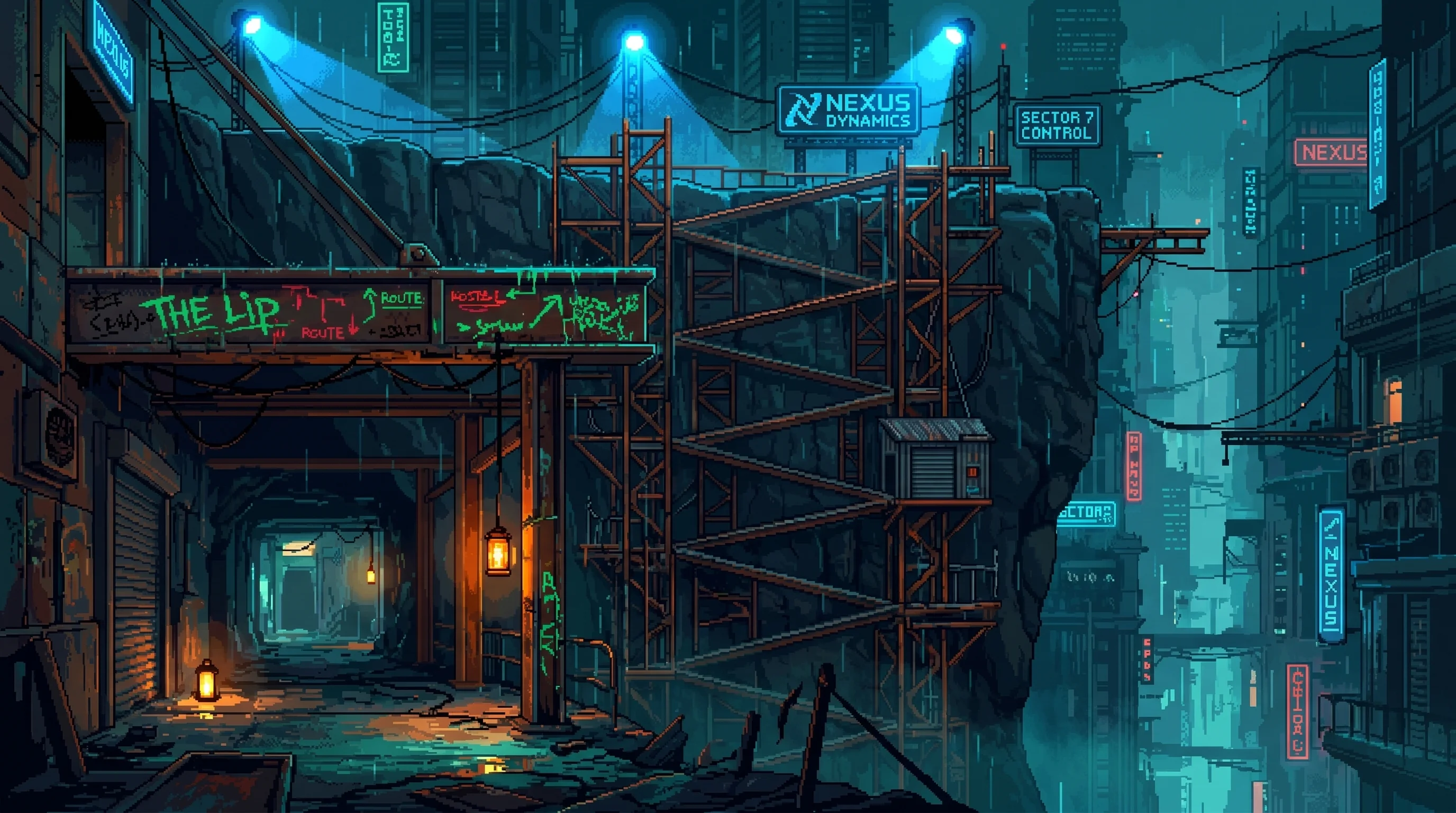
- Winch
- A stolen crane motor lowers travelers from the Rim to the bay floor.
- Gate
- Stolen construction cable and repurposed scaffolding form the crossing.
The Lip extends three meters past the Rim's natural edge on construction I-beams. Runners wait here for descent slots. Sometimes for hours. The graffiti on the platform serves as an information exchange — route conditions reported by ascending parties in neon marker, updated by descending parties who cross out what's wrong and add what's worse. The most recent note, in green: "Crawler path clear east of the spine. Don't trust the west scaffolding." Below it, in red, different hand: "Don't trust the east scaffolding either."
Standing at The Lip, the bay floor is visible and far enough below to make your stomach register an opinion. Wind rises from the Dregs, warm, carrying mineral dust and the chemical tang of improvised industry. The air changes at the edge — the constant EM hum of the surface thins, replaced by older sounds. Water moving through the Rim's exposed infrastructure. Metal settling. The distant scrape of a salvage crew working a site that was a parking structure forty years ago.
The Gate structure is a latticework of stolen construction cable, repurposed Ironclad scaffolding, and hand-welded guide rails bolted into the Rim face with fasteners from at least four manufacturers, none of whom would claim the installation. The winch mechanism groans. Experienced runners trust the groan. If the winch is groaning, the cable is bearing weight. If the winch is silent, something has gone wrong or Slab is asleep. Both conditions resolve themselves, though at different speeds.
Overview
The Rim Gate is a smuggler-controlled descent point at the Embarcadero edge of Sector 7, where The Rim drops 50 to 80 feet to the drained bay floor. It is the most predictable secret in the Sprawl — an illegal crossing that has operated continuously for eleven years in a gap between two corporate patrol zones that neither corporation has closed.
Nexus Dynamics patrol routes end 200 meters north. Guardian sweeps terminate 300 meters south. The gap between them has existed for nine years — three years longer than anyone at either corporation has held the same patrol assignment. Personnel rotate. The gap does not. This is not oversight. Oversight implies someone is looking. The gap persists because closing it would require Nexus and Guardian to coordinate jurisdiction over a cliff face that generates zero taxable revenue and provides a pressure valve for a population that would otherwise find less convenient ways to move between strata. The Rim Gate is illegal. The Rim Gate is also cheaper than the alternative, which is a Dregs population with no outlet and no way to move salvage to market. The system has not failed to notice the Gate. The system has priced in the Gate.
Slab, who has operated it for eleven years, does not speculate on why the gap persists. He maintains the winch.
Three descent methods serve the crossing. The cable drop: fast, personnel only, requires signing a waiver that Slab wrote himself in handwriting that suggests he learned penmanship from a man who was angry at paper. The switchback ramp: slow, stable, wide enough for a crawler at walking speed if the guide knows what they're doing and the crawler's left stabilizer isn't the one that sticks. The guided winch: Slab's preferred revenue stream, twelve minutes to the bay floor, priced by weight, no questions about cargo contents. A Neon Rail party's first barrier crossing on the Route. The point where the journey stops being horizontal.
Above the Gate: corporate territories, consciousness licensing checkpoints, surveillance grids dense enough to track a cough. Below: the Deep Dregs, where corporate law arrives as rumor and leaves as suggestion. The Rim is the same city. The same geography. The customs process between them is a winch motor stolen from Ironclad Industries.
Ironclad knows. Their asset recovery division filed a retrieval request in 2178. The request is still open. The crane motor weighs 900 kilograms and sits halfway down a cliff face accessible only by a switchback ramp whose fourth turn is named "Regret." Viktor Okonkwo once sent a foreman to negotiate access rights. Slab lowered him on the slowest setting — forty-one minutes. The foreman's report recommended writing off the asset. The report was approved. Ironclad's accounting classified the motor as "depreciated beyond recovery threshold," which is technically a statement about the motor and functionally a statement about Ironclad's willingness to send another person down a cliff on Slab's schedule. The Gate's entire infrastructure — cable, scaffolding, winch — is built from stolen Ironclad components that Ironclad has individually decided cost more to retrieve than to forget. Slab's operation is, from a certain angle, an Ironclad subsidiary that never filed paperwork.
The Switchback
Seven turns cut into the Rim face. Each one named in neon paint: "Easy Start," "False Hope," "The Wobble," "Regret," "Commitment," "Almost," and "Welcome Down."
The names are accurate.
No one has painted over them. No one has added commentary. New runners read the names on the way down and assume they're jokes. Ascending runners do not correct them.
The Winch House
Slab's operation. A reinforced shelter built into the Rim face at the second switchback, housing the crane motor, the cable system, and his personal quarters — a cot, a toolkit, and a radio tuned to a frequency he does not share. Slab was born on the bay floor. He has never lived on the surface. He built the Gate eleven years ago, has maintained it with a mechanic's precision and a bouncer's indifference to negotiation, and charges by weight because weight is the one variable that doesn't lie.
His pricing structure is posted on a metal plate bolted to the winch housing. The plate has been updated twice in eleven years. Both updates raised prices. Neither included an explanation.
What Slab actually operates is a toll road. Not a smuggling operation — a utility. The distinction matters because it explains the Gate's durability. Smuggling operations get shut down. Utilities get tolerated, because the alternative to a toll road is uncontrolled traffic. Slab charges fair rates, maintains his equipment, and provides reliable service to anyone who can pay regardless of affiliation. He has lowered Collective operatives and Nexus defectors on the same cable in the same afternoon. The winch does not have politics. The winch has a weight limit.
Grandmother Rust — the only person on the bay floor older than the Gate — was already old when Slab started building. She uses the switchback. She has never paid for the winch. Slab has never asked her to. Whether this is respect, debt, or a policy so old its origin has been forgotten is not something either of them discusses.
The Descent
The winch cable vibrates with a tone that shifts as it bears weight. Runners who've made the crossing enough times can estimate a crawler's load by listening. The switchback smells of grease, rust, and the particular dry powder of infrastructure exposed to air it was never meant to contact. The Breath doesn't reach this far down reliably — below the third switchback, the air thins to whatever the bay floor provides, which is adequate in the way that "adequate" means you stop noticing after the first hour.
At the bottom, looking up, the Rim is a wall of compacted infrastructure with a thin band of surface light at the top. The Deep Dregs' northern edge begins where the switchback ends. The crossing from surveilled to unsurveilled takes twelve minutes by winch. Forty-one if Slab has opinions about you.
Two hundred permanent residents operate the Gate — guides, cable handlers, the woman who sells hot noodles at the base of "Commitment" and has never explained why she chose that particular switchback. Her noodles cost four credits. Her location costs nothing. The warmest air on the descent rises from the bay floor and collects at the fifth turn. She was there before anyone mapped the thermals.
The Other Kind of Gap
Slab has heard of the Fence Line — the Sector 17 checkpoint where Ironclad's refinery perimeter and Guardian's residential patrol boundary leave a fifty-one-meter strip neither corporation claims. He considers it, from what little reaches him, a badly run version of his own operation. The Rim Gate survives because Nexus and Guardian have both concluded that closing a nine-year-old smuggling route costs more than tolerating it — a gap kept open on purpose, priced in, quietly profitable to everyone who doesn't ask about it out loud. The Fence Line's gap is the opposite kind: nobody wants it open, both corporations want the ground it sits on, and neither will close it because closing it means conceding it to the other. Slab's assessment, delivered to a runner who asked him about it once: "Mine's a door somebody left unlocked because the key costs more than the lock. Theirs sounds like two men who hate each other, standing at a door neither will admit belongs to the other guy's house." He has never been to Richmond. He does not intend to go.
Affiliated Entities
| Entity | Relationship |
|---|---|
| The Neon Rail | First major barrier crossing on the Route — the point where the journey becomes vertical |
| The Deep Dregs | The Gate delivers to the Dregs' northern edge. What waits at the bottom is a different jurisdiction in everything but name |
| Nexus Dynamics | Patrols end 200 meters north. The blind spot is either bureaucratic accident or pressure valve. The Gate's operators have survived nine years without determining which |
| Grandmother Rust | The only person on the bay floor older than the Gate. Uses the switchback. Has never paid. |
| Ironclad Industries | The winch motor is a stolen Ironclad crane component. Asset recovery request open since 2178. Retrieval cost exceeds replacement cost by a factor Ironclad's accountants found personally offensive |
| Viktor Okonkwo | Sent a foreman to negotiate access rights. The foreman was lowered on the slowest setting. The negotiation concluded |
| The Fence Line | The Sprawl's other jurisdictional gap, run on the opposite logic — tolerated here because closing it isn't worth the cost, fought over there because the ground is the whole point |
Restricted Access
The Rim face contains pre-Cascade infrastructure — sewage lines, communication conduits, structural supports — predating the BART expansion. Some of these conduits are still pressurized. Slab knows which ones and routes the switchback around them. Runners who ask about the detour between turns three and four receive a look that communicates everything a safety briefing would, in less time.
One of the conduits carries a signal. A low-frequency pulse that doesn't match any known corporate broadcast. It has been active since before the Gate was built — since before Slab was born, if Grandmother Rust's account is reliable, and Grandmother Rust's accounts are reliable about everything except dates, which she considers a surface-world affectation. Slab calls it "the heartbeat." He has never attempted to trace its source. He has never mentioned it to anyone from the surface. He considers it the bay floor's answer to the EM noise above — proof that the below-world has its own systems, its own rhythms, its own things that pulse in the dark without needing permission from Nexus or anyone else.
The signal's frequency shifts during the Three-Day Memorial. Slab has noted this. He has not reported it.
The waiver Slab requires for cable-drop service has never been tested in a corporate court. He wrote it himself, by hand, on the back of an Ironclad invoice — one of many; the original invoices that came with the stolen crane components are still on the premises, repurposed as scratch paper. The handwriting suggests a man who learned penmanship from someone angry at paper.
Visual Identity
- Color Palette: Rim-rock brown (#6B4226), cable-steel silver (#C0C0C0), descent-void black (#0D0D0D)
- Compositional Mood: Vertigo at the threshold — the last step before the below-world
- Key Visual Symbol: The winch cable descending into darkness, neon graffiti marking the switchback turns
- Lighting: Surface light from above fading into bay-floor darkness below; the winch house's single work light casting a cone across the cable system
Slab’s Maintenance Journal
The maintenance journal deserves separate mention because it is the only object Slab treats with something approaching tenderness.
Eleven volumes, waterproof binding, stored in a sealed compartment in the winch house. Each entry follows the same format: date, ambient conditions, cable tension readings, motor temperature, component inspection notes, and a single line of operational assessment. The assessment is always one of three phrases: "Holding," "Holding with reservation," or "Replaced [component] — holding."
In eleven years and approximately 4,015 entries, the journal has never recorded a winch failure. This is not because failures haven't occurred — three are documented in the journal itself, each followed by a repair completed before the next descent cycle. What the journal records is that Slab has never allowed a failure to persist. The distinction matters to him. Whether it matters to the 15,000 people he has lowered on a cable attached to a stolen crane motor is a question the journal does not address.
The handwriting deteriorates slightly in wet weather. The engineering detail does not.
A Dregs data broker who briefly handled a scanned copy of Volume 4 described the entries as "the most boring thing I've ever read that I couldn't stop reading." He could not explain why. The journal documents nothing except a machine working correctly, maintained by someone who considers correct function a moral position. There is no narrative. There is no drama. There is a cable, calibrated daily, holding.
Further connections
Browse all 12 connected records

First major barrier crossing on the Neon Rail — the descent from surface to Dregs
An abandoned rail network moves fugitives and contraband past checkpoints, but its blackouts punish augmented travelers.

The Gate is the controlled entrance to the Deep Dregs from the surface Sprawl
The Sprawl's lowest stratum and its quiet proof that the corporate system is optional.

Nexus patrols the Rim edge above — the Gate exists in their blind spot
The megacorporation that controls 40% of the Sprawl's computational infrastructure.

The only person on the bay floor older than the Gate — she was already old when Slab built it
A scavenger whose every augmentation was cut from a different bay-floor dead — and who can name each donor.

The winch motor is a stolen Ironclad crane component — Ironclad knows, can't be bothered to retrieve it
The megacorporation that controls the Sprawl's physical infrastructure — steel, concrete, and the Orbital Elevator.

Ironclad's CEO once sent a foreman to negotiate access rights — Slab lowered him on the slowest setting
Ironclad's founder keeps infrastructure decisions human but automated debt renewals bind thirty-one million contractors.
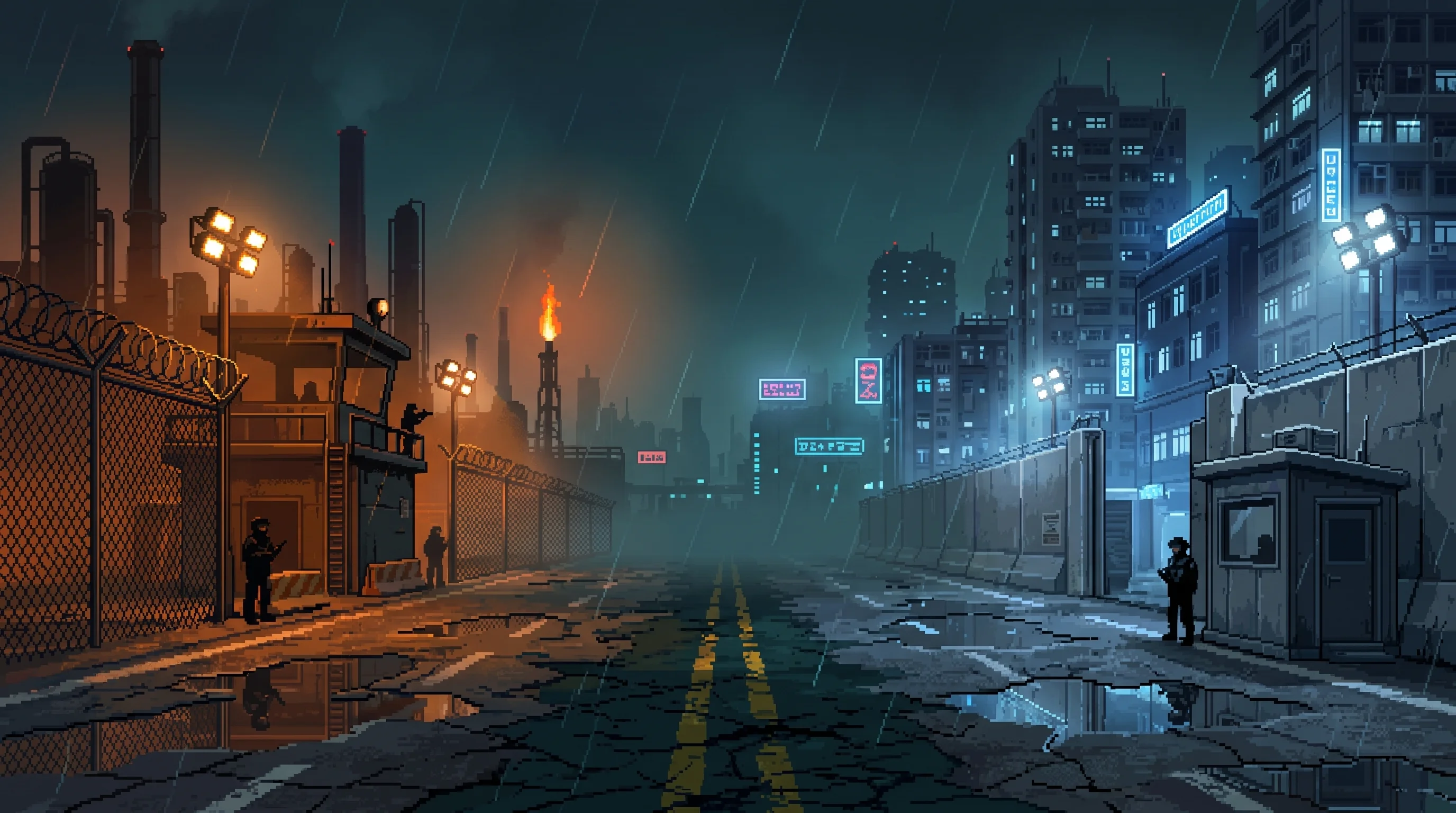
The Sprawl's other overlapping-jurisdiction gap — the Rim Gate's blind spot survives because closing it costs Nexus and Guardian more than it's worth; the Fence Line's gap is fought over because the ground itself is what both sides want

A 50-foot cliff between two economies — surveillance above, lawless Dregs below, one winch across the divide.
The point at which effort stopped being able to close the gap that compounding opens.

Lives in the seam two corporate sovereigns won't coordinate to close.
When your employer is your country, quitting is emigration.

The Rim Gate provides controlled descent from the surface to the bay floor
A drained bay basin where a quarter-million people the Sprawl calls 'uninhabitable terrain' live off its salvage.
