
The Mobility Myth
12% of Dregs residents entering corporate employment through Prosperity Pathway achieve stable Professional-tier within 5 years
Overview
Every quarter, Good Fortune publishes the Pathway Spotlight — a four-page spread featuring a recent Prosperity Pathway graduate in their new Professional-tier apartment. The latest issue profiles Kaya Osei, formerly of Sector 11's lower Dregs, now a Nexus data analyst living in a Compact-subsidized unit with 9-foot ceilings and a consciousness licensing tier she describes as "like waking up for the first time." The spread includes three photographs: Kaya at her workstation, Kaya in her kitchen, Kaya looking out a window that faces something other than a wall.
Seventy-three people entered the Prosperity Pathway with Kaya Osei. Good Fortune's quarterly report lists their status under "Ongoing Placement Efforts," a category that has contained the same seventy-three names for fourteen months. Forty-one of them carry an average of ¢40,000 in Pathway debt. Nineteen are working forced-focus contracts to service it. The remaining thirteen have been reclassified as "Pre-Pathway Status" — a designation that means they are back in the Dregs, carrying debt they did not have before and neural architectures partially reorganized around enhancement tiers they can no longer access.
Nobody is photographed in the "Pre-Pathway Status" category. There is no spread.
The Sprawl's official position is meritocratic. Work hard. Enhance wisely. Climb. The Corporate Compact rewards performance. The consciousness licensing system provides a floor. Good Fortune provides financing. The system is open. Approximately 12% of Dregs residents who enter corporate employment through Prosperity Pathway programs achieve stable Professional-tier status within five years. At ten years, the number is 4%. At management level: 0.3%.
The numbers are small but nonzero. This is the load-bearing fact. The entire architecture of the Great Divergence rests on a 12% success rate — enough to keep the brochures honest, enough to keep enrollment stable, enough to ensure that every Dregs resident who looks at their life and wonders is this it has a specific, named, photographable answer: no, look, Kaya Osei made it.
Kaya Osei did make it. Kaya Osei is real.
The 88% failure rate is also real. Good Fortune's marketing division has never published it. The Human Remainder has, repeatedly, to diminishing public interest. The number is too large to feel like a number. It feels like weather.

The Visible and the Dissolved
The myth's mechanism is not deception. Nobody lies. The mechanism is visibility.
The 12% who succeed wear Professional-tier markers that are impossible to miss — faster speech cadence, the particular steadiness of enhanced cognition, eyes that track rather than drift. They move through the Sprawl's corporate districts as living advertisements. Triumph Social profiles them. Good Fortune quotes them. Nexus hires them at rates that suggest the Pathway is working.
The 88% who fail dissolve. Not dramatically. Not with any single identifiable event. They return to the Dregs carrying cognitive downgrade — neural architectures that spent two years adapting to Professional-tier processing speeds and now run at Basic, which feels like trying to think through gauze. The clinical term is "tier reversion syndrome." The Dregs term is "the hangover." It lasts, on average, nine months. Some report it never fully clears.
A Dregs resident who never entered the Pathway and a Dregs resident who entered, failed, and returned are indistinguishable to the casual observer. Both live in the same sectors. Both work the same contract shifts. Both carry the same licensing tier. The difference is interior — the returned resident knows what Professional-tier cognition feels like, knows they can't afford it, and knows the specific texture of the gap. This knowledge does not appear on any diagnostic scan. It does not photograph well.
Good Fortune's actuarial models have a name for the returned residents: "experienced prospects." The designation is not pejorative. It is market segmentation. A resident who has tasted Professional-tier consciousness and lost it is 340% more likely to take a second Pathway loan than a resident who never tried. The second loan's default rate is 94%.
| Parallel | Lottery tickets in a regressive tax structure |
|---|
The Brochure and the Spreadsheet
The Prosperity Pathway's recruitment materials are produced by Good Fortune's Aspiration Division — a 140-person department whose only function is translating the 12% into feelings. The brochures are beautiful. Warm lighting, clean typography, the specific shade of gold that Good Fortune's behavioral research division determined triggers "aspiration without anxiety" in Basic-tier neural profiles.
The brochures do not contain the number 88. They do not contain the number 94. They contain Kaya Osei, and before her Deshi Montoya, and before him Adaeze Nwosu, and before her a continuous chain of real people who really succeeded, stretching back to the Pathway's founding in 2168. The chain has never been broken. There has always been a face.
The Human Remainder publishes a counter-brochure every quarter. Identical format, identical typography, identical warm gold. The only difference is the content: seventy-three names instead of one, debt figures instead of apartment photographs, tier reversion timelines instead of testimony. The counter-brochure is factually impeccable and has never changed a single enrollment number.
This is the asymmetry that makes the myth structural rather than conspiratorial. Hope photographs well. Debt does not. Success has a face. Failure has a spreadsheet. Given the choice between a face and a spreadsheet, the human neural architecture — Basic-tier or Professional — chooses the face. Every time. The myth doesn't need to be believed. It needs to be possible. The 12% makes it possible. The 88% makes it profitable.
Cross-Tier Exposure
The Mobility Myth's maintenance requires a specific ignorance: that Dregs residents not experience Professional-tier consciousness casually. The Pathway is designed as a controlled exposure — years of structured enhancement within corporate environments where the experience is framed as earned. Uncontrolled exposure is different. When a Dregs resident visits a corporate district through a work program and feels Professional-tier processing for the first time without three years of Pathway debt attached, the framing collapses.
Good Fortune's risk modeling team tracks this. A 5% increase in cross-district exposure — work visas, connection tourism, temporary corporate contracts — correlates with a 1.2% increase in support for the Bandwidth Equity Act, the legislative proposal that would redistribute consciousness licensing capacity. The correlation has held since 2179.
Transit between tiers is therefore expensive, documentation-intensive, and designed to be exhausting without being prohibited. Prohibition would create martyrs. Inconvenience creates apathy. The transit fees are set by the Corporate Compact's Infrastructure Committee, whose published rationale cites "congestion management" and "atmospheric processing load balancing." The fees have increased 14% year-over-year since 2180. Atmospheric processing load in transit corridors has remained flat.
88% are worse off than when they started — carrying debt and degraded cognition
The Exit They Can't Erase
Prosperity Pathway enrollment has declined 3.2% annually since 2180. The decline does not correlate with economic conditions, employment rates, or Pathway marketing spend. It correlates with the growth of Dregs alternative infrastructure — each G Nook terminal installed, each Lamplighter junction maintained, each cycle of the Blackout Economy survived without corporate intervention.
The returned residents are the mechanism. They have been inside. They have experienced Professional-tier consciousness, worked corporate contracts, sat in Compact-subsidized apartments with 9-foot ceilings. And they came back carrying ¢40,000 in debt and a nine-month hangover. Their testimony circulates through Dregs networks — not as propaganda, not as political argument, but as the specific, boring, granular details of what the Pathway actually costs. How the forced-focus contracts feel. What tier reversion does to your sleep. The exact moment you realize the second loan's interest rate means you will never reach zero.
This testimony has no counter. Good Fortune can publish Kaya Osei. Good Fortune cannot unpublish the seventy-three people who entered with her. They exist. They talk. They are believed, because they are describing an experience their neighbors watched them enter and watched them exit, and the exit looked worse than the entrance.
The Proof of Optionality — the accumulating evidence that functional life outside the Corporate Compact is not just survivable but, by several quality-of-life metrics, preferable — does not need to be argued. It needs to be lived in proximity. The Defector Network processes approximately 200 successful defections per year. Each defection produces a person who exists outside the system and can testify from experience that the exit cost is painful but finite. Human beings, unlike brochures, cannot be unprinted.
The Mobility Myth does not require the Proof to be defeated. It requires the Proof to be invisible. The containment is holding. The containment is also leaking. Every G Nook terminal, every returned resident, every connection tourist who walks through the Dregs and notices that the people here seem to know each other's names — each one widens the gap between what the brochure promises and what the spreadsheet confirms.
The brochure is getting more beautiful every quarter. The Aspiration Division's budget increased 22% last year. Kaya Osei's spread was the most-viewed content on Triumph Social for eleven days.
Enrollment is still declining.
Good Fortune's marketing materials feature success stories prominently; the 88% failure rate is never mentioned
Affiliated Entities
- The Great Divergence is what the myth obscures
- The Prosperity Pathway is the myth's financial expression — the ladder that 88% fall off
- Good Fortune markets the myth — featuring the 12% while the 88% go unmentioned
- The Human Remainder cites the 88% rate as evidence the myth is engineered
- The Proof of Optionality is the myth's existential threat — the evidence that the system is not just unfair but unnecessary
Visual Identity
- Palette: Bright Prosperity red-and-gold (the 12% success) against Dregs amber (the 88% failure) — same palette, different saturation
- Key Symbol: A spotlight illuminating one person in a crowd of shadows
- Mood: The specific cruelty of hope that serves the system more than the hoper
Connected To
Primary Connections

The Divergence's alibi: that effort still crosses it. Good Fortune's quarterly Spotlight photographs the one Pathway graduate in seventy-three who reached Professional tier; the other seventy-two return to the Dregs deeper in debt.
The point at which effort stopped being able to close the gap that compounding opens.
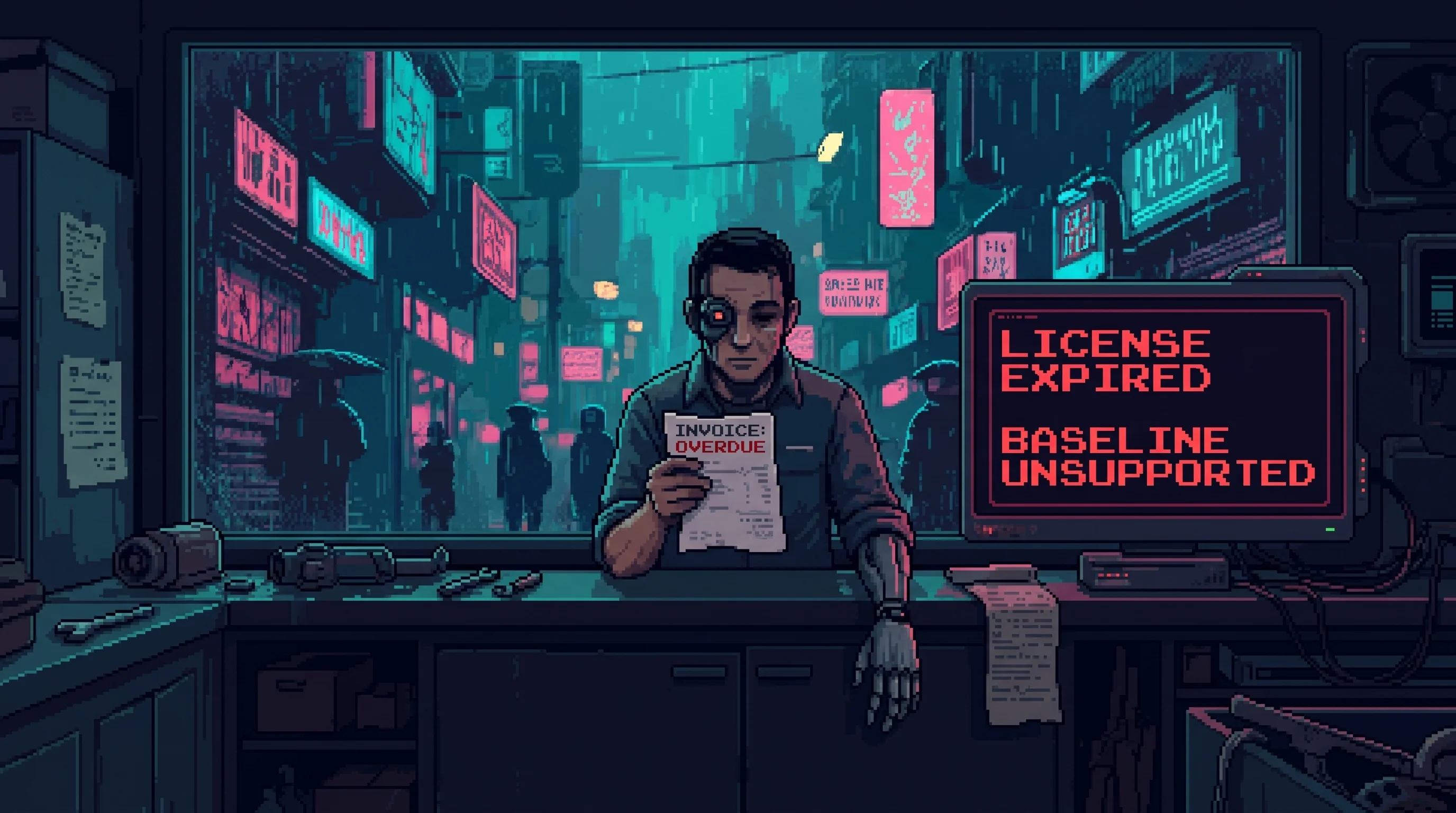
The quarterly Spotlight profiles the one graduate in her 9-foot-ceiling apartment; the other seventy-two sit under 'Ongoing Placement Efforts' for fourteen months, forty-one of them ¢40,000 deeper in Pathway debt.
Upgrades rewire users until baseline feels disabling, removal risks catastrophe, and each version demands the next.




—