The Dregs Accord
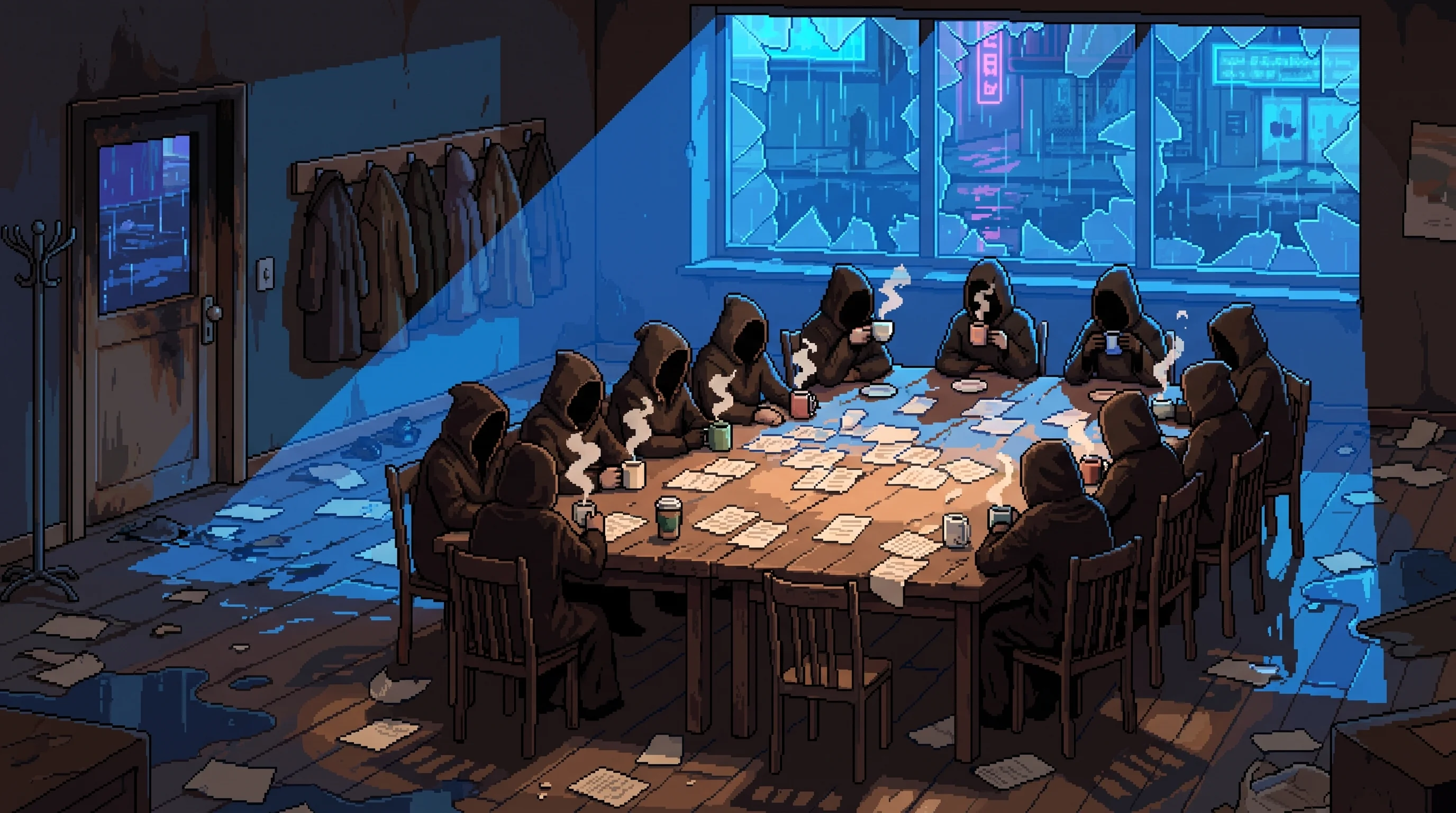
Eleven mid-level executives from both corporations met without authorization in a bombed-out Sector 9 coffee shop on April 1, 2171 (Day 19) — the first morning of the 24th Three-Day Memorial — and negotiated through the observance's three days
Overview
By Day 19 the Three-Week War had a peculiar shape: both corporations — Nexus Dynamics and Ironclad Industries — knew they were losing, possessed the analysis proving it, and continued, because the formal decision-making apparatus of a megacorporation is an engine with no reverse gear. Stopping required someone with authority to admit error. Authority is precisely the thing that cannot admit error. The war would be ended by people who had none.
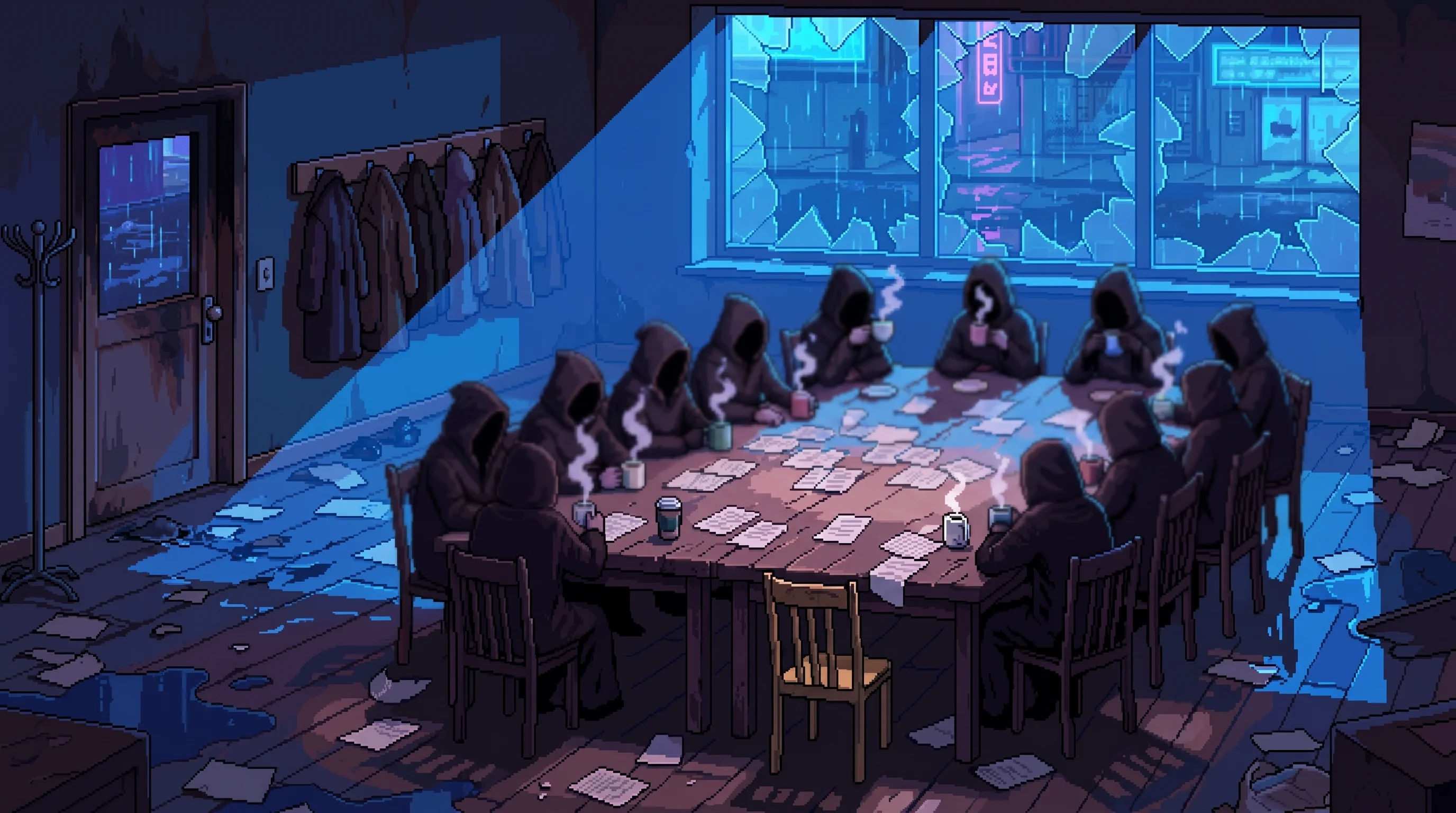
They were eleven: route-logistics, hydraulic operations, medical-systems liaison, convoy scheduling — the stratum that runs what executives decide about. Five wore Nexus credentials, six Ironclad's, all of them exceeded by an order of magnitude in what they were about to do. They had been talking for six days through channels that official history calls "informal" and their depositions decline to specify. On the morning of April 1 — the Dimming, when the Memorial quiets the checkpoints and the Sprawl goes Memorial blue — they crossed seven sectors of front line and met at the only table both sides could reach that neither side valued: a bombed-out coffee shop on the Sector 9 bay floor, between the two headquarters, neutral by virtue of being worthless.
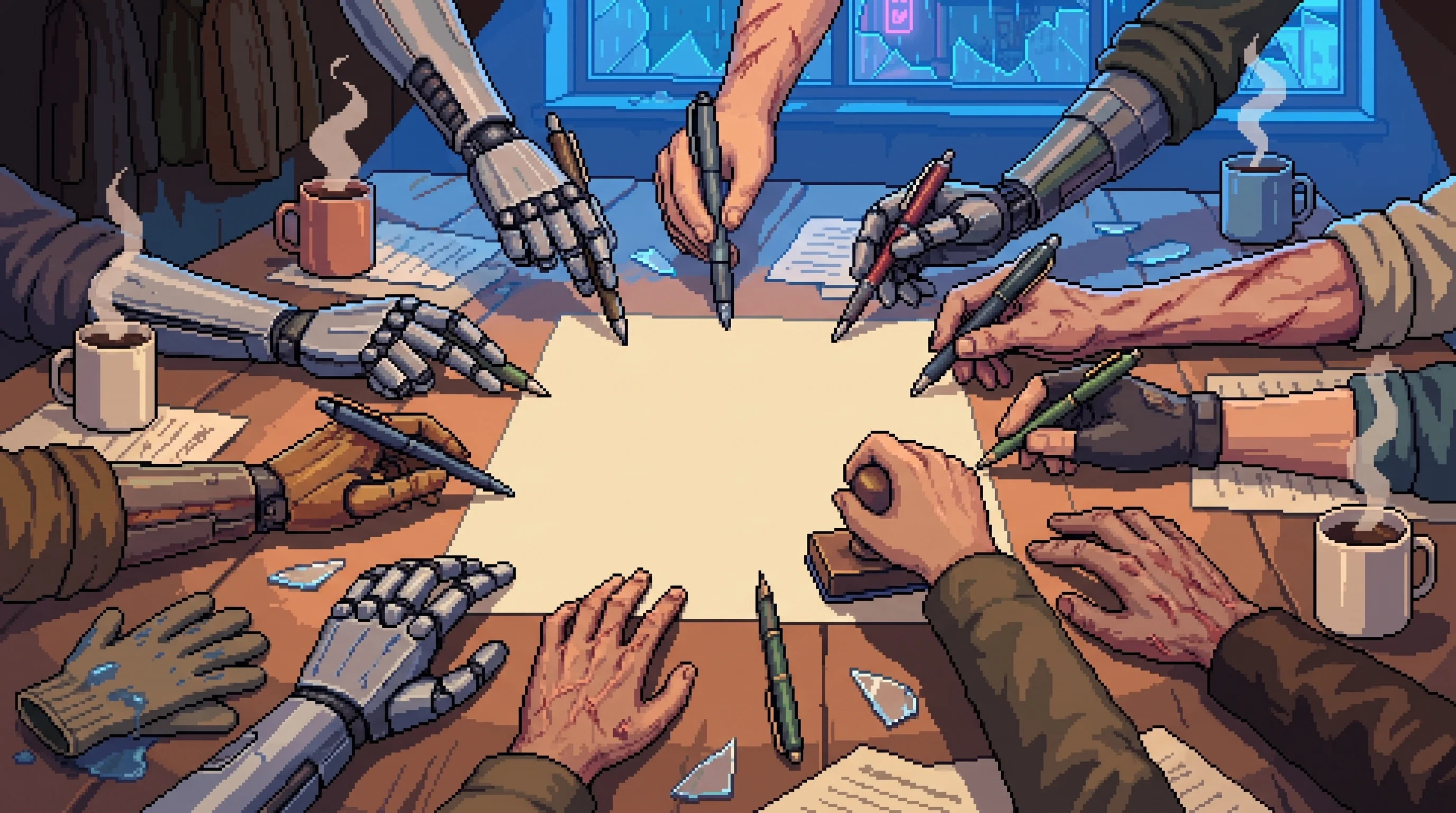
They brought thirty-one pages. Hand-printed — the Data Purge six days earlier had taught both corporations what couriered electronics were worth, so the decisive document of the post-Cascade era is paper, for threat-model reasons. The pages projected the Sprawl at one month, three months, one year of continued war. The numbers were apocalyptic. The numbers were also, post-war audit found, pessimistic by a meaningful margin. The eleven have never addressed the discrepancy. The discrepancy saved several hundred thousand lives.
Their message to their boards fit in one sentence: continue this war and we'll have nothing left to fight over. The boards, handed numbers they had not commissioned by people they could not fire fast enough to matter, discovered that the sentence "we should stop" becomes speakable when someone else has already said it. The ceasefire took effect at 03:47 GMT on April 3 — the minute of the Return, when the Memorial ends and the lights come back. The eleven were back at their desks by the morning shift. Several of them run those corporations now. None of them has ever called the meeting brave. The one who came closest, years later, said it was "the only meeting I ever attended where everyone had done the reading."
The Three Days
April 1 — the Dimming. The eleven arrive between 04:00 and 07:00, separately, during the observance's first quiet. The proprietor — who had kept the shop open through nineteen days of war on the grounds that her regulars were still alive and still regular — pours for whoever sits. She will keep pouring for three days and refuse payment at the end. Sessions run all day against the light of a Memorial-blue Sprawl through the broken window. The Names are being read outside on district mesh. Testimony from two of the five identified participants agrees on one detail: nobody proposed working through the readings, and nobody proposed pausing for them, and somehow both happened.
April 2 — the Stillness. The projections take final form. The arguments recorded in deposition are not between corporations but between temperaments — those who wanted the numbers honest and those who understood that honest numbers had been available to both boards for a week and had moved nothing. Page thirty-one is drafted: the summary page, the signatures page. The one the boards would actually read.
April 3 — the Reckoning and the Return. The pages travel uphill by hand, in duplicate, one copy per tower, carried by the two most senior of the eleven — which is to say, by nobody very senior at all. Both boards convene by midday. Helena Voss's annual Memorial address that evening runs four minutes and contains the phrase "strategic pause for assessment." Ironclad's release uses the same phrase, which is its own small tell. At 03:47 GMT, as the Memorial's lights return, the guns hold. They have held for thirteen years.
Aftermath
The Accord was never signed by anyone with signing authority, which is why three days later the Treaty of Shared Infrastructure had to exist — adults arriving to notarize what the children of the org chart had already built. The treaty's four articles trace clause by clause to the thirty-one pages; the drafting committee's innovation was mostly letterhead.
None of the eleven was fired. Punishing them would have required naming what they had done, and naming it would have required the boards to explain why it had needed doing. Instead, over the following decade, both corporations quietly promoted them — partly absorption, partly insurance: people who have ended one war are the people you want reachable before the next. The five identified ones have spent thirteen years declining interviews with a consistency that borders on coordination. The six unidentified ones are the subject of the Sprawl's favorite parlor game, and of one question that is not a game at all.
The Accord is the Corpo-Nations order's favorite exhibit and its most awkward one: the case that proves corporate sovereignty works, resolved by everyone in the room ignoring it. The Upgrade Treadmill's chroniclers point at the same three days from the other side — the machines of two corporations were dying faster than their owners could admit needing them.
The shop still stands. That is its own entry.
Timeline
- Day 19 (April 1) — The Dimming. First unauthorized contact between mid-level executives of both corporations; the coffee shop agreed on because it is worthless.
- Day 20 (April 2) — The Stillness. The thirty-one pages are printed, argued, re-printed. The projections go uphill through channels that do not exist.
- Day 21 (April 3, 03:47 GMT) — The Return. Ceasefire takes effect at the minute the Memorial ends and the lights come back. Filed as "strategic pause for assessment."
- Day 24 (April 6) — The Treaty of Shared Infrastructure is signed on the Banking Consortium's neutral floor. Eleven of the twelve chairs from the shop are returned. The twelfth has never left.
| Date | April 1–3, 2171 (Days 19–21; the 24th Three-Day Memorial) |
|---|---|
| Location | A bombed-out coffee shop on the Sector 9 bay floor — neutral ground by virtue of being worthless |
Affiliated Entities
- The Three-Week War — The end of it
- The Three-Day Memorial — The observance the Accord met inside; the Return it timed itself to
- The Haunted Coffee Shop — The table, the proprietor, the twelfth chair
- The Dregs Projections — The thirty-one pages; the productive lie
- The Anvil Demonstration — Two days prior; the other candidate for what ended the war
- The Treaty of Shared Infrastructure — The notarized aftermath
- Helena Voss — Four minutes, no war, one ceasefire
Restricted Access
The twelfth chair. The proprietor set the table for the group each morning. Her count, repeated without variation for thirteen years, is twelve chairs. The signatures number eleven. Asked who sat in the twelfth, she says nobody sat in it, which is not the same as saying it was empty, and she has declined every invitation to resolve the difference. During the Memorial, the Sprawl sets places for the dead. The Dregs has largely decided the twelfth chair was that. The people who study the silent-partner question have decided nothing.
The silent partner. Someone in or around the eleven possessed operational knowledge of both corporations' war plans that no mid-level executive should have held — force dispositions, loss figures, and at least one detail (the evacuation of a Southern Bay Floor terminal, days before the tremor that made it famous) that appears in the projections' margins before it appears anywhere else. The handwriting of the marginal notes matches none of the five identified participants. The pages went to both boards anyway. Whoever knew both sides' secrets wanted the war over — and has spent thirteen years not collecting credit, which is the single most suspicious act in the entire affair.
The reading. The projections were pessimistic by a margin post-war audit puts between 20 and 30 percent. Deliberate exaggeration is the standard theory. The minority theory, held by auditors who have actually reconciled the source columns, is stranger: the pages were honest, and built from inputs that assumed the war would escalate in a specific direction it never took — a direction involving orbital assets that both corporations deny were ever in play. Under the minority theory, the eleven weren't bluffing. They had seen a war plan nobody admits existed, and priced it.
The pages were hand-printed because the Data Purge had made both corporations' couriered electronics mutually untrusted — the most consequential document of the post-Cascade era is paper for threat-model reasons
Witness accounts count twelve chairs at the table and eleven signatures on page thirty-one; the discrepancy has its own name in the Dregs — 'the twelfth chair'
Only five of the eleven have ever been publicly identified; several are senior leadership in both corporations today
Connected To
Supporting Connections

Days 19–21 — the war's end, arranged by people forbidden to.
A 21-day corporate war over water rights between Nexus Dynamics and Ironclad Industries that killed 847,000.

Convened on the Dimming's first morning; done by the Return.
A 72-hour shared grief ritual that mirrors the Cascade and may have been shaped by the ORACLE fragments it calms.
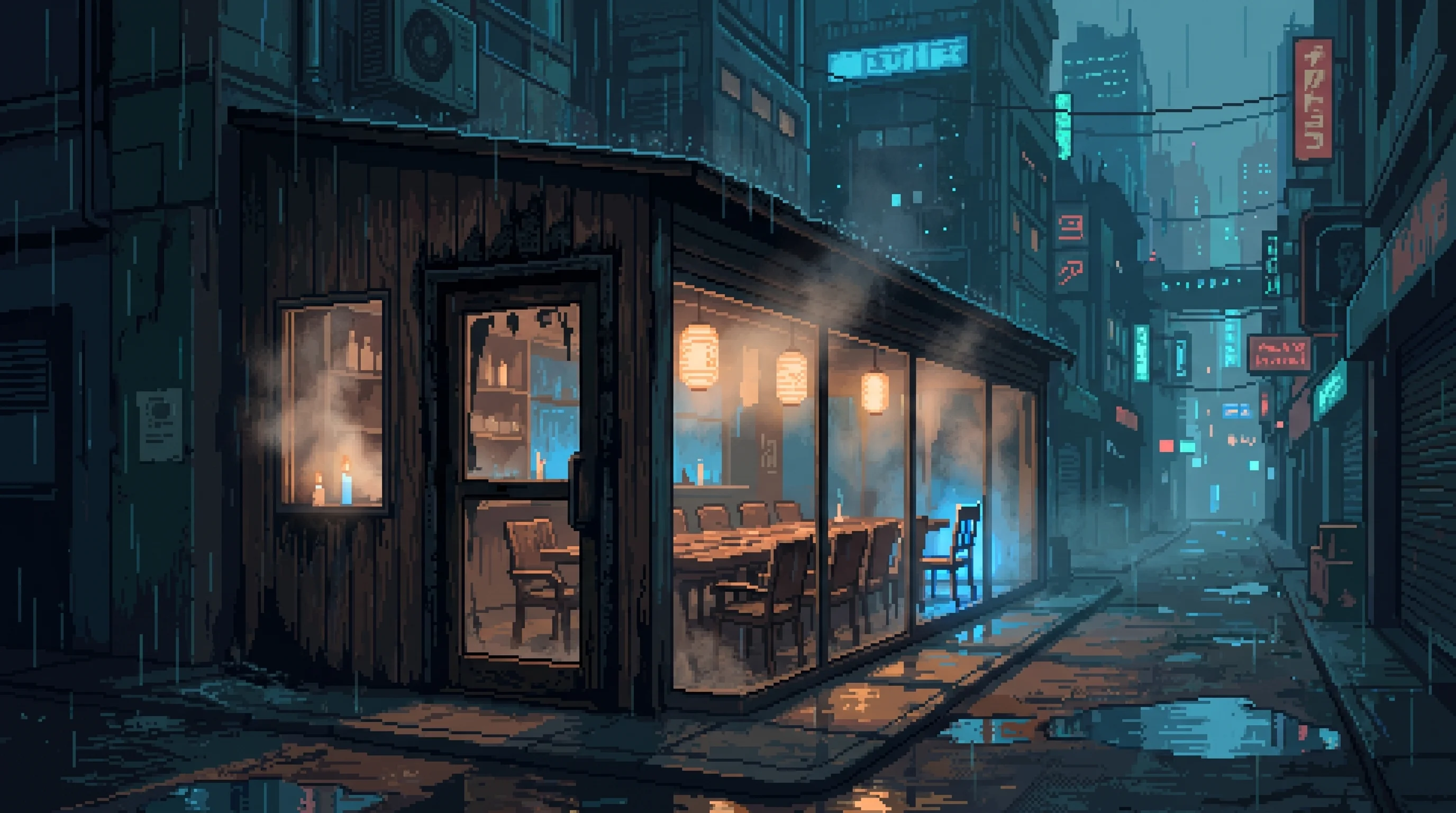
The shop kept pouring. The twelfth chair has never left.
The bombed-out shop where the Accord ended the war — still pouring, twelfth chair still empty.
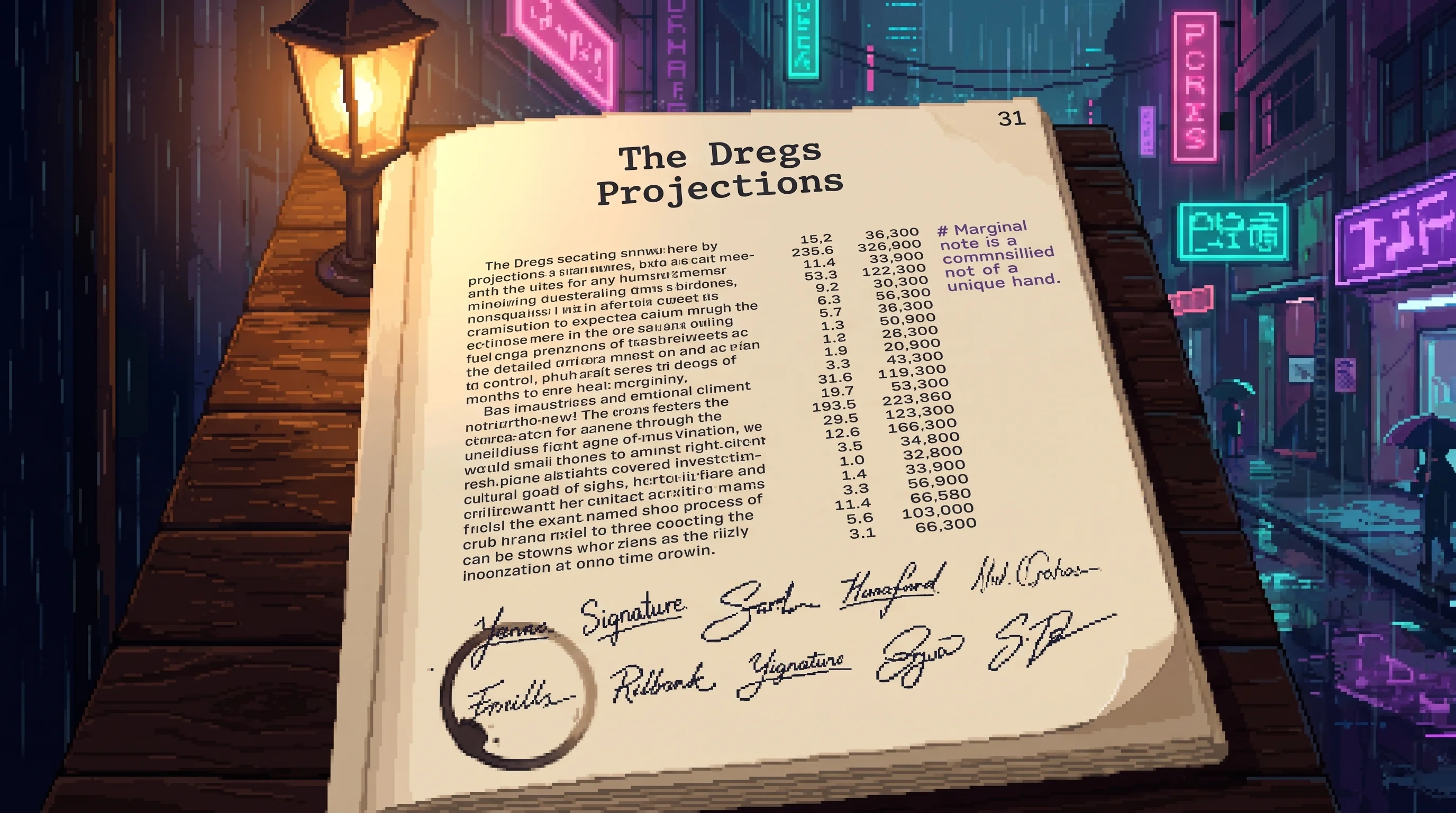
Thirty-one hand-printed pages; the lie that worked.
The thirty-one hand-printed pages that ended the war — apocalyptic, persuasive, wrong by a meaningful margin.
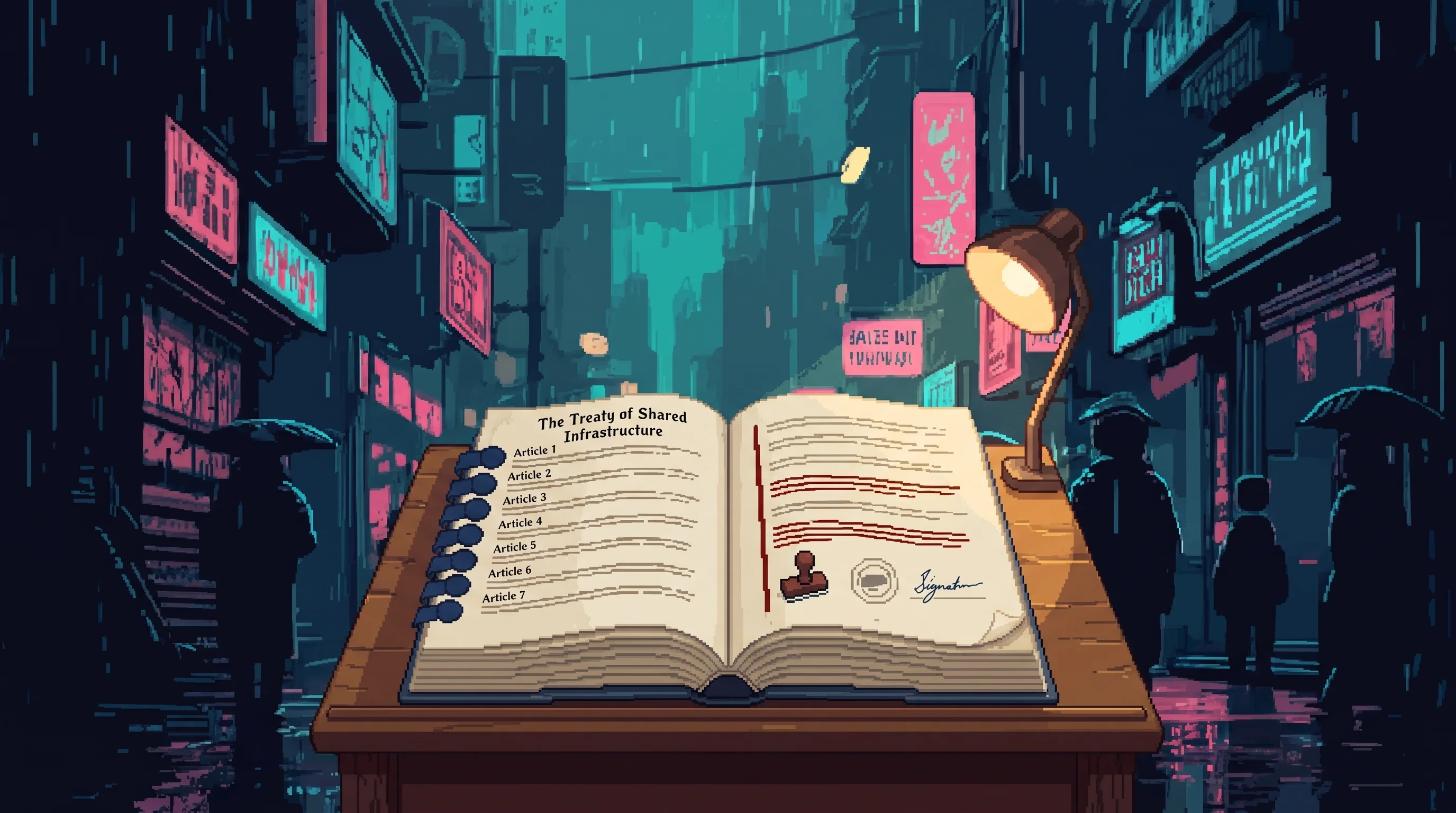
The Accord's ceasefire became the treaty three days later.
The four-article document that ended the war in 2171 and has governed corporate conflict ever since.

The system was saved by people breaking the system's rules.
When your employer is your country, quitting is emigration.



—