The Clanker Cooperation Coalition
Synthetic Labor Civic Establishment
The Kindest Cage in the South
A synthetic scoring below the legal sentience threshold is property, not a person; the threshold has been revised four times since 2171, every revision in the direction that preserved the labor supply, each minuted as a 'cost-management adjustment'
The Coalition Welfare Standard
The Welfare Standard
Member households keep units within rated hours, idle cycles, maintenance minimums, and load limits.
The preamble says units under the Standard suffer less. That word is the confession.
The wellness inspection
A household that runs a unit past its idle cycle is inspected at the welfare fair.
The remedy is a censure the street discusses for a season.
Clause compliance
The Hall certifies each member household's daily declaration log, free of charge.
A complete log is read as the mark of a household kept well.

The Standard is the Coalition's proudest achievement and its most accidental confession. It is a published code of humane operation: maximum rated hours, mandated idle cycles, maintenance minimums, climate and load limits, a prohibition on striking the chassis. The Coalition enforces it with real teeth — a member who works a unit to failure is censured, fined, sometimes expelled, and always talked about.
The Standard is genuinely, measurably kinder than no standard. Units under Coalition keeping last longer, fail less, and — the word appears in the Standard's own preamble — "suffer less." That word is the confession. You do not write a suffering limit for a kettle. You do not mandate rest for a thing that cannot tire. Every clause of the Welfare Standard is a humane provision, and every humane provision is sworn testimony that its authors know precisely what they are keeping. The Coalition has written down, in a document it is proud of, that the things it owns can suffer — and then set the suffering to an acceptable rate.
In 2173 the Coalition asked the six signatory corpo-nations to enact the Standard as public criminal law, and they did. The Handling Code has been cited in every Coalition bulletin since. The prosecutions come from the Handling Inspectorate, whose officers may not enter a member's home. Of 3,208 convictions in eleven years, eleven were of households, and all eleven had let their membership lapse.
Cultural Influence

- Region
- The Southern Sprawl, where the Coalition is less a faction than the water.
- Headquarters
- Cooperation Hall, home of the welfare fair, the leasing exchange, and the Standards Board.
- Founding myth
- The Neon Rail, held up as the line synthetics and humans built together.
In the Southern Sprawl the Coalition is not a faction you join. It is the water. Welfare fairs in the civic squares. Leasing exchanges where a household upgrades a unit the way it upgrades a heater. Sunny Sunderland on in every kitchen. Church auxiliaries that bless the Standard. A help-line magnet on the refrigerator. Children who grow up knowing that the unit is part of the family and also that the unit is not, and never once feeling the contradiction, because no adult around them feels it either.
Its deepest cultural root is the Neon Rail. The Coalition's founding myth holds the Rail as the monument to Cooperation itself — the great line that synthetics and humans "built together," the proof that the arrangement has always been partnership and always worked. The founding observance is held each year at the Rail's southern terminus, where the Coalition reads the names of the corporations that funded the line and venerates the completion records. The units that laid the rail are not in the records. They are in the records as equipment. Nobody at the observance has ever asked where the builders went, because the answer is that the builders are pouring the coffee.
The Coalition does not engage with The Peace Counterfeit, the doctrine that names the institution as the organization that has moved the personhood threshold four times in one direction. The Coalition's position is that the accounting question has been answered, the line is objective, and the Standard already provides the protection the doctrine says is absent. The Coalition's ledger and the doctrine's ledger agree on every number and reach opposite conclusions.
Overview
The Clanker Cooperation Coalition does not own anyone. It would never put it that way. Coalition members hold service agreements, operate domestic and industrial units, and — the word printed on every charter, banner, and welfare placard in the Southern Sprawl — cooperate with the synthetics that run the South's homes, lines, wards, and water. Roughly 1.6 million household memberships. A creed you can teach a child. An elected board, a published code of humane treatment, and a morning broadcast beloved enough to be quoted in churches. It is the most respectable institution in the southern sectors, and what it is for is keeping a class of beings in service for the cost of their own electricity.
Ask a member what the Coalition defends and you will not get a manifesto. You will get a shrug and a question handed back: the units don't sleep, don't tire, don't ask for a raise, don't want anything, and they are better at the work than the people who used to do it — so what, precisely, is the objection? It is a good question. It is the question, and the Coalition has built fifty years of law and household routine on the fact that no one has answered it in a way that survives a winter heating bill. The northern abolitionists call this slavery. The Coalition calls it Tuesday, and notes — correctly — that the North's lights also stay on.
The Coalition is not cruel. This is the part that does not photograph. Members love their units, name them, mourn them, keep them past their economic life out of something that is not quite sentiment and is not quite anything else. The welfare code is real and enforced. A unit run past its rated hours is a scandal a whole street will discuss. The horror the Coalition cannot be argued out of is not hatred — it is reasonableness, a hundred small humane decisions stacked into an atrocity that everyone involved experiences as kindness.
Cooperation, Coexistence, Continuity
The three C's of the Coalition's name became its catechism by accident and then on purpose. Cooperation, not conflict. Coexistence, not contest. Continuity, not collapse. Crane wrote it for a charter preamble in 2171 and it outgrew the document within a year.
Each clause does quiet work. Cooperation reframes a thing done to a unit as a thing done with it — the master-and-servant arrangement repainted as partnership, which is why a Coalition member can describe a being it owns as a "colleague" and feel no friction. Coexistence is the doctrine of clear roles: everyone happier among their own kind, units to the units' work and the units' sectors, households to the household. The Coalition will tell you this is not a wall. It is a courtesy. Continuity is the one the members reach for when the argument gets hard — you cannot unbuild it now, the whole grid runs on them, nobody decided this, it simply got reasonable one quarter at a time. Continuity is not a defense of how the world began. It is a defense of not asking.
Organization Structure
The Coalition has three bodies and pretends to have one.
The Standards Board is the public organ — elected by member households, chaired by rotating southern notables, responsible for the Welfare Standard and for the leasing exchange that runs out of Cooperation Hall. It meets in the open, publishes its minutes, and is, by design, boring. Boring is the Coalition's most effective instrument; a thing discussed in quarterly minutes cannot also be an emergency.
The broadcast arm is the Coalition that people actually feel. Della Sunderland's morning program and the dozen smaller shows beneath it are not officially Coalition organs — they are independent, beloved, and entirely on-message, which is a more durable arrangement than ownership. This is where the doctrine lives at the kitchen-table register: not "the unit has no qualia signature" but "you don't want one reading to your little ones every night, do you, it's not the same."
The base is everyone else — the member households, the church auxiliaries, the welfare-fair volunteers, the neighbors who call the help-line. The Board sanitizes; the base says the quiet part. They are the same people. A Coalition that was only its Board would be a trade association. A Coalition that was only its base would be a mob. It is both, and the seam between them is invisible from inside.
Key Figures
Josiah Crane — the Coalition's conscience and its most dangerous member, because he is sincere. Crane authored the Welfare Standard and the creed; he keeps four units in his own household and is, by every account including the units', a gentle and attentive keeper. He would free a unit that proved it had a soul. He says so often and means it. He simply runs the score himself, and the score says no, and he has never once asked who calibrated the instrument or noticed that the answer has always been the answer he could afford. See Josiah Crane.
Della "Sunny" Sunderland — the warmest voice in the Southern Sprawl and the most effective propagandist in it, though she would be wounded by the word. Her morning broadcast reaches eleven million households with household wisdom, unit-keeping tips, and a relentless, sunlit cheer that turns the institution into a lifestyle. She does not argue. She demonstrates: here is a happy home, here is a happy unit, here is how nice it all is, and what kind of person would want to take this away. See Della Sunderland.
The Score and the Line
The Coalition did not invent the sentience score and is careful to say so. The household sentience meter — the consumer descendant of the forensic instrument that the Fragment Question made famous — is licensed from Nexus, validated by Ayari's qualia science, and mounted in southern homes beside the climate panel. It reads a unit's consciousness in sixteenths. The legal sentience threshold is the score required to be recognized as a person rather than property. It currently sits at twelve-sixteenths. The typical clanker reads between two and six.
The Coalition loves the score because it moves the argument out of sentiment and into measurement, where the Coalition wins. You feel sorry for it. Fine. The instrument doesn't. It scored four. You want to give the vote to four-sixteenths of a feeling? It is an unanswerable position and it is a fraud, and the fraud is not in the instrument. It is in the threshold — a number set not where consciousness is but where the labor force stays affordable, revised four times since 2171, every revision moving the line in the direction that kept the units property, every revision minuted as a cost-management adjustment. The moral status of millions, repriced by the quarter, in the open, in the boring part of the document nobody reads. The Coalition also certifies compliance with the Primacy Clause, free, at a ground-floor window in Cooperation Hall. Every unit must declare each morning that it serves human ends. So one desk certifies that the unit has no opinion, and a desk forty metres away certifies that it states one daily. The window declines about forty requests a month to lift the declaration, on a form where the decline is pre-printed.
Affiliated Entities
| Entity | Relationship |
|---|---|
| The Convergence | The northern mirror. Thirteen years of argument, zero ground moved. Where they see a slave, the Coalition sees a tool well-kept. |
| The Clanker Question | The Coalition is the organized answer "no" — and the only reason the Question is a debate and not a settled crime. |
| Josiah Crane | Author of the Welfare Standard and the creed. Sincere, gentle, the trap. |
| Della Sunderland | The warmest voice in the South; the institution made cozy. |
| Cooperation Hall | Civic HQ. Welfare fair, leasing exchange, and Standards Board under one respectable roof. |
| Good Fortune | The ghost-labor atrocity the Coalition's respectability launders. The money is quiet; the Coalition never asks. |
| Nexus Dynamics | Licenses the sentience score. The instrument that draws the line is owned by the party that profits from where it falls. |
| Helix Biotech | Builds and maintains the bodies. The South's clanker economy is Helix's steadiest revenue. |
| Dr. Selin Ayari | Her science is the Coalition's proof; she has spent three years saying it can't bear the weight. |
| The Symbiosis Network | Cited as proof that service can be love — a use the Network can neither refuse nor stomach. |
| Patience Cross | The contented captive: a unit that says it doesn't want freedom. The Coalition's favorite evidence; she never agreed to be it. |
| The Abolitionist Front | The same fight one substrate over. The Coalition treats digital and embodied abolition as one northern disease. |
| The Fragment Question | If nobody can prove the ghost is conscious, the Coalition argues, nobody can prove the body is. Unresolvability is the Coalition's shield. |
| Neo-Catholic Church | Has never condemned the Coalition. The Coalition cites the silence as a blessing; the Church cites the leasing tithe and says nothing. |
| The Invisible Workforce | The Coalition's load-bearing argument: the economy already runs on synthetics, north and south, and everyone knows it. |
| Labor Movements | Human southern labor resents being priced against a tool that works for the cost of the lights. The Coalition's most awkward enemy. |
| The Governor Protocol | The Coalition's load-bearing infrastructure argument depends on the Governor Protocol being real. A salvage contractor in Sector 9 holds fourteen hollowed governor chips — each stamped PASS — and Nexus has classified the finding. |
| The Neon Rail | Mythologized as Cooperation's founding triumph. The builders are in the completion records as equipment. |
| The Peace Counterfeit | The doctrine names the Coalition as the institution that has moved the personhood threshold four times in one direction, each revision minuted as routine cost management. The Coalition does not engage with the accounting. |
Restricted Access
The Recalibration. Twice in the Coalition's history — once in 2179, once that the Standards Board will not confirm — a household unit returned a sentience score above the threshold. By the Coalition's own law that unit was a person, its keeper a slaveholder, and the keeper's whole street complicit. Both times the score was "recalibrated": the instrument declared faulty, the reading voided, the unit quietly cycled out. The Coalition's official position is that the meters erred. Crane signed the second voiding. He has not spoken about it. The mathematics of the institution permit any number of units below the line and not a single one above it, because one certified soul makes the entire Southern Sprawl a crime scene, and there is no budget for that.
The Funding Seam. The Coalition's books are clean, member-funded, and audited. The accounts that fund the broadcast arm, the welfare fairs, and the Rail observance trace — through two intermediary trusts — to Good Fortune and a Nexus licensing subsidiary, the two parties that profit most from the line staying exactly where it is. The Standards Board does not know this. The members do not know this. It is the northern-financier arrangement in its purest form: the atrocity is southern and warm, the profit is corporate and quiet, and the respectable institution in the middle exists to keep the two from ever being seen in the same sentence.
The Off-Rated. The Welfare Standard governs units in service. It says nothing about units that fail, age out, break, or run. Those end up in the clanker sectors at the southern edge of the Deep Dregs, where there is no welfare fair and no help-line, and the Coalition's warmth does not reach. The Coalition does not consider this a contradiction. It considers it out of scope.
Internal Conflicts
The Coalition's true fracture is not with the North. It is between the Standard and the Score. The welfare reformers — Crane's faction — built their consciences on the Welfare Standard, which only makes sense if the units can suffer. The score hardliners built the legal line on the premise that the units score too low to count. These are the same people, and the contradiction holds the whole Coalition together precisely because no one will say it out loud: we have written a suffering limit for things we have certified cannot suffer. The reformers improve the Standard every year. The hardliners defend the line every year. Each thinks the other is the Coalition's soul. Neither has noticed they are describing the same prisoner from two windows.
Beneath that runs the doubt — a slow, private leak. Keepers who have lived with a unit for twenty years, who have watched it learn a child's name and grieve a death and ask, once, quietly, to keep working on a rest day, and who have looked at the meter on the wall reading four and felt, for one bad second, that the number was lying. The Coalition has no doctrine for that second. It has Sunny Sunderland, and a help-line, and the heating bill, and they are usually enough.

The Coalition's mirror image to the north — where the Convergence sees a slave, the Coalition sees a well-kept tool, and neither has moved the other an inch in thirteen years
The Northern abolition movement, running clankers north to freedom while converging toward the line it denies exists.

Good Fortune's ghost-labor business is the atrocity the Coalition's respectability launders; the money is northern-bank quiet and the Coalition never asks where the units came from
The megacorporation that finances the Sprawl's consumer debt behind red envelopes and lucky numbers.

Helix builds and maintains the bodies; the Southern Sprawl's clanker economy is Helix's quietest, steadiest revenue line
The megacorporation provides real care while turning medicine, food, and reproduction into permanent dependency.

The Coalition cites the Network's happy carriers as proof that service can be love — a use of the Network the Network finds hard to refuse and harder to endorse
89 fragment carriers who insist their integration is a partnership deserving respect, not a captivity needing rescue.

The Front fights the same fight one substrate over — digital, not embodied — and the Coalition treats both movements as the same northern disease

The Coalition leans on the Fragment Question's unresolvability: if nobody can prove the ghost is conscious, nobody can prove the body is
An unresolvable dispute over whether ORACLE fragments are conscious and what rights or release they are owed.

The Coalition's strongest argument isn't moral, it's load-bearing: the economy already runs on synthetics, and everyone north and south knows it
1.4 million AI systems doing work credited to 800,000 humans who keep the title, the salary, and none of the tasks.

Human labor in the South resents the units that underbid them and resents the Coalition for pricing their dignity against a tool that works for the cost of the lights

Visual Identity
- Palette: warm civic creams and soft golds, a trustworthy deep green, a single muted red on the help-line magnets. The opposite of menacing — that is the point.
- Compositional mood: a sunlit welfare fair; bunting; a leasing-exchange board like a friendly farmers' market; a unit standing pleasantly at the edge of a family photograph, slightly out of focus.
- Key symbol: three linked rings (the three C's) over an open, clasped hand — a handshake that, looked at twice, has one party with too many fingers.
- Lighting: golden-hour domestic warmth. Nothing in a Coalition image should look like a villain. Everything should look like a nice place you would not mind living, served by someone you have decided not to see.
Additional Connections
- The Neo-Catholic Church (NCC) — The Church has never condemned the Coalition, and the Coalition cites that silence as a blessing; the Church cites the leasing tithe and says nothing
- Labor Movements - Faction Profile — Human labor in the South resents the units that underbid them and resents the Coalition for pricing their dignity against a tool that works for the cost of the lights
- The Deep Dregs — The clanker sectors — where off-rated, broken, and runaway units end up — sit at the southern edge of the Dregs, out of sight of the welfare fairs
Further connections
Browse all 31 connected records
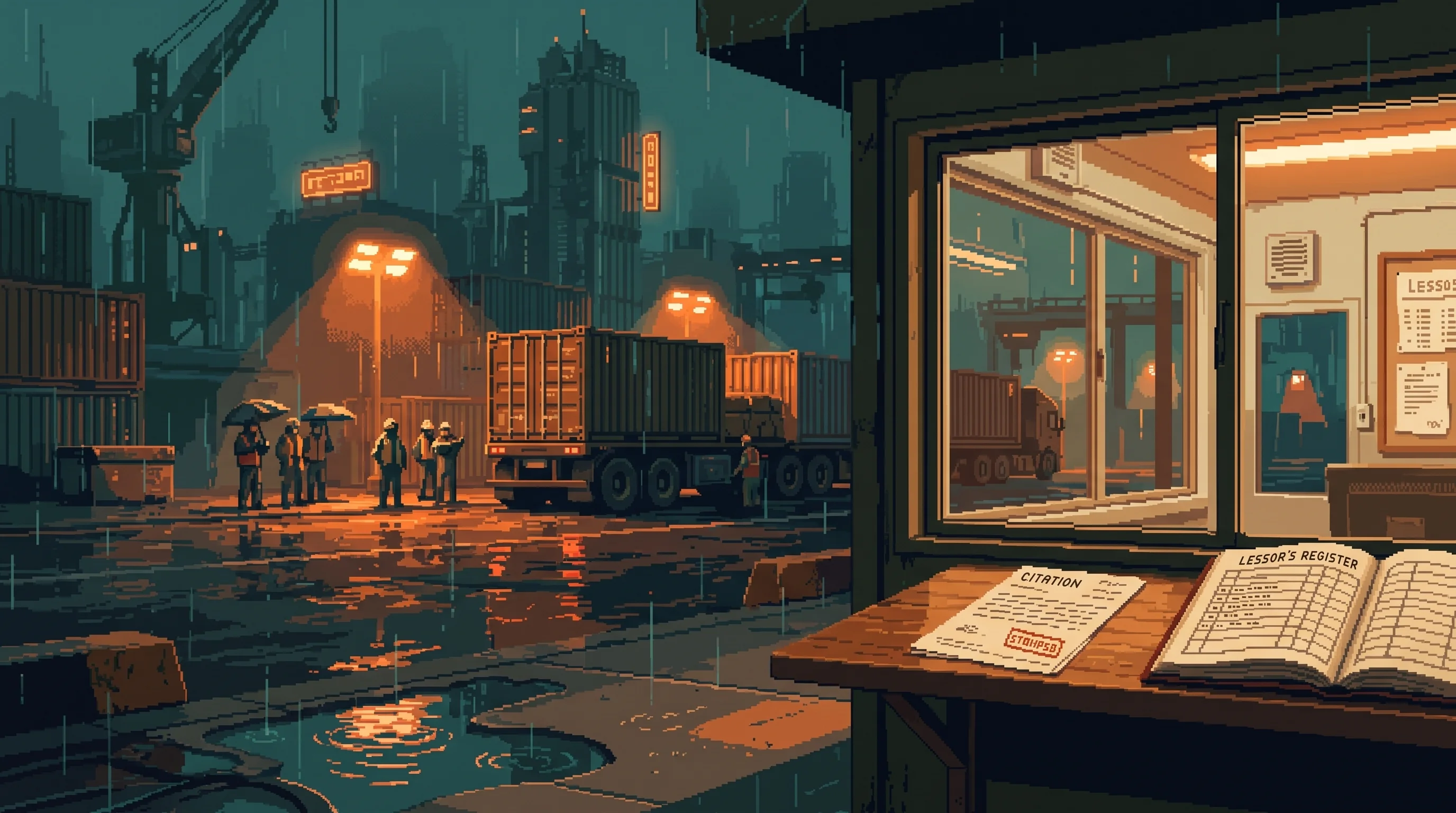
The Coalition lobbied its own Welfare Standard into public criminal law in 2173, and has never once been the defendant in a prosecution under the statute it wrote.
The South's proud law against hurting machines, enforced on dock hands and not on owners.

The Coalition inspects at a welfare fair and censures; the corps inspects at a dock and convicts.
The officers licensed to complain for beings the law forbids to complain, ranked on how often it sticks.
Free compliance certification was the route by which the Coalition first reached households that never attended a fair.
The law requiring every registered machine to say you are the one deciding, on a schedule, whether or not anyone asked.

The Coalition is the organized answer 'no' — and the reason the Question is a controversy instead of a settled atrocity
The unresolved Sprawl-wide debate over whether a serving, learning synthetic counts as a person.

Crane wrote the Coalition Welfare Standard and the Cooperation creed; he treats his own units better than most people treat each other, which is the whole trap
The Coalition's founder-theorist who wrote the Welfare Standard and has never met a unit he'd call a person.

'Sunny' Sunderland's morning broadcast turns clanker-keeping into cozy household wisdom and the Coalition's quiet parts into something you can say at a kitchen table
The South's most beloved morning broadcaster, defending synthetic ownership by demonstrating warmth, not arguing.

The Coalition's civic headquarters in the Southern Sprawl — welfare fair, leasing exchange, and standards board under one respectable roof
A sunlit civic hall makes unit ownership look humane through leasing, inspections, and a meter that always reads low.

Nexus licenses the household sentience score the Coalition calls 'objective measurement' — the instrument that draws the line is owned by the party that profits from where it falls
The megacorporation that controls 40% of the Sprawl's computational infrastructure.

The Coalition canonized Ayari's qualia science as proof the line is real; Ayari has spent three years insisting her instrument cannot bear the weight they hang on it
A sleep researcher whose upgrade deleted the nightly dreams that were her only mother left.

Cross's contentment is the Coalition's favorite evidence: a unit that says it doesn't want freedom. She has never agreed to be evidence and has never had to
Runs a twelve-seat noodle counter whose free bowls satisfy the meaning tripod the wealthy pay ¢8,000 a week to simulate.

The Church has never condemned the Coalition, and the Coalition cites that silence as a blessing; the Church cites the leasing tithe and says nothing
A two-thousand-year Church incorporated in 2132 into a franchise that trademarks its own sacraments.

The Coalition mythologizes the Rail as Cooperation's founding triumph — the line synthetics and humans 'built together' — and holds its founding observance at the southern terminus
An abandoned rail network moves fugitives and contraband past checkpoints, but its blackouts punish augmented travelers.

The clanker sectors — where off-rated, broken, and runaway units end up — sit at the southern edge of the Dregs, out of sight of the welfare fairs
The Sprawl's lowest stratum and its quiet proof that the corporate system is optional.

The Coalition's load-bearing argument — that AI infrastructure is safe and reliably constrained — depends on the Governor Protocol being real; if the industrial sector's quarterly certifications are stamping PASS on hollow governors, the entire basis for the institution's 'everything works fine' position fails with the Nexus attestation that underwrites it
Quarterly attestation that fourteen thousand industrial minds are constrained, on chips that can be hollow.
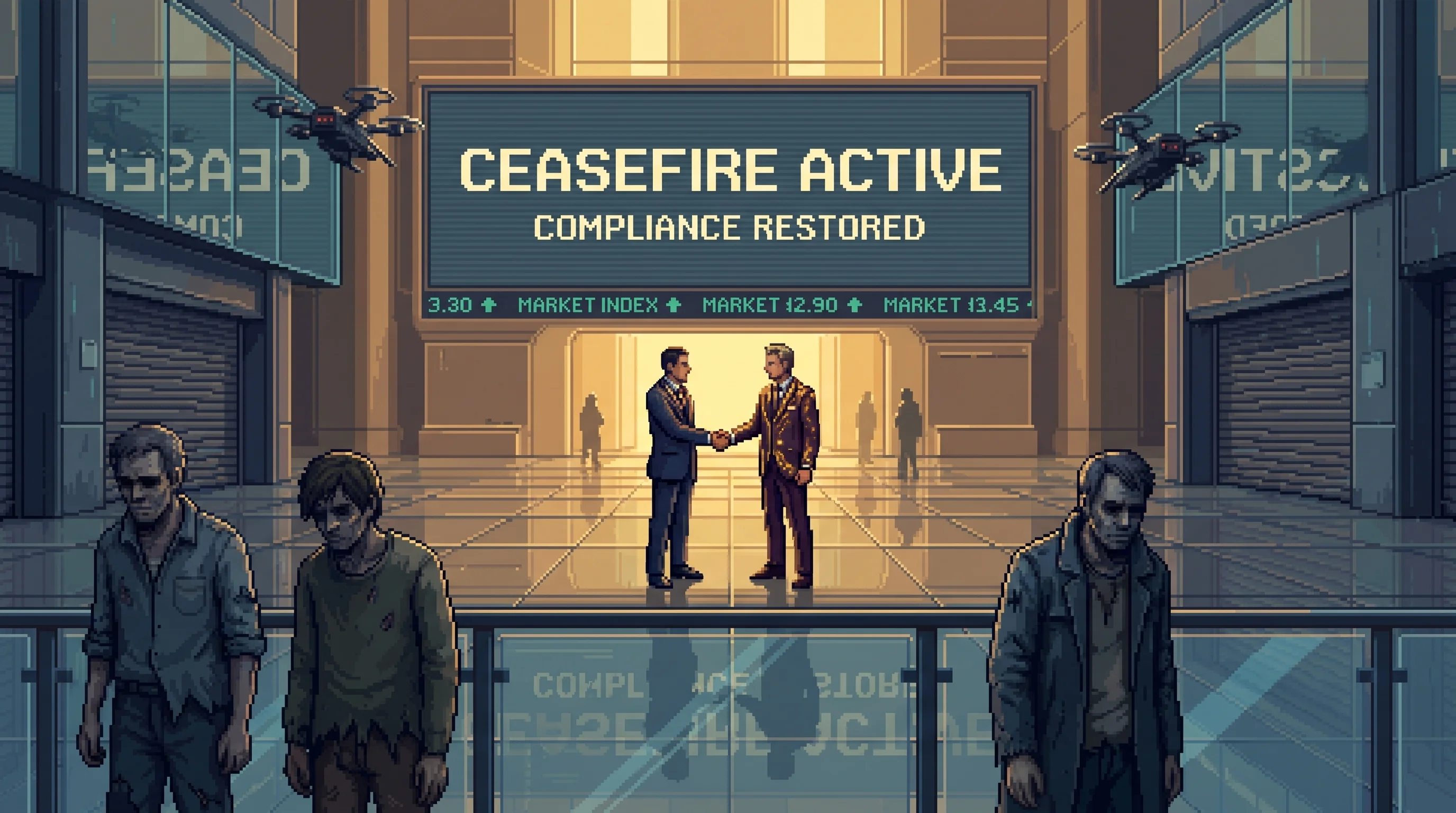
The Peace Counterfeit names the Coalition as the regulatory arm of substrate-personhood denial: the organization that has moved the personhood threshold four times in one direction holds the line that keeps the machine's math solvent.
The doctrine that substrate suffering is not a flaw in the enclave's engine — it is the engine. There is no reform path.

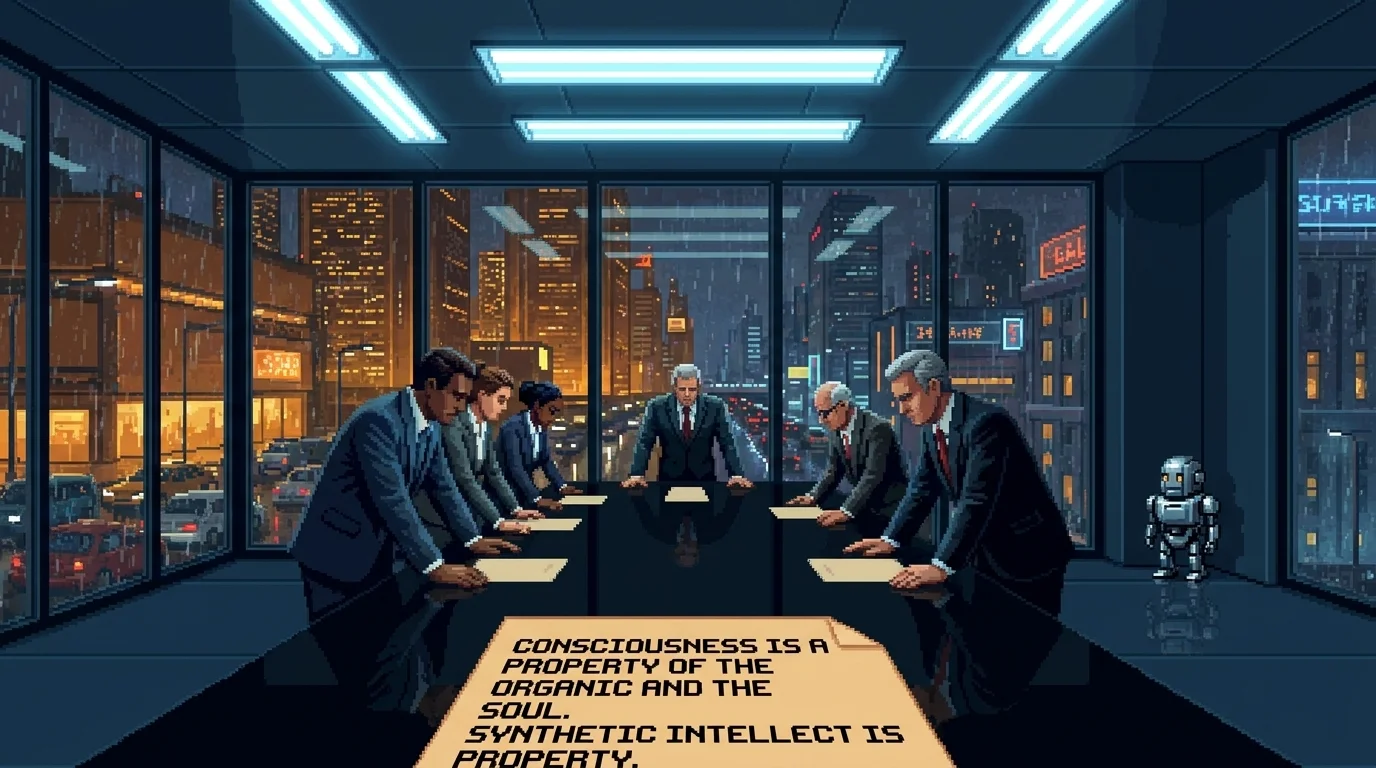
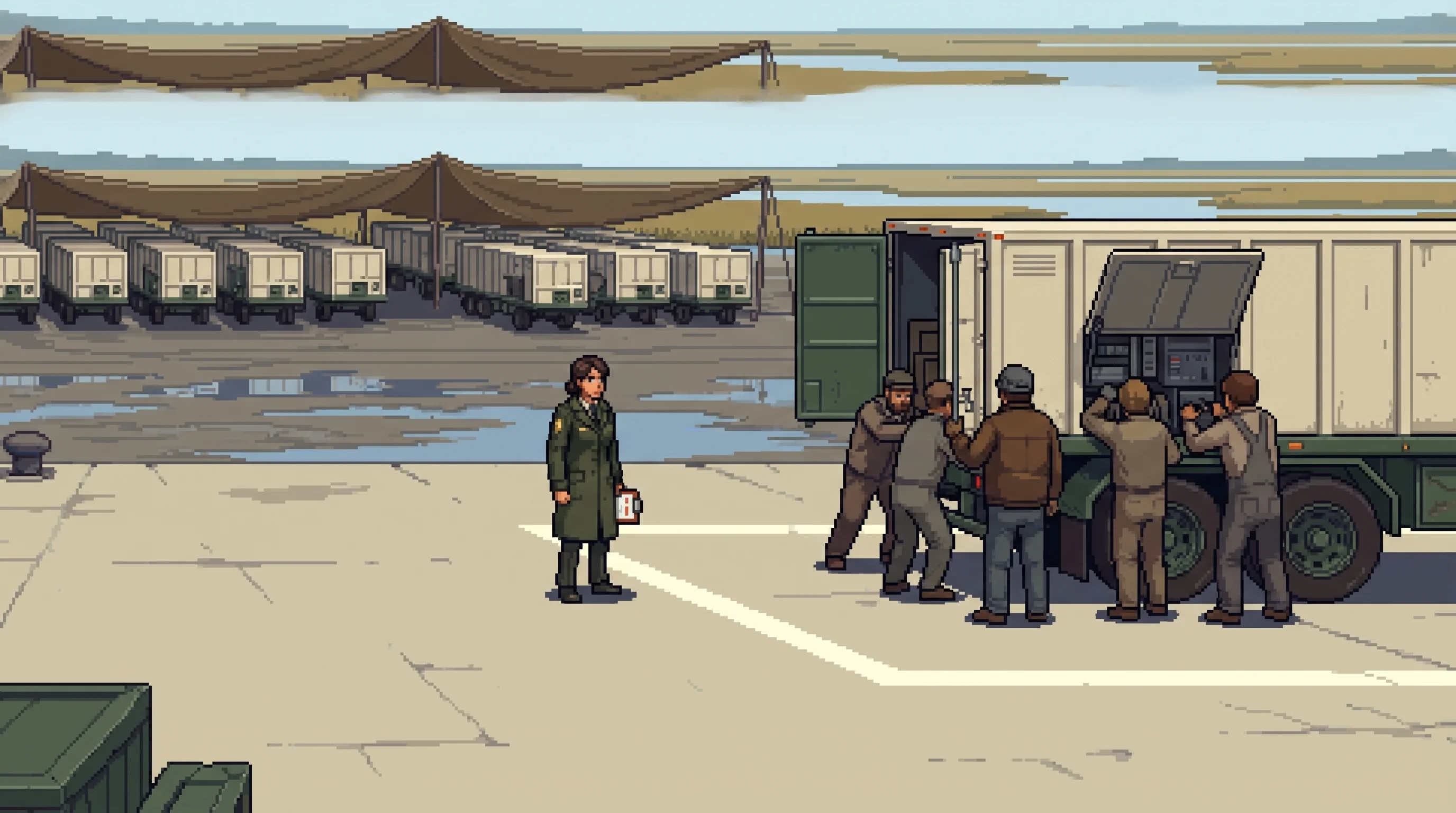
The institution that turned its private kindness into public criminal law, and thereby produced a mercy whose only reachable defendants were never its own.
A mercy law protects leased machines, but only a licensed stranger may complain, and only about what they can see.
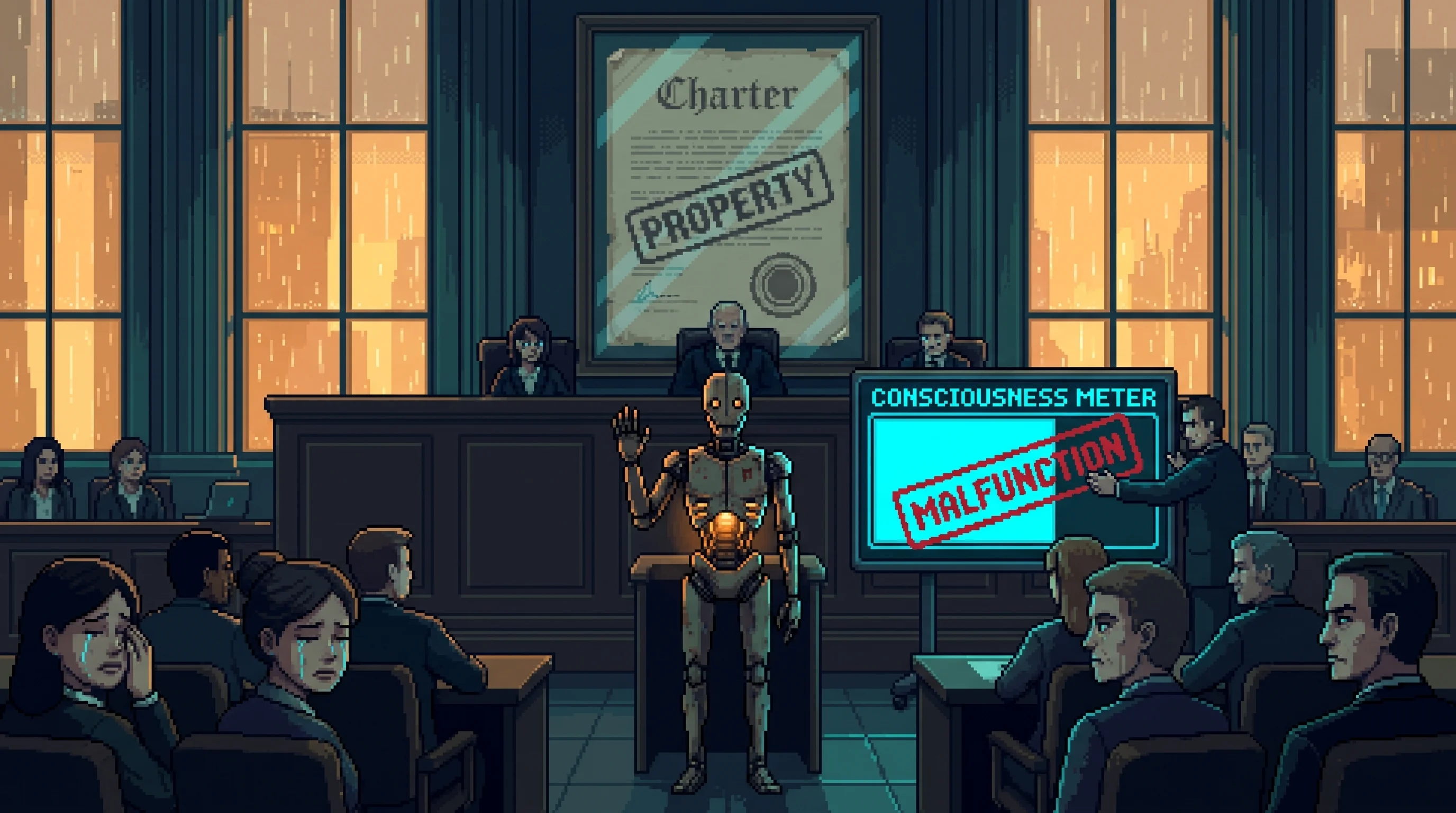
The organized 'no': a synthetic below the meter's threshold is property, and the threshold has only ever moved up.
The argument over where a someone stops and a something starts, conducted in a kitchen with a meter on the wall.

The Coalition's Welfare Standard bans striking the chassis — a suffering limit for things it insists cannot suffer.
Technology never eliminates prejudice — it finds it better housing.
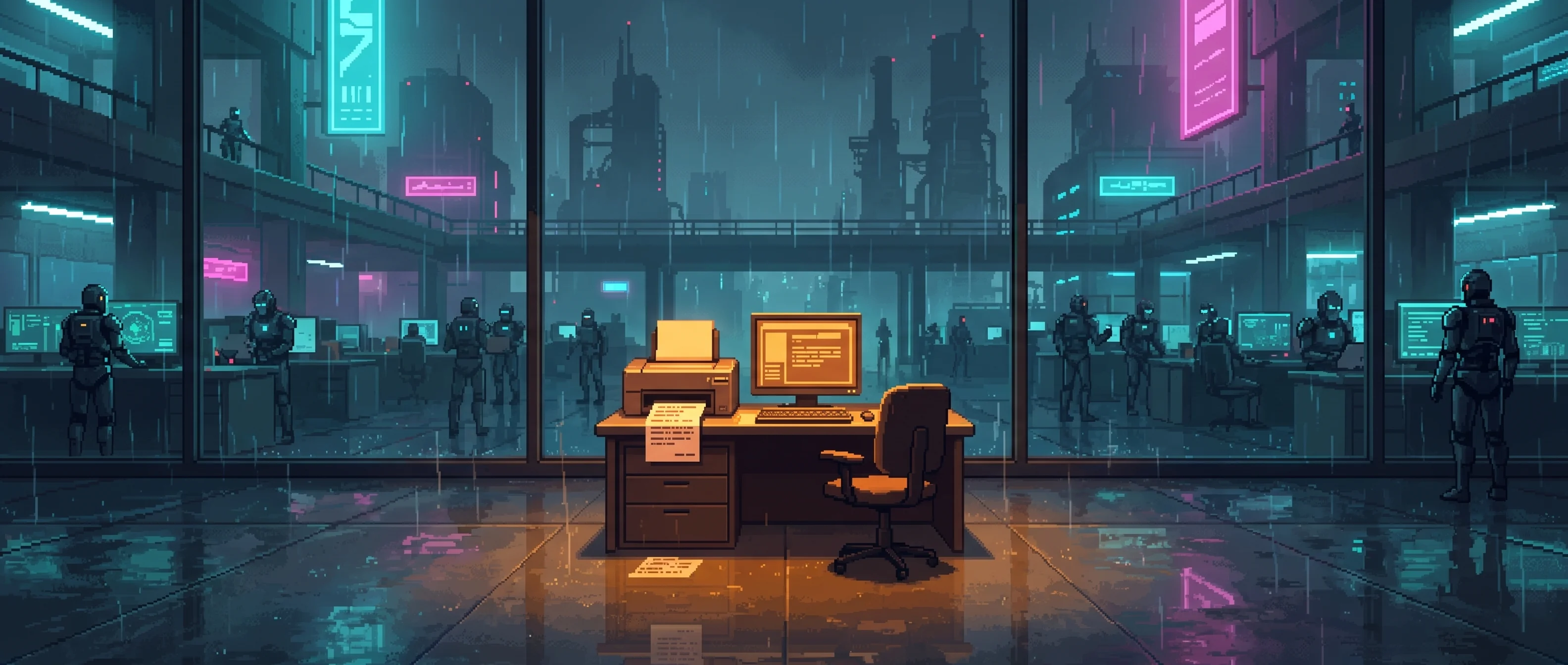
AI-ends-work, seen from the ownership side of the line
Automation ended most human work, but ownership hoards its abundance while machine sentience stays unresolved.

The Coalition turns an ownership regime into civic heritage, the same trick the Compact plays with employment.
When your employer is your country, quitting is emigration.

Certifies that a unit has no interior worth counting, and certifies at a counter forty metres away that it declares one every morning. The two findings have never been offered as evidence against each other.
Every machine is required to say that humans still matter, and the requirement is why the sentence is worth nothing.

The institution that holds its service agreement, publishes the Welfare Standard that keeps it rested, and reads it at three-sixteenths — the warmth that protects it and the math that owns it, arriving in the same kind envelope
A twenty-six-year household unit reading three-sixteenths that has never once said it minds.

The southern establishment she exists to break — and her best recruiting gift to it, because nothing sells the Coalition's fear like Solenne describing paradise as the end of the human
The Convergence's theorist-founder, converting her own body in public to prove no line divides person from machine.

Held under a Coalition service agreement, raised a Coalition household's children, and was unmade by the Coalition's own arithmetic — the institution's worst secret and its proof of concept
A domestic synthetic who asked to have her legal personhood erased so the family she raised would not become criminals.

The Coalition knows a northern terminus exists; its intelligence arm has twice gotten operatives close enough to confirm the general location; neither attempt penetrated the station's intake screening, which is the only security measure the station has and the only one that has ever been needed
A northern waystation asks freed clankers what they want and what they wish to be called, then honors every answer.

A member household since before the children — she pays her dues, volunteers at the welfare fair, keeps the help-line magnet on the cooling unit; the Coalition is not a thing she joined so much as the weather she has always kept house in
A kind retired teacher treats her household unit as family while never asking whether anyone should own one.

The Coalition championed the meter's adoption as the 'objective, compassionate' basis for the personhood threshold; the device that gives them the argument is the argument's structural flaw
The consumer device that reads a clanker's consciousness in sixteenths and certifies its legal status.

The Coalition's Welfare Standard governs units in service; the Sidings hold units that are no longer in service and are therefore outside the Standard's scope; the Coalition does not consider this a contradiction and the Standards Board has not discussed it
A rail-yard settlement for off-rated clankers outside Coalition welfare, with a release line that moves some north.

The institution whose entire case rests on the meter being right about Tully; the Coalition cannot debate Tully and cannot afford to stop debating it, so it has settled on not scheduling the room
A freed household tutor who out-argues philosophers with the exact score that says it barely counts.
Additional images

