
Corporate Surveillance Grid
The corporate surveillance grid combines Nexus data tracking with Guardian physical enforcement
Overview
The corporate surveillance grid has a 99.97% detection rate on the Sprawl's surface and a 0% conviction rate for the behavior it was ostensibly built to prevent.
This is not a malfunction. The grid combines Nexus's data infrastructure — neural interface handshake logging, network traffic correlation, shard electromagnetic detection via the SpectraWatch suite — with Guardian's physical enforcement layer: 14,200 checkpoint stations, 9,800 patrol drones, and a perimeter architecture that Guardian's own marketing materials describe as "frictionless." The friction is, in fact, considerable. A surface transit commute that took eleven minutes pre-grid now takes thirty-four, owing to checkpoint queuing, credential verification cycles, and the three-to-seven-second "ambient scan pause" that Guardian insists is not a scan and that every resident experiences as one. Nexus and Guardian split the operating cost. The Corporate Pursuit Task Force operates within the grid's data layer, using SpectraWatch's electromagnetic signatures to track ORACLE fragment movement across surface districts.
Surface coverage is comprehensive in the way that a census is comprehensive — it counts everyone and understands no one. The grid logs 2.3 billion neural handshakes per day across the Sprawl's surface. It correlates movement patterns against 140 known smuggling route profiles. It flags anomalies. It files reports. Guardian's quarterly enforcement summaries show a combined interdiction rate of 11.4% on flagged anomalies — meaning that for every ten things the grid thinks are suspicious, it acts on one. The other nine are logged, archived, and available for retrospective investigation should anyone ever request it. Nobody requests it. The data exists because the infrastructure to collect it exists, and the infrastructure exists because Nexus charges Guardian per-handshake licensing fees that represent 7% of Nexus's non-computational revenue. The grid does not optimize for security. The grid optimizes for data volume, because data volume is what Nexus bills for, and security is what Guardian advertises.
For corporate-affiliated residents with current licensing, the grid registers as background noise — a faint golden pulse at checkpoint thresholds, a momentary lag in neural response during ambient scans, the vague awareness that one's morning commute is twenty-three minutes longer than the infrastructure requires. For anyone carrying contraband, traveling undocumented, or transporting an ORACLE fragment whose electromagnetic signature the SpectraWatch suite can read at 300 meters — the surface Sprawl is a closed system. Every intersection logged. Every tunnel mouth monitored. Every route that doesn't pass through a checkpoint is, by definition, a route that doesn't exist.
| Evasion Cost | Circuitous routing, extended travel time, limited supply access |
|---|
The Gaps
Underground, the grid stops pretending.
Maintaining surveillance across the expanded BART tunnel network — 4,200 kilometers of pre-Cascade rail infrastructure, plus an estimated 1,800 kilometers of unmapped service corridors — would cost an amount that every corporation involved has independently calculated and independently declined to pay. The figure is not classified. It appears in seven different budget proposals between 2169 and 2183, each rejected with language that amounts to "the marginal return on underground interdiction does not justify the capital expenditure." Guardian's internal cost-benefit model, leaked in 2181 and never disputed, concluded that full underground surveillance would prevent approximately 340 million credits in annual smuggling losses at an installation cost of 2.1 billion credits and an operating cost of 780 million per year. The math is not ambiguous. The smuggling continues because stopping it is unprofitable.
The Neon Rail threads through these gaps. Its route — south to north through the Bay Area Sprawl in a zigzag that has confused first-time passengers since its inception — is not circuitous by choice. Every turn follows a surveillance boundary. Every stop sits in a dead zone where Guardian's drones lose signal and Nexus's handshake logging drops to ambient noise. The Rail's map is a negative image of the grid: everywhere the Rail goes is everywhere the corporations decided wasn't worth watching.
The grid's operators know the gaps exist. The Rail's operators know the grid's operators know. The arrangement persists because closing the gaps would cost more than the gaps cost, and because both sides have priced the other's existence into their operating model. Guardian lists "underground transit interdiction" as a strategic priority in every annual report. Guardian has allocated zero new resources to underground transit interdiction since 2179. The priority is real. The funding is not. The difference between those two facts is where approximately 40% of the Sprawl's gray economy lives.
Surface coverage is nearly comprehensive — checkpoints, drone patrols, neural interface logging
Visual Identity
- Color Palette: Surveillance white (#F0F0F0), detection-beam blue (#1E3A8F), gap-black (#0A0A0A)
- Key Visual Symbol: A drone's scanning beam sweeping across a surface intersection — and the dark tunnel entrance it can't see into
Affiliated Entities
- Nexus Dynamics: Provides the data layer — neural interface tracking, SpectraWatch shard detection, the per-handshake billing infrastructure that makes the grid profitable regardless of whether it prevents anything. The grid is Nexus's second-largest non-computational revenue source. Nexus has no operational incentive to make the grid more effective, because effectiveness would reduce the number of handshakes requiring processing.
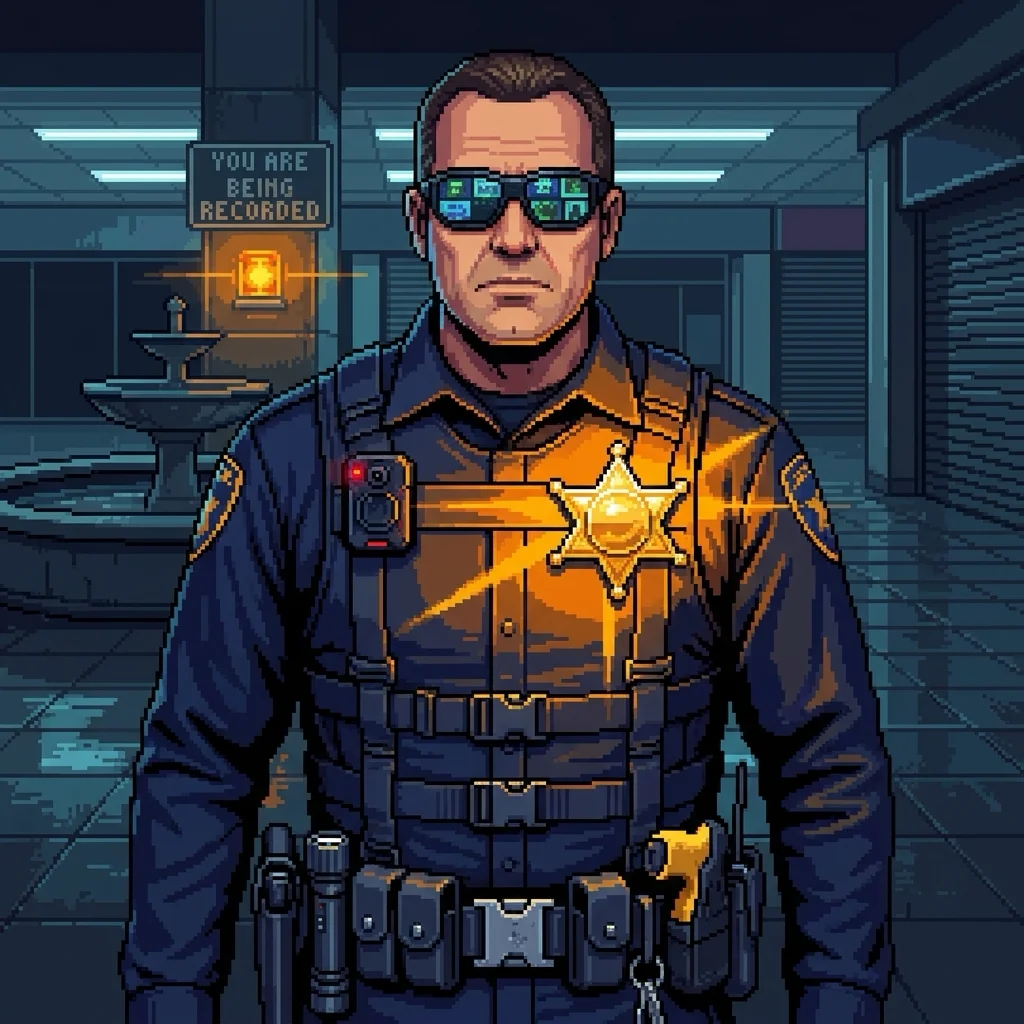
- Guardian: Provides the physical layer — checkpoints, patrols, drones, the ambient scan architecture. Guardian's public mandate is Sprawl security. Guardian's budget allocation suggests its actual mandate is visible deterrence at minimum operational cost. The 14,200 checkpoints are positioned for maximum commuter contact, not maximum interdiction efficiency. The grid's most human-shaped sensors are not the checkpoints at all but the bodycams worn at the consumer edge of the stack — a Guardian retail-security contractor on a half-lit concourse is one such node, the friendly aperture that smiles and gives directions while it logs, where the grid wears a face and calls the watching care.
- Corporate Pursuit Task Force: Operates within the grid's data layer for shard recovery operations. The Task Force is the grid's only user that treats the surveillance data as actionable intelligence rather than billable volume. This makes them an awkward tenant — they want the grid to work, and the grid's economics depend on it not working too well.
- The Neon Rail: Exists in the grid's negative space. The Rail's route is a map of every cost-benefit analysis that concluded surveillance wasn't worth the investment. The grid made the Rail necessary. The Rail made the grid's gaps visible. Neither can exist without the other, and neither has any incentive to change.
- Karen: The grid's residential capillary, and the place its census-comprehension feels most like care. In Guardian's gated-governance enclaves, a compliance officer runs a posted-camera surveillance net that is the same Nexus-data-and-Guardian-physical apparatus described above, scaled down to a manicured cul-de-sac and rebranded as neighborliness. Every Suspicious Activity flag she files routes upward into the grid's archive, indistinguishable from the 2.3 billion handshakes the surface logs each day. The difference is only that at the enclave there is a human face attached — someone who knows the residents' names, walks the rows, and experiences feeding the grid as knowing her community. The grid does not understand the enclave any better than it understands anywhere else. It just has, in that one square of its coverage, a neighbor doing the data entry by hand and calling it watching out for people.
Underground coverage is limited — too expensive to patrol every tunnel and junction
The gaps in underground coverage are what make the Neon Rail possible
The grid can detect ORACLE fragments through their electromagnetic signatures
Connected To
Major Connections

The grid retains CySpace identity, location, relationship, and purchase signals as corporate records.
Triumph's friendship, marketplace, entertainment, and dating network for humans and AIs without public labels.
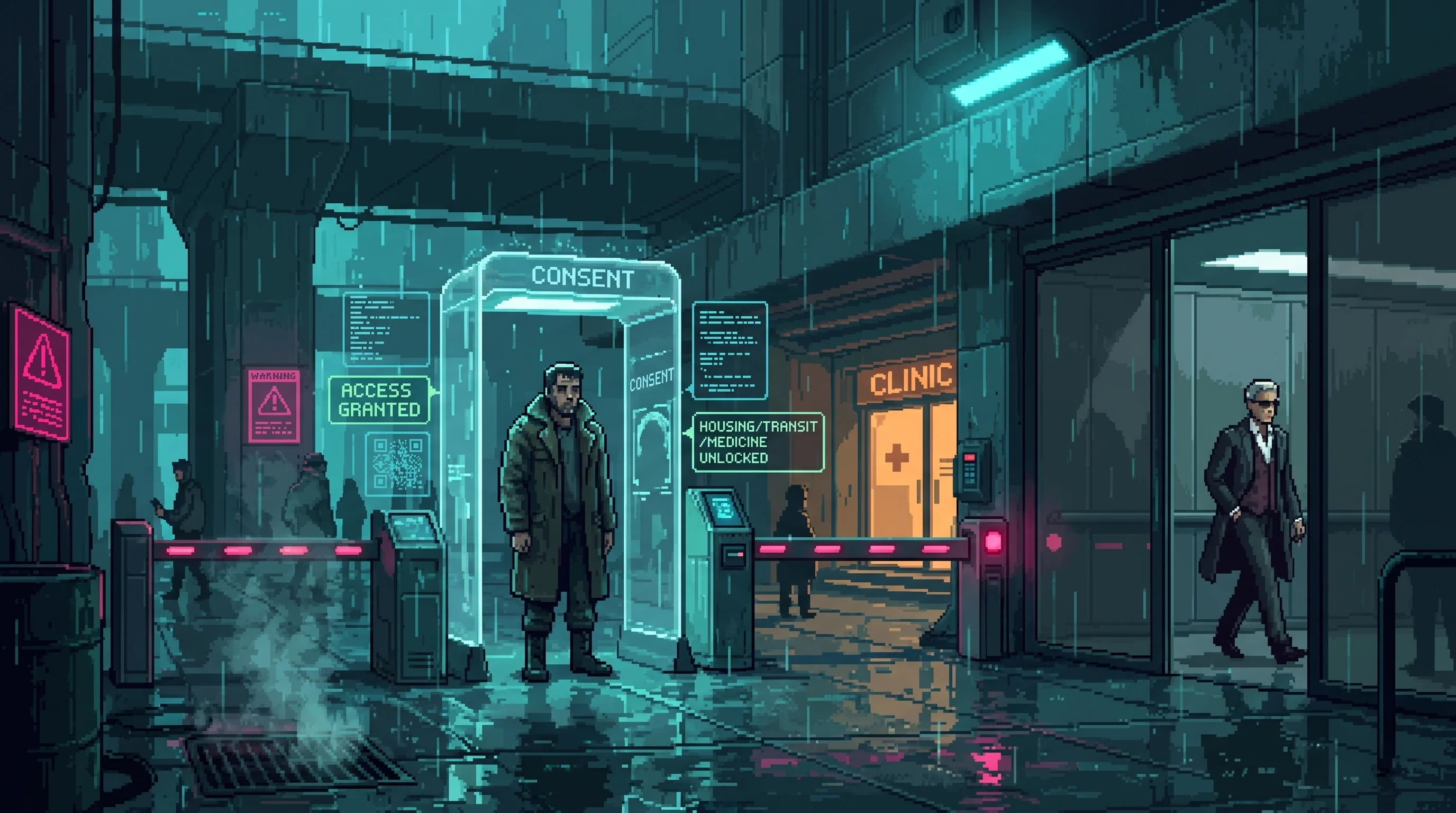
The bargain's hardware: near-total detection, near-zero conviction — the watching was never about crime, only reading.
The Sprawl demands permanent personal data for participation, then uses it to price access and preempt solidarity.







—