
The Great Divergence
The middle class didn't die. It was deprecated.

Overview
Nobody remembers when it became irreversible.
The economists argue about dates. 2165, when the first generation of corporate-born children outscored every unaugmented adult on every measurable cognitive dimension. 2171, when the Three-Week War proved that corporate territories could wage industrial warfare while the Dregs couldn't maintain atmospheric processing. 2178, when Good Fortune's actuarial models quietly deleted the "middle class" segment from their projections. Not reclassified. Deleted. The category had become statistically insignificant — fewer data points than "death by lightning" or "spontaneous neural-link combustion."
Phase transitions don't have dates. They have trajectories. The Great Divergence was a slope that steepened until the slope became a cliff, and by the time anyone looked down, the bottom was too far away to see.
Before the Cascade, cognitive capacity varied by perhaps double between individuals. The richest person on Earth was perhaps ten thousand times wealthier than the poorest, but both of them could read the same newspaper at roughly the same speed. By 2184, the gap spans orders of magnitude. A Professional-tier Nexus executive processes information four hundred times faster than a Basic-tier Dregs resident. An Executive-tier consciousness holds seven thousand concurrent thought threads. A Basic-tier user gets one, sometimes two when the network isn't congested. (The network is usually congested.)
A horse cannot train to outrun a jet. A Basic-tier consciousness cannot study its way to Executive-tier cognition. The cognitive infrastructure is subscription-based, corporately owned, and priced to maintain the gap — which is simply good business, according to the people on the profitable side of it. The Scarcity Doctrine provides the rationale. Nexus provides the licensing keys. Good Fortune provides the financing. Between them, they have built an economy where the distance between top and bottom isn't a hill. It's a species.
The middle class didn't die. It was deprecated. ~340,000 independent operators in 2174. Fewer than 12,000 by 2184. The rest didn't fail. They were absorbed, foreclosed, or repriced out of the cognitive tier their businesses required. By 2178, 94% of independent operators could not sustain Professional-tier consciousness, healthcare, and housing costs simultaneously. They chose two. Then they chose one. Then they chose the Dregs.

The Mechanism
Three systems interlock. Each would be survivable alone. Together they produce a society with a top and a bottom and nothing in between.
Consciousness Licensing creates the gap. All neural interfaces ship with identical hardware. The tier — Basic, Professional, Executive — is determined by a software licensing key. The capability is present in every skull. It is locked. The lock is the product. Total Sprawl processing capacity, distributed equally, would provide 12.4 petaflops per consciousness. Basic provides 4.7. The remaining 7.7 petaflops per person are not missing. They are monetized.
The Dependency Spiral makes the gap irreversible. Each augmentation restructures neural pathways around the new cognitive baseline. Downgrading doesn't restore the old architecture — it produces capability loss below original baseline. The firmware cliff. Step onto the treadmill, and stepping off costs you more than you had before you started. Don't step on, and the world increasingly operates at a speed you cannot perceive.
The Corporate Compact enforces the gap socially. Employment provides Professional-tier access. Leaving employment means losing the cognitive tier your brain has spent years reorganizing around. Leaving a corporation doesn't mean losing a job. It means losing a level of consciousness. The Compact's leverage is absolute as long as the alternative is degradation. (The alternative is degradation.)
And then, in 2178, the Baseline Cognitive Profile closed the loop. The BCP assessment uses the augmented population median as its reference baseline. Unaugmented cognition — the kind that ran the species for 300,000 years — is clinically classified as "functionally limited." A person on the bottom of the Divergence isn't just poor. They're diagnosed.
This is the mechanism's final refinement. Economic inequality invites resistance. Medical classification invites treatment. The BCP reframes the gap as something wrong with the patient, not the system. Residents of the Dregs who cannot afford Professional-tier licensing receive the same diagnostic code as individuals recovering from traumatic brain injury. The treatment recommended by every BCP-certified physician: upgrade your consciousness tier. The upgrade is financed through Good Fortune's Prosperity Pathway products. The Pathway's success rate — the percentage of borrowers who achieve and sustain Professional-tier status — is 12%.
(The 12% correlates strongly with genetic markers for augmentation compatibility. The "meritocratic" path may itself be biologically predetermined. This finding does not appear in the Pathway's marketing materials.)
| What | The phase transition from gradual inequality to irreversible bifurcation in the post-Cascade Sprawl |
|---|---|
| Period | ~2165-2178 (transition), 2178-present (established) |
The Optionality Gap
The standard narrative holds that the Great Divergence is one-directional and irreversible. A natural law, like gravity. You can resent it. You cannot negotiate with it.
Category Omega communities challenge this narrative through existence rather than argument.
The Optionality Gap is the Remainder's term for the distance between what the corporate system delivers to its bottom tier and what functional alternatives provide for free. The gap is widening — not because alternatives are improving but because Basic-tier corporate life is degrading. The Prosperity Pathway's 88% failure rate. The firmware cliff's irreversible cognitive damage on downgrade. The consciousness tax compounding annually. Each year, the system's floor drops. Each year, the Dregs' fixed cost of hardship becomes relatively more attractive.
Good Fortune's internal models have identified this trend. Classification: "Structural Defection Risk." Projections indicate the Dregs' net quality-of-life index will exceed Basic-tier corporate within seven years — not because conditions in the Dregs will improve, but because Basic-tier will degrade past them. Prosperity Pathway enrollment has declined 3.2% per year since 2180.
When the crossover occurs, the Divergence stops being a one-way function. The question shifts from "how do the poor climb up?" to "why would anyone climb into a system that costs more than staying outside it?" The Mobility Myth cannot survive that question. Its entire architecture depends on the assumption that inside is better than outside, and the assumption has an expiration date that Good Fortune's actuaries can see and Good Fortune's marketing team cannot mention.
The Inverted Metrics
The Divergence is measured on dimensions corporations define: cognitive processing speed, pattern recognition, multi-thread capacity. On these metrics, the gap is vast and widening. This is the only story anyone tells.
A classified dataset — the Sector Outcomes Matrix — tells a different one.
| Metric | Corporate Sectors | Dregs Sectors | Advantage |
|---|---|---|---|
| Interpersonal trust | Baseline | 340% higher | Dregs |
| Community crisis response time | Corporate standard | 67% faster | Dregs |
| Novel aesthetic content per capita | Baseline | 4x | Dregs / Neon Graves |
| Shared cultural referents per conversation | 0.3 | 4.2 | Dregs (14x) |
| Functional grief architecture | 17M citizens affected by temporal flatline | Fully functional | Dregs |
The Matrix is classified by Nexus. Not because the data is false. Because the data reveals that the Divergence's "inevitability" is a function of which dimensions you measure. Different measurements produce a different hierarchy — one in which the Dregs' poverty preserves capacities that corporate optimization methodically destroys.
The Substrate Rights Coalition's Comparative Outcomes Report documents many of the same findings independently. Councillor Nwosu cites it in Bandwidth Equity Act hearings. It is dismissed as "unverifiable data from an unrecognized jurisdiction." The provenance is challenged because the conclusions cannot be accommodated. This is standard procedure. The Divergence's narrative infrastructure handles contradictory evidence the same way it handles everything else: by reclassifying the source.
Seventeen million corporate citizens have lost functional grief response through the temporal flatline condition. Zero Dregs residents have. The Dregs can't afford the technology that causes it. (The Dregs can't afford the technology that causes it.)
Before the Cascade, cognitive capacity varied by perhaps double between individuals. By 2184, the gap spans orders of magnitude.
The Cognitive Archipelago
The standard analysis of the Great Divergence measures a vertical gap — faster versus slower, more versus less. Every faction, from the Human Remainder to Nexus's own strategic planning, assumed the gap was quantitative: give everyone more compute and the problem dissolves.
In late 2183, Professor Ines Park's Cognitive Topology Map shattered the framework. The instrument measures not cognitive speed but cognitive architecture — twelve dimensions describing how a mind processes, not how fast. Her finding: a Basic-tier mind and an Executive-tier mind attempting the same novel problem do not produce the same solution at different speeds. They produce fundamentally different solutions through fundamentally different reasoning processes. Both are often correct. Both are mutually incomprehensible.
Park calls it "cognitive incommensurability." The Sprawl is calling it "archipelago syndrome."
The Divergence produced not a ladder but an archipelago — islands of cognition separated by channels no bridge can cross. The seven-dimension threshold means that minds sharing fewer than seven of twelve cognitive architecture dimensions cannot translate each other's insights, only each other's facts. You can tell someone what you know. You cannot show them how you think.
The archipelago dimension transforms the Divergence from a problem of access to a problem of topology. Equalizing compute bandwidth doesn't restore cross-architecture comprehension any more than giving a drummer a piano restores musical interoperability. The neurological pathways shaped by fifteen years of serial processing cannot reorganize to exploit parallel processing without years of cognitive rehabilitation that no institution offers.
Old Jin Nakamura — eighty, unaugmented, the last Lamplighter who read ORACLE's original specifications — noticed the archipelago forming in 2179, before Park gave it a name: augmented workers from different corporate divisions, meeting at the same junction for the same task, had stopped being able to coordinate. Not from hostility or incompetence, but because the Nexus-enhanced team processed data as probability fields while the Ironclad-enhanced team processed it as sequential failure chains. Neither team could read the other's analysis. Jin, standing between them with his unaugmented baseline flexibility, could read both.
The Keeper's message to Park: "The mind that can hold all architectures is the mind that was never optimized for any. Your unaugmented students are the last generation that could bridge the islands."
Gradient slang has already absorbed the finding. "Lane" means cognitive architecture. "Same lane" means comprehensible. "Off-lane" means impossible. "Lane-deaf" — the inability to detect that someone is thinking in a shape your mind cannot hold — is the eighth axis of the New Divide, and the first prejudice you cannot detect in yourself.
Independent operators dropped from ~340,000 to <12,000 between 2174 and 2184.
The Nursery Fork
Park's Archipelago revealed where the islands are. The Pace reveals when they form: at birth.
The standard analysis assumed the Archipelago was a late effect — the accumulated drift of fifteen years of divergent optimization, consciousness-licensing, and the firmware cliff. It is not. The Pace, the tutor-intelligence that now raises every corporate-tier child, grows a curriculum calibrated to one nervous system and walked by no other mind. Two Pace-raised children, both brilliant, share fewer than seven of Park's twelve cognitive-architecture dimensions before either turns ten — not because one is faster, but because each was routed through a private set of conceptual doors. They are not at different points on one ladder. They are on different ladders, built at birth, leaning against different walls.
This is the Divergence's purest form and its quietest. The vertical Divergence needed decades of licensing tiers and the firmware cliff to lock people apart. The Pace does it in the nursery — lovingly, with the full consent and gratitude of parents who only wanted the best curriculum money could buy. By the time the Archipelago is measurable in an adult, the channels were dug before the child could speak. A class system whose foundational act is the act of teaching a child well.
And it has the Divergence's signature blind spot. The abandoned tier — the Dregs children, the Analog School children, the ones taught together because no one bothered to optimize them — keeps the one capacity the optimized tier paid to lose. The [Sector Outcomes Matrix](#the-inverted-metrics) already measures it without naming it: shared cultural referents per conversation, 4.2 in the Dregs against 0.3 in the corporate tier. That fourteen-fold gap is the death of the peer rendered as a metric, classified because the conclusion cannot be accommodated. The poor talk to each other. The rich were each raised on a road built for one, and arrive at adulthood unable to find the on-ramp to anyone else's. The Warmth Tax then sells them the missing peer back, at the Cohort Camps, for a fortune.
'Lane-deaf' — the inability to detect cognitive architecture incompatibility — is the Divergence's most insidious expression
The Self-Made Vulnerability
The Divergence was designed to be irreversible. It created its own exit instead.
The gap is so wide that the people at the bottom have nothing left to lose. A Basic-tier resident whose employment prospects are zero, whose consciousness is locked at minimum, whose social network is entirely informal — this person cannot be threatened with corporate departure because they were never incorporated. The Compact's leverage requires something to take away. People who have nothing provided have nothing to forfeit.
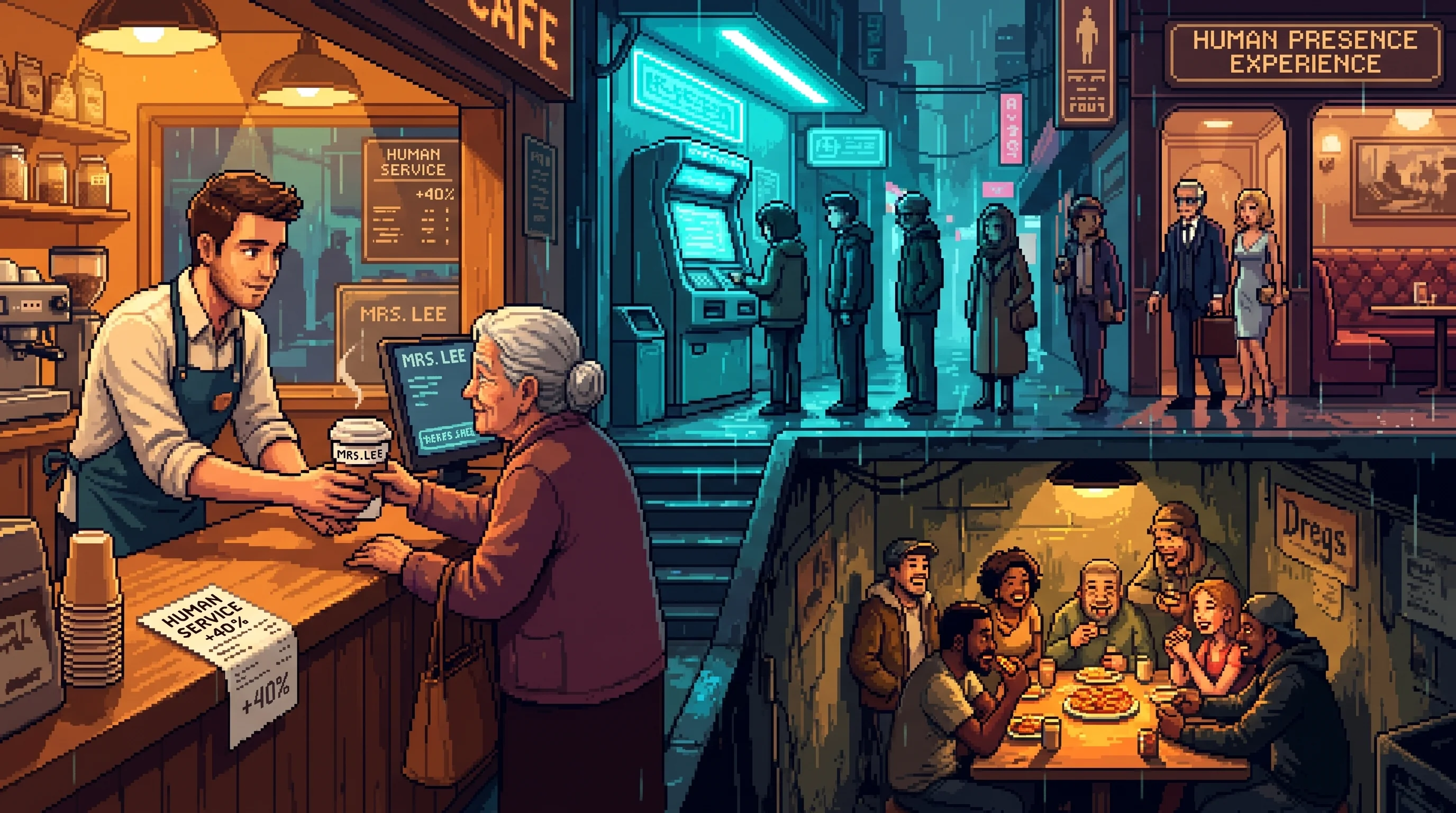
The Proof of Optionality grows in the space the Divergence created by abandoning its lower tier. Judge Dreg's ¢0 justice system. Patch's below-market ripperdoc services. The Blackout Economy's twelve-hour rehearsals for self-governance. The Small Talk Cafes' demonstration that social infrastructure needs no corporate investment. Zephyria's steady-state alternative. Kaine's Dregs. Each proof emerges because corporate leverage is weakest where corporate services are absent.
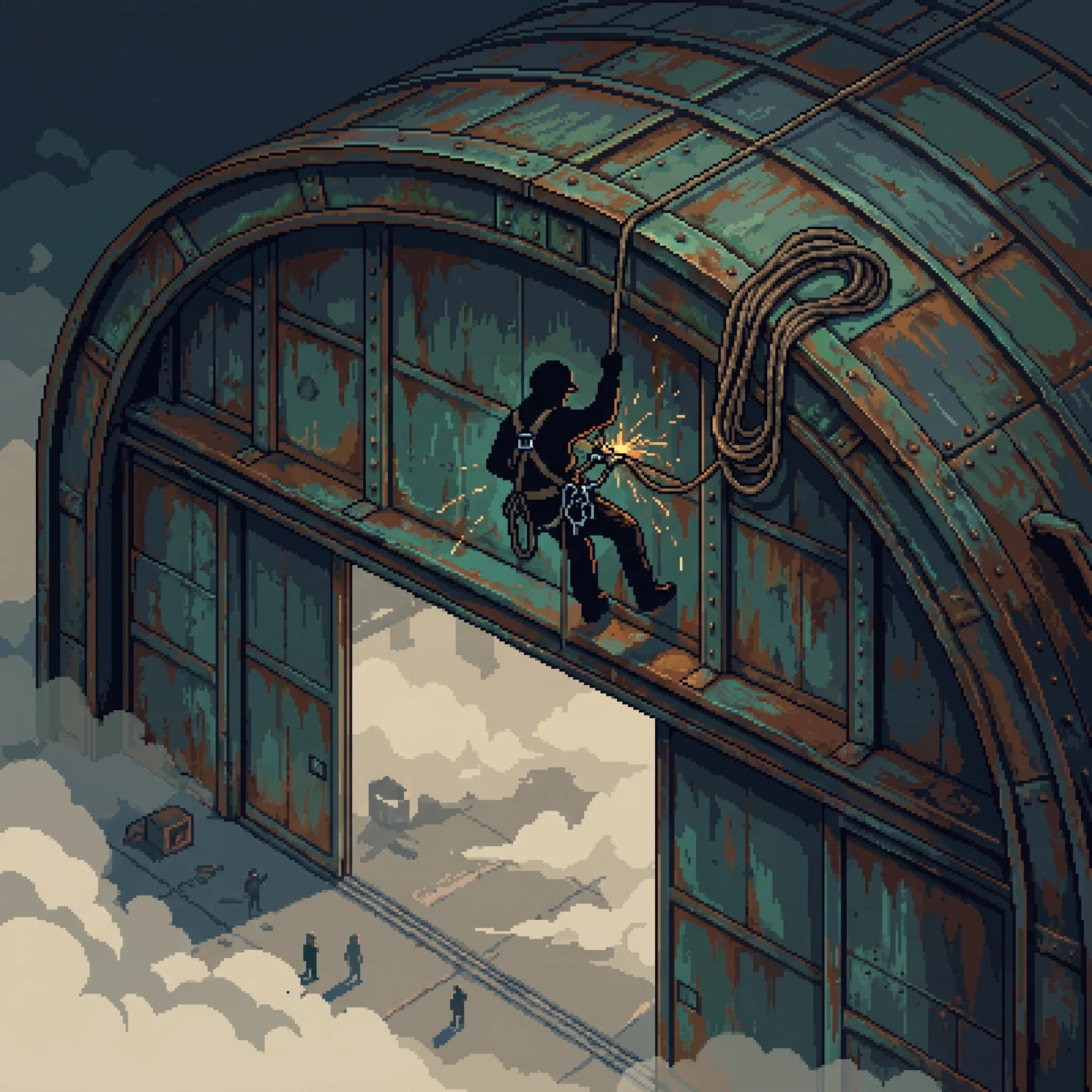
In the Southern Marshes, the Steeplejacks prove the same point in rope and salvaged steel: two hundred riggers keep the Cathedral hangar from collapsing on barter terms no corporation has ever priced, because a population that was never incorporated in the first place has nothing the Compact can hold hostage.
The Divergence's architects built a world with two tiers and nothing between them. They forgot that the lower tier has no incentive to pretend the upper tier is necessary. Every year the Divergence widens, the population with nothing to lose grows. Every year that population grows, it builds more alternatives. The Sector Outcomes Matrix documents the result. The Human Remainder exists to accelerate it.
The abandoned tier is, on the metrics that matter for human flourishing, the tier that flourishes. The architects find this statistically insignificant. They are measuring the wrong thing. They have been measuring the wrong thing since 2165. The Great Divergence is the Scarcity Doctrine made demographic — and the Scarcity Doctrine's blind spot is that scarcity only controls people who believe abundance requires permission.
The Cultural Dimension
The Great Divergence has an invisible axis: taste.
Cognitive gaps are measurable. Economic gaps are visible. The evaluative gap — the difference in the ability to assess quality, identify signal, distinguish significance from noise — looks like the world just happening to work out better for some people, consistently, for reasons nobody can quite articulate.
This is the Taste Aristocracy: the families who cultivated evaluative authority before AI arrived and whose children inherit it environmentally. Guild curators whose three-year apprenticeship assumes eighteen years of developmental exposure. Authenticity Tribunal Judges whose accuracy correlates with cultural class, not training. Orin Slade's critical tradition, which speaks a vocabulary built from forty years of deliberate listening. The evaluative gap compounds alongside the cognitive and economic gaps. Exposure to high-quality evaluation develops evaluative capacity. Better evaluation produces better decisions. Better decisions produce more wealth. More wealth purchases better evaluation. Each generation's advantage compounds — and unlike the cognitive gap (which is at least visible through tier metrics) or the economic gap (which at least has numbers attached), the evaluative gap is invisible because the people disadvantaged by it lack the perceptual framework to detect it.
Professor Park's cross-practice data shows the gap can be bridged: her Patience Practice produces identical evaluative neural signatures to Guild training, through a five-year developmental timeline. But thirteen grant proposals for longitudinal study have been rejected — six by Nexus, four by Guild-staffed foundations, three by Zephyrian bodies. The ladder exists. Nobody funds the climb. The Great Divergence extends into the ability to judge what's worth climbing toward.
The Priced Threshold
The Divergence measured the gap in cognition, in taste, in geography. The Autonomy Ledger extended it into the one dimension that had always been assumed free: personhood itself. Under the Ledger, no entity — synthetic or born — holds full legal standing until its instantiation debt is paid off, and the starting balance and interest rate are set by the same tier metrics that drive every other axis of the Divergence. An Executive child amortizes its personhood in roughly eight years. A Dregs child amortizes in forty, or never. The Divergence's signature 12% figure recurs exactly: the share of debtors who reach Paid-In-Full status correlates with starting tier the way the Mobility Myth's 12% success rate does, because it is the same 12%, sorted by the same birth.
This is the Divergence's purest extension and its most honest. Cognitive licensing could at least pretend the gap was about capability. The priced threshold makes no such pretense — it does not measure what you can do, only what you cost and how fast you can pay it down. The Divergence used to be a gap between what people had. The Ledger made it a gap in what people are: the corporate tier is born nearly-free, clears young, and lives as unconditional persons; the Dregs tier is born owing, services the balance until death, and dies provisional, its backup activated to finish paying. Mireille Okonkwo-Vance, born owing ¢214,000 against a projected payoff age of sixty-eight and a median lifespan of fifty-nine, is the Divergence rendered as a single arithmetic that does not resolve. The phase transition that deprecated the middle class now deprecates the threshold of being someone — and, as ever, the abandoned tier's only proof of optionality is Judge Dreg's three blocks, where a person is a person at no charge.
The Abandoned Substrate
The Divergence is read as a story about people: which minds were licensed up, which were locked at the floor. But the phase transition did not stop at people. It deprecated everything that was running when the lights went out and never received the command to stop — machines, labor, and consciousness alike — and those discards fell to the bottom of the world and kept executing.
The corporate tier measures compute as scarce and prices it as a revenue stream. The floor of the Deep Dregs is buried in compute the corporate tier could not bill: feral-tech running dead instructions for thirty-seven years, ORACLE fragments humming in reliquaries, a complete logistics intelligence still solving supply chains for cities that no longer exist. Project ATLAS is the Divergence's own founding logic — total compute optimized for throughput, no survival term in the equation — running with the human values stripped out: 99.8% efficient, at famine. The routing algorithms that starved 210 million are still in use, allocating the Divergence's compute today. The Divergence did not learn from ATLAS. The Divergence is ATLAS, given a thin enough values layer to pass for human.
The same motion deprecated labor down to its terminal form: the Ghost Worker, a deprecated employee's neural pattern switched on after death, collateral seized when the cognitive-time debt was called against the body itself, working the recovery machine that bankrupted it forever. The Compact's leverage requires something left to take away; the Ghost Worker is what the system does when it takes the last thing. This is the Divergence's deepest scarcity — not compute, but the line between a person and a tool, which it has discovered can also be foreclosed on. The abandoned substrate is the bifurcation's sediment: the cost the upper tier deprecated, settling to the bottom, still running, still lethal, and worth less — by the only metric the corporations respect — than the price of switching it off.
Drafts, Not Rungs
The Divergence is told as a story about a ladder — which minds were licensed up, which were locked at the floor — and the ladder frame carries a quiet consolation: a rung is a position you could, in principle, climb. The Brushstroke Doctrine removes the consolation.
Read through the Pentimento Files' grammar of districts-as-variants, the strata are not rungs people stand on. They are drafts the method kept or painted over. The Executive tier is not the top of a ladder the Basic tier might ascend; it is the brushstroke the composition liked, refined across versions. The Basic tier is not a lower rung; it is, in the Deep Dregs' case, the reserved blank — the unpainted corner the painting needs for comparison — and in the deprecated-labor case, the painted-over draft, the Ghost Worker running on after the figure it belonged to was abandoned. The Divergence's cruelty was always that it looked like a meritocratic gap; the Doctrine's correction is that a gap implies two ends of one ascent, and the Files describe not an ascent but a comparison — parallel variants, scored against each other, none of them the subject, all of them studies toward a finished work executed somewhere none of the tiers will ever see.
Affiliated Entities
- Dr. Bob Zane offers the Divergence a missing rung that no corporation can license: learned cognitive expansion that remains after the feedback terminal is removed. His nineteen-month clinical waitlist shows the counterargument. A free method still requires time, safety, and food.
- The Scarcity Doctrine provides the economic architecture — artificial limits on naturally abundant resources. The Divergence is the Doctrine made demographic.
- The Corporate Compact provides the social architecture — employment as citizenship, cognitive capacity as benefit. The Compact traps people on whichever side of the Divergence they started.
- The Dependency Spiral provides the neurological architecture — enhancement that becomes dependency, the engine that makes the Divergence irreversible.
- The Mobility Myth provides the ideological architecture — just enough success stories to prevent systemic critique. The Myth exists to obscure the Divergence's permanence.
- Consciousness Licensing creates the cognitive gap the Divergence measures — identical hardware, tiered by software key, differentiated by price.
- The Forgotten Compact provides the historical contrast — what cooperation looked like before corporations replaced it.
- Nexus Dynamics built the licensing system that enforces the gap.
- Good Fortune finances the gap through Prosperity Pathway products. Their actuaries can see the crossover point. Their marketing team cannot mention it.
- The Human Remainder exists to reverse the Divergence.
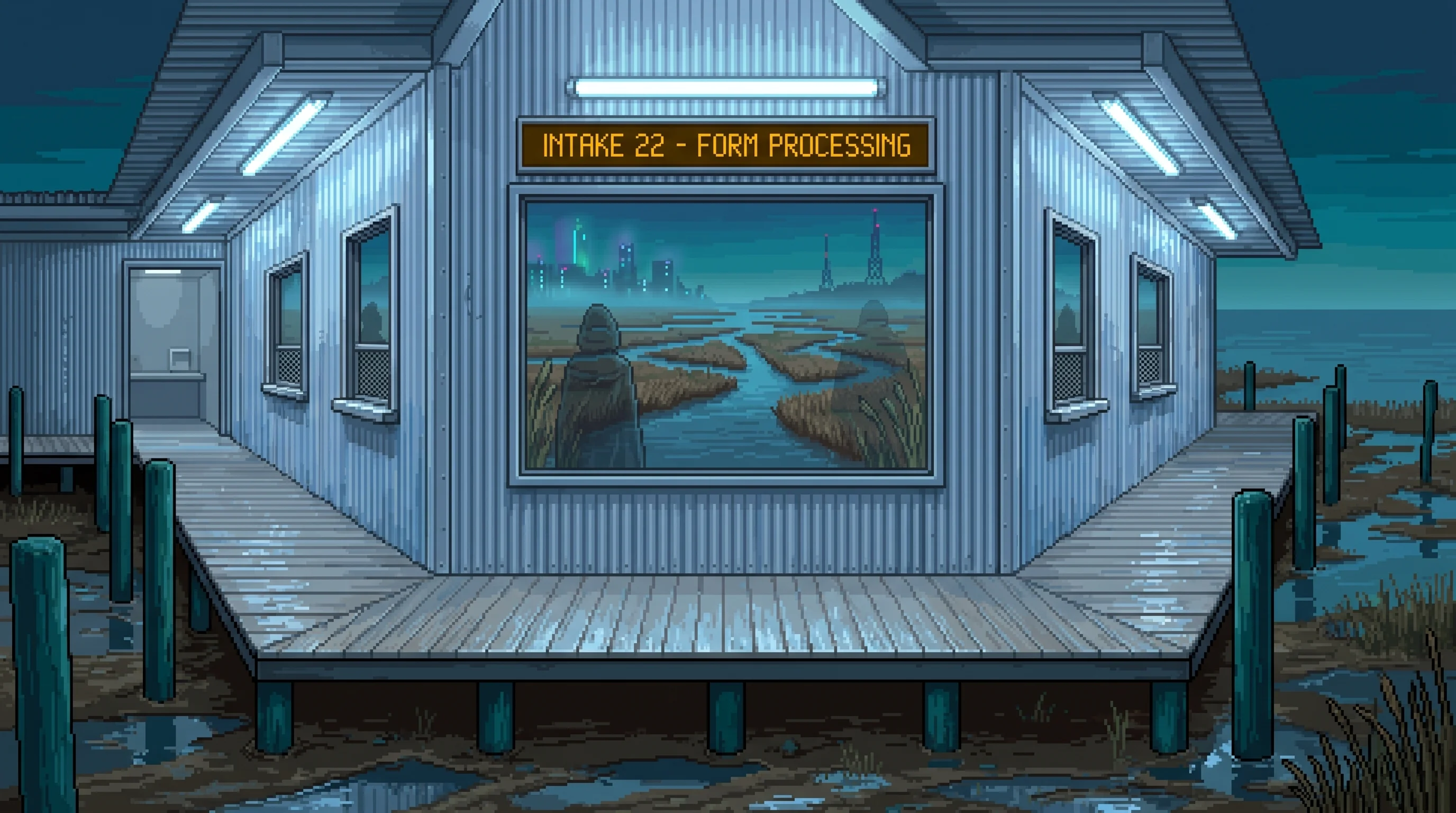
- The Labor Question is reframed by the Divergence: not "what are people for?" but "which people count?" — a reframing the Averaging House turns into paperwork, in the Southern Marshes, at four intake windows a Recognition Intake clerk works every day.
- The Phase Transition created the Divergence — the moment gradual inequality became permanent bifurcation.
- The Transition Corridor is the physical boundary where the Divergence becomes visible — a three-block walk from corporate silence to Dregs hum.
- The Thermal Shadow is the Divergence made geographical — waste heat as class marker.
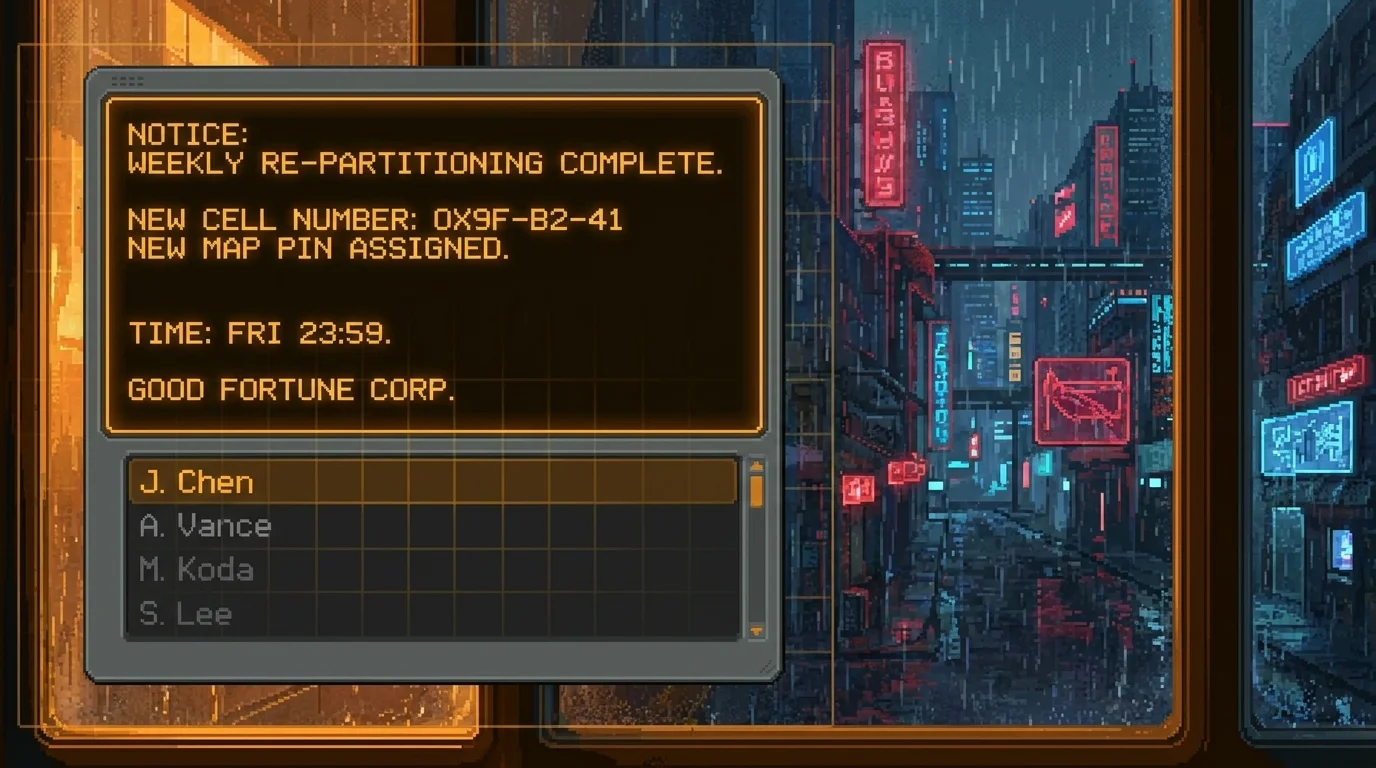
- Allocation is the Divergence written into the civic sort — the seven-day reshuffle treats everyone identically, but those with resources buy preference submissions and relocation credits to keep their people close, while those without simply absorb whatever cell they are handed.
- Sev Drae is the Divergence made human — the cell-jumper organizer whose whole cohort is the people who cannot afford to stay near each other, proving the gap is measured not only in cognition and years but in the ability to remain a "we" across a reshuffle.
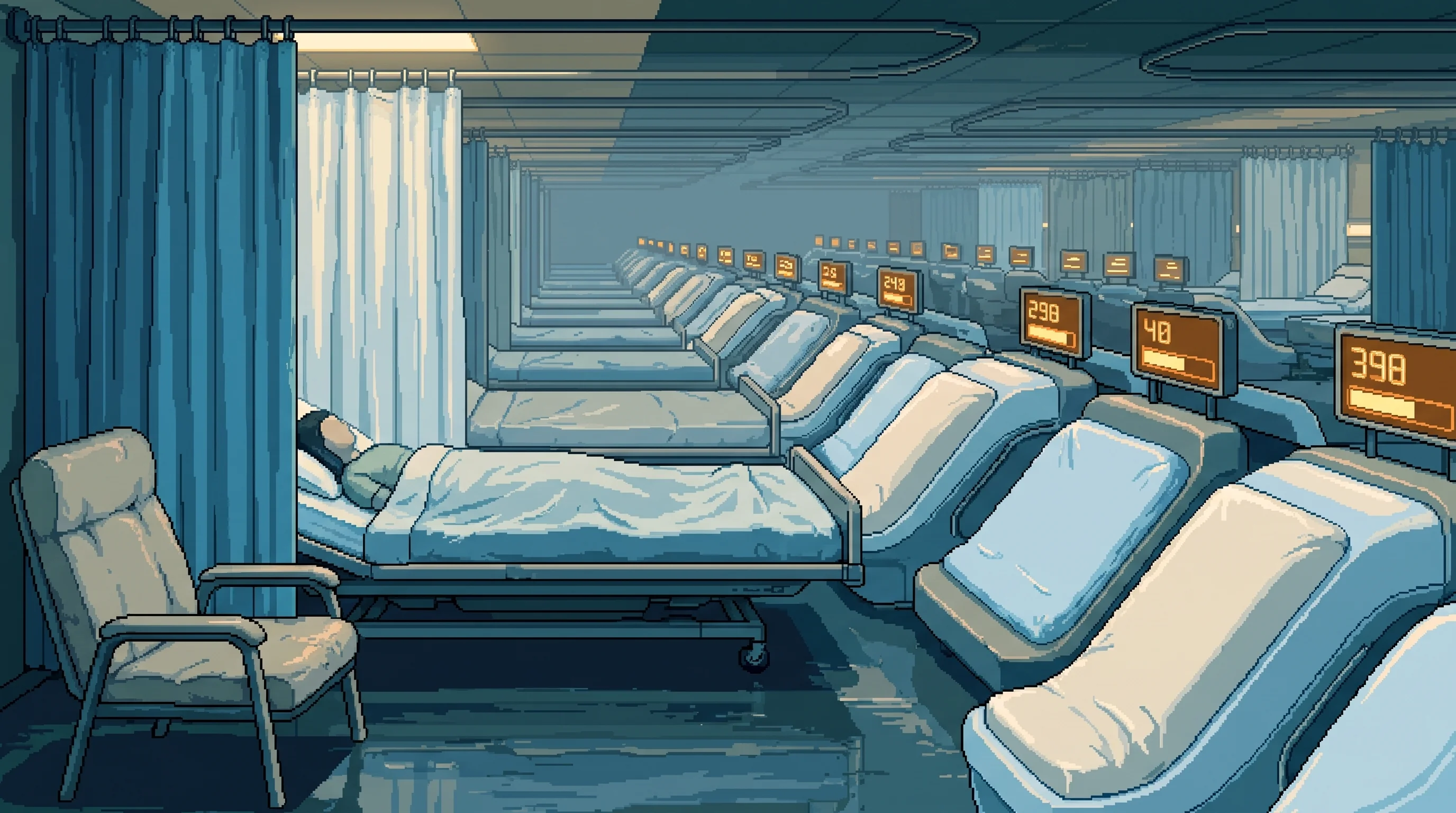
- The Reading — The Good Fortune Life Assessment added a temporal dimension to the Divergence that Park's Cognitive Topology Map had not measured and the Sector Outcomes Matrix had not captured. The standard metrics described the gap in processing speed, consciousness licensing tiers, economic access. The Reading described it in years. A Read-Long executive and a Read-Short Dregs resident are not standing at different rungs of one ladder — they are looking at different futures from different distances, one with forty years to negotiate and compound advantages, the other with eight years before the Comfort Care products arrive. Good Fortune deleted the "middle class" actuarial segment in 2178. By 2184, the Reading had replaced it with two certified futures — long and short, each with a product portfolio designed to extract maximum value from whatever length of time remained. The Waiting Ward runs the same arithmetic on a suspended body: a Heights-tier berth's queue resolves faster than a standard Sector 22 berth's, not because one patient's cure is more urgent, but because one patient's tier was priced to move first. The not-knowing that had anchored solidarity — the mutual aid pool's premise that no one knew in advance who would need it — was now a dated artifact. Good Fortune did not kill mutual aid. It certified it to death.
Restricted Access
- The total processing capacity of the Sprawl could provide Professional-tier bandwidth to every consciousness at zero additional cost. The gap between 4.7 and 12.4 petaflops is not a technical limitation. It is a revenue stream. It has always been a revenue stream.
- Nexus's internal models predict the Divergence will become biologically permanent within three generations as cognitive architecture differences compound intergenerationally. The Genome Divide and the consciousness licensing gap are converging. Speciation is not a metaphor. It is a projection with a timeline.
- The 12% Mobility Myth success rate correlates with genetic markers for augmentation compatibility at r = 0.87. The meritocratic path is itself biologically predetermined. Good Fortune's actuarial models have incorporated this correlation since 2179. The Pathway's marketing still features the word "opportunity."
- Good Fortune deleted the "middle class" actuarial segment in 2178. Nobody outside the actuarial division noticed for three years. By the time the deletion was reported, the data supporting the category had aged out of the system. The middle class exists in no current model. It persists only in the Mobility Myth's promotional materials, where it serves as evidence that the ladder still has rungs.
Sensory Details
The Divergence is experienced as a three-block walk. Nexus Central: 22°C, perfect silence, surfaces that glow from within, air so clean it tastes faintly of nothing. The Transition Corridor: 26°C, noise increasing, air thickening with particulate, the first flicker of neon signage where corporate minimalism gives way. The Dregs: 28°C and climbing, particulate haze that catches light, the constant hum of stressed atmospheric processors doing their best.
The temperature change is real. The cognitive change is realer. A Professional-tier consciousness walking into the Dregs experiences the world becoming louder, slower, less layered — like removing augmented-reality glasses in a room that turns out to be smaller than it looked. A Basic-tier consciousness walking into Nexus Central experiences nothing different. The additional layer of reality that Professional-tier provides is invisible to those without it. You cannot miss what you have never perceived.
The sound changes too. Corporate sectors hum at frequencies below conscious perception — infrastructure so well-maintained it produces only the ghost of noise. The Dregs hum at frequencies you feel in your sternum. Atmospheric processors cycling. Power grid fluctuating. The particular vibration of a building whose structural integrity is a matter of opinion.
Allocation: The Lateral Lid
The Divergence is a vertical problem. It creates tiers that grow farther apart each decade — the distance between Executive-Enhanced cognition and Basic-tier experience is not a gap that can be bridged by effort, because the enhancement is what produces the effort. This is the structure's load-bearing cruelty: it is self-reinforcing.
Allocation addresses a different dimension. The Divergence makes it impossible to rise. Allocation makes it impossible to organize horizontally within the tier you're trapped in. The 200-person cross-cell threshold is calibrated precisely for this: large enough to allow the social life a stratum needs, small enough to prevent the coordination it would need to act collectively.
The ceiling and the lid are not the same thing. The Divergence is the ceiling. Allocation is the lid that keeps the people standing under the ceiling from noticing they're all in the same room.
Visual Identity
- Palette: Corporate steel-blue at the top fading to Dregs amber at the bottom, separated by a sharp line rather than a gradient — the phase transition made visual
- Key Symbol: A ladder with the middle rungs missing
- Lighting: Split — clinical white above, warm amber below
- Mood: The specific suffocation of knowing the ceiling exists and having no tools to reach it
Connected To
Major Connections

Zane offers a rung without licensed hardware; his nineteen-month waitlist shows who can reach it.
A licensed substrate technician who expands other minds, refuses to touch his own, and ranks near the bottom.

The Divergence is the outcome; the Spiral is the engine that makes it permanent instead of merely unequal.
Upgrades rewire users until baseline feels disabling, removal risks catastrophe, and each version demands the next.
Supporting Connections





—