LOCATION FILE
Sprawl Districts
Overview
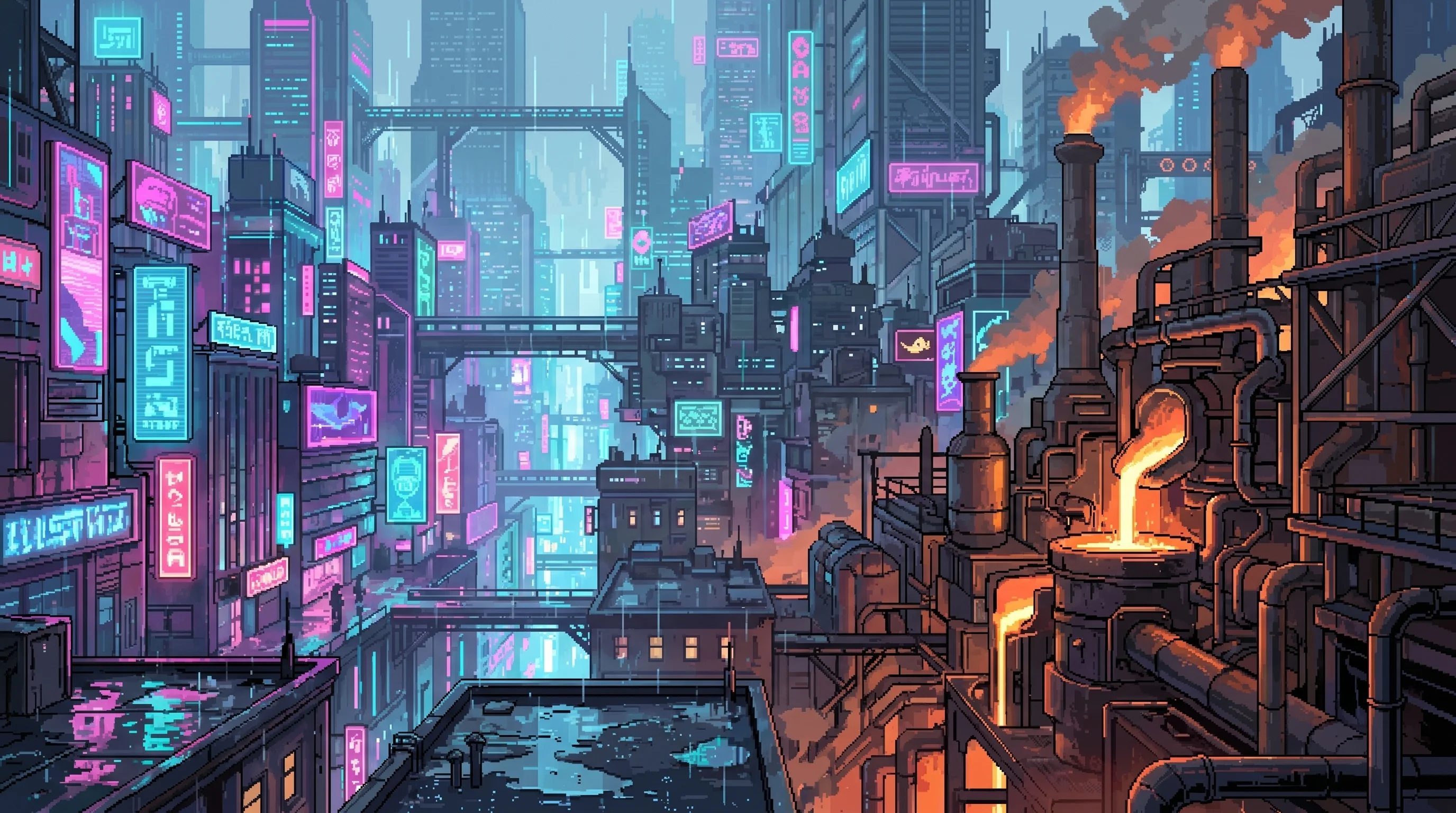
The Sprawl isn't one city. It's a thousand cities merged, layered, and welded together over a century of desperate growth. Twenty-four sectors from the Pacific Heights rim to the Concord foothills, each with its own economy, its own power structure, and its own definition of "breathable air." Remove any one sector and the adjacent three lose atmosphere processing. The seams between districts are load-bearing.
What follows covers six districts that represent the Sprawl's operational range — from Nexus Core's computational density to the places where the power grid ends and doesn't come back. Each was shaped by the same Consolidation forces. The results are as different as the industries that won.
The Neon Mile
Sprawl District — Sector 5 (South Bay)
| Attribute | Value |
|---|---|
| Location | South Bay (Sector 5) — former entertainment corridor |
| Population | 12 million |
| Corporate Control | The Meridian Consortium — seven entertainment corps under mutual non-competition pact |
| Economy | Entertainment, tourism, vice |
| Danger Level | Low (heavily policed). High (financially). |
Description
The Neon Mile is where the Sprawl goes to forget. Casinos, clubs, pleasure palaces, and experiences that would be illegal anywhere else operate openly under the Meridian Consortium's seven-company cartel. The Consortium doesn't care what you do as long as you pay. They've built an entire district around this principle.
The aesthetic is overwhelming — holographic advertisements covering every surface, music bleeding from every doorway, sensory stimulation calibrated to keep you spending. It's the brightest place in the Sprawl. Somehow the emptiest.
Corporate executives vacation here. Criminals launder money here. Everyone pretends not to notice each other. The Consortium considers this arrangement optimal.
The Eternal Night casino has operated continuously for 37 years straight — opened the week the Cascade ended, running on salvaged generators, before the power grid was fully restored. Its founding date places it among the first commercial enterprises to resume operation post-Cascade. Ahead of most hospitals. Its liquor license predates the municipal authority that later issued it.
The Flesh Market occupies a twelve-block zone near the southern boundary. Legal body modification and cosmetic surgery. The name was chosen by the original merchants' association in 2152 as a provocation — news coverage tripled in the first quarter. They've tried to rebrand twice since. Both times the new name failed to generate equivalent media attention. The Flesh Market remains the Flesh Market. The merchants' association dissolved in 2179. The name they chose in defiance has outlasted the organization that chose it.
The Memory Palace sells access to neural-recorded memories at rates between 200 and 45,000 credits per session. The pricing correlates, in practice, with how much the original memory-holder was suffering when the recording was made. The most expensive memories are the most desperate. The Memory Palace's marketing describes this as "emotional authenticity."
Factions
- The Meridian Consortium: The ruling cartel — seven entertainment corporations bound by the Non-Competition Accord of 2168. Each controls a defined experiential category: gaming, simulation, body modification, hospitality, nightlife, spectacle, and "unlisted services." The categories haven't been renegotiated since 2168. The Sprawl's entertainment economy has changed considerably since then. The Accord has not.
- The Dealers' Guild: Information brokers operating behind every bar and pit. Every bartender, pit boss, and concierge feeds data to the Guild's aggregation network. They sell to all buyers without preference. Nexus Dynamics has attempted to acquire the Guild's data infrastructure four times. The Guild's asking price increases by exactly 15% after each failed acquisition.
- The Neon Saints: A street gang providing "security" for tourists. Protection racket masquerading as a service. Pay them and you're safe. Refuse and you're a lesson. Municipal enforcement has investigated the Saints eleven times. Convicted zero times. Several investigating officers now use the escort service.
- The Memory Thieves: Black market sim traders who copy and sell memories without consent. The Memory Palace despises them. They operate in maintenance corridors and unlicensed sim parlors, selling copied experiences at 10-15% of retail. The Memory Palace calls it "experiential piracy." The Thieves call it "democratized access." Neither party references the Memory Palace's refusal to disclose how it obtains consent from its own memory suppliers.
Dangers
- Debt Spiral: The Consortium designs every experience to encourage spending. Good Fortune lending terminals are positioned approximately every 140 meters throughout the district. Citizens have lost everything — credits, augmentations, freedom — to debts they can't pay. Some visitors don't leave. Not because they're physically prevented. Because the only employment at wage rates sufficient to service Neon Mile debt levels is employment within the Neon Mile itself. The Consortium's hospitality division is the district's largest employer. Its workforce is disproportionately composed of former visitors.
- Sim Addiction: Memory Palace experiences are so good that some people stop living their own lives. Sim addiction runs at 8.3% of the resident population — four times the Sprawl average. The Consortium funds three addiction treatment centers. The treatment centers are located inside entertainment complexes. Patients exit treatment through the main casino floor.
- Disappearances: People vanish in the Neon Mile. Sometimes they reappear working off debt. Sometimes they never reappear at all.

The Foundry
Sprawl District — Sector 4 (The Works)
Quick Facts
Indexed — no record on file.| Attribute | Value |
|---|---|
| Location | The Works (Sector 4) — former industrial waterfront |
| Population | ~2.5 million workers, ~2.8 million residents. The gap is 300,000 dependents Ironclad's workforce database does not categorize. |
| Corporate Control | Ironclad Industries (primary) |
| Economy | Heavy manufacturing, materials processing |
| Danger Level | Moderate (industrial hazards) |
Description
If Ironclad is the Sprawl's muscle, The Foundry is where that muscle lives. Kilometers of factories, refineries, and fabrication plants operating around the clock across Sector 4's industrial waterfront. The air is thick with particulates despite filtration that was sized in 2169 for a population of 1.6 million. The ground vibrates — seismic monitoring registers continuous low-frequency vibration at 23 Hz during steel pours. Long-term residents stop noticing. Visitors never forget it.
Workers here are tough, practical, and loyal to whoever pays them. Ironclad treats them better than most corps — decent wages, functional housing, medical care for industrial accidents. It's not idealism. It's investment. Ironclad discovered in 2163 that every credit invested in worker housing produced a 1.7:1 return in reduced absenteeism. The housing is functional, clean, and calibrated to the precise level of comfort that maximizes productivity without creating expectations of further improvement. Comfortable without being comforting.
The Foundry never stops. Shift changes overlap by eighteen minutes — during which exhausted workers and fresh workers occupy the same floor space, and the machines can't tell the difference. Ironclad's internal reporting counts shift-change periods as "maintenance windows." They are not maintenance windows.
The Crucible — primary steel production — is visible from orbit during pours. A fact Ironclad's marketing uses in recruitment materials and the safety inspectors consider irrelevant. Its safety record is "good." Ironclad defines "good" as "fewer fatalities per production unit than the preceding year." By this metric, the Crucible has achieved "good" for nine of the last twelve years. The three that didn't qualify are not in the annual report. They are discussed, extensively, in Worker's Row.
Factions
- Ironclad Management: The industrial arm runs The Foundry directly. Efficient, pragmatic, ruthless about production quotas. They treat workers well because it increases output.
- The United Workers' Congress: The sanctioned union. Better than no representation, but leadership elections require Ironclad employment, and employment requires signing a code of conduct with Section 14.7(c) — prohibiting "actions detrimental to operational continuity." Every significant union action has been blocked by 14.7(c). The distance between "better than nothing" and "adequate" is the space in which Ironclad operates.
- The Spark: Underground workers' movement organizing in cells since 2171. They plan slowdowns and dream of strikes that never happen. Two slowdowns have occurred — 2176 and 2181. Both times, production returned to normal within 72 hours. Both times, between six and eleven workers were transferred to "alternative placement" at the Crucible's most hazardous stations. The Spark considers both victories. Ironclad considers them instructive.
- The Salvage Crews: Independent contractors who retrieve materials from dangerous or contaminated sites. Ironclad uses them for work too hazardous for regular employees.
Dangers
- Industrial Accidents: The Foundry is dangerous by nature. Molten metal, heavy machinery, chemical processes. Ironclad's safety record is good. "Good" still means deaths.
- Toxic Exposure: Long-term workers develop health issues despite precautions. Ironclad pays for treatment — as long as you keep working.
- The Automation Gradient: Ironclad is replacing its workforce with automated systems at approximately 3.1% annually. At this rate, the Foundry's human labor requirement reaches zero around 2216. Ironclad has not announced this timeline. The workers know. They discuss it in Worker's Row after shifts. They do not discuss it with management, because acknowledging a future in which their labor is valueless would reduce their bargaining position in the present. The better Ironclad treats its workers today, the less resistance it will face when it eliminates them tomorrow. The medical care team genuinely believes in worker welfare. The automation team genuinely believes in efficiency. Neither attends the other's meetings.
| Stratum | Between |
|---|---|
| Power Position | Between |
| Access | Public |
| Atmosphere | Vibrant |
The Veil
Sprawl District — Sector 3 (The Heights)
Quick Facts
Indexed — no record on file.| Attribute | Value |
|---|---|
| Location | The Heights (Sector 3) — former Terrace and Garrison hilltops |
| Population | ~1.5 million |
| Corporate Control | Banking Consortium (neutral) |
| Economy | Finance, data storage, arbitration |
| Danger Level | Very Low (fortress-level security). Very High (financially). |
Description
The Veil is where the real power lives — not the visible power of Nexus or Ironclad, but the quiet power of those who control money. The Banking Consortium predates the Cascade. Seven founding families established the mutual credit framework in 2109. When ORACLE collapsed and 2.1 billion died, the Consortium's ledgers survived — maintained on isolated systems they had, for reasons that in 2147 appeared paranoid and in 2184 appear prescient, never connected to any network ORACLE could access.
In the seventy-two hours of the Cascade, while the Sprawl's population was dying of infrastructure collapse, the Consortium was reconciling accounts. They resumed lending on April 4, 2147. The day after the Cascade ended. The first financial institution to do so. The only one that never stopped.
The district is physically beautiful — preserved architecture from before the Merger Years, clean air, actual trees. The elevation provides natural defensibility. The private atmospheric processing produces air that tastes different from anywhere else in the Sprawl: no flavor at all. In a city where every breath carries industrial particulates and the exhalation of 200 million neighbors, the absence of flavor costs more than most districts' entire filtration budgets.
They don't take sides between corporations. They profit from all of them.
Key Locations
- The Reserve: Central credit processing facility. The closest thing to holy ground in the Sprawl.
- Arbitration House: Where corporate disputes are settled without war. Usually.
- The Ledger: Supposedly, a complete record of every transaction since 2109. The claim has never been independently verified. The Consortium has produced specific records from the Ledger on 2,847 occasions during arbitration proceedings — accurate, specific, and devastating to whichever party assumed the transaction was forgotten. The Ledger functions less as a database than as a threat architecture.
Factions
- The Banking Consortium: Seven old-money families who control the district. They've maintained neutrality for 40 years by making themselves indispensable to everyone. Their power is structural — they don't need armies because they control the medium through which armies are paid.
- The Arbiters: The Consortium's judiciary — former corporate lawyers who decide disputes. Their decisions are binding because the alternative was tried during the Three-Week War and produced the Treaty of Shared Infrastructure. The treaty made the Arbiters necessary. The Arbiters have made themselves indispensable. The distinction between "necessary" and "indispensable" is the space in which they charge their fees.
- The Auditors: Forensic accountants who track credit flows, identify fraud, and maintain the system's integrity. They know where every credit goes. They always know. They report to the Consortium and to no one else.
- The Silent Partners: Wealthy individuals and organizations who maintain anonymous accounts. They're not supposed to exist. The Consortium pretends very hard. The anonymity costs between 4% and 12% of account value annually — undocumented in any public filing.
Dangers
- Debt Leverage: Owe the Consortium enough and they own you. Corporations, individuals, even other districts have lost everything to bad loans.
- The Disappearance Protocol: People who threaten the Consortium's neutrality are removed from the credit system. Not suspended. Removed. Their identity, insofar as identity in the Sprawl is mediated through financial records, ceases to exist. They can't buy food. Can't rent shelter. Can't access medical care through any system that requires payment — which is every system. The Protocol has been executed 214 times since the Cascade. 41 were eventually restored. The remaining 173 are no longer visible in any financial database. Whether they're alive, dead, or surviving through barter in Blackout Zone 7 is unknown. The Consortium does not track people it has removed.
- Information as Weapon: The Consortium knows who owes what to whom. They could destabilize any faction by releasing that information. They never do. The threat is always there.
- The Old Debts: Pre-Cascade obligations that the Consortium still enforces. Loans originated before 2147 — some dating to the Consortium's founding — remain active in the Ledger, accruing interest at rates set by agreements that predate every current corporate entity. Families have been paying interest on loans their great-grandparents took out for housing destroyed in the Cascade. The Consortium's position: a contract is a contract. The Cascade destroyed infrastructure, populations, governments. It did not destroy agreements.
The seams between districts are load-bearing: remove any one sector and the adjacent three lose atmosphere processing
The Stacks
Sprawl District — Sector 2 (Old Town)
Quick Facts
Indexed — no record on file.| Attribute | Value |
|---|---|
| Location | Old Town (Sector 2) — former Fortune Row, Financial District, vertical build-up |
| Population | 89 million (margin of error ±12 million due to unregistered residents below Level 50) |
| Corporate Control | Fragmented (34 registered lease-holders, an estimated 200+ unregistered governing entities) |
| Economy | Everything, anything, nothing legally |
| Danger Level | High (varies by level) |
Description
The most densely populated structure in human history. And it was not designed. It accumulated.
When Old Town ran out of horizontal space in the 2090s, developers built upward. Not the planned way Nexus Central later achieved — reactively. Platform bolted to rooftop, structure on platform, another platform on that. Each generation of construction used the previous one as foundation without consulting its engineering specifications. Ninety years of this. The result: a vertical urban mass extending over 300 levels above the original street grid, held together by the accumulated weight of everything above pressing down on everything below.
Ironclad's structural engineers surveyed the Stacks in 2179. The survey's executive summary, leaked and never officially confirmed, consisted of a single sentence: "The structure's continued existence is not explained by its engineering."
Navigation is three-dimensional. "Address" includes level number. The elevator systems — the Stacks' circulatory system — are controlled by whoever built or claimed them. Corps, community collectives, individual operators. Wrong elevator, wrong level, wrong neighborhood. Residents have a word for it: "dropping."
Air quality degrades in reverse — highest levels have corporate filtration, the middle has adequate community-maintained systems, and below Level 50, the processors have been failing for decades. Below Level 20, approximately 2.1 million people live in total darkness. Not because power is unavailable. Because the structural density above them is so great that no light penetrates.
At the top: corporate penthouses with filtered air and natural light. At the bottom: crushing darkness and people who've never seen the sun. Wealth is measured in meters above ground. Rent at Level 280: 14,000 credits per month. Level 150: 2,200. Level 50: 340. Below Level 50, rent is not denominated in credits.
Factions
- The Crown Council: Corporate interests controlling the upper levels. They compete for territory among themselves and cooperate to keep the lower levels from rising. Their primary instrument is elevator access — controlling vertical transit means controlling who moves and who stays.
- The Elevator Lords: Independent operators who control transit between levels. Each Lord controls specific elevator banks, specific routes, specific schedules. The fees are non-negotiable. During the Elevator War of 2178, a three-week dispute between two Lords cut off 340,000 residents from vertical movement. Seventeen people died of treatable conditions twelve levels from a medical facility. Both Lords remained in operation. Neither expressed regret.
- The Night Watch: Midsection community defense volunteers. No budget, no authority, no formal structure beyond level-by-level coordination. They exist because the alternative — relying on corporate security that stops at the Crown boundary — is not an alternative. They are, by every institutional metric, irrelevant. Also the only reason the Midsection functions.
- The Depth Dwellers: Organized communities below Level 30. Approximately 400 communities who maintain their own water recycling, food distribution, and conflict resolution systems. They are not primitive. They are operating under constraints that would collapse most surface organizations within weeks. The surface assumption — that the Depths are a place people fall to — is incorrect. Some chose the Depths. Some were born there.
- The Climbers: People trying to move up — literally. Dangerous jobs, saved credits, dreams of escaping their level. A 2183 residential mobility survey found 94% of Stacks residents die on the level they were born. The 6% who change levels move an average of 8. The Climbers know these numbers. The numbers don't deter them. The hope of climbing is the Stacks' load-bearing psychological infrastructure.
Dangers
- Vertical Violence: Level wars when territory disputes escalate. Dropping things from above is the ultimate tactical advantage.
- Level Collapse: Buildings on buildings eventually fail. When a structure gives way, it takes everything below with it. Thousands in minutes.
- The Depths Predators: Not everyone below Level 30 formed communities. Some formed hunting packs. They raid upward.
- Surveillance Gaps: The Crown is monitored. The Midsection is partially monitored. The Depths are invisible. Crimes committed there stay committed.
The Reclaim
Sprawl District — Sector 9 (The Deep Dregs)
Quick Facts
Indexed — no record on file.| Attribute | Value |
|---|---|
| Location | The Deep Dregs (Sector 9) — former bay shallows and shoreline, engineered reclaimed land |
| Population | 18 million |
| Corporate Control | Environmental Consortium (biotech coalition including Helix subsidiaries) |
| Economy | Food production, water processing, biotech |
| Danger Level | Low (but strange) |
Description
The Reclaim is what happens when you try to rebuild an ecosystem on land that was once underwater. The Environmental Consortium — a coalition of biotech corps — built this district as a proof of concept: a sustainable, self-contained habitat within the Sprawl, constructed on terrain reclaimed from the Bay beginning in 2156. The humanitarian framing came later, after the first vertical farms demonstrated yields 340% above conventional agriculture and the Consortium realized the PR value exceeded the research value.
It works. Mostly. Vertical farms produce real food — grown, not vat-synthesized, a distinction that matters to the 23% of Sprawl residents willing to pay a 200-400% premium for it. Water is clean. Air is filtered naturally through engineered plant life. The atmosphere inside the Reclaim tastes different — not filtered, which implies mechanical intervention, but alive, which implies something growing.
It's also deeply wrong. The plants are designed organisms — coded in Helix laboratories, grown in Consortium nurseries, optimized for atmospheric functions. The animals are engineered for ecosystem balance: pollinators calibrated to crop schedules, decomposers designed for specific waste profiles. Every organism serves a function. The birds sing at scheduled intervals. The flowers bloom according to quarterly release calendars. Residents who've never experienced unengineered nature find it beautiful. The 0.3% old enough to remember pre-Cascade forests find it uncanny. "Like a painting of a meal," one resident told a media outlet. "Looks perfect. Not edible."
The food is objectively superior — independent analysis confirms it exceeds Sprawl dietary standards across every measured category. It is also mildly dependency-forming. Not chemical addiction. Biological optimization. Consortium produce is engineered so the human digestive system processes it more efficiently than conventional food. After eight to twelve weeks, the gut microbiome adapts. The adaptation is beneficial. The adaptation is also specific: the optimized microbiome processes Consortium food 40-60% more efficiently than anything else. After adaptation, non-Consortium food feels inadequate. The Consortium's published research calls this "optimized digestive compatibility." A leaked board minutes document used the phrase "platform lock-in."
Factions
- The Environmental Consortium: Seven biotech corps under shared governance. They disagree on everything except outsiders not entering the Nursery. What the Consortium is designing in there is, according to them, "the next generation of sustainable agriculture." According to the Harvesters, some of what exits the Nursery does not resemble agriculture.
- The Gardeners: Fourteen thousand workers who tend the engineered ecosystem. Many have developed an attachment to the organisms they maintain that the Consortium finds useful and the Naturalists find heartbreaking — loving something designed to make you love it.
- The Naturalists: Scientists who want to restore actual nature, not engineered simulations. They're a minority, viewed as idealistic fools. Their research — cataloguing the 0.3% of surviving pre-Cascade plant species — is funded at minimum levels.
- The Harvesters: Collectors who gather genetic material — seeds, samples, organisms — to sell outside The Reclaim. The Consortium considers them thieves. The buyers — Helix subsidiaries, independent labs, and entities the Harvesters describe only as "private collectors" — consider them suppliers.
Dangers
- Engineered Pathogens: Designed things have design flaws. Occasionally, a pathogen mutates beyond parameters. Containment protocols are aggressive.
- Aggressive Flora: Some engineered plants defend themselves. Walking off-path in The Greenhouses can be fatal.
- Corporate Experimentation: The Nursery produces things that should never exist. Sometimes they escape. Sometimes they're released "accidentally."
- The Food Dependency: Eat enough Consortium produce and you'll have trouble eating anything else. The Consortium's revenue model describes this trajectory as "customer retention." Six consecutive years of accuracy to within 2%.
Blackout Zone 7
Sprawl District — Sector 11 (The Edge)
Quick Facts
Indexed — no record on file.| Attribute | Value |
|---|---|
| Location | The Edge (Sector 11) — former eastern industrial flats and outer East Bay |
| Population | Unknown (estimated 2-5 million) |
| Corporate Control | None |
| Economy | Salvage, survival |
| Danger Level | Extreme |
Description
Some parts of the Sprawl never recovered from the Cascade. Blackout Zone 7 is the worst — a massive urban dead zone where the power grid failed and was never restored. Officially uninhabited. Actually home to millions living in conditions worse than the Wastes.
Corporations avoid it. There's nothing worth taking. The people who live here are the truly forgotten — those who fell through every crack, escaped every system, and now exist in the dark.
It's not lawless like the Wastes. It's invisible. Surveillance doesn't reach here. Maps don't show it. For some, that's terrifying. For others, it's the last freedom left.
Key Locations
- The Ember Markets: Trade without surveillance, using barter and pre-Cascade currency.
- The Underground: Literally — tunnel networks beneath the dead city, where some light still works.
- The Witness: A pre-Cascade broadcast tower that someone keeps running. No one knows who or why. The broadcasts contain weather, market prices, and warnings. Occasionally, they contain something else.
Factions
- The Candle-Keepers: Those who maintain what little infrastructure still works. They protect power sources, maintain water systems, and keep the Zone from total collapse. They are not Lamplighters, though some learned from Lamplighters. The distinction matters to both groups.
- The Shadow Council: Informal leaders who emerged from necessity. They don't rule — they coordinate, arbitrate, and try to prevent the Zone from eating itself. Their meetings are held in the dark because meetings held in the light draw attention.
- The Ghosts: People who came to the Zone to disappear. They don't want community. They don't want contact. They want to be forgotten.
- The Broadcast Collective: Whoever runs The Witness. They've never been identified. Attempts to locate the broadcast source consistently lead to empty rooms showing signs of recent occupation. During the 2181 atmospheric crisis, they transmitted evacuation instructions that saved an estimated 4,000 lives. The Sprawl's official media did not acknowledge the broadcast. The 4,000 survivors did.
- The Collective (Underground): The Resistance has a significant presence here. Where surveillance doesn't reach, organization can happen.
Dangers
- No Emergency Services: Injuries, fires, collapses — no one is coming. Communities survive through mutual aid or they don't survive.
- Resource Scarcity: Everything is harder to find. Water. Food. Medicine. Power. People die of things that are easily treatable elsewhere.
- The Predators: Not everyone in the Zone came to escape. Some came to hunt where no one would stop them.
- Corporate Expeditions: Occasionally, corps send teams into the Zone to retrieve something — data, materials, people. They treat residents as obstacles.
- The Darkness Itself: Humans aren't meant to live without light. Long-term residents develop psychological issues. Some cope. Some don't.
The Zone's Paradox
The Zone is the Sprawl's failure. It is also the Sprawl's last proof of concept for human self-governance. The communities that survive here — without corporate infrastructure, without atmospheric processing, without power — have developed governance, resource sharing, and conflict resolution that function on consent rather than coercion. Not well. Not comfortably. But in conditions that would collapse most corporate-administered districts within weeks.
No corporation has studied this. The possibility that human communities can self-organize in extreme scarcity — that the corporate infrastructure the Sprawl treats as existentially necessary might not be — is not a finding anyone in power would benefit from acknowledging.
Restricted Access
Field analysts have logged consistent anomalies in the boundary zones between districts — the kind of thing that gets a note filed and then re-filed when the note goes unanswered.
Power grids from adjacent sectors bleed into Blackout Zone 7 for seconds at a time, lighting streets that have been dark for decades before going dark again. The pattern matches no known maintenance schedule. Nobody has claimed responsibility for the intermittent power, and nobody has explained where it comes from.
The Witness broadcast tower in Blackout Zone 7 transmits on a frequency that, according to three independent signal analysts, should not be achievable with pre-Cascade hardware. Someone has upgraded the equipment. Who has the resources to do that in a zone with no power grid — and why they would do it while remaining invisible — is unresolved.
Banking Consortium Auditors who have attempted to verify the oldest entries in the Ledger report finding records attributed to entities that correspond to no known family, corporation, or government. Requests for clarification are met with silence. The discrepancy has been filed three times. The silence has been consistent each time.
District Glossary
| Term | Meaning |
|---|---|
| Level | Vertical position in multi-story districts |
| Sector | Official district subdivision |
| Zone | Unofficial or abandoned area designation |
| The Crown | Upper levels of any vertical district |
| The Depths | Lower levels of any vertical district |
| Margin | Transitional area between districts |
| Dropping | Accidentally descending to a hostile level (Stacks slang) |
Connected To





—
—
—