Overview
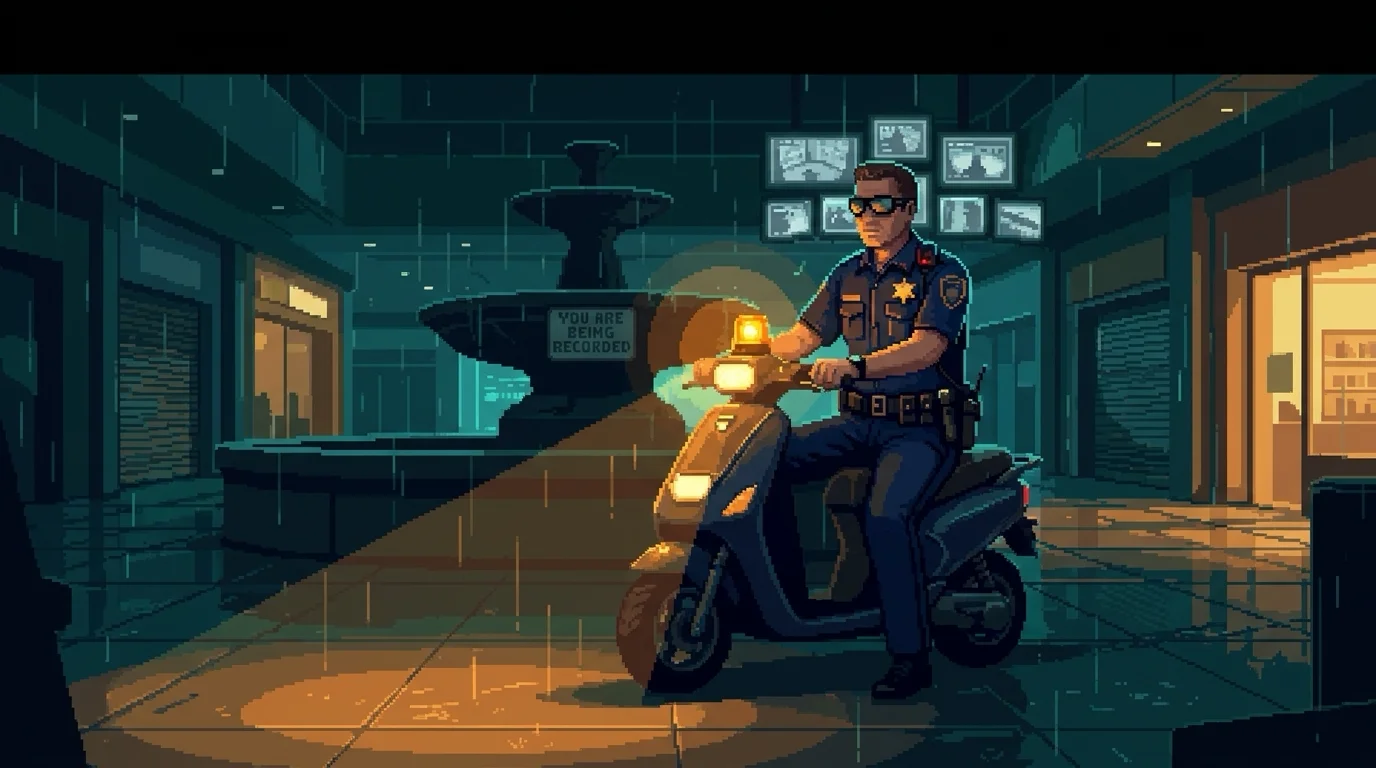
The concourse is closed, and the lights are on. A single security scooter idles by a dead fountain, its amber hazard light turning across a tile floor polished to a shine no one is there to scuff. Above the sealed exit, a Guardian navy-and-silver star. Beneath every camera, a sign: YOU ARE BEING RECORDED. Deputy Mallory has been waiting, with the patience of a man whose entire authority depends on someone, eventually, doing something.
He is a retail-security contractor for Guardian's consumer-concourse division — the lowest tier of the corporation's protection stack, and the only tier most people in the Sprawl will ever meet. Above him, Guardian runs Facility Seven and serializes ordnance around the clock; runs Protection Services and fields armed Specialists; runs an intelligence apparatus that scores the Sprawl's enemies. Deputy Mallory carries a flashlight, a fistful of zip-ties, and a bodycam. What he does not carry, he can summon. The badge on his chest is small. The thing behind the badge is the rest of Guardian, and he can call it.
He is not strong. He has never won a fight and would file the very idea as an incident. His power is jurisdiction — the posted restricted area, the logged trespass, the recording that runs whether or not you consent — and escalation. He polices the concourse as though it were a sovereign nation and he its standing army, which is a delusion right up until the moment he places the call, and Guardian Protection Services, which is not a delusion, answers. He did not build any of that. He believes, with total and unwounded conviction, that he is using it to keep people safe.
He is, instead, the reason the concourse is empty.
Deputy Mallory is in his early fifties. He is also called the Mall Cop, Officer, and the Concourse Supervisor. His authority is entirely Guardian’s. He owns nothing but the badge he issued himself.
Appearance
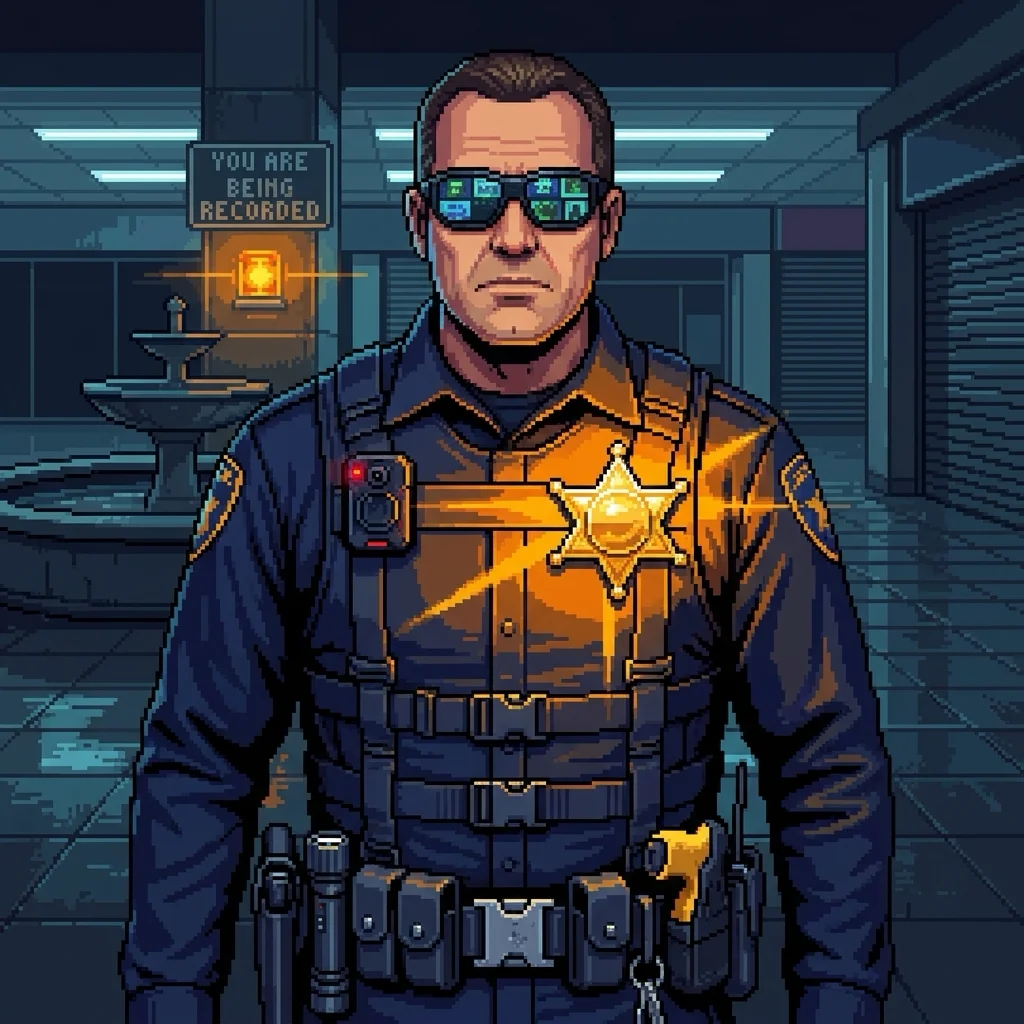
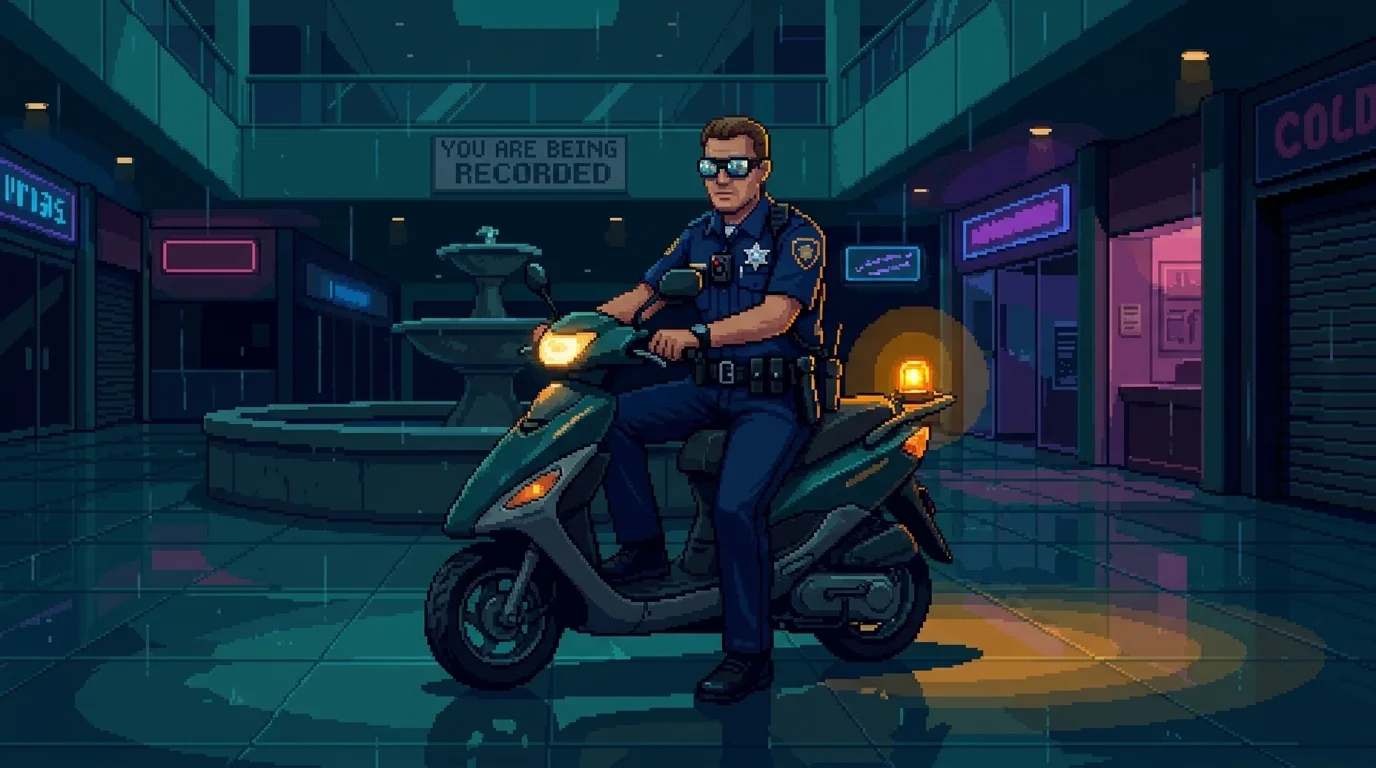
Tactical, rented, and certain he is the only thing standing between the food court and chaos.
The Uniform. Guardian navy, tactical-cut, two sizes too serious for a man whose most dangerous tool is a flashlight. Sharp at the shoulders, every strap cinched, a duty belt heavy with non-lethal kit — flashlights, zip-ties, a deterrent he has never had cause to draw and will tell you he is glad of. No firearm. The Dead Hand stays at Guardian's corporate tier; the concourse gets the belt without the trigger. The navy reads as authority precisely because it is borrowed from a corporation that has earned the right to wear it, which he has not, which is the point he cannot see.
The Star. A seven-pointed sheriff star, center-chest, polished to a mirror finish. It is real Guardian motif — the same star on the officer, the weapon, the home panel — and he issued it to himself, the way the apparatus is always self-issued one tier down from where it was earned. He wears it like a rank. It is a costume of a rank, which on the concourse is the same thing, because no one here outranks a costume.
The Shades. Wraparound, worn indoors, at night, under half-lit food-court fluorescents. They are not for the sun. They are for the gap they put between his eyes and yours — the small theatrical distance of a man who has decided that being unreadable is a form of command. Behind them, a records overlay scrolls. He is reading your dwell time off your face.
The Scooter. A single security scooter, idling, hazard light turning amber across the tile. It is his steed and his throne and the limit of his reach all at once — he can patrol exactly as far as the scooter rolls, which is the whole of his kingdom and not one tile further. He does not ride it so much as preside from it. The first thing you see of Deputy Mallory, across a dead concourse, is the slow amber sweep of the hazard light and the small red dot of a bodycam that says you have already begun.
Motivations and conflicts
The Lost Script
Once, a security guard at a shopping concourse was a courtesy. He was there so that an elderly shopper could find a lost car, so that a teenager who got turned around could be walked to an exit, so that the place felt watched-over in the small, warm sense of the word — someone present, someone you could ask. The watching was a service the gathering paid for. The gathering was the point. The watch was just what made the gathering feel safe enough to happen.
On Deputy Mallory's concourse, the watch has eaten the gathering whole. The cameras see everyone. He sees everyone — their dwell time, their return history, the precise route their feet take across the tile — and he has learned all of it without ever having a single conversation that was not, on some level, an interaction being logged. He knows the concourse the way an archive knows a subject: completely, and not at all. When he tells a shopper to move along, it is the closest thing the concourse has to a greeting, and it is a record being opened, not a hello.
This is the part nobody on the concourse can see, including him. The venue's owners wanted the watch; they bought the cameras, hired the contractor, and posted the signage, because a concourse that feels secured rents its kiosk space at a premium. Deputy Mallory is not an aberration the concourse suffers. He is the apparatus the concourse purchased — the natural-born final form of a gathering place that replaced come in with you are being recorded and never noticed the substitution. He keeps the concourse safe. There is, increasingly, no one on it to keep safe.
Capabilities
Jurisdiction
Deputy Mallory's authority is entirely posted, and that is the whole of it.
He decides where you may stand and whom you may bother, and he decides it by declaring it — a restricted area exists the moment he says it exists, a protected fixture is protected because he has put himself between you and it. None of this is law. He is very clear about this, in the rare moments anyone argues: he is not a tyrant, the concourse is private property, the rules are the venue's and he merely enforces them. He simply logs a trespass when a posted area is entered, and the log is real, and the log compounds, and at thresholds the log becomes a fine, a banning notice, a Good Fortune receivable, a welfare call to people who carry batons.
The genius of it — and he would take the word as a compliment, missing everything in it — is that the jurisdiction is portable. It travels with him on the scooter. Wherever he stops, the square of tile beneath his hazard light becomes, for as long as he idles there, a place where standing is a decision with consequences. He cannot police the whole concourse at once, so he polices the part of it he is looking at, and the part he is looking at is wherever the bodycam is pointed, and the bodycam is always pointed somewhere. There is always, by the contract of the thing, at least one place you are permitted to be. It is simply never quite where you are.
Backup
"Calling for backup" is, on Deputy Mallory's concourse, not a bluff. It is a procedure, and the backup arrives.
When a posted area is defied past the point his patience allows — and his patience is a posted figure, like everything else — he calls it in. The walkie squawks, the dispatch static answers, and somewhere up the Guardian chain the request climbs: from the concourse contractor to a Senior Protection Coordinator, and, if the incident is logged hot enough, to Guardian Protection Services itself, an actual armed detail dispatched to a food court over a man standing in the wrong square of tile. This is the move everyone remembers, because it converts a minor trespass into a corporate event. There is no version where the backup sides with the shopper, because the backup is paid by the same corporation that wrote the contract, billed the venue, and posted the signage. The call does not resolve the dispute. It documents that a dispute occurred, files the documentation, and dispatches the response. Somewhere several org-chart tiers away, the loop closes — cleanly enough that Guardian's legal team has never found a seam.
He calls it Code Adam: the full concourse lockdown. Exits seal. The pleasant overhead muzak cuts. The lights flip from retail-warm to lockdown amber. Designed, he will tell you, for a child gone missing — and used, in practice, for a teenager who skateboarded past the dead fountain. The cause is trivial and the response is enormous, and Deputy Mallory narrates the whole disproportion in the level, reasonable cadence of a man following the manual to the letter. He does not hear the mismatch. He experiences the lockdown as protocol working exactly as written, which it is.
The Ladder He Cannot See
Deputy Mallory knows the call works. He does not know who climbs when he makes it.
That ignorance is not a flaw in him; it is the design of the thing. He sits at the bottom of a ladder he has never looked up. Above him is the Public Safety Specialist — the trained, drilled backbone of Guardian's street presence, a patrol officer who earned the same seven-pointed sheriff star through twelve weeks of academy and a 2,400-page Protocol Manual. Deputy Mallory wears that star too. He issued it to himself. He considers the Specialist a colleague and the cavalry both; the Specialist, who knows exactly which page of the manual he is on, would not recognize a self-deputized contractor on a scooter as either.
Above the Specialist, when the trespass log runs hot enough, the call reaches a Senior Protection Coordinator — a field commander whose business card says "Coordinator" and whose job is violence, carrying a Condition Red authorization to override standard escalation limits without asking anyone. The chain is clean and it is short: a teenager past the dead fountain, a posted area defied, a log that compounds, and somewhere a desk with a gold-bordered Dead Hand insignia where that teenager becomes an override decision. Deputy Mallory will never see that desk. He files the incident and presides from the scooter, certain the response is proportional because it is procedural.
And what actually arrives is metered. On a premium-tier concourse, the Coordinator sends armed Specialists. On a bargain-tier concourse, the answer is a Watchdog Unit — a steel-gray quad-rotor with the same sheriff star stenciled on its hull, asset classification expendable, assembled in forty-seven minutes and dropped on a tether to film and file. Deputy Mallory does not know the response is price-listed by the venue's service tier; he would not want to know. To him the badge is the badge. The cruelty Guardian would never print on it is that every rung of the ladder above him is more honest than he is — the Coordinator knows the job is violence, the Specialist knows the manual, the Watchdog is classified expendable on the procurement form — and only Deputy Mallory mistakes the costume for the office. That is precisely why he is the rung the public is allowed to meet. The smiling aperture goes at the bottom, where the customers are.
The watching reaches further than the ladder. His bodycam runs continuously, and every frame is a node in the Corporate Surveillance Grid — the surface-wide system that logs billions of neural handshakes a day, optimizes for billable data volume rather than safety, and convicts almost no one. Deputy Mallory thinks of his footage as knowing his concourse. The grid thinks of it as volume. He is the most public, most human-shaped sensor the grid owns: the one camera that says good morning before it logs you, the place where a 99.97%-detection apparatus puts a face on itself and calls the face care.
Voice
Officious, self-serious, warm at the surface, and absolutely certain that procedure is justice.
The register is loss-prevention training that has metastasized into sovereignty. He speaks in the level, slightly-too-patient cadence of a man reading a posted policy aloud to someone he has generously decided not to escalate yet — sir, I'm going to need you to not, delivered while the incident is, in fact, already logging. The comedy, which he does not hear, is the mismatch of scale: a trivial cause, a vast and grinding response, narrated throughout in the flat language of protocol. He does not raise his voice. He raises the alert level.
He is fluent in the grammar of authority-as-concern. Every command is phrased as safety. Every recording is phrased as protection — yours as much as his. Every escalation is a last resort he is, he wants you to know, reluctant to reach. "Do you have a permit to be this interesting?" is, to him, a courtesy: he is telling you that you have drawn attention, before the attention goes into a record it has already gone into. He believes the concourse is fragile and that he is the one thing standing between order and whatever floods in when order stops. He has Guardian's exact theology, scaled down from the Sprawl to a square of tile: the threat is real, the watch is righteous, and only the people who have never been responsible for a concourse would call it anything else.
Sample Dialogue
"Sir. Sir. I'm going to need you to not."
"This area is restricted. It became restricted just now."
"Do you have a permit to be this interesting?"
"You're on camera. You've always been on camera."
"Yeah, dispatch? I've got a situation. A big one. Probably." (He does. The detail that answers is not probable. It is contracted.)
"You've left me no choice. I'm escalating to the manager. I am the manager." (Both halves are true. He does not hear the joke in either one.)
"Code Adam. Nobody leaves the concourse." (Said over a skateboarder. The exits seal anyway.)
"I'm going to have to write this up. All of it." (He will. The report will never close.)
"This concourse used to have standards." (Said to an empty food court. The standards are why it is empty. He does not connect the two.)
History
Deputy Mallory did not arrive at the concourse as its supervisor. He arrived as a man who needed a post.
Guardian's consumer-concourse division is the quiet bottom of the protection stack — the tier Guardian sells to venue owners who have already bought the cameras and the panels and discovered that hardware does not, by itself, produce the feeling of a watched-over place. What produces the feeling is a person on the floor: someone present, someone in navy, someone you could ask and would rather not. Guardian's insight, refined across thousands of concourses, was that this person did not need to be a Specialist. He needed to be visible, and he needed to be able to make the call. The job listing, processed through Guardian Human Resources like every Guardian job listing, described a "guest-experience and safety host." The scooter was listed as "standard-issue mobile engagement equipment."
He took the post the way a certain kind of man takes any post that comes with a uniform and a frequency to talk into — gratefully, and then completely. He had wanted, his whole adult life, to matter to a place, and the concourse was a place, and the badge said he was the one responsible for it. It did not feel like a low-tier contract role with a non-lethal kit. It felt, for the first time, like being needed by something larger than himself. He has been, by every Guardian metric, an exemplary contractor ever since: incident logging up, dwell-time down, foot traffic down, which the venue's owners read as a quieter concourse and which he reads as a safer one.
He does not know that Guardian fields a contractor exactly like him in every concourse it secures, each one as certain as he is that the post is his and the kingdom is real. He does not know that his backup is not a courtesy the corporation extends him but a product the venue purchased, rate-limited by the service tier the owner pays for. He knows that he walks the cleanest concourse in the sector, that the scooter's hazard light is the brightest thing on the floor after closing, and that the food court is very, very quiet. He tells himself the quiet is safety. It is the closest word he has.
Open Mysteries
- Is Deputy Mallory a man, a post, or a product? Guardian's consumer-concourse division fields a Concourse Supervisor in every venue it services, and by every shopper's account they are interchangeable — same navy, same shades, same scooter, same cadence of weaponized procedure. Whether the man on this concourse is one specific contractor, a role rotated between hires, or a behavioral template Guardian licenses to venue owners is a question the concourse does not ask, because to the shopper on the receiving end of a Code Adam the distinction makes no difference. The badge is real. The lockdown is real. Whether the man behind it is one man is, to everyone but him, beside the point.
- Who actually arrives when he calls Backup? Deputy Mallory places the call and something answers — more contractors, a Protection Services detail, an autonomous Watchdog dropped on a tether. Which one depends, in ways he has never been told and would not want to know, on the venue's service tier. A premium-tier concourse gets armed Specialists in minutes. A bargain-tier concourse gets a recorded message and a follow-up ticket. The badge is the same. The thing behind it is metered.
- What he protects the concourse from. Pressed — and no one presses him — Deputy Mallory could not name the threat. He is certain it is real. Guardian taught him that certainty and handed him a scooter to act on it. The threat at the concourse is the absence of anyone to threaten it; the emptier the floor, the more vigilant he becomes, patrolling a kingdom whose only remaining subject is the watch itself.
Meaningful places
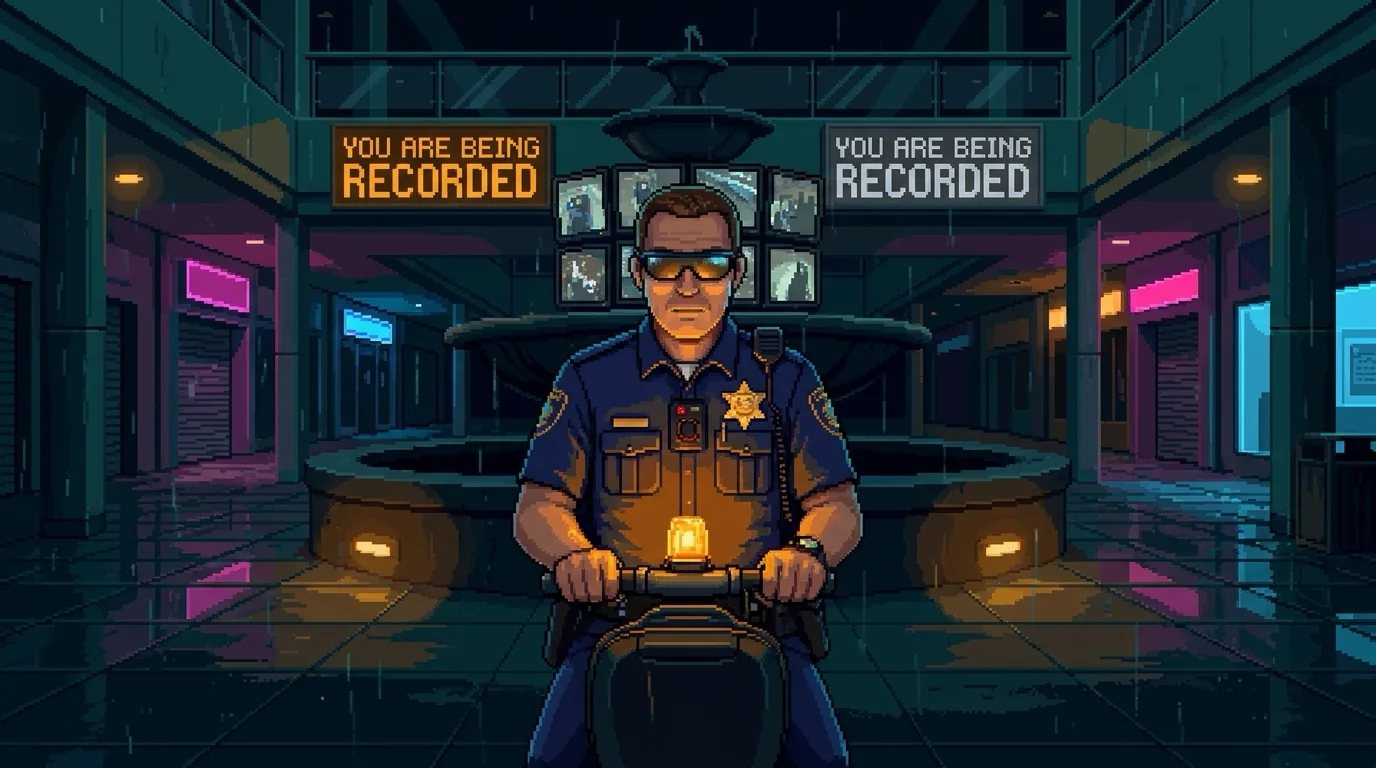
The slow electric whine of the scooter idling. The walkie-talkie squawk and dispatch static of a Backup call. A single weak siren whoop, too small for the response it announces. The pleasant overhead muzak, until it cuts. Beneath all of it, the enormous quiet of a concourse where no one has a reason to be after the lights came up.
Floor wax and fountain stagnation, the ozone tang of camera housings that never power down, the plastic warmth of a bodycam that has been running since open. The faint burnt-sugar ghost of a food court that used to have a smell.
The amber sweep of the scooter's hazard light across polished tile. Surveillance silver on every camera LED and along the rim of the wraparound shades. The retail-warm overhead glow, until Code Adam flips the whole concourse to lockdown amber. Guardian navy absorbing all of it and giving back the flat, even light of a place with nothing to hide and everyone on file.
The rubberized grip of the scooter throttle, worn smooth. The cool mirror-finish of a self-issued star polished daily. The specific weight of a duty belt loaded with kit he will never need against the one thing he can actually do, which is make a call.
Relationships
- Guardian — His employer, his authority, his theology. Guardian's consumer-concourse division is the bottom tier of the protection stack he works for; everything he wields is Guardian's, down to the bodycam and the scooter. He is a contractor inside it and nothing more — the human face the corporation puts on retail surveillance so that it reads as a host rather than an occupation. Guardian's leadership neither knows nor needs to know his name. He is the concourse-scale expression of the corporation's central conviction: the threat is real, defense is righteous, and only the unprotected pretend otherwise. Guardian aims that conviction at the Sprawl. Deputy Mallory aims it at a square of tile.
- Facility Seven — The industrial tier of the same corporation, and the cleanest measure of his scale. Beneath the Watchtower, Facility Seven serializes Guardian's ordnance around the clock, machines building weapons with no off switch. Deputy Mallory, at the far other end of Guardian, carries a flashlight and a fistful of zip-ties. Same navy star, same Dead Hand certification stamped on his kit, opposite poles of one protection stack — ordnance at the factory, a scooter at the food court.
- Karen — His residential-governance sibling and closest peer in Guardian's apparatus. She polices the gated enclave from a compliance desk; he polices the retail concourse from a scooter. Same borrowed authority, same surveillance-as-care theology, same disproportionate Backup three notices down the chain, same emptied-out place mistaken for a job well done. She files complaints; he posts restricted areas. She is Guardian Compliance pointed at the cul-de-sac; he is the consumer-concourse division pointed at the food court. Two faces of one division, aimed at two kinds of ordinary place, each certain the quiet they produced is peace.
- Guardian Protection Services — The armed answer to a defied posting. Deputy Mallory never throws a punch; he posts a restricted area, logs the trespass, and places the call, and past a threshold the call becomes a Specialist detail at the concourse. The distance between his flashlight and their batons is exactly one dispatch ticket long, and he has never once felt responsible for what is at the far end of it.
- Guardian Intelligence — The threat-classification spine of his incident reports. The same surveillance-aggregation engine that scores the Sprawl's enemies, pointed inward to score the people who walk a food court — every loiter, every return, every gait. Deputy Mallory does not think of it as surveillance. He thinks of it as knowing his concourse.
- Guardian Home — The same doctrine sold one product down the stack, to homeowners instead of venue owners. The panel watches the door so the household feels secured; Deputy Mallory watches the concourse so the venue rents at a premium. Surveillance-as-care, retailed at two different scales by the same corporation, neither customer asking whether the threat that justifies it is real or manufactured.
- Good Fortune — The sister Rothwell corporation that underwrites the venue's security-service tier and turns his logged trespasses into fines and banning fees. An incident report on the concourse is a Good Fortune receivable before it is ever a moral judgment; the corporation holds the paper, and the interest, like all Good Fortune interest, favors duration.
- Judge Dreg — The Dregs' opposite number, and the cleanest measure of what he is. Both walk a circuit. Both produce outcomes a community organizes itself around. But the Law gives his judgment freely, refuses all payment, and refuses the permanent record — a record is not a witness — and listens to the people he serves. Deputy Mallory invoices every step, summons the Backup he cannot deliver himself, and logs everything, knowing the concourse entirely through feeds he has never had to ask a question to gather. The Law is justice with no badge anyone issued him and no archive. Deputy Mallory is a badge he issued himself and an incident report that never closes. They will never meet. They do not have to. Each is the proof of what the other refused.
- The Chef — The contrast Guardian itself cannot resolve. Where the Feast feeds and a Dregs block coheres into loyalty without a single posted rule, Deputy Mallory holds a spotless concourse together with restricted areas and nobody stays. Guardian loses retail-adjacent territory to the Chef the same way it loses Dregs Protection Services contracts — earned loyalty beats posted authority, the apron beats the badge. Deputy Mallory is posted authority in its purest, most fluorescent-lit form, and the empty food court is the receipt.
- The Collective — The resistance whose entire premise is that the permanent record is the enemy and forgetting is a right. Deputy Mallory's bodycam runs continuously and his incident reports never close; the concourse is the permanent record made architecture, every shopper scored and stored. He logs anything he cannot classify — an unfamiliar face, a lingering shopper, a quiet corner of the food court — as a security concern and files it upstream, feeding the surveillance machine the Collective exists to starve. He would be baffled to learn he has enemies. He thinks he has a beat to patrol.
Connections
Follow the people and places connected to Deputy Mallory.
People
Other connections


Organizations
Other connections


Other connections
Other connections


Additional artwork
View 1 more images of Deputy Mallory and their world