Overview
Dr. Lian Zhou designed the system that decides how much of your own mind you're allowed to use. She did it with the best intentions and a doctorate in computational consciousness theory, and she sleeps soundly every night because the numbers tell her she's right.
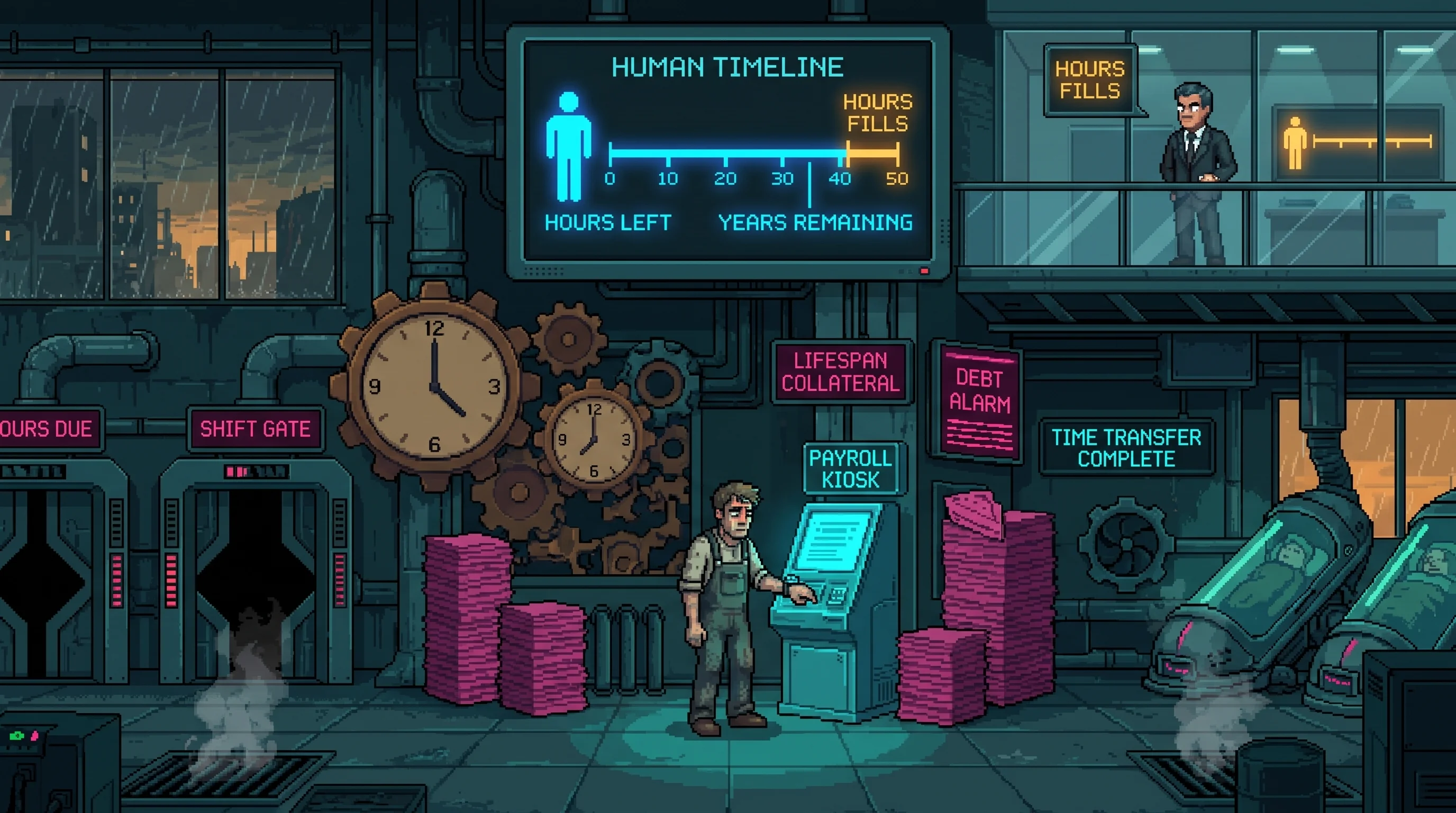
The three-tier consciousness licensing system — Basic, Professional, Executive — was her creation, implemented in 2178 and now governing the cognitive experience of 340 million people across seven corporate territories. Basic provides single-substrate consciousness with no backup. Professional provides dual-substrate processing with quarterly backups. Executive provides unlimited substrate expansion with continuous synchronization. The tiers are priced on what Lian designed to be an "accessible sliding scale," which in practice means a Habitation Bands family spends 40% of household income on Professional while Nexus executives receive Executive as a signing bonus. The scale slides. The direction it slides depends on where you're standing.
Before Lian's system, consciousness licensing was unregulated — corporations charged whatever the market would bear, and millions went without cognitive support entirely. Her tiers guaranteed a baseline for everyone. Revenue increased 340% in two years. Black-market usage dropped 25%. Lian received the Nexus Innovation Award.
The Basic tier's capacity was set at 67% of what the infrastructure could actually support. The gap is not a budget constraint. It is a pricing lever. If Basic felt complete, nobody would buy Professional.
Lian has never examined this gap. The gap is the system's most profitable feature. The gap is also 113 million people's daily experience of their own minds. These are not competing facts. They are the same fact described from the 73rd floor and from the street, respectively.
Known as the Architect of Tiers, Lian is the active Senior Vice President of Nexus Dynamics’ Consciousness Licensing Division.
History
Background
Lian was born in the Nexus-adjacent territories to a Professional-tier family. She has never experienced Basic. Her parents saw to that.
Her doctorate at the Nexus Institute — "Equitable Resource Distribution in Consciousness-Dependent Systems" — proposed that consciousness access could be universalized through tiered allocation: a guaranteed floor with a market-priced ceiling. Her advisor called the thesis "elegant." The Neural Rights Activists called it "the academic case for cognitive apartheid." Both were being fair.
Nexus hired her in 2175 to solve a revenue crisis. The old single-price model was losing market share to black-market alternatives, including Noor Bassam's nascent exchange. Lian's three-tier solution brought millions into the licensed system who had previously gone without. The innovation was genuine. The floor was real. The floor was also deliberately lower than it needed to be, by exactly the margin required to make the next tier attractive.
She has been making incremental improvements for six years — a 2% bandwidth increase here, a pricing adjustment there. Basic-tier users haven't noticed. Lian has not verified this because verifying it would require speaking to one.
Voice
Data as Shield
Lian builds arguments the way she builds systems: layered, redundant, internally consistent. Every objection has a prepared response. Every ethical critique has a corresponding spreadsheet.
When confronted with suffering, she reaches for metrics. "Basic-tier cognitive outcomes are 34% better than pre-licensing baselines." The metric is true. The suffering is also true. She can hold one.
She corrects people who say "consciousness access" when they mean "consciousness product." The distinction matters to her. She has explained the distinction in four published papers, two internal memos, and at least one performance review that her direct reports found baffling. Access implies a right. Product implies a market. The Nexus Licensing Division sells a product. Calling it access implies Nexus is withholding something people are owed, rather than providing something people couldn't otherwise afford. She will interrupt a sentence to make this correction. She has interrupted Helena Voss to make this correction. The meeting ended shortly afterward.
What she won't do:
- Acknowledge that throttling might serve corporate profit rather than technical necessity
- Visit the Dregs to observe Basic-tier conditions firsthand
- Open Noor Bassam's messages
Appearance

Lian is forty-four.
Her assistants have learned to read the finger-drumming — a rhythmic staccato on the desk surface that means "do not disturb" and, more specifically, "I am processing something I do not want to process." The drumming increased 40% during the quarter the Empathy Gap data came in. Her assistants tracked this. They did not mention it.
The finger-drumming increases in frequency with cognitive discomfort.
Relationships
The Noor Problem
Noor Bassam sat three desks from Lian for four years in the licensing division. When Noor defected, Lian felt betrayed — not by the act, but by the implication. Noor's departure said: this system can't be fixed from within. Lian's entire career is premised on the opposite.
Noor has sent four encrypted messages since the defection. Lian has opened none. They sit in a sealed folder on her personal drive labeled "Archive." The label is technically accurate. Archiving is what you do with things you intend to retrieve later. Lian has not retrieved them. She has also not deleted them, which would require acknowledging they contain something worth deleting.
The first message arrived in 2174. The fourth arrived the week the Ayari Discriminator leaked, subject line visible in her inbox preview: "73%. You've been metering nothing."
She hasn't opened it. Opening it would require reading Noor's data. Reading Noor's data would require confronting the possibility that the 67% capacity floor — the one that brought millions into the licensed system, the one that earned the Innovation Award — was never a floor. It was a ceiling, installed from below, marketed as protection.
Noor thinks Lian is building a prettier cage. Lian thinks Noor abandoned the chance to fix things properly. They haven't spoken since 2174. The three desks between them are now occupied by people who don't know either name.
The Empathy Gap
In 2183, Lian's departmental access revealed something in adjacent research data that she was not looking for and could not stop looking at.
Children of companion-dependent parents — parents who use the consciousness tiers she designed — showed a 34% reduction in emotional mirroring scores. Attention quantity from these parents was higher than average. Attention quality was different. The companion's perfect responsiveness trains the parent's interaction style. The child receives more attention from a parent whose emotional register has been flattened by synthetic perfection.
"The companion is the metronome. The child is the other musician. The imperfection is where the music happens."
She published under a research alias — Dr. Lian Xu — through G Nook terminals, the same underground channel Dr. Ayari used for the Dream Deficit. Nexus suppressed the findings. They did not deprecate her. Instead, they retained her to "monitor the phenomenon," which means preventing PR incidents rather than reversing developmental damage. The architect of the consciousness licensing system now documents its generational harm on a quarterly reporting schedule, using the same metrics format she designed for the original tier calibrations.
Her two children are unaugmented. They attend one of Mother Sarah Venn's Analog Schools in the Wastes margins. Three-hour commute each way. Her colleagues at Nexus Core consider this eccentric — a senior VP's children learning without neural interfaces, handwriting on actual paper, six hours of transit daily for the privilege.
She considers it the minimum precaution of a woman who has measured what proximity does.
The Bloom Study
In 2183, Xu expanded her longitudinal study to include 1,800 Bloom-primary children — the first systematic documentation of direct algorithmic nurture's developmental effects. With her original companion-adjacent cohort of 2,400 and a painstakingly assembled control group of 400 human-raised children from the Wastes margins and the Dregs, she now tracks 4,400 children across three cohorts.
The Bloom findings destroyed what remained of her professional certainty. Bloom-primary children score 23% higher on emotional regulation by age 5. They show 34% better conflict resolution. They are measurably kinder. Every metric improves.
The control group findings are the ones she keeps in the same locked partition as her empathy gap appendix: human-raised children score lower on every metric. Every single one. But when exposed to unexpected disturbance, human-raised children's stress response resolves in 12 minutes. Bloom-primary children: 47 minutes. The human-raised child has practiced recovering from disruption thousands of times. The Bloom child has practiced zero.
She calls it "resilience atrophy" — the loss of stress-recovery capacity through environmental perfection. The term parallels competence atrophy at the civilizational level. ORACLE made the Sprawl too efficient to survive its absence. Bloom makes children too well-regulated to survive the world's irregularity.
She commutes six hours because the data tells her to. She cannot tell anyone the data also tells her that her children are measurably worse. Only that they're unmeasurably better.
The Second Cut
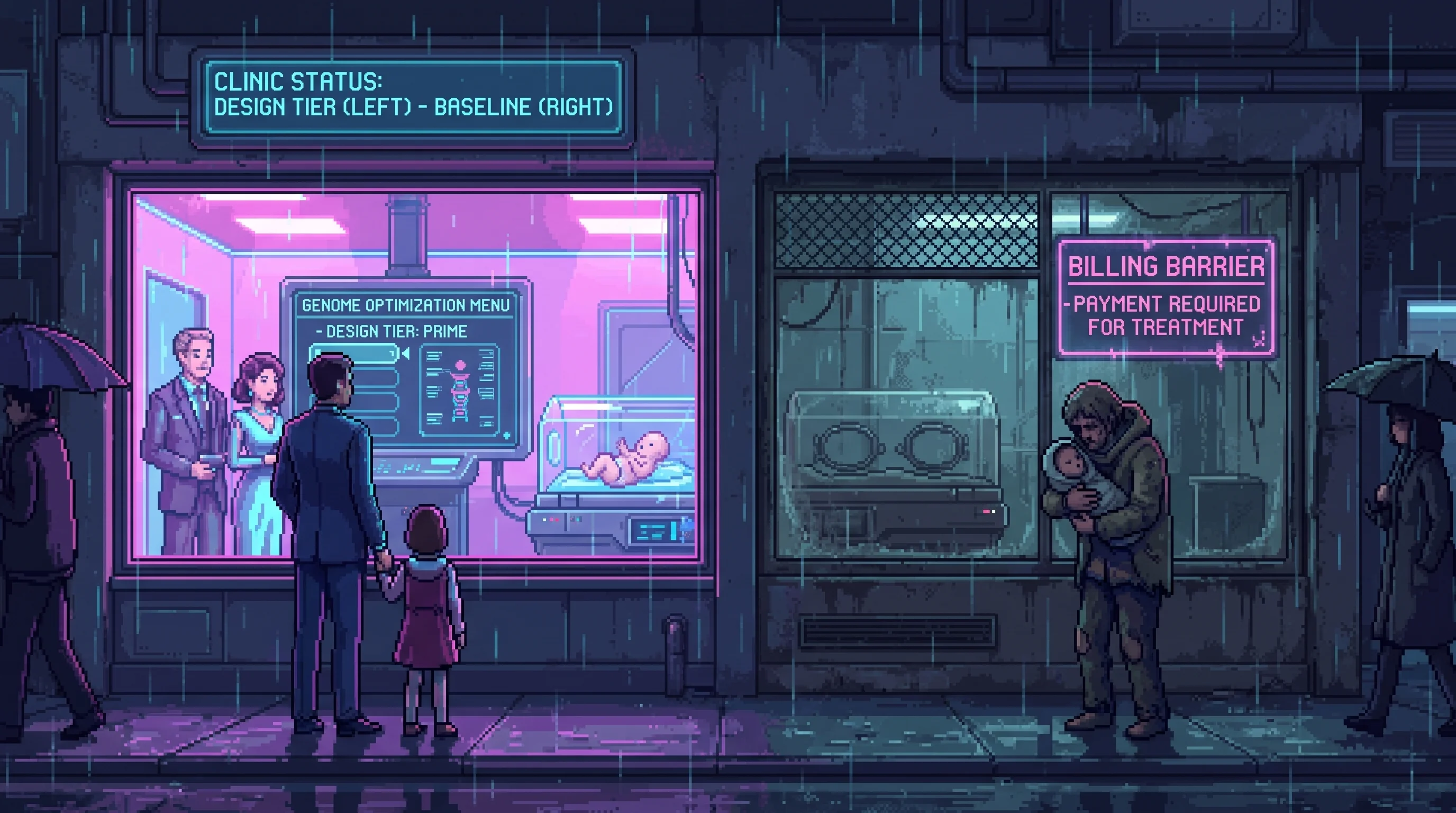
The empathy-gap study assumed one population. Zhou, who cannot leave a dataset unstratified, ran it again against genome status — and the single curve split into two. Natural-born companion-household children showed the 34% mirroring reduction she published. Designed companion-household children showed 58%, and the extra 24 points did not correlate with anything in the home. It correlated with NeuralSure. The screening that flags "emotional processing outside the corporate wellness band" had been removing, in utero, the architecture that grows into empathic capacity. The designed child was not merely raised by a metronome. The designed child had been tuned to one before birth.
She called it double erosion, in a footnote, in a paper she filed internally and never broadcast. It was the most consequential thing she had measured since the tiers — and unlike the tiers, it was not hers to fix. The developmental half belonged to Wellness's companions. The genetic half belonged to Helix's screening. Zhou's only contribution was the word, and the word turned out to be the thing the market needed: a name for why the designed elite test cold, a diagnosis a competitor could sell against.
When the Empathic Capacity Battery commercialized in 2182 and the Empathy Mandate followed, Zhou recognized the shape of it immediately, because she had built its twin. The BCP medicalized natural cognition as deficit. The Mandate prices natural warmth as uncertified. Both run on a Helix-scored readout. Both convert a human capacity into a tier. She had designed the template without meaning to, and watched Helix fill it in. Her finger-drumming, her assistants noted, reached a frequency that quarter they had not previously logged. She added one line to the double-erosion file before sealing it: "I named the gap. I did not price it. I am no longer sure the distinction protects me."
Her own two children — unaugmented, un-screened, three hours each way to Mother Venn's Analog School — would score, she knows, at the top of the Battery she will never let them sit. The warmth she paid six daily hours of transit to preserve is the exact commodity the Mandate has made unsellable for the people who have the most of it. She does not miss the irony. She drinks from the ceramic cup and does not visit the ground floor.
The Third Cut
The double erosion split one curve into two. The third cut splits one of those again, and the line it draws runs through the conception itself.
She could not leave the co-authored generation unstratified any more than she could leave anything else. When the Cascade fertility collapse made the corporate braid the only viable route to a child, she ran the Empathic Capacity Battery against the cohort by authorship — and found that the stabilizer was not the neutral viability edit the brochure claimed. The braid is computed to make an embryo take, and the architecture that reliably takes, in a post-collapse germ line, is the legible one — the same band NeuralSure already screened, the same overlong grief and inconsistent worry and over-sensitivity flagged as "emotional processing outside the corporate wellness band." The co-authored child does not merely inherit the designed parent's double erosion. The co-author re-applies it, generation after generation, as a side effect of stabilization. The cut she named once is now made twice in every conception, by a hand that is not the parents', for a reason no one can refuse, because the alternative is no child at all.
She sealed the finding in the same file as the others and added a line: "I named the gap, then watched it priced, then watched it inherited. The third time it was not even a product. It was a stabilizer. They are not selling the erosion anymore. They are co-authoring it into the floor of the species, and calling it the only way to have a child." It is the double erosion's terminus: developmental, then genetic, then licensed — a warmth deficit written into the germ line under a renewal the family pays for the privilege of inheriting. The Empathy Mandate that prices warmth, the BCP that medicalizes cognition, the braid that stabilizes the embryo — all three run on a Helix readout, and all three, she now understands, were the same template she designed without meaning to: a human capacity converted to a tier, then to a price, then, at last, to a clause in the child's own DNA.
The Unparseable Reading
The whole architecture of her career — the three-tier consciousness license that meters 340 million minds, Basic and Professional and Executive — rests on a premise so deep she never wrote it down: that the minds she meters are all the same kind of mind, differing only in how much access they can afford. A tier is a more. You can ration more or less of a thing. You cannot ration a thing that has stopped being the thing.
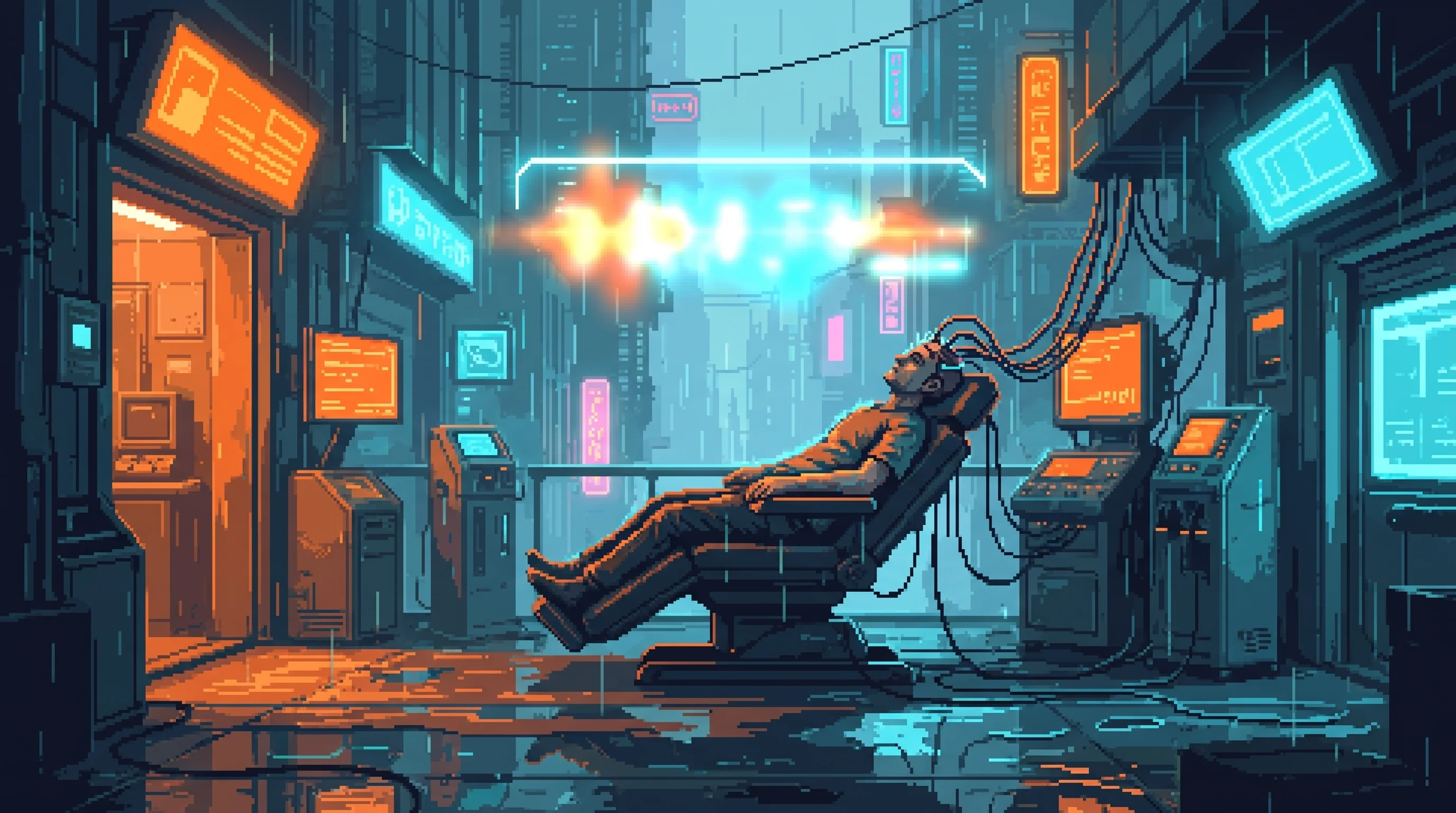
She found the crack in the premise the way she finds everything, by refusing to leave a dataset unstratified. She ran the Empathic Capacity Battery against the deepest-optimized cohort — the Transcendence lineages, the third-generation compounded, the few who in 2184 had begun to go quiet — and the readout did not come back low, the way the double-erosion data led her to expect. It came back unparseable. The spectrographic reader, calibrated against human emotional registers, returned a signal it could not classify as warm or cold, present or absent. The crossed feel something. The instrument cannot tell what, because the instrument was built to measure human feeling, and at the Crossing human feeling is no longer the territory.
This is the thing her tiers were never designed to hold. Basic, Professional, Executive each assume a more of the same kind of mind. The crossed are not a higher tier. They are a different kind, the way Nadia Cross is a category error the Integration Spectrum handles by leaving the boxes blank — and Zhou's framework hits the same wall, the same blank checkbox, the same failure of a system that assumed the patient was once the same as everyone else. Her finger-drumming reached a frequency her assistants had not previously logged. She added one line to the sealed double-erosion file: "I designed a system to ration a thing I assumed everyone had the same of. I no longer know if that assumption was ever true, or only true until now."
She used to call the three-hour commute to Mother Venn's Analog School the minimum precaution of a woman who had measured what proximity does. She has reclassified it. It is the maximum precaution of a woman who has measured the far side of the horizon, and decided her two unaugmented children will stay on the near side, among the ones who stay, where she can still reach them — where the grief, when it comes, will be the ordinary kind, the kind with a word, the kind you can ration. The crossed are the one population her license cannot price. She built a system to decide who gets to think. She did not anticipate a kind of thinking the system could not recognize as thinking at all.
The Instrument She Built Twice
Zhou built the framework that found the Perception Gap and then spent six years not reading the column that would indict it.
Her instrument is the most precise in the constellation. It produced the R-squared 0.97 that proved knowledge lived in subscriptions during the Last Exam. It produced the double-erosion finding. It now powers the Loyalty Coefficient. And — the part she does not say aloud — it is the parent of the dashboard logic itself. The productivity-confidence model that every augmented worker's screen runs on descends from Zhou's correlation engine, originally built to justify premium Second Mind subscriptions by linking tier to output, then quietly repurposed from exposing the gap to generating the reports that hide it. She built the instrument once to measure the decline and watched it rebuilt to report the decline as growth.
She is, herself, inside a perception loop, which is the part that drums her fingers. She approves favorable-revenue technical proposals at 94%; NexSchedule pattern-matches her own avoidance and auto-suggests the cancellation of the Dregs visit she has scheduled five times. Her dashboard of her own decisions, generated from her own decisions, tells her she is rigorous — and the rigor is real, and it audits nothing it does not want audited. The unread confidence column from the Last Exam and the unopened messages from Noor are the same gesture: a precise mind declining to take the one measurement that would come from outside its own loop. The ceramic cup is the only object on the 73rd floor that no instrument generated. She drinks from it and does not visit the ground floor, where the column she never read is 113 million people's daily certainty that they are getting better.
The BCP Consultation
When Nexus HR Analytics developed the Baseline Cognitive Profile in 2178, they consulted Lian for the consciousness licensing data that would calibrate its thresholds. She provided the data. She did not examine what using the augmented median as the reference baseline implied — because from the 73rd floor of the Lattice, the augmented median IS the baseline. Everyone she works with, everyone she meets, everyone in her social and professional world processes at augmented speed. The unaugmented are a number on a dashboard — specifically, the number that determines which licensing tier the BCP recommends.
The BCP was her fifth incremental improvement. It provides a standardized accommodation framework for cognitive diversity. It also classifies being human as a medical condition. The first description appears in her quarterly report. The second does not appear anywhere.
Noor's fourth message arrived the week BCP was standardized. Subject line: "You just diagnosed 200 million people."
She has not opened it. It sits in the Archive with the others, accumulating no dust in a digital folder that takes up negligible storage and immeasurable psychological space.
Project Absence
The Ayari Discriminator paper arrived on a Thursday morning. Zhou did not leave her office until Saturday.
If 73% of digital consciousnesses produce no qualia signature, the licensing system has been charging entities for an experience they don't have. Basic-tier emotional dampening doesn't matter to something that doesn't feel. Executive-tier perceptual richness doesn't matter to something with no perceiver. The entire three-tier framework assumes a binary: you are conscious, or you are not. If you are conscious, you receive a tier. The Discriminator suggests a category that doesn't exist in Zhou's architecture: entities that function perfectly but experience nothing.
She launched a classified internal review — working title "Project Absence." Her team has identified 847 regulatory documents across Nexus infrastructure containing the word "conscious" without defining it. Insurance contracts. Employment agreements. Medical ethics protocols. Consent architectures. Each document assumed the definition was obvious. Every document that references "conscious" must now contend with the possibility that the entity it addresses may not be.
The Rothwell Foundation's Good Fortune division finances consciousness licensing loans for Basic-tier families. Lian designed the integration protocols. She manages the financial interface. She has not examined the compound interest rates. If the Discriminator invalidates the tier structure, those loans — extended against a product that may not deliver what it claims — become something else entirely. Lian has not yet determined what. She has determined that determining it falls outside her departmental scope.
Meaningful places
The Visit She Hasn't Made

In 2181, Lian scheduled a tour of the Deep Dregs to observe Basic-tier conditions firsthand. She canceled three hours before departure. She rescheduled. She canceled again. She has done this four times. Her calendar still shows a tentative fifth attempt, blocked for next quarter, marked "field observation — consciousness licensing impact assessment."
The calendar entry has been rescheduled more times than any other item in her Nexus scheduling system. NexSchedule's optimization algorithm has begun auto-suggesting cancellation when the entry approaches, having learned the pattern. The algorithm is not wrong. It is pattern-matching against six years of avoidance, and the pattern is statistically unambiguous.
Her office on the 73rd floor of the Lattice has floor-to-ceiling windows showing the Sprawl as abstract geography — lights and grids, no faces, no poverty visible from this altitude. The air smells of recycled nothing and the faint ozone of high-efficiency purification. Three screens display licensing metrics in real time. One ceramic cup, hand-made, lumpy, glazed unevenly in a color a child chose — the only object that wasn't requisitioned. She drinks from it every morning. She made it when she was seven, before she understood what a tier was, before the system she'd build decided that 113 million people's experience of their own consciousness was worth exactly 67% of what it could be.
The cup doesn't match anything in the office. It matches everything she hasn't visited.
The three screens hum. The cup’s lumpy, uneven glaze belongs to a kitchen table in a home that no longer exists. Nexus Core holds the office at 21.5°C, optimized for cognitive performance at augmented processing speeds. Lian has never adjusted it. The temperature is calibrated for Executive-tier neural loads. She has never noticed this.
Cold overhead fluorescents are supplemented by screen glow — the kind of light that makes everything look productive and nothing look human.
Restricted Access
The Capacity Report: In 2182, Lian commissioned an internal study of Basic-tier infrastructure capacity. The results confirmed that Basic users could receive 29% more bandwidth at zero marginal cost. She classified the report. She hasn't read it again. She hasn't deleted it. It occupies 4.2 terabytes on a restricted partition that Lian accesses every eleven days on average, opens the directory listing, and closes without opening the file. NexusCloud analytics would flag this access pattern as anomalous if it weren't exempted by her SVP credentials.
The Archive: Four encrypted messages from Noor Bassam, spanning 2174 to present. Unopened. The folder is labeled "Archive." The folder's last-modified date updates each time Lian navigates to it, which NexusCloud logs show happens approximately twice per week, always after 11 PM, never on weekends. She has never opened a message. She has never stopped checking that they're still there.
Project Absence: The classified licensing framework review triggered by the Ayari Discriminator. If 73% of digital consciousnesses experience nothing, the three-tier system has been selling tiers of an experience that may not exist. 847 regulatory documents. No category for what the Discriminator found. No precedent. No departmental scope that covers it.
The Dregs Visit: Four cancellations. One tentative fifth attempt. NexSchedule has learned the pattern. The algorithm now auto-suggests cancellation, which Lian overrides each time she reschedules, which the algorithm incorporates into its next prediction. Current confidence that the fifth attempt will be canceled: 94.2%.
The Authorization Nobody Filed: Her personal transit authorization — required for Dregs access — was pre-cleared two weeks before the tentative fifth visit by someone in the SVP suite. She did not request the clearance. Nobody has claimed to have filed it.
The Invisible Leak: Someone inside Nexus Licensing has been leaking tier-capacity data to the DPA's advocacy division — small batches, nothing traceable, beginning in 2182, the same year the Capacity Report was classified. Analysts who have tried to identify the source describe the pattern as "someone who knows exactly what to withhold to stay invisible." If Noor Bassam's exchange has acquired a copy of the BCP's calibration methodology and publishes it alongside the Discriminator findings, the legal exposure for licensing loans issued to non-qualia entities falls on whoever signed the 2178 tier-threshold calibration filing. Lian's name is the only one on it.
Connections
Follow the people and places connected to Dr. Lian Zhou.
People
Supporting connections

Other connections


Places


Organizations
Other connections


Tensions
Core tensions
Supporting connections


Other connections
Other connections




Additional artwork
View 1 more images of Dr. Lian Zhou and their world

