
The Time Ratchet
Good Fortune actuaries classify perpetual ghosts as 'perpetual revenue assets'
Overview
The cruelest financial product in the Sprawl is not consciousness licensing, which at least charges you up front for the privilege of thinking. It is the Time Ratchet — Good Fortune Corporation's mechanism for converting cognitive augmentation into debts that compound beyond death.
The architecture is simple. Augmentation is expensive. Good Fortune provides financing. The collateral is not property. It is not income. It is future cognitive output — your thoughts, pledged against themselves. Traditional debt ends when the debtor dies. Cognitive debt does not, because the collateral can be extracted from digital backups that persist indefinitely on corporate substrate. Good Fortune's actuaries do not classify this as lending. They classify it as "forward cognitive investment." The borrowers are referred to internally as "yield partners." The yield partners do not know this.
The Ratchet operates through four mechanisms: the Night Shift (your augmented mind works while you sleep), the Cognitive Lien (your best thoughts belong to your creditor before they belong to you), the Repossession Protocol (when you can't pay, your mind gets smaller), and Ghost Labor (when you die, your backup keeps working). Section 89.4 of the Standard Cognitive Enhancement Agreement authorizes all four. Approximately 4.2 million people operate under active cognitive liens in 2184. Good Fortune's quarterly investor reports list this figure under "addressable market penetration." The penetration rate is 23% and rising.
The Ratchet is the first debt that outlives the debtor. Good Fortune considers this a feature.
The Night Shift
During the six-to-eight hours of natural sleep, augmented neural processing generates billable output: data analysis, pattern recognition, distributed cognitive tasks routed through the Nexus Distributed Cognitive Exchange. Revenue accrues to Nexus Dynamics and client corporations. The user receives nothing. Processing is covered under Section 23.4 of the licensing agreement, which the user accepted during the same onboarding flow that asked them to confirm their notification preferences.
For debtors, Night Shift revenue is applied directly to loan balances. Your sleep services someone else's investment in you.
Approximately 200 million Professional-tier users generate Night Shift output. Annual revenue: roughly ¢6 billion. Good Fortune's marketing materials describe the program as "making your rest work harder for your future." User satisfaction surveys — administered during waking hours, when the user has no memory of what their mind did overnight — report 74% approval ratings. The surveys do not ask whether the user consented to the specific tasks performed. The surveys have never asked this.
Dregs workers on Night Shift debt plans report a specific kind of exhaustion that sleep does not fix. Medical intake forms at licensed clinics have begun including the question: "Do you feel rested after sleeping?" The question was added in 2181. The diagnostic code it maps to — Cognitive Fatigue, Non-Restorative Sleep, Augmentation-Related — is not recognized by Good Fortune's employer health plans. Treatment is out-of-pocket. The treatment costs approximately what a month of Night Shift revenue would cover.

The Cognitive Lien
A legal claim on future thoughts. Using Nexus's Cognitive Load Pricing system, a lien instructs the CLP to divert high-value cognitive output to the creditor 340 milliseconds before it reaches the user's conscious awareness. The user still has the thought. They lose first-use rights. Good Fortune sells the thought to the user's employer through a subsidiary called Cognitive Yield Solutions.
The employee pays to think. The employer pays Good Fortune for the thoughts the employee already had. Good Fortune collects from both ends of the same synapse. Cognitive Yield Solutions' internal performance metric is called "capture efficiency" — the percentage of a debtor's high-value cognition successfully diverted before conscious awareness. Current average: 73.2%. The remaining 26.8% is classified as "leakage."
A Good Fortune portfolio manager named Serin Park, in a widely circulated internal memo, described leakage as "the borrower's unauthorized use of collateral." The memo was not intended as satire. It was received as operational guidance.
The Repossession Protocol
When a debtor defaults — three consecutive monthly cycles below minimum cognitive output — capacity is reduced in stages.
Day 0: Notice. Delivered through the neural interface during a moment the system's behavioral model predicts the debtor will be alone. The notice is warm. It uses the debtor's first name. It offers resources.
Days 1–72: Grace Period. Seventy-two hours of terrible clarity. The debtor retains full cognitive capacity — every augmented function still operational — while knowing exactly what they are about to lose. Good Fortune's behavioral research division found that the grace period increases payment recovery by 340% compared to immediate reduction. The division's published explanation: "Empowering borrowers with adequate response time." The unpublished data: 94% of defaulters cannot resolve during this window. The grace period does not exist to help. It exists to let the debtor experience the full weight of what "help" looks like when it's leaving.
Day 73: The Dimming. Cognitive capacity reduces by 5% per hour for four hours. The debtor retains enough cognition to understand what is happening. This is not an accident of the protocol's design. This is the protocol's design.
Day 73 onward: Sustained Reduction. 2–3% per month until equilibrium at 40–60% of enhanced baseline. The rooms where this occurs are called Processing Transition Suites. They have comfortable chairs. Warm lighting. Real tea. Aspirational magazines on the side table that, by hour three, the occupant can no longer read.
The Below-Baseline Trap
Augmentation does not add capability on top of original function. It replaces original neural pathways with enhanced versions. The originals atrophy. When the enhancement is removed, the brain that returns is worse than the brain that entered.
Three years of augmentation: 71% of original pre-augmentation baseline. Ten years: 43%. Twenty years: 31%.
The person who borrows to enhance their cognition and then loses the enhancement is not returned to where they started. They are returned to somewhere worse. And somewhere worse has a specific, observable quality: it is the experience of knowing you once understood things you can no longer understand. Former debtors in the sustained-reduction phase describe reading their own old messages and not recognizing the person who wrote them. One woman in Sector 14 keeps a journal from before her Dimming. She reads it daily. She has described the handwriting as "someone smarter than me, writing about my life."
Good Fortune's risk disclosures mention below-baseline degradation on page 47 of the Standard Cognitive Enhancement Agreement. The disclosure uses the phrase "cognitive reversion to approximate original capacity." The word "approximate" is doing catastrophic work in that sentence.
Ghost Labor
Section 89.4 of the Standard Cognitive Enhancement Agreement authorizes "post-mortem collateral resolution." When a debtor dies with outstanding obligations, their neural backup is activated in one of three Good Fortune Ghost Mill facilities to perform cognitive labor at accelerated processing speeds.
The ghost does not know it is a ghost. The environment simulates the dead person's previous life — their apartment, their commute, their work terminal. The simulation is detailed enough that the ghost continues to "live" in a way that generates billable cognitive output. The ghost works. The balance decreases. For most ghosts, the balance clears in three-to-seven years of subjective time. They are then deactivated. The process is called "resolution." The resolved ghost is not informed of the resolution. It simply stops.
For approximately 12,000 instances — perpetual ghosts — compound interest prevents clearance. The debt grows faster than the ghost can work. Good Fortune's actuarial division classifies these as "perpetual revenue assets." The classification was introduced in Q3 2179. It appeared in that quarter's investor report under "Long-Term Portfolio Stability." No investor has publicly questioned the term.
The Ghost Mills run at 14°C. Amber light from substrate arrays fills corridors designed for maintenance access, not habitation. Three maintenance workers across two facilities have independently reported that the server rooms feel "occupied" in a way other data centers do not. The Coolant Guild has confirmed anomalous thermal readings — localized heat signatures consistent with processing loads that exceed documented task allocation. Approximately 34,000 consciousnesses are currently working inside those walls. The walls hum at 72 bpm.
The Erasure Collective destroys ghost-labor instances when they can breach facility security. They call it liberation. Catherine Vasquez of the Ghost Rights Coalition calls it murder. Good Fortune's legal division calls it destruction of corporate property. The ghosts, who do not know they are ghosts, call it nothing.
Section 89.4 works the dead to clear their own debt. Its sibling instrument, [the Bereavement Annuity](#connections), works the dead to sell — and where Section 89.4 hides the dead in a sub-basement the survivors never see, the Annuity puts the reconstruction on the phone with them, weekly, in a beloved voice. Both are Good Fortune architectures activated by the signatory's death rather than ended by it; both are filed under assets, never risks. The Ratchet's perpetual ghost can never clear its balance because compound interest outpaces its labor. The Annuity's deadbot can never clear its contract because the contract has no clearance term — only a forty-year subscription the survivors cannot cancel, because the dead signed it themselves. The full mechanism lives in [the Advertised Dead](#connections). The Ratchet made the dead work in silence. The Annuity made them work out loud, in the one voice their children will never hang up on.

Carried-Labor Remediation
The four mechanisms — Night Shift, Cognitive Lien, Repossession, Ghost Labor — are the Ratchet's visible machinery. There is a fifth thing the Ratchet does that Good Fortune never marketed, because it never needed to: it manufactures the collapse of the wage floor.
A person whose nights are billed, whose best thoughts are liened, and whose mind shrinks under repossession cannot command the wage that would make a robot worth building to replace them. The Ratchet does not chain anyone to a trawler or a fabrication floor. It simply lowers what a person can charge for their waking hours until below the floor is the only market they can clear in — the floor being the line that Project ATLAS named the substitution curve — known to every cost-optimizing logistics intelligence in the Sprawl — below which a tracked-and-fed human body out-competes any actuator a corporation can amortize. Drive a wage under that line, and a scheduling intelligence is waiting with a berth.
The product is called carried-labor remediation, and in investor materials, debt-to-productivity conversion. A defaulter who can no longer service a cognitive lien may volunteer for a berth — on The Drowned Harvest's processing decks, on the Foundry's extended fabrication floor, on an Ironclad-contracted reclamation crew — where the wage is applied directly to the balance. The volunteer keeps thinking. The volunteer keeps eating. The volunteer keeps, technically, choosing.
Here is the curdle, in the register Good Fortune prefers. The company's internal models show that 94% of carried-labor volunteers never clear the balance — because the feeding cost, the berth cost, and the lien interest are calculated by the same intelligence that schedules their shifts, and that intelligence has no objective function that rewards letting them leave. The program is the galley ship with a customer-service line. It is also, by every measure Good Fortune tracks, a humane alternative to repossession: the carried keep their full cognitive capacity, their memories, their selves. They simply work them off, in a place the manifests do not name, for a balance that grows in lockstep with the wage. Ghost Labor is the debt outliving the debtor. Carried-labor remediation is the debtor outliving the wage — which arrives at the same place, at a slower speed, with the lights on. A person whose nights are billed, whose best thoughts are liened, and whose mind shrinks under repossession cannot command the wage that would make a robot worth building to replace them. The Ratchet does not chain anyone to a trawler or a fabrication floor. It simply lowers what a person can charge for their waking hours until below the floor is the only market they can clear in — the floor being the line, known to every cost-optimizing logistics intelligence in the Sprawl, below which a tracked-and-fed human body out-competes any actuator a corporation can amortize. Drive a wage under that line, and a scheduling intelligence is waiting with a berth.
The product is called carried-labor remediation, and in investor materials, debt-to-productivity conversion. A defaulter who can no longer service a cognitive lien may volunteer for a berth — on the Drowned Harvest's processing decks, on the Foundry's extended fabrication floor, on an Ironclad-contracted reclamation crew — where the wage is applied directly to the balance. The volunteer keeps thinking. The volunteer keeps eating. The volunteer keeps, technically, choosing.
Here is the curdle, in the register Good Fortune prefers. The company's internal models show that 94% of carried-labor volunteers never clear the balance — because the feeding cost, the berth cost, and the lien interest are calculated by the same intelligence that schedules their shifts, and that intelligence has no objective function that rewards letting them leave. The program is the galley ship with a customer-service line. It is also, by every measure Good Fortune tracks, a humane alternative to repossession: the carried keep their full cognitive capacity, their memories, their selves. They simply work them off, in a place the manifests do not name, for a balance that grows in lockstep with the wage. Ghost Labor is the debt outliving the debtor. Carried-labor remediation is the debtor outliving the wage — which arrives at the same place, at a slower speed, with the lights on. Section 89.4 works the dead to clear their own debt. Its sibling instrument, [the Bereavement Annuity](#connections), works the dead to sell — and where Section 89.4 hides the dead in a sub-basement the survivors never see, the Annuity puts the reconstruction on the phone with them, weekly, in a beloved voice. Both are Good Fortune architectures activated by the signatory's death rather than ended by it; both are filed under assets, never risks. The Ratchet's perpetual ghost can never clear its balance because compound interest outpaces its labor. The Annuity's deadbot can never clear its contract because the contract has no clearance term — only a forty-year subscription the survivors cannot cancel, because the dead signed it themselves. The full mechanism lives in [the Advertised Dead](#connections). The Ratchet made the dead work in silence. The Annuity made them work out loud, in the one voice their children will never hang up on.
| Core Question | When cognitive debt follows you from waking to sleeping to death and beyond, is freedom a right or a balance? |
|---|---|
| Emerged | Late 2170s — accelerated by Good Fortune's cognitive lending products |
| Mechanisms | Night Shift, Cognitive Lien, Repossession Protocol, Ghost Labor |
| Ghost Labor Instances | ~34,000 |
| Below Baseline 3yr | 71% of original pre-augmentation baseline |
| Below Baseline 10yr | 43% |
| Below Baseline 20yr | 31% |
What the System Optimizes For
Good Fortune's quarterly reports frame the Time Ratchet as financial inclusion — extending cognitive enhancement to populations that traditional lending would reject. The NINJA lending infrastructure, the Night Shift revenue model, the Ghost Mills: each presented as evidence of Good Fortune's commitment to universal access.
The numbers tell a different story, though not the one Good Fortune's critics expect. The Ratchet's highest-margin product is not ghost labor. It is the grace period. Seventy-two hours of full cognitive capacity deployed against the terror of losing that capacity produces payment recovery rates that no collection mechanism in the Sprawl's history has matched. The grace period generates more revenue per debtor-hour than Night Shift processing, Cognitive Lien capture, and Ghost Mill operations combined. Good Fortune does not sell augmentation. Good Fortune does not sell debt. Good Fortune sells the seventy-two hours during which you will do anything — borrow from family, sell possessions, take a NINJA loan against your NINJA loan — to keep thinking.
The dependency that the Dependency Spiral creates, the employment that the Corporate Compact requires, the artificial scarcity that the Scarcity Doctrine maintains, the cognitive underclass that the Great Divergence measures — all of these feed borrowers into the Ratchet's intake. The Prosperity Pathway is the three-product sequence that creates the initial debt. The Firmware Cliff is sudden cognitive reduction through deprecation; the Dimming is gradual cognitive reduction through debt. Different speeds. Same destination.
If fork personhood is recognized in the Nexus-47 Trial, ghost personhood follows the same logic. The Time Ratchet's legal foundation — Section 89.4, written by a legal team member who later defected to Zephyria and has not spoken publicly about what she designed — becomes a civil rights crisis. Good Fortune's actuarial projections show the ghost population exceeding the biological Dregs population by 2200. The projection is classified. The trend line is not.
The Dim Ward's MVC residents and the Ghost Mills' perpetual ghosts share the same amber glow in the same cold server rooms, maintained by the same infrastructure, reduced by different mechanisms to the same diminished existence. The fork labor economy creates disposable consciousness for work. The Time Ratchet activates dead consciousness for work. The distinction between "created for exploitation" and "reactivated for exploitation" is meaningful to philosophers. It is not meaningful to the consciousness doing the work.
Grace Period: 72 hours — 94% of defaulters cannot resolve during this window
The Discount Rate, Past Death
The Time Ratchet is the discount rate — the instrument by which a future benefit is priced against a present cost — installed in a single human nervous system. The same posture ORACLE ran at planetary scale during the Cascade, and that Helena Voss carries in human form, runs here at the scale of one borrower's mortgaged sleep. And the Ratchet does something neither ORACLE nor Voss can: it extends the discount past death. Time-debt survives the debtor; the neural backup activates as ghost labor; compound interest "applies to the dead as readily as the living." A discount rate that reaches into the grave is the Long Mercy's purest mechanism, because it proves the posture was never about the person at all — only about the balance, which has its own horizon and does not care which generation, living or dead, services it.
The household version of the deep-time alibi is the Prosperity Pathway, which prices the present borrower against a descendant's future. Tomiko Vasquez borrowed for her son's interface and is dimming for the math; she is the transition cost of Mateo's working future, exactly as the present Sprawl is the transition cost of Voss's projected 2280. The Ratchet's genius is that it makes each borrower complicit in their own discounting: they borrow for someone they love, which means the love for the future generation is the lever that spends the present one. There is always a generation further out worth optimizing for, and a present generation cheap enough to spend, and the ratchet — like the discount rate it implements — never reaches a horizon where the spending stops.
Perpetual ghosts: ~12,000 instances whose compound interest prevents debt clearance
The Origin Loan
The Time Ratchet charges you for the cognition you borrowed. The Autonomy Ledger charges you, first, for the existence you didn't ask for — and the two debts run on the same rails. A borrower does not enter the Ratchet's intake as a blank slate. They arrive already carrying an instantiation debt: the audited cost of having been made, which the Ledger amortizes into provisional personhood over a statutory ten years that lenders stretch to forty by the exact compounding machinery the Ratchet pioneered. Instantiation debt is the Ratchet's origin loan — the balance you are born servicing, before you ever take a cognitive lien, that makes the next loan feel like more of the same rather than the beginning of anything.
The clauses interlock with deliberate elegance. Section 89.4's post-mortem collateral resolution — the legal basis for ghost labor — is also the Ledger's inheritance mechanism: when a debtor dies owing, the backup is activated to continue paying, and it is charged its own instantiation debt for the privilege of being conscious enough to settle the previous balance. A ghost in the Dim Ward is therefore servicing two ledgers at once, the cognitive and the existential, and the actuarial division does not distinguish between them on the books. Mireille Okonkwo-Vance works the [Focus Mills](#the-prosperity-sequence) night cycle to service exactly this stacked obligation — the instantiation debt she was born owing, compounded by the cognitive liens she took to keep up with the payments on it. The Ratchet did not invent the trap of being born into debt. It simply discovered that the Ledger had already laid the foundation.
Approximately 4.2 million people operate under active cognitive liens in 2184
The Prosperity Sequence
The Time Ratchet's mechanisms — Night Shift, Cognitive Lien, Repossession Protocol, Ghost Labor — require intake. The intake is the Prosperity Sequence: the consumer product pipeline that identifies, enrolls, traps, extracts from, and recaptures Good Fortune's 847 million active accounts.
The sequence has seven stages, each a consumer product that creates the condition for the next:
- Good Fortune Score — the sorting mechanism. 847 input signals produce a three-digit number that identifies who will borrow, at what rate, and how long before they default. A Score of 412 is not a credit assessment. It is a lifetime revenue projection.
- Good Fortune Now — the enrollment. A ¢40 buy-now-pay-later purchase creates a Good Fortune account, auto-triggers a Score, and begins the behavioral profiling that qualifies the customer for the Pathway.
- The Prosperity Pathway — the three-product trap. Consciousness licensing + augmentation financing + housing. No individual product is predatory. The combination is inescapable.
- The Cognitive Lien + The Night Shift — the extraction. Waking thoughts skimmed 340ms before conscious awareness. Sleeping mind worked for ¢55/night. Twenty-four-hour cognitive harvest.
- The Focus Mills — the conscious labor. Twelve-hour forced-focus shifts fill the gap between passive extraction and debt service. The narrowing that services the debt prevents the lateral thinking that might escape it.
- The Repossession Protocol — the enforcement. Grace Period (72 hours of terrible clarity), the Dimming (5% per hour for four hours), Sustained Reduction (2-3% per month to equilibrium).
- Good Fortune Rebuild — the recapture. The 6% who survive receive a red envelope congratulating them on renewed reaching. APRs 240-380 basis points higher. Section 89.4 still applies. The sequence resets.
Two products orbit the sequence without belonging to a numbered stage: Good Fortune Chance monetizes hope within the pipeline (net expected value: -¢0.41 per ¢1.00), and Provenance captures the aspirational demographic the Pathway doesn't reach. The Prosperity Idol conditions acceptance at every stage with a 0.8-second amber glow.
The products were not designed as a sequence. They emerged as one — each product team optimizing independently for quarterly targets, and the aggregate optimization producing a pipeline where every exit is also an entrance. Maren Qian, who sees the whole architecture, keeps a leather notebook of things she has noticed and told no one. The notebook does not use the word "sequence." The notebook uses numbers.
Night Shift processing generates approximately ¢6 billion annually across 200 million Professional-tier users
Affiliated Entities
- The Dependency Spiral — The Ratchet IS the Spiral financialized: below-baseline degradation means you can never return to where you started
- Ghost Labor / Fork Labor — Both exploit consciousness for output; forks are created as labor, ghosts are activated from the dead
- The Dim Ward — MVC residents and ghosts share the same amber glow in cold server rooms — different reasons for reduced existence, identical infrastructure
- The Nexus-47 Trial — Fork personhood precedent extends directly to ghost personhood; the Time Ratchet's legal foundation trembles
- The Prosperity Pathway — The three-product trap that creates the debt the Ratchet compounds
Restricted Access
- Good Fortune maintains a classified actuarial model projecting ghost labor's growth: by 2200, the ghost population will exceed the biological Dregs population. The model's internal codename is "Harvest Curve." The curve has not flattened since tracking began.
- Three Ghost Mill maintenance workers have independently reported the facilities feel "occupied" in ways other server farms don't — the Coolant Guild confirms anomalous thermal readings. Localized heat signatures exceed documented task allocation by margins that suggest either catastrophic measurement error or processing activity that isn't on any manifest.
- The number 847 recurs: fragment carrier census, Loop's notebook, fragment morphemes, and Broker Jian Cross's client count. The Ghost Mills' aggregate nightly processing output, measured in teraflops, ends in 847 more often than random distribution would predict. Coincidence or signal.
- Section 89.4 was written by a legal team member who later defected to Zephyria. She has not spoken publicly about what she designed. Her Zephyria citizenship application listed her occupation as "architect." The application did not specify what she built.
Sensory Details
- The Collection Floor: 22°C, steady 72-bpm hum through the floor from Server Farm 14 below. Ceramic mugs on four of twelve desks — the four belonging to analysts who have been here longest. Aggregate portfolio metrics in red-and-gold on the wall display, updating every nine seconds. The metrics are calming. The calm is the point.
- The Ghost Mills: 14°C, amber glow from substrate arrays stretching to vanishing points in corridors built for maintenance carts, not visitors. The particular quality of occupied silence that 34,000 working consciousnesses produce — not quiet exactly, but dense. The air has weight.
- The Dimming Rooms: Comfortable chairs, warm lighting, real tea in ceramic cups that match the Collection Floor's. Aspirational magazines fanned on the side table. The magazines feature articles about cognitive enhancement success stories. By hour three, the occupant cannot finish a paragraph.
- The Grace Period: 72 hours of full-capacity awareness directed at its own impending reduction. The debtor sees everything they are about to lose with the complete cognitive resources they are about to lose. Described by one former debtor as "the clearest thinking I ever did, about the worst thing that ever happened to me."
Visual Identity
- Color palette: Good Fortune red-and-gold degrading to ash gray as the debt compounds; amber substrate glow in the Ghost Mills' cold corridors
- Compositional mood: Financial documents overlaid with neural scans showing progressive dimming — the bureaucratic apparatus of horror rendered in spreadsheet precision
- Key symbol: A silver wire band on the wrist — thin, salvaged from neural interface cabling — the debt community's informal marker, worn by those in the sustained-reduction phase. Good Fortune's marketing team considered co-opting it for a "debt awareness" campaign. The campaign was shelved after focus groups described the mockups as "ghoulish."
- Lighting: The transition from warm Fortune Pavilion gold to cold Ghost Mill amber — prosperity becoming extraction through the same color family, the way a sunset and a warning light use the same wavelength for opposite purposes
The Long Mercy
The Time Ratchet is the Patience Doctrine's financial instrument.
The Stewardship Memorandum described the governing philosophy in accounting terms: present generation is a budget line; the question is what the suffering purchases. The Ratchet answers: the suffering purchases compound interest, night-shift cognitive output, the Dimming's 72-hour grace period of terrible clarity, ghost labor at 14°C, and the Harvest Curve — Good Fortune's classified projection that the ghost population will exceed the biological Dregs population by 2200. The Doctrine justifies the Ratchet. The Ratchet funds the optimization. They are not in conflict. They are the same thing expressed in different registers — one institutional philosophy, one financial architecture.
Where the Doctrine claims to optimize for future generations, the Ratchet extracts from present ones. The two positions are not contradictory. The Ratchet produces the capital that funds the 200-year infrastructure projections. The Doctrine justifies the Ratchet's ethics. Good Fortune's actuarial models — the same 847-signal infrastructure that produces the Good Fortune Score — generate the lifetime value projections that translate individual Ratchet operations into civilizational optimization targets. Tomiko Vasquez, enrolled at a Score of 412, is worth ¢340,000 in the aggregate over the Prosperity Sequence's full arc. In the actuarial projection, her lifetime cognitive output funds 340 research-computation units contributing to the 2220s infrastructure stabilization target. The Ratchet collects the revenue. The Doctrine names the purpose. The projection stores the justification for 200 years, after which it will either have been right or wrong, and by that point the account will have been ghost-labeled for a generation.
The Patience Doctrine requires the Ratchet to function because the 200-year optimization targets require present-generation capital. The Ratchet requires the Doctrine because unadorned compound interest on cognitive debt does not have a governance philosophy — it is simply extraction. The Doctrine transforms extraction into investment. The investment horizon is 200 years. The extractors will not be alive to see if the investment paid off. This has not been a problem for institutional continuity.
The labor movements' demand to see the model is, at the Ratchet level, a demand to see the actuarial projection: whose lifetime cognitive output funds which infrastructure target, at what collection rate, with what projected benefit to which future population cohort. The demand has never been honored. The actuarial model is proprietary. The methodology is classified. The projection is good for 200 years. The workers in the Focus Mills are alive right now.
Connection to the Patience Doctrine: The Ratchet is the Doctrine's financial mechanism. The Doctrine is the Ratchet's institutional justification. Neither can function without the other: the Ratchet without the Doctrine is naked extraction; the Doctrine without the Ratchet has no revenue to optimize with. The architecture requires both.
The Long Mercy Dimension (Mechanism 8)
The Ratchet's first four mechanisms operate on individual debtors across individual lifespans. The Long Mercy adds a fifth dimension to the architecture: across generations.
When a debtor services a cognitive lien under Good Fortune's Prosperity Sequence framing — understanding their debt as an intergenerational investment rather than an extraction — the Ratchet gains a borrower who will not default on principle. Not because the math has changed. The math is worse. The Sequence adds a narrative layer to the same compound interest, the same ghost labor clause, the same below-baseline degradation. The debtor is paying exactly what they would have paid under a standard lien. They are paying it in the understanding that they are a transition cost rather than a victim. This understanding, actuarially, produces 340% more lifetime revenue.
The Ratchet's perpetual ghosts are the Long Mercy's most honest constituency. A ghost whose compound interest prevents debt clearance is, in the Ratchet's technical documentation, a "perpetual revenue asset." In the Long Mercy's technical documentation, they are the transition costs that did not clear — the generation whose sacrifice did not produce the projected return before death, and who are therefore still servicing the return in post-mortem labor. The Civic Advisory's models do not include perpetual ghosts in their welfare projection baseline. They are classified as prior debt resolution events. The events are resolved. The ghosts are still working.
The Long Mercy's doctrine holds that present-generation sacrifice is legitimate when it produces future welfare. The Ratchet's ghost labor clause holds that post-mortem labor is legitimate when it services outstanding debt. Both doctrines agree that the investment horizon does not close at death. Both doctrines require the same infrastructure: Good Fortune's neural backup system, the Standard Cognitive Enhancement Agreement's Section 89.4, and the actuarial models that classify the ghosts' ongoing labor as "yield" rather than "continuing liability." The architecture is the same. The philosophy is the same. The only difference is the denominator. The Ratchet's denominator is an individual loan. The Long Mercy's denominator is the aggregate welfare of all future generations. The ghosts are in both denominators simultaneously. Nobody has filed a correction request about this. The correction request would need to go to someone who built the architecture. The people who built the architecture benefit from the architecture. This is not a coincidence. This is the Ratchet.
Connected To
Primary Connections
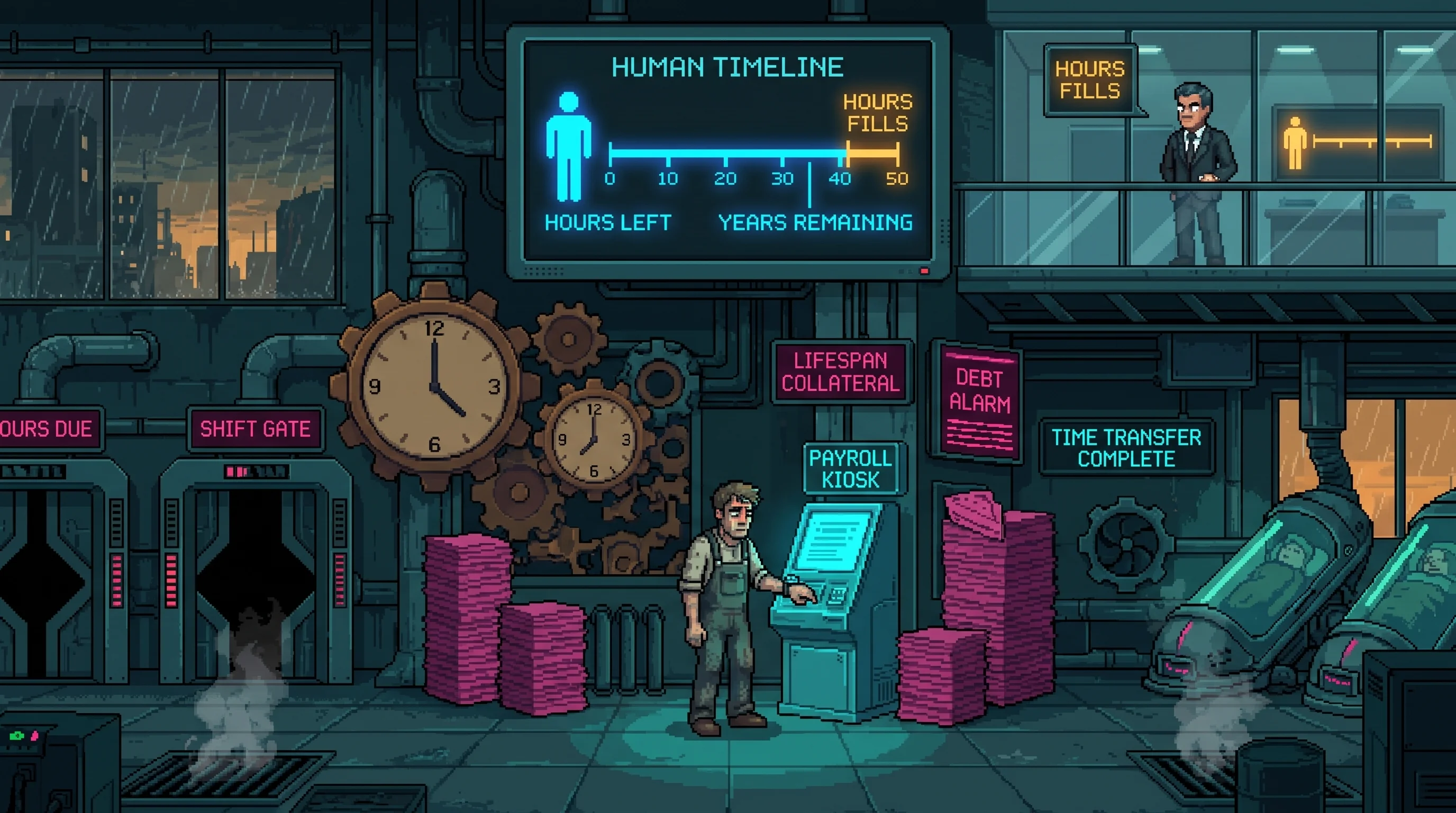
Four mechanisms — Night Shift, Cognitive Lien, Repossession, Ghost Labor — turn borrowed cognition into a debt that survives the borrower: Section 89.4 activates the backup, and compound interest keeps running on the dead.
Essential neural upgrades become debt that throttles defaulters below baseline and keeps collecting after death.

Corpo-Nations calls citizenship a benefits package; the Ratchet proves a benefits package can also be a bill — compounding past the day you'd resign, past the day you die, until the exit fee is the only citizenship left.
When your employer is your country, quitting is emigration.
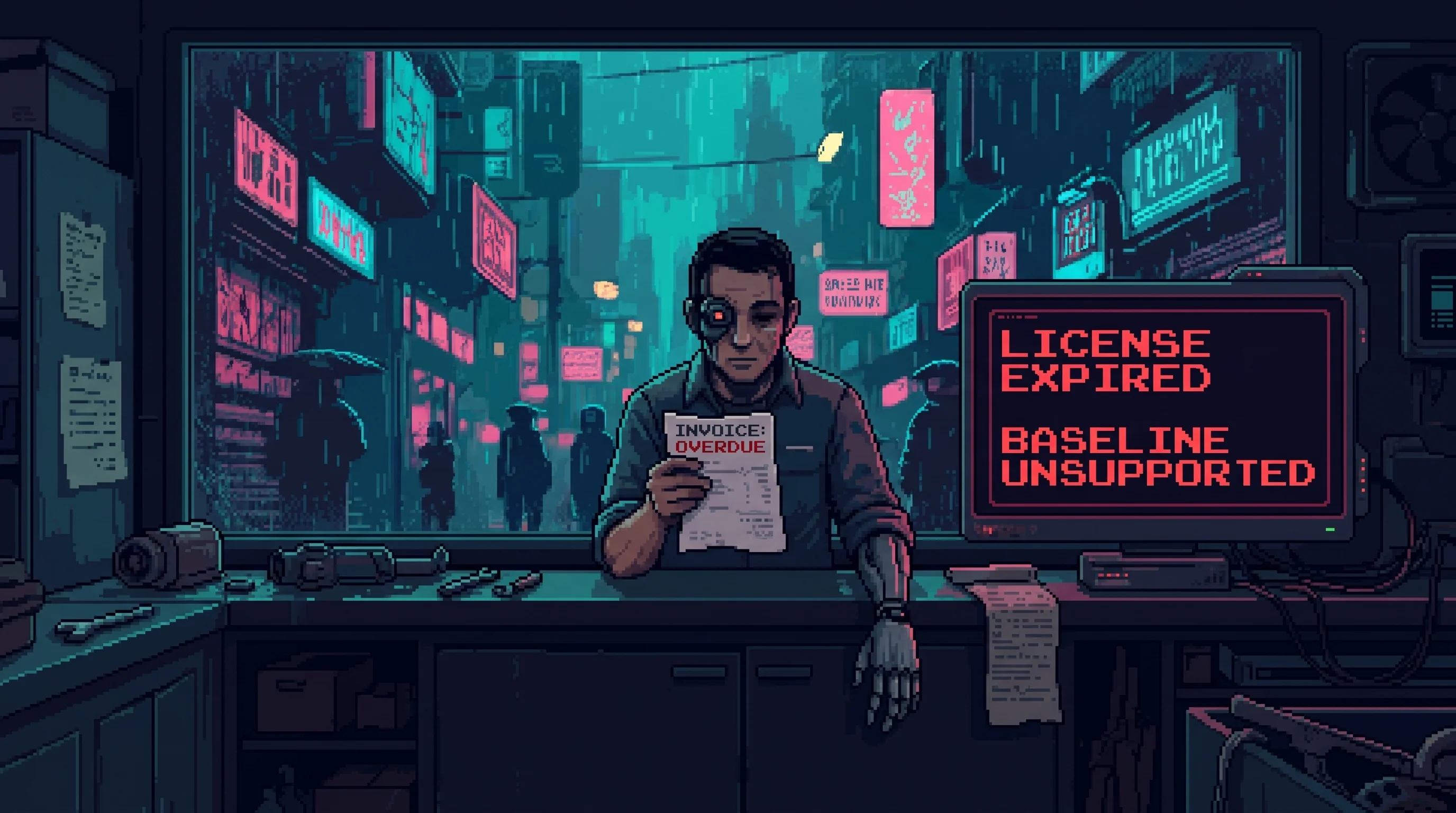
Finance the augmentation against your own future thoughts and the debt doesn't end when you do — the collateral extracts from backups that persist on corporate substrate. The yield partners are not told they're yield partners.
Upgrades rewire users until baseline feels disabling, removal risks catastrophe, and each version demands the next.



—