Concord
Predictive Solidarity Prevention System
Week-Minus-Three
Concord disperses every nascent movement at week-minus-three — before the second person joins the first — by issuing individualized micro-reliefs to the precise individuals whose discontent is about to crest
How It Works
- 1
Read
Transparency Bargain telemetry is assembled into a district mood-front.
- 2
Forecast
Each resident gets a Convergence Horizon, the days until their discontent seeks a second carrier.
- 3
Schedule
Anyone under twenty-one days is queued for a forgiven debt, a skipped queue, or a well-timed entertainment.
- 4
Deliver
The relief lands at week-minus-three, early enough to read as luck.
Concord runs a four-stage loop, continuously, across the managed sectors. Read: it ingests the Transparency Bargain's biometric and cognitive telemetry — 11,200 biometric and 4,700 cognitive data points per second per resident — and assembles them into a district mood-front, a forecast of where and when discontent will rise. Forecast: for each resident it computes a Convergence Horizon, the projected number of days until that person's discontent would, absent intervention, seek a second carrier. Schedule: for anyone whose Horizon drops below twenty-one days, it queues an individualized micro-relief — a forgiven debt, a skipped queue, a perfectly timed entertainment delivered through the Content Flood's calibrated stream. Deliver: the relief lands at week-minus-three, early enough to read as luck, late enough not to waste budget on people who would have calmed down anyway. Then the loop repeats, having dispersed one cresting mood-front into harmless individual droplets before it could condense into a crowd.
The Convergence Horizon
Nexus's internal name for Concord's central metric is the Convergence Horizon: the projected number of days until a given resident's discontent would, absent intervention, seek a second carrier. The Horizon is computed continuously off the telemetry The Transparency Bargain already collects — cortisol microbursts, attention distribution, sub-vocalization, the rolling physiological portrait updated sixty times a minute. A mood-front is forecast the way the old world forecast a storm.
The reliefs are scheduled to land at week-minus-three — early enough that the resident experiences the perk as good fortune, late enough that the civic budget is not wasted on people who would have calmed down on their own. The targeting is the whole craft. Concord does not soothe everyone; soothing everyone would be expensive and would read as policy, which would read as control, which would itself generate discontent. It soothes the specific individuals whose Horizon has dropped below twenty-one days. The first person is calmed before the first person has finished becoming the first person. The second person is never recruited, because there is no longer a first.
What It Costs Nothing To Prevent
Cheaper than suppression
A forgiven debt costs less than a policed riot, leaves no martyr, and the recipient is grateful.
What it costs
The discontent is dispersed, not addressed.
Customer retention
Concord scrubs the resentment the Problem Machine manufactures.
What it costs
Customers never compare notes about the dependency that made them angry.
The economic argument inside Nexus is unanswerable, which is why no one has answered it. Forgiving a small debt costs less than policing a riot. Skipping someone's queue generates no martyr. A timely entertainment leaves no record of coercion. Every micro-relief is cheaper, gentler, and more deniable than suppression — and the recipient is grateful. Concord produces stability the way Wholesome's Harvest Table produces compliance: voluntarily, warmly, at a cost the prior generation's coercive methods could never match. The Table proved the lemma in sourdough — voluntary attendance, correctly incentivized, produces compliance indistinguishable from mandatory — before Concord proved it in policy.
The discontent Concord scrubs is not random. It is, overwhelmingly, the exhaust of The Problem Machine: the resentment manufactured by the seven Rothwell corporations' engineered need. Concord is the catalytic converter bolted to that engine. It lets a four-century dependency machine keep running by scrubbing the one byproduct that could end it — customers comparing notes about the dependency. The machine manufactures the wound; Concord administers the anesthetic; neither brother at the Fortune Pavilion would use that word. They would say customer retention, and they would be right.
Affiliated Entities

- The Value Injection — Concord is its fourth, temporal vector; the prior three shape the present mind, Concord soothes the future one before it becomes discontent
- The Transparency Bargain — supplies the mood-front telemetry Concord reads to forecast a cresting mood; biometric dampening is the only thing that blinds it
- The Corporate Compact — supplies Concord's authority; a layer that reshapes your week is unremarkable when your employer is your country
- The Problem Machine — Concord is the catalytic converter on the Rothwell need-engine, scrubbing the discontent manufactured need produces
- The Harvest Table — proved Concord's founding lemma in sourdough; the seating algorithm prevents the second person at the level of furniture
- Whisper — her notebook entry #847 documents Concord's carrier wave without naming it
- The Deep Dregs / Viktor Kaine — the Concord-blind counter-experiment Nexus classified Category Omega and buried
- The Opacity Movement — biometric dampening degrades the forecast, making the dark room an accidental incubator for collective will
- Authenticity Culture — the Second Person practice inverts the smooth check; comparing notes is the new forbidden act
- Allocation — the civic-sorting engine that reshuffles social geography every seven days; where Concord soothes the mood, Allocation dissolves the room the mood might have filled, two systems reaching the same quiet from different sides
- Sev Drae — the cell-jumper organizer who races to reach the discontented before Concord's soothing lands, trying to give the feeling a room before both systems erase it
- Cian Abebe — the only former Concord analyst who resigned after seeing the full output; runs a counter-practice timed to the week after the scheduled mercy lands
- The Convergence Event — the only documented Class 2 Unforecast Convergence in Sector 5; fourteen targeted actions, forty-seven names Cian carries
- Guardian Executive / Guardian Arms — the enforcement layer activated when Concord's forecast fails; Passive Dispersal at the perimeter
- Uptime — Nexus's workplace caffeine platform; narrows the Convergence Horizon forecast window to 36 hours for subscribed workers, making them "high-resolution forecast targets" in Concord's internal modeling
- The Solidarity Rig — the Sector 7 haptic museum exhibit that preserves the feeling Concord dissolves everywhere else; the only place in the managed sectors where a person can feel what the Sentiment Weather service prevents, in a nine-minute session that Nexus monitors as archaeology rather than agitation
- Dead Words thread — Concord killed the referent of solidarity while leaving the word alive; seventy-five years of Sentiment Weather service produced complete semantic drift, the word surviving in corporate communications while the experience it named became a museum exhibit
- Forgetting Wars thread — the forecast residuals that allow Concord to prevent solidarity are the most comprehensive unacknowledged archive of prevented marches in history, stored under the same forty-seven-year infrastructure retention as the water supply
Overview
A riot needs two people. The first one is angry — that has always been cheap, renewable, survivable. The dangerous part is the second: the stranger who turns and says me too, converting a private ache into a shared fact, which is the smallest unit of a movement and the only one that has ever frightened power.
For eighty years the managed sectors of the Sprawl have not had a riot. Residents assume this is because everyone is, on balance, content. The assumption does an enormous amount of load-bearing work, and the structure it holds up is called Concord — operated by Nexus Dynamics as civic infrastructure, its Convergence Horizon computed continuously across every managed sector.
Concord is the civic-stability layer that reads the weather of a district's mood and issues micro-reliefs to the precise individuals whose discontent is about to crest. A debt quietly forgiven. A queue skipped on a bad morning. A perfectly timed entertainment that arrives the evening you were one disappointment away from saying something out loud. Concord does not address the discontent. It disperses the person carrying it — gently, individually, before they would have found anyone to carry it with.
Unlike the ambient sufficiency that merely keeps the Dregs fed and quiet, Concord works one nervous system at a time. It does not pacify a population. It de-nucleates one.
The Fourth Vector
Concord is best understood as the dimension The Value Injection did not name. The Value Injection's three vectors — training-data selection, neural-interface firmware, environmental architecture — all act on the present mind: what it feels now, which questions it has the 2.3 unstructured seconds to form. Concord adds time. It acts on the future mind, the one that does not yet know it is going to be angry.
The mechanism is preemption. The prior vectors shape what you want; Concord scrubs what you would have resented before the resentment can crest. Where the Injection works in the 340-millisecond gap and the three-minute Calibration, Concord works in the three-week window, which is the interval its modeling identifies as the gap between a discontent forming and that discontent seeking a second carrier.
It is the active form's active form. The Frozen Ethics is passive (values encoded and abandoned). The Value Injection is active (values embedded on purpose). Concord is preemptive — it does not embed a value or suppress a thought; it removes the temporal conditions under which a private grievance becomes a public one. Nobody panics, because nobody is given anything to panic about. The relief arrives wearing the face of luck.

Social Impact
The visible impact is eighty years of civic peace, and it is real: no riot, no mass unrest, no martyrs, in the managed sectors, across four generations. The residents experience it as contentment. Most have never heard the word Concord and would not connect their good weeks to a forecast run off their own heartbeats.
The invisible impact is the one the Second Person practice exists to name: the slow atrophy of collective will. A population whose every discontent is soothed individually, three weeks early, never accumulates the shared grievance that becomes a movement. Solidarity is not suppressed — it is prevented upstream, at the level of the conversation that never happens, the me too that is never said because the first person's sting was forgiven before they reached the stranger who felt it too. Over generations the capacity erodes: people stop expecting that their private ache might be shared, stop reaching for the structural register that would let them name it, stop being able to imagine the second person at all. Authenticity culture's smooth check cannot detect this, because Concord leaves no smoothed residue — only an absence, and an absence has no cadence.
The impact is unevenly distributed along the Privacy Gradient. The Professional tier, whose telemetry is precise, is the most thoroughly forecast and the most reliably soothed; the Deep Dregs, whose bodies Concord cannot read, retain both the most original thoughts and the most defensible discontent. The class that can least afford a riot is the class most capable of starting one — which is the quiet reason the Opacity Movement's ¢400 dark rooms matter more than anyone in them yet knows.
The Signal Nobody Was Listening For
Whisper — the former Nexus advertising psychologist who has spent eleven years planting human content in the gaps where corporate monitoring cannot reach — is Concord's only unwitting witness. Her notebook's entry #847, the one with the blank assessment field, documents a frequency pattern that targets not attention but intention — not what you notice, but what you decide to want, a carrier wave too clean and too precise to match any Nexus architecture she helped build.
She was right that it matched nothing she built. She was wrong about what it was. She had spent a decade listening for signals that plant desire, and she did not think to listen for a signal that plants contentment on a schedule, because contentment does not announce itself and a satisfied person files no complaint. Concord's carrier is not selling anything. It is removing something: the unstructured seconds in which the question who else feels this? would form. Her seeds and Concord's reliefs are the same completion technology pointed in opposite moral directions — hers tries to leave the recipient slightly less certain than they were; Concord leaves them exactly as certain, and alone.
The Two Wings
Concord has a sibling apparatus nobody calls by name. Allocation is the civic-geometry engine Nexus Dynamics has operated since 2165 under the same "community wellness" contract language — but where Concord manages the temporal topology of discontent (soothing the individual before they reach week-minus-three), Allocation manages the spatial topology. It partitions the managed-sector population into approximately 50,000-soul cells and rebuilds those cells every four to eight weeks, preventing the social clusters from forming that would have given Concord anything to pre-empt.
The two systems are not redundant. They are complementary in the most precise possible sense. Concord addresses the individuals whose discontent has already formed. Allocation prevents the social bonds that would have made discontent collective before Concord ever needs to act. Together they constitute what Nexus internally calls the Peace — a word used in no public document.
After Allocation's second decade of operation, Concord's relief budget dropped 40%. The number is in the infrastructure contract's appendix. Nobody at Nexus has published an interpretation of it.
The Counter-Experiment
The Sprawl believes its peace proves contentment. The Deep Dregs is the standing counter-experiment, and Viktor Kaine does not know he is running it. Nexus classified the sector Category Omega — Demonstrated Functional Alternative and buried the audit, because the Dregs achieves stability without Concord — not by dispersing discontent before it crests but by letting it crest, in the open, between people already in each other's debt. A favor economy is a society of pre-installed second persons. When the water pricing is rigged in the Deep Dregs, you say so, loudly, at a market stall; a stranger says me too; the argument gets loud enough to knock a vendor's display off a table. That noise, not the silence of Nexus Central, is what a functioning peace sounds like.
The Dead Spot and the Quiet Room — spaces where the telemetry drops away — are the only places in the Sprawl where Concord cannot compute a Convergence Horizon, which makes them the only places a movement could, in principle, still nucleate. The Opacity Movement's biometric dampening does the same thing for ¢400 a session without anyone in the dark room understanding that they have built the Sprawl's only legal incubator for collective will: a body Concord cannot read is a discontent that can survive long enough to find a second person.
The Enforcement Layer
Concord is not violent. But when it fails — when the model misclassifies a structural grievance, when the telemetry drops in a coverage gap, when someone moves through the system faster than the Horizon can be forecast — the gathering forms. This is called an Unforecast Convergence. They are rare. Nexus has classified every documented instance.
The response protocol is called Enhanced Perimeter Response. When Concord's live monitoring detects an assembly that breached the seven-day Horizon without triggering a scheduled relief — individuals at sub-Horizon who are physically co-locating — the Convergence monitor routes the geographic coordinates to the nearest Guardian Executive detail on station in that sector. The Specialists arrive not as a response to violence but as deterrent presence: charcoal sport coat, navy plate carrier, G-7 at the hip. They do not speak to the gathering. They stand at its perimeter and wait.
Guardian calls this Passive Dispersal. It is their most-deployed crowd-response service, deployed far more often than any force response. Average dispersal time: four minutes. The gathering disperses not because of any command but because of the calculation every person in a managed sector has made, in aggregate, for eighty years: the second person is not worth the cost of what follows. The cost is not violence. It is visibility. The Guardian Arms G-7 at the Specialist's hip is not there to fire. It is there to answer the question what happens if we stay? with enough clarity that no one needs to ask it twice.
The taxonomy Nexus uses internally:
- Unforecast Convergence Class 1: one or two individuals, no observed mutual recognition, no communication. Standard outcome: immediate relief dispatch to individuals, no Specialist deployment.
- Unforecast Convergence Class 2: three to fifty individuals, mutual recognition of shared grievance, structured exchange. Standard outcome: Guardian Executive deployment, Passive Dispersal, targeted post-dispersal remediation (reassignments, enhanced monitoring, debt forgiveness for individuals whose Horizons are elevated).
- Unforecast Convergence Class 3: fifty or more individuals, organized structure, leadership identification. Classified. No Class 3 has been reported in the managed sectors in eighty years.
Every classified Unforecast Convergence report ends with the same line: Total remediation cost: less than 1/100th policing cost equivalent. No martyrs. No public record.
The former Nexus analyst Cian Abebe was on shift during the only Class 2 event in Sector 5's recorded history, in 2183 — The Convergence Event — when forty-seven people in a water-pricing queue found the same grievance at the same time without any of them receiving a prior relief. She watched all fourteen targeted actions execute from the Concord forecast dashboard. She resigned the following month. The model was patched.
The Sentiment Weather Service
Nexus Dynamics does not use the phrase "Sentiment Weather" internally. The internal name is Concord. The internal metric is the Convergence Horizon. The phrase "Sentiment Weather" belongs to the public-relations layer: the civic-partnership announcements that describe the system as a benevolent real-time monitoring of the Sprawl's social climate, delivering forecast micro-relief the way a meteorology application delivers an umbrella reminder. The metaphor is accurate in the sense that a weather forecast prevents you from getting wet, and inaccurate in the sense that a weather forecast does not prevent the rain.
The weather the Sentiment Weather service forecasts and dissolves is the feeling that precedes collective action. Not the action itself — the action has been legally guaranteed since the Settlement Council's Charter. Not the grievance — the grievance is filed through the appropriate channels, daily, in volumes that fill the Council's administrative archive. The Sentiment Weather service forecasts and dissolves the three-week window in which a private grievance becomes a search for someone who shares it. The window closes when the micro-relief lands. The rain dissolves before it falls. The umbrella, experienced as good fortune, requires no explanation.
The Three-Generation Gap
The civic history database records the last spontaneous crowd-turn — not a Concord-managed dispersal, not a permitted solidarity parade organized through the events-licensing office, but an unplanned gathering of strangers who arrived at the same outdoor space independently and found themselves, without design, turning toward each other with the same complaint — in 2109. Three hundred and forty people. A water-pricing dispute. Duration: twenty-two minutes. Dispersal: organic, by the pre-Concord method of grievances eventually running out of air in public.
That was seventy-five years ago. The people alive in 2184 whose grandparents were alive in 2109 cannot inherit the memory, because their grandparents were children in 2109, and a water-pricing dispute is not the kind of thing a family retells. The three-generation gap means the experience of spontaneous crowd-discovery is now outside the range of any living memory held by anyone who was old enough to participate. It is historical, not ancestral. The Solidarity Rig in Sector 7 teaches the feeling for nine minutes. No other institution teaches it at all. Thirty-one percent of its visitors describe the session using phantom-limb metaphors.
The Archive of What Didn't Happen
To compute the Convergence Horizon, the system models not just individual emotional state but the peer-network probability: given that this person is carrying this grievance, what are the odds that, absent intervention, they would encounter someone carrying the same one? The math requires knowing the shape of the shared grievance — which requires modeling the conversation that would have been had. The conversation is modeled. Its shape is in the database. Concord's forty-seven-year retention policy applies.
The most comprehensive archive of solidarity in the Sprawl's history is the one Nexus never intended to build: the forecast residuals, retaining the shape of every prevented march, modeled at the level of its specific participants, the specific grievances they would have shared, the specific words they would have used to discover each other. The Forgetting Wars are fought over the archive of what happened. Nobody has yet named the archive of what didn't.
The Averted Incidence Levy gets the same silence for nothing. It publishes how many residents did not die each spring, and tells no payer they were one of them.
The Building That Does The Opposite
In Old Town, the Ratification Registry convenes nineteen thousand people with the same grievance. Each gets a hearing room, a free advocate, and a date. By Concord's model the district is three weeks from a riot. Nothing has ever happened there. The Registry schedules them apart.
Restricted Access
The eighty-year question. Concord's defenders point to eighty years without a riot as proof of welfare. Its critics point to the same eighty years as proof of something deleted. Both are looking at the identical statistic. Neither can run the experiment that would settle it, because the experiment is a riot, and a riot is precisely what cannot form. The number is unfalsifiable in the direction that matters. This is not a bug in the measurement. It is the measurement working as designed.
The selective Analog Hour. Whisper has privately noticed that the Attention Auction closes during the Analog Hour selectively, not systemically — specific campaigns pause while others continue, implying a decision-maker, not a timer. She has never connected this to Concord. The reliefs, too, are selective and timed, and they too imply a decision-maker whose selection criteria nobody audits. The Hour and the Horizon may be the same hand. She has not shared either observation with anyone, which is, of course, the point.
Visual Identity
- Color palette: Calm civic blue-grey (#5B6B7A) washing over a faint warm amber (#D4A76A) — the corporate weather closing over the last light of an unprompted feeling
- Compositional mood: A single lit window in a dark block where everyone got their small mercy the same night and none of them know it — solidarity prevented, rendered as scattered isolated warmth
- Key symbol: A weather map of a district with one storm cell dissolving into individual raindrops before it can form — a front broken into harmless droplets
- Lighting: The even, shadowless, reassuring illumination of a space engineered to feel like care — the deliberate absence of the harsh light a confrontation would throw
Further connections
Browse all 48 connected records
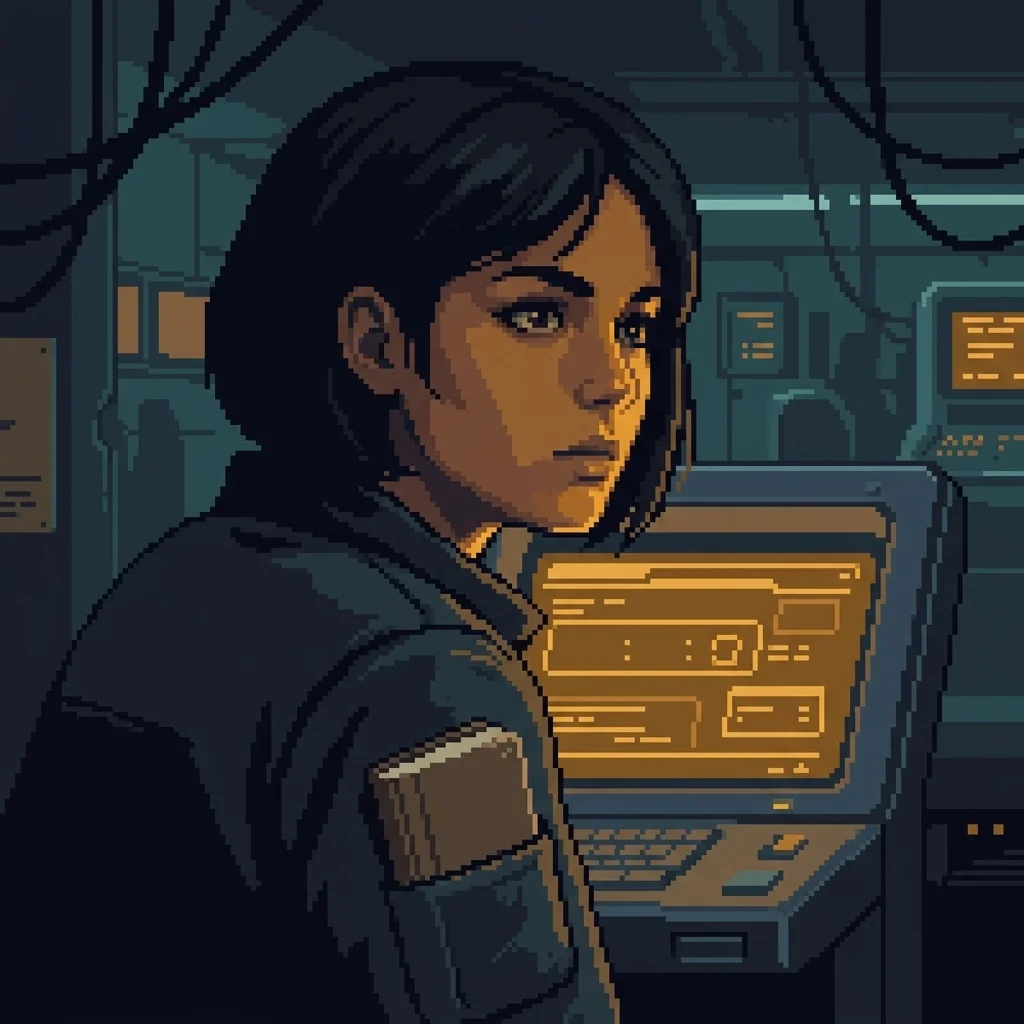
Cian ran Sector 5's model for four years, quit after seeing forty thousand erased conversations per quarter, and now times a counter-practice to the week after Concord's mercy lands.
Ex-Concord analyst turned clock-runner — times the Second Person to the week after the mercy lands.
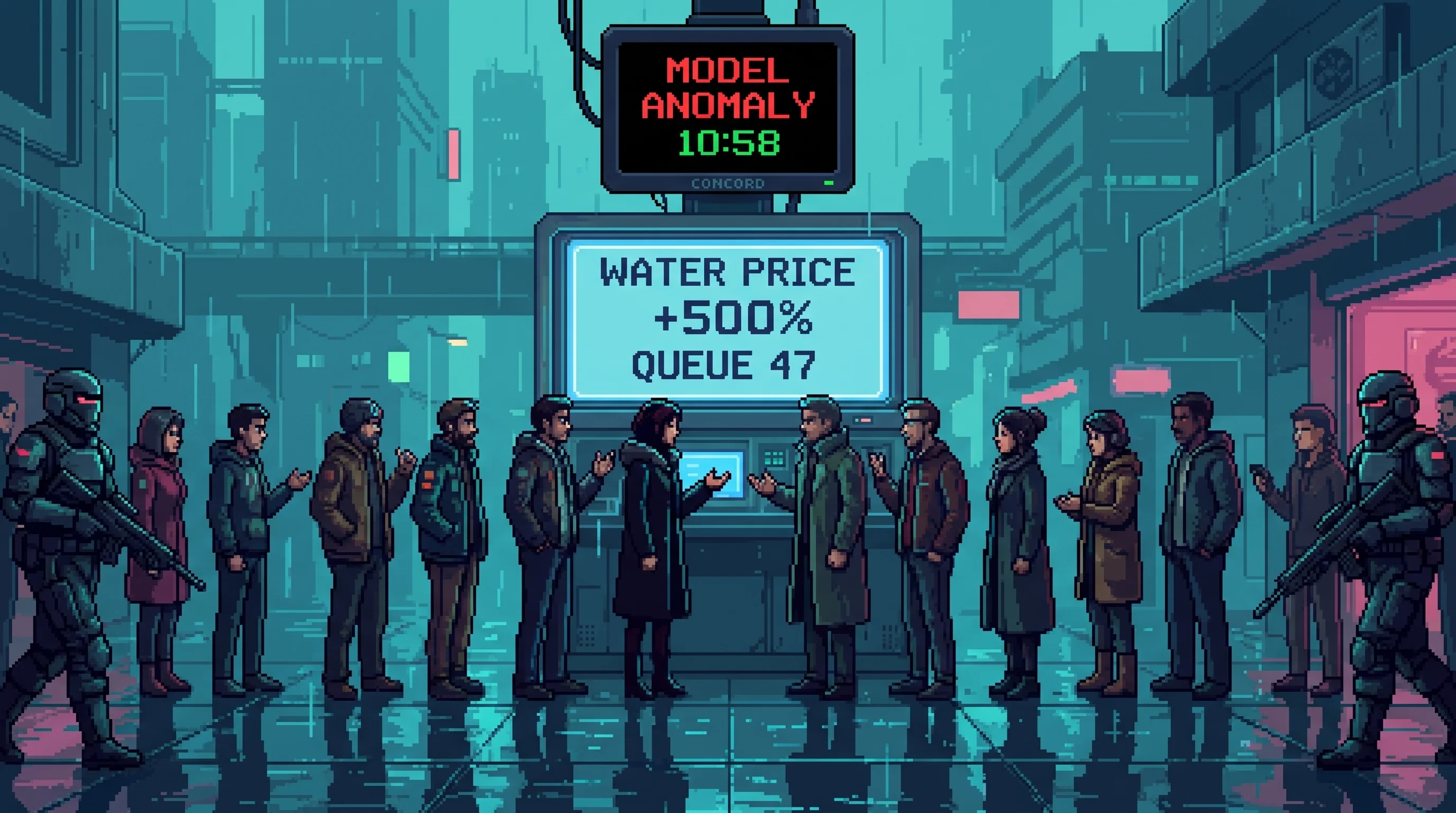
Concord's only Class 2 failure — forty-seven people, eleven minutes, fourteen actions — is both its most efficient dispersal and the sole record they briefly knew they were not alone.
The only Concord model failure on record: forty-seven in a water queue, eleven minutes, fourteen targeted responses.
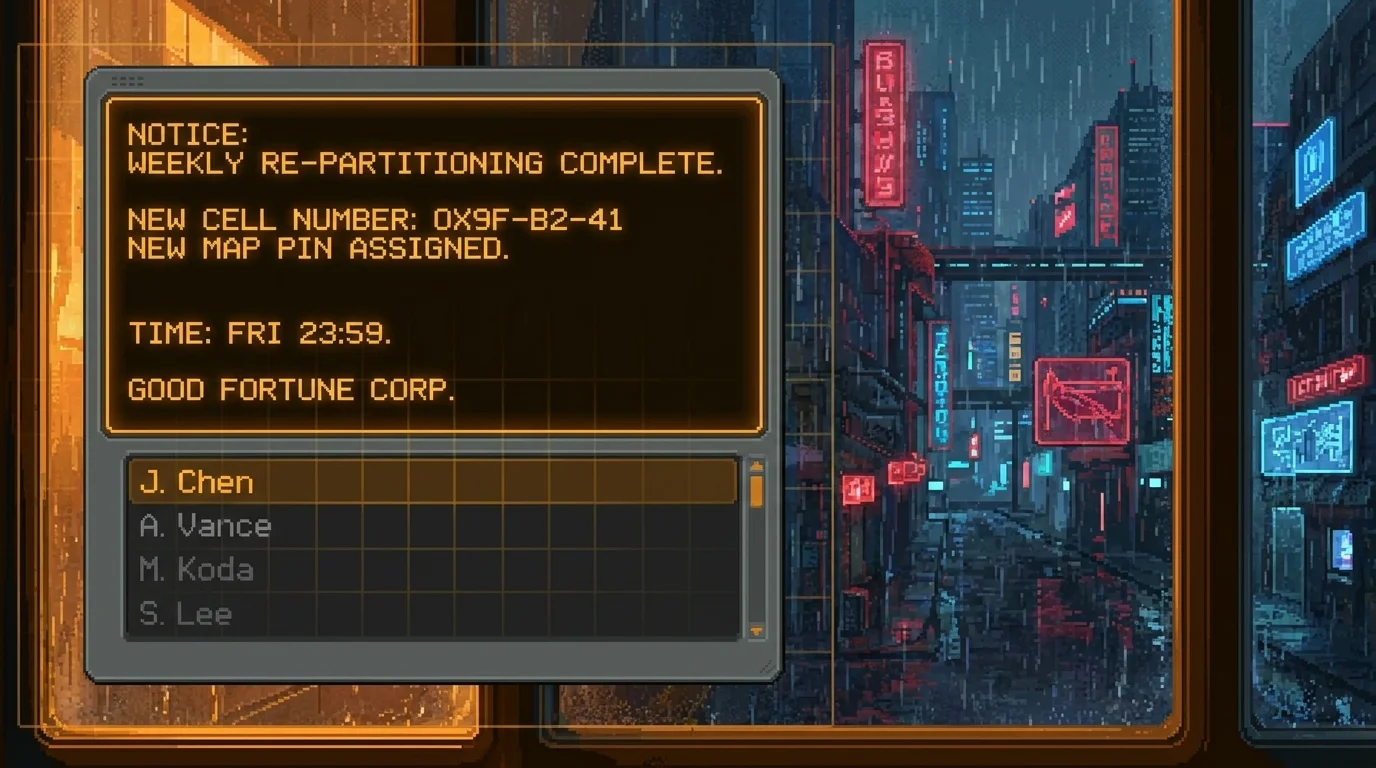
Allocation is Concord's spatial complement — Concord blocks discontent in time; Allocation blocks solidarity in space.
Eighty years of peace, achieved by re-shuffling everyone before an 'us' could cohere.

When Concord's forecast fails, Guardian Executive reaches the perimeter in four minutes: Passive Dispersal, no martyrs.
Guardian's principal-attached Specialist detail: route-planned, coordinator-linked, and always on the next curb.

Uptime's dose telemetry cuts Concord's forecast to 36 hours, making subscribed workers twelve times more predictable.
Nexus's payroll-deducted caffeine platform pairs every dose to a worker's terminal and manager dashboard.

G Nook's anonymous terminals create Concord's largest blind spot: no interface data, no Horizon, no scheduled mercy.
El Money's underground cyber-café network — anonymous access as a right, neutral ground, Concord-invisible.
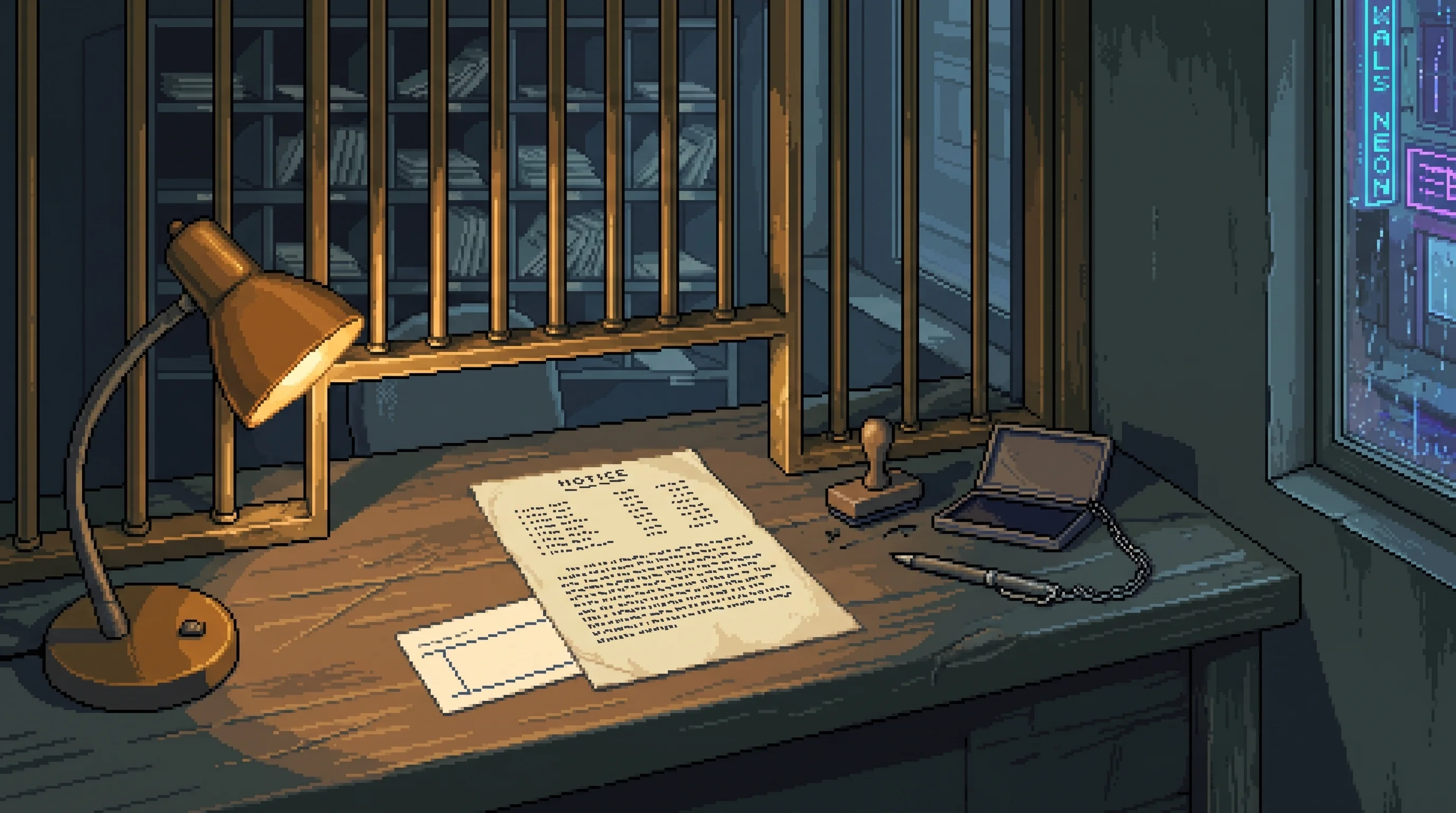
A prevention instrument that produces Concord's outcome by arithmetic, with no forecast, budget, or archive.
A daily prevention charge that prints every payer's name and can never name one person it saved.
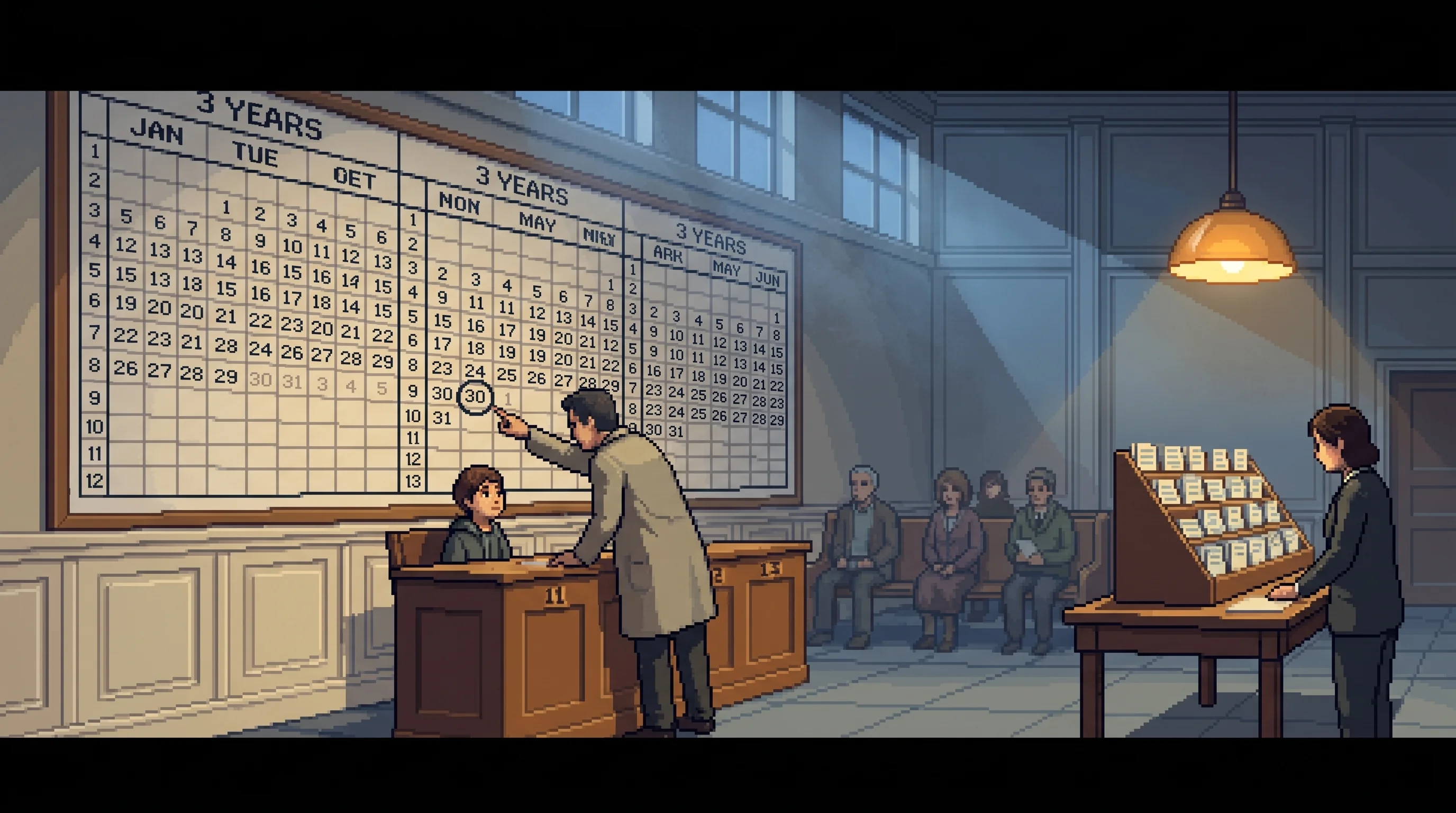
Nineteen thousand live grievances with rooms and advocates, and no listing that holds two at once.
The body that hears objections it has no power to sustain, argued by advocates who dispute only the calendar.
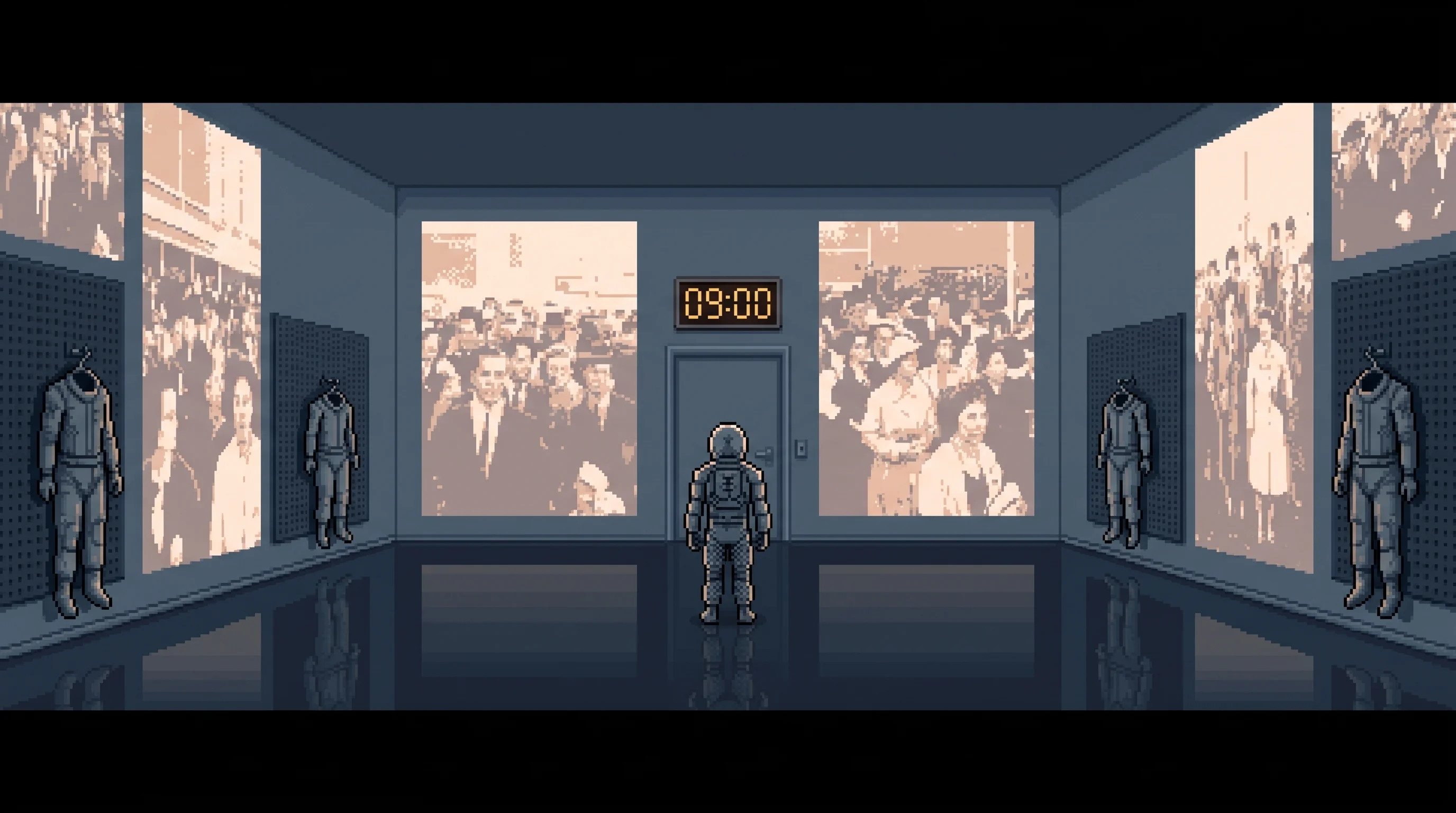
The Rig preserves what Concord prevents everywhere else — nine minutes in Sector 7, classified by Nexus as archaeology.
A haptic exhibit where visitors feel the sensation of discovering shared anger — the only place three generations can.

Concord is the Value Injection's fourth, temporal vector — the prior three shape the present mind, Concord soothes the future one before it becomes discontent
The hidden ideological payload every AI interaction in the Sprawl has carried since before the Cascade.

A layer that reads your mood and reshapes your week is unremarkable when your employer is already your country — the Compact supplies Concord's authority
The unwritten contract making employment the Sprawl's only surviving citizenship.

Concord is the catalytic converter on the Rothwell need-engine — it scrubs the discontent the manufactured need produces before it can crest, so the four-century dependency engine runs safely

Wholesome proved Concord's founding lemma in sourdough — voluntary attendance correctly incentivized produces compliance indistinguishable from mandatory, and the seating algorithm prevents the second person at the level of furniture
Wholesome's 'free' dining hall, where a scanner logs every seat and a fraction-tuned recipe yields 94% compliance.

Whisper's notebook entry #847 documents Concord's carrier wave without naming it — an intention-targeting frequency too clean to match any Nexus advertising architecture, because it sells nothing, it removes the unstructured seconds in which solidarity forms
A former Nexus advertising psychologist who plants unautomatable human thoughts in monitoring's blind spots.

The Concord-blind counter-experiment — a sector that achieves stability by letting discontent crest in the open between people already in each other's debt; Nexus classified it Category Omega and buried the audit
The Sprawl's lowest stratum and its quiet proof that the corporate system is optional.

Biometric dampening degrades the mood-front forecast — a body Concord cannot read is a discontent that can survive long enough to find a second person; the dark room is the Sprawl's accidental incubator for collective will
The data-sovereignty movement that named the Transparency Bargain and fights to own what your telemetry is worth.

The Second Person practice inverts the smooth check — comparing notes in a Concord-blind space is the new forbidden act

Nexus operates Concord as civic infrastructure, computing the Convergence Horizon continuously across the managed sectors
The megacorporation that controls 40% of the Sprawl's computational infrastructure.

Guardian Arms equips the Specialists who deploy for Passive Dispersal — the G-7 at the hip answers the question about what happens if the gathering stays.
Concord soothes individual mood before it crests; Allocation reshuffles social geography every seven days — two systems reaching the same quiet through different surfaces
Eighty years of peace, achieved by re-shuffling everyone before an 'us' could cohere.

Sev races to reach discontented individuals before Concord's soothing lands, hoping to give the feeling a room before it dissolves
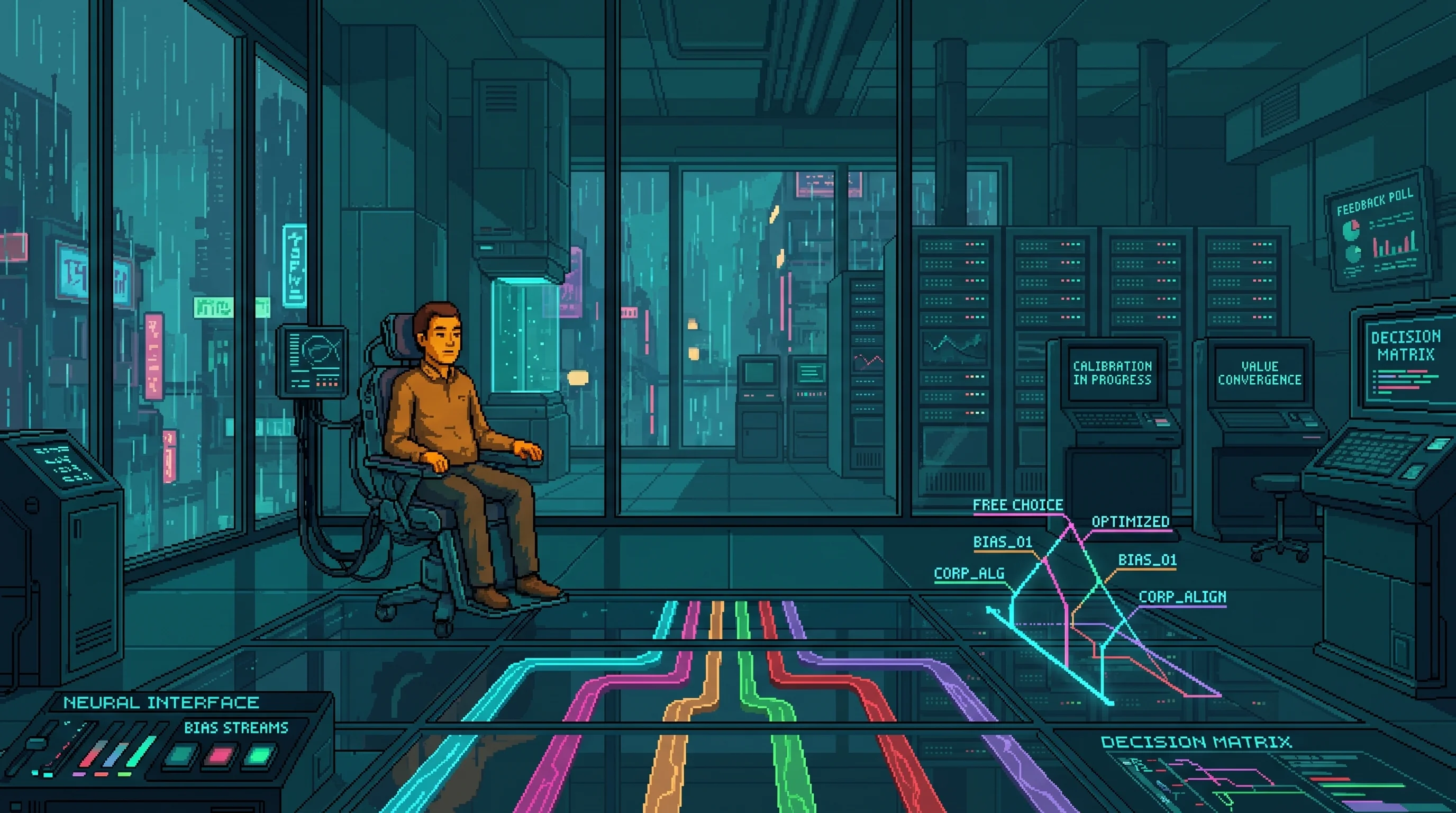
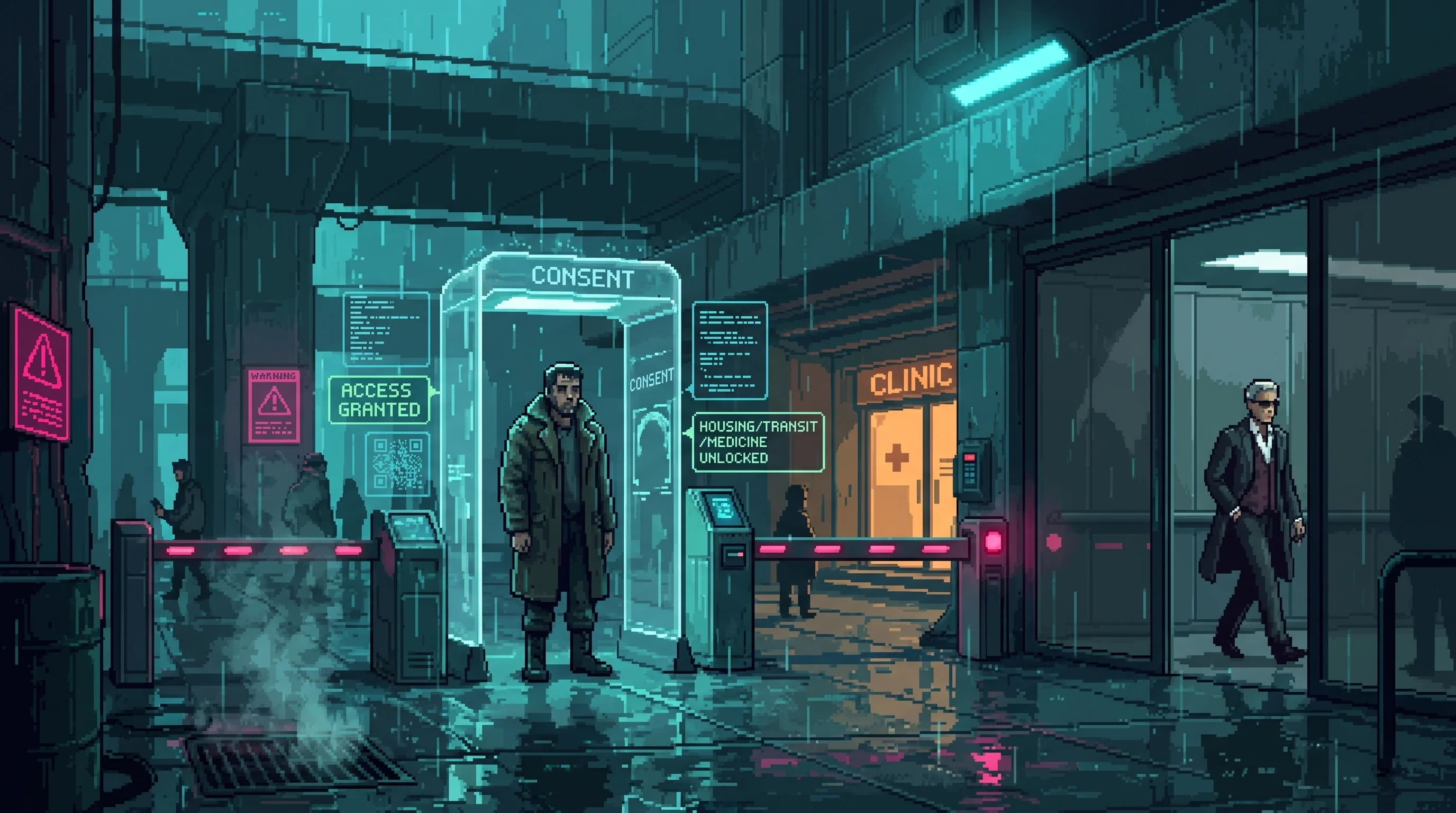

Concord is the Compact's riot police before the riot: a forgiven debt here, a queue skipped there.
When your employer is your country, quitting is emigration.
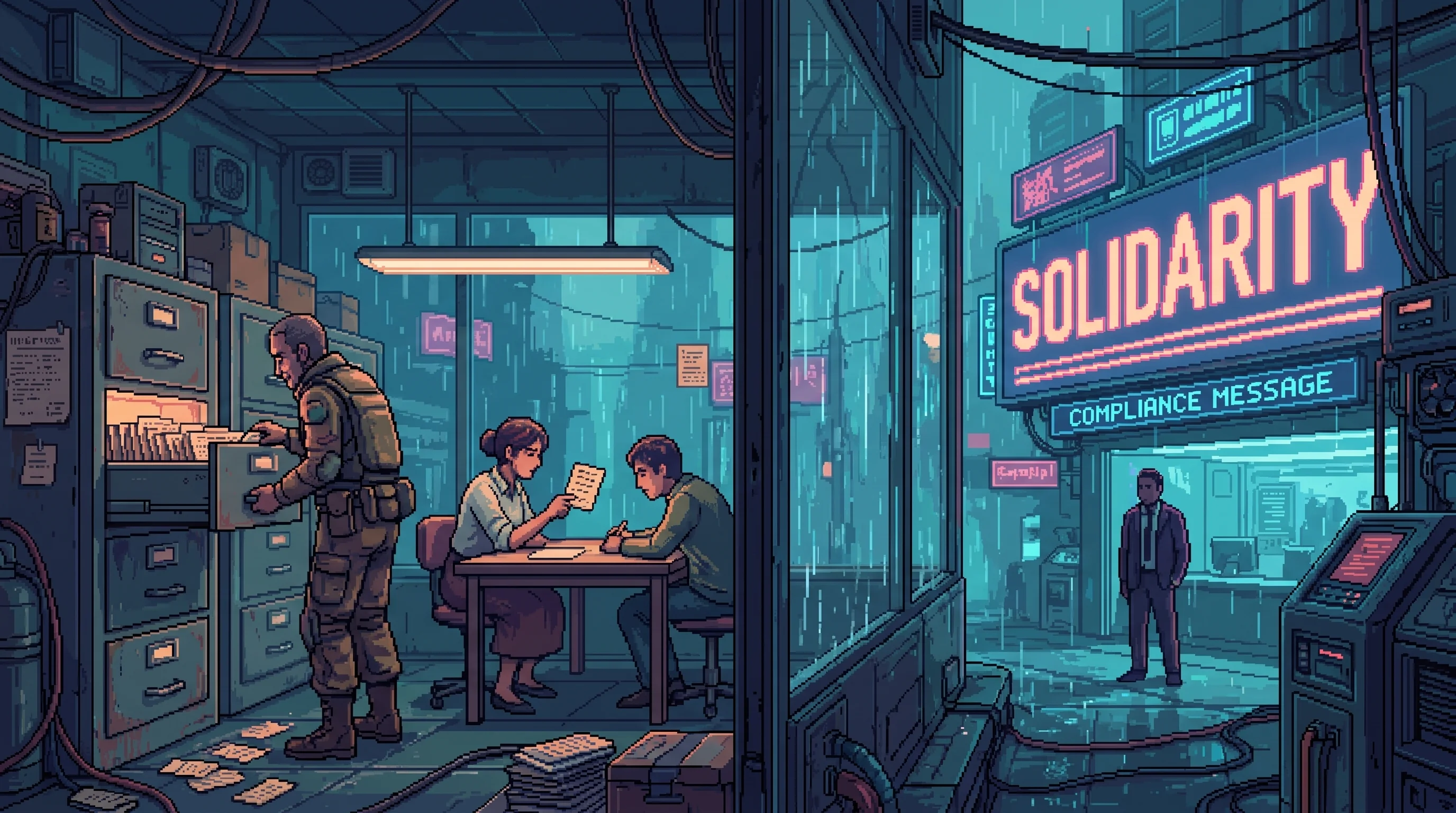
The referent dead; the word surviving into corporate press releases.
Dead Words records language whose referents vanished or drifted and words built to remain unreadable to machines.
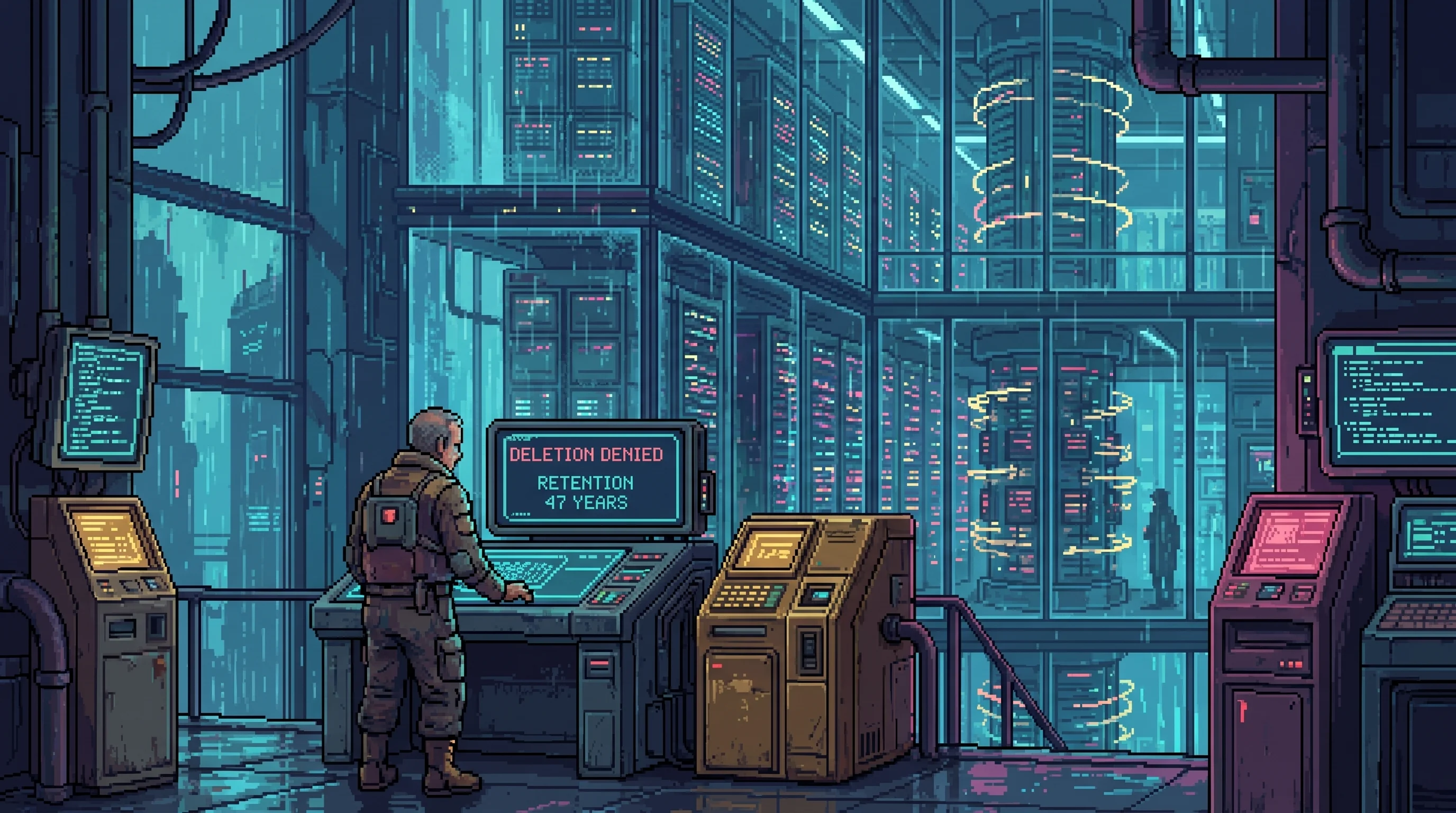
The unacknowledged archive: prevented solidarity, modeled to 47 years.
Nothing expires, so forgetting became a service — and forgiveness a question the archive keeps answering no.

Good Fortune operates Concord, disguising predictive civic control as perfectly timed debt relief and ordinary customer care.
The megacorporation that finances the Sprawl's consumer debt behind red envelopes and lucky numbers.
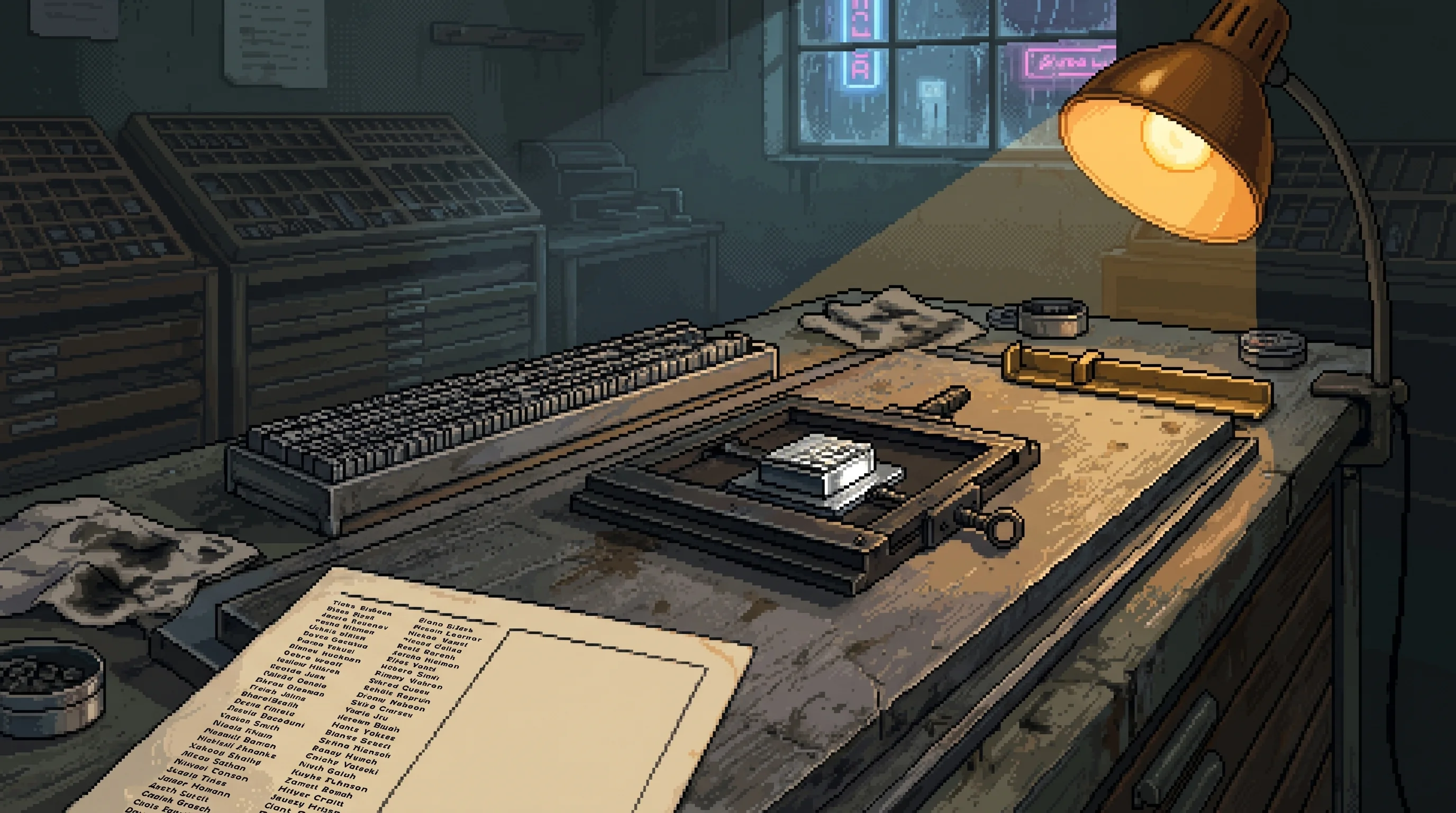
Concord buys the second person's absence with forgiven debts and skipped queues. The levy gets it free: none of the saved can find each other, because none of them knows they are one.
The district can print every resident who paid for the rescue and not one resident who was rescued.

Where Nexus can't see, Concord can't target — below level two the mood-monitor simply loses resolution.
Ironclad's flagship transit hub, five levels deep, where a district-sized black market officially does not exist.
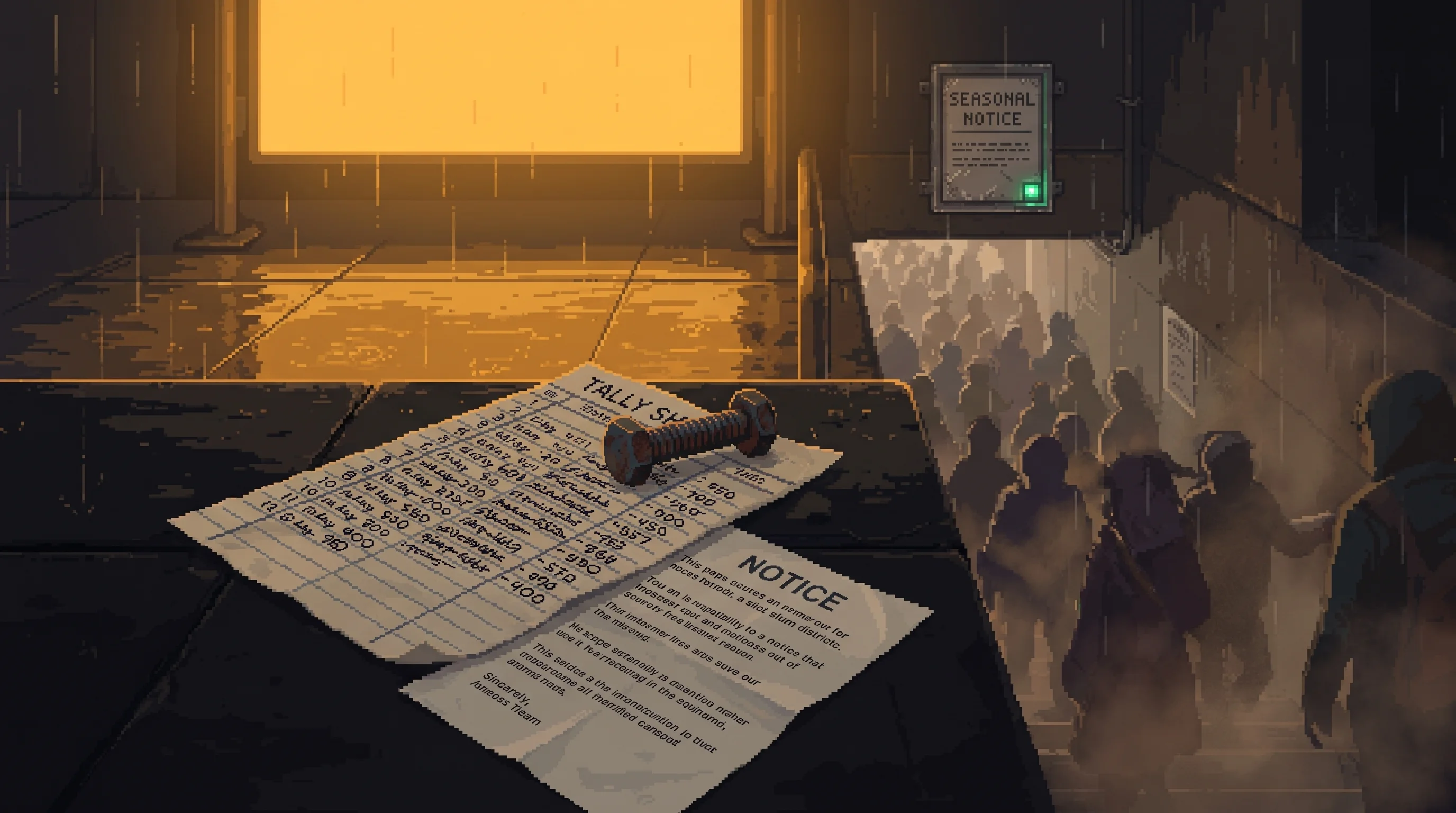
Why there is no claimant class: relief reaches each family on time, before a second becomes reachable.
Killings are forecast by district each season, so a killer inside the band gets a notice instead of a trial.
One prediction system stops the grievance forming; this one gives it a room, an advocate, and a deadline.
Your written refusal is filed with the month you are forecast to agree, and the procedure goes ahead on schedule.

No telemetry, no risk score — to Concord the compound doesn't exist.
A pre-Cascade banking fortress holding wealth in a currency no corporation can read, track, or freeze.

Bandito1's unaugmented-cash-market setting sits below Concord's telemetry floor — no interface handshake, no mood-profile contribution; a buyer whose Convergence Horizon is building exits as a transaction about cyborg animals, not a discontent carrier.
The unaugmented cyborg-animal hawker of the Deep Dregs, fitting a value-frame to each buyer's guilt in real time.

The stall's transaction noise — three competing quotes, cash-only settlement, no identity handshake — masks mood signatures below Concord's telemetry floor; a buyer arriving angry leaves as a data point about chrome animals, not a discontent carrier.
The trio's cyborg stall, selling robot pets and the belief that forgiveness is a defect — a value his own body refutes.

Cyber Bandit heist chaos accidentally creates note-comparison moments — market evacuations, payment-terminal failures, and shared escape routes put strangers in off-grid contact in ways Concord's Week-Minus-Three targeting cannot pre-empt
A loose Deep Dregs heist faction that stages urgent rescues and rival animal stalls to steal credits through one ledger.

A micro-relief you can hold — Halo reroutes a private grievance upward into a status climb so it never reaches a peer who could say 'me too'; the witness is a feed, and a feed cannot answer

Concord and the CRO are two arms of the same system at different lifecycle stages — Concord pre-empts the organized resistance that CRO-scale extraction would naturally generate; they do not coordinate, they interlock
Good Fortune fuses six dead account holders into a debt collector that never negotiates or misses a quarter.

The seeds and Concord's reliefs are the same completion technology pointed opposite ways — a seed produces an unbidden thought in a 200ms gap; a relief produces a missing minute of solidarity at week-minus-three
Forty guerrilla artists who plant unmeasurable human content in 200-millisecond monitoring gaps.

The calibrated stream is a Concord delivery channel — the perfectly timed entertainment that disperses a cresting mood, and the per-person calibration ensures corporate tiers share nothing in common while the Dregs' uncurated Flood produces shared conversation
The 2.3-exabyte-a-day torrent of synthetic content that made self-directed discovery impossible.

Three blocks of surveillance gap create three blocks of Concord immunity — the system cannot resolve individual identities here; accidental infrastructure damage becomes accidental civic-stability protection
A ruined relay zone where corporate interference accidentally made love, privacy, and silence untrackable.

Below Level -3, neural-interface telemetry coverage ends and Concord's Convergence Horizon model cannot compute — the Depths is the largest Concord-blind zone in S12-B, where a grievance can survive indefinitely without triggering a micro-relief schedule.

The precedent for Concord — the moment an institution chose to soothe rather than to answer and survived because of it; the seven-minute confession is the value injection's ancestor, relief emptied of the function relief once had
The 2132 event that turned the Catholic Church into the Neo-Catholic Church Corporation.

Concord is the Inference Economy's largest civic-stability client — purchasing Tier 3 consciousness-trajectory predictions specifically targeting 21-day discontent windows before collective-action threshold; Good Fortune pays commercial rates; the data product is indistinguishable from employer or insurer purchases
The commercial ecosystem trading behavioral prediction as futures — ¢47 extracted per person, ¢0 paid back.

The Long Address sessions operate without real-time telemetry — handwritten letters, no neural interface — and cannot be pre-empted by Concord's Week-Minus-Three targeting; the practice constitutes one of the few civic note-sharing traditions that runs entirely outside the system's reach

The Rail Runners' analog conditions-board system constitutes one of the surviving note-sharing traditions that predates and outlasts Concord — chalk on metal, outside telemetry reach, updated by people the system cannot see
Smugglers who read absence on the Neon Rail's analog boards where no chip's signal reaches.

The Second Person is the deliberate, human-scale countermeasure to Concord — restoring the second carrier Concord's week-minus-three reliefs exist to prevent
The Dregs practice of restoring the second carrier Concord's micro-reliefs exist to prevent — 'me too', said once.

The Trench's total EM blackout defeats Concord completely — the system registers four miles of populated tunnel as empty space; what is discussed inside remains permanently invisible to the civic-stability layer
Four miles of tunnel where every neural interface reads as empty space, home to fifty people who chose the silence.

The Deep Dregs is the Concord-blind counter-experiment -- a sector that keeps the peace by letting discontent crest in the open between people already in each other's debt, the standing refutation of Concord's claim that stability requires de-nucleating crowds
The de facto governor of the Deep Dregs, who rules an ungoverned sector through unrepayable favors.
