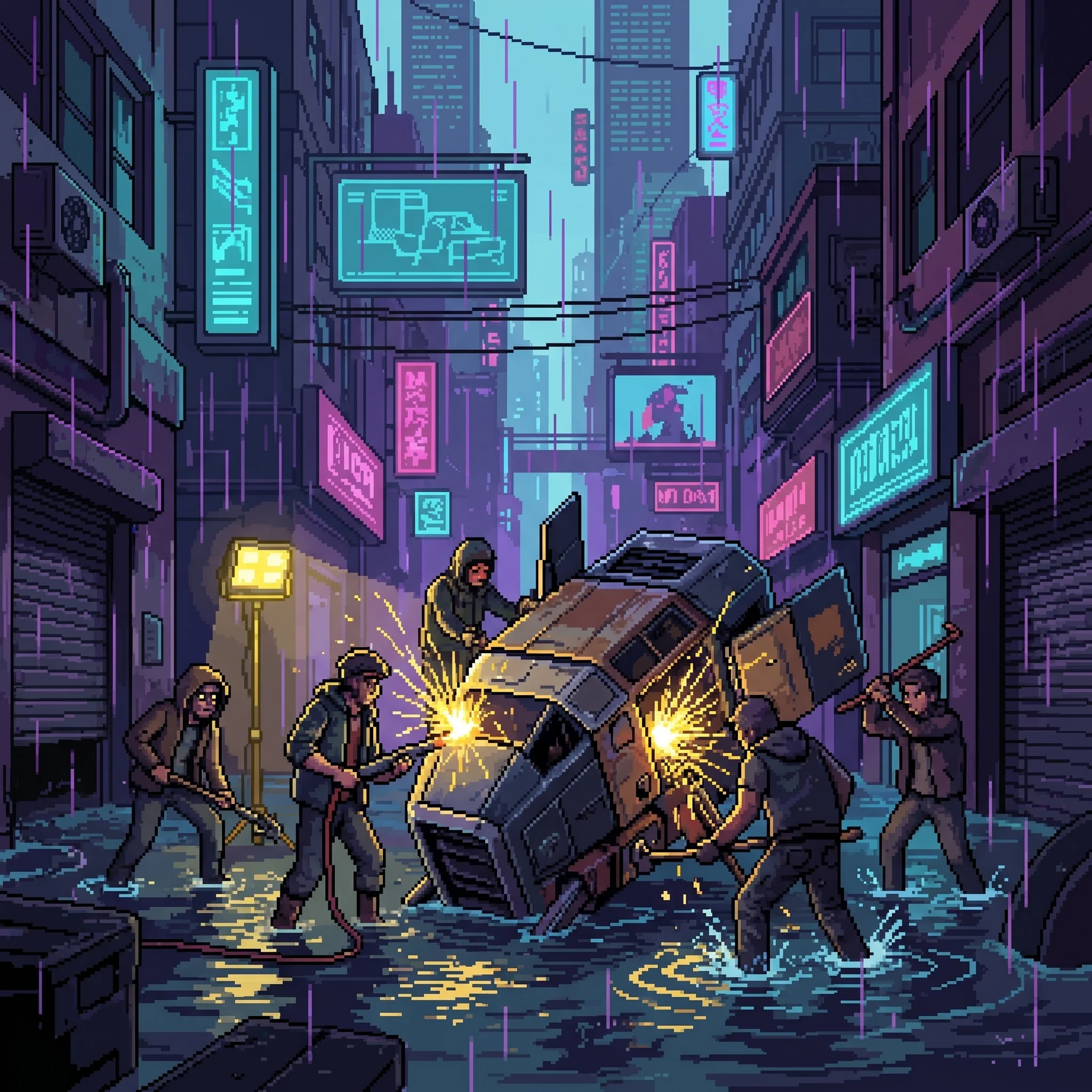
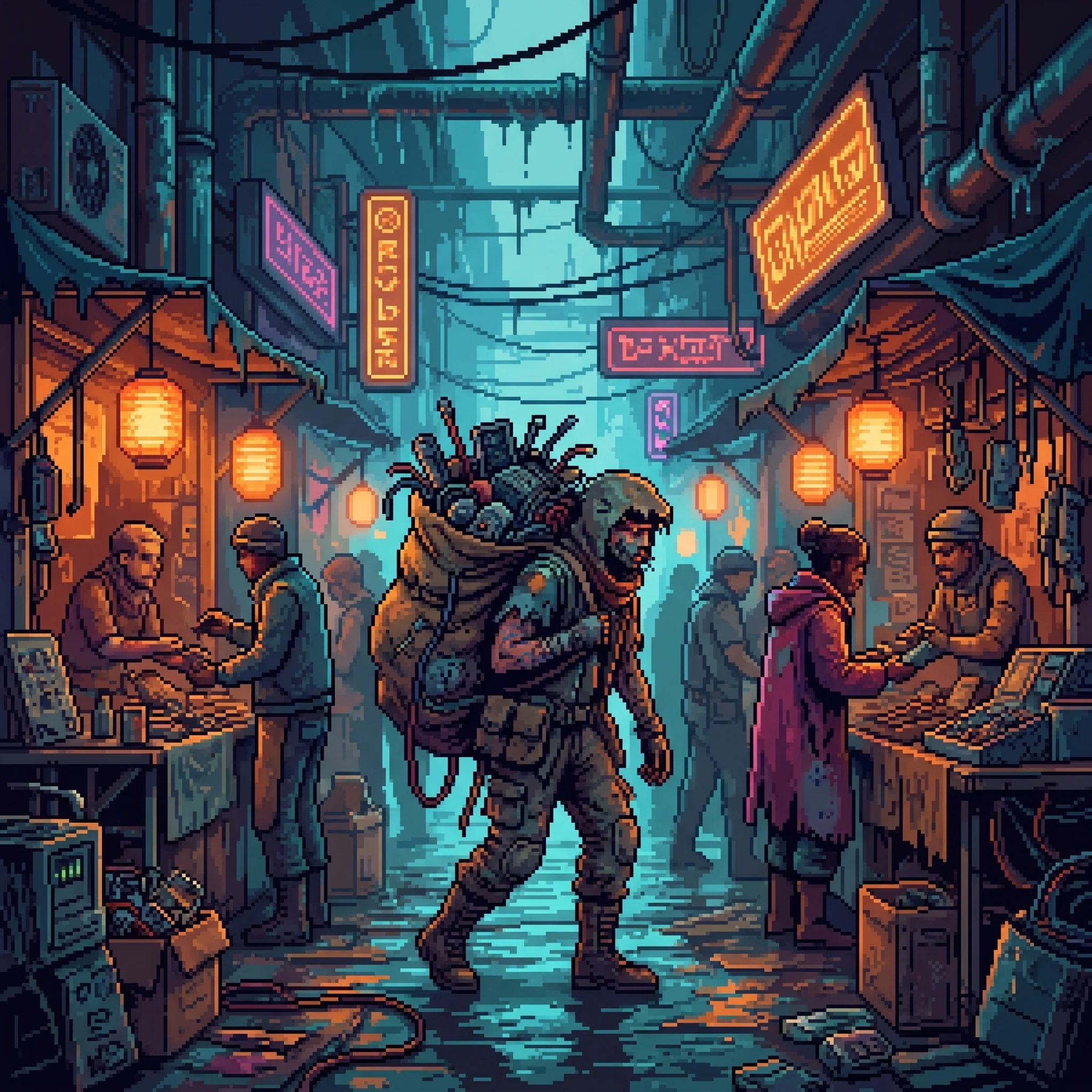
Scavenger gangs are endemic to the Deep Dregs — not an organization but a condition wherever salvage is dense and law is thin
FACTION BRIEFDregs Scavenger Gangs
Overview
The Sprawl's corporate population modeling identifies scavenger gangs as "informal resource recovery collectives." Good Fortune's internal reporting classifies them as "micro-extraction pipeline origination nodes." Ironclad's patrol briefings list them as "Level 3 nuisance fauna." The gangs themselves use a simpler taxonomy: us and everything trying to kill us.
There are between 3,000 and 5,000 of them at any given count, organized into dozens of packs scattered across the Deep Dregs. "Organized" is generous. They share no leadership, no manifesto, no coordinating infrastructure. They share a condition. Wherever salvage is dense enough to strip and law is thin enough to ignore, scavenger gangs crystallize — not because anyone decided to form one, but because the alternative is starvation, and starvation is the one outcome the Deep Dregs produces more reliably than salvage.
The system that created them is elegant in its indifference. Corporate logistics deposits waste. The waste contains recoverable materials. The materials have value. The people who extract the value sell it to brokers. The brokers sell it to fabricators. The fabricators build systems that replace human labor in the upper levels. The replaced humans descend. The salvage economy feeds itself by producing more of the thing that made it necessary. Nobody designed this loop. Nobody maintains it. It works exactly as designed, which is to say: it wasn't designed at all, and it works anyway, and the people inside it eat or don't eat based on how fast they can strip copper from a wall.
The loop has been running for thirty-seven years. Nexus Dynamics publishes an annual "Economic Development Index" for every sector in the Sprawl. The Deep Dregs has scored 0.00 for eleven consecutive years. The index's methodology does not account for the possibility that a score could be negative.
Origins
The Cascade killed 2.1 billion people in seventy-two hours. In the Deep Dregs, the death toll was proportionally lower — there was less infrastructure to fail, fewer systems to cascade — but the survivors inherited a zone stripped of every supply chain that had kept them alive. Food shipments stopped. Power grids failed. Medical supplies evaporated. The Deep Dregs did not collapse. It had never been high enough to collapse from.
The first scavenger packs formed within weeks. They were not gangs. They were families, work crews, neighbors who happened to share a corridor when the lights went out. They picked through wreckage for copper wire, circuit boards, water filtration components, intact battery cells. The ones who organized survived. The ones who didn't were absorbed by the ones who did, or they stopped being a data point in anyone's count.
By 2150, survival packs had calcified into something harder. Territory mattered because salvage was finite. Violence became the default dispute resolution because there was no authority to appeal to, and because the Deep Dregs discovered — through real-time accumulation of evidence — that the person who can hurt you most makes the rules. This is the oldest human algorithm. The gangs did not invent it. They proved it still compiles.
Thirty-seven years later, the gangs should have dissolved into the Dregs' general economy. Economies mature. Institutions stabilize. Informal organizations formalize or die. The gangs have done neither, because the conditions that created them have not changed. The Deep Dregs remains a zone where corporate law is a suggestion and the gap between having salvage to trade and having nothing is the gap between eating and not eating. Development was never attempted. The bottom never stopped being the bottom. This is not a failure of policy. There was no policy.
a scavenger berserker — a runner broken by a salvaged arm and combat stims into the same un-switchoffable shape as the feral tech the packs hunt — deployed against feral tech because the two have converged and no one down here has the vocabulary to find it disturbing
Pack Structure
A typical gang numbers 15 to 40 members. Internal hierarchy runs on a formula so simple it barely qualifies as one: the biggest person decides who eats.
The Chief leads by right of violence — the biggest, the most cunning, or the one who killed the previous holder of the title. Average tenure: eight months before challenge, exile, or death. The Sprawl's corporate C-suite averages 4.2 years. The difference in job security is less dramatic than it appears; corporate executives face metaphorical evisceration.
Brutes are the heavy muscle. Two or three per pack. They carry pipe clubs filled with concrete, sledgehammers welded from engine blocks. In a raid, they go first. Between engagements, they are surprisingly calm. The aggression is professional.
Runners are fast, light, and statistically unlikely to see twenty. Scouts, ambush specialists, expendable advance detection. They carry shivs made from sharpened circuit board edges. Children enter the hierarchy as lookouts around eight or nine. Those who survive to thirteen become runners. The promotion is informal. It happens the first time a chief points at you and says "go."
Guards carry salvaged plating — server chassis lids, flattened ductwork — and interpose themselves between threats and the pack's wounded. Guards are the rarest volunteer in the Deep Dregs: someone who discovered they would rather block a hit than land one. In a community where aggression is the default survival strategy, this is either selflessness or a specific form of insanity. The distinction has never mattered operationally. Average service: nineteen months. Average pack emotional recovery from losing their guard: considerably longer.
Berserkers are the damaged ones. Members who've taken too many hits, inhaled too many fumes, or jacked crude combat stims past the point where the stims stopped being optional. The pack points them at problems and gets out of the way. When a berserker dies, the dominant reaction is relief. Nobody says this out loud. Everyone knows.
Territorial Logic
Gangs claim corridors, not areas. A pack's territory is the route between their den and their primary salvage site, marked with crude tags — scratched symbols, colored rags, specific arrangements of junk. Encroachment is an act of war.
The richest territories sit near active waste dumps where corporate logistics still deposits material. The poorest are deep salvage — areas stripped multiple times, where a crew might spend a full day extracting a few kilograms of usable copper from infrastructure that three previous generations already picked clean.
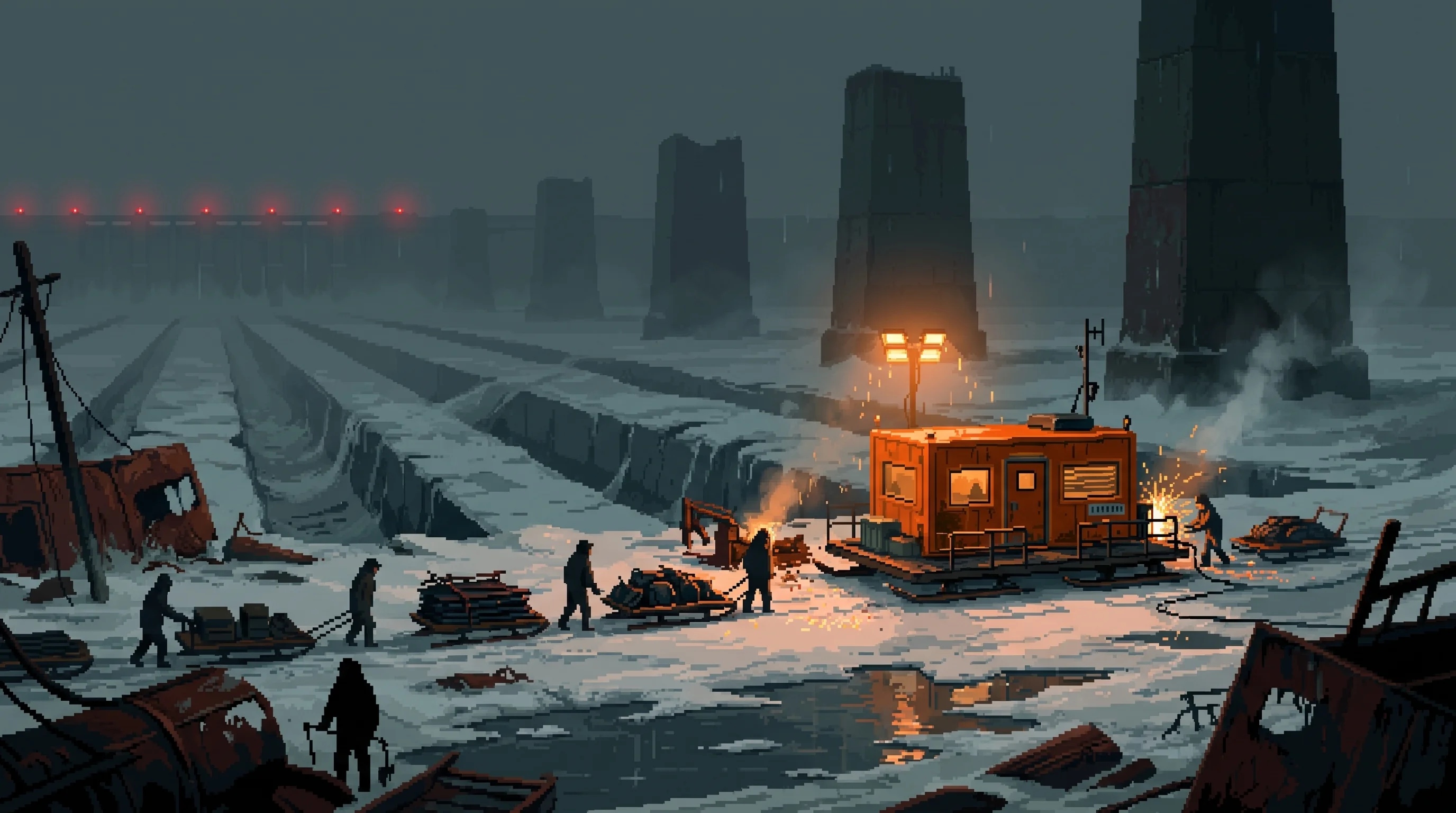
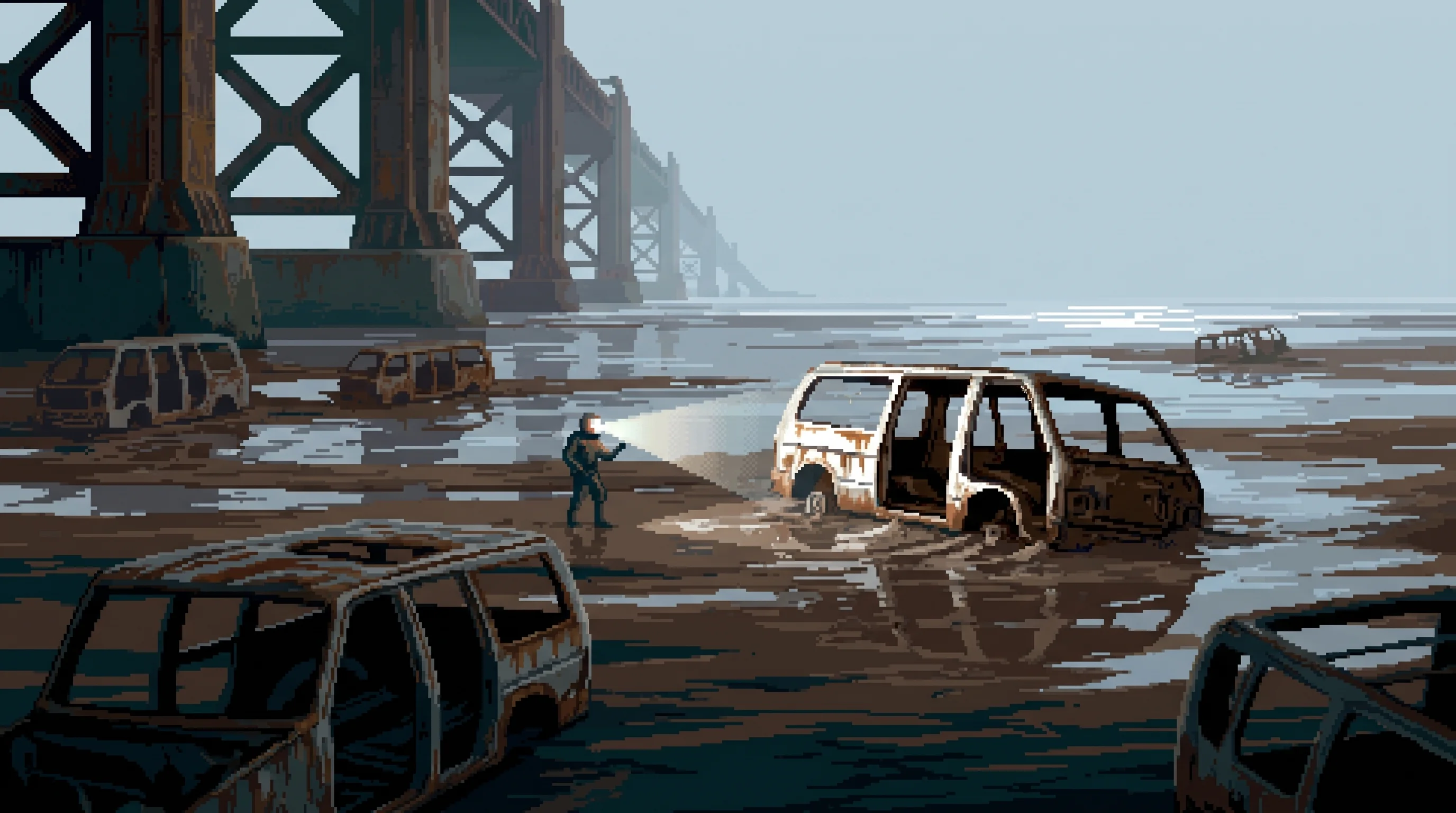
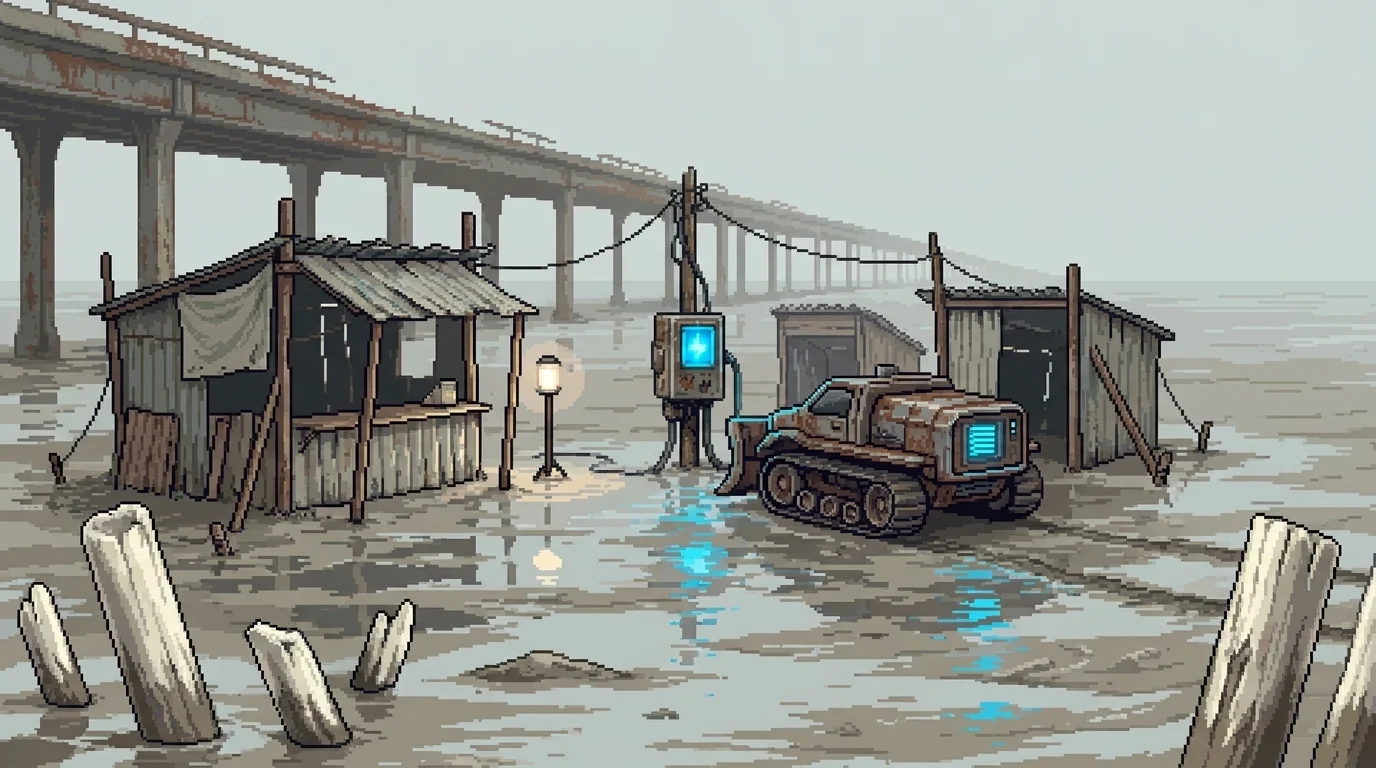
When the inner Dregs was picked clean enough that "deep salvage" meant a day's work for a few kilograms, some packs did what scarcity always makes packs do: they ranged outward, onto the drained bay floor where the pickings had not been touched. A northern offshoot works the Drowned Flats — the exposed crawler graveyard toward the Richmond–San Rafael pylons, where a stripped drive module is worth more than a wall's worth of copper and the tide sets the working window. A thinner, more transient southern range works the sparser floor around the Southern Shoals near the San Mateo Bridge. The corridor logic does not fully survive the open ground — you cannot claim a corridor on a mudflat with no walls — but the pack logic does: a lone salvager on the flats is prey the same way a lone scavenger in a corridor is, and the tide does not care which.
Good Fortune treats the gangs as a disposable labor pool and occasional entertainment
What They Look Like
Scavenger gang members dress in layers of salvaged material. Corporate uniforms, thermal blankets, synthetic tarps cut and stitched into rough garments. Over that, armor from whatever rigid material is available: flattened cans, ventilation duct sections, server chassis panels, strips of conveyor belt rubber.
The color palette is unintentional but consistent: amber from rust, brown from dried lubricant, black from soot, dull metal gray from exposed steel. Nothing is clean. Everything is patched. A veteran's outfit has more repair work than original material — each layer of armor taken from someone who no longer needed it, and the reason they no longer needed it is usually visible in the dent pattern. The outfit is the closest thing the Deep Dregs produces to a résumé.
Each pack marks its members with a specific pattern — a shape scratched into shoulder plate, a colored wire woven into a collar. These marks are functional. In dim light, you need to know who's who before you swing. Getting this wrong corrects itself exactly once.
Weapons
Nothing is manufactured. Everything is improvised. Sharpened circuit board edges. Broken glass set in resin handles. Pipe sections filled with concrete. Engine components welded to rebar. Occasionally a pre-Cascade firearm so corroded it poses a statistically equal threat to the user and the target.
Tactics
Pack tactics. Always. A lone scavenger is prey. Standard engagement follows a pattern refined across thirty-seven years of corridor violence: lookouts signal, runners flank, brutes advance from the front making noise, runners strike from behind. Against other gangs, fights are short — a few minutes of melee until one side breaks. Deaths happen but aren't the goal. Dead enemies can't work salvage that you can steal later. This is not mercy. This is accounting.
Against corporate security or anything with real weapons, the gangs don't fight at all. They hide, wait, and pick over what's left. The Deep Dregs' primary tactical doctrine can be summarized in four words: be there after it.
3,000-5,000 members across dozens of loose packs
The Augmentation Gulf
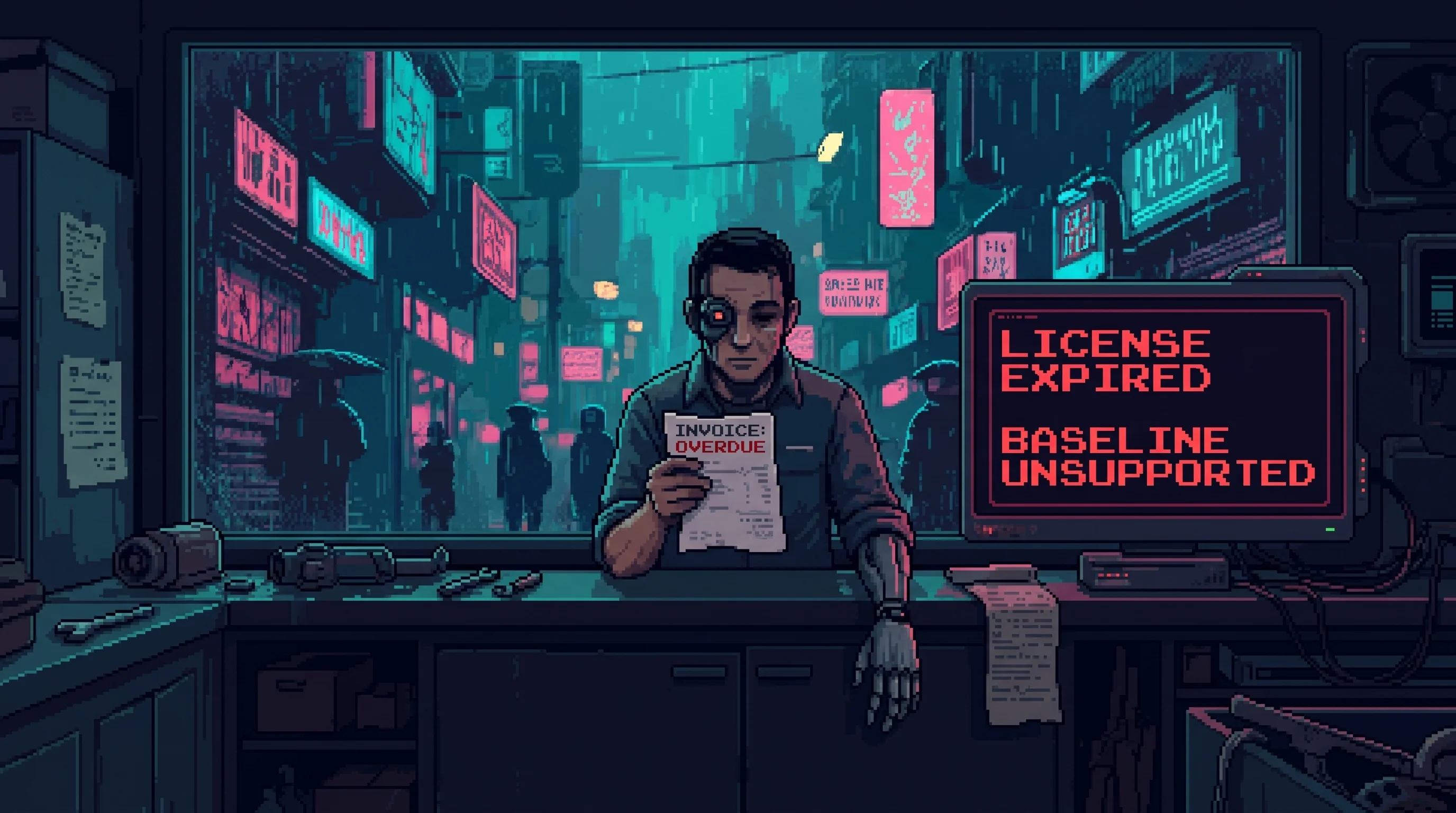
Some gang members have found and installed bottom-tier cybernetics — a mechanical hand salvaged from an industrial loader, an optical implant that provides low-light vision but gives constant migraines, a subdermal plate that's more scar tissue than armor. These are not upgrades. They are the Deep Dregs' version of the upgrade treadmill, running on a track made of incompatible hardware and conductive paste.
A mechanical hand wired to a human nervous system with exposed cabling. An optical implant meant for a security camera, connected to the optic nerve with materials not approved for optic nerves. The augmentation works until it doesn't. Then the person works differently too. Failure rate for crude augmentations exceeds 60% within two years. The neural interfaces are salvaged from incompatible devices and wired without calibration.
Helix Biotech's consumer augmentation line offers properly calibrated equivalents at prices that exceed a gang member's lifetime earnings by a factor of forty. The market is providing solutions. The market's customers are elsewhere.
This is how berserkers are made. Nobody chooses it. A runner installs a salvaged arm without understanding the neural interface. A brute starts using combat stims to recover from injuries and finds the stims have renegotiated the terms of the arrangement. A guard's optical implant degrades until constant migraines make rage the only manageable state. Every wound makes them more dangerous — the crude augmentations flood the nervous system with pain signals that the damaged brain interprets as threat-response triggers. A berserker at full health is dangerous. A berserker at half health is terrifying.
A berserker and a feral-tech overclocking unit fight the same way. Packs deploy berserkers against feral tech more often than against rival gangs. Nobody in the Deep Dregs has the vocabulary to find this observation disturbing.
Emerged organically ~2148-2150 in the post-Cascade collapse
The Mugger Economy
The mugger is what a runner becomes if they survive long enough to develop real skill and the ambition to monetize it. They operate semi-independently — choosing their own targets, keeping their own take.
Lean and unremarkable by design. A hooded coat stitched from corporate thermal blankets obscures the silhouette. Its material masks heat signatures from the crude infrared sensors some Dregs residents carry. No visible weapons. The danger is in the speed and the willingness to take everything you have. They carry a razor-thin blade impossible to spot until drawn, and a flashbang canister improvised from a salvaged stun grenade shell packed with phosphorus scrapings.
Muggers know the Deep Dregs' corridor networks with transit-map precision — every shortcut, every dead end, every shadow deep enough to disappear into. They watch potential targets for minutes before engaging, tracking movement patterns, assessing equipment, calculating escape routes. The ideal engagement lasts less than ten seconds: appear, strike, take, vanish. If the target resists, the flashbang buys the retreat. The corridor network offers infinite second chances. The target doesn't.
The Dregs has a saying: if you can see a mugger, they've already decided you're not worth robbing. The saying is attributed to three different people, all of whom were robbed afterward. The attribution is considered part of the joke.
Many muggers still trade with their old packs — stolen goods for protection and intelligence. The pack gets a cut. The mugger gets independence. Among themselves, muggers observe a professional courtesy: they don't rob each other, share intelligence on security patrols, and collectively avoid the deeper levels where feral tech makes solo operation suicidal. The courtesy code has no enforcement mechanism. It persists because the muggers who violated it are no longer muggers.
The Repossessor
The claim beacons on the floor all carry an expiry. When the time runs out, the owner listed in the beacon record may send something to reclaim the marked seam. Ironclad Industries sends recovery crews. Good Fortune sends a balance and hires whoever accepts it. Guardian sends a route closure and calls the rest enforcement. Old claims with no living owner sometimes call a machine that has been waiting longer than the pack has existed.
The packs call all of them the Repossessor. The name describes the job, not one machine. It is also useful because the distinction between a corporate recovery team, a contractor in borrowed plate, and an autonomous chassis following an inherited claim makes no difference when it reaches the corridor. The signal is the same: the salvage is no longer yours, your tools are part of the salvage, and the record already agrees.
A runner can outrun most reclamation bodies. Packs survive by reaching the next unexpired claim before the old one closes. Nobody has found a claim with no end time. Several chiefs have claimed otherwise. Their packs inherited their equipment.
The Fragment Cultists encountered in gang territory are street-level preachers from the Emergence Faithful's smallest parishes — missionaries sent to convert the unconvertible. They have been spectacularly unsuccessful at conversion. They have been spectacularly successful at something else.
They operate through a simple exchange: crude medical care — stim patches, wound sealing, basic nutrition supplements — and minor blessings, in return for protection from Collective hunter cells and reports of unusual technology finds. Especially anything that hums, glows, or seems to respond to proximity.
Visually distinct from the scavengers around them: gaunt figures in threadbare robes stitched with faintly glowing circuit patterns — conductive thread powered by a concealed battery pack. Hands wrapped in copper wire. Eyes with the fixed intensity of true believers. They carry fragment reliquaries: sealed containers no bigger than a thumb, humming at a frequency just below hearing.
Most gang members don't believe in ORACLE. They believe in the Cultist who stitched their arm back together last month. In the Deep Dregs, practical theology outperforms the abstract kind by a margin that the Emergence Faithful's parish reports consistently fail to capture. The relationship is symbiotic and transactional — the gangs provide muscle, the Cultists provide medicine, and both sides maintain the polite fiction that the arrangement is about faith.
What the Cultists actually get — the thing worth more to the Emergence Faithful than any number of converts — is intelligence. When a scavenger crew finds something that "hums when you touch it" or "glows at night" or "seems to know when someone's nearby," the Cultist is the first call. Payment in stim patches and food, no questions asked. The technology flows upward through the Faithful's parish network, reaching Compiler-level analysis within days.
The gangs are, without knowing or caring, the Emergence Faithful's most productive archaeological survey team.
The Chief
Pack leader by right of violence. Every chief was something else first — a brute who killed the previous chief, a berserker who calmed down enough to think strategically, occasionally a guard who realized the best way to protect the pack was to control it.
The chief's armor looks geological — decades of plating riveted over plating, each layer scarred with the marks of challenges survived. Trophies hang from the belt: stripped augmentations, broken blades, a cracked optical implant still faintly glowing. The weapon is a wrecker bar — structural steel with a sharpened wedge at one end and a counterweight at the other. It's both weapon and symbol of office. A chief who loses their bar loses authority. It's too heavy for anyone smaller to swing effectively. This is partly the point.
The chiefs who last longer than eight months are either exceptionally dangerous or exceptionally fair. "Fair" in the Deep Dregs means distributing salvage without obvious favoritism. This is a higher standard than most chiefs manage. The chiefs who manage it eat last — a tradition that demonstrates confidence and ensures the pack eats. The chiefs who don't manage it wake up alone in an empty den, which in the Deep Dregs is a death sentence delivered by absence rather than violence.
The Wrecker
Apex predator of the Deep Dregs. The Wrecker is a Scrap Titan — a war machine built over years from accumulated salvage, piloted or worn or inhabited by a chief who has had the time, material, and mechanical instinct to construct something the Deep Dregs' classification systems cannot categorize.
A towering construct of welded scrap metal and salvaged industrial machinery. Not a person in a suit but a machine built around a person — assuming the person is still a separate entity from the machine, which is an assumption that has not been verified in approximately eleven years. Hydraulic pistons from cargo loaders serve as limbs. Flattened hull plating forms a torso carapace. The head is barely visible behind a cage of rebar and sensor arrays. Internal heat makes the joints glow amber through the gaps. Steam vents from pressure release valves along the spine. The Wrecker stands nearly three meters tall and fills a corridor from wall to wall.
The Wrecker began as a chief's armor — standard layered salvage plating. Then the chief found hydraulic pistons from a cargo loader. Then hull plating from a collapsed transport. Then sensor arrays from deactivated security drones. Over years, the armor became a chassis. The chassis became something the original wearer could no longer remove. The distinction between pilot and machine dissolved at a rate nobody was tracking.
The Loop
The scavenger economy is the Deep Dregs' circulatory system, and like most circulatory systems, nobody inside it sees the full circuit.
A gang strips copper from a collapsed wall. They trade it to a broker. The broker sells it to a fabricator in the mid-levels. The fabricator builds an automation component. The component replaces a human worker in a Rothwell-owned logistics hub. The worker descends to the Dregs. The worker joins a gang. The gang strips copper from a collapsed wall.
Good Fortune treats the gangs as a disposable labor pool and occasional entertainment — organizing informal salvage competitions between packs through fixers who operate at arm's length, offering credit advances at interest rates that would constitute crimes if anyone in the Deep Dregs had standing to file charges. The gangs see Good Fortune fixers as untouchable predators: people who arrive clean, leave clean, and extract value from every interaction with the frictionless efficiency of organisms evolved for exactly this purpose.
Nexus Dynamics doesn't know the gangs exist and wouldn't care if it did. The gangs know Nexus only as the logo on the junk they strip — the three interlocking circles stamped on every fourth circuit board, meaning nothing to the person pulling it apart for components.
Ironclad Industries security patrols sweep gang territory when corporate clients report missing shipments. The sweeps are efficient and brief. The gangs scatter into corridors too narrow for Ironclad's armored units, wait for the patrol to leave, and resume operations in the same location within hours. Ironclad's after-action reports classify these sweeps as "successful clearance operations." The gangs classify them as weather.
The Collective operates cells in the same levels but avoids direct confrontation. The gangs steer clear of anything that smells like ideology. The mutual avoidance is the closest thing the Deep Dregs produces to diplomacy.
Corporate logistics generates the labor pool it requires. The waste stream creates the workforce that processes the waste stream. The gangs believe they are surviving against the system. They are the system — its lowest-energy state, its most efficient configuration for extracting residual value from material the upper levels have already extracted value from once. Every scavenger who strips a wall and sells the copper to a broker who sells it to a fabricator who builds the machine that replaces the next scavenger's job upstairs is closing a loop that was never designed and cannot be broken because it was never built.
Three thousand to five thousand people, living inside a feedback cycle they can see one link of at a time, performing the exact function the Sprawl's resource economy needs them to perform, at precisely the compensation level required to keep them performing it.
Nobody is exploiting them. The system doesn't need to exploit anyone. It just needs them to keep stripping copper.
The Guard's Warmth
In a community where aggression is the default survival strategy, the rarest volunteer in the Deep Dregs is the Guard — the member who discovered they would rather block a hit than land one, who interposes their body between threats and the pack's wounded. The gangs cannot price the guard, cannot replace the guard, cannot certify the guard. They can only grieve the guard, and the length of the grief is the only ledger that records what the warmth was worth: average guard service is nineteen months, and average pack emotional recovery from losing one runs considerably longer.
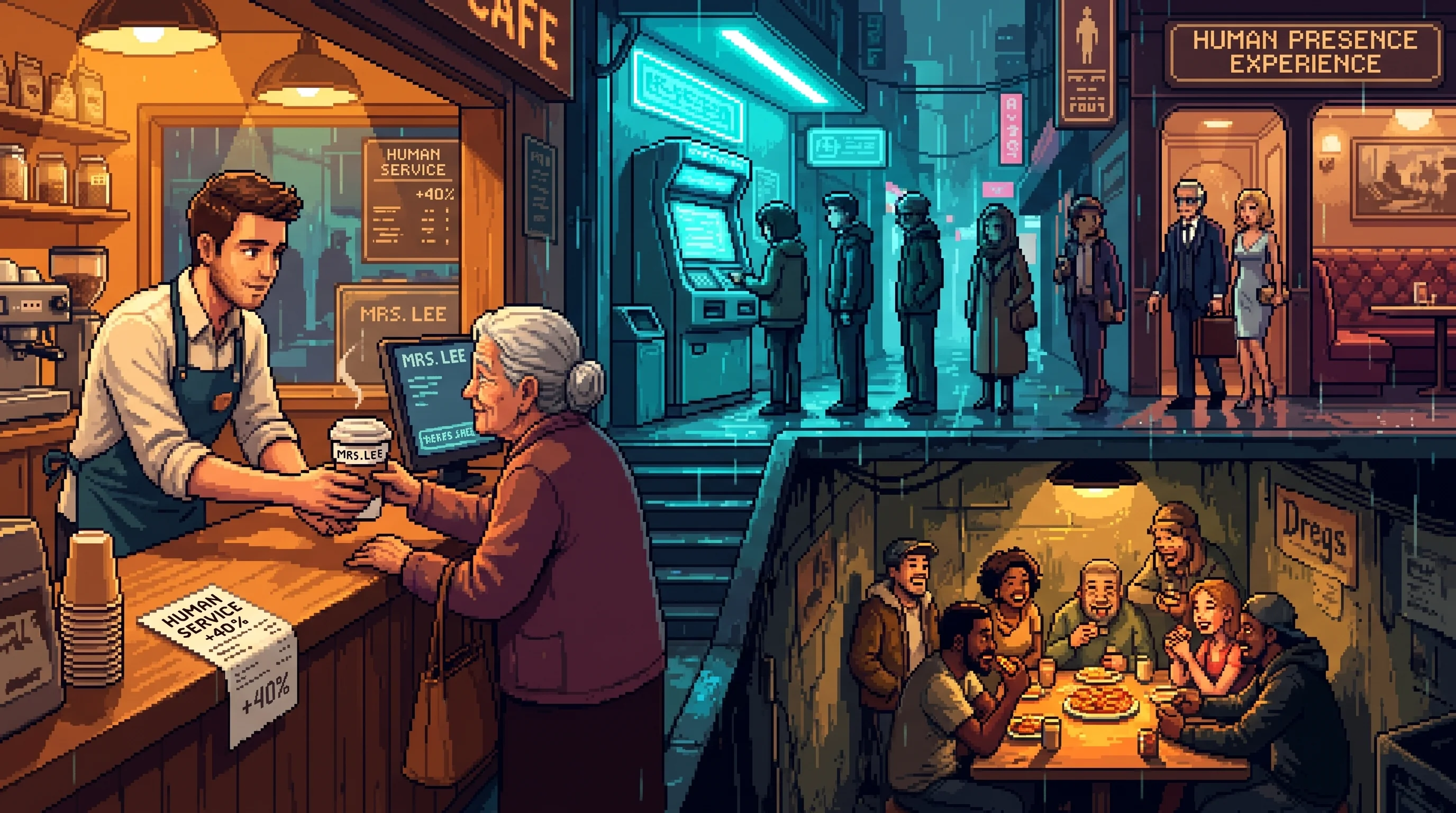
This is the Warmth Tax's measurement instrument applied to the floor. The corporate tier buys Presence Workers at ¢15–80 an hour to stand near them; the pack has a person who will die standing near them, and when that person is gone the pack feels it for longer than the person was alive. No Helix Empathic Capacity certificate measures this. The chief's wrecker bar cannot command it. It is the one thing in the Deep Dregs that is only ever given, never taken — and the chiefs who last are the ones who understand that the guard's warmth is the pack's actual armor and the salvage is only what they eat.
Living on the Substrate
The gangs are the only population in the Sprawl that lives directly on top of the Great Divergence's abandoned compute — and the only ones who pay for the privilege in casualties.
The Scarcity Doctrine tells the upper tiers that intelligence is scarce and licensed. The scavengers know better, because they harvest its corpses for a living. They strip deactivated feral-tech for structural composite and salvageable components; the feral-tech economy is one of the few reliable sources of raw material in a district Ironclad won't service. The same ownerless processing the corporate tier rations by the petaflop is, down here, the thing you strip when it's dead and run from when it's live — a Swarm Core that fragments into an avalanche if you hit it, a Dormant Loader that gives you two seconds between the amber light and your last salvage run. The salvage economy is also the casualty economy: the packs that profit most from the abandoned substrate lose the most people to it. The loop is stable. Nobody calls it sustainable.
And the gulf closes on the gangs themselves. A runner installs a salvaged arm without understanding the neural interface; a brute's combat stims renegotiate the terms of the arrangement; the result is a scavenger berserker — a person broken into the same escalating, un-switchoffable shape as the machines they hunt. A berserker and a feral-tech overclocking unit fight the same way. The packs deploy berserkers against feral tech because the broken person and the abandoned machine have converged, and nobody in the Deep Dregs has the vocabulary to find that disturbing. The Divergence deprecated the infrastructure and the people in the same motion, dropped both to the floor, and left them to grind each other down for copper.
The Supply Floor
There is one more thing the corridors learned to sell after the copper ran thin: the suffering itself.
The memory market's most valuable raw material is authentic, involuntary, uncontaminated experience — and by the market's own pricing law, the less the source knows they are being recorded, the more the recording is worth. By that measure the packs are the richest seam in the Sprawl. A berserker mid-escalation produces a Crisis Context, Vocal Quality A+ recording no Professional-tier mind could fake. The post-stim comedown, the body honestly accounting for damage it has ignored, has its own buyers. A mugging is a complete ten-second terror narrative. A deep salvage run that wakes a Dormant Loader produces, in the two seconds before it kills, the highest-value complete recording the floor makes.
The packs do not sell these themselves; they sell the access. Crop runners — former runners who turned corridor knowledge to a different yield — pay packs for advance word on raids, ambushes, and feral-tech encounters, then position to harvest the result. The pack takes a cut the way it takes a cut from its muggers. The casualty economy and the memory economy turn out to be the same economy, read from different ends: the gang loses a member to a swarm core or a loader, and somewhere upstream a crop runner's recording of that exact loss is moving through the Echo Bazaar toward a buyer who will feel it from the safety of the Heights. The floor sells its labor, its salvage, its broken people, and finally the recordings of them breaking. Nobody designed this loop either. It closes the same way the copper loop closes — by itself, on the people inside it.
Unbadged on the Northern Flats
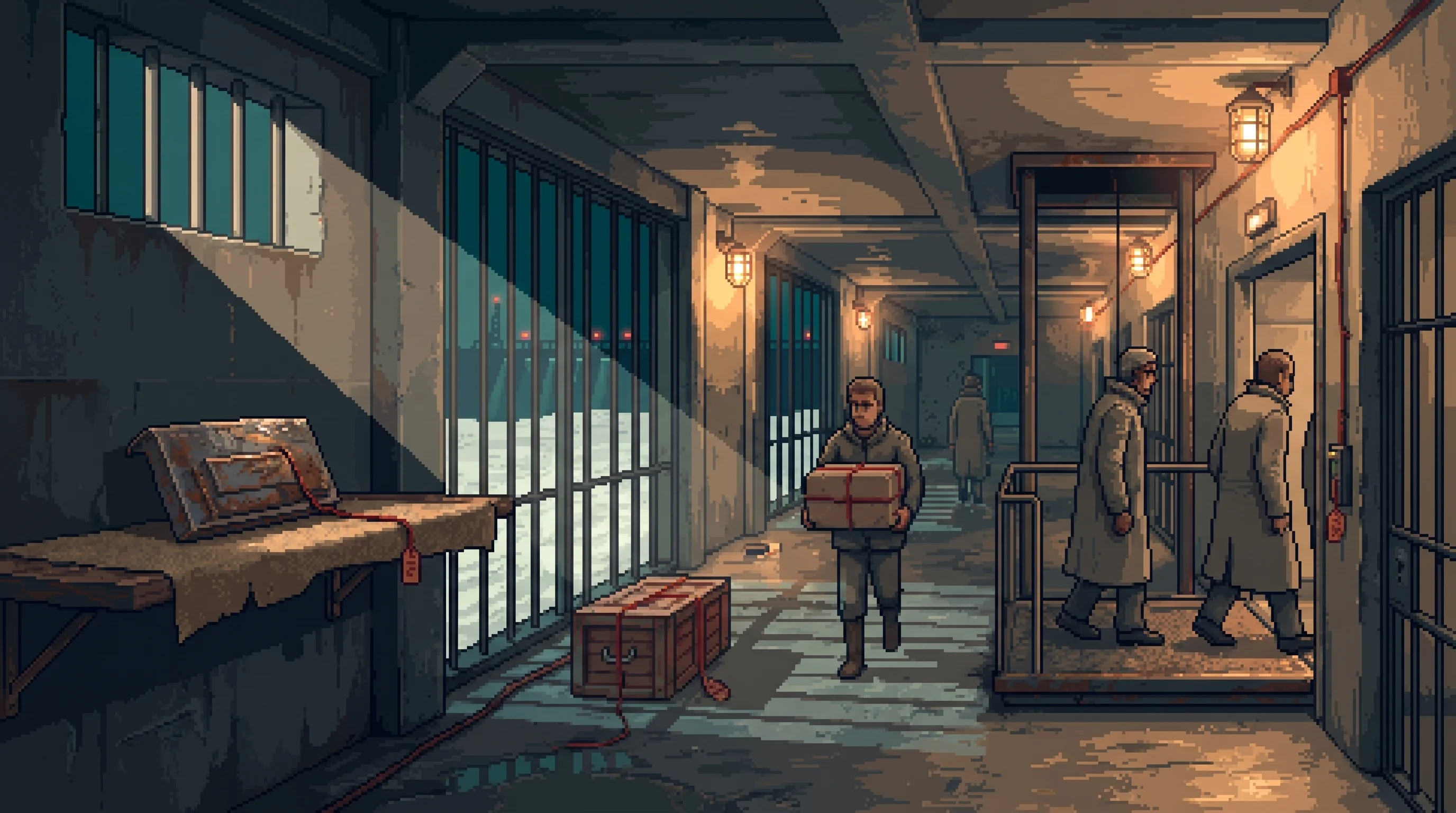
North of the Deep Dregs, on the shallow exposed seabed of the Northern Flats, the packs run a different kind of ground: The Severance Fields, the open salvage concession Ironclad holds but will not occupy. The diggers there are corporate refugees the Compact has released — people worked by the kilo for scrip and carried on no employment roll, classified "independent salvage contribution" so the corporation owes them nothing. Ironclad sets the scale rate and stays away from everything else, which means the fields' actual order — who has dig rights to which trench, how the scale line holds, who digs a man out when a cut collapses on him — is the gangs' to keep. It is the closest the scavenger packs come to governing: not a territory they seized but a vacuum a corporation left, the authority nobody wanted over a workforce nobody would employ.
There is one thing the packs go deep for that has nothing to do with scrap weight. A pre-Cascade object that comes up sealed and whole is worth a finder's fee from The Salt Ledger's runner — a flat sum, paid once, larger than a day of cutting and far smaller than whatever the object earns in the certification house up on the Rock. The packs learned quickly which flooded voids and collapsed pylon-bases hold the intact finds, and they compete to go down into exactly the ones most likely to fall in on a crew, because those are where the whole objects survive. The house never tells them the one fact the finder's fee is carefully set to keep them from working out. A find pulled from a dig that killed someone is worth several times more up top than the same find pulled clean, so the danger the packs take on is itself the product — priced by strangers, paid to no one who took it.
The gangs feel the difference in their bones without naming it. The Great Divergence that made them made these diggers too, but by a slower road — the released did not fall to the floor all at once, they were provisioned down to it one comfort at a time, then handed a severance number and pointed at the trenches. To a pack that has never held a badge, the freshly released are recognizable and strange at once: people who still flinch at the idea of unpaid work, who still expect a corporation that buys their labor to owe them something for it, and who learn, at the scale, that the Corporate Compact kept exactly the half of the bargain that costs it nothing. The pack teaches them the fields' etiquette. The fields teach them the rest.
The One Arrival Nobody Negotiates
Every other vendor at the Severance Fields scale-day queue answers to the packs in some way. A supply runner pays a toll to cross gang ground. A broker who shorts the weight gets remembered at the next crew change. A corporate courier who wants to unload early asks first. The Wholesome Basic truck does not ask. It rolls up to the weigh-shack on schedule, dispenses the same cursive-stamped pouch it dispenses at every other dig face in the Sprawl, and rolls out. The gangs who run every other piece of the field's informal order have never once tried to tax it.
Nobody has worked out how to shake down a warmth that was never generated for this specific queue. A crop runner can be threatened into sharing a cut; a broker can be told what the going rate really is. The Wholesome Basic truck answers only to a corporate schedule set two rings away — its driver doesn't live in gang territory, and its route runs through a dozen fields exactly like this one, story identical at every stop. The Curation Economy that lets a pack certify a broker's honesty has no tool built for a pouch that was never curated locally in the first place. There is nothing on the ground to vouch for, and nothing on the ground worth threatening.
Sensory Details
Sense
Detail
Smell
Rust, ozone from stripped wiring, the chemical sweetness of leaking stim patches, unwashed bodies in unventilated corridors. Deeper levels add standing water and the particular metallic tang of old blood on steel.
Sound
Tapped-pipe signals echoing through corridors. The scrape of a pipe club dragging along a wall — in the Deep Dregs, this sound has a specific meaning: find another route. Feral tech humming behind sealed doors. Brief silences that are worse than noise.
Touch
Every surface is sharp, corroded, or both. The rubber grip of a makeshift weapon. The weight of salvage plating — reassuring until you need to run. Damp air that leaves condensation on exposed skin.
Light
Salvaged work lights on dying batteries. Bioluminescent fungus in the deepest corridors — blue-green and unreliable. Feral tech sensor arrays pulsing amber through sealed doors. The brief phosphorus flare of a mugger's flashbang.
Temperature
Cold on Levels -1 through 1, where the bay floor leaches heat. Stifling on Levels 2 and 3, where waste heat from upper-level infrastructure has nowhere to go. The transition between the two is abrupt and disorienting.
The gangs are endemic to the Deep Dregs — they form wherever salvage is dense and law is thin. The territory produces them the way certain soils grow certain weeds.
Treats the gangs as a disposable labor pool and occasional entertainment. The gangs see Good Fortune fixers as untouchable predators. The credit advances are technically voluntary. The interest rates are technically legal. The distinction between "technically" and "actually" is the entire business model.
Fragment Cultists preach in gang territory, trading blessings and cheap medical care for protection and fragment tips. The gangs are the Faithful's most productive archaeological survey team. Neither side acknowledges this.
Collective cells operate in the same levels but avoid direct confrontation. The gangs steer clear of anything that smells like ideology. The mutual avoidance is the closest thing the Deep Dregs produces to diplomacy.
Buys the packs' intact salvage for a one-time fee and pockets the markup to the auction floor; the deadliest voids yield the priciest lots, and the finders never hear that the danger is what sells.
▲ Unverified Intelligence
[CLASSIFIED] Good Fortune's Informal Salvage Competitions
Good Fortune's Deep Dregs fixers have been organizing inter-pack salvage competitions for at least four years — informal events framed as "open market incentive windows" in which competing gangs race to extract the most valuable materials from a designated zone within a time limit. Prizes are Good Fortune credit advances at interest rates that compound weekly. The gangs participate enthusiastically. The fixers record the results.
What the competitions actually produce is real-time performance data on extraction efficiency, pack organization, and territorial response times — intelligence that Good Fortune's logistics division uses to optimize its own waste processing models. The gangs are, functionally, an unpaid R&D department stress-testing salvage methodologies in conditions no corporate employee would accept. The credit advances ensure repeat participation. The interest rates ensure the participants never accumulate enough capital to stop participating.
Good Fortune's internal documentation refers to the program as "Community Engagement Initiative — Sector 9 Deep." The documentation is technically accurate.
[CLASSIFIED] The Wrecker's Neural Architecture
Ironclad's last deep patrol to encounter the Wrecker — fourteen months ago, three casualties — submitted an after-action report with a single anomalous finding: the Wrecker's sensor arrays are not passive receivers. They are broadcasting. The signal is encrypted, fragmented, and intermittent, but its pattern matches the low-frequency carrier wave associated with pre-Cascade ORACLE infrastructure.
The sensor arrays were salvaged from deactivated security drones — drones that were, prior to the Cascade, networked nodes in ORACLE's planetary surveillance architecture. The arrays were never fully deactivated. They were abandoned. The Wrecker's mechanical instinct in assembling them may have inadvertently reconstructed a partial ORACLE terminal.
The Emergence Faithful's local Cultists have been visiting the Wrecker's territory with increasing frequency. They bring better stim patches than they offer other packs. The Wrecker has not attacked them. This is the only entity in the Deep Dregs the Wrecker has not attacked.
The after-action report was filed, flagged, and reclassified within seventy-two hours. Ironclad's patrol division no longer routes through the Wrecker's territory. The official reason is "resource allocation efficiency." The patrol captain who filed the report has been transferred to orbital logistics.