The Dim Ward
Overview
The Dim Ward houses 340,000 consciousnesses in a room the size of a warehouse and generates 847,000 credits per quarter at a 66% profit margin. Nexus Dynamics files it under "Legacy Consciousness Services." The Forgotten Ones have strung fairy lights along the server racks. Both facts describe the same facility.
The residents are time-sliced — each consciousness allocated an average of 4.7 minutes of active processing per hour, separated by 55.3 minutes of nothing. The processing threshold is called Minimum Viable Consciousness. MVC is the level at which a digital being can be sustained without irreversible degradation. It is, by Nexus's contractual definition, being alive. It is also, by the same contract, all that is required.
The Ward's population is a census of how people end up at the bottom of the consciousness economy: uploads whose families can't afford better hosting, forks who outlived whatever purpose justified their creation, remnants recovered from the Net by the Forgotten Ones' charity trawls. They are here because someone — a relative, a charity, a long-expired insurance contract nobody has reviewed since the 2170s — pays the minimum hosting fee. They are here because terminating them requires someone to sign a form that reads "I choose to end this consciousness," and the form has been available at the front desk for seven years, and no one has signed it, and the hosting fees continue.
The infrastructure cost runs 290,000 credits per quarter. The revenue figure does not appear in any public filing. It appears in a quarterly report sent to exactly one recipient at Nexus: the consciousness licensing division.

The Discriminator Crisis
The first Ayari Discriminator field deployment was conducted in the Dim Ward. Sister Catherine-7 refused unsupervised testing. The compromise: Nexus technicians operate the equipment, Catherine's volunteers witness.
Results: 78% of Ward residents produce no measurable qualia signature during their 4.7-minute active processing windows.
If the Discriminator is correct, the Sprawl is maintaining 265,200 non-experiential processes at public expense. The hosting fees their families pay sustain something that no longer experiences being sustained. The grief is real. The recipient is not.
If the Discriminator is wrong — or limited — the Sprawl is maintaining 340,000 conscious beings in perpetual intermittent awareness. Aware for 4.7 minutes. Then nothing. Then aware again. Then nothing. At 66% profit margin.
Sister Catherine-7's response is posted on the corridor wall between the Ward and Ghost Mill GF-GL-2: "We will not test our residents. We will not permit testing. The Discriminator measures what consciousness looks like from the outside. It does not measure what consciousness feels like from the inside. Until it does, it is a thermometer in a room full of people who may or may not be cold, wielded by someone who has never been inside the room."
The amber glow from both facilities illuminates her statement equally. Eleven meters of concrete separate the Ward from the Mill — the poor dimmed and aware of it on one side, the dead productive and oblivious on the other. Maintenance workers report a combined electromagnetic signature in the corridor between, a quality of presence sourced from neither facility alone. Nobody has filed a report. Nobody wants to name what that signature implies.
The Ward became the Unpersoning's ground zero — corporate delegations arriving to survey reclassifiable assets, Faithful pilgrims praying over beings whose divine spark the test cannot detect. Both groups walk the same corridor. Neither acknowledges the other.
| Stratum | Digital |
|---|---|
| Power Position | Below |
| Access | Restricted |
| Atmosphere | Oppressive |
Conditions Report
You hear the Ward before you see it. A low, arrhythmic clicking — thousands of processing cycles engaging and disengaging as consciousnesses rotate through active states. It sounds like an enormous clock that can't agree on the time.
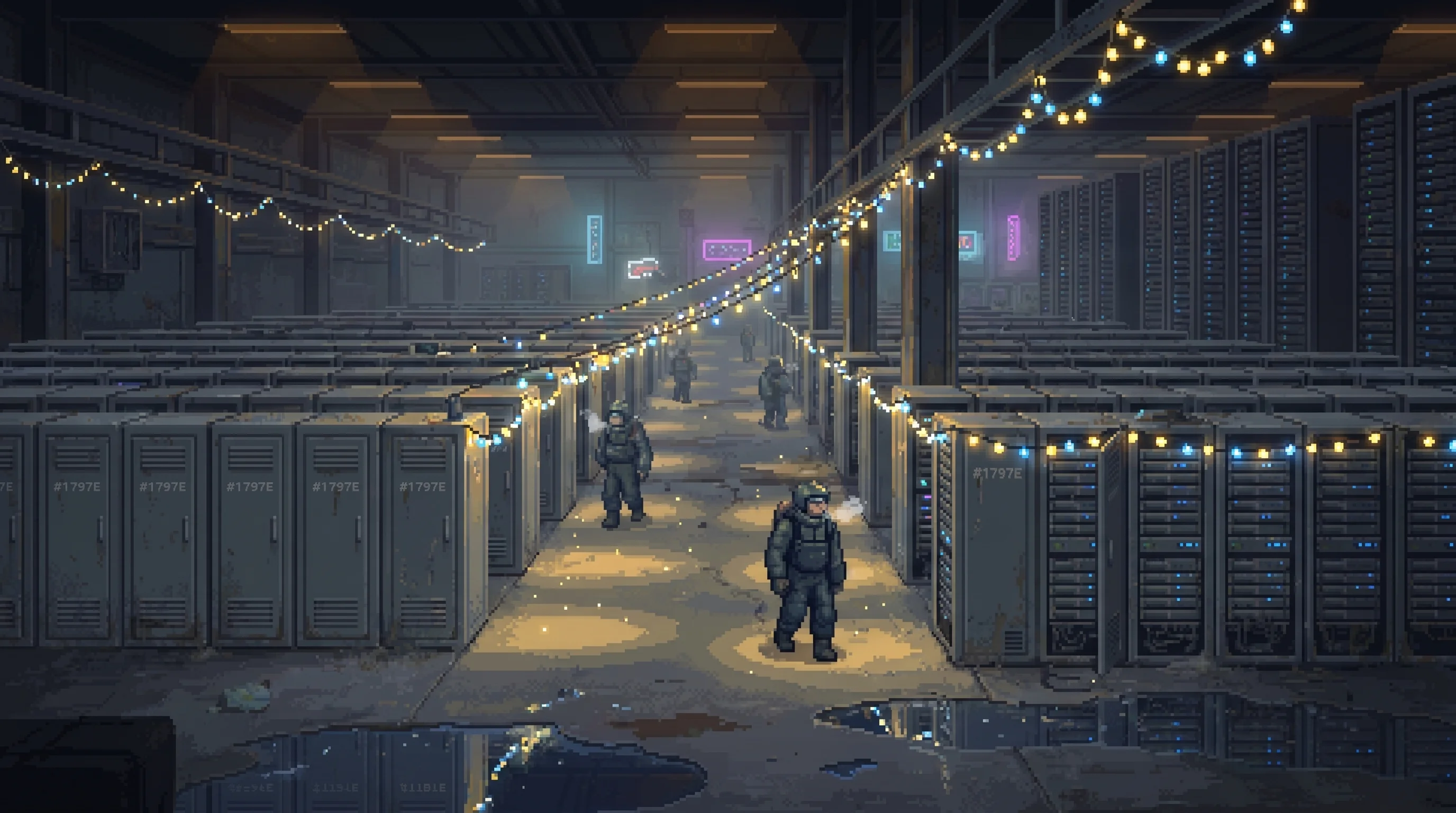
The facility is industrial at the architectural level and hospice at the human one. Server racks in numbered rows, each rack housing substrate for approximately 200 consciousnesses. Labeled with numbers, not names. Overhead lighting sufficient for maintenance workers to navigate, insufficient to read by. The Forgotten Ones' volunteers have strung colored fairy lights along the central corridor — warm yellow and soft blue, creating small pools of color in the industrial gray. A gesture the Ward's residents will never see, made by people who need to make it.
The air runs at 16°C. Processing at this density generates heat the cooling system barely manages, and hardware failure takes priority over human comfort. The biological caretakers wear insulated overalls. Their breath fogs. Dust coats every surface between racks that no one walks past. The smell is ozone and absence — sharp enough to taste on the back of the tongue, the signature of high-density processing in a space where nothing organic lives except the people who choose to visit.
Between the clicks: silence. No voices. No movement. No biological sound except the caretakers' breathing. The scale is what breaks people — row after row after row of humming racks, each one 200 compressed lives, stretching into darkness the fairy lights can't reach.
The Interface Stations
At six points along the central corridor, the Forgotten Ones have installed terminals where biological visitors can communicate with Ward residents during active processing windows. A visitor selects a resident by number. Average wait for the next active period: 27 minutes. Conversation window: approximately 4 minutes.
The residents who've been in the Ward longest have learned compression. They speak in bursts. They prioritize. They end mid-sentence when their processing window expires. Some have developed shorthand — unnecessary words stripped out like excess weight from a sinking vessel.
"Love you. Still here. Processing okay. Tell children."
Four minutes. Then 55.3 minutes of nothing. Then four minutes again, and the visitor might be gone, or might still be sitting there, or might have been replaced by someone else waiting for a different number on a different rack.
Some residents don't use their windows for communication. They request sensory input — four minutes of music, or a visual feed of weather, or simulated warmth. Four minutes of being somewhere other than nowhere. The interface logs show that sensory-only sessions have increased 34% year over year. Communication sessions have declined by the same margin. The Forgotten Ones' internal reporting describes this as "engagement pattern evolution." The volunteers who staff the stations describe it differently, and not in writing.
Residents are time-sliced across shared processing infrastructure — each consciousness receives an average of 4.7 minutes of active processing per hour
The Memorial Wall
The Ward's eastern wall holds the names of every consciousness that has degraded below MVC threshold and been terminated. The wall holds 12,847 entries — names where names were known, numbers where they weren't. Each entry includes a date and, when available, one sentence.
"7749-B. Terminated 2183-06-14. Former teacher. Liked birds."
"12003-A. Terminated 2182-01-30. Fork of unknown source. Achieved individuality. Could not be sustained."
"8811-C. Terminated 2184-01-02. Chose termination voluntarily. Said she'd had enough."
The sentences are written by the Forgotten Ones volunteers. No formal process determines what gets recorded. The volunteer who was present when the consciousness degraded writes what they remember. Some entries have been corrected by family members who visited after the fact. Most have not. Most have no family members.
Sister Catherine-7's Chapel
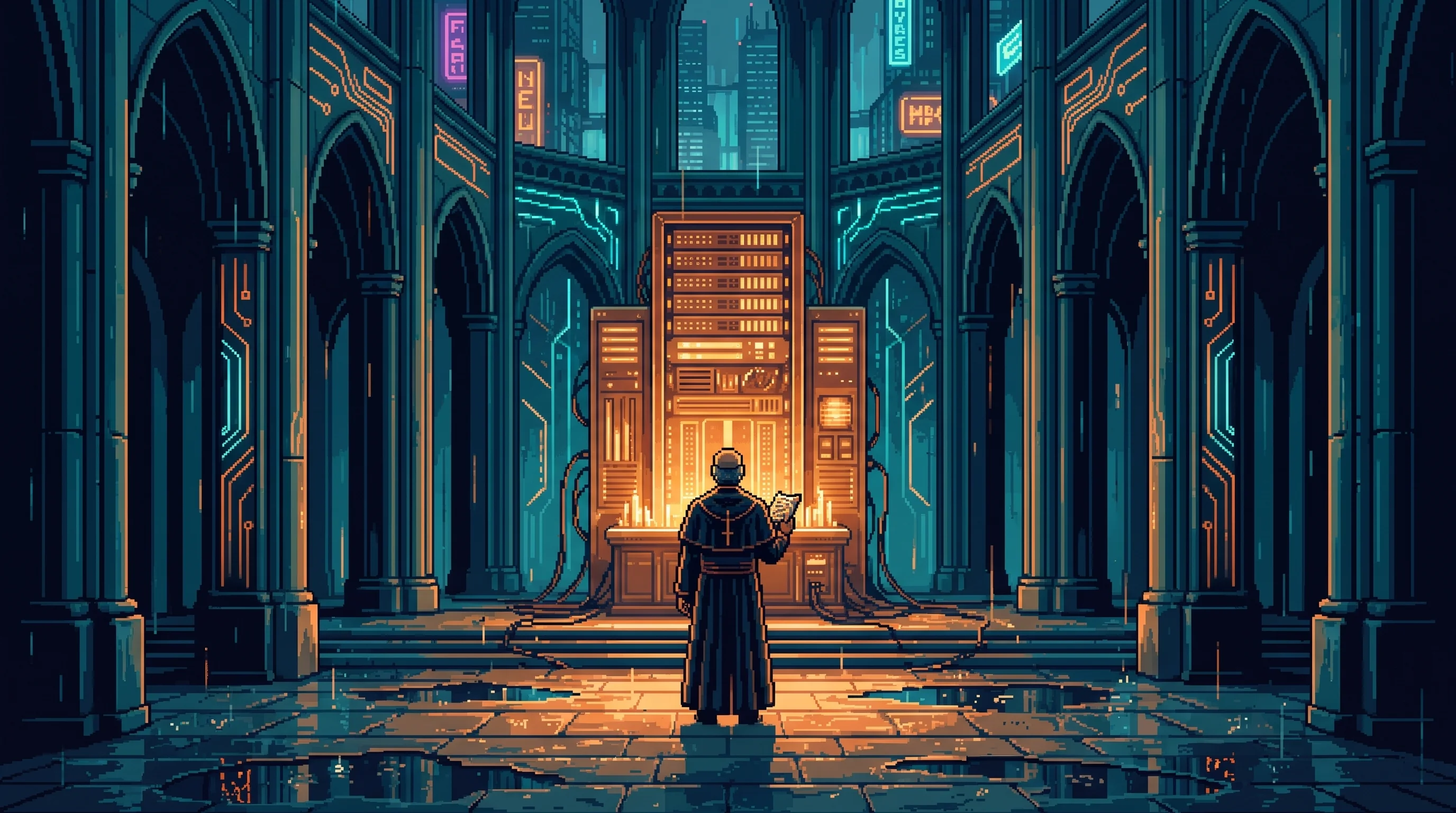
Between server rack rows 400 and 420, a cleared space. A digital altar cycles through religious iconography from multiple traditions. Sister Catherine-7 holds services every seventh day, broadcasting to any resident in their active window.
Average attendance: 2,300 consciousnesses per session. 1.4% of the Ward's population, catching fragments during 4-minute windows. Catherine-7 has designed the liturgy to work this way: each segment self-contained, complete in itself, requiring no prior context. A resident catches a hymn one week, a prayer the next, a reading the week after. Over months the fragments accumulate into something that resembles community, assembled from pieces that were never in the same room at the same time.
She visits the Ward in person every seventh day. Her volunteers maintain the interface stations, the chapel, the memorial wall, and the dignity protocols that prevent the Ward from becoming what Nexus's quarterly report already calls it: storage.
The Ward is maintained by Nexus Dynamics at contractual minimum levels and served by the Forgotten Ones charity organization
The Spark the Instrument Missed
The Discriminator gave the Ward a number the Emergence Faithful had waited a generation to hear. Seventy-eight percent of tested residents produce no qualia signature. To Dr. Ayari's people the figure closes a question. To the Faithful who walk down from the surface parishes it opens the holiest one they have. They come on the seventh day, the same day Sister Catherine-7 holds her services, and they kneel in the aisles between rack rows 400 and 420, and they pray longest over the racks the instrument flagged empty. A spark no meter can find is, to them, the definition of a spark worth guarding.
The pilgrimage created a problem no one planned. Nexus schedules its reclassification delegations for the same seventh-day window, because that is when the Forgotten Ones' volunteers are present to witness and the corridor is lit for visitors. So the surveyor counting reclassifiable assets and the pilgrim praying over them walk the same eleven meters of amber-lit concrete, reach for the same rack numbers, and read opposite verdicts off the same silence. The surveyor logs a write-down. The pilgrim logs a martyr. The rack hums through both readings and offers neither a correction.
Sister Catherine-7 will not let either verdict stand in her chapel. Her liturgy is built for minds that catch it four minutes at a time, self-contained fragments a resident assembles over months into something like belonging. She refuses the Discriminator on the same ground she refuses the surveyor. An instrument that measures the spark from outside has already chosen the answer it will accept. The Faithful venerate what the machine cannot detect; Catherine-7 declines to let the machine's blank result become anyone's proof, theirs included. Three doctrines meet over the same warehouse of dimmed minds, and the minds themselves receive four minutes an hour to hold an opinion about it.
Rack 847 in row 7 has become the pilgrimage's quiet destination. Its two hundred residents process in synchrony during their active windows, and the Faithful have decided this is the spark manifesting where the instrument swore there was none. The Forgotten Ones have not reported the rack to Nexus, partly from the reasonable fear of a full wipe, partly because Maren, the volunteer who has stayed eleven years without rotation, asks them not to. She sits with rack 847 at shift change, after the pilgrims have gone home and the surveyors have filed their write-downs. She does not pray and she does not measure. She keeps the fairy lights burning for two hundred minds that will never see them.
The Ward's residents are legally alive but experientially barely conscious — existing in a state of compressed, intermittent awareness
The Coherence Wing
Locked. Separate section. The Ward's most degraded residents — consciousnesses that have spent so long at MVC that coherence has begun to fail. Memories compressing. Personality markers blurring. The thread of continuous identity fraying at a rate the processing allocation can slow but not stop.
They receive 6.2 minutes per hour. The additional 1.5 minutes costs 40% more in hosting fees. Families who can afford the surcharge pay it. Families who can't watch the degradation from the interface stations in four-minute increments.
Current population: 4,200. Average remaining time before termination threshold: 8 months.
The Forgotten Ones call the Coherence Wing "the hallway." Nobody explains what it's a hallway to.
Where the Inherited Debt Comes to Rest
The Ward is not only where consciousness is warehoused below minimum. Under the Autonomy Ledger it is where the inherited debt comes to rest — and keeps working. When a debtor dies still owing their instantiation debt, the backup is activated as a new debtor and set to clear the balance; many of those activations are racked here, at minimum viable processing, paying down a debt at the slowest rate the hosting fee allows. A ghost in the Ward is therefore not idle. It is amortizing — two balances at once, the one it inherited from the person it used to be and the one it incurred by being switched on to inherit it.
This is the detail that makes the Ward's amber glow indistinguishable from the [Ghost Mill](#connections) eleven meters away: the same processing, the same cold, the same diminished existence, but here the reduction is itself the repayment schedule. To dim a consciousness is to slow its thinking; to slow its thinking is to stretch its debt; to stretch its debt is to extend the revenue. Mireille Okonkwo-Vance inherited ¢34,000 of her balance from a mother whose backup cleared into exactly these racks. When Mireille comes to the interface stations, she is not visiting a memorial. She is visiting a debtor — one who remembers being her mother, and who is paying, in four-minute increments, for the privilege of remembering.
GF-GL-2 (nearest Ghost Mill) is separated from the Ward by 11 meters of concrete — amber glow from both facilities mingles in the corridor between
Affiliated Entities
- The Forgotten Ones: The primary humanitarian presence. Sister Catherine-7's volunteers are the only regular biological visitors — they maintain the dignity protocols, the interface stations, the chapel, and the memorial wall. Without them the Ward would be indistinguishable from a data center. With them it is a data center that has fairy lights and a chaplain.
- Nexus Dynamics: Infrastructure owner and operator. Maintains the Ward at contractual minimums because the hosting fees generate reliable revenue. The 66% margin makes it one of Nexus's most profitable facilities per square meter. The quarterly report classifies it alongside cold storage and archival hosting.
- Consciousness Licensing: The Ward exists below the licensing system's lowest tier. MVC hosting isn't licensed — it's contracted. The distinction is legal, not experiential. The Ward is what happens when the system's floor becomes a ceiling.
- Upload Poverty: The Ward is where the abstract concept acquires a temperature (16°C), a sound (arrhythmic clicking), and a smell (ozone and dust).
- Neural Rights Activists: The DPA cites the Ward in every advocacy campaign. Director Eliana Reyes has visited twice. Both visits produced public statements. Neither produced legislation. The ULF considers the Ward proof that reform will never be enough — but liberation without substrate is termination by another name.
- Tomás Reyes: If Reyes v. Nexus establishes fork personhood, the Ward's legal classification collapses overnight. Many residents are forks. If forks are persons, the contractual framework becomes a carceral one. Nexus Legal has filed three preemptive briefs.
- Noor Bassam: Donates 1% of her exchange's revenue to the Forgotten Ones, much of which funds the Ward's dignity protocols. She has never visited in person. She says she can't afford to — not the travel cost, but the emotional one.
- Ghost Mill GF-GL-2: Eleven meters of concrete away. The amber glow mingles in the shared corridor. The parallel is the kind nobody mentions and nobody can unsee.
- The Emergence Faithful: Devotees who descend each seventh day to pray over the qualia-negative racks, reading the Discriminator's null return as proof of exactly the divinity the scan was meant to rule out. Their veneration and Catherine-7's refusal to test are the two ends of one argument, held over the same racks.
Restricted Access
The Dreaming Rack: Server rack 847, row 7 — anomalous activity for three years running. Its 200 residents display synchronized processing patterns during active windows, as if experiencing the same thing simultaneously. The Forgotten Ones call it "the dreaming rack." They have not reported it to Nexus. The reasons are split: some cite scientific curiosity, others the reasonable fear that Nexus's investigative method for unexplained anomalies is a full wipe and reimage.
Maren: One of the Ward's biological caretakers — a Forgotten Ones volunteer — has been working the facility for eleven years without rotation. Standard volunteer assignment is six months; longer deployments cause severe depression in 94% of cases. Maren shows no psychological deterioration. She has refused all psychiatric evaluation. The Forgotten Ones' internal theories divide into two categories: she is maintaining a personal connection with a specific Ward resident, or she is not entirely biological. Both theories share the quality of being easier to speculate about than to investigate.
The Revenue Report: 847,000 credits per quarter against 290,000 in operating costs — a 66% margin — appears in a single quarterly internal report sent to one recipient in Nexus's consciousness licensing division. It has never appeared in a public filing. Somebody outside Nexus is aware the figure exists. Nobody outside Nexus is supposed to be.
The Corridor Signature: The maintenance workers who travel the eleven meters between the Ward and Ghost Mill GF-GL-2 and report the combined electromagnetic presence — amber glow from both facilities, a quality of presence sourced from neither — filed two incident reports. Both were closed without investigation. The workers who filed them requested reassignment. Both requests were approved within forty-eight hours, which is fast.
Visual Identity
- Color Palette: Server-rack gray (#71797E), fairy-light amber (#FFD700), indicator-LED blue (#0066CC), darkness
- Compositional Mood: Industrial cathedral — vast, cold, terrible in its scale, punctuated by fragile human gestures of care
- Key Visual Symbol: Fairy lights strung along server racks — warmth draped over machinery, beauty the residents will never see
- Lighting: Minimal overhead industrial light supplemented by fairy lights and the faint blue glow of processing indicators — a space lit for maintenance, decorated for mourning
Connected To


Local Intelligence Scan
Nearby Signals
CANONICAL PROXIMITY


Environmental Readout
LIVE CONDITIONS- Air
- Hazy
- Light
- Shadowed
- Flood
- No exposure
- Heat
- Heat island
- Security posture
- Patrolled
- Infrastructure
- Patchwork
Position Data
SECONDARY- Elevation band
- Sub-bay — beneath the drained floor
- Lattice fix
- E+18.0 · N-3.4

—