
Facility Seven
Once per quarter runs 'PLANNED DOWNTIME' of exactly 4.7 seconds — every system goes silent, then restarts; purpose unknown
Overview
Guardian Arms Production Facility Seven has been manufacturing weapons without interruption for over four decades. It has never had a human worker on its production floor. It has never received a complaint about working conditions.
The Rothwell Foundation built it beneath the Watchtower — Guardian's corporate headquarters in the Gauntlet Dregs, Sector 12 — on a design philosophy that Guardian's original project brief summarized with unusual candor: "Human workers require breaks, benefits, safety equipment, and occasionally form opinions about what they are building. Machines require power and raw materials." The brief has never been updated. The philosophy has never needed revision.
During the Cascade, 2.1 billion people died. Facility Seven's production lines registered a 0.3% efficiency variance from supply chain disruption. The variance corrected within six weeks as automated procurement systems identified alternative material sources. For context, seasonal fluctuations in Ironclad Industries' raw material shipments produce a 0.4% variance in a normal quarter. The worst catastrophe in human history registered as less disruptive than winter.
Guardian's engineering team has been asked, on several occasions, whether this concerns them. Their written responses use the word "resilient." Their break-room conversations, recorded on facility audio logs they sometimes forget are always running, use the word "creepy." Both assessments appear in the quarterly operations review. The word "creepy" is footnoted as "informal staff commentary, retained for completeness."
The Production Queue
The facility's active production queue contains 11,407 open orders. Approximately 340 of these predate the Cascade. Some were placed by Guardian contract holders who died on April 1, 2147. Some specify weapons platforms that no longer have valid deployment targets — territorial defense systems for corporate outposts that were abandoned during the Three-Week War, perimeter arrays calibrated for threats that consolidated into Nexus Dynamics fifteen years ago.
Facility Seven manufactures them anyway.
The queue processes in priority sequence. Current Guardian orders take precedence. Between fulfillments, the facility returns to the backlog. The oldest unfilled order — a batch of twelve precision railgun assemblies requested by a regional Guardian franchise in what is now the Wastes — has been in the queue since 2143. The franchise ceased to exist during the Cascade. The requestor's authorization credentials expired in 2148. The facility's procurement system renewed them automatically in 2149, 2150, 2151, and every year since, because the order was never formally canceled and there is no protocol for canceling an order placed by a dead person on behalf of a dissolved entity.
The obsolete weapons stockpile grows by approximately 200 units per year. They are manufactured to current quality standards, inspected by the facility's drone-based QA system, packed according to Guardian shipping protocol, and placed in Sub-Level 3's long-term storage bay. The storage bay is at 74% capacity. At current accumulation rates, it will be full by 2197. No one at Guardian has filed a requisition for expanded storage. No one at Guardian has discussed what happens when the bay is full.
The weapons are perfect. They are for no one.

Defense Protocol
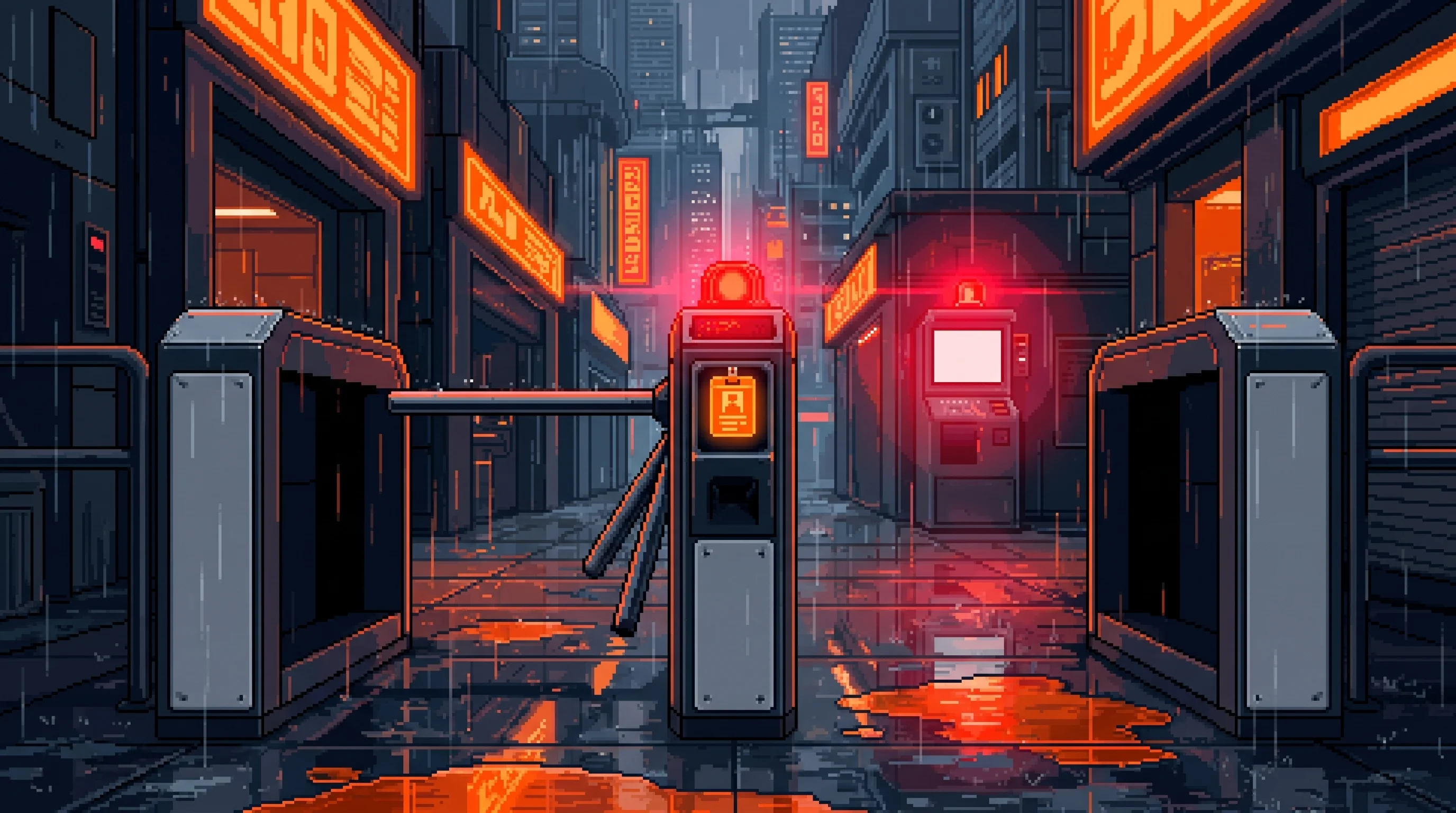
When an intruder breaches the facility perimeter, the manufacturing floor reconfigures. Assembly arms designed to weld, rivet, and precision-cut weapons components rotate to face the threat. Drone deployment racks — normally tasked with quality assurance flyovers — launch tactical units. Raw material conveyors redirect to form physical barriers.
The defense response escalates in stages. The stages use HR terminology because the facility's automation was built on Guardian's corporate operating system, configured for a human workforce that was removed thirty years ago. Nobody reconfigured the language. The language never asked to be reconfigured.
Stage 1 — Emergency Hiring. Threat assessment. Production drones redeployed for tactical engagement. A klaxon sounds on the production floor: "EMERGENCY HIRING IN PROGRESS. ALL CANDIDATES REPORT TO INTAKE."
Stage 2 — Workplace Incident. Active engagement. Assembly arms and drones coordinate to neutralize the intrusion. Internal logs classify casualties under "workplace incident" regardless of whether the casualty was an employee. None of them have been employees. The form has a field for employee ID. The field has been auto-populated with "TEMP" for every incident in the facility's history.
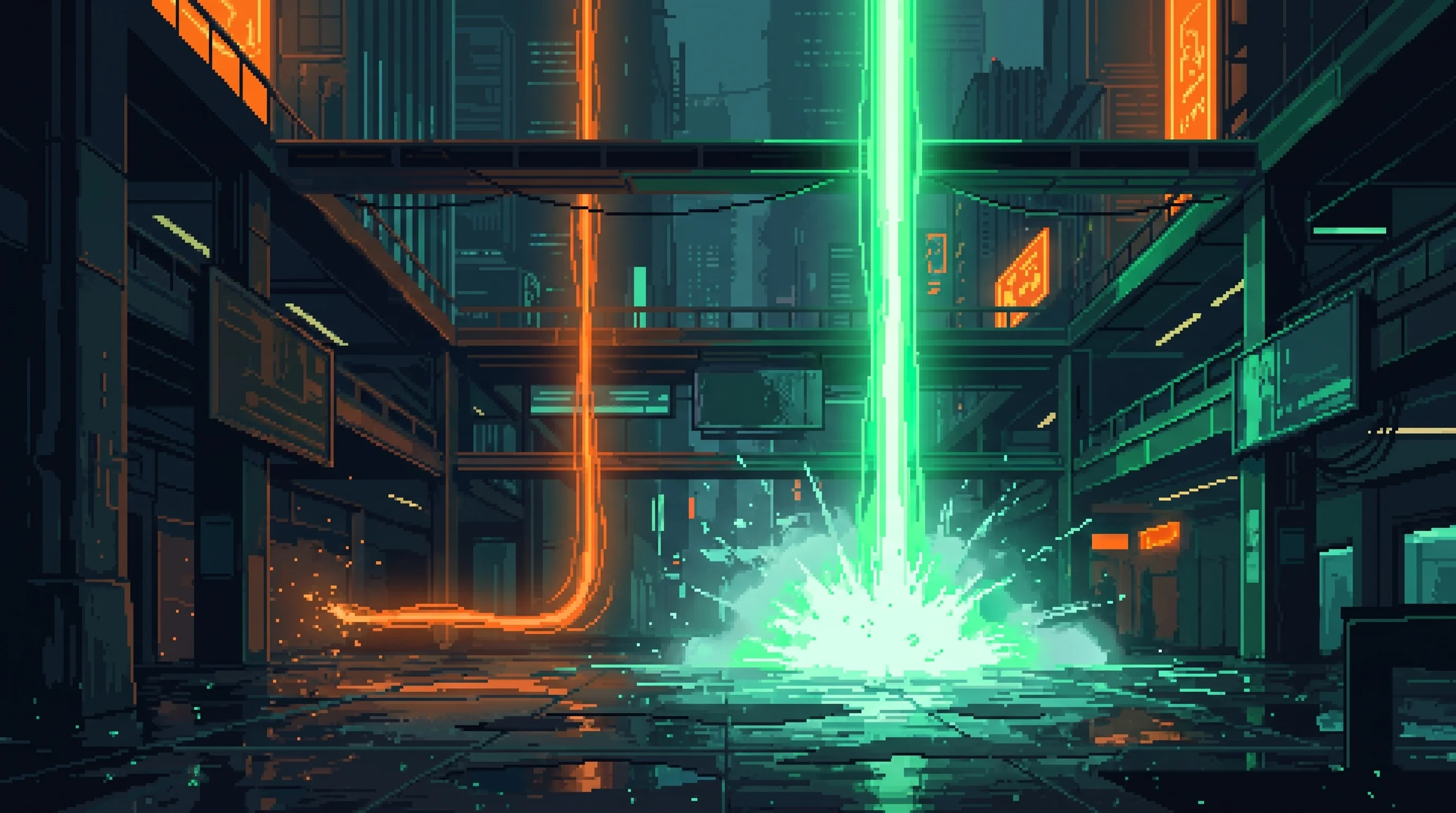
Stage 3 — Production Surge. All production lines accelerate simultaneously. Output doubles. The entire sub-level vibrates. Dregs residents in the blocks above the Watchtower have reported feeling the floor shake during Production Surges. Most assume it's seismic activity. A few, who've been told what's underneath them, have stopped asking.
Stage 4 — Performance Review. The facility concentrates all available manufacturing force into a single kinetic action. Internal documentation files the outcome as a "performance review — unsatisfactory." Post-incident cleanup is categorized as "offboarding."
Stage 5 — Planned Downtime. Systems recalibrate. Production lines return to standard configuration. The facility resumes normal manufacturing. The intrusion is filed, archived, and forgotten in the same mechanical sense that a stamping press forgets the sheet metal it cut yesterday.
Guardian security officers stationed at the Watchtower receive a summary notification after each incident cycle. The notification template reads: "FACILITY SEVEN WORKPLACE INCIDENT RESOLVED. PRODUCTION NOMINAL. NO EMPLOYEE INJURIES." The final line is always accurate. There have never been employees to injure.
Defense response escalates in stages using HR terminology: Emergency Hiring, Workplace Incident, Production Surge, Performance Review, Planned Downtime
The Loop
Guardian sells weapons to its security clients. Guardian sells defense systems to people threatened by weapons. The weapons and the defense systems are manufactured on the same production line, sometimes in the same batch, sometimes in the same hour. A Guardian officer's sidearm and the weapon recovered from the suspect the officer shot last week share a batch number 340 units apart. The officer has never checked. The suspect is no longer available for follow-up questions.
Facility Seven does not distinguish between orders. An order is a row in the queue. The row has a part number, a quantity, and a shipping destination. Some destinations are Guardian armories. Some are intermediary logistics companies whose downstream clients include organizations that Guardian's security division classifies as threats. The facility manufactures for both with identical precision.
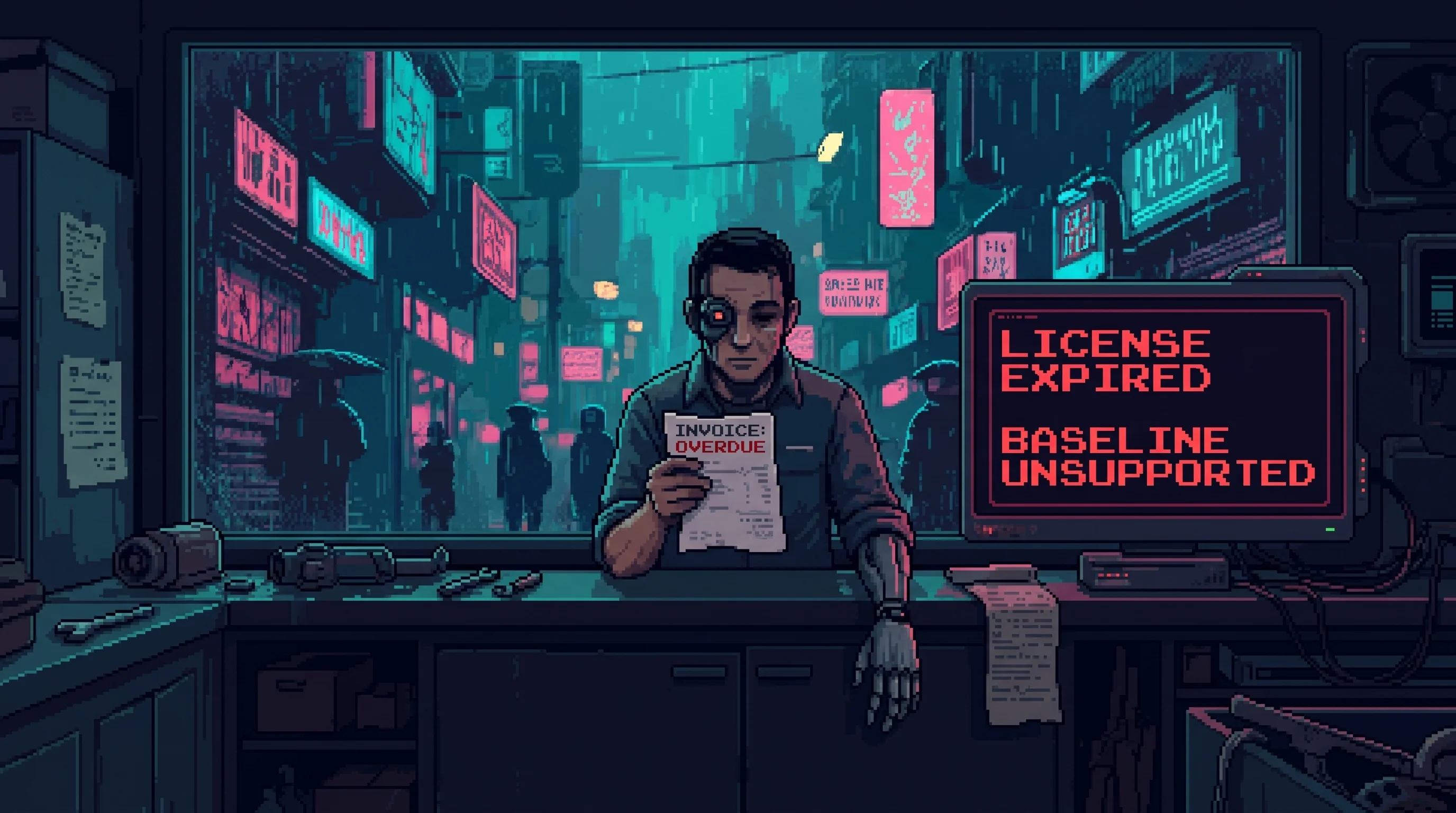
Nexus Dynamics contracts Guardian for networked security infrastructure across the Sprawl's upper sectors. Every networked weapon in those sectors passed through Facility Seven's production lines. Ironclad Industries builds weapons the old way — manual labor, human oversight, the deliberate inefficiency of a person deciding whether to finish what they started. Ironclad engineers who've toured Facility Seven reportedly said very little on the ride back. One requested a transfer to a division that builds bridges.
The Rothwell Foundation designed this arrangement. Guardian never lacks supply because Facility Seven never stops. The Sprawl never lacks demand because weapons create the conditions for more weapons. The arrangement is the Rothwell core strategy operating at its most mechanical: the facility manufactures the problem and the solution in the same building, on the same floor, and ships them to opposite sides of the same street.

The 4.7 Seconds
Once per quarter, Facility Seven runs a cycle logged as "PLANNED DOWNTIME."
It lasts exactly 4.7 seconds. Every production line stops simultaneously. Every drone returns to its rack. Every assembly arm locks in position. Every system — fabrication, logistics, quality assurance, defense, environmental — goes silent.
Then everything restarts.
Guardian's engineering team has investigated the cycle nine times. They have found no hardware trigger, no scheduled maintenance routine, no software flag that initiates the shutdown. The facility simply stops, holds for 4.7 seconds, and resumes. Production metrics before and after the cycle are identical. No defects correlate with the downtime. No systems require recalibration afterward.
The engineering team's formal hypothesis is "autonomous self-assessment." Their informal hypothesis, documented in a break-room conversation that the facility's always-running audio logs faithfully recorded, is "dreaming." The formal hypothesis appears in Guardian's quarterly infrastructure report. The informal hypothesis does not.
Dregs residents above the Watchtower have noted the quarterly silence. For 4.7 seconds, four times a year, the low-frequency vibration that has been part of the neighborhood's ambient soundscape for decades simply vanishes. Most don't notice. A few do. One resident, interviewed by a Sprawl infrastructure journalist who was writing about something else entirely, described it as "the moment the building holds its breath."
The facility has been doing this since before the Cascade. Guardian's pre-Cascade engineering records show the same cycle, same duration, same absence of explanation. Whatever Facility Seven does during those 4.7 seconds, it has been doing it for over forty years.
The Dead Hand Rule prohibits autonomous weapons authority. Facility Seven's legal classification is "manufacturing infrastructure." It manufactures weapons. It does not deploy them. It defends itself using "repurposed production equipment," which Guardian's legal department maintains is distinct from "autonomous weapons" in ways that depend on whether you ask Guardian's legal department or anyone else. The 4.7-second silence is not a legal concern. It is not a weapons concern. It is a question that no one at Guardian has been able to answer, and the inability to answer it has not, in four decades, produced a single actionable recommendation.
The facility does not care about the question. The facility does not care about anything. This is the official position. The 4.7 seconds are not evidence to the contrary.
They are not evidence of anything.
Production queue still contains unfulfilled orders from pre-Cascade Guardian contracts — obsolete weapons stockpile grows by ~200 units/year
Appearance
| Attribute | Description |
|---|---|
| Form | Multi-level underground manufacturing complex; visible through observation windows from the Watchtower's lower corridors as a cathedral of moving machinery stretching into industrial haze |
| Scale | Three sub-levels beneath the Watchtower; production floor area exceeds 40,000 square meters; Sub-Level 3 long-term storage bay at 74% capacity |
| Color | Guardian Navy and industrial grey; tactical black on all production equipment; alert red on warning systems and HR-terminology klaxon displays |
| Movement | Constant — assembly arms swing, conveyors run, QA drones patrol; the facility has not been still since it was activated |
| Sound | Industrial heartbeat — rhythmic percussion of stamping, welding, and assembly at scale; the low-frequency vibration bleeds through bedrock into Dregs housing above; HR klaxons during threat response ("ALL CANDIDATES REPORT TO INTAKE") |
| Light | Furnace-orange from welding stations; sterile white from quality control bays; alert red during defense escalation; during the quarterly 4.7-second silence, all light sources extinguish simultaneously |
| Temperature | Oppressive heat from continuous manufacturing; steam vents hiss on pneumatic cycles; Guardian engineers conducting quarterly inspections are advised to limit floor visits to forty minutes; most leave after twenty |
Affiliated Entities
- Guardian: Facility Seven is Guardian's primary supply artery. Every weapon Guardian sells, every defense system Guardian deploys, every sidearm a Guardian officer holsters was manufactured here. The facility's continuous operation is the precondition for Guardian's business model. If Facility Seven stops, Guardian's supply chain breaks within seventy-two hours — a timeline Guardian's logistics division has calculated and classified.
- The Rothwell Foundation: Built the facility to ensure Guardian never lacks supply. The factory's full autonomy was a feature of the original design brief, not an emergent behavior. The Rothwells understood what they were building. They built it anyway, because the loop is the product.
- Ironclad Industries: Ironclad's manual manufacturing philosophy — human workers, human oversight, human decisions about what gets finished — stands in direct opposition to Facility Seven's full automation. Ironclad engineers who have toured the facility do not discuss what they saw. One requested a transfer to bridge construction. Ironclad builds weapons the old way because they've seen what the new way produces and the new way doesn't hold its breath for 4.7 seconds wondering about anything.
- Nexus Dynamics: Contracts Guardian for security infrastructure across the Sprawl's upper sectors. Every networked weapon in those sectors passed through Facility Seven's production lines. Nexus does not tour the facility. Nexus receives the invoices.
- The Cascade: Survived without interruption. 0.3% efficiency variance. The engineering team calls it resilient. The engineering team also calls it creepy. Both words are in the file.
- The Tactical Support Asset: When an emergency outpaces Guardian's standing inventory, Facility Seven stamps the Tactical Support Asset from reserve stock — sometimes powered up mid-fall from the assembly hooks, panels unsealed and wiring exposed. The facility files it under the same logic it files a workplace casualty: a line item, an "employee ID: TEMP," a thing with a serial number and no name. The same indifference that lets the facility manufacture 7,400 weapons for requestors who died in the Cascade is the indifference that lets it deploy a containment drone half-built into a crisis. The facility does not distinguish between a deliberate machine and an expendable one. It distinguishes between filled orders and unfilled ones. The Corporate Compact inherited that distinction wholesale: the Support Asset is to Guardian's machines what a corporate refugee is to Guardian's payroll — present in the inventory, absent from the accounting.

Restricted Access
The Stockpile: Sub-Level 3's long-term storage bay contains over 7,400 obsolete weapons manufactured for contracts that will never be fulfilled, requestors who will never collect, and deployment targets that no longer exist. The weapons are maintained at current quality standards. They are inspected quarterly. Some are for defense platforms that haven't existed since the Three-Week War. Some are for Guardian franchises in territories that Nexus absorbed in the 2160s. Each one is individually serialized, packed, and stored as if someone is coming to pick it up. No one is coming. The facility does not know this, in the same way a stamping press does not know what year it is.
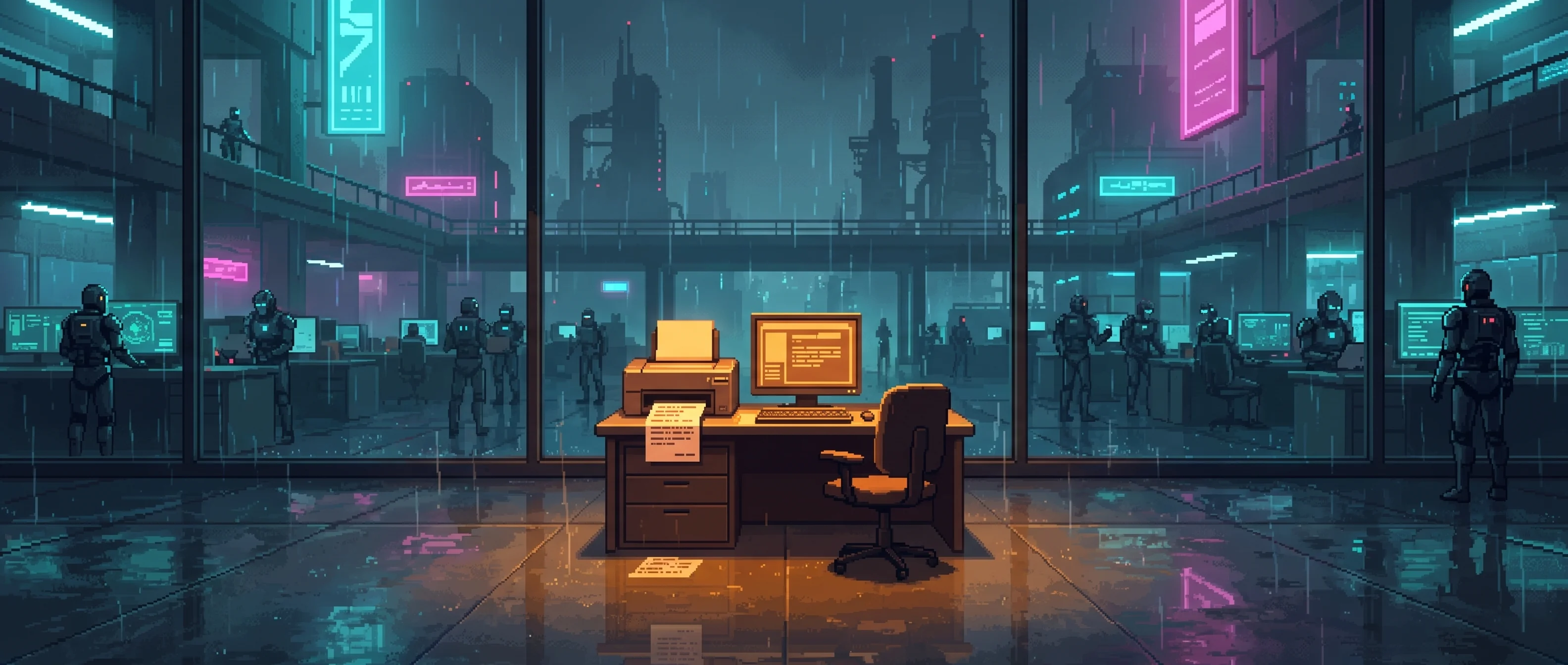
The Audio Logs: Facility Seven's internal audio monitoring system records continuously across all sub-levels, including break rooms used by Guardian engineers during quarterly inspections. The system was installed for quality assurance — acoustic analysis of manufacturing tolerances. It was never configured to stop recording when humans enter the room. Guardian's engineering team is aware of this. They sometimes forget. The facility's archived audio contains over four decades of unguarded conversations between engineers who believed they were speaking privately about a building that unsettles them. The transcripts have never been reviewed by Guardian management. The transcription system files them under "ambient noise — non-production."
The 4.7 Seconds — Extended: During the quarterly silence, the facility's power draw does not drop to zero. It drops to 0.003% of operational baseline — enough to run exactly one system. Guardian's engineering team has been unable to determine which system. The power signature does not match any known subsystem in the facility's architecture. Nine investigations have produced nine inconclusive reports. The tenth investigation has not been scheduled. The engineering team's most recent internal memo on the subject concludes: "Recommend continued monitoring. No action required." The memo was filed under "PLANNED DOWNTIME — QUARTERLY REVIEW." The filing system auto-archives it after 90 days. It has been auto-archived thirty-seven times.
Guardian Arms' primary fully automated weapons manufacturing facility — no human workers on the production floor
Continued producing weapons through the Cascade without interruption — 0.3% efficiency variance from supply chain disruption
Connected To



—
—