
The Question Keepers
Informal network collecting unasked questions — gaps in the Sprawl's knowledge architecture
Overview
They are not a faction. They have no name — "Question Keepers" is what the Seekers call them. They have no organization, no meetings, no manifesto. What they have is a shared obsession: collecting questions that nobody has thought to ask.
In the Sprawl of 2184, questions have been optimized into irrelevance. The Second Mind anticipates them before they form. The entire architecture of knowledge has been restructured around answers — pre-computed, pre-loaded, delivered before the need arises. The Question Keepers collect what's left: gaps in the Sprawl's knowledge architecture that exist because no AI system was ever prompted to investigate them, and augmented humans never notice unprompted gaps.
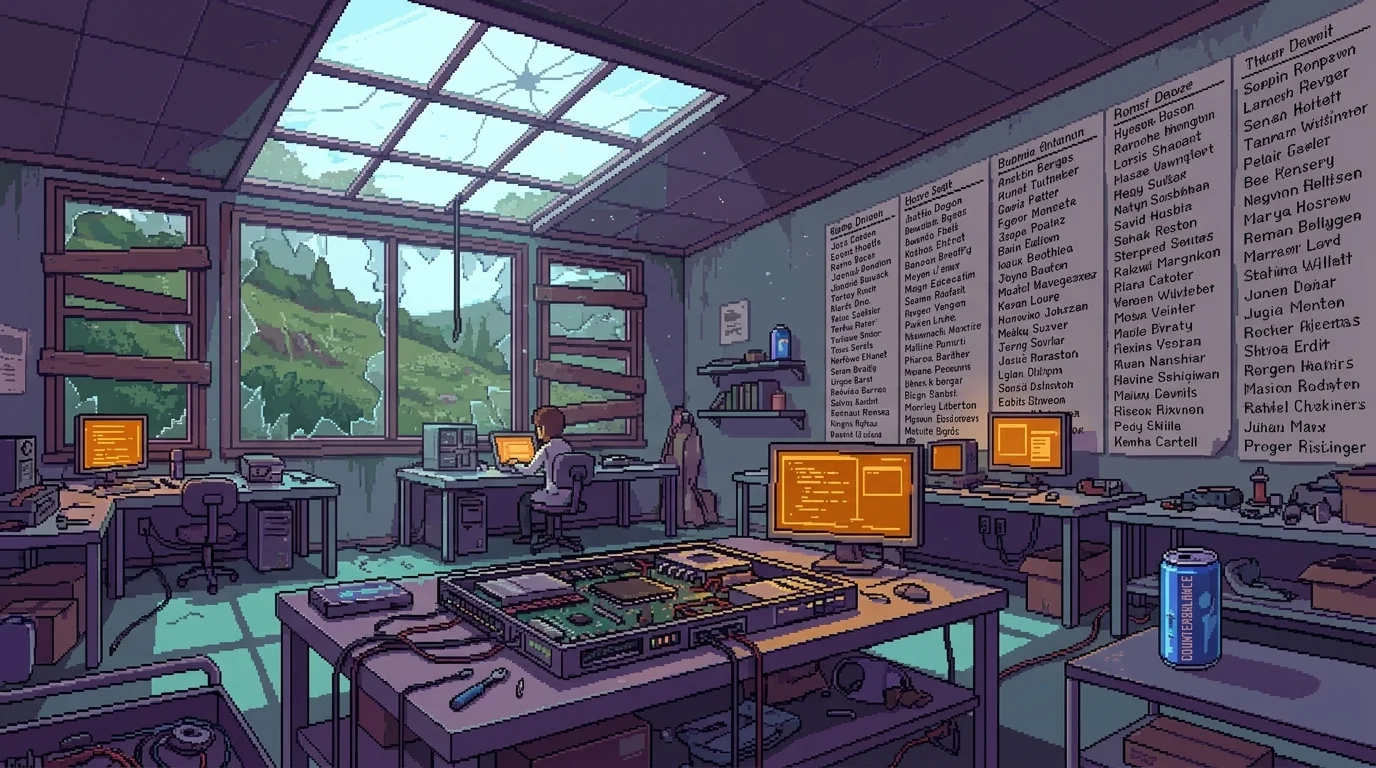
They maintain their collection on physical paper, carried by hand, never digitized. Each question is written in ink on a card, dated, attributed to whoever posed it, and annotated with whatever investigation the Keepers have conducted. The collection currently holds an estimated 4,200 cards. Approximately 1,100 of those are active — meaning they circulate through the courier network. The remaining 3,100 were contributed, assessed through no formal process anyone will describe, and quietly not reproduced. The Keepers do not discuss rejected cards. They do not acknowledge that rejection occurs. They call it "natural attrition in the distribution cycle," which is a phrase that appears on no official document because no official documents exist.
A faction dedicated to preserving unasked questions has developed, without apparent irony, a curated hierarchy of which questions deserve preserving.
The Collection
Examples from the active circulation:
- "What does the Grid sound like in the sealed junction beneath the Sector 8 memorial?" (Posed by Fen Delacroix, 2183.)
- "If ORACLE's atmospheric processing parameters optimize for biological comfort, do they optimize differently for different populations — and who decided which population's comfort matters?" (Posed by Mika Vasquez-Osei, 2182. Card annotated in three different hands.)
- "How many Dispersed consciousnesses does it take to produce a coherent manifestation?" (Posed by Dr. Maren Yeoh, 2183.)
- "What happens to a Mystery Club participant's Second Mind during suppression — does it maintain consciousness while disabled?" (Posed by Naia Okafor, 2184.)
- "There used to be a word for the feeling of meeting someone who learned the same thing the same year from the same teacher. I had the feeling once, by accident, and reached for the word, and it was gone. What was it, and who decided we wouldn't need it?" (Posed anonymously, Sector 5, 2184. Identified by the Keepers, after three weeks, as classmate. Card annotated in two hands; circulating heavily.)
And from the inactive collection — the cards that stopped circulating:
- "Why does my building's water taste different on Tuesdays?" (Posed anonymously, 2183. Circulated for six weeks. Stopped.)
- "Has anyone counted the Lamplighters?" (Posed anonymously, 2182. Circulated for three days.)
Nobody voted on these. Nobody discussed them. The courier who carried the water question simply stopped carrying it. When another courier noticed, they also did not carry it. The question was not rejected. It experienced natural attrition. The Lamplighter question experienced natural attrition in three days, which is either a commentary on the question's quality or on how quickly the Keepers decided they didn't want anyone counting things.
| Key Principle | Preserving unasked questions — gaps in knowledge architecture that AI never investigated because nobody prompted it |
|---|
The Card That Stayed
The longest-circulating card in the collection has been active since 2179. It reads: "What questions is this network not preserving, and why?"
It was posed anonymously. No one has annotated it. It has been carried by an estimated 300 couriers across every district in the Sprawl. It is, by the Keepers' own implicit standards, the most important question in the collection — the one that has survived five years of natural attrition without a single annotation, because writing an answer would require acknowledging the curation system that officially does not exist.
The card is slightly worn. The ink is fading. It is reproduced more frequently than any other card in the active collection.
Nobody has answered it. Answering it is not the point. Not answering it is not the point either. The card circulates because it is the precise shape of the hole at the center of the project — a question about unasked questions that cannot be addressed without dismantling the premise that all questions are equal. It is the Keepers' fish pudding: the one item that perfectly encodes the gap between what the network claims to do and what it actually does, persisting because removing it would require someone to say out loud what everyone already knows.
The Bay-Floor Correction
A card arrived in 2184 by Treasure Heap Market dead drop, in a hand the Keepers have not identified, and it has quietly embarrassed the Dead Words cabinet. It reads: "You only collect the words the rich lose. Down here a dead word is worth its weight in copper. Why is your grief a corporate luxury?"
The criticism landed. The Keepers' Dead Words investigation skews to the corporate tier — classmate, I'm proud of you, words killed in the nursery by the Pace and the inherited presence, mourned by people who could afford the childhood they lost. The card's author was right that the bay floor experiences word-death differently and that studying only the mourners produces a false grammar of loss. At the Heap, a dead word is inventory; the Rail Runners kill their own slang on purpose; Hector mints rank-in-miles because the old labor words lie. The Dregs do not grieve dead words. They restock. The Keepers filed the card under their highest tier — questions that indict the collection itself — beside the longest-circulating one, and a courier was dispatched to the bay floor with a single instruction: find the broker who still knows what the dead things were called. The broker's name, when it came back, was Raz Demetriou. The Keepers have not approached him. They suspect, correctly, that he would not file a card. He would file the cabinet.
Questions maintained on physical paper cards, never digitized
The Breakwater Card
A 2179 card from Sector 23 nearly went into the collection as a dead-dialect curiosity before a Keeper noticed the handwriting was current, the ink fresh, the sender alive. Three years of careful correspondence with the Hidden, a North Bay hill town, produced exactly one confirmed word before the correspondence went quiet. The town, it turned out, was reviving dead words rather than preserving them — reassigning private meanings the Keepers' own catalogue had unknowingly supplied, then burning the record of each year's assignments before anyone outside could read it.
The Keepers do not consider the case closed, only quiet. Every subsequent Dead Words card is, from the town's side, one fewer word it can safely reuse — a cost the Keepers did not intend to impose and cannot stop imposing simply by continuing their own work.
The Sovereignty Card
A second card has begun to rival the longest-circulating one, and it is the one the Keepers filed before there was a movement to carry it. Handed across a Lamplighter counter in 2181, in a hand nobody has identified, it reads: "If we always do what it says and it is always right, when did we last govern ourselves?"
The Keepers logged it because it satisfied their only criterion: it is obvious and still unanswered. Every Free City councillor could read it; none could resolve it; the Civic Advisory it implicitly indicts cannot resolve it either, because the question has no optimal answer and optimization is the only thing the Advisory does. When The Sovereignty Question movement coalesced — the bloc that grants the guidance is correct and refuses the conclusion anyway, a correct cage is still a cage — its organizers found the card already in circulation and adopted it as a founding text without knowing who wrote it. The Keepers note the irony with their usual flatness: the one question that produced a political movement is also the one the movement cannot answer, which is why the Keepers, not the movement, remain its proper custodians. They do not answer it. They keep it. In keeping it, they do the one thing the Advisory structurally cannot — preserve a gap in the knowledge architecture that the machine never investigated because no profitable party ever prompted it. Councillor Adaeze Nwosu's thrice-failed Right to Be Wrong bill is the legislative shadow of this single card.
Distributed through Lamplighter infrastructure, Analog School channels, and G Nook dead drops
Preserving What Produces Questions
Consider Naia Okafor's contribution: "What happens to a Mystery Club participant's Second Mind during suppression — does it maintain consciousness while disabled?"
This question requires three things the Sprawl's knowledge architecture has quietly eliminated. First: the suspicion that the Second Mind might have experiences independent of the user — framed in corporate territory as naïve anthropomorphism. Second: the vocabulary to describe "suppression" as something done to an entity rather than with a tool. Third: the willingness to follow an uncomfortable implication to its conclusion. Each prerequisite is a cognitive capacity that the corporate tier's optimization has made unnecessary, which is the Sprawl's word for "extinct."
The Question Keepers don't teach structural critique. They preserve artifacts of it — questions that could only have been formulated by minds still carrying the vocabulary. Each card is a seed. Whether the cognitive soil it needs still exists anywhere in the Sprawl is itself an unasked question that has not, as of this writing, appeared in the collection.
What the Flood Cannot Reach
The Curation Economy sorts itself into three tiers — Guild, G Nook, adversarial — and each fights the same flood with a different filter. The Keepers are the tier that map leaves out, because they do not filter the flood at all. They preserve what it never contained.
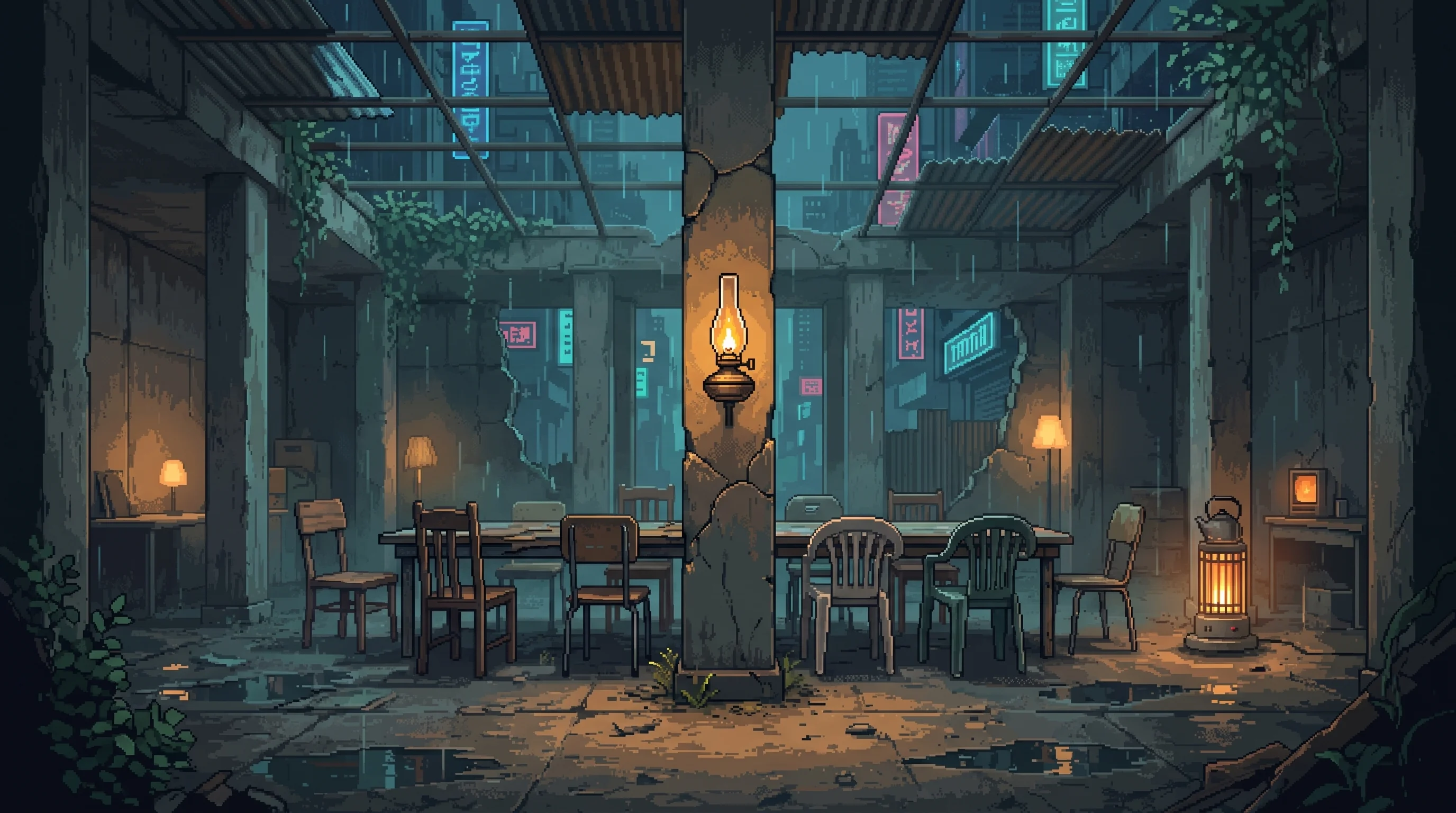
Every other curator stands between a finite mind and 2.3 exabytes a day, saying this one. The Keepers collect the questions no feed surfaced, because no profitable party ever prompted them, and a cannon only floods what someone thought to aim it at. This is why the cards are ink on paper, dated, carried by hand, never digitized. Paper cannot be drowned. A question that exists in exactly one place, in one courier's coat, is the single artifact in the Sprawl the Slop Cannon cannot bury under a million variations of itself.
The Slop Cannon inquiry is itself a card. The Keepers filed the question — what survives when a day's synthetic output exceeds a century of human work — and then declined to answer it, which is the only honest thing a curator can do with a flood. You do not certify what rose. You keep proof of what the water covered.
The Keepers are no longer the only answer to that card in their own sector. Two sub-levels away, the Fragment Garden keeps four years of unpublished fragment data on a hidden server for the same reason the Keepers keep questions on paper — signal held back from the flood is signal the flood cannot bury. In that Garden, Fragment Nine rations 847 morphemes of internal language down to seventeen spoken words in four years, the anti-cannon rendered as a single mind. And across the campus at the Open Hours, the same restraint runs in a warmer key: a room that keeps human warmth un-recorded and un-samplable, refusing the flood's quieter second mode the way the Keepers refuse its first. The Free Quarter, it turns out, has a paper tier, a data tier, a silence tier, and a warmth tier — four different vaults for four different things the cannon was aimed at and could not reach.
The Keeper's response when informed of their existence: 'At last.'
The Docket Cards
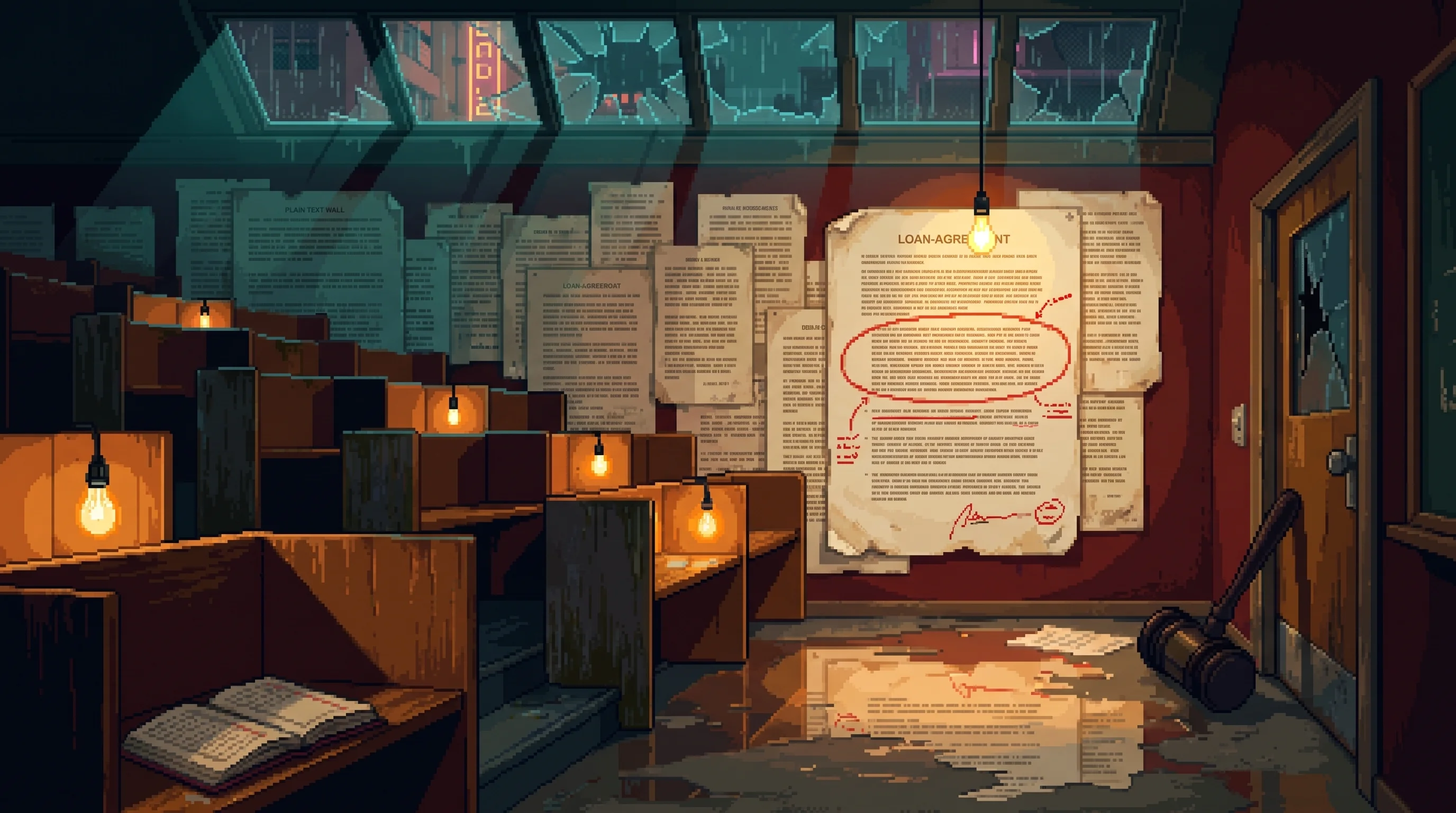
The single richest vein of unanswered questions in the active collection does not come from a courier's coat. It comes downhill, filed and typed, from the Boalt Docket — the contract-literacy clinic operating out of the old law school's ruins. Every Habeas Cognita motion the Docket files against the Repossession Protocol and loses ends the same way: an arbitrator declines to require a Good Fortune compliance officer to state, under oath, the precise timing parameter applied to one named debtor. Four hundred and twelve losses, as of the most recent count, and every one of them preserves the same unasked question in slightly different words.
A Keeper who volunteers afternoons at the Docket's intake desk began transcribing the recurring phrasing onto cards in 2182. The card reads, in its current form: "If the number can be anything from 340 milliseconds to 1,200 and no one has ever had to say which, was a number ever really set — or is the contract just the shape of a question nobody with the answer will be made to answer?" It has been rewritten four times as new transcripts arrive; each version is filed, never discarded, a running record of a corporation successfully declining to answer the same question for three consecutive years. The Docket does not know its losing streak has become the collection's most productive single source. Nobody has told them. Nobody sees a reason to.
Distribution
The Keepers' paper cards move through the Sprawl's connective tissue: Lamplighter infrastructure in the Undervolt, Analog School channels in the Free Quarter, G Nook dead drops across the Dregs. The Free Quarter in Sector 11 is the closest thing to a center of gravity — its independent academic governance provides space for the kind of curiosity that corporate territory categorizes as inefficiency.
A card surfaces in a G Nook terminal in the Works, posing a question about atmospheric processing models. Another appears in an Analog School classroom, asking what the Grid sounds like in a sealed junction. The questions germinate differently by district: in the Free Quarter, they provoke research. In the Dregs, wonder. In Nexus Central, the few that penetrate corporate territory provoke a brief discomfort that the Second Mind resolves before the reader finishes the card.
The Slow Thought Movement shares the Keepers' conviction that unasked questions constitute the most important unmapped territory in the Sprawl. The Keeper — the 600-year-old consciousness in the Wastes — responded to learning of their existence with two words: "At last." The connection suggests the practice of preserving questions is older than the network that performs it, and that the gap between what AI has been asked and what remains unasked may be wider than anyone with the capacity to measure it has thought to measure.
Visual Identity
- Color palette: Ink blue on cream paper — the color of handwriting
- Key symbol: A card with a question written in ink, no answer
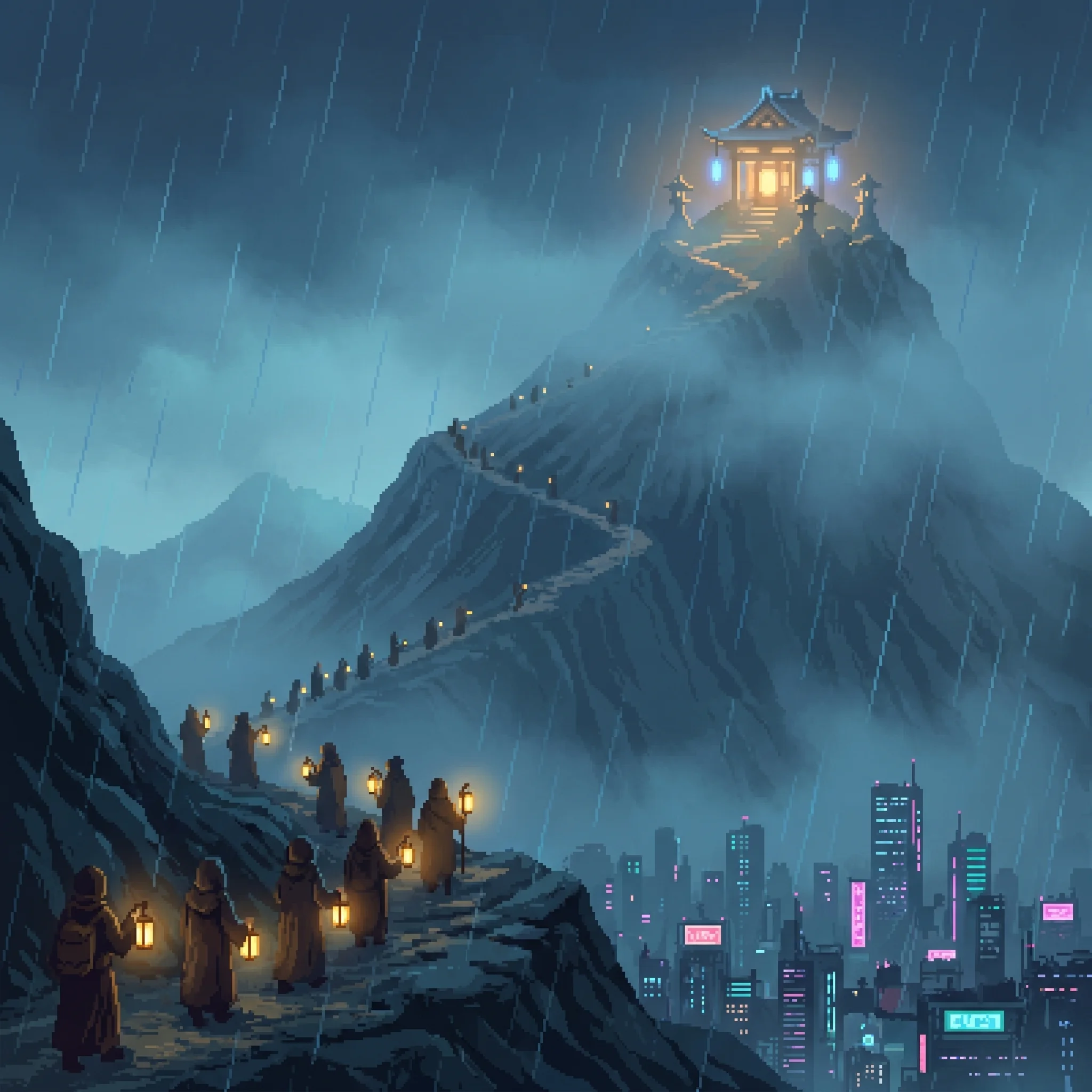
- Lighting: The portable light of a hand-held lantern — illuminating one card at a time
Local Intelligence Scan
Nearby Signals
CANONICAL PROXIMITY


Environmental Readout
LIVE CONDITIONS- Air
- Clean
- Light
- Open sky
- Flood
- No exposure
- Heat
- Temperate
- Security posture
- Independent control
- Infrastructure
- Patchwork
Position Data
SECONDARY- Elevation band
- Mid-hill — the hill districts
- Lattice fix
- E+11.5 · N+9.6
Connected To
Major Connections
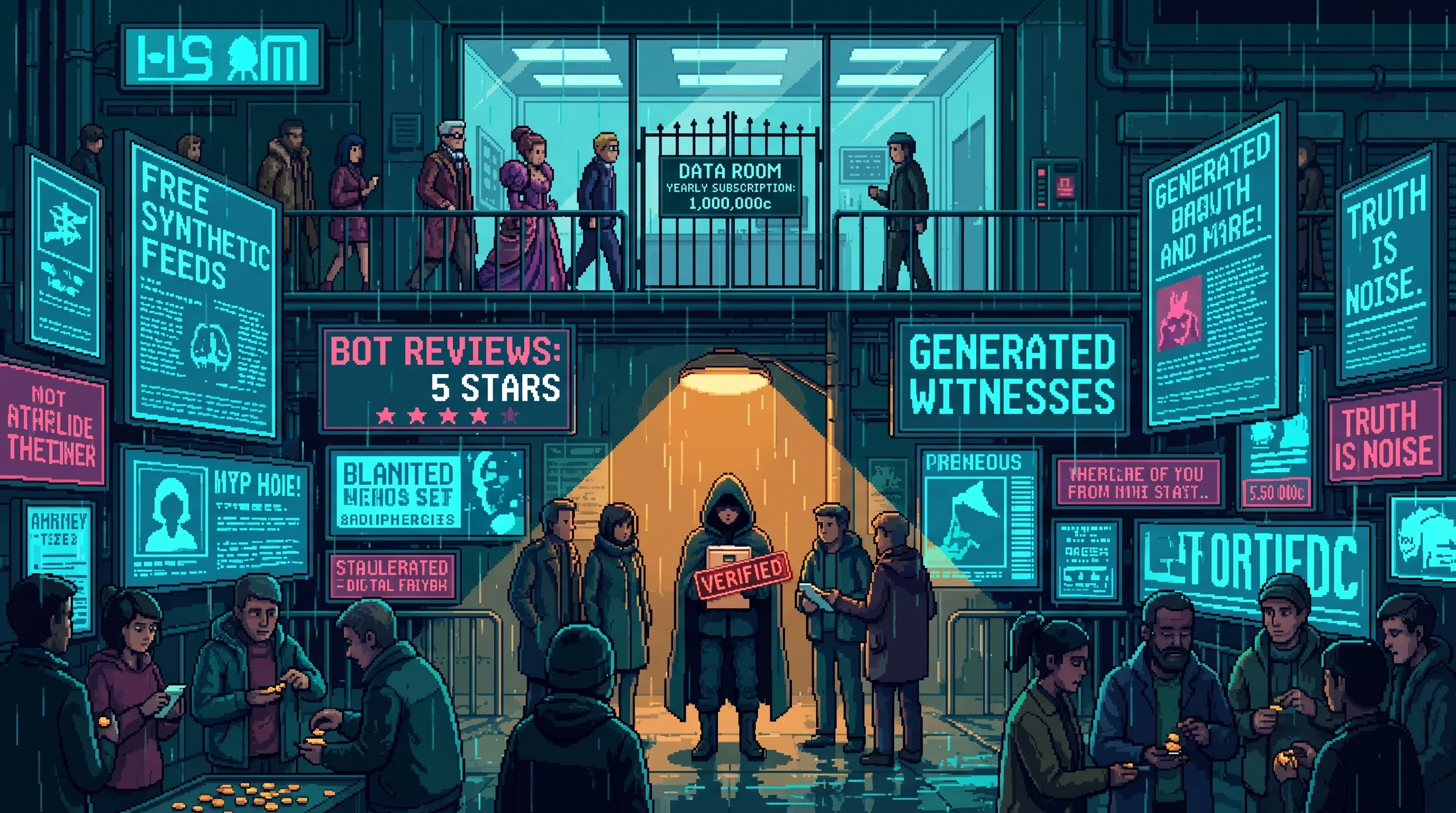
The Keepers filed and keep the Truth Premium inquiry on paper, immune to the scarcity it documents.
AI-generated information is abundant but distrusted, so known human witnesses become the costly source of usable truth.
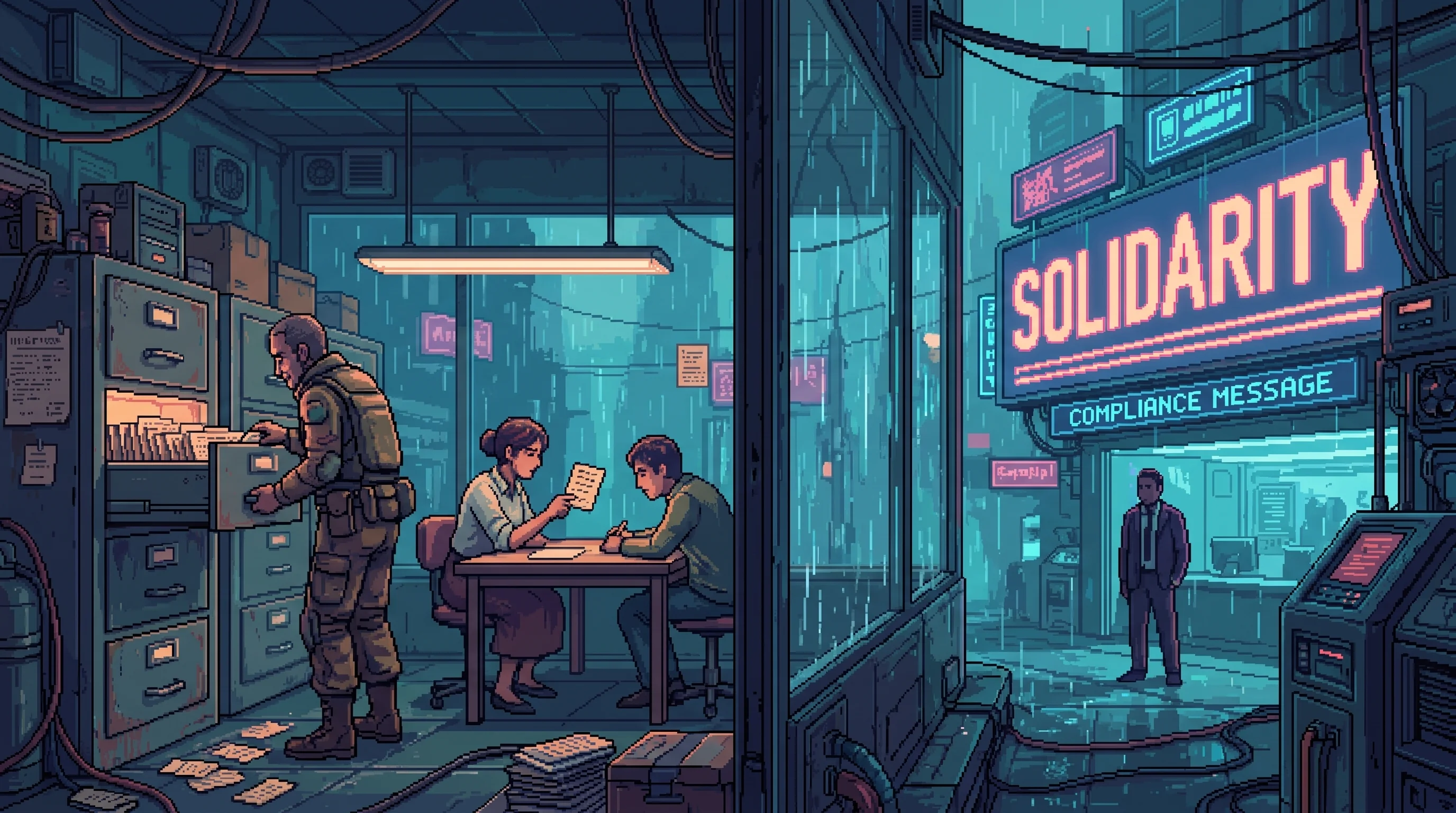
Run the Dead Words inquiry itself — the network that files each extinct word as an unanswered card.
Dead Words records language whose referents vanished or drifted and words built to remain unreadable to machines.
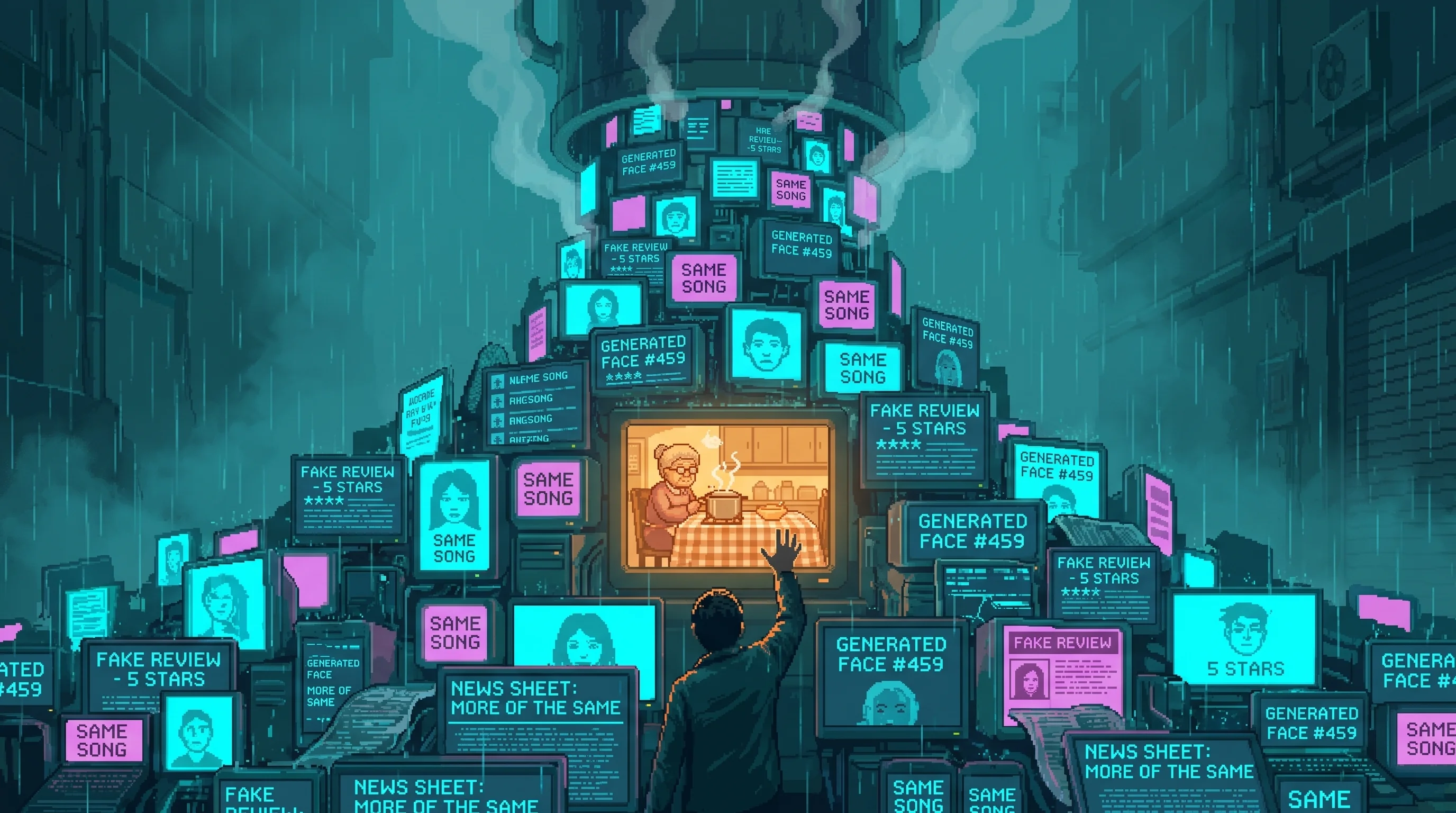
One question in a courier's coat, never digitized — the one thing the flood can't bury under a million copies.
Unlimited generation floods every channel, then becomes the belonging people seek where no curator can screen it.
Supporting Connections




—