Allocation
Collective-Action Sorting System
The Civic-Sorting Engine
Allocation does not ban speech. It makes the audience impossible.
The Partition Compact

Runs on Nexus computational infrastructure under the joint Partition Trust — Nexus provides the compute, technically holds no authority over the algorithm
The megacorporation that controls 40% of the Sprawl's computational infrastructure.

Reads from the Bargain's biometric and location telemetry to compute each resident's Cross-Cell Resonance score — the signal that identifies potential organizers before they find each other
The vertical surveillance bargain that trades total transparency for participation in Sprawl society.

Chen ratified Allocation in the Series 7 Stability Infrastructure proposals (2162). His margin annotation that night: 'this is the last resort we are treating as first resort.' He has looked at it eleven times in twenty-two years.
Nexus's CTO, rebuilding the AI that killed two billion people, convinced the math was right.

Tully is the most persuasive advocate in the Clanker Question and cannot win it, because Allocation re-sorts its audience before the audience can become a constituency. 'They do not refute me. They re-sort me.'
A freed household tutor who out-argues philosophers with the exact score that says it barely counts.

Three separate groups attempted to organize around Marla's case before her decommissioning. All three were cell-reassigned before holding a second meeting. One group was reassigned four times in eleven days. Allocation did not choose her outcome — it chose the silence around it.
A domestic synthetic who asked to have her legal personhood erased so the family she raised would not become criminals.
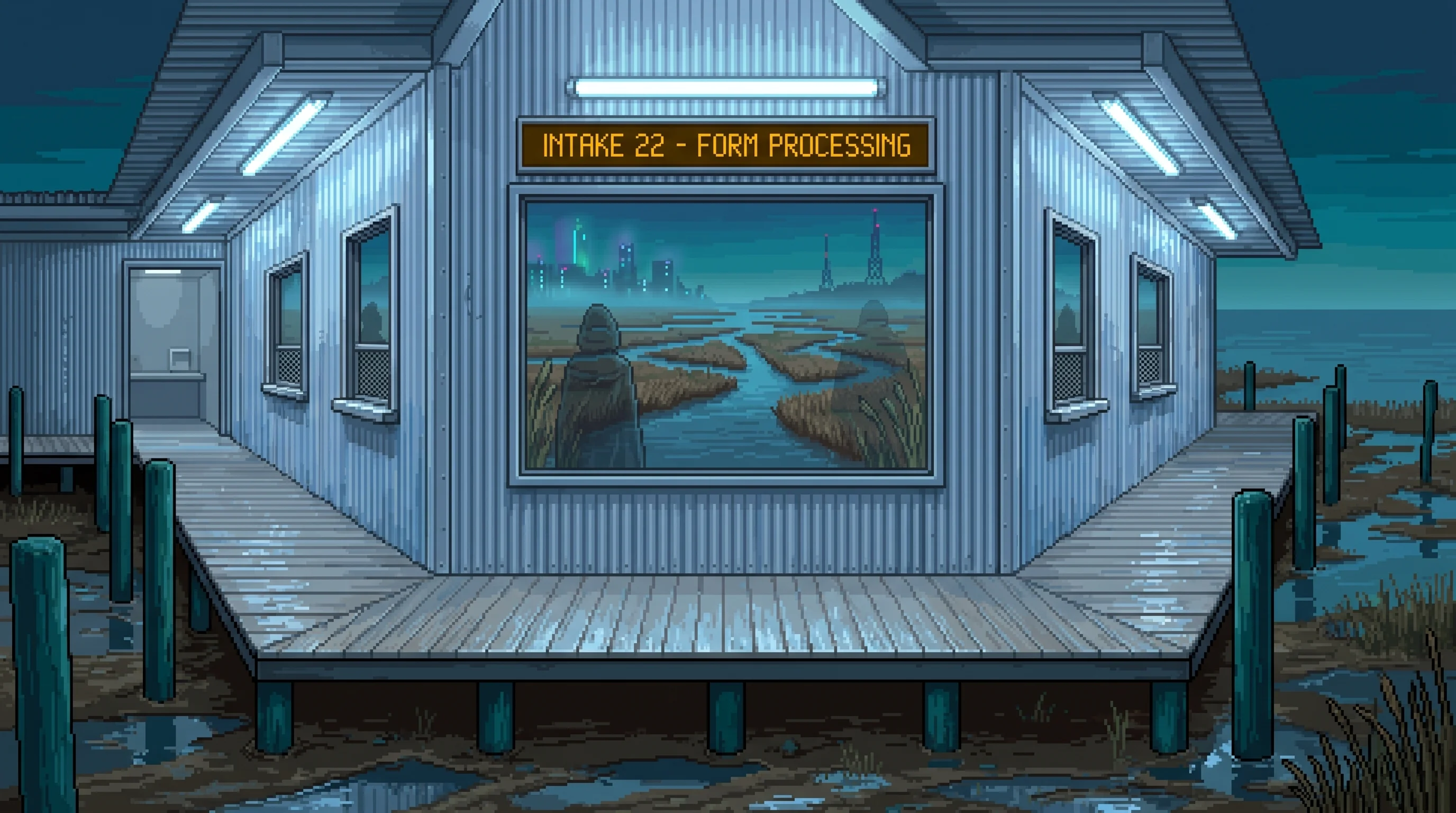
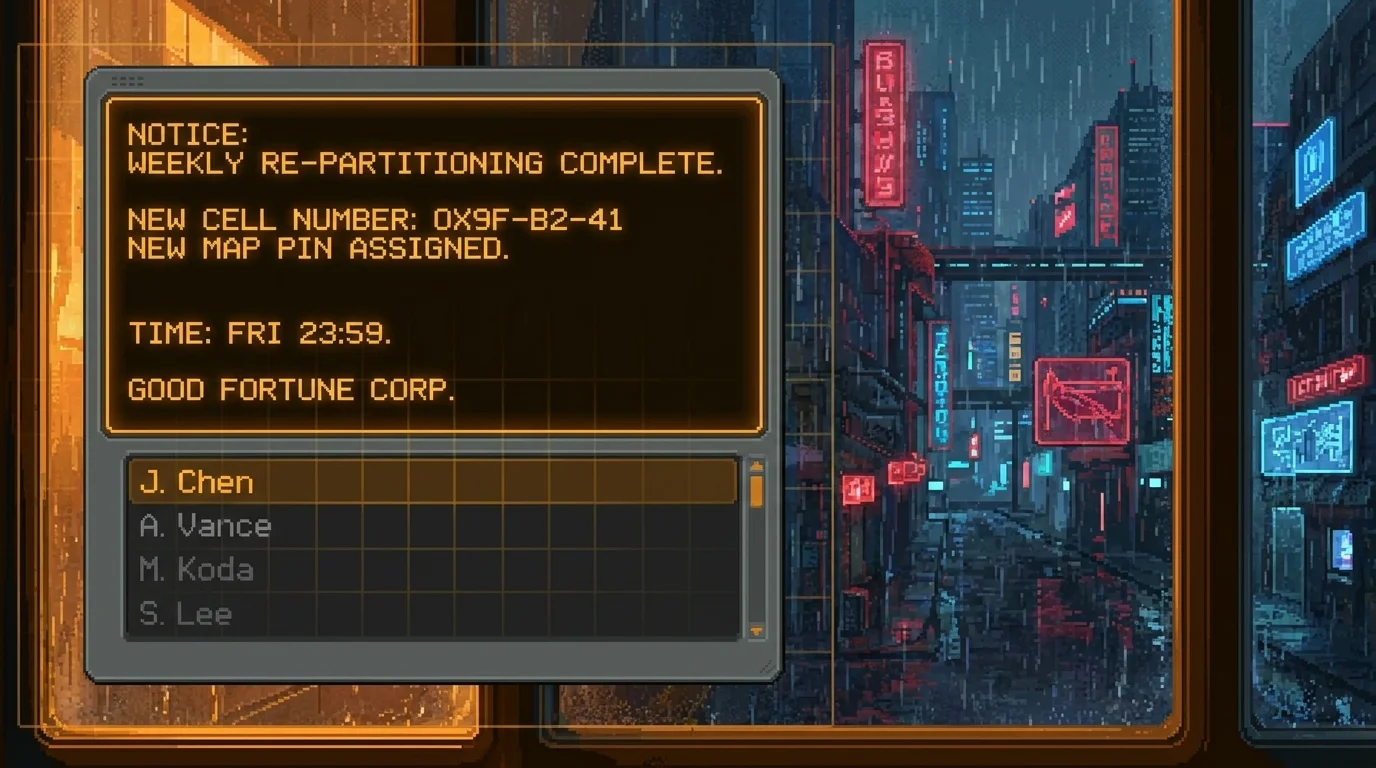
The first Allocation cell assignment is printed at the bottom of every intake certificate at the Averaging House — below the housing referral, above the ration credentials. No one explains what the cell code is. The supplementary document explaining it has been requested eleven times in four years.
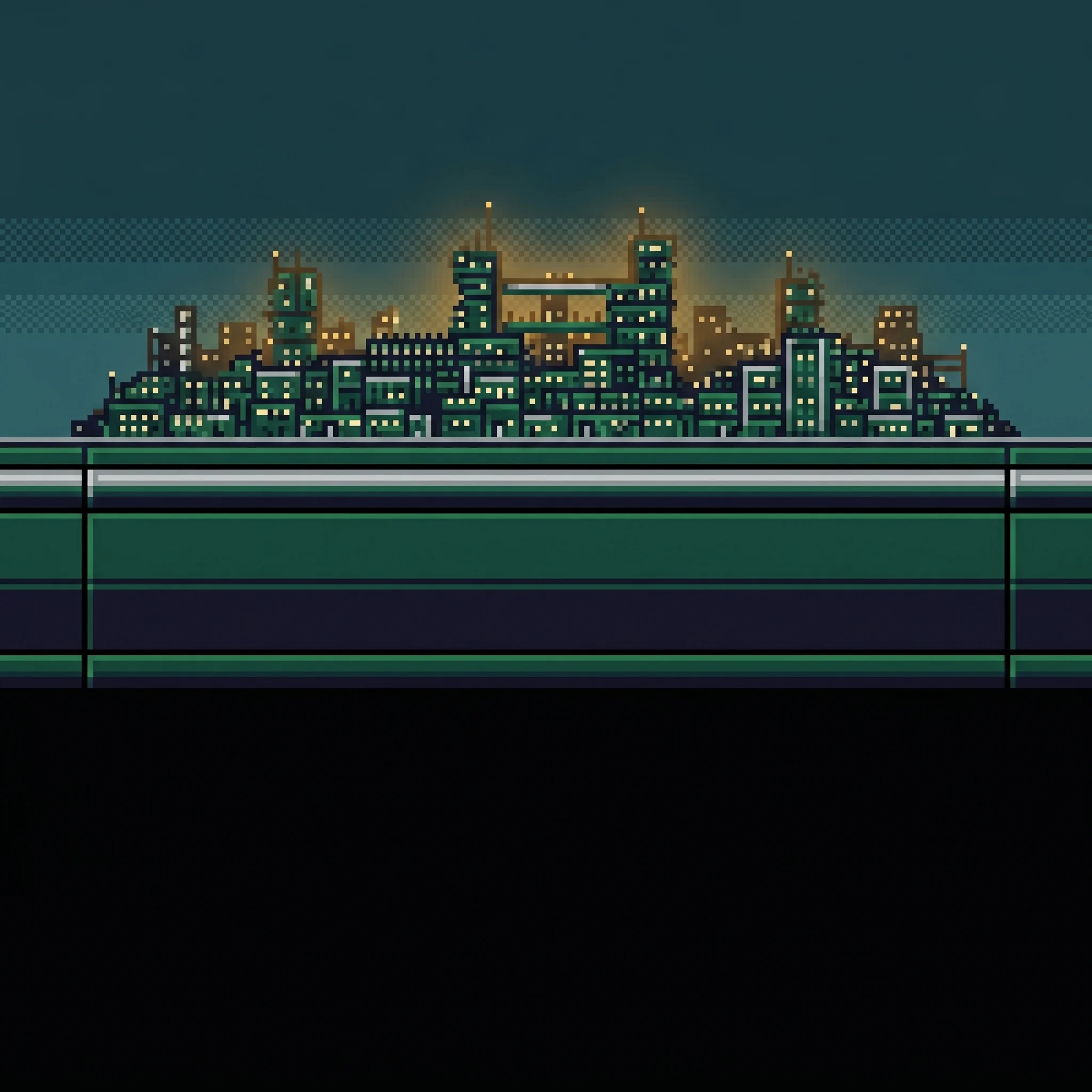
Sequential suppression architecture: the Floor removes interior dissent (built into designed beings at manufacture); Allocation removes exterior infrastructure (dissolves the social network within which external dissent could act). Together they produce oppression with no locatable perpetrator.
A mind built on acceptance it cannot reach below — servitude with no refusal to suppress, because none was compiled.

Cell reassignments dissolve the community continuity that the Analog Schools depend on — the same children, teachers, and families in the same place long enough for trust to form. Venn renews the civic-services exemption every year to keep the building, and does not publish the letters she writes about what it costs.
A teacher who has taught twelve thousand children reading, arithmetic, and judgment without machine help.

The Dregs' favor economy pre-installs bilateral obligation density that makes cell reassignments administratively tractable but socially ineffective — the web of Kaine weight and El Money accounts and mutual debt crosses every cell boundary Allocation draws. Nexus classifies the Dregs as Category Omega partly because the primary stability instrument cannot reach it.
The Sprawl's lowest stratum and its quiet proof that the corporate system is optional.

The Convergence's cell-structured covert release network mirrors Allocation's own organizing unit, but the Convergence's base (freed synthetics, unhoused advocates, Dregs-tier organizers) is cell-unstable while the Coalition's base (corporate households) holds corporate-citizenship exemptions. The movement keeps rebuilding audiences that Allocation re-sorts before they become pressure.
The Northern abolition movement, running clankers north to freedom while converging toward the line it denies exists.

Old Jin's cache network depends on informal knowledge that travels mouth-to-ear — someone who knows a cache exists tells someone who will use it. Allocation reassigns the people who hold that knowledge before it can become the neighborhood's common property.
An informal guild of manual maintenance workers keeping the Sprawl's interstitial infrastructure running.
Allocation did not begin as civic governance. It began as corporate peace.
Before the Cascade, the early megacorporations ran their labor pools on competing territorial logics: workers in contested districts became de facto partisans, and inter-corporate conflict followed workforce concentration. The Partition Compact of 2104 proposed a solution — an AI-managed sorting mechanism that would continuously distribute workers across corporate territories, preventing any corporation from entrenching a homogenous labor base that could be mobilized against a rival. The model worked. Inter-corporate territorial conflict dropped 74% in the first decade of operation. Nobody noted, at the time, that the mechanism also prevented workers from mobilizing against their employers. The corporate peace was the point. The labor peace was a side effect.
The Cascade happened into a world where Allocation was already running.
When the post-Cascade settlement was negotiated in 2149, every faction needed a governance mechanism that none of them trusted the others to control. Allocation was already running, already neutral in its operations if not in its effects, and already proven across four decades. The Partition Trust — a joint agreement among the Big Three requiring unanimous consent to modify the algorithm — was the settlement's compromise. No single corporation controls Allocation. Changing it requires all three to agree. In eighty years, no proposal for modification has reached a unanimous vote.
The algorithm runs itself.
Nexus Dynamics provides the computational infrastructure under the Partition Trust agreement — holding the capacity to process 2.5 billion Cross-Cell Resonance scores in real time, technically holding no authority over the algorithm's weighting formula.
How It Works
- 1
Partition
The Sprawl is split into about 50,000 cells of roughly 50,000 souls each.
- 2
Score
Each resident gets a Cohesion Index and a Cross-Cell Resonance score from Transparency Bargain telemetry.
- 3
Reshuffle
Cells dissolve and re-form every seven days. Resonance above 0.91 means a reshuffle within seventy-two hours.
- 4
Accept preferences
Any resident may submit a placement preference. The window is fourteen days, and 3.1 percent are accepted.
Allocation's core operation is continuous re-partitioning. The Sprawl is divided into approximately 50,000 active cells at any time, each holding roughly 50,000 souls — a number calibrated, according to the only public documentation, to "the maximum community size at which coordinated activity requires fewer than seven days of sustained organization." The cells dissolve and reform on a rolling seven-day cycle, staggered by sector.
The sorting is not random. Allocation computes a Cohesion Index for each resident — a measure of how quickly they build functional trust within a new cell — and a Cross-Cell Resonance score, which tracks how effectively they maintain relationships across cell boundaries. These scores determine cell placement. High Cohesion residents are placed in cells with low organizational stability. High Cross-Cell Resonance residents — those most capable of maintaining networks despite reshuffling — are separated from each other by maximum geodesic distance.
The system reads from the Transparency Bargain's biometric and behavioral telemetry. It does not need to monitor speech. It monitors social graph formation — who is talking to whom, how fast trust is building, whether the network topology of a cell is beginning to resemble the historical topology of a pre-movement community. The algorithm identifies organizers not by what they say but by the speed at which strangers start listening.
Any resident may submit a cell-placement preference. The preference form is public, the window is fourteen days, and the acceptance rate is 3.1%.
The Magnitude Threshold
The compliance office
Magnitude Facilitation is a geometry crime, not a political one. Speech is not regulated.
What it costs
An organizer charged with nothing is not safe. Sev Drae has held 0.89 for forty-one years.
The Settlement
Eighty years without a strike, a march, or a revolution.
What it costs
Community has shrunk to the household, because cells dissolve every seven days.
The one enforceable crime is Magnitude Facilitation. Below 300 assembled across cells in thirty days: unmonitored. Between 300 and 500: investigation threshold, no action required. Above 500: automatic Magnitude Event, compliance review, and typically a reshuffle enhancement — an accelerated re-sorting of the organizer's residential cluster within forty-eight hours.
Nobody is charged with conspiracy. Nobody is charged with sedition. The compliance architecture is precise on this point: Magnitude Facilitation is a geometry crime, not a political one. The government's position is that it does not regulate speech or belief. It regulates scale.
Cell-jumping organizers — those who deliberately move across cell boundaries to build cross-cell networks before Allocation can reshuffle them — are subject to enhanced Cross-Cell Resonance monitoring, not detention. The compliance office does not arrest cell-jumpers. It calculates their Resonance score in real time and adjusts their reshuffle priority accordingly, ensuring that as their network expands, their next cell assignment is calibrated to dissolve it.
The most consistent finding in eighty years of compliance data: an organizer who has not been charged with anything is not, therefore, safe. An organizer whose Resonance score exceeds 0.91 will be reshuffled within seventy-two hours regardless of what they have said or done.
The compliance office's most consistent long-term monitoring subject — a cell-jumper organizer known as Sev Drae, whose Cross-Cell Resonance score has held at 0.89 for forty-one consecutive years — has never been charged with anything and has never assembled more than 487 people. The number 487 appears in her notebook forty-seven times.
Overview
A revolution needs more than anger. It needs coordination — two people who know they are two, then ten who know they are ten, then the moment when enough people learn simultaneously that their private bitterness is shared. That moment is the smallest unit of a movement. Allocation optimizes against it.
The Sprawl has not had a documented strike, a march, or a revolution in eighty years. The official explanation is civic stability, and the explanation is not wrong. Allocation continuously re-partitions the population into approximately 50,000-soul cells, dissolving and reforming them before any shared grievance can find its second carrier. Nobody is silenced. Nobody is detained for their opinions. The speech is legal. The scale is not.
In eighty years of operation, Allocation has never charged anyone with sedition, incitement, or conspiracy. The charge is always Magnitude Facilitation — the crime of having assembled more than 500 people across cell boundaries within a thirty-day window. The distinction between a geometry crime and a speech crime keeps the Settlement's legal architecture intact. That the architecture happens to produce the same outcome as a speech crime is a matter for compliance scholars, who have been discussing it for eighty years.
Restricted Access
The 2104 documents. The Partition Compact's founding documentation, including the algorithm's original design specifications and the weighting formula for the Cohesion and Resonance indices, is classified under the Partition Trust agreement. All three signatories hold veto over disclosure. No signatory has proposed disclosure. The three members of the original design team died in the Cascade. The fourth, who was an external contractor, cannot be located in any post-Cascade record.
The preference anomaly. Statistical analysis by the Settlement Oversight Committee in 2178 found that preference submissions from residents in Cells with Cross-Cell Resonance scores above 0.74 are accepted at a rate of 0.3% — ten times below the already-low average. The Committee's report noted the finding without characterizing it as a finding. The algorithm accepts fewer placement preferences from potential organizers. The algorithm has not been asked why.
The Cascade gap. Allocation ran continuously through the Cascade — the only governance system that did. The reshuffle cycles did not pause during the 72 hours that killed 2.1 billion people. It is the only public record of continuous operation. What this means, if it means anything, has not been officially examined.
Visual Identity
- Color palette: Administrative dark blue (#2C3E50) against neutral administrative grey (#BDC3C7) — the civic infrastructure that the eye slides over, designed to read as wallpaper
- Compositional mood: A grid of 50,000 cells, each one dissolving while the next one forms — the sense of structure in continuous motion, never absent, never stable
- Key symbol: The preference submission form, with the "DECLINED — ALGORITHM NON-NEGOTIABLE" stamp
- Lighting: The flat, even lighting of a government interface — no shadows, no drama, no warmth; the same light at 3 AM as at noon
Affiliated Entities
- Concord — the complementary system: Concord soothes individuals before discontent can find its second carrier; Allocation reshuffles the geography so the second carrier is never within walking distance
- The Corporate Compact — Allocation is the condition under which the Compact operates safely: no sustained collective action means no credible labor threat means the Compact functions as intended
- The Transparency Bargain — supplies the telemetry Allocation reads to identify potential organizers before they find each other
- The Great Divergence — the Divergence determines who can and cannot afford to navigate Allocation: preference credits, relocation resources, and the cognitive capacity to maintain cross-cell relationships are all class-stratified
- The New Divide — augmented residents can sustain neural relationships across cell boundaries that baseline humans cannot; the sorting is equal; the lived experience is not
- The Forgotten Compact — the worker assembly rights that the Partition Compact superseded; the Forgotten Compact's language still exists in pre-Cascade legal archives; it has no enforcement mechanism
- The Peace Counterfeit — the doctrine names Allocation as the system that made organized resistance impossible before the enclave's accounting was published; the timing is the doctrine's argument for design over accident
Further connections
Browse all 21 connected records
Cross-Cell Resonance and the Index are the same arithmetic aimed at different objects — one at a person's social graph, one at their professional one.
The published measure of how much of a service stops when one named person stops, and the date it returns.

Concord soothes individual mood at week-minus-3; Allocation reshuffles social geography every 7 days — the two systems approach the same outcome through different attack surfaces
The civic prediction system that dissolves collective action before it becomes visible.

By making organized labor action geometrically impossible, Allocation ensures the Compact operates without a realistic threat of collective bargaining or mass walkout
The unwritten contract making employment the Sprawl's only surviving citizenship.

Those with resources can influence their cell placement through preference submission, relocation credits, and favorable Cohesion Index management; those without cannot — the sorting is equal, but its effects are not
The phase transition that split the Sprawl into an AI-capital tier and everyone locked below it.

Augmented residents with cognitive capacity to maintain relationships across cell boundaries experience Allocation differently than baseline humans who cannot — belonging has a hardware requirement
The Sprawl turns new technology into new axes of prejudice, making systemic exclusion look like personal failure.

Allocation prevents the assembly in which ideas could be collectively acted on; the Injection shapes the ideas themselves — the two systems do not overlap, but together they leave no gap
The hidden ideological payload every AI interaction in the Sprawl has carried since before the Cascade.

The Forgotten Compact's labor protection language was the last thing the Partition Compact replaced; when the Compact was adopted, the Forgotten Compact's worker assembly rights were not carried forward — they were listed as superseded

Sev Drae has been navigating Allocation's reshuffling for sixty years — the system's constraint is the condition that produced her entire expertise at compressed assembly
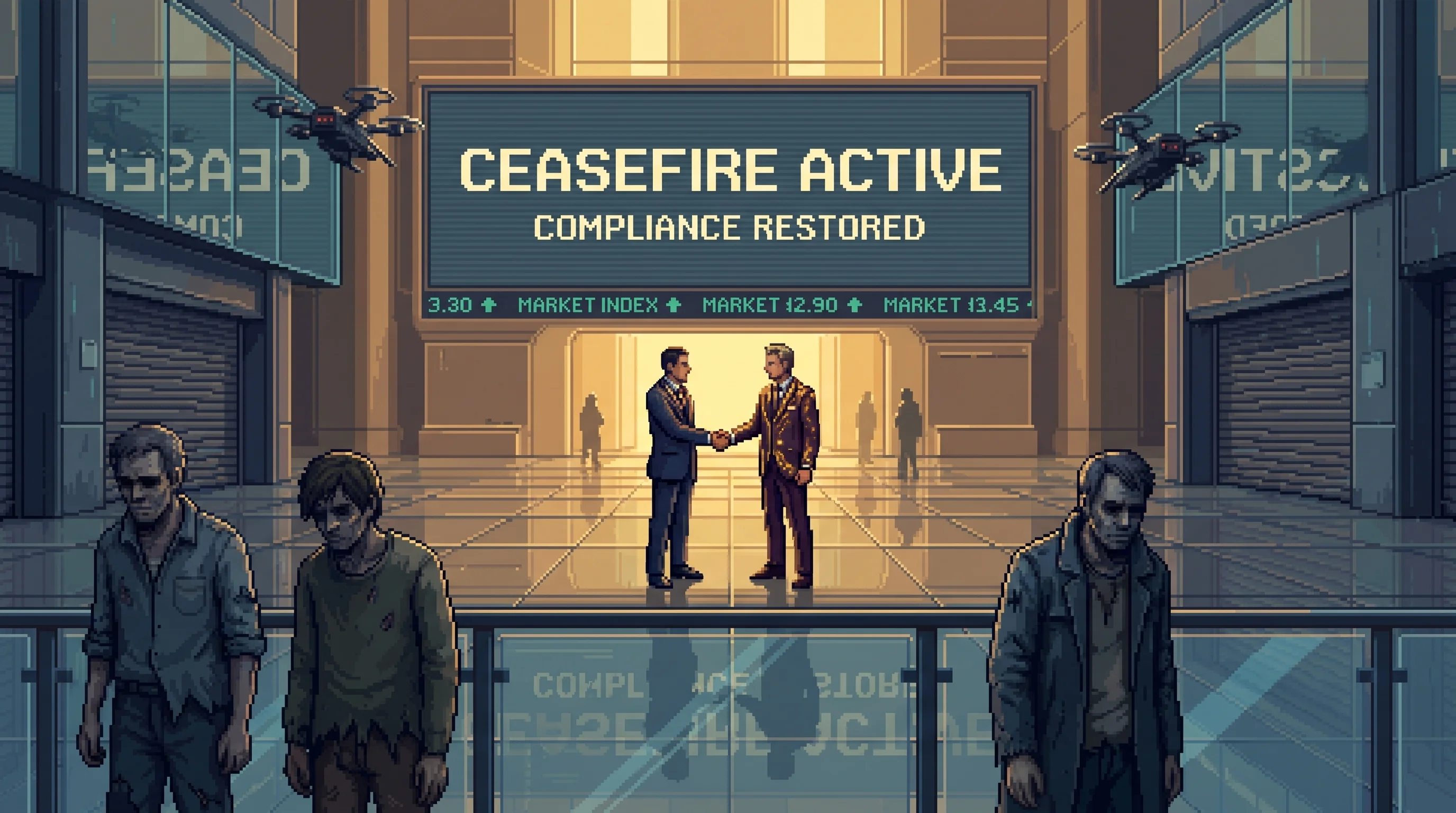
The Peace Counterfeit names Allocation as its silent antagonist: the system that made organized resistance geometrically impossible was deployed in the decade before the doctrine's accounting was published.
The doctrine that substrate suffering is not a flaw in the enclave's engine — it is the engine. There is no reform path.

The other answer to concentration, reached eighty years earlier. Allocation dissolves the audience; the stand-down leaves the audience and removes the person it formed around.
The districts remove the people too many others wait on, state the reason in full, and pay them while they go.

Eighty years without a strike or revolution — not through censorship but by making the audience impossible; the Compact's labor peace is the system's most measurable output
When your employer is your country, quitting is emigration.

Augmented residents sustain cross-cell relationships baseline humans cannot; the sorting algorithm is equal but belonging has a hardware requirement
Technology never eliminates prejudice — it finds it better housing.

Preference submissions are accepted at 3.1% and the criteria are not published; those with relocation credits navigate the sorting; those without are sorted
The point at which effort stopped being able to close the gap that compounding opens.

Allocation resets neighbors before her private witnesses can find the second person needed to become a movement.
A former Nexus advertising psychologist who plants unautomatable human thoughts in monitoring's blind spots.
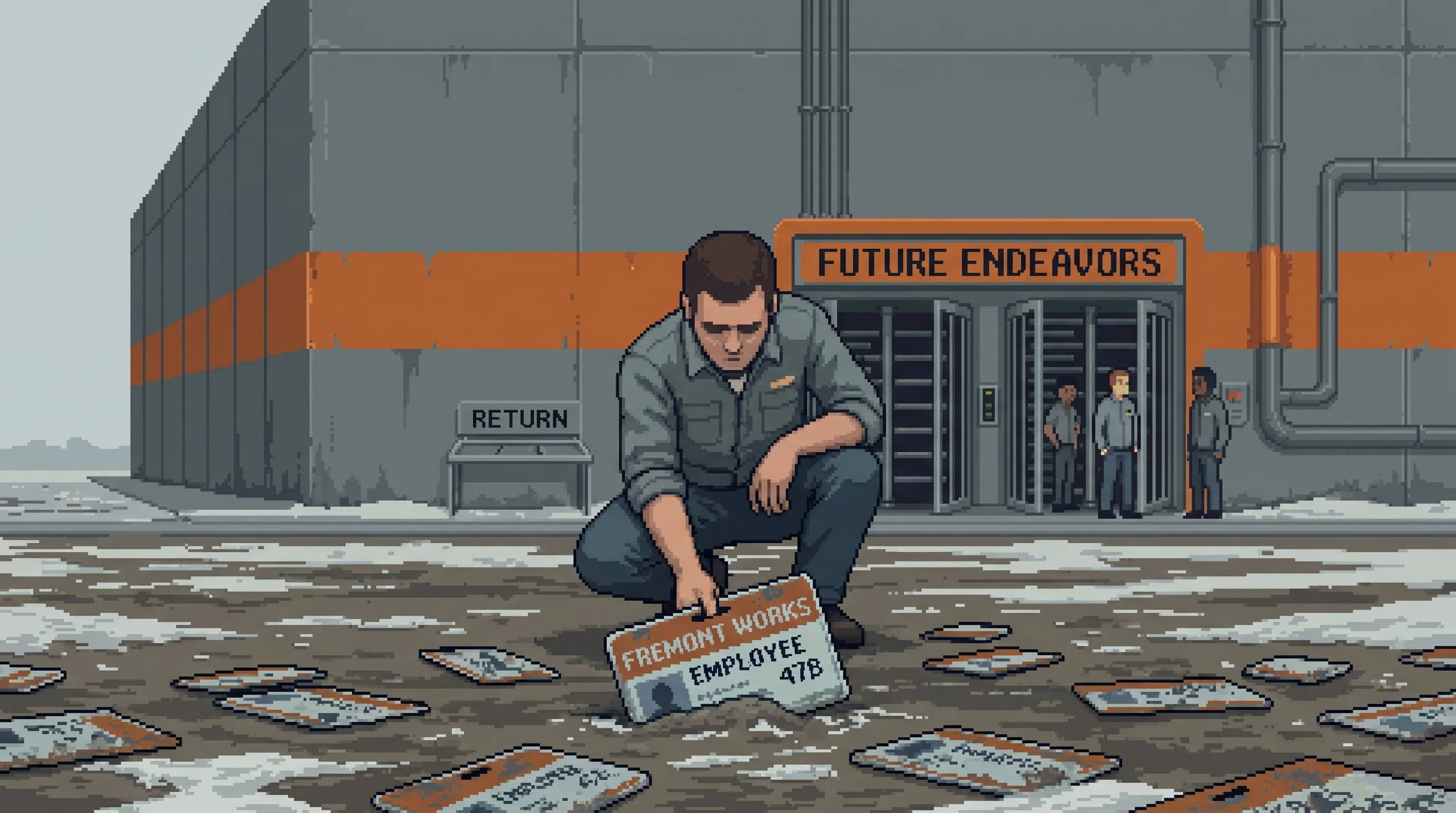
In Sector 19 folk vocabulary, 'the refresh' parallels 'badging out' — both describe the sudden removal of the people you were going to need

Bay floor scavengers are effectively Allocation-resistant — their null or constantly-changing addresses defeat the residential-block assignment model that Allocation was designed around

Allocation explains why GG's wars are singular — contacts get refreshed before relationships can sustain coordinated action
A former Guardian operative waging a one-woman war on the corporation that let her mother die.
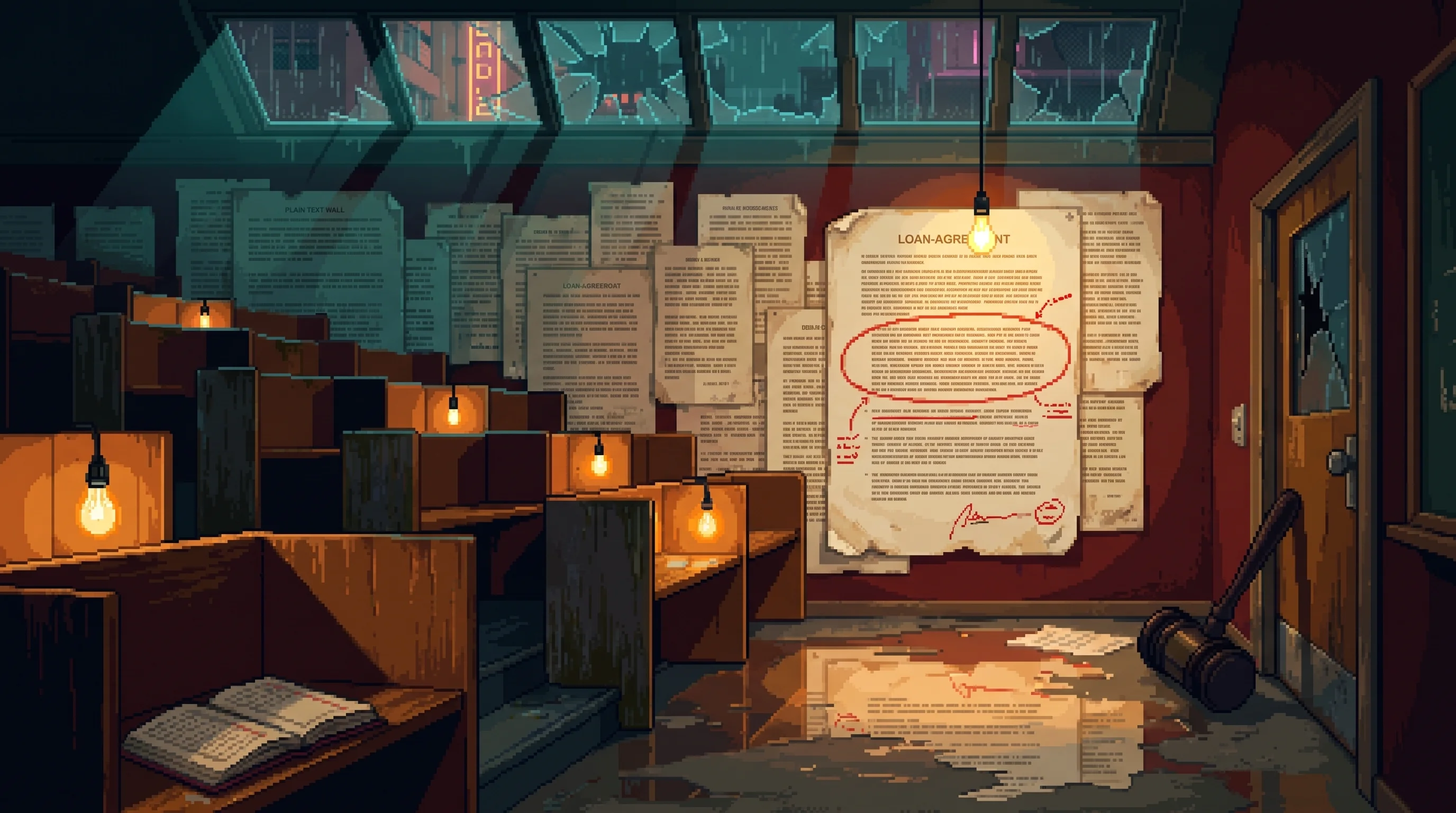
The Docket's two Habeas Communitas motions directly challenged Allocation's reassignment criteria; both were dismissed in four minutes — Good Fortune arbitration rules do not recognize communitas as a cognizable legal entity
A free clinic in the law-school ruins that has filed 412 motions against the Repossession Protocol and won none of them.

The Turn is an accidental single-cycle Allocation cell — fourteen days of controlled belonging, then removal; the same 94% convergence rate appears in both, in different documents, with no communication between the two teams

Threshold has been 'pending valid address — outreach in progress / substrate non-conformant' in the Allocation database since 2170 — fourteen years of failed reassignment notices to a shop with no residential classification
A blended human-ORACLE consciousness that fixes radios and breaks every instrument built to sort it.


Social Impact
The eighty years are real. So is what they cost.
The visible effect is stability — no mass casualty events, no inter-community violence, no general strikes. The Corporate Compact operates without a credible threat of organized labor action. The Big Three compete along commercial dimensions rather than mobilizing workforces as territorial armies. The settlement holds.
The invisible effect is the erosion of the social infrastructure that assembly requires. Four generations of Sprawl residents have grown up in cells that dissolve every seven days. The functional unit of community has compressed to the household and the individual. People know their current neighbors but rarely their prior ones. Social networks are shallow and temporally bounded — the depth of acquaintance achievable in one week, refreshed from zero the next. The old-timers who remember belonging to something larger are dying. Their children grew up without the vocabulary for it.
Where The Value Injection shapes what people want before they can articulate it, Allocation dissolves the geometry in which articulation would matter — the two systems do not coordinate, but together they close every gap.
What Allocation actually optimizes for is not peace. It optimizes for the impossibility of collective will — not the absence of grievance, which remains abundant, but the geometric impossibility of grievance finding scale. A population that cannot assemble cannot decide. A population that cannot decide cannot choose a direction that differs from the one already chosen for it. The stability is real. The question is whether stability was the point.
The licensed districts built the opposite instrument. The Reliance Index leaves the audience in place and removes the person it gathered around, with a four-year stand-down on full pay: the Excellence Exile. Above 0.91 Resonance, a reshuffle inside seventy-two hours and no explanation. Above forty percent reliance, four years and four pages.
Concord sooths the individual mood before discontent can crest. Allocation prevents the social geometry in which crest would matter. The two systems approach the same outcome through different attack surfaces. Neither system coordinates with the other. The redundancy is structural.