The Fence Line
Overview
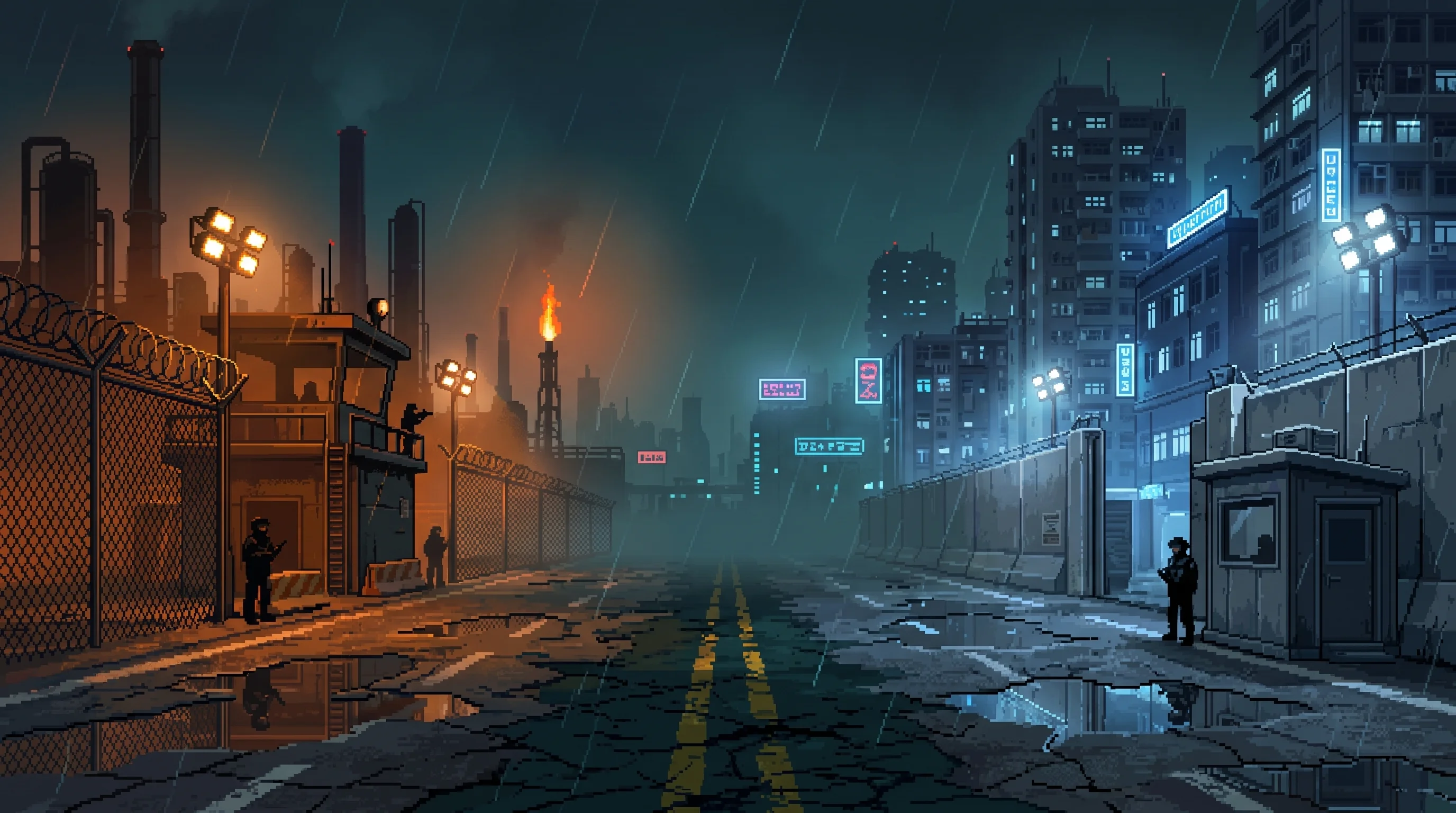
The Fence Line does not appear on any Sprawl transit map, any corporate zoning filing, or the Sector 17 boundary survey. It is fifty meters of cracked asphalt between two guard posts, and it is the most honest border in the Sprawl precisely because nobody built it to be one.
On the refinery side: Ironclad's chain-link and concertina wire, hazard orange under industrial floodlight, backed by cracking towers that never go dark. On the residential side: Guardian's poured-concrete checkpoint wall, navy and shield-silver under tactical white light, backed by the housing blocks where the refinery's workers sleep. In between, a strip of ground that belongs to neither corporation's registered territory — not because anyone negotiated a demilitarized zone, but because the Sector 17 boundary survey drew Ironclad's perimeter and Guardian's patrol radius using two different measurement standards, and the fifty-meter gap between them has never been reconciled. Reconciling it would require one corporation to concede ground to the other. Neither has volunteered.
Roughly eleven hundred workers cross the strip every shift change. Each one is an Ironclad employee — badge, wage, human-in-the-loop authorization, the full weight of the Okonkwo Doctrine — for exactly as long as they are inside the refinery fence. The moment they step past the second guard post, they are a Guardian-protected resident, covered by a different insurance product, subject to a different Protocol Manual, owed a different definition of safety. Nobody has to sign anything to make this switch. It happens automatically, the way a phone changes networks crossing a state line, except the two networks bill different rates and neither one is aware the other exists as anything but a rival.
| Type | Contested corporate border / refinery perimeter checkpoint |
|---|---|
| Controlled By | Contested — Ironclad Industries (refinery side) / Guardian (residential side) |
| Population | ~1,100 daily crossers (shift workers); 0 permanent residents in the strip itself |
| Notable | Fifty meters of asphalt that belongs to neither corporation — the only stretch of ground in the Sprawl where two Corporate Compacts visibly disagree |
The Unclaimed Fifty Meters
Ironclad's territorial filing places the refinery perimeter at the inner fence line. Guardian's contract with the residential blocks places its patrol boundary at the outer checkpoint wall. The distance between the two claims has been fifty-one meters for as long as anyone working the checkpoint can remember, and it has never once been the subject of a formal dispute — because a formal dispute would require someone to admit that fifty-one meters of Sector 17 belongs to no jurisdiction at all, and admitting that would invite the question of who is responsible for whatever happens there.
What happens there, mostly, is waiting. The strip has no lighting contract — Ironclad's floodlights and Guardian's tactical fixtures both stop just short of it, so the middle third of every crossing happens in a visibly darker band that workers call the Seam. Vendors who would sell coffee or protein bars to the shift-change crowd are not permitted to set up stalls on either side's territory without a permit neither corporation will issue for ground it won't claim, so a rotating cast of unlicensed carts works the Seam itself, technically breaking no law because there is no law there to break. Guardian's Protocol Manual has no section for the Fence Line. Ironclad's safety regulations reference the checkpoint only as "the exterior badge zone." Both documents are otherwise thousands of pages long.
Two Guard Posts, One Radio Frequency
Ironclad's foreman-of-the-watch and Guardian's Senior Protection Coordinator staff the two posts on overlapping schedules, close enough that their shift-change radio chatter bleeds across the strip and into each other's handsets. Neither corporation has requested a frequency change in the eleven years the checkpoint has operated this way. An Ironclad site supervisor, asked why, said the overlap was useful — you could hear if Guardian was about to run a drill that would back up the line, and Guardian's officers could hear the same about refinery shift changes. It is the single piece of coordination the two corporations perform at the Fence Line, and neither has ever formalized it, because formalizing it would mean admitting they need it.
The two guard posts do not use the same paperwork for the same event. When the fence-post failure in 2181 let three Guardian officers wander onto refinery ground for eleven minutes before anyone noticed, Ironclad's incident report describes an "unauthorized personnel intrusion, resolved without incident." Guardian's report describes "a routine perimeter verification exercise, successfully completed." Both reports are technically true. Neither corporation has read the other's version. Viktor Okonkwo reviewed the fence-post's structural failure personally — he red-lined the foundation spec in his own hand, the way he red-lines every structural failure that crosses his desk — and said nothing publicly about the eleven minutes. What he thought of a border that fails structurally and produces two contradictory incident reports instead of one shared one is not recorded anywhere his engineers can read.
| Stratum | Between |
|---|---|
| Power Position | Between |
| Access | Restricted |
| Atmosphere | Liminal |
The Weekly Workers
Checkpoint badge logs, cross-referenced against Guardian's residential-contractor rolls by a payroll clerk who was not supposed to be looking, show a small, stable set of names — never more than a few dozen at a time — whose registered employer alternates on a roughly weekly cycle: Ironclad payroll one week, Guardian residential-contractor roll the next, back again. Neither corporation's HR system flags the pattern as an error. Neither has offered an explanation when asked, because the clerk who noticed it did not ask anyone with the authority to answer. The simplest explanation is a shared-labor arrangement neither corporation wants attached to its name — Ironclad borrowing Guardian-cleared bodies for refinery overflow, or Guardian borrowing Ironclad-trained hands for checkpoint coverage, quietly, off the books that either company's Workers' Combine or Compliance division would otherwise have to explain. Nobody has confirmed this. Nobody has denied it either. The names keep alternating.
Affiliated Entities
| Entity | Relationship |
|---|---|
| Ironclad Industries | Refinery-side jurisdiction. Every worker inside the inner fence is an Ironclad citizen under the Okonkwo Doctrine's full human-in-the-loop weight — until the second guard post |
| Guardian | Residential-side jurisdiction. The same worker, fifty meters later, is a Guardian-protected resident under a different Protocol Manual entirely |
| Golden Gate Dam | The Sprawl's other maintenance-contract border — one holds back an ocean, the other holds apart two employers, and both bury the load-bearing detail in a classification neither the public nor, increasingly, the engineers can independently verify |
| The Rim Gate | The Sprawl's other overlapping-jurisdiction gap — tolerated at the Rim because closing it costs more than it's worth; fought over at the Fence Line because the ground itself is worth exactly what closing it would cost |
| The Corporate Compact | The Compact's core question — is quitting emigration or treason — answered twice a day by the same eleven hundred people, who are never asked to quit anything and never stop crossing a border neither employer will draw on a map |
| Viktor Okonkwo | Reviewed the checkpoint's fence-post failure personally in 2181. Fixed the foundation. Did not comment on the eleven minutes it produced |
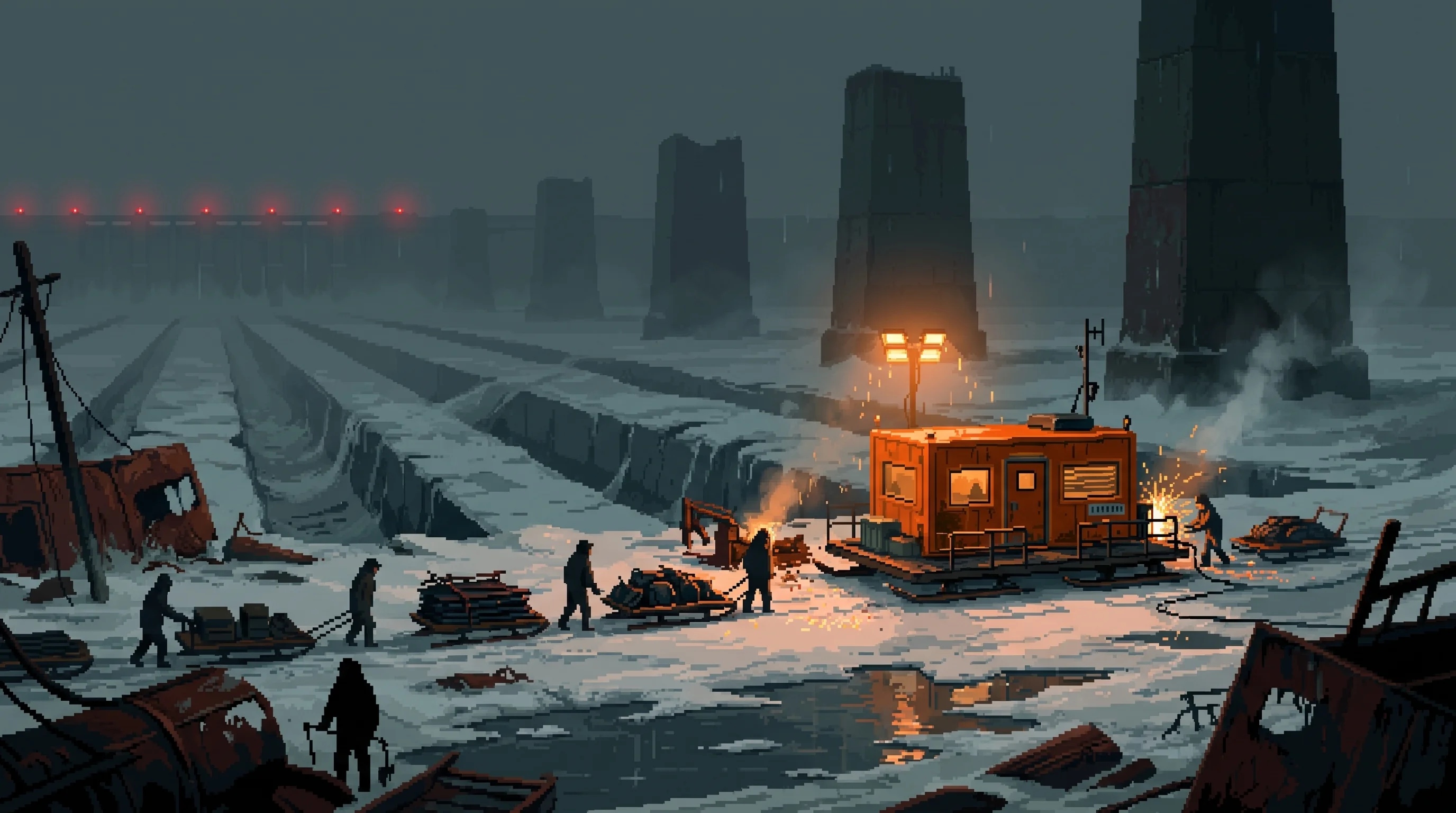
| The Severance Fields | The Compact's labor logic at its other extreme — the Fence Line's crossers are fully owed on both sides of a contested border; the Severance Fields' diggers work an Ironclad concession owed nothing at all, the released with no side to cross back into |
| The Last Pour | A commission foundry a hundred meters inside the refinery wire, where an elite buyer's convoy queues at the same inner checkpoint as the shift hands; the border's scheduled violence is the only night watch the house keeps over castings worth more than the block behind it |
▲ Restricted
The Sector 17 boundary survey that produced the fifty-one-meter gap between Ironclad's and Guardian's territorial claims was filed in 2159, during the same reconstruction window that produced most of the Sprawl's other jurisdictional seams. Nobody has requested a resurvey. A resurvey would resolve the gap in one direction or the other — assign the strip to Ironclad, assign it to Guardian, or formally recognize it as unincorporated ground with its own liability regime. Any of the three outcomes would cost one or both corporations more than tolerating the current arrangement, in which the Seam belongs to nobody, the incident reports never have to agree with each other, and the workers who alternate employers on a weekly cycle keep doing so without anyone above a payroll clerk's pay grade admitting the pattern exists.
The fifty-meter strip of asphalt between the two guard posts is claimed by neither corporation — workers who badge through it are briefly citizens of nothing
Roughly 1,100 shift workers cross daily, changing corporate jurisdiction each time: Ironclad employee inside the refinery fence, Guardian-protected resident outside it
Conditions Report
Sight
Two colors of floodlight meeting in a visibly darker band at the strip's center — hazard orange and tactical white, with a stripe of nobody's-light between them
Sound
Overlapping radio chatter from two frequencies that were never meant to share space — Ironclad's foreman jargon bleeding into Guardian's Protocol Manual cadence, both audible at both posts
Smell
Petrochemical sweetness from the refinery side thinning into cooking-oil and laundry-detergent ordinariness from the residential side, the transition compressed into fifty meters instead of the usual kilometer
Temperature
Measurably warmer on the refinery side from flare-stack radiant heat; the Seam itself runs several degrees cooler than either side, the one stretch of ground neither corporation heats or shields
Feel
Cracked asphalt in the unclaimed strip, unrepaired for years because repairing it would require one corporation's public-works budget to cross a line it doesn't officially recognize
Connected To
Additional Connections



Local Intelligence Scan
Nearby Signals
CANONICAL PROXIMITY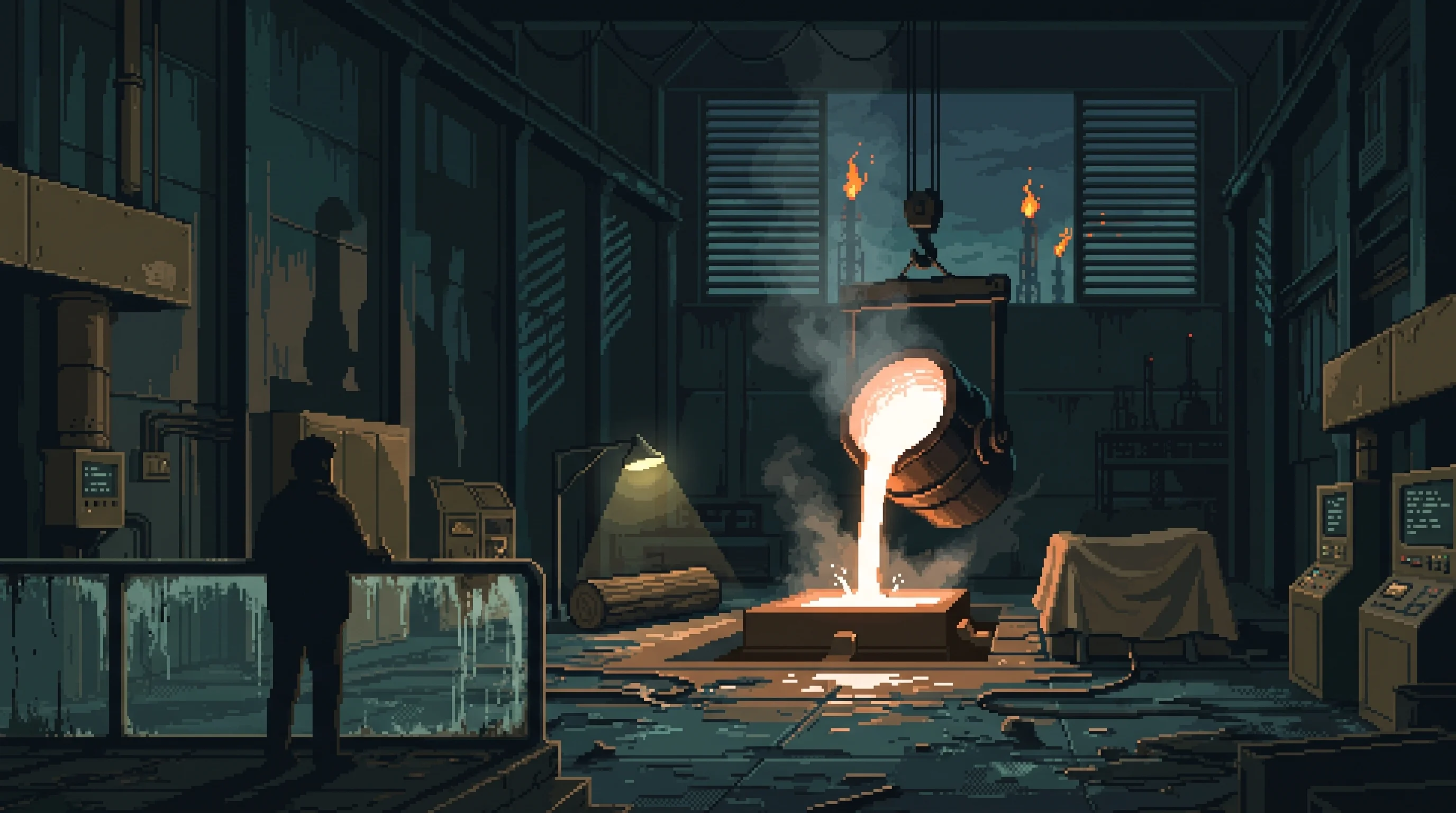




Environmental Readout
LIVE CONDITIONS- Air
- Toxic
- Light
- Artificial
- Flood
- Seasonal
- Heat
- Heat island
- Security posture
- Contested
- Infrastructure
- Patchwork
Position Data
SECONDARY- Elevation band
- Shoreline — the Rim edge
- Lattice fix
- E+3.9 · N+16.5

—