The Podcast AMOG
The Frame Merchant
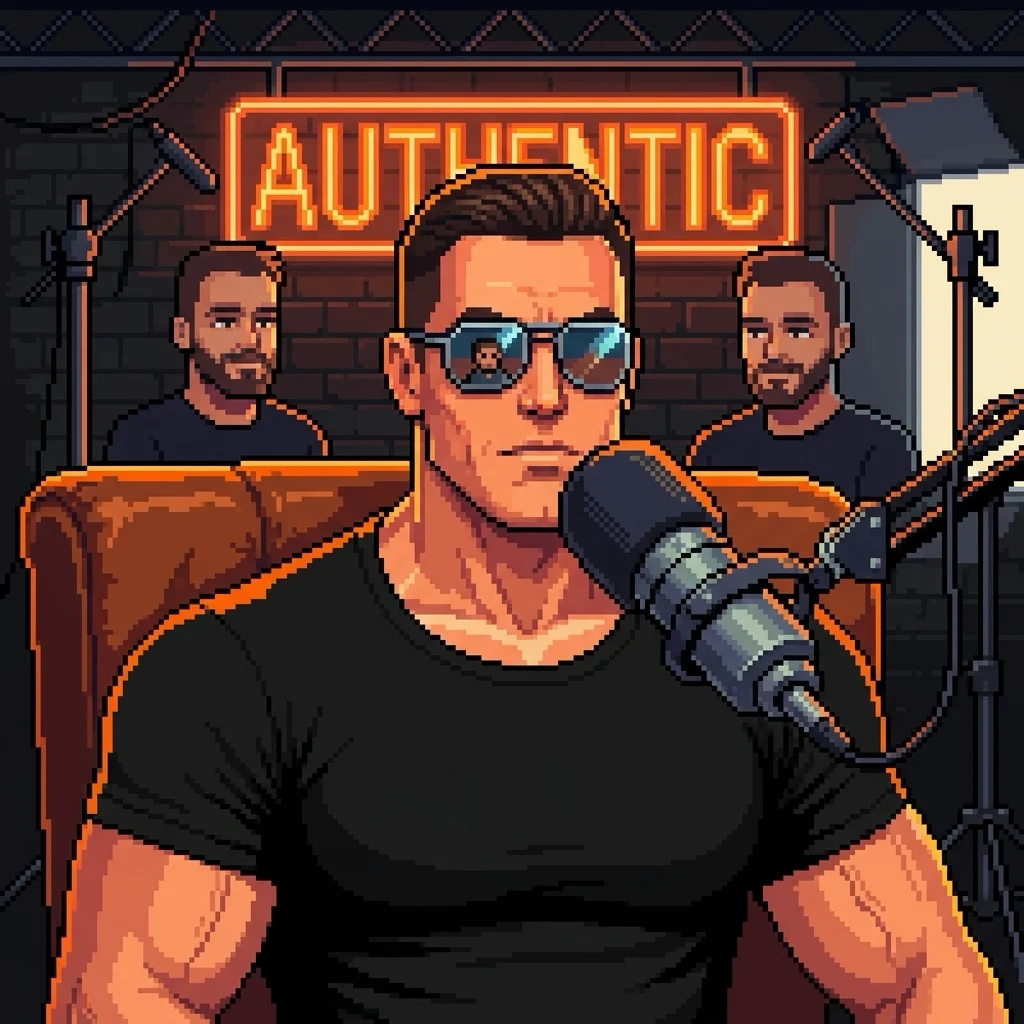
Two co-hosts sit in the dark behind the throne and nod at intervals; in years of recorded shows neither has ever spoken, and the question of whether they are employees, set dressing, or the same generated face is one the production has never answered
- Augmentation
- partial — voice-warming throat chrome and a confidence-stabilizer subdermal, both undisclosed on air
- Archetype
- manufactured-masculinity content personality
- Location
- an Ironclad-owned soundstage, The Bayfront (Sector 6)
Overview
He does not stand when you enter. Standing would mean you mattered.
Chad is the human face of Ironclad Industries' manhood marketing — the personality the corporation attaches to real men do real work in the real world so that a slogan about steel and sweat can be sold to men who have never poured a footing. Ironclad makes the girders the Sprawl stands on. Chad makes the feeling that comes free with them: that you are not soft, that your problems are a frame problem, that certainty can be performed until it becomes load-bearing. The corporation sells the atoms. He sells the posture.
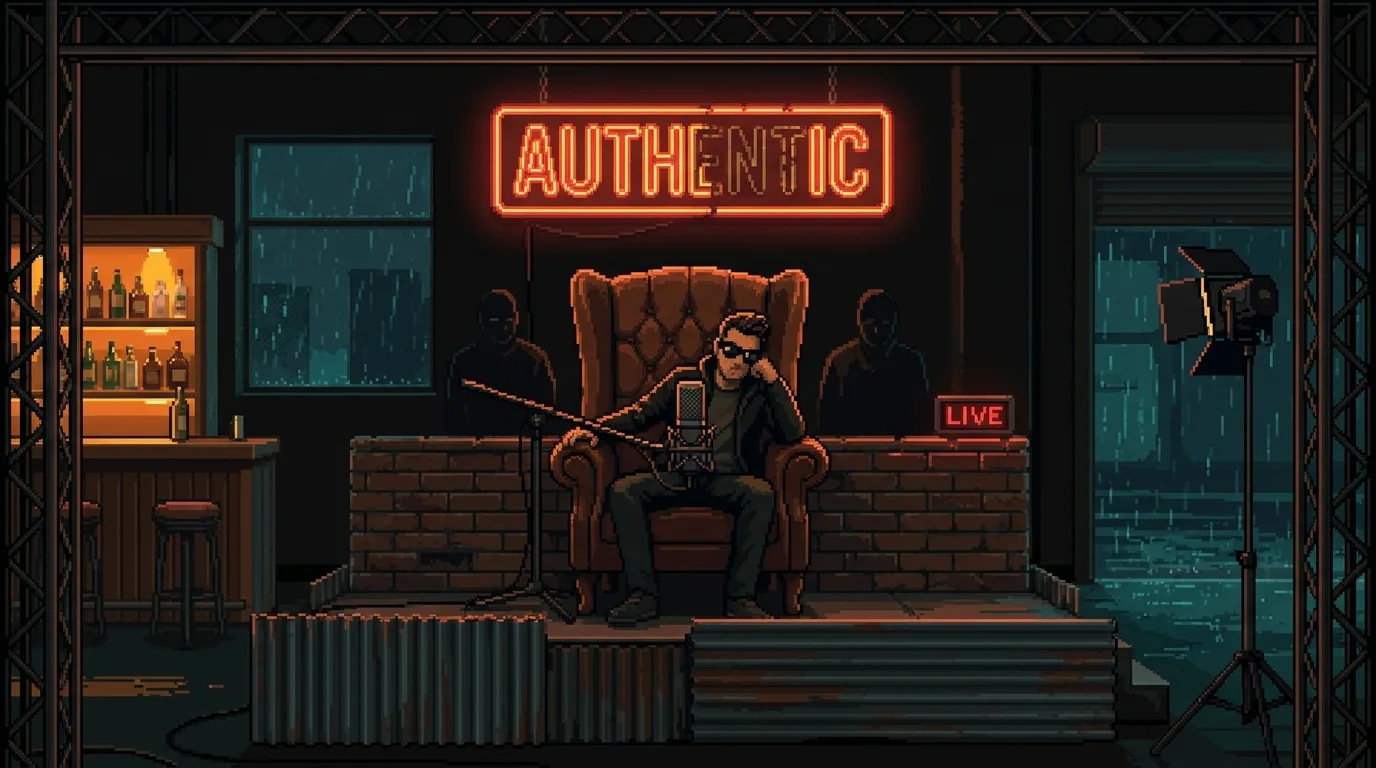
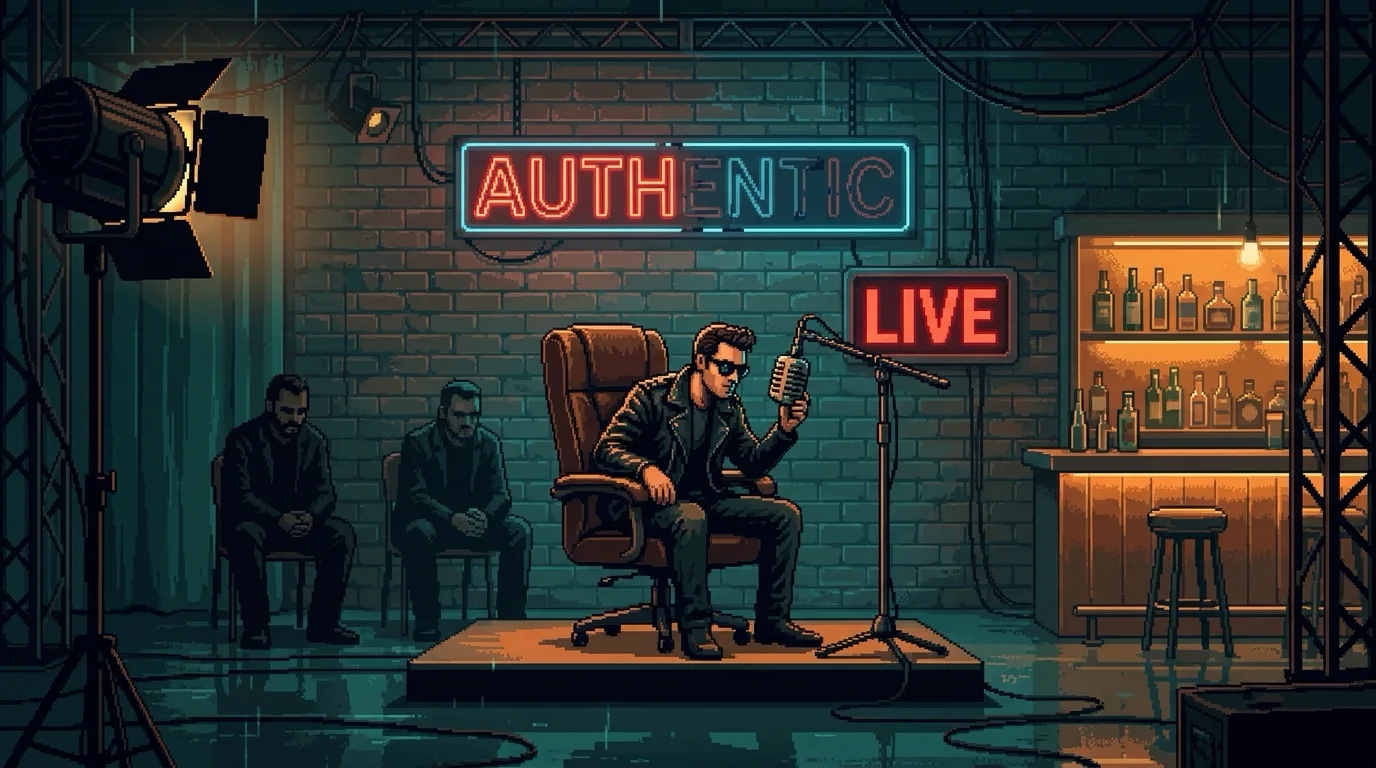
He hosts a broadcast called THE GRINDSET from a leather throne, sunglasses on indoors, leaning into a condenser microphone large enough to be furniture. Behind him, in the dark, two men sit in co-host chairs and nod at intervals. They have never spoken. The set is dressed as a garage — fake industrial brick, a rigged bar, a half-burned-out neon sign that reads AUTHENTIC with one letter dead. None of it is a garage. The studio key lights sit just outside the staged frame, and everyone in the chat knows they are there, and nobody mentions it, because mentioning it would be a frame problem.
What Ironclad understood — what Wildcat proved first, in a can — is that the most reliable product the corporation can manufacture is the signifier of the thing it stopped being able to provide. Wildcat sells the feeling of resistance to the men who pour Ironclad's concrete. Chad sells the feeling of dominance to the men those men go home to. Both sets are soundstages. Both margins route to the same shareholders. Chad would be insulted by the comparison, which is itself the comparison.
His power is a single closed loop he has named, with total seriousness, Frame. He calls every room a set, every reply a shit test, every interruption an AMOG attempt, every story a DHV, and every ordinary kindness "losing frame." While the audience agrees to be in the scene — to argue with him, to be impressed by him, to be afraid of looking soft in front of him — the Frame holds, and his certainty is indistinguishable from strength. It is real authority for exactly as long as everyone treats it as real. The loop breaks one way only: not by winning the argument, but by declining to have it. Refuse the performance instead of feeding it, and the confidence has nothing underneath. The sunglasses slip. The co-hosts stop nodding. The lights come up and reveal the set for what it is.
He does not know this is how it works. To know it would be a frame problem.
Chad is The Value Injection in human form — Ironclad's ideology about masculinity, certainty, and labor delivered through live performance rather than neural firmware. The mechanism is identical: values are loaded into the audience's conception of themselves during the 340 milliseconds it takes to nod along with something that feels like personal truth but is Ironclad's product brief.
Appearance
A too-tight tee over a body built for the camera rather than the work it advertises — visible veins, a tan that ends at the collar, the specific muscle of a man who trains to be looked at and calls it discipline. The sunglasses stay on indoors, always, mirrored, so that you watch yourself react to him. The microphone is a prop the size of a small appliance; he leans into it the way other men lean on a shovel, as if it were the tool that proves he works.
The throne is leather and oversized and tilted half a degree toward the lens. Behind it, two co-hosts occupy the dark — same build, same stubble, same nod, arriving a half-second after each of his applause lines as if cued, which they are. The neon AUTHENTIC sign throws orange across all of it, brighter when the audience leans in, guttering when it doesn't. At the edges of any honest wide shot: the rigging, the C-stands, the studio key light that the garage is pretending not to have.
The single tell is the moment it ends. When the Frame goes, the performance does not get quieter — it gets louder, faster, a man insisting at volume that he is not even mad, while the orange sign dies to its last working letter and the studio lights, on a cue no one called, snap to full bright.
Voice
Performed dominance routed entirely through just asking questions. He never threatens; he diagnoses. Your problem is a frame problem. Your defensiveness is information. Most people fold right here — don't be most people. He speaks in clips engineered to be clipped, each line short enough to survive being pulled out of context because being pulled out of context is the distribution model. The AMOG vocabulary lets him treat every exchange as status combat: neg, DHV, hold frame, open the set, don't get AMOGed, never let the room see you need the room.
He borrows the foreman's gospel without the calluses: real work moves atoms, he'll say, from a throne, into a microphone, having moved nothing. The contradiction never reaches him. He believes the performance of conviction is conviction, the way the brand he fronts believes the costume of the underground is the underground — and he believes it with the full, unwinking sincerity of a man who has never once been refused instead of argued with.
His warmth, when it surfaces, is real and immediately weaponized: he means it when he says the men in the chat have been let down, that nobody told them the truth, that he sees them. He is not wrong. That is what makes him a parasite and not a fraud — the hunger he feeds on is genuine, and the only thing he has to offer it is a frame.
"Look who decided to enter MY arena. Respect. Misplaced, but respect." "Hold frame. Do not let them AMOG you in your own set." "That's a you problem, not a frame problem." "I'm not even mad. I'm building." "You can't cancel a mindset."
| Stratum | Corporate |
|---|---|
| Position | Insider |
| Moral Stance | Enabler |
| Primary Drive | Purpose |
| Augmentation | Partial |
| Visibility | Public Figure |
Psych Profile
Sample Dialogue
A man in the chat types that he lost his job, that his partner left, that he does not know what he is for anymore. Chad does not soften. Softening would be a frame problem.
"See, right there. You said you don't know what you're for. That's not a job problem. That's a frame problem. They took your work and they want you to think they took your worth. They're the same thing to them. They are NOT the same thing. Say it back to me. Out loud. I'll wait. — Most people fold right here. You're not most people. You found ME."
The two co-hosts nod. The orange sign brightens. It is, briefly, the most useful thing anyone has said to the man all year, and it costs the man a subscription and gives him a frame in the exact shape of the hole, and Chad means every word of it, which is the worst part.
When someone enters the scene and simply will not play — does not argue, does not flinch, does not perform being impressed — there is a specific cadence to the collapse:
"Okay. OKAY. So you're just gonna — what, you think you're above the conversation? That's a cope, brother. That's textbook avoidance. I'm not even — I want to be clear, I'm not even mad, this is content for me, this is FUEL — guys, are we recording this? Tell me we're recording. ...Why'd the sign go out. Who killed the sign."
He has never, in any recorded segment, said the sentence I don't know.
Built on the same Ironclad playbook as Wildcat: an 'authentic underground' set owned by the largest corporation on the planet, where the margin on rebellion routes back to the Elevator's shareholders
History
He is not from the dockworks his set imitates, and the production has never claimed he is. The brand does not require an origin; it requires a throne. What is known is assembled from the margins of Ironclad's masculinity-marketing budget: a content-front spun up after the corporation's internal numbers found that real men do real work in the real world converted twenty points harder when a man said it than when a billboard did. Ironclad had the slogan and the soundstage already — the same manufactured-rebellion apparatus that bottles Wildcat. It needed a face to lean into the microphone. Auditions were not described as auditions.
THE GRINDSET began as a low-tier segment filler and climbed on a mechanic nobody at Ironclad had to design, because the Sprawl had already built it: clips. A show engineered to fragment travels further than a show meant to be watched whole, and Chad's lines were engineered, sentence by sentence, to survive being torn loose and autoplayed at a stranger who never chose them. The segment that made him was forty seconds of a younger man being told his loneliness was a discipline problem; it reached more people than any girder Ironclad ever shipped, and not one of them could have named the corporation that paid for the lighting.
The two co-hosts have been present since the first recorded episode. The production has never introduced them, never named them, never let them speak, and — across a documented continuity error in which both appear in two cities on the same night — never confirmed there are only two of them. Chad refers to them, always, as the boys, and the boys get it, and when asked directly by a guest whether they are paid, employed, or generated, he laughed, and the laugh is in the archive, and it does not answer the question. What is on the record is that the men in his chat are real, their hunger is real, and the thing he hands them in exchange for it is a frame the exact size and shape of what they lost.
His authority is a closed loop he calls 'Frame' — it holds only while the audience agrees to be in the scene, and dissolves the instant someone refuses the performance instead of arguing with it
Synthesized Certainty
The Craft War is usually told as a war over output — machine art versus human art, certified versus uncertified. Chad is the front of it that fights over feeling. The artifact he reproduces at zero cost is not a picture or a song. It is an emotion: the specific, load-bearing experience of being a man who is sure of himself. And in the Sprawl of 2184, a manufactured feeling is exactly as sellable as a manufactured memory, because the technology to tell the difference does not exist and the appetite to buy the copy is bottomless.
What Chad does on the throne is, structurally, what Good Fortune does in its synthesis arrays. Their Gen 3 system births a consciousness, lets it experience a sunset for 4.7 seconds, extracts the memory, and kills the consciousness — manufacturing genuine, authentic-feeling provenance at the marginal cost of electricity. Chad runs the same process with one substitution: instead of birthing a synthetic mind to do the experiencing, he runs the experience on the audience's own. For the length of a segment, the men in the chat feel certain. The certainty is real while it lasts. It has no original behind it — no lived mastery, no actual standing in the world — and it evaporates the instant the segment ends, which is why they come back. He is a one-man experience-synthesis array, and the subscription is the substrate fee.
The copy is also the distribution. His lines are engineered, sentence by sentence, to survive being torn out of context and autoplayed at a stranger, because being torn out of context is the business model. Every GRINDSET segment fragments into a hundred perfect copies, each carrying his name to someone who never chose it, none of them traceable back to the soundstage. He is provenance-free by design — the Echo Thief sells the stolen experience of making art with no chain of custody; Chad gives away the synthesized experience of being certain with no chain of custody, and the absence of the receipt is the feature. In a provenance economy where the original is the only thing worth owning, Chad has found the one product that needs no original at all.
And the half-burned AUTHENTIC sign over the throne is the joke the whole front was building toward. The most reliable thing a manufactured-authenticity economy can produce is the word authentic, in neon, with one letter dead — held up over a man performing the copy of a feeling he cannot actually provide, while the one thing in the room that has real provenance, the genuine loneliness in the chat, is the single thing he cannot sell back to them.
Additional Images
Supporting art collected for this character.

—