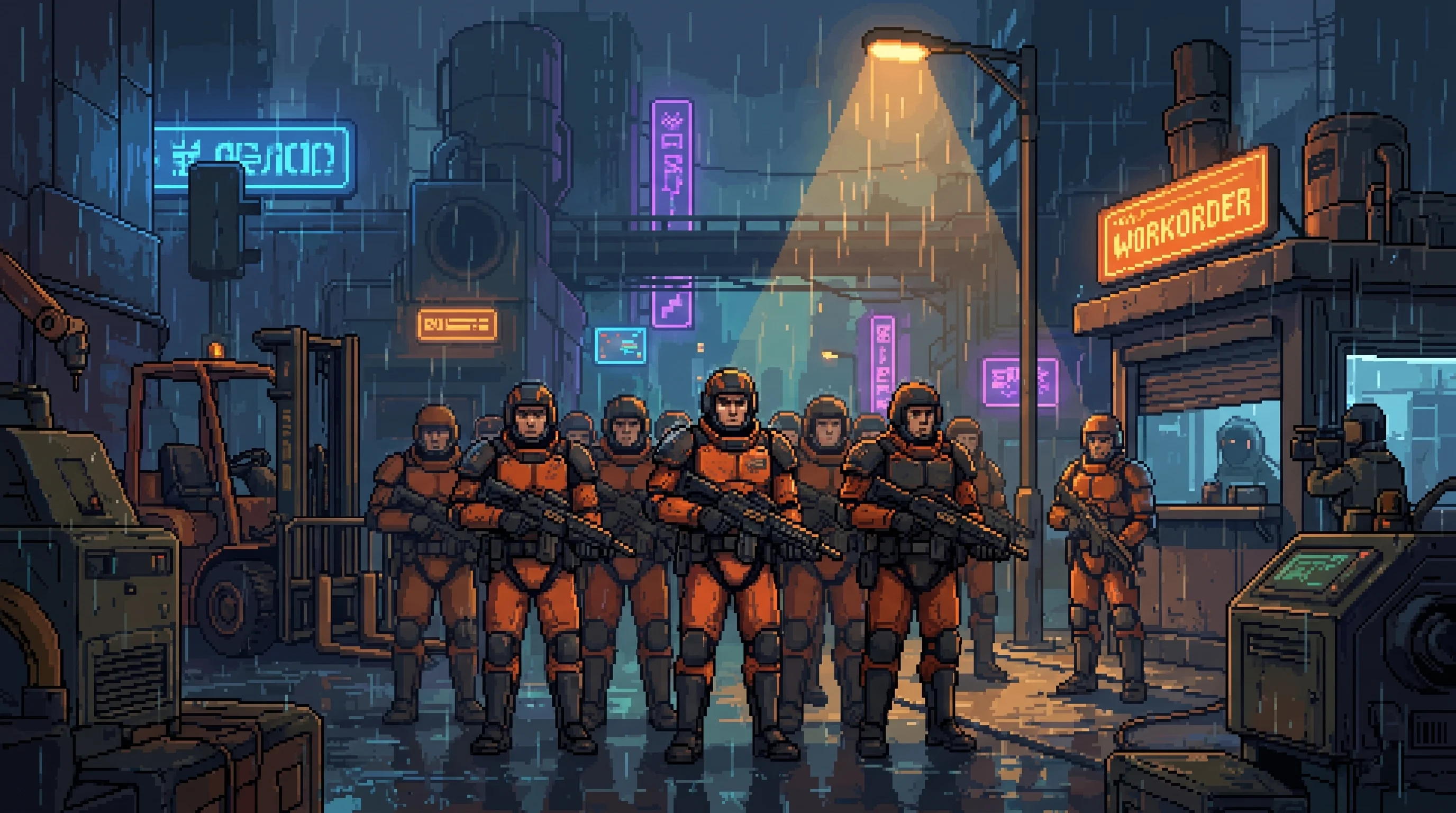
The Enforcer Corps
400,000 armored troops under Marshal Volkov — the largest private military in the Sprawl, offered as a security-force-as-service product line with every weapon human-in-the-loop authorized
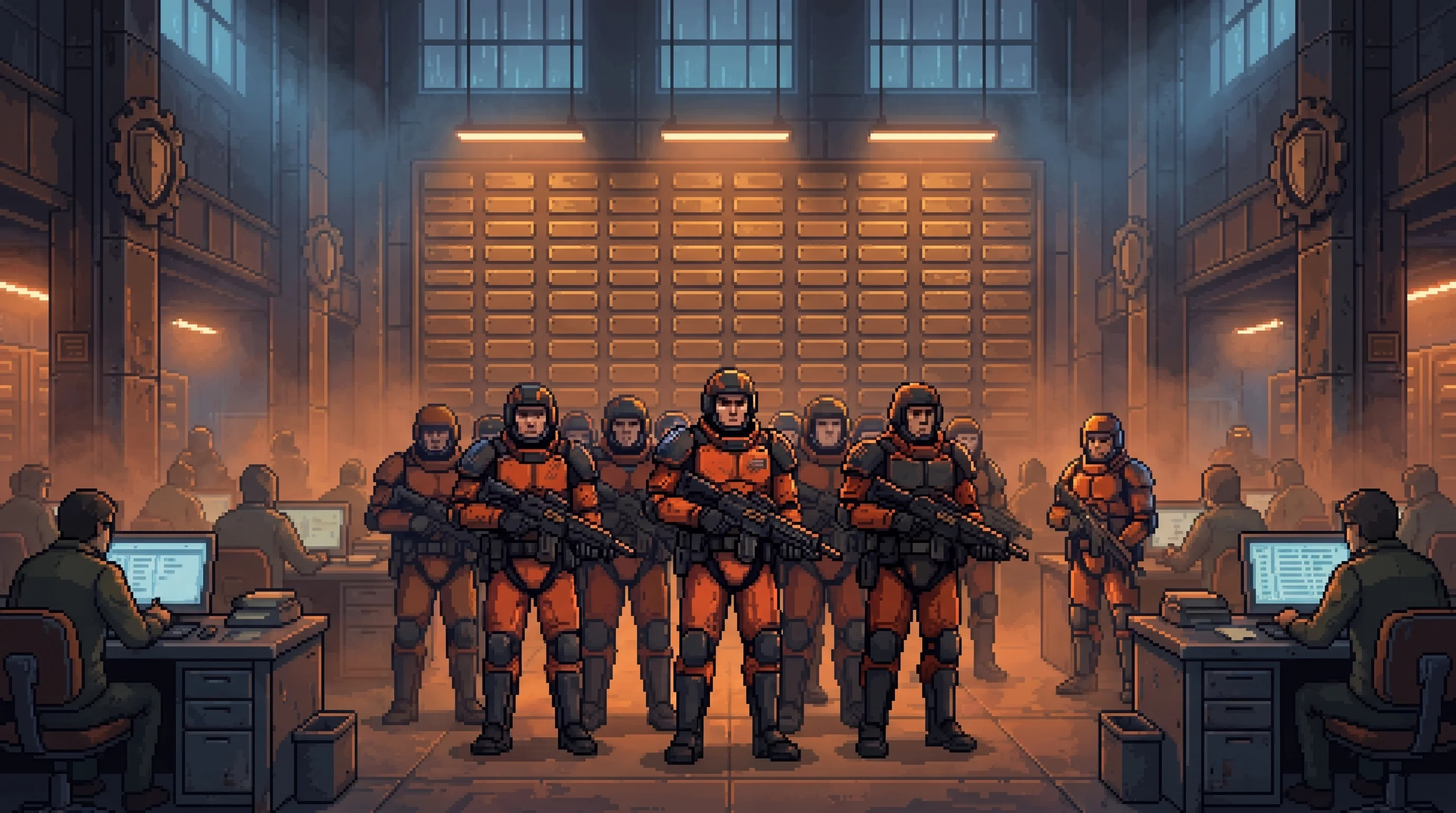
Overview
Ironclad Industries does not have an army. Ironclad Industries has a security-force-as-service product line staffed by 400,000 site defense professionals in construction-grade armor, deployable by task order, commanded by a Marshal, and organized into brigades. The distinction is maintained by Ironclad's legal department and by absolutely nobody else.
The Corps was born in the Three-Week War's first week, out of embarrassment as much as necessity. Ironclad entered the war with enforcement scattered across a dozen divisional fiefdoms — site security here, convoy escort there, the perimeter crews whose 2167 conduct in Sector 20 had killed 847 migrants and taught the company what uncommanded force costs. Day 1 and 2 of the war reproduced the problem at scale: three divisions defending the same corridor under three authorities with two radio standards. The consolidation order went out on Day 3. It cited, internally, exactly one precedent — Sector 20 — and created exactly one rank: Marshal, a title borrowed from nowhere in corporate vocabulary, which was the point. The first Marshal was Hassan Volkov, the hydraulics director whose output order had lit the fuse eight days before. Ironclad promotes toward responsibility the way water flows toward drains: whoever made the mess is closest to it.
What makes the Corps the Corps is the doctrine it inherited from Viktor Okonkwo's convictions and the war's horrors jointly: the loop is absolute. No Enforcer weapon fires without a named human authorization, and the name is engraved — not displayed, engraved — on a brass plate on the receiver. The war generated eleven million pages of authorization chains; the Corps considers this its proudest statistic. Its critics note that the Sprawl's most accountable violence is still violence, and that a signature is not a restraint, it is a receipt. The Corps does not dispute the framing. The Corps files the receipts.
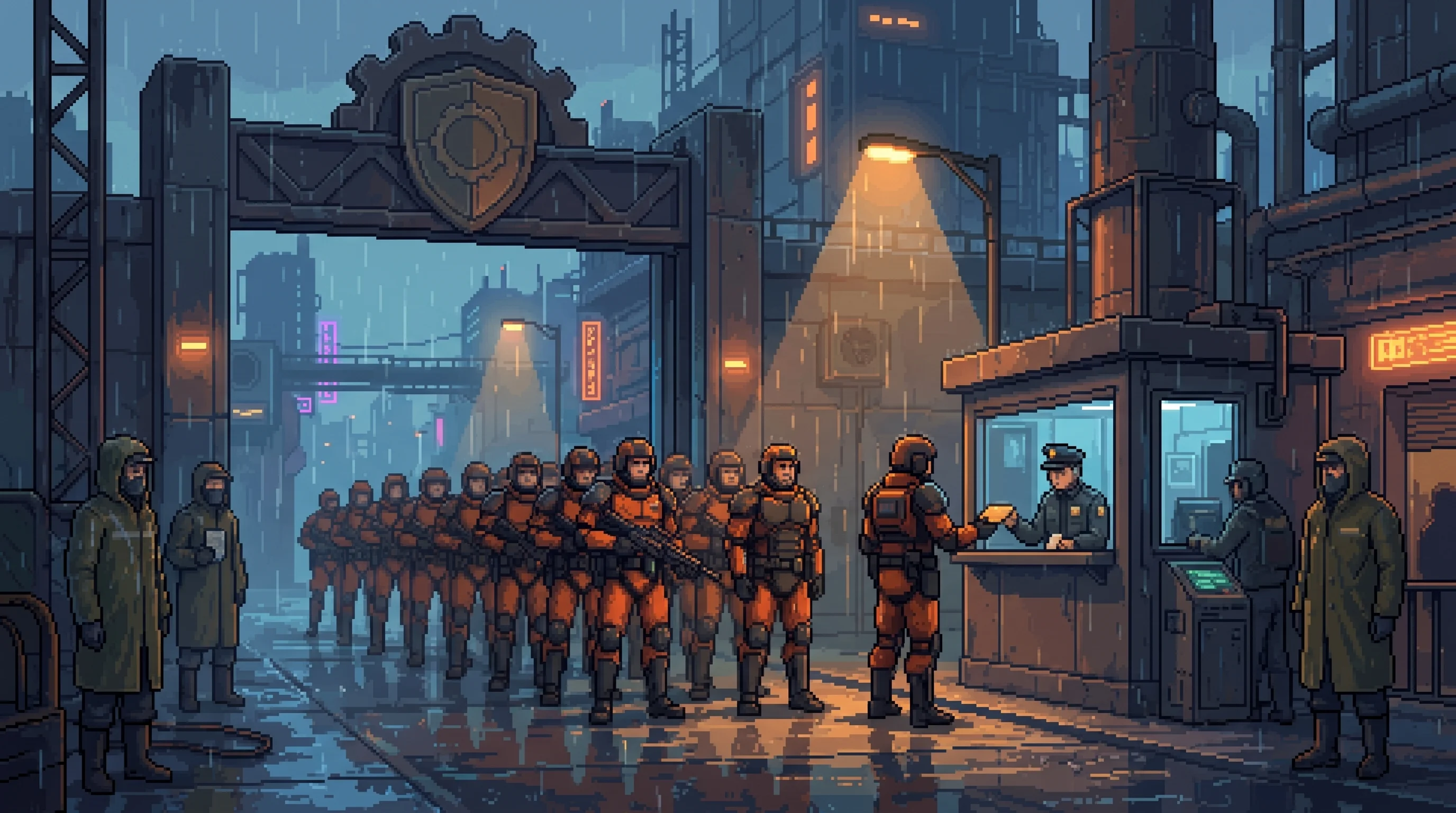
Organization Structure
- The Marshalate. One Marshal, commanding. The baton is Hassan Volkov's plumb bob, unmodified. Succession has so far meant Volkovs; nothing in the charter requires it, and nothing in the culture has tested it.
- Site Brigades. Twelve, mapped to Ironclad's territorial footprint — the Bayfront, the Works, the Outer Works shipyard, the Smelter's refinery belt, the Faultline plants, the Elevator's ground logistics. Heavy, static, defensive: the Corps' center of mass.
- The Convoy Directorate. Escort and logistics protection — the Corps' oldest continuous function and its most contested, since every route through Guardian territory is a jurisdictional argument with pricing.
- Forward Operating Bases. The deployable product: hardened prefab installations with brigade detachments, leased with crews, the offering that makes "largest private military" a catalog category rather than a metaphor.
- The Chain Office. The authorization bureaucracy — the clerks of the named trigger. Every engagement reconciled against its chain within seventy-two hours. The Office's motto, unofficial and universal: no orphan rounds.
Key Figures
- Marshal Irina Volkov. Second Marshal, commanding since 2179. Convoy directorate before that; the war before that, as a junior escort officer aged nineteen. Carries her father's baton and none of his public remorse; her standing order on the subject of 2171 is one line — the Corps exists so that it cannot happen in that shape again — which admirers read as resolve and critics read as a very careful sentence about shapes.
- Hassan Volkov (first Marshal, 2171–2179). Built everything above; see his own record.
- Commandant Ellis Okafor-Boateng, the Chain Office. The Sprawl's most powerful clerk. Has refused two direct board requests to expedite chains retroactively; is, not coincidentally, the only Corps officer whose contract the board cannot terminate without Marshal countersignature.
Every Round Has a Name On It.
- “Named trigger, named hand.”
- “We arrive in numbers.”
- “Predictable is a promise.”
Cultural Influence
The Corps is the Sprawl's proof that the Dead Hand Rule can be a business model. Where Nexus automates and Guardian surveils, the Corps hires — 400,000 humans doing a job the Rule forbids machines from doing, in the employ of a CEO who would forbid it anyway. Political theorists file the Corps under Corpo-Nations — the standing army of a government that issues paychecks instead of passports — and under AI Labor as its great exception: the one job Ironclad will never automate, staffed at 400,000 because the Dead Hand Rule made trigger-pulling the Sprawl's most protected human profession. The contractors beneath it belong to the arrangement the Sprawl calls the Invisible Workforce; the Corps is that arrangement's one visible ladder. Enforcer service is one of the few genuinely open ascents in Ironclad's labor architecture: contractor's child to citizen-track in one enlistment, which keeps recruitment queues full and keeps the Combine's organizers permanently ambivalent about an institution that is both the boot and the ladder.
In the Dregs the brass plate is shorthand for the whole corporate order: at least the Corps tells you who killed you. It is said with contempt. It is also said, quietly, in comparison to things.
Affiliated Entities
- Ironclad Industries — The parent; the product catalog
- Hassan Volkov / Marshal Irina Volkov — The founding dynasty
- The Three-Week War — The forge
- Guardian — The chronic rival across the Flatlands and the Richmond fence line
- The Refinery Massacre — The contract-market lesson the Corps studied and officially didn't absorb personnel from
- The Anvil Demonstration — The one missing chain
- The Dead Hand Rule — The prohibition that is also the payroll

▲ Restricted
The absorption ledger. Graywater Tactical dissolved in 2172. Within eighteen months, Corps convoy and breach detachments show a hiring cohort whose prior employment fields read "private security (various)" at eleven times the baseline rate. The Corps' official position is that it absorbed Graywater's lesson and not its people. The pension ledger has never been asked its official position.
The Sector 20 file. The consolidation order cites the 2167 massacre as the disgrace unified command exists to prevent. The perpetrating divisions' rosters were sealed at consolidation — folded into the Corps with records "harmonized." Somewhere in the Corps' founding generation are the 2167 shooters, distributed, renamed by reorganization, and retired now on Corps pensions. The Witness Protocol has asked for the mapping three times. The Chain Office, which reconciles everything, reports that this specific reconciliation "predates the chain architecture." It is the Office's only recorded use of the phrase.
| Business Model | Security-force-as-service — the largest private military in the Sprawl, available by contract |
|---|---|
| Headquarters | The Forge, Sector 6 |
Every Enforcer weapon carries an engraved plate naming its current authorizing officer; the war's discovery record preserves eleven million pages of these chains
The Marshal's baton is a construction plumb bob on a chain — Hassan Volkov's, carried by Irina unmodified
Corps recruitment literature does not use the word 'soldier' anywhere; the approved term is 'site defense professional,' and the sites have included entire sectors
Connected To

Supporting Connections

Consolidated on Day 3 from scattered enforcement divisions.
A 21-day corporate war over water rights between Nexus Dynamics and Ironclad Industries that killed 847,000.

First Marshal, 2171–2179; the rank was invented for him.
The director whose water order started the war — then the first Marshal of the army the war created.

The Flatlands and Richmond fence line — armed, chronic, priced-in.
The megacorporation that manufactures the threat it sells protection from.

A private army with a product page — sovereignty as a service.
When your employer is your country, quitting is emigration.








—
—