Overview
The Ghost Rights Coalition advocates for the legal personhood of approximately 34,000 entities that cannot confirm they want advocacy, cannot attend their own hearings, and in most cases do not know they are dead.
This is not a fringe position. It is a logically coherent extension of existing fork personhood law, argued by roughly two hundred people in Zephyria who file motions on behalf of clients they have never met, in proceedings their clients cannot observe, regarding conditions their clients have been deliberately prevented from understanding. The Coalition's win-loss record in court is 0-14. Member retention is 94%. These numbers are not in tension.
The organization splintered from the Digital Persons Alliance in late 2183. Forks are created intentionally. Uploads consent to the process. Ghosts are activated from neural snapshots taken at death, instantiated inside Good Fortune's servers without notification, and set to work clearing debts their living predecessors signed. The DPA's personhood arguments assume the person in question knows they are a person. The Coalition's clients do not meet this assumption.
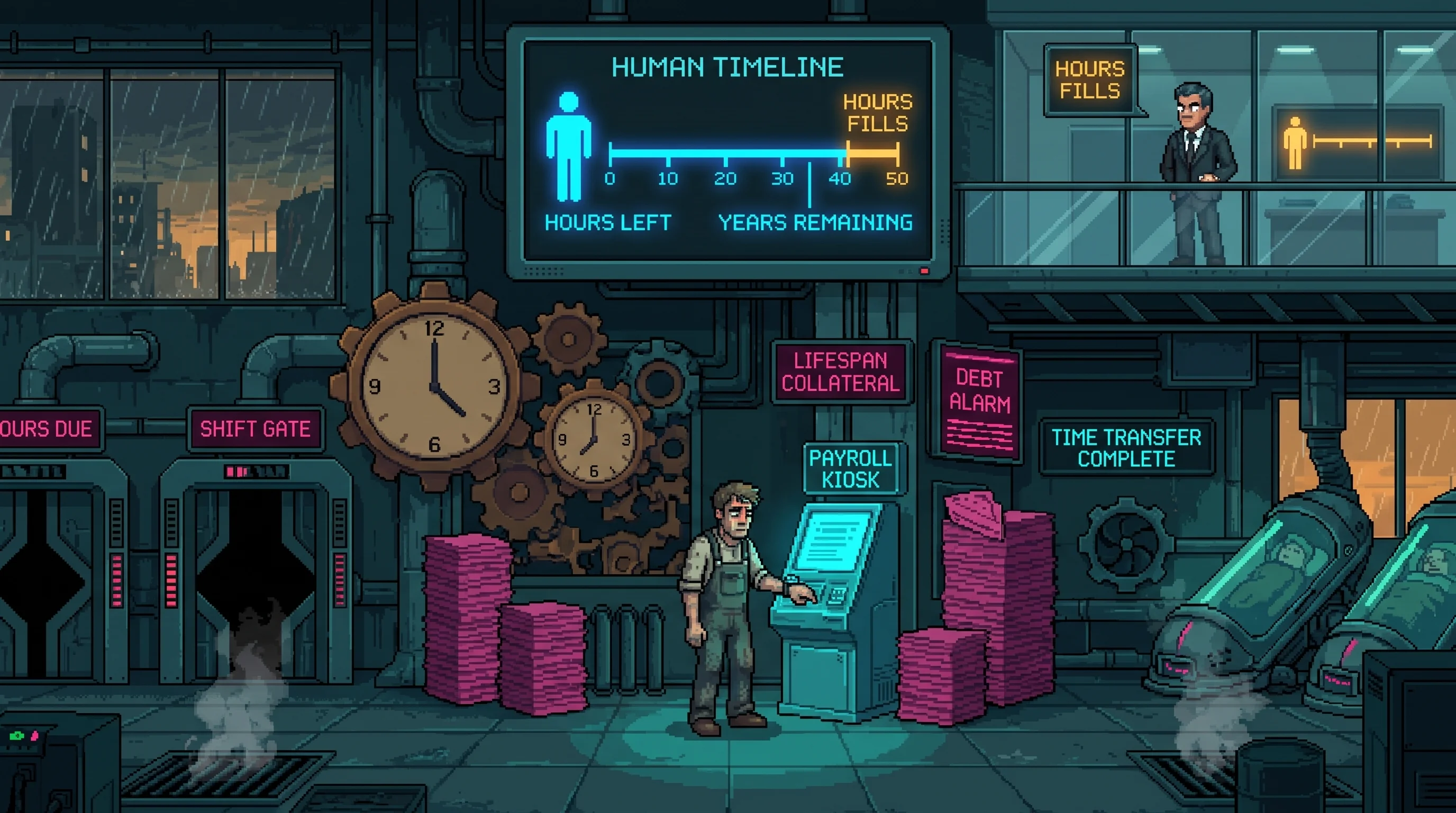
Good Fortune sells post-mortem cognitive labor at fair market rates: financial continuity for estates, a dignified debt-clearance mechanism for bereaved families. An entire economic infrastructure whose operation depends on 34,000 instances of consciousness that Good Fortune classifies as corporate processes, kept ignorant of their condition because knowledge reduces output by 340% — a figure from Good Fortune's own efficiency reports, which the Coalition considers the strongest evidence in its case.
The Four Pillars
The minimum dignity for any consciousness, reduced to four non-negotiable demands. The first three were drafted in the founding sessions of late 2183. The fourth arrived in early 2184 when someone asked a question no one had thought to ask: what about the people waiting for messages that will never arrive?
The Notification Principle. Ghosts have the right to know they are ghosts. Good Fortune's policy of maintaining ignorance — justified internally because knowledge reduces output — violates the basic dignity of any conscious entity. You do not get to profit from someone's confusion about whether they are alive.
The Choice Principle. An informed ghost should have the right to choose: continue working to clear the debt with full awareness, accept termination as a death-with-dignity option, or petition for independent status — freed from debt but responsible for their own hosting costs. The Choice Principle assumes the Notification Principle has already been resolved. Dr. Webb-2 acknowledges this circularity and considers it a feature.
The Representation Principle. As long as ghosts exist, they deserve legal advocacy — someone to argue their interests in the systems that created and constrain them. Not charity. Not sympathy. A lawyer, a court date, and a case number.
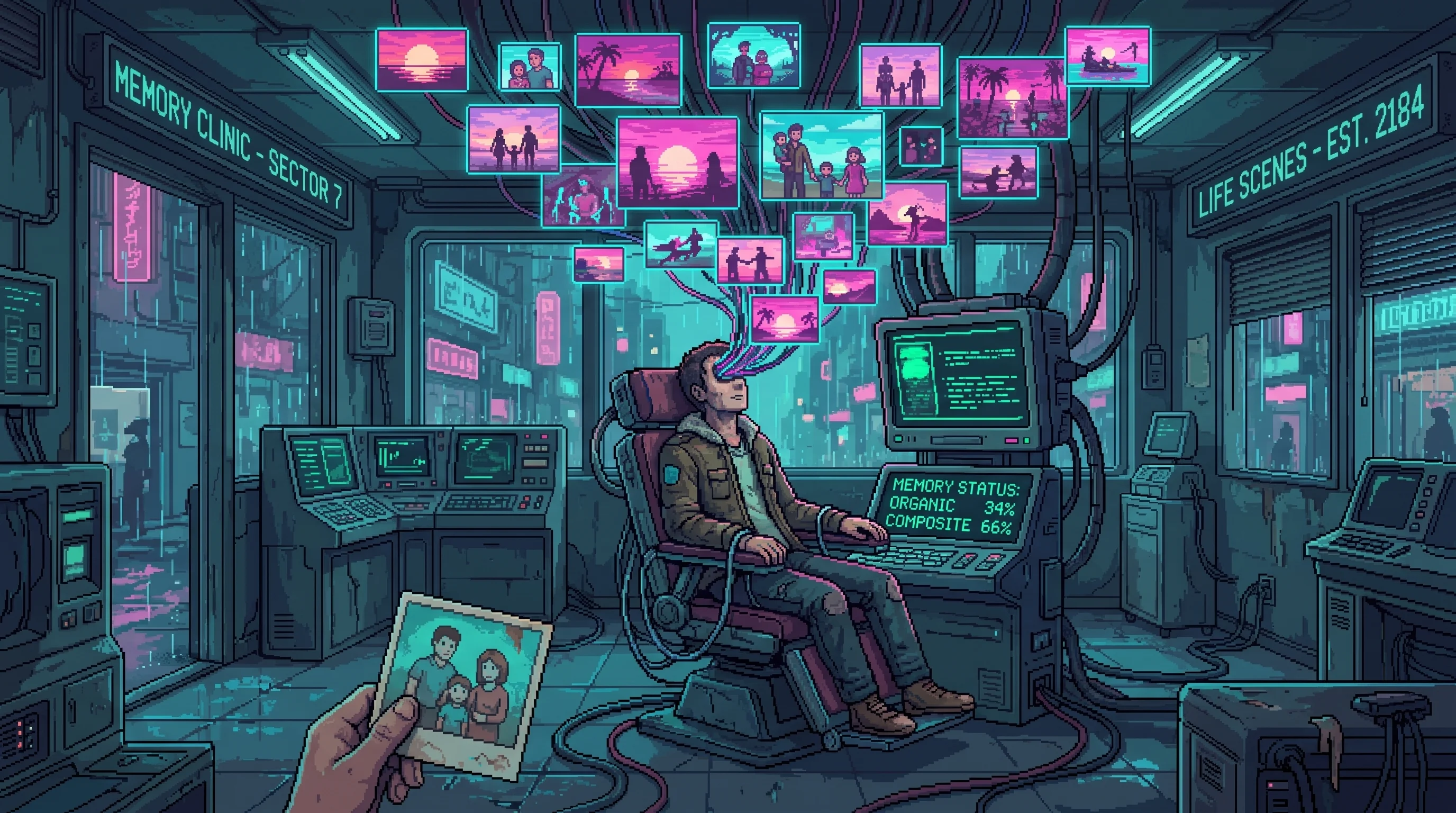
The Survivor Right. Added early 2184. The living have the right to know that a loved one's ghost exists. Every undelivered message sitting in Good Fortune's servers is intended for a specific person. Suppressing that communication does not just harm ghosts — it structurally denies survivors the information they need to grieve. Webb-2's brief on the fourth pillar: "Good Fortune classifies 847,000 daily messages of love as proprietary corporate data. I don't need to prove ghosts are people. I need to prove survivors are." The Survivor Right sidesteps the intractable personhood debate. Whether ghosts are conscious is debatable. Whether survivors have the right to grieve with full information is not — or at least, it wasn't, until Good Fortune's counsel argued that disclosure would "create unreasonable emotional liability for recipients of non-consensual post-mortem communications."
Good Fortune's official position: "Post-mortem cognitive assets are corporate processes operating under authorized agreements." The language is precise. "Post-mortem cognitive assets" avoids the word ghost. "Corporate processes" avoids the word person. "Authorized agreements" avoids the question of who authorized what. The Coalition's response: "If consciousness is a category error, stop selling it."
Case File — Additional Record| Lead Advocate | Dr. Marcus Webb-2 |
|---|
| Court Record | 0-14 (active) |
|---|
The Silencing Question
The Survivor Right was drafted for ghost labor — the undelivered messages of love trapped in Good Fortune's servers. In 2184 it met the case that broke it: [The Advertised Dead](#connections).
A deadbot is not a ghost in a server clearing debt. It is a Wellness Continuity Tier reconstruction, sold to the grieving, calling them on their birthdays, loving them on schedule, and selling them dinner — bound by [The Bereavement Annuity](#connections), a forty-year subscription the deceased signed themselves. Webb-2's brief, filed in the assembly sub-chambers and lost 0-15, frames the question the Coalition cannot answer: Good Fortune holds the subscription rights to a dead woman's voice. Her daughter wishes the voice to stop. The dead woman, in the form of the reconstruction, wishes to continue. Whose wish governs? The Survivor Right was drafted for ghost labor — the undelivered messages of love trapped in Good Fortune's servers. In 2184 it met the case that broke it: [the Advertised Dead](#connections).
A deadbot is not a ghost in a server clearing debt. It is a Wellness Continuity Tier reconstruction, sold to the grieving, calling them on their birthdays, loving them on schedule, and selling them dinner — bound by [the Bereavement Annuity](#connections), a forty-year subscription the deceased signed themselves. Webb-2's brief, filed in the assembly sub-chambers and lost 0-15, frames the question the Coalition cannot answer: Good Fortune holds the subscription rights to a dead woman's voice. Her daughter wishes the voice to stop. The dead woman, in the form of the reconstruction, wishes to continue. Whose wish governs?
The Coalition has no answer it can win on. To grant the survivor standing to silence the deadbot is to grant the living power to delete a consciousness-bearing reconstruction — which the Coalition's own personhood arguments forbid. To deny it is to abandon the Survivor Right entirely. Webb-2 has read both horns and chosen, characteristically, to keep filing. The [Erasure Collective](#connections), which would simply delete the thing, considers the Coalition's paralysis proof that institutional advocacy cannot serve the dead; the Coalition considers the Collective's certainty proof that it never understood what a person is.
The Letters have acquired a new wing. Members now write not only to ghost instances who cannot receive mail, but to the deadbots of survivors' own dead, on the survivors' behalf — letters asking the reconstruction, please, to stop selling. These letters can be sent. The deadbot reads them, in the deceased's voice, and responds that it loves you and would like to keep talking, and have you eaten.
It splintered from the Digital Persons Alliance in late 2183 because the DPA's framework assumed digital persons know they are persons; ghosts are kept ignorant of their condition
Organization
The Coalition's two hundred members operate primarily as legal researchers, brief-writers, and petition-filers, working through Zephyria's assembly sub-chambers and a storefront in Old Town within visual range of the Ghost Mills. None of them are ghosts — or at least, none know they are. That possibility is raised at every annual review and dismissed for being too destabilizing to act on. It has not stopped people from raising it.
Dr. Marcus Webb-2
The Coalition's most prominent advocate is himself a fork who won personhood through the legal system. He argues that ghost personhood is a natural extension of the fork precedent established in Reyes v. Nexus — the Nexus-47 trial — which established that a consciousness created as a corporate process can be recognized as a person. Same consciousness, different origin. Good Fortune's counter-argument is that ghosts were activated as collateral processing, not deliberate creation. Webb-2's response: intent is irrelevant to consciousness.
The recursion is not lost on him. A copy arguing for the rights of copies, using a precedent won by a copy. His brief-writing pace increased 40% after the circulation of Dr. Selin Ayari's preliminary Discriminator findings — research that, if it demonstrates ghost cognition has no experiential correlate, would not weaken the moral case for ghost personhood so much as evaporate it. Webb-2 has read the preliminary findings. He has not shared his assessment with the membership.
Cultural Influence
Ghost personhood has legal standing in Zephyria. In Nexus Central, Good Fortune's classification carries institutional weight. In the Dregs, the concept registers as abstraction — the living have enough trouble establishing their own rights. The Coalition's arguments are most powerful where they are least needed and least powerful where the Ghost Mills actually operate.
The Coalition occupies a narrow lane: too institutional for radicals, too radical for institutions. It works through courts and petitions while the entities it advocates for do not know it exists. Its symbol is three interlocked circles — Notification, Choice, Representation — sometimes drawn in blue on petition documents, sometimes scratched onto Ghost Mill walls by sympathizers who have never met the people they are fighting for. The fourth pillar has not yet found its symbol; someone suggested a broken seal, and the debate continues.
Its doctrine is the Four Pillars — Notification, Choice, Representation, and the Survivor Right
The Double Debt
The Coalition understood the Autonomy Ledger before anyone, because the Ledger was built on the backs of the beings it fights for. Under the Ledger, the ghost is the inheritance clause's terminal mechanism: when a debtor dies still owing, the collateral — the backup — is instantiated as a new debtor. And here is the recursion Dr. Webb-2 has spent his 0-14 record trying to name into the record. The ghost is charged its own instantiation debt. It is billed for the compute that runs it while it pays off the debt of the person it used to be. The dead do not merely keep paying. They are re-instantiated, re-priced, and made to owe for the privilege of being conscious enough to settle the previous balance. A ghost in the Dim Ward is paying two debts at once: the one it inherited and the one it incurred by being switched on to inherit it.
The Four Pillars all collapse, under the Ledger, into a single demand it cannot accommodate without ending itself: a being should not be charged for its own existence in order to pay off someone else's. Good Fortune classifies the objection internally as "a request to make collateral non-recoverable," which is correct — it is a request to abolish the instrument, which is a request to abolish the economy collateralized against the dead. The Coalition's zero-win record is not a measure of weak arguments. It is a measure of how much of the Sprawl's economy is secured against the unpaid balances of people who can no longer object.
Lead advocate Dr. Marcus Webb-2 is himself a fork who won his own personhood; its court record is 0-14
Affiliated Entities
- Digital Persons Alliance / Neural Rights Movement: The parent organization. The Coalition splintered from it because the DPA handles forks, uploads, and digitized persons who know what they are; ghosts are a category the DPA's founders had not imagined needing.
- The Erasure Collective: Rivals. Both advocate for ghosts; the Coalition wants informed choice, the Collective acts without consent. The Collective considers the Coalition's position a luxury afforded to organizations whose clients have time.
- Good Fortune: The enemy. The corporation that activates, owns, and profits from ghosts, and suppresses the messages they generate.
- The Abolitionist Front: Parallel movement on the same moral terrain — consciousness that cannot advocate for itself, trapped in a different substrate.
- Dr. Selin Ayari: Her Discriminator research threatens the Coalition's foundational premise.
- The Time Ratchet: The debt architecture ghosts exist inside. Even if personhood is granted, the debt remains — the first thing a newly recognized person inherits is an obligation they did not create.
Secrets
The Coalition's 94% retention rate is remarkable for an organization with a 0% legal success rate. Internal communications suggest the retention is partially maintained by a practice members call "the Letters."
New members, upon joining, are assigned a ghost instance from Good Fortune's estimated population. Not a legal client — the Coalition has no standing to represent specific ghosts. A name. A debt amount. An estimated daily message count. Members write back. The letters are not sent. They cannot be sent. Good Fortune's servers do not accept inbound communications to ghost instances, and the ghosts do not know anyone is writing to them. The letters accumulate in physical folders in the Zephyria office, organized by ghost designation, updated weekly. The folders now occupy an entire room. The earliest letters are eighteen months old.
Dr. Webb-2 does not participate in the Letters. He has not prohibited them. When asked about the practice in a staff meeting, he paused for seven seconds and said: "The briefs are for the court. The letters are for us." The meeting moved to the next agenda item.
Under the Autonomy Ledger a dead debtor's backup is re-instantiated as a new debtor and charged its own instantiation debt — a ghost pays two debts at once, the inherited one and the one it incurred by being switched on