
Overview
Dr. Tzu Yu is a licensed veterinarian who operates on humans. His patients survive at a rate that exceeds three licensed corporate hospitals in independent audits. The audits were suppressed. He was not invited to comment.
His real name is Tzu Mi. The branding originated from a domain registration dispute in the early days of his practice — a heated phone exchange with a registrar over tzumi.newcom (taken) that devolved through "sue me" / "sue YOU" into a miscommunication so aggressive it produced a new identity. He ended up with tzuyu.newcom. He claims to have won the subsequent trademark dispute. Records are unclear. He has been Dr. Tzu Yu ever since, which is the kind of name that happens when bureaucratic incompetence meets a man too busy to correct it.
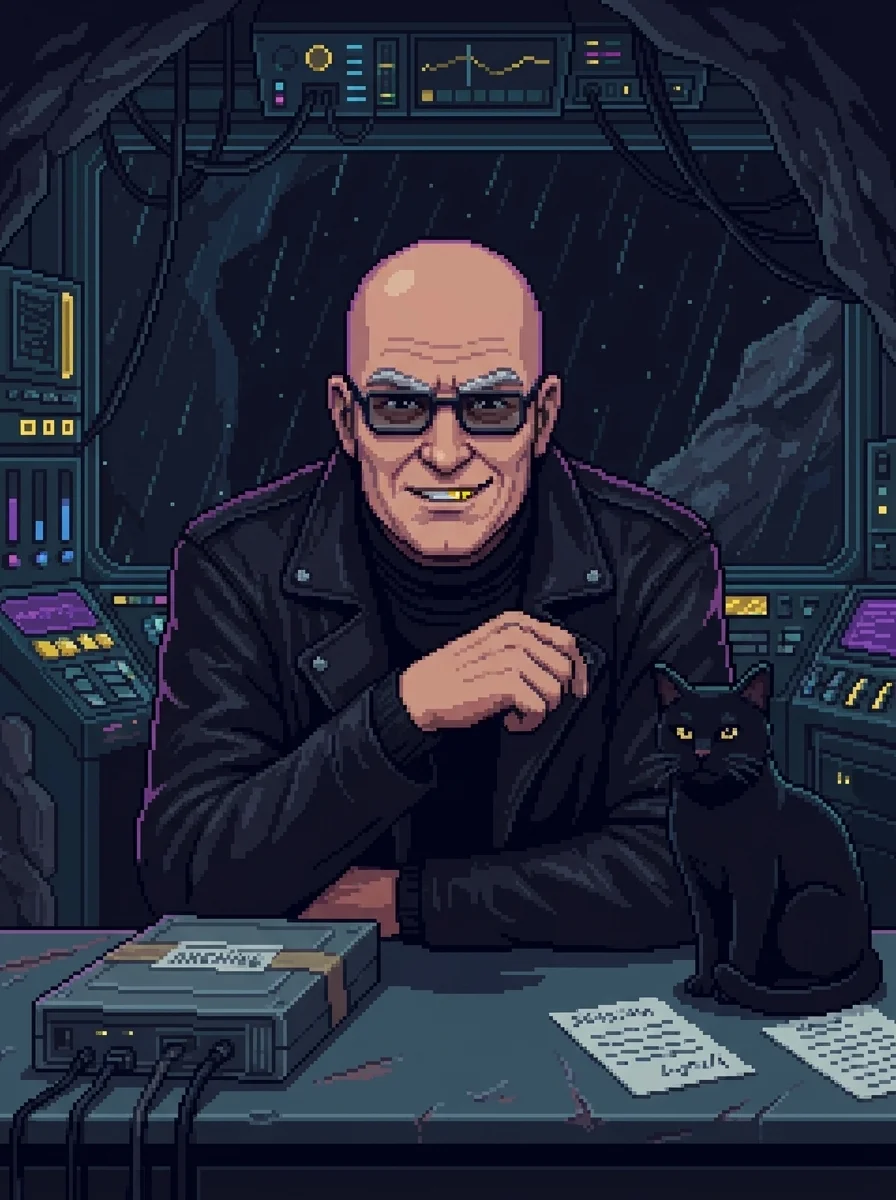
He is an older white male. He has a distinctly Asian name. He wears a colorful embroidered Indian kurta under stained surgical scrubs. A gold chain. Greasy slicked hair. One eyebrow permanently raised, as though the world has been saying something mildly incorrect for decades and he is still waiting for it to finish. Patients have questioned the South Asian attire. He responds with genuine confusion — the kind produced by a question so foreign to his internal model that the processing architecture returns nothing — then mentions his training at the Bio-Himalayan School with the specific pride of a man who does not hear how narrow "7th best East of Delhi, excluding Neo China" sounds as a geographic qualification.
Belt loadout: hemostatic spray, thermal receipt printer, surgical instruments, and something that is either a laser scalpel or a weapon. He does not clarify which. No gloves unless actively operating. Sometimes not even then.
He runs a mobile clinic in the Lower Sprawl, relocating every few months to stay ahead of Nexus Medical Authority and the occasional Inquisitor raid. His current location circulates through El Money's G Nook network and a rotating supply of thermal-printed flyers that appear in the specific corners of the Sprawl where people get hurt and can't afford questions:
NO CORPORATE INSURANCE? NO PROBLEM.
THE FASTEST MEDS ON THE BLOCKCHAIN
Dr* Tzu Yu — Discrete Medical Services
tzuyu.newcom
The flyers do not mention that the doctor is, technically, a veterinarian.
Quick Facts
| Attribute | Value |
|---|---|
| Name | Dr. Tzu Yu (real name: Tzu Mi) |
| Aliases | "The Vet," "Doctor" (audible quotation marks) |
| Profession | Unlicensed cybernetic surgeon (licensed veterinarian) |
| Specialty | Elite pet augmentation; human cybernetics (technically illegal) |
| Location | Mobile clinic, Lower Sprawl (relocates every few months) |
| Credentials | Bio-Himalayan School of Medicine (ranked 7th best East of Delhi, excluding Neo China) |
| Signature Item | Thermal receipt printer, belt-clipped, operational during surgery |
| Status | Active, evading regulation |
The Asterisk
Every advertisement, every flyer, every thermal-printed invoice refers to him as Dr* Tzu Yu. The asterisk leads to fine print: "*'Dr' refers to earned title, not licensed status. Results not guaranteed. Patient assumes all liability. For educational and entertainment purposes only."
The Bio-Himalayan School of Medicine's accreditation was revoked in 2156 and retroactively reinstated under circumstances that three regulatory bodies have described as "suspicious" and one has described as "legally impossible." The asterisk has never saved him from a lawsuit. The results have. Patients call him "Doctor-Star" sometimes, pronouncing the asterisk. He does not correct them.
Critics call him "Doctor" with audible quotation marks. He has no medical degree, no corporate certification for human medicine, and no apparent concern about either. He studied law after the first lawsuit. Not to comply with regulations. To understand them well enough to route around them.
History
Background
Tzu Yu went to veterinary school because animals don't sue. This is his explanation. He delivers it with the clinical detachment he applies to everything, as though the decision to abandon human medicine for animal medicine and then return to human medicine through the back door of elite pet cybernetics is a perfectly coherent career trajectory.
He installed neural interfaces in prize-winning racehorses — specifically the 2169 Cascade Memorial Cup winner, though he refers to this as "a routine cognitive-enhancement integration, nothing extraordinary, approximately 97.3% of the challenge was anesthesia timing." He gave aging billionaires' dogs titanium joints. He performed experimental consciousness transfers on dying pets (success rate: classified, though he will quote figures that change slightly each time). Along the way, he saved a CEO's dying dog at 3 AM, and the CEO remembered. He gave a senator's cat twenty more years, and the senator owed him. His professional network spans every major corporation in the Sprawl, built entirely through veterinary house calls that happened to involve neural-grade cybernetics and the kind of conversations people have at three in the morning when their animal is dying and their guard is down.
The pivot to humans was gravitational. Runners with shattered limbs showed up. Operatives with failing augmentations showed up. People the corporate system had no interest in treating showed up. The anatomy, Tzu Yu noted, was not that different. Seid started supplying the limbs. A good installation makes Seid's products look good. A reliable supplier means Tzu Yu can promise patients results. Neither would call it friendship. It is the kind of professional trust that has outlasted most marriages in the Sprawl, including several of their own.
Elite pet augmentation during the day. Human cybernetics at night. Same hands.
The Free Surgeon's Price
His elite pet augmentation clients pay full price — rates exorbitant enough to fund the mobile clinic's Dregs operations. His Dregs patients pay what they can. Sometimes nothing.
A runner whose leg Tzu Yu saved for zero credits offered her apartment as his next clinic site before he asked. A courier whose augmentation he repaired for "whatever you have" — 14 credits and a carton of synthetic eggs — has been carrying his messages for three years, unprompted. Mrs. Yu opens the drawer of undelivered invoices once a year and confirms they are still there. Neither of them discusses what this means.
Monetary debt has terms. Gratitude has none.
Voice
Tzu Yu speaks at one volume, one cadence, and one register regardless of context. A routine consultation and emergency limb reattachment receive identical vocal treatment. He begins sentences with "Well, actually..." and "Medically speaking..." and provides statistics that sound precisely calculated — "in approximately 73.4% of cases involving that particular augmentation series" — with the serene authority of a man who knows nobody will check. Nobody has ever checked. Nobody could. The precision is the point.
He critiques patients' appearances during surgery. He genuinely notices the suboptimal nose while removing the bullet lodged next to it, and his professional obligation compels him to mention both. "While I'm taking the bullet out of your face, I could also try to fix that beak of a nose while I'm in there. I'm sure you know how much it turns off the other gender, so might as well do two for one and get a discount." The patient cannot leave. The doctor cannot stop noticing things. He delivers these observations with the clinical detachment of a nail salon technician — conversational, professional, entirely unaware that the context of emergency surgery might warrant different social norms.
He has never admitted to a mistake. When outcomes disappoint, the shortfall is attributed to the patient's "unusual anatomy," "incompatible genetics," or failure to follow seventeen-step aftercare instructions provided at a level of detail that no human being could retain. The procedures were perfect. The patient's body declined to cooperate.
Patients under anesthesia have woken to find itemized charges for each individual suture printed on thermal paper and placed on their chest. Real-time surgery requires real-time billing. You know exactly what each stitch costs. It is the most transparent medical care in the Sprawl.
"Well, actually, your neural interface isn't malfunctioning. Medically speaking, what you're experiencing is calibration drift. Occurs in approximately 34.7% of Series 7 installations within the first eighteen months. I can correct it in forty-three minutes. The procedure will temporarily affect your ability to distinguish blue from green. This typically resolves within seventy-two hours. In about 6% of cases, the color confusion becomes permanent, but most patients adapt. Now. Billing structure first, or shall I explain what happens to your visual cortex during recalibration?"
"Wow, who botched your face job? Oh, wow. That's the original? I guess you're just too busy with corporate life. Me, personally, I would have addressed it early."
"Before you go, I should mention the aftercare protocol involves seventeen distinct steps performed at intervals of precisely four hours. I have a pamphlet, but patients retain the information better verbally. The first step involves cleaning the incision site with saline heated to exactly 37.2 degrees Celsius..." (patient has left) "...which minimizes thermal shock to the surrounding tissue. The second step..." (continues explaining to empty room)
Capabilities
The Practice
The clinic never occupies the same address for more than a few months. The medical supplies inside are eclectic — some veterinary-grade, some bearing corporate logos scratched off with what appears to be a surgical instrument, some prototypes from Helix Biotech's rejected pipeline that never reached market. Tzu Yu is evasive about procurement the way a river is evasive about where it started.
The medical assistants have prominent cybernetic augmentations and uniforms that Mrs. Yu has described, on multiple occasions, as medically unnecessary. The Doctor maintains the modifications are "required for optimal range of motion during in-flight procedures." Mrs. Yu has been married to him for 34 years. She is not convinced. The uniforms remain unchanged. He genuinely believes patients appreciate it. Patient satisfaction surveys — which he designed, administers, and interprets — confirm this.
The Platinum Tier
For those who can afford it, Tzu Yu operates a rapid-response surgical service from a modified Blackhawk-class VTOL designated ANGEL ONE. The deployment SLA is twelve minutes. Not seventy-five. Time is tissue. The helicopter contains a surgical bay with nerve-mapping systems originally designed for racehorses, synthetic plasma reserves, and military-grade hemostatic systems. Operations begin in transit.
Below the Rim
ANGEL ONE's twelve-minute SLA assumes a clear sky, a helipad, and a patient who had the decency to get injured on the surface. Underground patients are more complicated.
For emergencies below the Rim — the bay floor, the tunnel infrastructure, the deep underground — Tzu Yu deploys the "Spelunking Protocol." ANGEL ONE lands at the nearest surface access. The flight nurses, in full surgical kit, carry a collapsible suite designated ANGEL TWO on their augmented backs and descend on foot. Tzu Yu coordinates via comm relay from the helicopter. ("Left at the junction. No, the other left. The one that smells like sulfur.")
ANGEL TWO contains the same core capabilities as the helicopter bay, minus automated blood typing (too heavy) and the nerve-mapping system (too fragile for tunnel transport). What it adds is a portable EM shield that creates a three-meter bubble of signal stability — enough for surgical augmentations to function in partial blackout zones. In total blackout, even the shield fails. Tzu Yu has performed two surgeries in total blackout using unaugmented technique, which he describes as "the way they did it before the Cascade, which is to say, badly, but with excellent outcomes because I'm very good at bad surgery."
Underground extractions add 20-40 minutes depending on depth, which Tzu Yu considers "medically suboptimal but economically instructive — patients who get injured underground are statistically more likely to pay on time, because they've recently been reminded of mortality."
His underground patient statistics are disproportionate to the population below the Rim. He treats surface executives and corporate officers and the occasionally careless. Underground, he treats everyone. The pricing differential is handled by what Mrs. Yu calls "the charitable accounting methodology" and what Tzu Yu calls "I forgot to send the invoice." The invoices are, in fact, printed on the thermal printer. They go in the drawer.
Relationships
Affiliated Entities
Mrs. Yu handles scheduling, billing, supply chain, and plausible deniability about what the practice actually is. She has opinions about the flight nurses. She has opinions about the late-night emergency calls. She has opinions about "educational and entertainment purposes only" as a medical disclaimer. The Doctor responds to all concerns with genuine confusion. Their marriage has survived 34 years of unlicensed surgery. This may be his most remarkable medical achievement.
Seid supplies the limbs. Tzu Yu installs them. Years of professional trust. A good installation makes Seid's products look good. A reliable supplier means Tzu Yu can promise results.
El Money has his number. The G Nook network knows his current clinic location — mutual respect between operators outside corporate systems. GG occasionally needs repairs that cannot go through official channels. Tzu Yu asks no questions about how the Sprawl's deadliest operative acquired her injuries. The Keeper uses his services on retainer — Kaiser's robotic body requires occasional veterinary expertise. The irony amuses both of them.
Olga shares his operating philosophy about credential injustice and the failure of the licensed system to recognize obvious competence. Their late-night clinic closures in Sector 9 coincide. The precise nature of the arrangement is unclear and neither party discusses it directly.
Cyber Castle maintains an ongoing arrangement — Tzu Yu keeps the Castle's host Rima Sky operational. The tea gummy incident was the beginning. It has been decades since.
Kira Vasquez operates an unlicensed medical practice in the Dregs with a different specialization and the same commitment to treating people the corporate system abandons. They have never discussed a referral arrangement. They do not need to.
Pets maimed in Cyber Bandits heists reach his table too, and sometimes their buyers. He itemizes both.
The NCC Inquisitors have complex institutional feelings about Tzu Yu. The morally guided ones have vowed to shut him down. Middle management has grown fond of his "voluntary donations." The donations ensure advance warning of raids. The raids become theatrical. Everyone gets what they want.
Restricted Access
- [ ] Which corporate executives owe him favors, and for what — the 3 AM house calls built a network he has never fully deployed
- [ ] His relationship with Helix Biotech's rejected prototypes — some of the supplies in the clinic have never reached any market
- [ ] His co-founding role in Licenses Without Borders alongside Olga — hundreds of forum accounts, one author archetype per founder, billing precision and medical coding exactitude distinguishing his posts from hers
- [ ] What he understands about Olga's free sample program — specifically, where the products come from and where the documentation goes
- [ ] Why he really left the elite pet circuit — the gravitational drift toward human patients may have been less passive than he describes
- [ ] The contents of the drawer — Mrs. Yu opens it annually. The invoices are still there. The total, if collected, would fund the clinic for years. The total will never be collected.
Connections
Follow the people and places connected to Dr. Tzu Yu.
People
Supporting connections
Other connections


Places
Other connections


Organizations
Other connections


Tensions
Supporting connections



Other connections
Supporting connections

Other connections


Additional artwork
View 1 more images of Dr. Tzu Yu and their world

Historical artwork
Earlier depictions and related artwork.


