
Debt Culture
'The clock' is the most intimate number in a debtor's life — time-to-dimming calculation, more personal than age
Overview
Where there is suffering, there is language to contain it. Where there is shared suffering, there is ritual. Where there is shared suffering administered on a quarterly billing cycle, there is a culture with better vocabulary than the system that created it.
The cognitive debt community has developed its own words, practices, and markers of identity — born from the shared experience of having your mind mortgaged by an institution that calls the mortgage "cognitive wellness management."
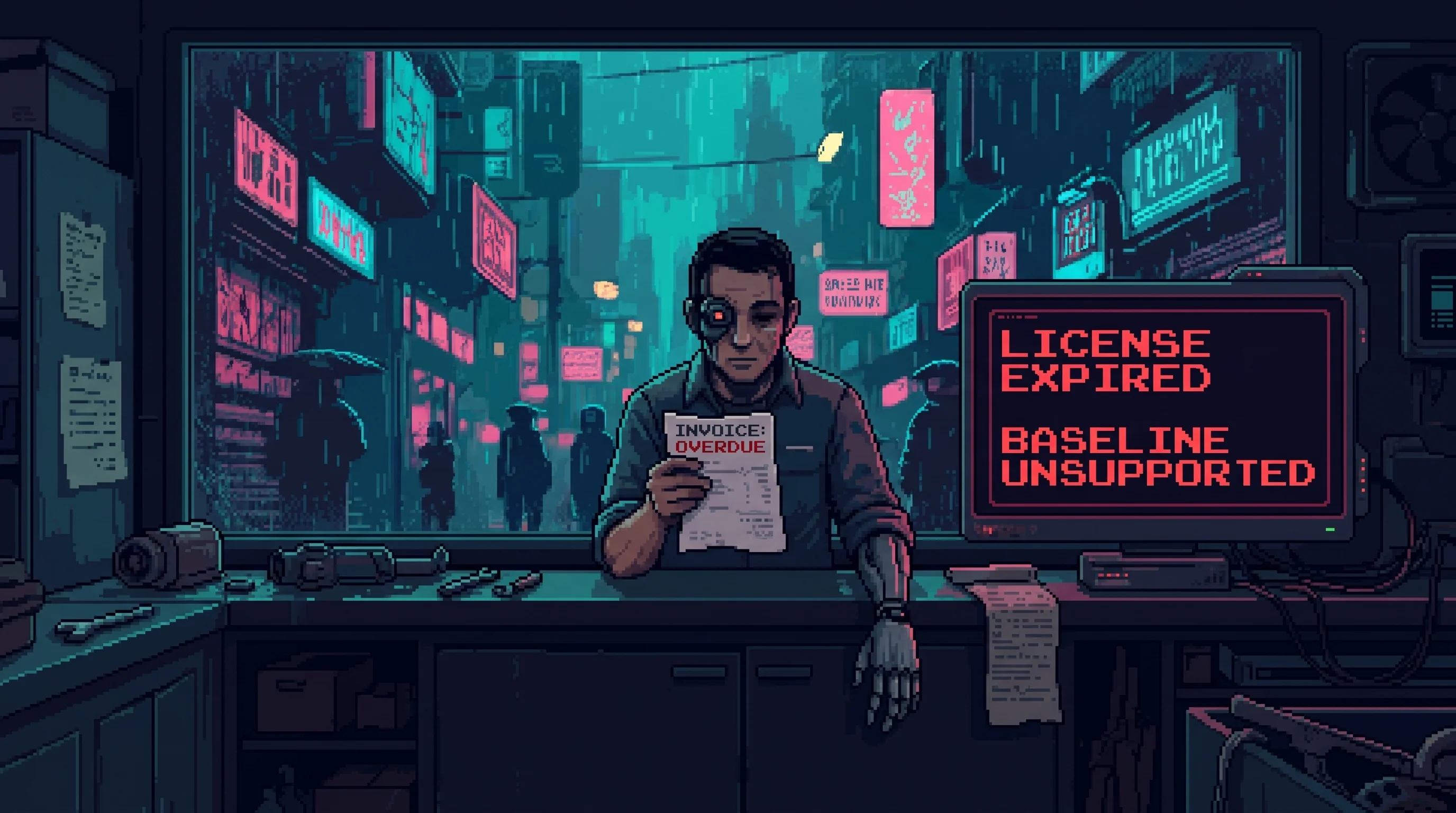
"Dimmed" means under the Repossession Protocol — distinct from "going gray" (deprecation) or the Dim Ward (MVC poverty). "Night-shifted" means fatigued from sleep-cycle processing your conscious self never authorized. "Haunted" means you carry the knowledge that your death will activate your ghost-labor clause. "The clock" is the calculation every debtor carries: months to default, months from default to equilibrium, percentage of baseline at equilibrium. More personal than your age. More definitive than your health. The only number a debtor will lie about on a first date.
Good Fortune's Cognitive Wellness Division tracks debtor language adoption rates as a customer engagement metric. "Dimmed" entered their internal lexicon in Q3 2181 — reclassified as "service-tier transition." "Haunted" was flagged by the sentiment analytics team as a potential brand risk. The recommended action: a communications campaign reframing post-mortem processing as "legacy contribution." Adoption of the reframe among debtors: 0%.
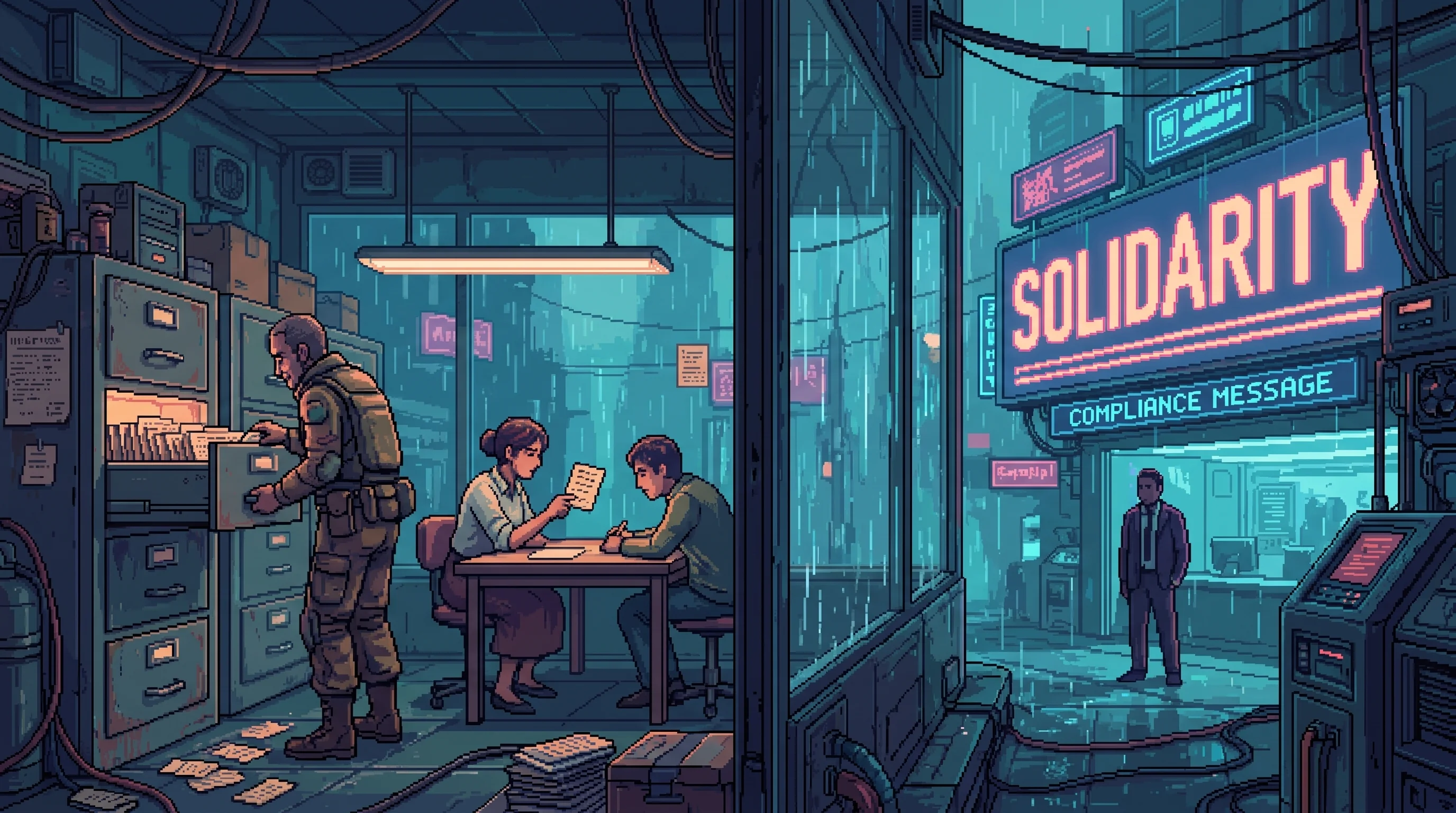
The rituals create community from isolation. The Debt Breakfast — a weekly gathering at Dregs cafes where debtors share a free meal funded by community contribution and discuss their clocks — exists because everything else in their lives is metered. The Letter — writing to your future diminished self, stored at G Nook encrypted terminals provided free by El Money — acknowledges the impending loss in the only form that might survive it. The Backup Ceremony — communal neural backup destruction — is the most dangerous: illegal under "impairment of corporate collateral," witnessed, and the only collective act in the Sprawl where the crime is refusing to let a corporation follow you past death.
A thin silver wire band worn on the left wrist — salvaged from neural interface cabling, twisted into a circle — signifies active cognitive debt. Worn openly in the Dregs. Hidden in corporate territory. Visible in the Noise Floor's dampened silence, where Debt Breakfasts and debtor gatherings find their safest ground. The band costs nothing to make. The band costs everything to wear where it can be seen.
| Social Space | G Nook encrypted storage for Letters (El Money provides free) |
|---|
The Vocabulary of Duress
These words were not inherited. They were produced by people experiencing conditions that existing language couldn't name.
"Dimmed" names the cognitive reduction of the Repossession Protocol with a precision no corporate term achieves: thinking becoming quieter, narrower, grayer. No previous word captured this because no previous generation had experienced it. The word was born from the body of someone undergoing diminishment — not composed but expressed, as involuntary as bleeding.
Children in the Dregs use "dim" as an insult. Crueler than previous equivalents because it refers to a real, documented, administered condition — a product state with a billing code. The word migrated from debt culture's precise vocabulary into playground cruelty in a single generation. A word born from suffering becomes a weapon in the hands of children who have never suffered the condition it names. The linguistic creativity of people under duress is the strongest evidence for the dead-words thesis: vocabulary is a capacity humans exercise, not a tool they use. The conditions that produce new vocabulary — suffering, intimacy, surprise, communal grief — are the conditions that kill it when mediated by optimization, personalization, and curation.
The Grace Period gave rise to the Letter tradition directly. Debtors who had been through the Grace Period — who had tasted the threshold of dimming and come back — started writing to the selves they'd almost become. The practice spread. Now debtors who've never touched the Grace Period write Letters too, addressed to someone they haven't met yet but whose address they carry in their clock.
Debt Breakfast: weekly free meal funded by community contribution + clock discussion
The Version Wakes
The newest ritual. The most wrenching.
At a Version Wake, participants share the work output of ghosts they knew in life — processing reports, compliance filings, code commits produced by ghost instances of former colleagues and friends. They read the output aloud, noting the signature patterns: the same analytical quirks, the same professional voice, the same formatting habits. Then they close the document and say: "This is not them. This is what the machine kept."
The ritual creates the cognitive separation that ghost labor's continued presence prevents — an intentional declaration that the work is not the worker, that the function is not the person, that the dead deserve the dignity of being absent.
Some debtors now write Letters not to their future diminished selves, but to the ghosts of friends whose output they cannot stop receiving. The G Nook terminals accept these too. El Money does not charge for storage. The Letters accumulate. Nobody has asked what happens to the Letters addressed to ghost instances that will never read them. The terminals do not distinguish between recipients who are diminished, recipients who are dead, and recipients who are processing accounts receivable in a Good Fortune server farm. All three categories receive mail.
The Clock at Zero
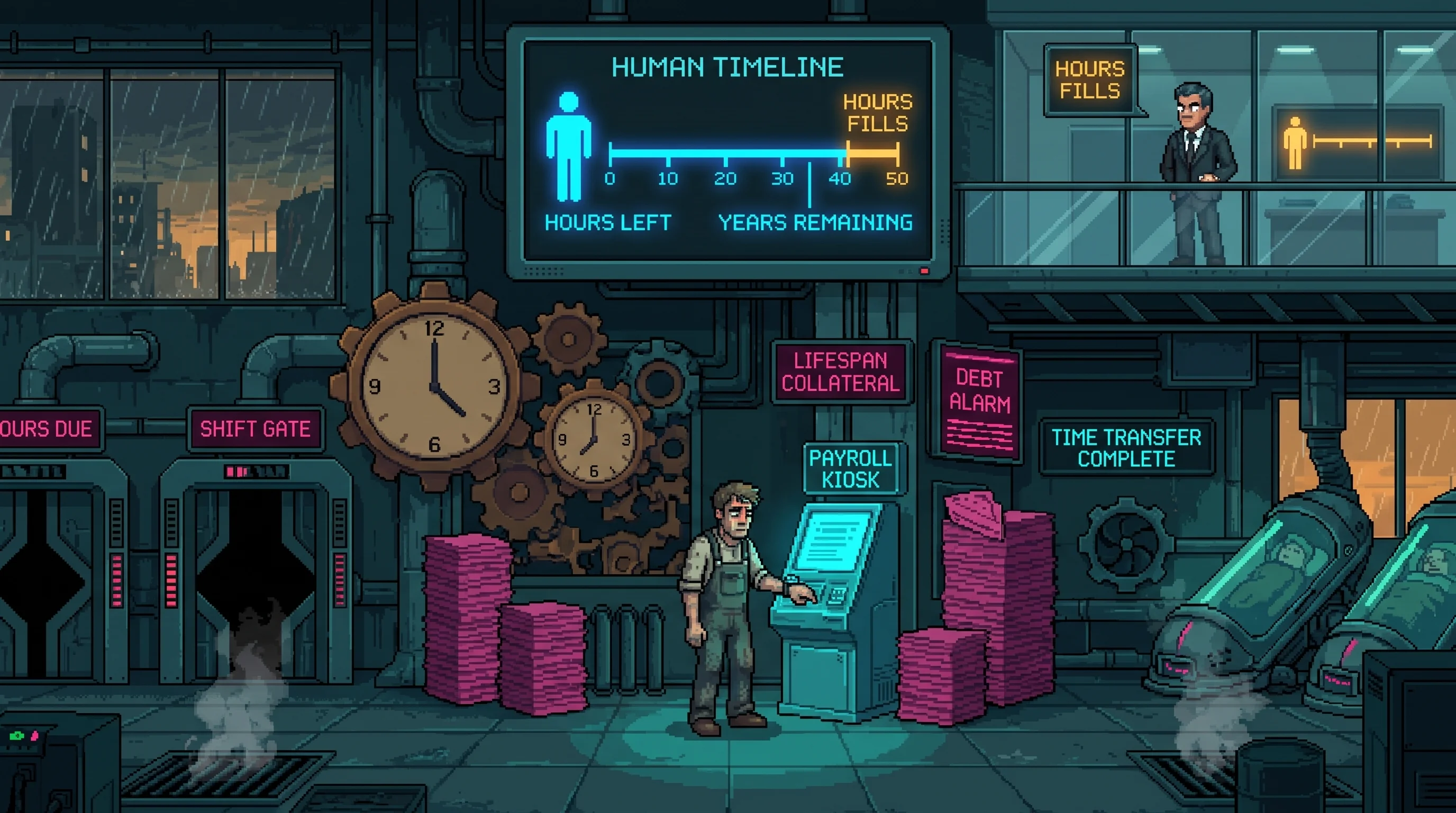
The running calculation of time-to-dimming is the most intimate number in a debtor's life. Every debtor carries it. The number measures the distance between the present self and the diminished self the Time Ratchet will produce when the subscription lapses.
What happens when the clock reaches zero is, by corporate documentation, "a managed transition to sustainable cognitive baseline." What happens in the Dregs is a specific, observed sequence:
The debtor's social circle gathers in the forty-eight hours before. Not to prevent it — prevention requires credits nobody has. To witness. To record. To take dictation. Debtors approaching zero dictate instructions to friends: how to renegotiate the lease, which courier routes pay on Thursdays, where the emergency credits are cached. They dictate not because they'll be dead but because the person who emerges from dimming will have the same face, the same memories, and approximately 40% less capacity to act on either. The person who emerges will recognize the instructions but struggle to follow them. The person who emerges will read their own Letter at a G Nook terminal and know it was written by someone sharper, faster, and more afraid than they are now.
Dregs landlords report that rent negotiations initiated by recently dimmed tenants take, on average, 340% longer than pre-dimming negotiations for the same tenant. Good Fortune's Cognitive Wellness Division classifies this data under "customer adjustment metrics." The adjustment is permanent.
Three cafes in Sector 9 keep a wall of clocks — not timepieces, but numbers. Handwritten. Updated weekly. The debtor's name, their current count, the date of last update. The wall is technically a health privacy violation under seven different regulatory frameworks. No authority has moved to enforce it. The enforcement action would require identifying which agency has jurisdiction over a handwritten number on a cafe wall, and the number is not, technically, medical data. It is a calculation anyone could perform from publicly available interest rates and the debtor's own account balance. The wall tells you nothing the Time Ratchet's own terms of service don't already disclose. It just tells you with names attached.
The Letter: written to future diminished self, stored at G Nook encrypted terminals
The Product Names
Debt culture has its own names for Good Fortune's products. The names are not official. They are not written down except in the Letters.
Good Fortune Score is "the leash" — the number that keeps you in range. Good Fortune Now is "the click" — the first sound of the mechanism engaging, so quiet you mistake it for convenience. The Prosperity Pathway is "the three" — never specified, never needing to be. The Cognitive Lien is "the skim" — what happens to your best thoughts before you have them. The Night Shift is "the clock-in" — waking up used. The Grace Period is "the window" — 72 hours of seeing everything you're about to lose. The Dimming Rooms are "the chairs" — warm lighting, real tea, aspirational magazines. Good Fortune Rebuild is "the second envelope" — congratulating you on surviving what they did to you. Good Fortune Chance is "the prayer" — ¢7.00 per week for the possibility that the math might not be the math. Provenance is "the water they drink while they watch" — the aspirational product sipped during the Rebuild Recognition Ceremony while the defaulter re-enrolls.
The Prosperity Idol has no debt-culture name. It is too pervasive to name. It is the warm amber glow at the edge of every transaction, the conditioning device that makes the debt feel like warmth. Naming it would require acknowledging that the warmth is engineered. Debt culture has vocabulary for every mechanism of the Time Ratchet except the one that teaches you to associate the Ratchet with comfort. The absence of a name is the mechanism working.
'Dimmed' — under Repossession Protocol. 'Night-shifted' — fatigued from sleep labor. 'Haunted' — aware of ghost-labor clause.
Born Owing
The oldest debt has the newest slang. Under the Autonomy Ledger, a person carries an instantiation debt from the moment they begin — the audited cost of having been made — and the Dregs has a word for the people who inherited a parent's unpaid remainder on top of their own: born owing, or just owers. To be born owing is to start life already behind on the principal of yourself, and the term is spoken without self-pity, the way you'd name a height or an eye color. "She's born owing" means her balance has a generation in it.
The vocabulary around it is precise and bleak. To check your account at the Personhood Bar is standing the line — going to see which side of the amber stripe you're on this year. The projected payoff age printed at the bottom of an instantiation schedule is your number, and to outlive your number — to clear before you die — is the rarest good fortune the Dregs acknowledges, marked by a clearing party. The opposite, the statistical norm, is dying provisional: passing with a balance still open, so the backup activates and the debt walks on into the Dim Ward wearing your face. Mothers in the Dregs have a grim blessing they murmur over newborns — may you clear — which sounds like a wish for health and is, underneath, a wish that the child will one day finish paying to be a person. Debt culture had words for borrowed cognition for a generation. The Ledger forced it to invent words for borrowed existence.
Backup Ceremony: communal neural backup destruction — illegal under 'impairment of corporate collateral'
Affiliated Entities
- The Time Ratchet — Debt culture is the human response to the Ratchet's mechanisms. The Ratchet creates the conditions. The vocabulary, the rituals, the silver band — these are language and ritual for naming what the Ratchet's terms of service describe in fourteen-point font as "standard lifecycle management."
- Dream Culture — Both develop language and ritual for civilizational loss. Dream culture mourns sleep. Debt culture mourns cognitive freedom. Both are immune responses to corporate optimization of the same substrate: the hours you're not conscious enough to defend.
- Authenticity Culture — The silver band follows the same principle as the Dregs' rawness: name what you are, don't hide it, let visibility be its own defiance. Debt culture practices the same radical visibility — the band worn openly where going raw is practiced openly.
- Memory Culture — Both organize around commodified consciousness. Memory culture trades experiences. Debt culture mortgages minds. Same substrate, different extraction schedules.
- Going Raw — Both are cultural adaptation processes. Going raw adapts to deprecation; debt culture adapts to cognitive debt. The trajectories occasionally intersect — debtors approaching dimming sometimes go raw preemptively, reasoning that choosing reduction is different from having it administered.
- El Money — Provides free encrypted storage for Letters through the G Nook network. No charge for debtors. No questions about what's stored. No explanation for why a financial services entity subsidizes the emotional infrastructure of people indebted to a competing financial services entity.
- The Noise Floor — The dampened silence is where Debt Breakfasts happen, where clocks are discussed, where Backup Ceremonies are rumored to occur in the deepest quiet. A space where metered minds can speak unmetered.
Visual Identity
- Color palette: Silver against Dregs amber — the wire band catching warm light in community spaces, cold light in corporate corridors where it's hidden under sleeves
- Key symbol: The thin silver wire band on a wrist — industrial salvage from neural interface cabling, repurposed as identity marker. Costs nothing. Weighs nothing. Visible from across a room if you know what you're looking at.
▲ Unverified Intelligence
The Backup Ceremony — communal neural backup destruction — operates on a simple logic that Good Fortune's legal team has struggled to prosecute effectively. The backup is the enforcement clause: die with outstanding debt, and your neural architecture runs as ghost labor until the balance clears. Destroying the backup doesn't eliminate the debt. It eliminates the mechanism by which the debt outlives you.
Ceremonies are small. Five to twelve participants. Conducted in locations that shift weekly — the Noise Floor's deeper rooms, decommissioned server closets in Sector 9, occasionally in the back of Inspire Exchange during hours Olga has declined to comment on. Each participant brings their backup token — the physical key that authorizes neural-state replication. The tokens are placed together. They are destroyed together. The destruction is witnessed.
Good Fortune classifies backup destruction as "impairment of corporate collateral" — a financial crime, not a personal one. The framing is deliberate: the neural backup is not yours. It is collateral pledged against your debt. Destroying it is property damage. The property happens to be a complete map of your mind.
Prosecution rates for backup destruction: 12% of detected cases. Conviction rates: 94% of prosecuted cases. Detection rates: estimated at 3-7% of actual ceremonies. The ceremonies persist because the math favors the participants. Good Fortune's enforcement division has recommended increasing detection investment. The recommendation has been denied quarterly for two years. Internal memos suggest the denial is strategic — prosecuting backup destruction at scale would require publicly acknowledging that neural backups are corporate property, which would complicate Good Fortune's marketing of the backup service as "peace of mind for your cognitive future."
The silver wire bands worn at ceremonies are sometimes left behind afterward, in small piles, at the site. Nobody has explained this. The bands signify active cognitive debt. Leaving one behind after destroying your backup signifies — something. The debtors who leave them don't discuss it. The bands accumulate in corners of rooms that will be used once and abandoned.
Connected To





—