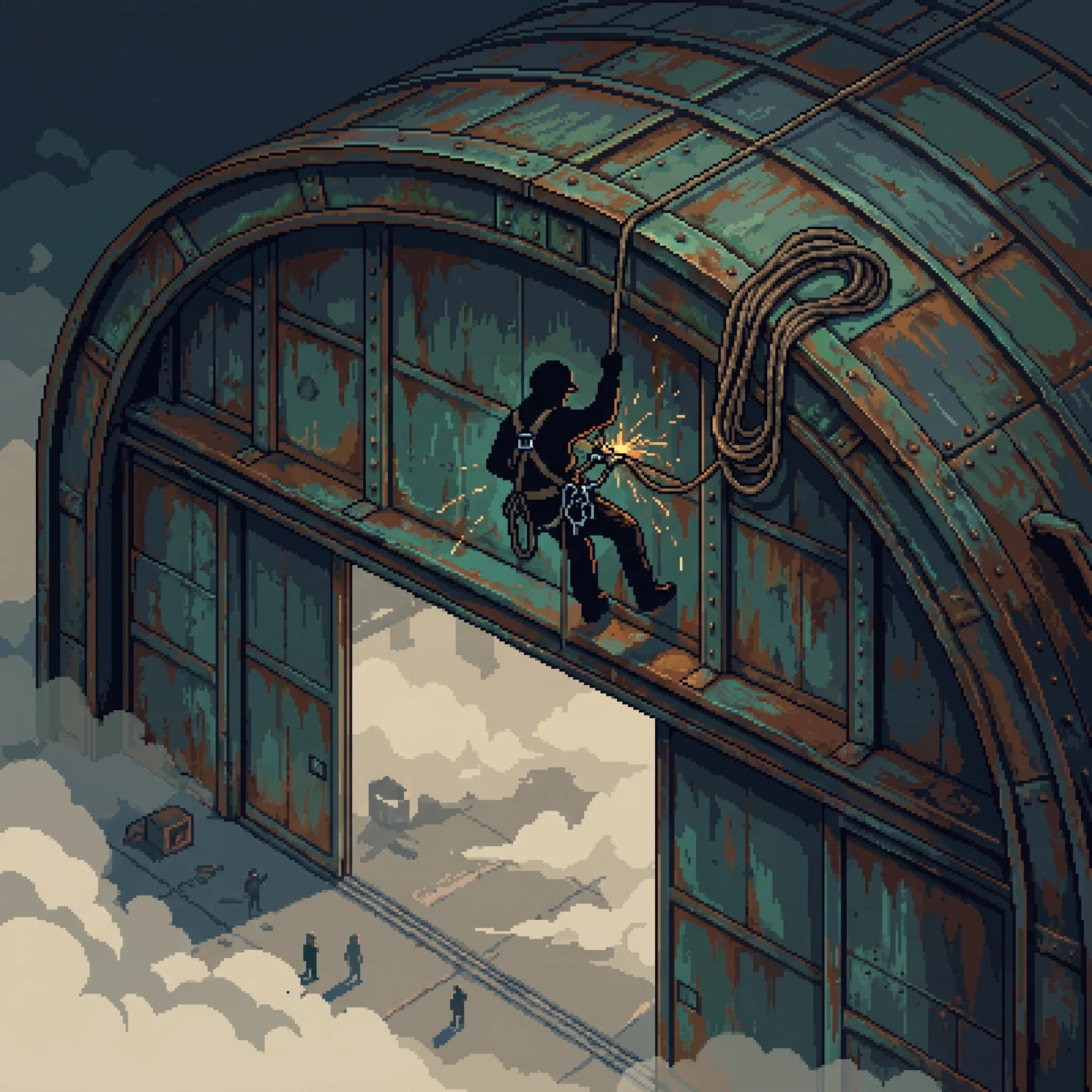
The Steeplejacks
A standard Ironclad-spec wet-environment maintenance drone lasts a median eleven weeks in Cathedral service before salt intrusion seizes a servo or shorts a control board; a Steeplejack's rope and harness routinely outlast three drone replacement cycles
Overview
The old glossaries call the Cathedral a hangar the size of a weather system, visible for ten miles across flat salt water. Standing under it, that description undersells the thing. Warm air off the reed beds meets the cold steel of its roof, and the building generates its own fog. Nobody built it to shelter anyone. It was built to hold an airship, then a research fleet, then nothing. What it holds now, most nights, is whoever the marsh has pushed further than the Dregs will take them — and it can only hold them because someone keeps its roof from falling in.
That someone is the Steeplejacks. There are about two hundred and ten of them, working in four-person rotations, climbing a structure that corrodes faster than any comparable building in the organized Sprawl, because the same 90%-humidity air that makes the marsh unlivable for most machines makes the Cathedral's roof panels rust from the inside within a decade of installation. Ironclad tested a wet-environment maintenance drone here in 2179. It lasted eleven weeks before a servo seized on the north quarter and the unit had to be cut free and scrapped for parts. Ironclad did not send a second drone. Ironclad did not send an invoice, a contract, or a claim of any kind. The Cathedral is not Ironclad's problem, because problems require ownership, and nobody wants to own eleven acres of failing roof over a population that generates no revenue.
So the market found its own answer, the way it always does when the corporate answer is silence: three dockworkers with nothing left to lose climbed the Cathedral's east face in 2151 and patched a hole in exchange for a dry corner to sleep in. Thirty-three years later, their trade is the only reason the largest structure in Sector 22 hasn't collapsed into the marsh it was built beside.

Organization Structure
There is no Steeplejack office, charter, or membership roll, and that absence is load-bearing. A guild that appears on a registry is a guild a corporation can serve papers to, tax, license, or simply outbid. The Steeplejacks have none of those exposures because they have none of the infrastructure that creates them.
What they have instead is the rotation. Riggers work in fixed four-person teams — two on rope, one on the winch, one on ground-watch reading the wind off the salt ponds, because a gust that would be a nuisance anywhere else can put a climber into a support beam eighty feet up. Rotations are assigned by the oldest active rigger, currently Ines Delgado, forty-one years in harness, who holds no formal title and would refuse one if offered. Delgado does not lead the Steeplejacks. She keeps the list of who owes whom a rotation, who taught whom the panel-31 knot, and who is too hungover to climb this week. That is the entire administrative apparatus of a trade that keeps a structure the size of the Cathedral standing.
Payment moves in three currencies: dry-storage rights inside the hangar's lower deck, salvage shares from whatever the crew strips off a condemned panel, and ration chits traded hand to hand from whoever commissioned the repair. Nobody has ever been paid in scrip that could be traced to a corporate account, and the guild intends to keep it that way.
Key Figures
Ines Delgado — Forty-one years climbing. The closest thing the Steeplejacks have to an office, in the sense that she is where disputes go to be settled and nowhere else exists to send them. She apprenticed under one of the original 2151 founders and has outlived two entire generations of rotation partners. She does not climb the north quarter anymore. She still inspects it, from the ground, twice a week, because her eyes are better than most riggers' harnesses.
Odalys Ferreira, Desmond Cole, and Mireille Tran — The three dockworkers who patched the Cathedral's east face in 2151 for a dry corner to sleep in. None of them are alive in 2184. Ferreira tied a modified bowline to secure that first patch. The Steeplejacks still call it the Ferreira hitch, and every apprentice learns it in their first week, whether or not they ever learn her name.
Coen Bautista — Died in 2183, nineteen years old, four months into his harness rotation. Went through a rusted seam on the north quarter and fell eleven meters onto salt-crusted concrete. He is buried beneath panel 31, the one he had patched himself two months before he fell through a different one. Marsh mud does not hold a grave — pilings do, and the Cathedral's foundation is the only ground in a day's walk that will.
Reyna Castillo — Bautista's rotation partner. She still climbs past panel 31 every rotation because it is the fastest route to the north quarter's worst leak, and she has repatched the seam that killed him three times since. It still leaks. She stopped expecting it not to sometime in the second year.
If it holds, we didn't touch it. If it's ours, it holds.
- “the Ferreira hitch holds”
- “dry corner for dry work”
- “we don't sign anything”
- “ask who tied it”
Cultural Influence
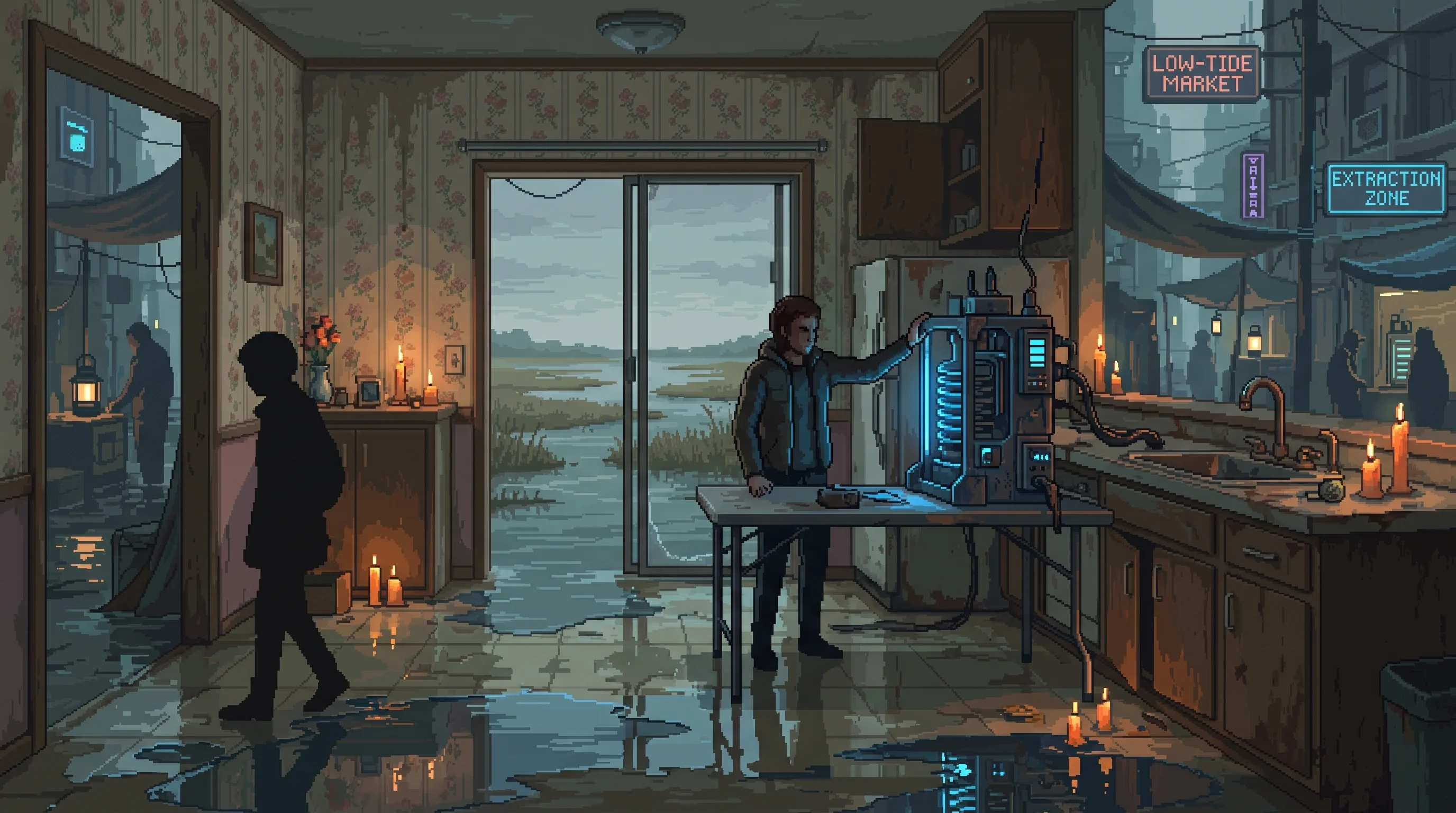
The Steeplejacks have no anthem, no uniform beyond salt-bleached canvas harnesses, and no recruitment drive, but the Platform Settlements measure status against them anyway: a family with a Steeplejack in the rotation has a dry corner of the Cathedral guaranteed in flood season, and everyone in the marsh knows exactly which families those are. Apprenticeship is the closest thing the Southern Marshes has to upward mobility that doesn't route through a corporate ledger.
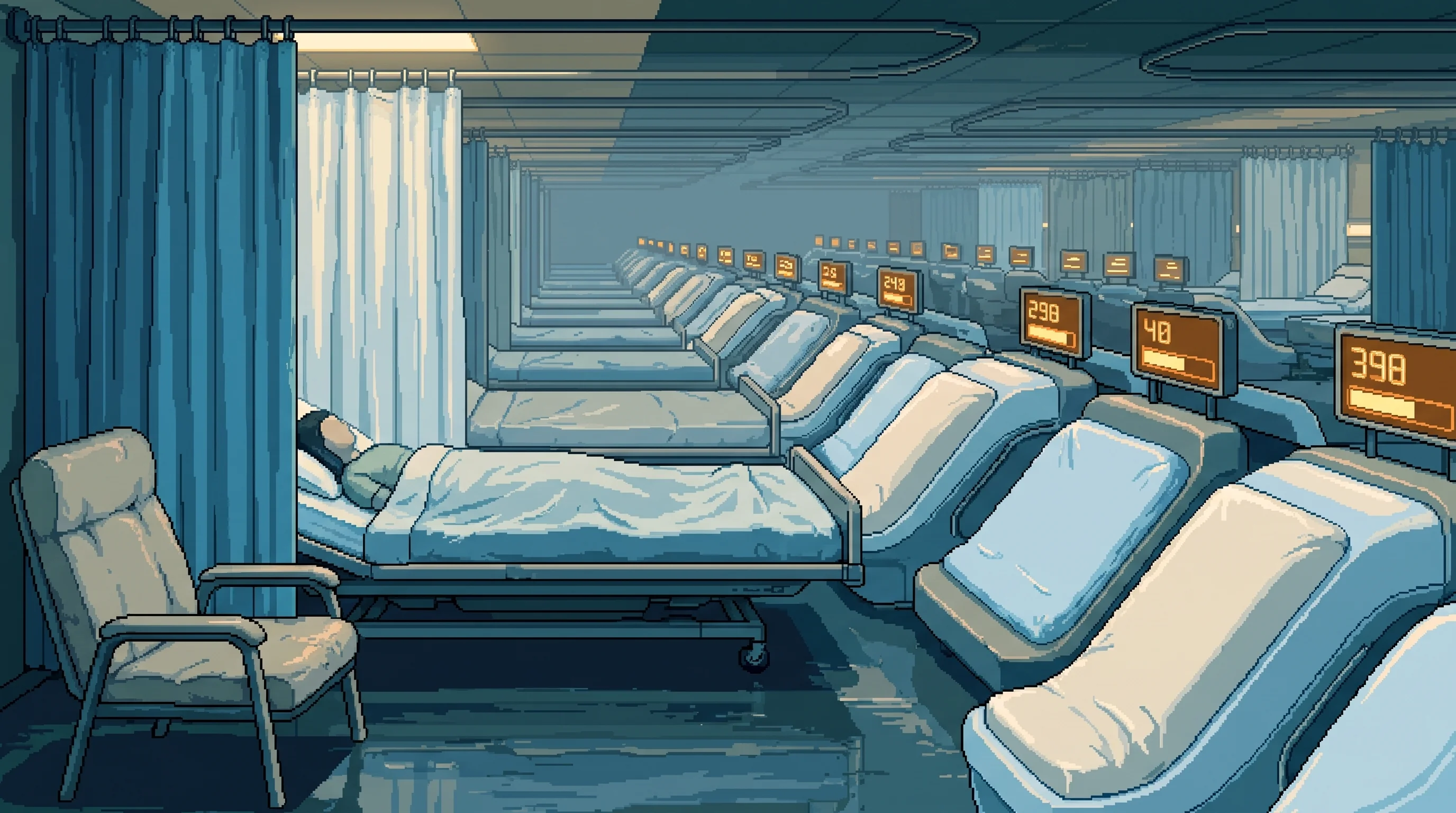
The guild's suspicion of Relief's medical boats and Wholesome's ration outreach runs on arithmetic the riggers do out loud, the same way Ines Delgado teaches knots. A scanned rigger is a rigger with a price a corporation can undercut. A counted family is a family Relief can build a dependency map around. The Steeplejacks have watched what happened to the Averaging House's newly-instanced arrivals a few kilometers north — legal personhood bought with a ration card and a residual-configuration form nobody reads before signing — and decided, without ever voting on it, that staying illegible was worth more than any service a scan could buy them.
The one corporate exception is quiet and unadvertised: Halcyon Bridgeworks pays Steeplejack crews, in cash, off any ledger its Rothwell auditors would need to explain, to reseal the Waiting Ward's window frames each rain season. The same humidity that seizes Ironclad's drones warps Halcyon's window seals a half-day's walk away, and a terminal-care subscription company with a cerulean brand built on hope finds it cheaper to pay the guild it would never admit exists than to solve the seal problem any other way.
Affiliated Entities
- Organic Deployment Threshold: The Steeplejacks are its ungoverned twin. Ironclad's Workforce Optimization division has never filed a configuration document for Cathedral maintenance, because no division has ever claimed the Cathedral as an asset worth optimizing. The same arithmetic that makes contracted humans cheaper than robots at the Heap and the Foundry produced the same answer here without a spreadsheet, a classification level, or a single quarterly review.
- The Labor Question: A third proof of the Cheaper Hand, found with no ATLAS lineage and no corporate sponsor at all. Salt humidity prices the machines out before any wage floor does, and the gap filled itself with people nobody had to put in debt to get.
- Ironclad Industries: Never contracts Cathedral work, but its rejected deep-environment gear — harnesses, cable, subplate joints too corroded for orbital certification — resurfaces in the marsh salvage markets as Steeplejack rigging. One program's scrap is another trade's entire toolkit.
- Relief: Steeplejack crews refuse the aid-distribution enrollment scans Relief runs across Sector 22, on the correct assumption that a mapped population is a priced population.
- Wholesome: The guild is the one population in Wholesome's Sector 22 outreach territory its dependency maps have never closed around, for the same reason.
- Halcyon Bridgeworks: Quietly pays Steeplejack crews, off the books, to reseal the Sector 22 Waiting Ward against the humidity Halcyon's own maintenance contracts can't solve at any price a vendor ledger could survive explaining.
- The Waiting Ward: A half-day's walk away on the same humidity gradient. One building spends a fortune keeping the salt air out. The other exists because nobody will spend a fortune keeping it out.
- The Deprecation: Never applies here. The Deprecation processes enhanced corporate employees out of relevance through firmware reversion and consciousness-tier downgrade, and that pipeline only runs on someone who was enhanced and employed to begin with. No Steeplejack was ever either. There is no status left for the vocabulary to revert. Exclusion this total looks, from inside the marsh, almost like an exemption.
- The Great Divergence: The tier gap runs on things a corporation can threaten to take back — a license, a job, a cognitive upgrade half-paid-for. The Cathedral's rigging guild was never handed any of those, which puts two hundred riggers somewhere the Compact's usual leverage cannot follow.
| Type | Informal rigging and structural-maintenance trade, unlicensed |
|---|---|
| Leadership | None — trade passed master-to-apprentice; disputes arbitrated by convention, not authority |
Sensory Details
| Sense | Detail |
|---|---|
| Smell | Wet rust and rope tar — the specific mineral tang of oxidizing steel mixed with the tallow riggers work into harness rope to keep it from stiffening in the humidity |
| Sound | Wind through the Cathedral's open doors makes the whole structure hum at a low frequency riggers learn to feel in their sternum before they hear it — a rising hum means a gust worth stopping the rotation for |
| Touch | A rusted panel seam gives slightly under a boot before it gives completely; riggers learn to read the difference through two layers of boot leather |
| Sight | Reed-bed fog rolling through the hangar's open doors at dawn, backlit by the first light through gaps in the roof where a panel hasn't been patched yet |
Visual Identity
- Color Palette: Oxidized copper-green panel patina, salt-bleached canvas and rope, rust-orange at every seam and joint
- Compositional Mood: A single rigger small against an impossibly large curved roof, rope the only line connecting the human scale to the structure's scale
- Key Symbol: The Ferreira hitch. Every apprentice learns this modified bowline first, tied originally by a founder who has been dead for decades
- Lighting: Flat marsh-fog gray outside, shafting into gold wherever a gap in the roof lets dawn light through
No Steeplejack carries a corporate payroll record — payment is barter only, which is the entire reason no Organic Deployment Threshold calculation has ever been run for Cathedral maintenance: there is no contract to calculate against
He is buried beneath panel 31, the one he had patched two months earlier, because marsh mud does not hold a grave and pilings do
Local Intelligence Scan
Nearby Signals
CANONICAL PROXIMITY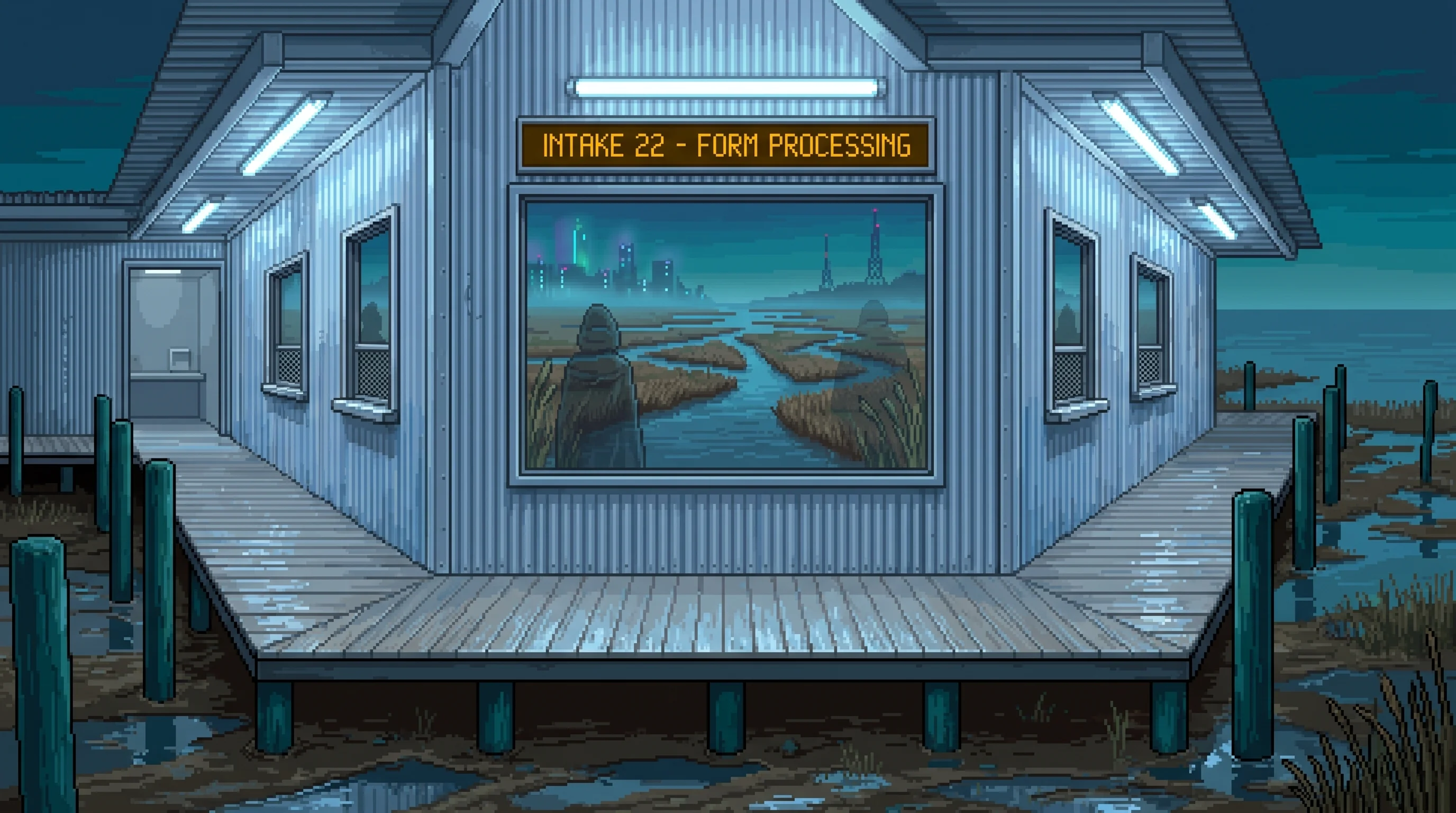


Environmental Readout
LIVE CONDITIONS- Air
- Hazy
- Light
- Fog shrouded
- Flood
- Chronic
- Heat
- Temperate
- Security posture
- Ungoverned
- Infrastructure
- Improvised
Position Data
SECONDARY- Elevation band
- Bay floor — below the Rim
- Lattice fix
- E+10.9 · N-30.2
Connected To




—