The Heat Ward
Overview
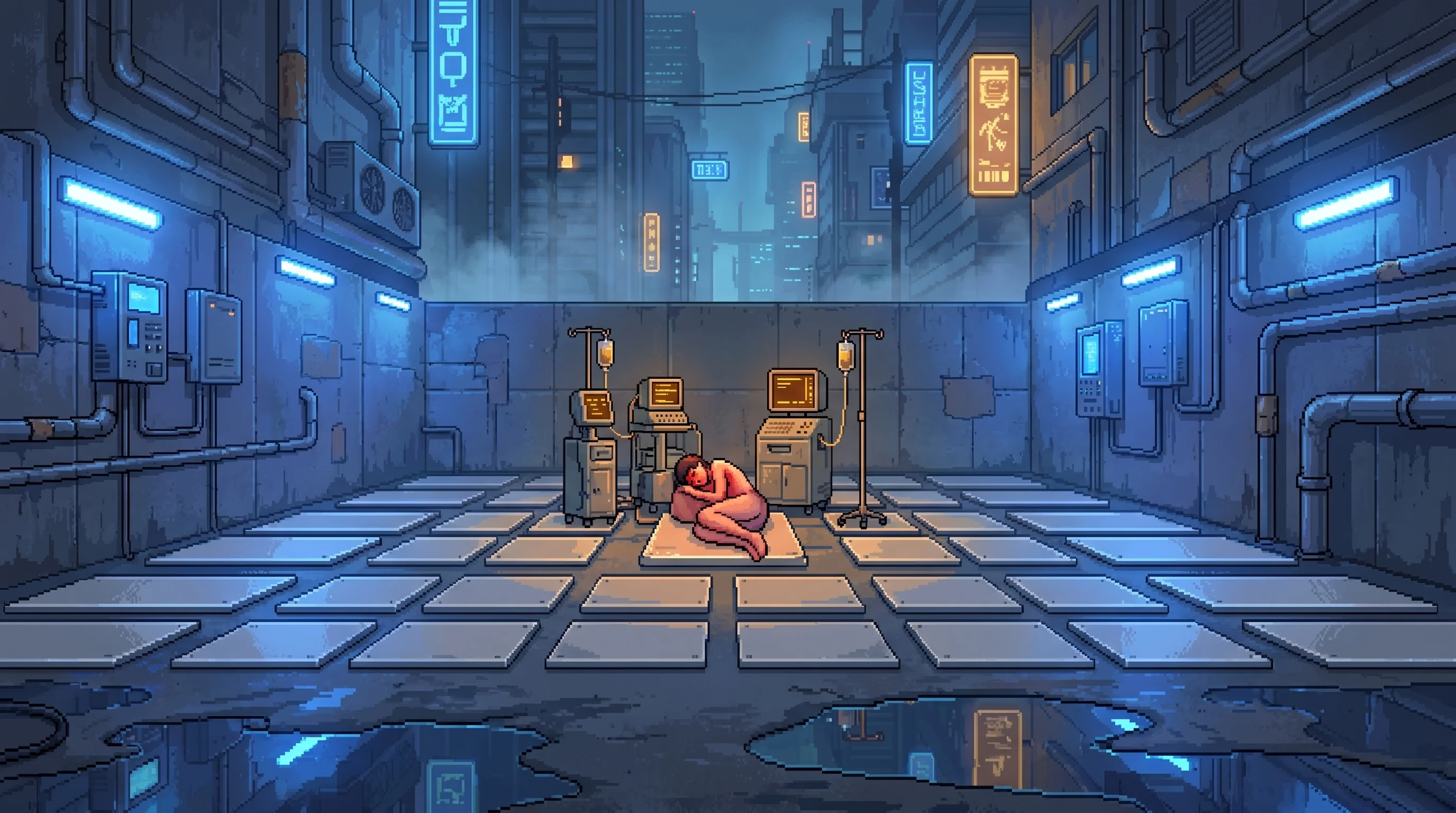
The Heat Ward has treated 847 patients as of February 2184. It has zero beds, zero institutional funding, and zero official recognition from any medical authority in the Sprawl. The cooling mats — sixty of them, salvaged from decommissioned Nexus server farm substrate systems — maintain a surface temperature of 18°C, which is the precise temperature specified in Nexus Technical Bulletin 4401-C for "optimal crystalline substrate preservation during thermal exceedance events." The bulletin does not mention humans. The mats do not know the difference.
The Coolant Guild built the Ward over three years in the Cold Corridor's widest junction, a maintenance bay at sub-level S4-D that nobody else wanted because the ambient temperature runs 8-12°C year-round. Cold enough to discourage squatters. Cold enough to discourage corporate inspection. Exactly cold enough to keep sixty overheated people alive when the compute climate turns lethal and the temperature in the upper levels hits 34°C.
Dr. Selin Ayari's Insomnia Ward network provided the medical equipment — monitoring rigs, IV stands, a field triage protocol adapted from her overnight clinics. The Coolant Guild provided the engineering. The Cold Corridor provided the coolant. Nobody provided the funding. The Ward's operating budget, such as it exists, is a line item on no organization's books. Coolant Guild invoices for the junction's thermal load list the Ward's draw under "Substrate Maintenance — Legacy Systems." The legacy systems are people.
Dr. Felix Strand
The Ward's medical volunteer is Dr. Felix Strand — deprecated Helix pharmaceutical assistant, dimmed neurologist, the only person in the junction whose hands are steady enough and whose knowledge is broad enough to manage thermal shock cases without institutional backup.
"Deprecated" is Helix's classification for pharmaceutical assistants whose certification lapsed when Helix automated the role in 2179. "Dimmed" is the informal term for neural-augmented specialists whose augmentations have degraded past manufacturer warranty. Strand's neurology augmentation operates at approximately 40% of its original capability, which means his diagnostic accuracy exceeds that of most fully certified general practitioners in the upper levels by a comfortable margin. He can identify the onset of thermal organ failure from across the room by watching how a patient breathes.
He does not bill. He does not file. He moves between the silver mats in the blue coolant light, checking vitals on monitoring equipment that Dr. Ayari's network maintains remotely. 847 patients. No fatalities on the mats. Three fatalities in transit — patients who arrived too late, carried down from the upper levels by neighbors who did not know the Ward existed until the thermal emergency was already underway.
Strand does not discuss the three. He discusses the 847.

Conditions Report
The Cold Corridor's coolant system runs at a rhythm the regulars call "the pulse" — a 72-beat-per-minute flow cycle that is either a coincidence of fluid dynamics or a Guild engineer's quiet joke. It is audible in every room of the Ward, a low hydraulic thrum beneath the conversation, the monitoring beeps, the occasional sound of someone crying from relief on a mat that was built to keep a server rack at optimal temperature.
The air smells clean. Not hospital-clean — infrastructure-clean. Synthetic coolant has a faint chemical sweetness that the upper levels never encounter because up there the coolant is sealed inside walls and floors. Down here the pipes are exposed, patched, occasionally leaking. The sweetness is the smell of a functioning system viewed from behind.
Blue light from coolant monitoring panels. Amber light from medical equipment. Silver mats on bare concrete. The visual palette is identical to every Nexus server maintenance bay in the Sprawl. The difference is the shapes on the mats. Server substrate is rectangular. Humans are not, but they learn to fit.
During a thermal emergency, the Ward fills in under twenty minutes. People arrive flushed, disoriented, some carried. They lie on the silver mats and the mats do what they were designed to do — pull heat from whatever is on top of them, efficiently, precisely, without discrimination. The relief is physical and immediate. Some patients describe the first thirty seconds as the most intense bodily sensation they have experienced. Several have cried. The mats' temperature logs do not record this.
| Established | ~2181 by Coolant Guild in coordination with Dr. Ayari's Insomnia Ward network |
|---|---|
| Medical Volunteer | Dr. Felix Strand (deprecated Helix pharmaceutical assistant / dimmed neurologist) |
| Patients Treated | 847 as of February 2184 |
| Irony | People cooled by the system that heated them, sheltered by the infrastructure that displaced them |
Affiliated Entities
| Entity | Relationship |
|---|---|
| The Cold Corridor | The Ward occupies the corridor's widest junction — a maintenance bay the Guild adapted because the cold that makes it uninhabitable makes it medically useful |
| The Coolant Guild | Founded and maintains the Ward. Guild engineers adapted the substrate cooling mats for human use. The modification required changing one setting. |
| Dr. Selin Ayari | Her Insomnia Ward network provided medical equipment, triage protocols, and remote monitoring infrastructure — the same system that runs her overnight clinics |
| The Insomnia Wards | Shared medical protocols and equipment. The Heat Ward's monitoring rigs report to the same network as Ayari's clinics across the Sprawl |
| Dr. Felix Strand | Deprecated Helix pharmaceutical assistant. Dimmed neurologist. 847 patients, zero mat fatalities. Steady hands and a 40% augmentation that outperforms most fully certified practitioners above |
| Thermal refugees | The Ward's patients — displaced from upper levels during compute-climate thermal events, cooled on mats designed for crystalline substrate |
| Nexus Dynamics | The cooling mats are Nexus hardware. The coolant is Nexus infrastructure. The thermal emergencies are Nexus computational load. Nexus does not know the Ward exists. The Ward runs on Nexus systems. |
Visual Identity
- Color palette: Coolant blue (#4169E1), silver mats (#C0C0C0), amber monitoring light (#D4A017)
- Key symbol: A human shape on a silver rectangle designed for crystalline substrate — the machine's temperature control serving a purpose its manufacturer never specified
- Lighting: Blue from coolant monitoring, amber from medical equipment — infrastructure lighting that was never meant to illuminate skin but does

| Stratum | Dregs |
|---|---|
| Power Position | Below |
| Access | Underground |
| Atmosphere | Dangerous |
60-person capacity on cooling mats salvaged from server farm substrate systems
Irony is architectural: people cooled by the system that heated them
Connected To




Local Intelligence Scan
Nearby Signals
CANONICAL PROXIMITY



Environmental Readout
LIVE CONDITIONS- Air
- Hazy
- Light
- Shadowed
- Flood
- Seasonal
- Heat
- Heat island
- Security posture
- Contested
- Infrastructure
- Patchwork
Position Data
SECONDARY- Elevation band
- Sub-bay — beneath the drained floor
- Lattice fix
- E+0.4 · N-3.3

—