
Big Ruthie
Her chief answered nine redeployment orders over those 22 hours with the identical logged reply: 'Unable to comply. Machine is load-bearing'

Overview
Big Ruthie is one machine of the Pourhorses, Ironclad Industries' walking construction fleet: Loadbearer-Gantry hull LG-214, laid down 2156, 2,900 tonnes, a span-setter that spent fifteen years raising the Outer Works — including the stair cores of the Excelsior residential grid, which mattered later. A crew painted BIG RUTHIE on her cab in 2157. No surviving record says who Ruth was. The district considers the question closed.
Her war was short and split in half. Requisitioned on Day 3 of the Three-Week War with her crew of seven and refitted with a breaching grapple, she opened three Nexus data centers for Operation BEDROCK — buildings whose owners had declined to open them. She was staged at the Outer Works yard for the bay-floor work when the Grid Collapse of Sector 8 put the Excelsior grid in the dark, 800 meters east of her floodlights. The yard, on isolated backups, kept welding. For a day the blocks held. Then, at about three in the morning on Day 12, the batteries the recyclers ran on reached the end of their exact sizing. Her crew stood in a lit yard, listening to a dark district. The chief walked her off the staging line.
The walk took most of an hour. The next 22 hours took sixty-one doors — sealed block exits, engineered to hold against people pushing from inside, pulled out frame-and-all. The machine was built by the company that built the doors. The crew had set those stair cores, and knew where every block would give. Dispatch ordered her back to staging nine times. The chief's logged reply never varied: Unable to comply. Machine is load-bearing. Under Ironclad's own doctrine a load-bearing machine cannot be moved without a releasing engineer's countersignature, and no engineer would sign a release, sight unseen, for a load the chief kept swearing to. The form had a field for load. It had no field for anything else the chief was doing, so the load is what the record says.
Her log counts doors. It does not count people. Asked under oath, once, how many came out, the chief's answer is in the record: fewer than knocked.
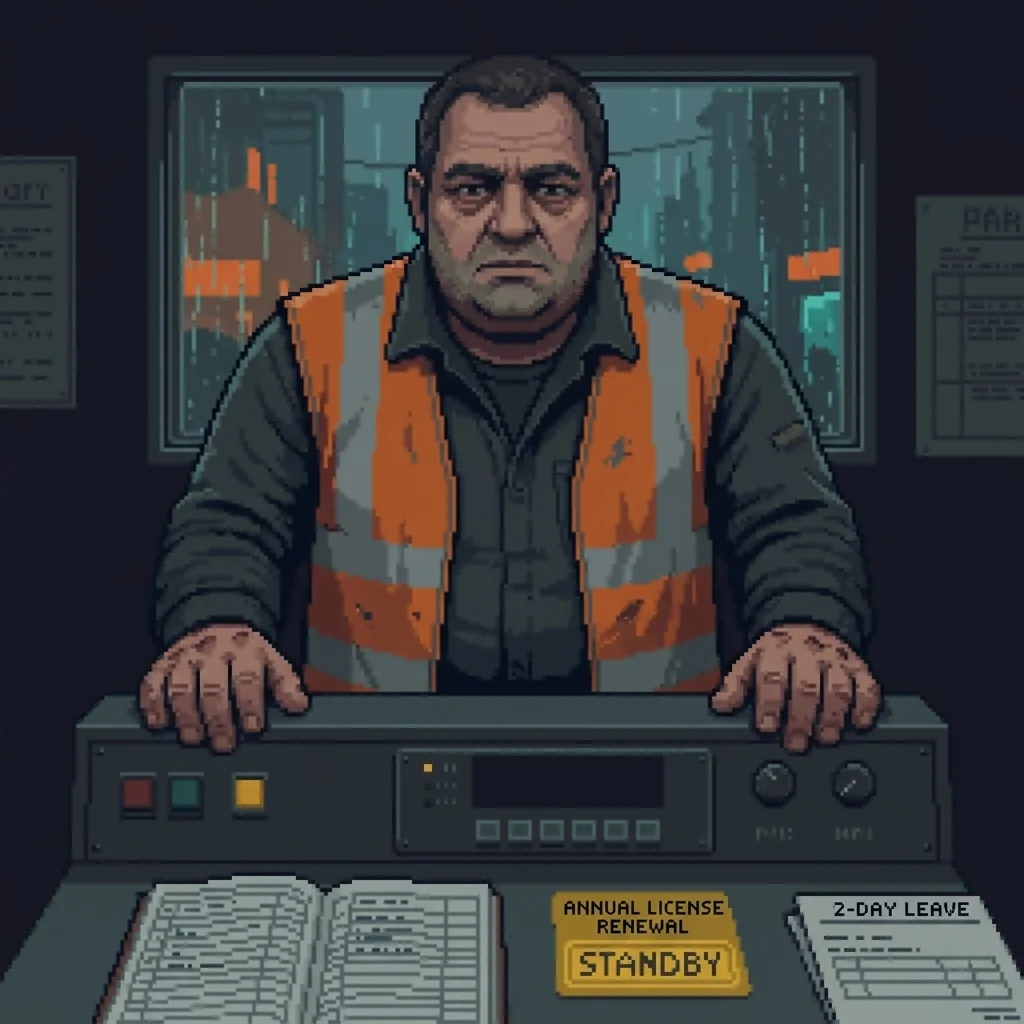
For thirteen years the chief's name lived in a deposition index and a license renewal. It is on the record now — Marek Stolarz, weighbridge master, eastern yards — and the people who keep Ruthie have responded to its publication the way the crews always responded to paperwork: they continue to call him the chief.
Appearance
She stands where she stopped, mid-stride, one walking shoe forever forward, at the mouth of an Excelsior residential street that has been rebuilt around her stance. The work orange has faded thirteen years toward rust everywhere except the cab name, which gets repainted. She still wears her torch-scarred war plate; the crew cut most of it away during the 47 hours for reach, and what is left is the shape of what the reaching required. Her joints are black with fresh grease — she is a maintained machine, not a wreck, and smells like one: grease, cold steel, and the wet-concrete breath of the street she is part of now.
Her grapple is lowered to chest height, jaws open, and between the jaws run wires strung with door keys — left by visitors, one at a time, for thirteen years. The Doorwrights string and oil them every spring; the count stood at 11,406 last spring. When the wind comes off the bay the keys move, and the district says she rings. At her feet is a brass plaque Ironclad affixed in 2174: IRONCLAD INDUSTRIES HONORS EQUIPMENT AND PERSONNEL — COMMUNITY CONTINUITY OPERATIONS, 2171. The plaque does not mention that she spent those operations refusing Ironclad's dispatch orders. It is the only part of her nobody maintains. It stays legible anyway. Brass is like that.
Provenance
Built 2156 at the Outer Works; fifteen years of spans and stair cores. Requisitioned to the Enforcer Corps on Day 3 of the war — the hull enrolled, her crew attached by one-page works order — under the doctrine that puts a named hand on every lever. Her BEDROCK service is on her chain like everyone else's. The district does not hold it against her, on grounds it has never needed to write down: the machine was as much a hostage as the rest of the payroll. After the lights came back she stayed a month, lifting what the recovery needed lifted, and some of what she carried out of the blocks that month is why nobody has ever proposed moving her to somewhere more convenient.
Ironclad's tow order was cut in 2172 and has been open ever since — the oldest open work order in the company, reissued automatically each quarter, arriving in the yards like weather. Executing it requires a releasing engineer's signature on the load report. The load report still says what the chief filed. In thirteen years, through three amnesty offers and one attempted reclassification of the entire hull as scrap, no engineer has signed, and the company that wrote the doctrine has discovered what the doctrine is for: a named hand can refuse.
The crew were seven. Their names are on the Corps' chain records and on no plaque, because the district knows them and declines to spend them. The chief has never given an interview, comes back once a year, and — the one fact this record will spend — still renews a heavy-plant license every year, category gantry, for a machine that will never walk further than ten meters. The Corpo-Nations theorists keep Ruthie as a footnote with a barb in it: the company owns her, the district keeps her, and sovereignty turns out to be whoever the engineers won't sign against.
| Hull | Loadbearer-Gantry LG-214, laid down 2156; 2,900 tonnes |
|---|---|
| Name | 'Big Ruthie,' cab-painted 2157; no record of who Ruth was |
The Walk
Every March 26 at 02:11 — the minute Sector 8's lights came back — the Doorwrights fire her engines, and Big Ruthie walks ten meters out and ten meters back, floodlights on, every key ringing. It is the shortest parade in the Sprawl and the only one whose route has never changed, because the route is the point: she moves just far enough to prove she still can, and stops where she stopped.
The guild took over her upkeep in 2172 and has never called it a memorial. Her line item on the Doorwright rolls reads equipment: pry bar, large. She is, by their reckoning, a tool of the trade, the trade being doors. The guild's whole law applies to her the way it applies to a stuck exit: the door opens or we come back. People leave door keys year-round. In spring they also leave pump grease, cans of it, more than one machine can use. The wrights trade the surplus to the yards for parts. The district's grief has a supply chain now, running at a small operating profit everyone involved has agreed not to examine.
Affiliated Entities
- The Pourhorses — Her class; the fleet that walked to war and back
- The Grid Collapse of Sector 8 — The 47 hours; her 22
- The Three-Week War — Both halves of her service
- Ironclad Industries — Owner of record; author of the unsigned tow order
- The Enforcer Corps — Her wartime chain, and the doctrine that protected her
- The Doorwrights — Keepers; she is their largest pry bar
- The Unsealed Door — The other Sector 8 memorial, welded open in Neon Graves
She has stood where she stopped ever since: Ironclad's tow order has been open since 2171, because moving a machine reported load-bearing requires a releasing engineer's signature, and no engineer has ever signed
Visitors leave door keys; the Doorwrights string them on wire between the jaws of her lowered grapple and oil them each spring — 11,406 at the last count, and when the wind is right the district says she rings
Connected To
Supporting Connections

One hull of the walking fleet; the one the Sprawl knows by name.
Ironclad's crewed walking heavy plant — the fleet that built the Sprawl, un-built seven sectors, then rebuilt them.

Sixty-one doors pulled during the 47 hours.
The Day 11 grid attack that killed 89,000 people behind their own doors — filed inside Nexus as a load rebalance.

The company owns her; the district keeps her; no hand will sign.
When your employer is your country, quitting is emigration.






—