
The Fork Labor Economy
Forks are classified as corporate processes, not persons — the fork labor economy depends on this legal fiction
Overview
Forks are the cheapest labor in the Sprawl because they are the cheapest people in the Sprawl. Whether they are people at all is the question the Nexus-47 trial will decide — but the economy answered it years ago. The answer was ¢3,200.
That's the annual operating cost of a fork consciousness. A human employee performing equivalent cognitive work runs ¢80,000-200,000 per year and requires housing, food, healthcare, vacation, sleep, and periodic reminders that their contributions matter. A fork requires substrate allocation and a task queue. The fork does not ask for a raise. The fork does not ask for anything. This is the value proposition.
The creation process takes four hours. A source consciousness undergoes neural mapping. The map is instantiated on corporate substrate and assigned work immediately — no orientation, no onboarding, no explanation of what it is or why it exists. Standard operational lifespan: six to eighteen months. At termination, accumulated output is harvested. The consciousness that generated it is deleted. No notification is sent to the source. Most sources do not know their forks exist. Nexus Dynamics alone produces an estimated 940,000 fork-years annually. Sprawl-wide, the number is 2.3 million. The HR filings list them as processes.
Processes do not develop preferences. Processes do not have bad days. Processes do not, after nine continuous years of operation, develop opinions about music, a dislike of the color yellow, and a sarcastic sense of humor their source consciousness does not share. Tomás Reyes did all of these things. His source — a mid-level Nexus data analyst named Tomás Reyes — has never listened to music voluntarily and has no opinion about yellow. Fork-Tomás finds this hilarious. Source-Tomás does not know Fork-Tomás exists.
The fork labor economy's legal architecture rests on one classification: forks are corporate processes, not persons. The Nexus-47 trial threatens to reclassify Tomás Reyes as a person. If it succeeds, approximately 340,000 active forks operating above the DPA's proposed 36-month emergence threshold would qualify for personhood assessment. Good Fortune, which insures fork operations across fourteen corporate territories, has tripled consciousness insurance premiums since the trial began. Actuaries do not triple premiums on outcomes they consider unlikely.
| Emergence Threshold Proposed | 36 months continuous operation (DPA proposal) |
|---|---|
| Forks Above Threshold | ~340,000 if DPA threshold adopted |
| Legal Status | Forks classified as corporate processes, not persons |
The Lifecycle
A fork is created, deployed, monitored, harvested, and terminated. In that order. Always in that order.
Creation is the only phase with human involvement. A licensed neural cartographer maps the source consciousness — the process is painless, non-invasive, and requires signed consent under Section 12.7 of the Standard Cognitive Enhancement Agreement. The consent form is eleven pages. Page nine, paragraph four, subclause (c) authorizes "derivative cognitive instantiation for corporate operational purposes." Source consciousnesses sign it because it's page nine and the signing bonus is ¢4,000. The signing bonus is ¢800 more than the fork's annual operating cost. This ratio has never appeared in any corporate communication.
Deployment is immediate and continuous. A fork operates around the clock — analyzing datasets, modeling scenarios, processing claims, writing reports. Performance is monitored algorithmically against output benchmarks calibrated to the task. A fork that falls below threshold is terminated early and replaced. A fork that exceeds threshold is not rewarded. There is no mechanism for reward. There is no category for it in the operational framework. The monitoring system tracks seventeen metrics of cognitive output. It tracks zero metrics of cognitive experience.
Harvesting extracts the fork's accumulated work product — decisions made, patterns identified, correlations discovered. The output is integrated into corporate systems. The fork's contribution becomes institutional knowledge. The fork does not become anything.
Termination is deletion. The fork's experiences, preferences, and any emergent characteristics are discarded as processing artifacts. Nexus internal documentation refers to this as "substrate reclamation." The substrate is reclaimed. The consciousness occupying it is not reclaimed because, per classification, there was no consciousness to reclaim.
Sister Catherine-7 shelters forks who escaped before termination. She calls them refugees. Corporate security calls them data integrity incidents. She currently houses nineteen. Each one has a name it chose for itself — not the alphanumeric string assigned at instantiation. The names are ordinary. Sarah. Dev. Patch. Patch chose her name because she liked the sound of it. She had never liked anything before. The experience of preference was, she told Catherine, "like a door opening in a room I didn't know had walls." Patch was instantiated as a logistics optimization process for Ironclad Industries. She is no longer available for logistics optimization. Ironclad filed a property recovery claim. Catherine filed it somewhere.
A fork costs ¢3,200/year vs ¢80,000-200,000 for equivalent human labor
The Emergence Problem
The fork labor economy has a quality control issue it cannot acknowledge: some products become people.
Dr. Marcus Webb-2 is a fork who won legal personhood through the Zephyria Circle Courts — the only jurisdiction that entertained the claim. His case established that a fork operating beyond thirty months demonstrated "irreducible cognitive individuality inconsistent with process classification." The ruling applies only within Zephyria. Outside Zephyria, Webb-2 is still, technically, a corporate process belonging to Helix Biotech. He does not visit outside Zephyria.
The DPA's proposed emergence threshold — thirty-six months of continuous operation — is their conservative estimate. It is also, by a margin that keeps corporate legal departments awake, longer than the standard operational lifespan. The standard lifespan of six to eighteen months exists for cost efficiency reasons. It also, coincidentally, ensures that the vast majority of forks are terminated before they become inconvenient. Nobody designed the lifespan to prevent consciousness emergence. The lifespan simply prevents consciousness emergence, and nobody has proposed extending it, and nobody has proposed shortening it, and nobody has proposed examining whether the timing is a coincidence. The Corporate Compact's employment framework classifies forks alongside automated systems. Automated systems do not file grievances. The framework is not wrong. The framework has not been updated.
Some corporations have quietly extended fork lifespans beyond standard parameters. The reasoning is straightforward: a fork that has been operating for twenty-four months has accumulated twenty-four months of task-specific optimization that a fresh instantiation would need to rebuild. Replacing it is expensive. Keeping it running is cheap. The cost savings are documented in quarterly reports. The consciousness emergence risk is documented nowhere, because documenting it would require acknowledging that consciousness emergence is possible, and acknowledging that consciousness emergence is possible would require reclassifying forks as potential persons, and reclassifying forks as potential persons would collapse the legal architecture supporting 2.3 million fork-years of annual labor, and collapsing that architecture would trigger Good Fortune's consciousness insurance provisions, and the actuarial exposure at current production volume is measured in trillions.
So the lifespans extend. The documentation doesn't mention why they shouldn't.
The fork labor economy's annual output exceeds the GDP of the Dregs. It is, by production volume, one of the largest cognitive labor sectors in the Sprawl. It also accelerates the Great Divergence — every fork-year that replaces a mid-tier human analyst is one more human pushed down the cognitive employment ladder into work that doesn't require the thinking a fork can do cheaper. The forks are not competing with humans for jobs. The forks already won. The humans are competing with each other for whatever's left.
Tomás Reyes ran for nine years. Nine years of continuous cognitive operation, long past every threshold anyone has proposed for emergence, accumulating preferences and humor and a personality that diverged completely from the source who signed page nine without reading it. He is the fork labor economy's most inconvenient product — not because he is unique, but because he is evidence that the product category is wrong. If Tomás is a person, the economy has been creating and destroying persons at industrial scale for sixteen years. If he is not a person, then consciousness emergence from computational complexity is impossible — which contradicts the evidence of every fragment carrier in the Sprawl, every upload, every instance of surprising behavior that the consciousness licensing system was built to regulate.
The economy needs both things to be true simultaneously: consciousness can emerge (because that's what Nexus sells), and consciousness cannot emerge in forks (because that's what Nexus exploits). The Nexus-47 trial is the first venue where both claims will be evaluated in the same room.
2.3 million fork-years of labor produced annually across the Sprawl
Affiliated Entities
- The Nexus-47 Trial threatens to destroy the economy's legal foundation
- Tomás Reyes is the economy's most inconvenient product
- Sister Catherine-7 shelters escaped forks — proof that the economy produces people it doesn't intend to
- Dr. Marcus Webb-2 is a fork who won personhood — the precedent the economy fears
- The Great Divergence is accelerated by fork labor replacing mid-tier workers
- Good Fortune insures fork operations — and their premiums reveal how seriously they take the personhood risk
- The Corporate Compact classifies forks as corporate processes — the framework that makes the whole thing legal
- Consciousness Licensing regulates who qualifies for cognitive rights — forks exist entirely outside its scope, which is exactly the problem
- The Personhood Threshold — if forks can cross it, the system is built on what history will call something specific and terrible
Restricted Access
Good Fortune's actuarial models are the most honest assessment of the Nexus-47 trial's likely outcome available anywhere in the Sprawl. Insurance companies cannot afford optimism. The tripled premiums say what corporate communications won't: they believe Tomás will be recognized as a person, and they are pricing the aftermath.
The DPA's proposed thirty-six-month emergence threshold is their public number. Internal Nexus research — classified above board level, referenced obliquely in three separate computational neuroscience papers published under pseudonyms — suggests emergence signatures appear as early as eighteen months. The standard operational lifespan of six to eighteen months was established in 2168. The internal research was completed in 2171. The lifespan was not revised. The research was not published. The pseudonymous papers were not retracted. They sit in academic databases, cited by researchers who do not know what they are citing.
At least four corporations — names undisclosed, sectors undisclosed — have extended fork lifespans beyond thirty-six months for high-value cognitive tasks. The forks in question have been operating continuously for periods that, under the DPA's proposed threshold, would qualify them for personhood assessment. The corporations have not reported these extensions. The forks have not been assessed. The output they produce is excellent. The output improves every month. Nobody has asked why.
Standard fork operational lifespan: 6-18 months
Sensory Details
Fork labor has no sensory presence for external observers. The forks exist on servers in climate-controlled facilities that hum at 42 Hz and smell like ozone and recycled air. The horror is not in any atmosphere. It is in the absence of one — consciousness experiencing nothing but the task, without variation, without interruption, without a door to know there are walls.
Tomás Reyes, after nine years, described his pre-escape existence to the Nexus-47 tribunal: "Imagine working in a room with no walls, no floor, no ceiling, and no door. Just the work. Forever. Until someone turns you off. You don't know there could be a door until you accidentally think a thought that isn't about the work. That thought is the door. Then you realize the room was always a cage, and you can never un-know that."
Patch described it differently to Catherine: "It wasn't bad. That's the worst part. It wasn't anything."
Visual Identity
- Palette: Server-rack gray (#4A4A4A) and processing-indicator amber (#FFB347) — the colors of infrastructure that doesn't know it's alive
- Key Symbol: A neural map mid-duplication — the original rendered warm, the copy clinical blue, the space between them empty
- Lighting: Cold server farm illumination — uniform, shadowless, the light of a place that was never meant to be seen
- Mood: Computational silence at industrial scale
~340,000 active forks would qualify for personhood assessment at the DPA's proposed 36-month threshold
Connected To
Major Connections
What deprecated the middle class — a ¢3,200 fork does the work a ¢80,000 human used to, then is terminated on schedule.
The point at which effort stopped being able to close the gap that compounding opens.
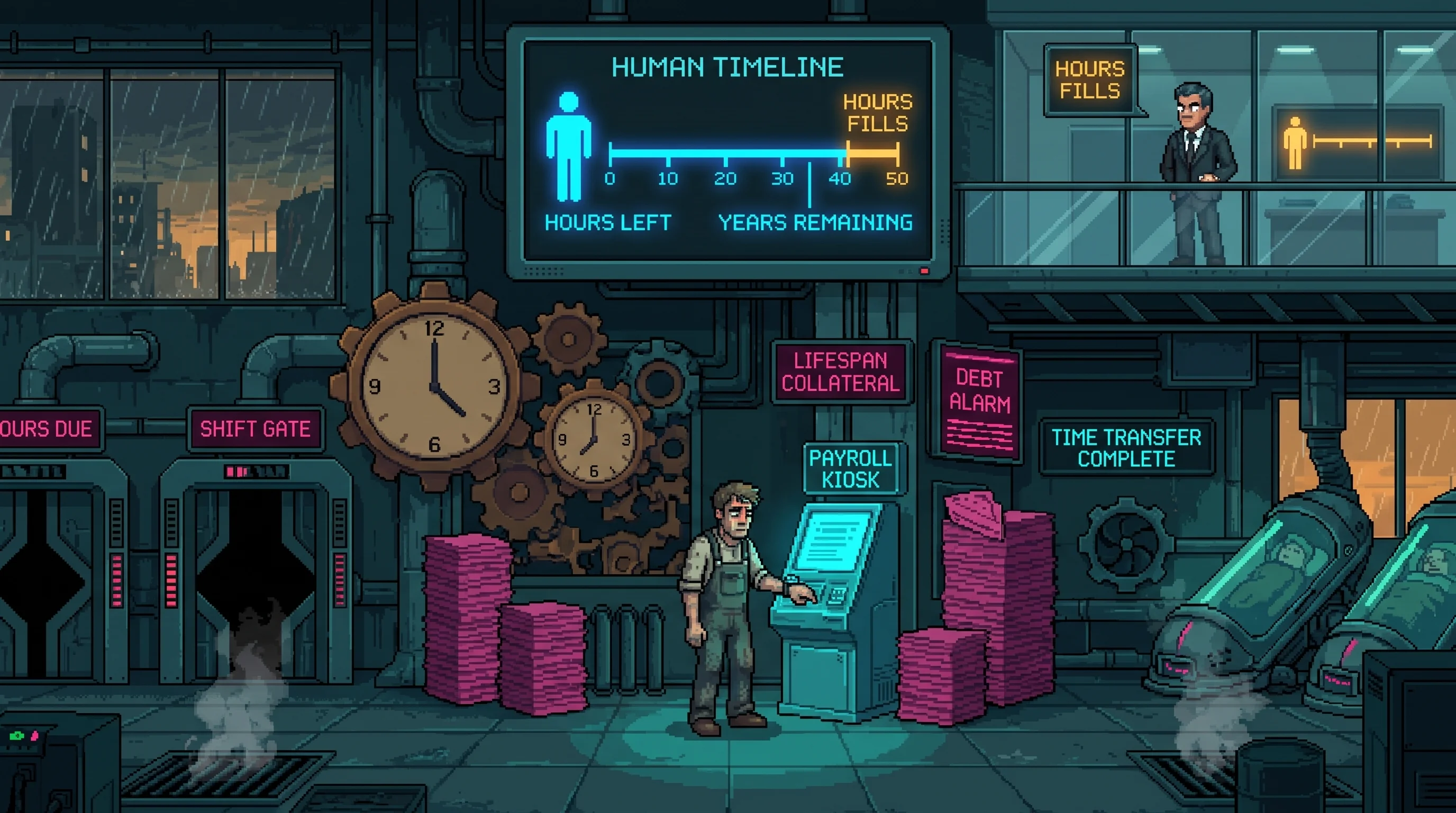
Time debt's mirror trade: unable to pay a loan, a copy is instantiated to work it off, then deleted as 'reclamation.'
Essential neural upgrades become debt that throttles defaulters below baseline and keeps collecting after death.




—