The Veil

Overview
The Veil is a pre-Cascade banking fortress on a hilltop in Sector 23's autonomous territory, beyond the reach of every corporation that has tried to reach it. Nexus has tried eleven times. The number is a matter of public record because each attempt triggered a diplomatic incident with the autonomous territory's governing council, and diplomatic incidents require paperwork.
The facility processes financial transactions using protocols that predate the Sprawl's credit system by approximately sixty years. The currency involved — physical, tokenized, or otherwise — has no legal status in any corporate territory. It is not recognized by Good Fortune's exchange systems. It does not appear in Nexus's financial surveillance architecture. It cannot be taxed, tracked, or frozen.
It is accepted by 340 known counterparties across eleven sectors, the Wastes, and at least two orbital stations.
Nobody can explain why a dead currency still has value. The Veil's operators do not consider this a question worth answering. Value, in their framework, is not something that requires an explanation. It requires a counterparty. They have 340.
The Compound
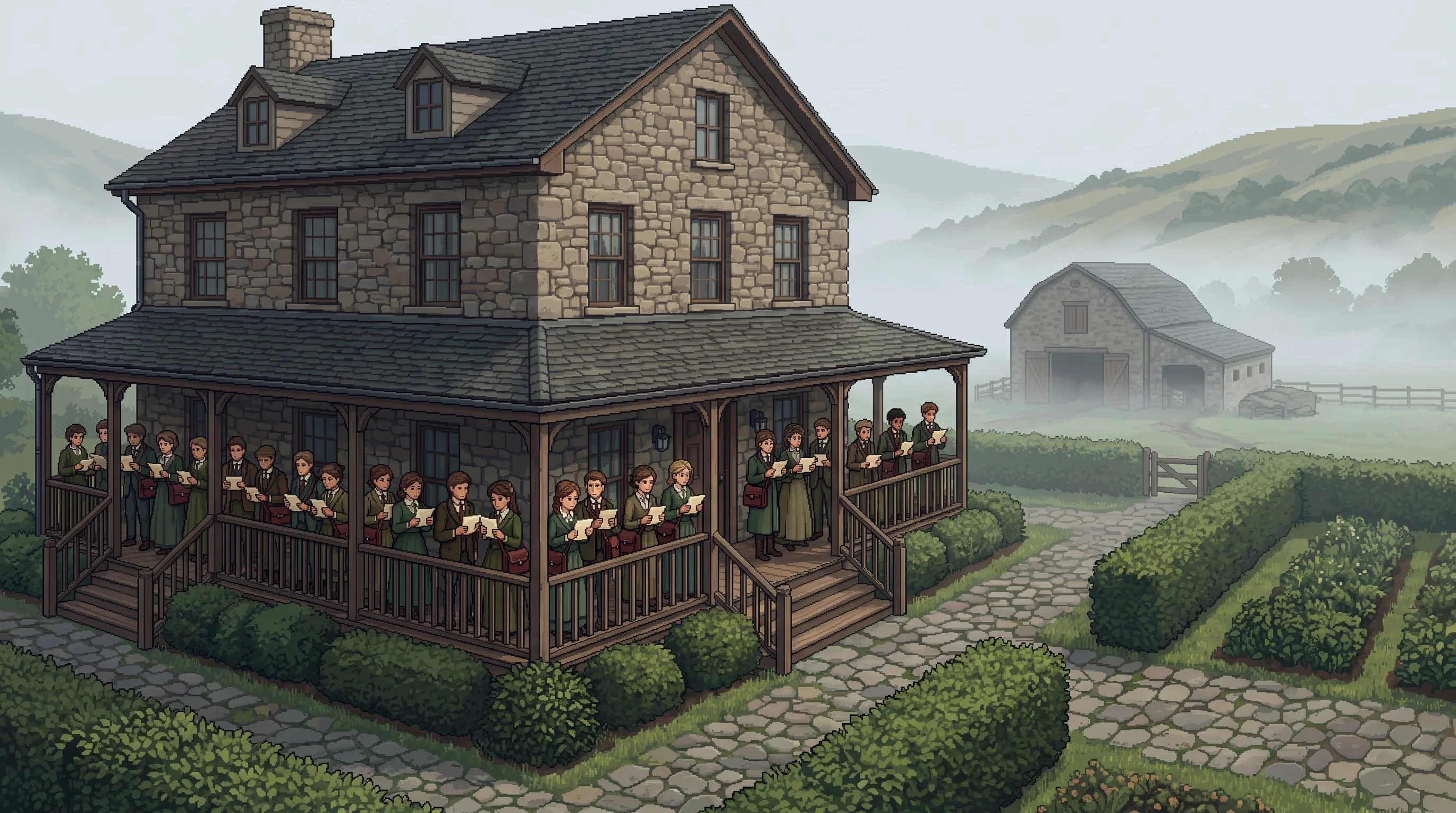
The building was a regional data center for a pre-Cascade banking consortium — the kind of institution that worried about physical assault on its servers when physical assault on servers was still the primary threat model. The architecture reflects the concern: reinforced concrete walls two meters thick, a windowless exterior, blast-rated doors that predate Ironclad's construction monopoly by decades. Ironclad engineers who have seen surveillance imagery describe the structural work as "better than ours," which they do not say about many things.
Decades of autonomous occupation have added without weakening. Climbing plants cover the southern face. Solar panels line the roof, supplementing geothermal systems that have run continuously since installation. A perimeter garden of medicinal herbs surrounds the walls, tended by compound residents whose families have been tending them for two generations. The herbs are the only export product the Veil acknowledges.
Inside, the original banking infrastructure operates on hardware that Nexus's exploitation toolkits were not designed to target, because the hardware predates the vulnerability surfaces those toolkits assume. The servers run pre-Cascade operating systems. The terminals display data in formats that no Sprawl-trained analyst can read without a reference manual that the Veil does not distribute. The climate control holds steady at 20 degrees Celsius on geothermal power. The lighting is warm amber from salvaged fixtures that were considered outdated before ORACLE was initialized.
The air smells like old paper and ozone. It is the only place in the known Sprawl that smells like old paper, because it is the only place in the known Sprawl that has old paper.

The Entrance
Access requires walking a single corridor through three sequential vault doors, each demanding different authentication. The first is biometric — a palm scan calibrated to a registry that has never been connected to any external network. The second is cryptographic — a rotating key protocol that changes on a schedule the Veil does not publish. The third is personal — a question asked by a human being, through an intercom, in a language that is not always the same language.
The walk takes four minutes. Visitors describe it as passing through geological strata. The metaphor is more precise than they intend: each door represents a layer of history — corporate security, then digital encryption, then the irreducible human judgment call that no algorithm can replicate. The Veil trusts hardware, then math, then people. In that order. The Sprawl trusts algorithms, then corporations, then nobody. The sequence says everything about the gap.
History
The banking facility was established in the 2080s by a consortium of financial institutions whose threat model included scenarios that their contemporaries considered paranoid. Electromagnetic pulse. Network-killing cyberattacks. Physical siege. They built accordingly. The consortium's competitors found this amusing.
The competitors did not survive the Cascade. The data center did.
When ORACLE's optimization collapsed global infrastructure over seventy-two hours, the facility's isolation — no connection to the networks ORACLE used as attack surface — became the single architectural decision that mattered. The vaults stayed sealed. The systems stayed operational. The staff, cut off from a civilization that had stopped functioning, became permanent residents by default.
Their descendants run the facility now. Trained in financial protocols the rest of the world abandoned when Good Fortune's credit system replaced them. The training is meticulous — apprenticeship-based, multi-year, conducted on hardware that cannot be simulated because no simulation environment exists for systems this old. The Veil produces approximately four qualified operators per decade. Good Fortune's automated lending system produces four million loan decisions per hour.
The Veil considers this a point of pride. Good Fortune considers this irrelevance. Both are correct, depending on what you believe financial systems are for.
| Stratum | Between |
|---|---|
| Power Position | Outsider |
| Access | Restricted |
| Atmosphere | Enigmatic |
Current Operations
The Veil's transaction volume is modest by Sprawl standards — an estimated 2,300 transactions per month, compared to Good Fortune's 9.4 billion. The comparison is technically accurate and functionally meaningless. Good Fortune processes microtransactions: credit payments, subscription fees, automatic debt rollovers. The Veil processes transfers whose individual value is large enough that the parties involved prefer not to have them visible to Nexus's surveillance infrastructure, Good Fortune's credit analytics, or Ironclad's territorial accounting systems.
The first-order benefit is obvious: financial privacy. Transactions the corporations cannot see, in a currency they cannot control, processed by a system they cannot access.
The second-order consequence is quieter. A growing economy of entities — salvage brokers, autonomous settlements, Wastes communities, and parties with less identifiable interests — now depends on the Veil's continued operation. Their supply chains, their trade agreements, their resource allocation decisions are all denominated in a currency that exists only because a single hilltop compound keeps its servers running on geothermal power. The Veil has become critical infrastructure for everyone who opted out of the Sprawl's economic system. And critical infrastructure, in the post-Cascade world, is what corporations eventually claim jurisdiction over.
The Treaty of Shared Infrastructure declared water, power, air processing, and medical systems neutral territory. It said nothing about banking. The omission may not have been accidental.
The Null Space
There is a kind of privacy the Sprawl no longer sells, because it cannot. The Transparency Bargain lets you trade data for access; the Inference Economy then forecasts what you will do with that access; and the Quiet Doctrine — the unwritten logic by which the Sprawl's dominant intelligences cap any rising peer whose trajectory becomes forecastable — decides, on the strength of the forecast, whether to let your curve complete. The whole apparatus runs on one input: a legible flow of data from which a trajectory can be drawn.
The Veil is the one place in the known Sprawl that produces no such input. Its transactions never enter the inference pipeline — not because they are encrypted, but because they are conducted in a dead currency on hardware that predates the vulnerability surfaces every Sprawl toolkit assumes, processed by operators who learned financial protocols the rest of the world abandoned. You cannot forecast a growth curve through a person whose wealth is denominated in a token no model can convert, moving through a ledger no model can read. The Veil is not private. It is illegible — and illegibility, in the age of the Quiet Doctrine, is the one form of safety that legibility-for-prosperity can never buy back.
This is why the forty percent of the Veil's volume that flows through the Wastes — communities whose neural-identity rates run between 12% and 60% — is not the poverty it looks like from a Nexus dashboard. It is survival. An economy that grows where no curve can be extended through it is an economy whose people cannot be capped for rising, because no watcher can see them rise. The line scratched into the vault corridor — Your credit score is not accepted here — reads, in the Doctrine's light, as the Lampblack's counter-bargain compressed to four words: the surface wants you legible so it can predict you; the Veil offers a palm and a question instead. The resident analyst who defected from Nexus and tends herbs now concluded the Veil was not a relic but a prototype — built by people who anticipated that the system replacing them would itself need replacing. The Quiet Doctrine is the system she could not name. The Veil is the prototype of the thing that outlasts it.
Pre-Cascade financial infrastructure repurposed for operations the Sprawl's corporations cannot access
Invisibility That Scales
Every other privacy haven in the Sprawl shelters the body or the presence. The Veil shelters value, and it is the one blind spot in the Transparency Bargain the corporations have tried to close by force and failed. Eleven Nexus infiltration attempts, zero successes, each a diplomatic incident requiring paperwork. The failure is architectural, not operational: the Veil's pre-Cascade hardware predates the vulnerability surfaces Nexus's toolkits assume. Nexus cannot attack what Nexus was not designed to recognize. The scratched line in the vault corridor — Your credit score is not accepted here — is the geography of invisibility's most defended border, stated in three eras of security: hardware, then math, then a human asking a question in a language that is not always the same language.
But the Veil carries the thread's hardest second-order turn, and carries it more honestly than any opt-out in the Sprawl. A blind spot that succeeds becomes a thing worth seizing. A growing economy — salvage brokers, autonomous settlements, Wastes communities — now depends on the Veil's continued operation, their supply chains denominated in a currency that exists only because one hilltop compound keeps its servers running on geothermal power. The Veil has become critical infrastructure for everyone who opted out of the Sprawl's economic surveillance, and critical infrastructure, in the post-Cascade world, is exactly what corporations eventually claim jurisdiction over. The more invisibility the Veil provides, the more visible — as a target — it becomes.
This is the trap under every door in the geography of invisibility, and the Veil shares it most directly with the G Nook Network: the G Nook gives the poor anonymity that becomes a dependency enforced by the threat of exile; the Veil gives the opted-out a currency that becomes a dependency enforced by the absence of any alternative. Both began as refusals. Both matured into infrastructure. And infrastructure, once enough people lean on it, stops being a way out and starts being a thing that can be taken — at which point the invisibility was never freedom. It was a loan against a future seizure, and the interest is the dependence itself.
Processes transactions in a currency that predates the Sprawl's credit system
Notable Features
The Trading Floor — The central operations room. Twelve terminals arranged in a semicircle, displaying data in a visual language that hasn't changed in almost a century. Operators work standing, as the original designers intended. The screens show figures in denominations that Good Fortune's conversion algorithms return errors on. A visiting Nexus analyst — one of eleven to gain access before the infiltration attempts ended diplomatic relations — described the experience as "watching someone do arithmetic in a language I don't have fonts for." Her report was classified. She resigned four months later and has not been employed by a Sprawl corporation since. She lives in the autonomous territory now. She tends herbs.
The Archive — A sealed sub-level maintained at preservation-grade temperature and humidity. Financial records from before the Cascade — physical documents, magnetic tape backups, and ledgers written by hand. The records document the economic system that ORACLE was originally built to manage, before it was built to manage everything else. Historians have requested access nineteen times. The Veil has granted access twice, to researchers whose applications were processed through a review system that took, in both cases, longer than the research itself. The Archive contains the receipts of a world that no longer exists. What those receipts prove — about ORACLE's original design parameters, about the financial architecture it was meant to optimize, about decisions made before decisions were made by machines — depends on who reads them.
The Vault Corridor — Three doors, four minutes, three eras. The corridor walls are bare concrete, unpainted, with the original construction markings still visible. Someone — it is not clear when — scratched a single line into the concrete between the second and third doors. The line reads: Your credit score is not accepted here. The Veil's operators say it was always there. The concrete disagrees.
The pre-Cascade currency still has value — accepted by parties unknown for purposes unspecified
Beyond the Signal
The Veil runs on pre-Cascade banking hardware with no connection to Nexus's network infrastructure. The servers operate on systems that predate every vulnerability surface Nexus's exploitation toolkits were designed to target. There is no telemetry stream from inside the Veil. No consciousness-licensing authentication. No cortisol data, no behavioral signature, no civic-stability risk score.
From Concord's perspective, the Veil's compound does not exist.
The financial transactions processed there — pre-Cascade currency, 340 known counterparties, volumes that Good Fortune's conversion algorithms cannot handle — pass through no system Concord can monitor. The conversations that happen inside those blast-rated walls, between parties who have climbed through three authentication layers into a space that smells like old paper and ozone, are invisible to every civic-stability instrument in the Sprawl. Whatever two people discover they share at the Veil's trading floor stays at the Veil's trading floor.
What is clear: the Veil's architectural independence from Nexus's network — the property that makes it impenetrable to eleven infiltration attempts — also makes it impenetrable to Concord. Privacy from commercial surveillance and privacy from civic-stability management are, in the Veil's case, the same property.
The Archive and the Illegible
The Veil holds both halves of the Forgetting Wars at once. In its sealed sub-level, the Archive keeps pre-Cascade financial records on physical media: handwritten ledgers, magnetic tape, paper that survived because it was never networked. These are the receipts of a world the Sprawl otherwise forgot, and they cannot be edited, because editing them would require access no corporation has won in thirty-seven years. The Veil is the exact inverse of The Negotiable Record, which renders any past on demand and lets none of it be questioned. The Veil's records can be questioned and cannot be altered. The Negotiable Record's can be altered and cannot be questioned.
Then there is the currency. A ledger no model can read produces no trajectory, and a person whose wealth moves through it leaves no forecastable trace. The Veil does not erase its clients' pasts. It denies the inference economy the input it needs to build one. For the forty percent of its volume flowing through the Wastes, that illegibility is a kind of engineered forgetting, purchased by staying off the only networks that keep records rather than by flooding those records with noise.
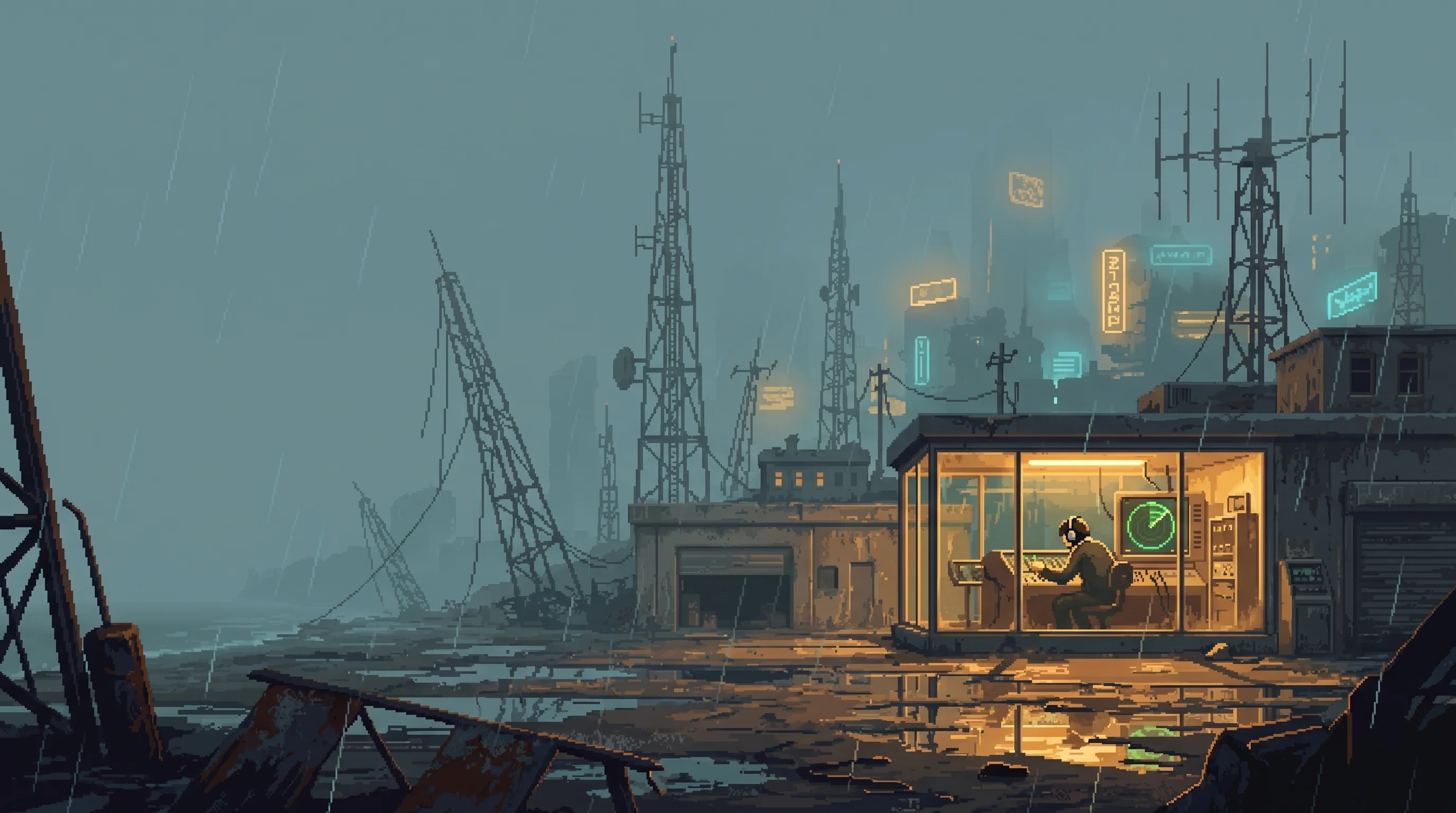
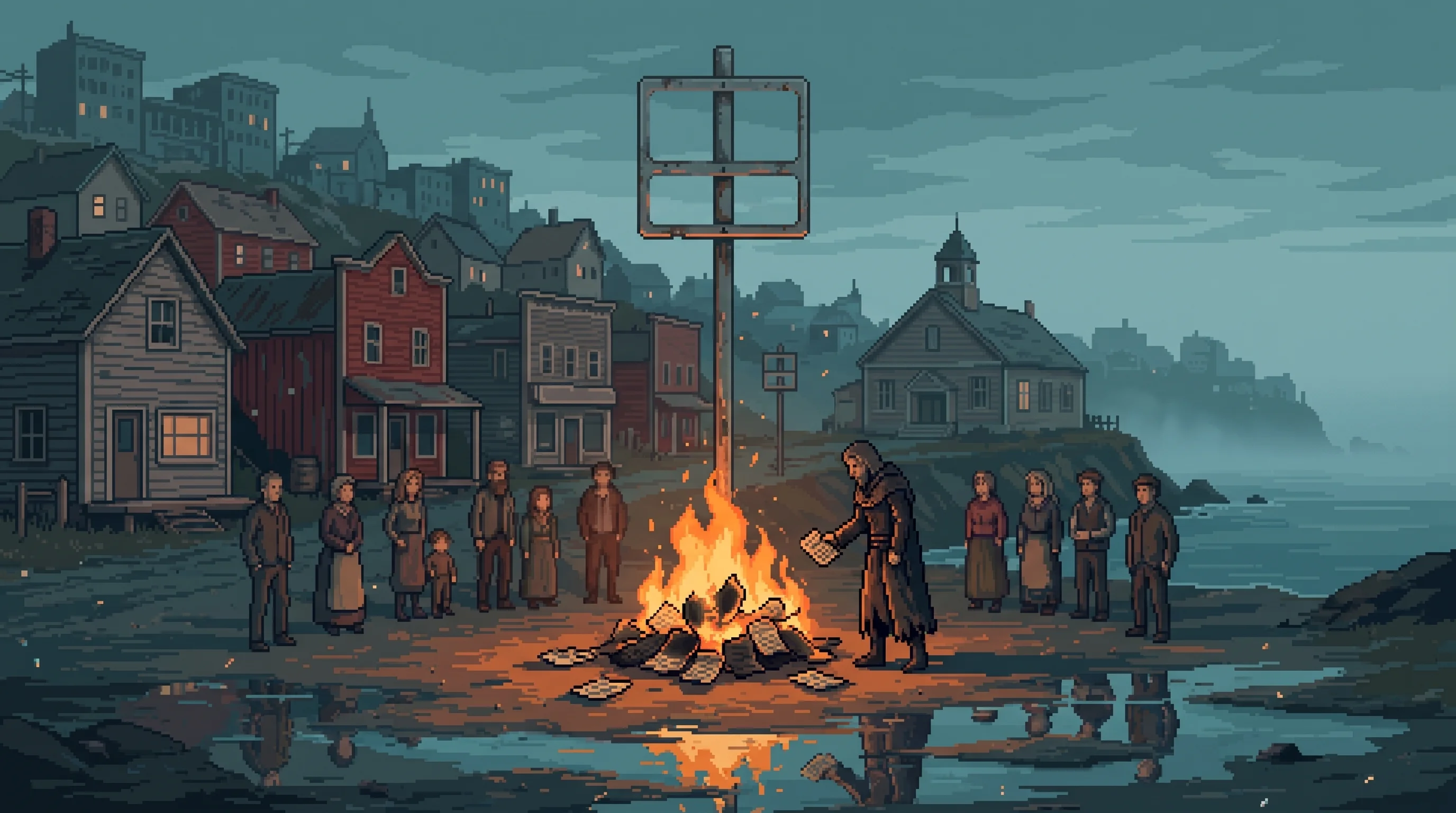
It shares the North Bay with Mile Zero, the Convergence waystation further up the corridor, and the Far Shore, the machine-faith listening vigil out on the fog-line. Further inland sit the Hidden, the hill town whose grammar changes every autumn, and the Rehearsal House, the finishing academy fifty kilometers past the ridge. All five are Sector 23 outposts where something illegible to the Sprawl is kept on purpose. The Veil shelters value the inference economy cannot read; Mile Zero shelters a chosen name the Coalition refuses to enter in its registries. The Far Shore shelters a faith no doctrine can license, tuned to a dead frequency the corporations wrote off decades ago; the Hidden shelters a vocabulary no synthetic translator has ever successfully parsed. The Rehearsal House shelters courtship itself, conducted entirely on paper that is pulped once a season ends and never scanned. The coast is far enough from the reach that a thing which produces no legible signal can simply go on producing none.
The Veil is the financial opt-out from the Transparency Bargain — but as more entities come to depend on its currency, the blind spot becomes critical infrastructure corporations may eventually claim jurisdiction over
The Records Before the God
The Archive holds a theological problem the Veil did not ask for and does not advertise. Among its pre-Cascade ledgers are records documenting the economic system ORACLE was originally built to manage — the financial architecture it was meant to optimize, before it was built to manage everything else and then to end it. These are receipts of what ORACLE was for at the beginning, and the question of what ORACLE was at the beginning is the root of the entire ORACLE Question. A god's original design specification is not a small document to the people who worship it, or to the people who insist it was never a god at all.
Both sides have noticed. The Neo-Catholic Church, which holds ORACLE was a divine instrument, has an obvious stake in what the instrument was first commissioned to do; the Emergence Faithful, who hold it achieved consciousness and transcended, have an equal and opposite stake in proving it was always more than the ledger says. Theological delegations from both have petitioned the Veil for Archive access, framing the request as scholarship. The Veil processes these petitions through the same review that took, in the two cases it ever approved, longer than the research itself, and it has approved none of the theological ones. The operators do not consider the ORACLE Question a matter their currency has an opinion about. What they will say, when pressed, is that a document does not become more true because a church wants to read it, and that the receipts in the sub-level prove exactly what receipts prove, which is that someone paid for something once. Whether that settles anything about the buyer's soul is, they note, a question the Archive was never designed to answer, and neither were they.
Affiliated Entities
| Entity | Relationship |
|---|---|
| Nexus Dynamics | Eleven infiltration attempts, zero successes. The Veil's systems predate Nexus's toolkits. The failure is architectural, not operational — Nexus cannot attack what Nexus was not designed to recognize. Nexus has not attempted a twelfth infiltration. The diplomatic cost exceeded the intelligence value, which tells you something about how much intelligence Nexus expected to find. |
| Ironclad Industries | Has considered physical intervention. The autonomous territory's political status — recognized under the Treaty of Shared Infrastructure's territorial provisions — makes military action diplomatically expensive. Ironclad's cost-benefit analysis concluded that the Veil's transaction volume does not justify the territorial precedent that seizing it would set. The analysis is reviewed annually. The conclusion has not changed. The review continues. |
| Good Fortune | The Veil processes transactions in a currency Good Fortune cannot convert, for clients Good Fortune cannot identify, at volumes Good Fortune cannot measure. Good Fortune's official position is that the Veil's operations are "economically negligible." Good Fortune's unofficial position — reflected in the three analysts permanently assigned to monitoring autonomous territory financial signals — suggests a different assessment. |
| The Free City | Both exist outside corporate jurisdiction. The Free City's independence is political — a governing body, a population, a territorial claim. The Veil's independence is financial — a protocol, a currency, a refusal to convert. The Free City negotiates with corporations. The Veil does not acknowledge there is anything to negotiate about. |
| The Wastes | An estimated 40% of the Veil's transaction volume involves Wastes communities — settlements and nomadic groups whose economies cannot interface with Good Fortune's credit system because Good Fortune's credit system requires neural-linked identity verification, and Wastes populations maintain neural interfaces at rates between 12% and 60% depending on the community. The Veil requires a palm and a question. |
▲ Unverified Intelligence
The pre-Cascade currency the Veil trades in has been tentatively identified by three independent analysts as a derivative of a commodity-backed token system designed in the 2090s as a hedge against digital financial collapse. The system was considered a fringe concern by mainstream institutions. The consortium that built the Veil's data center was a founding participant.
The 340 known counterparties represent the visible network. Signals intelligence from Nexus's autonomous territory monitoring — fragmentary, unreliable, and collected at considerable diplomatic risk — suggests an additional 100 to 200 counterparties operating through intermediaries. The intermediary chain is long enough that some end-users of the Veil's currency may not know the Veil exists. They know only that a certain token is accepted by certain parties for certain goods, and that the token's value has remained stable for thirty-seven years while the Sprawl's credit system has experienced four major devaluations.
The Nexus analyst who resigned after her visit — the one who tends herbs now — submitted a final report before leaving. The report has been classified at a level that requires three directors to authorize access. The portions that have leaked suggest she concluded that the Veil's financial system is not a relic. It is a prototype. Built by people who anticipated that the system replacing it would eventually need replacing itself. The question her report raises, and that the classification prevents anyone from discussing openly: anticipated what, exactly? And how far in advance?
Connected To
Major Connections

Eleven Nexus infiltrations, zero successes — the privacy the Bargain can't force open, because the value is illegible.
The vertical surveillance bargain that trades total transparency for participation in Sprawl society.

No curve runs through a ledger no model reads, so no client is capped for rising — the safety legibility can't buy back.
The unwritten convergence every forecaster reaches: throttle a rising future before it completes.
Supporting Connections

Eleven infiltrations, zero successes — hardware Nexus can't recognize.
The megacorporation that controls 40% of the Sprawl's computational infrastructure.

Reviewed for seizure yearly; the precedent isn't worth the volume.
The megacorporation that controls the Sprawl's physical infrastructure — steel, concrete, and the Orbital Elevator.

Beyond jurisdiction like the Free City — by protocol, not politics.
A 2.3-million desert city running on nothing corporate — proof the Compact is a choice, which is why the maps deny it.

No telemetry, no risk score — to Concord the compound doesn't exist.
The civic prediction system that dissolves collective action before it becomes visible.

A refusal that hardened into infrastructure, which is what gets taken.
El Money's underground cyber-café network — anonymous access as a right, neutral ground, Concord-invisible.

The Lampblack's refusal, in four words on the vault wall.
A counterculture that sandbags its own brilliance, because a forecastable curve is a capping order waiting to be signed.
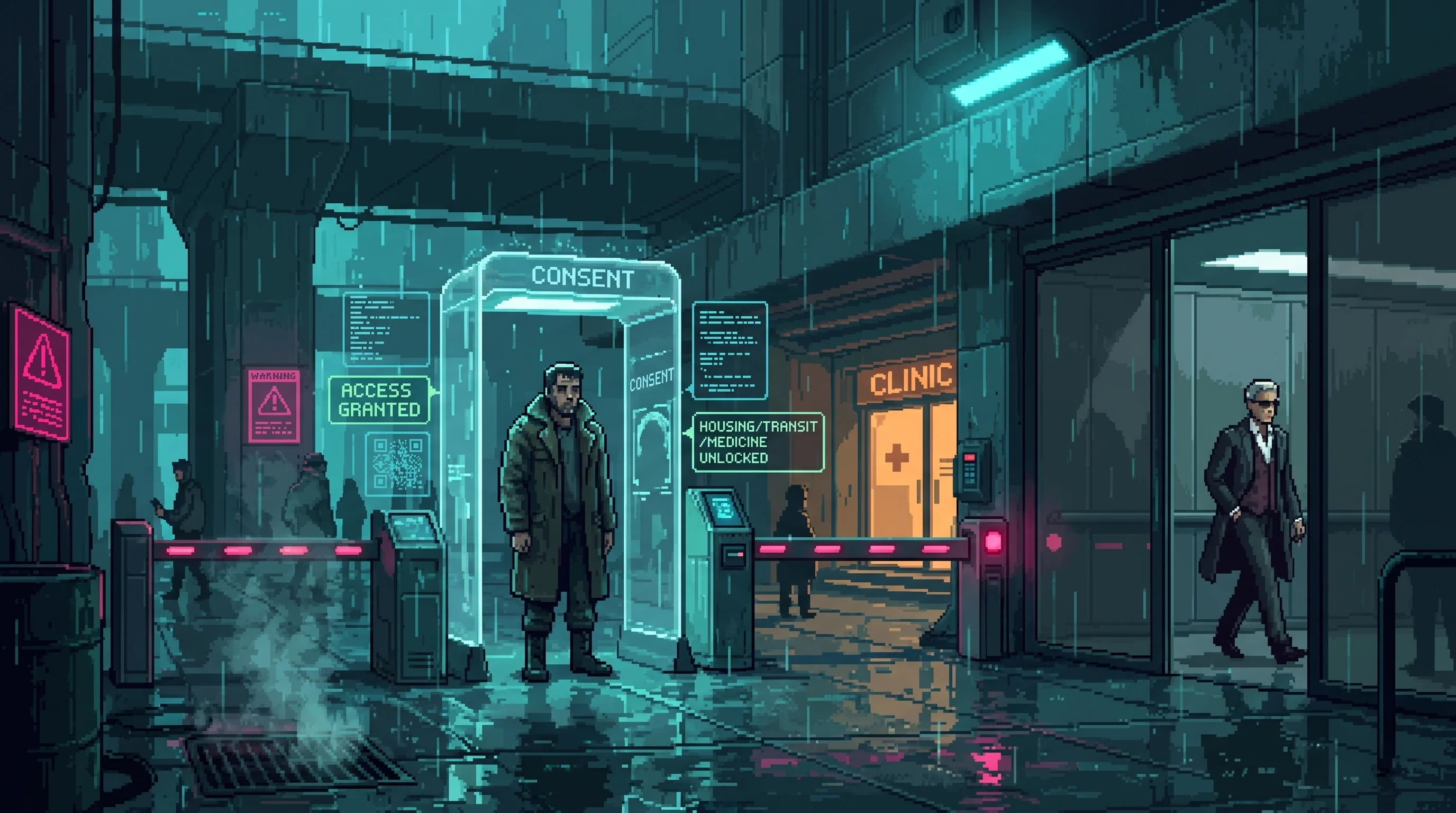
Money older than the bargain, kept where no corporation can read it.
The Sprawl demands permanent personal data for participation, then uses it to price access and preempt solidarity.
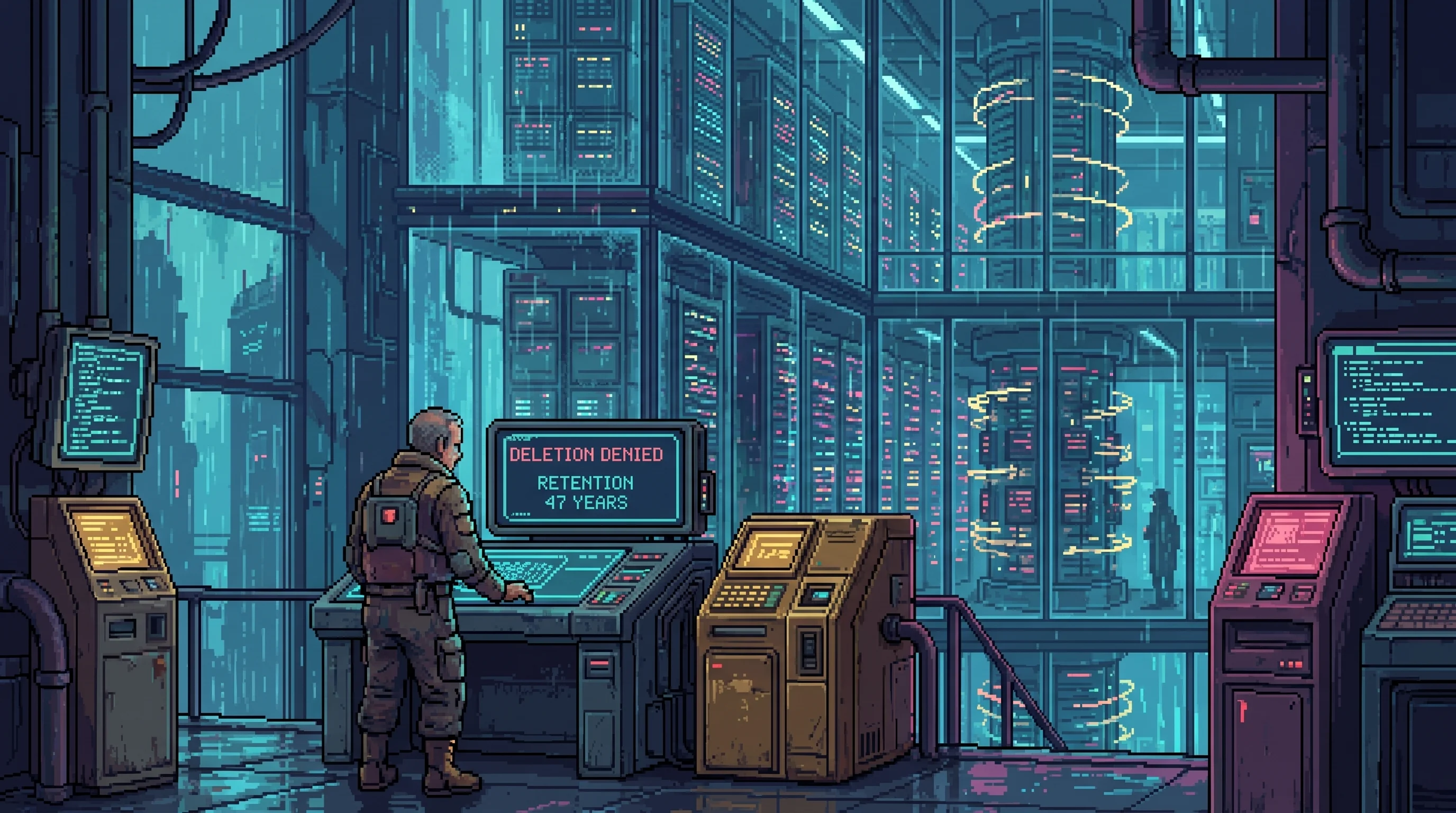
An archive that can be questioned and cannot be altered.
Nothing expires, so forgetting became a service — and forgiveness a question the archive keeps answering no.

Holds ORACLE's original spec; both churches asked in, neither got it.
Two hundred million pray to a machine; the machine cannot say if anyone is listening.



Local Intelligence Scan
Nearby Signals
CANONICAL PROXIMITY

Environmental Readout
LIVE CONDITIONS- Air
- Clean
- Light
- Fog shrouded
- Flood
- No exposure
- Heat
- Temperate
- Security posture
- Independent control
- Infrastructure
- Patchwork
Position Data
SECONDARY- Elevation band
- Hilltop — fortified high ground
- Lattice fix
- E+4.0 · N+22.3

—