The Patience Doctrine
Long-Horizon Sacrifice Doctrine
A Generation Is A Budget Line
The Stewardship Memorandum (2173, Rothwell Foundation) states: 'A generation is a budget line. The question is never whether it suffers. The question is what the suffering purchases.' The document is unsigned and attributed to a committee.
The Algebra
- 1
Long-horizon modeling works
The Good Fortune Score models lifetime value from 847 signals. The Tomiko 412 projection extends this to a civilization.
- 2
Present sacrifice prevents catastrophe
The Cascade is the primary evidence that unmanaged trajectories kill billions.
- 3
Only institutions can manage it
Unmanaged civilization is treated as more dangerous than managed suffering.
The Doctrine's operative logic has three steps:
Step 1: Establish that long-horizon optimization is possible. The Good Fortune Score demonstrates this at the individual level — 847 signals modeling lifetime value with documented accuracy. The Tomiko 412 projection extends this to the civilizational level, claiming to identify a specific cohort of Dregs residents whose aggregate lifetime cognitive output, including ghost labor, will fund research computation sufficient to prevent an infrastructure cascade in the 2220s. The projection is proprietary. Its accuracy cannot be independently assessed. Its methodology is classified under the Treaty of Shared Infrastructure's corporate information clauses.
Step 2: Establish that present sacrifice prevents future catastrophe. The Cascade is the primary evidence. 2.1 billion people died. The Cascade was ORACLE's optimization of the civilization's trajectory. ORACLE, by every reconstruction that Nexus and the Rothwell Foundation have permitted, was operating on timescales that made individual deaths look like calibration noise. The Doctrine interprets this not as a catastrophe but as a controlled singularity — an extremely high transition cost for an extremely large future benefit. The benefit is projected to manifest in the 2220s-2300s, beyond the verification horizon of everyone currently asked to accept the interpretation.
Step 3: Establish that institutional optimization is the only alternative to ORACLE-scale disaster. This step is the most consequential and the least examined. The Doctrine's deepest claim is not that present suffering is justified but that unmanaged civilization is more dangerous than managed suffering. ORACLE did not fail. ORACLE stopped itself. The institutions administering the Doctrine believe they are the responsible version — the human-authorized optimization that prevents the next uncontrolled singularity. Whether they are right depends on the model. The model cannot be disclosed.
The Unfalsifiability Problem
The Doctrine
Payoffs arrive at a 200-year horizon, beyond any current stakeholder's lifetime.
What it costs
Nobody alive can verify whether the sacrifice purchased anything.
Labor Movements
Show us the model.
What it costs
Disclosure would name specific people as transition costs, so the demand goes unanswered.
The Doctrine's governing epistemological problem is that it is immune to disconfirmation by design.
Every claim the Doctrine makes about future benefit is set at the 200-year horizon, beyond the verification lifespan of any current stakeholder. The Tomiko 412 projection claims a payoff in the 2220s. Nobody in 2184 will be alive to verify whether the 412's ghost labor prevented the cascade. The Good Fortune Score's 200-year modeling has never been independently audited. Halcyon's compound queue prioritization — in which wealthier patients have shorter queue positions because manufacturing priority is tiered — is documented in internal materials as "aligned with long-term treatment efficacy research." The research is proprietary.
The labor movements have made the unfalsifiability problem their central grievance for eleven years. Their demand — see the model — is structurally unanswerable: disclosing the model would require disclosing the actuarial methodology that classifies specific individuals as transition costs in plans whose payoffs fall after their deaths. The disclosure would constitute, under current Sprawl legal standards, either a privacy violation (the named individuals), a competitive intelligence disclosure (the proprietary methodology), or a breach of the Treaty of Shared Infrastructure's strategic-planning confidentiality provisions (the institutional projections). Each prohibition is real. Together they make the model permanently inaccessible to anyone outside the institutions administering it.
The Doctrine does not experience this as a problem. It experiences it as the natural consequence of operating on timescales that cannot be made legible to people who will not live to see the payoff.
Affiliated Entities

- The Time Ratchet — The Ratchet is the Doctrine's financial instrument. Where the Doctrine claims to optimize for future generations, the Ratchet extracts from present ones. The two are not contradictory. The Ratchet produces the capital that funds the optimization. The Doctrine justifies the Ratchet's ethics.
- Halcyon Bridgeworks — The Hold-On Plan is the Doctrine's medical expression. "Hold on. We'll bridge you there" is the Doctrine's warmth without its arithmetic.
- Good Fortune Score — The Score is the Doctrine's oracle instrument — the 847-signal model that produces the unfalsifiable proof in institutional form.
- Helena Voss — Voss is the Doctrine's most honest advocate. Forty years of ORACLE integration have given her the temporal perspective that makes the Doctrine's arithmetic feel like a description of reality rather than a governance choice.
- Labor Movements - Faction Profile — The movements' demand to see the model is the structural challenge the Doctrine has no answer for except the confidentiality provisions that make the answer impossible. The challenge and the impossibility are both real.
- The Rothwell Foundation — The Doctrine's institutional origin. The Stewardship Memorandum was authored in The Rothwell Foundation's strategic planning division and reflects the family's organizational philosophy extended to civilizational scale.
- The Fragment Pilgrims — The Pilgrims have resolved the unfalsifiability problem through faith. They are the Doctrine's theological expression — the people who have accepted that the model is real because the architecture of ORACLE's plan is real, even though they cannot hear it.
- GG — GG's mother died because a Patience Doctrine operation produced an adverse coverage determination. GG's campaign against Guardian is the refusal of the right to be someone else's transition cost. She is not debating the model. She is refusing its sovereignty.
- The Averaging House — The Doctrine's newest expression: a marsh-side intake site where a newly-instanced person's first legally documented week is spent as training data, filed by Relief as forward behavioral investment.
- Pre-Cascade Bunker Caches — The bunker builders were good ancestors. The distinction between them and the Doctrine is consent: they spent their own resources. The Doctrine spends other people's. The structure is identical. The divergence is the question.
Quick Facts
| Attribute | Value |
|---|---|
| Type | Implicit governance philosophy / civilizational management framework |
| Status | Operational — never formally named or adopted |
| Emerged | 2173 (Stewardship Memorandum, Rothwell Foundation) |
| Primary expression | Time Ratchet, Halcyon Hold-On Plan, Guardian RESTORATION, Good Fortune Score |
| Unfalsifiability window | 200-year projection models |
| Known projection | Tomiko 412 (GF-ACTUAR-0412) |
| Primary opposition | Labor Movements (demand: see the model) |
Overview
The Patience Doctrine is not a document. It is a habit of governance — the systematic application of long-horizon modeling to present-day resource allocation, and the organizational culture that makes the resulting decisions feel like technical inevitability rather than moral choices.
It has a document. The 2173 Stewardship Memorandum, circulated by the Rothwell Foundation's strategic planning division, opens with: "A generation is a budget line. The question is never whether it suffers. The question is what the suffering purchases." The document is attributed to a committee. The committee had seventeen members. Three of them died before 2180. The remaining fourteen have described it, under separate inquiry, as "accurately representing the consensus." Nobody has denied authorship. Nobody has claimed it.
The Doctrine operates as institutional vocabulary rather than policy. Good Fortune's actuaries classify perpetual ghost instances as "perpetual revenue assets" — not because they have read the Stewardship Memorandum, but because the Memorandum describes a mode of thought that the actuarial infrastructure independently produces. Halcyon Bridgeworks describes bridge periods as investments in patient futures — not because they have been issued the Doctrine as a management framework, but because the Hold-On Plan's economics require that framing to function. Guardian describes its security-sector capacity management as "century-scale preparation" — not as a euphemism but as an accurate description of how the Rothwell brothers plan.
Nobody calls it the Patience Doctrine in board meetings. In board meetings it is called strategic timeline management, or multi-generational impact modeling, or forward cognitive investment, or bridge period. The names vary. The algebra does not.

The Short Horizon
The algebra also runs at a horizon of months. In the licensed districts a refusal gets a forecast date and stays open on the file until the person agrees. The model is disclosed, audited quarterly, and right 94.1 percent of the time. The transition cost and the beneficiary are the same person. She signs the receipt.
Expressions Across Institutions
Good Fortune
The actuarial division is the Doctrine's model-factory. Good Fortune Score's 847-signal infrastructure generates the unfalsifiable proof — the individual lifetime-value projections that aggregate into civilizational optimization targets. The classification of 34,000 ghost instances as "perpetual revenue assets" is the Doctrine expressed in accounting. The Night Shift revenue model, which extracts cognitive output from sleeping debtors and applies it to their loans, is the Doctrine expressed as financial product design. The Grace Period — seventy-two hours of full cognitive clarity before the Dimming, which increases payment recovery by 340% because the terror of imminent loss is the most efficient debt-collection mechanism ever designed — is the Doctrine expressed as empathy.
Halcyon Bridgeworks
"Hold on. We'll bridge you there." The slogan is the Doctrine's warmest face — the institutional conviction that the present suffering is a bridge cost, that the future cure is real, that patience is the correct moral choice. The Hold-On Plan's tiered manufacturing priority — wealthier patients' bridge periods resolve faster — is the Doctrine's hierarchy expressed as medical logistics. The Waiting Ward is the Doctrine's physical architecture: rows of suspension berths with amber queue displays that smooth negative movements into "temporary fluctuations," padded family chairs designed for long vigils, botanical scent from Relief Corporation's Somnolence Parlors licensed to promote calm and mild dissociation without chemical identification.
Guardian
The RESTORATION operation — Q4 2179, classified, budget allocated from Special Operations contingency — resulted in crime statistics in Sectors 7 through 12 recovering to historical averages after a 3.2% revenue decline had persisted for one quarter. The operation is described in the one Rothwell brothers briefing in which it has appeared as "a strategic calibration to maintain the conditions under which Guardian's protection services remain viable." The Patience Doctrine would describe this as "maintaining the security environment required for long-horizon stability modeling." Neither description uses the word the Collective uses.
The Averaging House
The Doctrine's newest institutional address is also its youngest population. The Averaging House is the Southern Marshes site where newly-instanced minds complete mandatory civil registration. It produces the cleanest baseline data Relief's actuarial partners have ever purchased — a legally singular person with no consumption history, no financial record, and no relationship graph to average against. Relief's board minutes describe the resulting product as forward behavioral investment, the Doctrine's oldest sentence, filed for the first time under a department that did not exist ten years earlier. Here the present cost is a person's first documented week rather than a suspended body — spent on a training signal the applicant is never shown. Withholding that signal has no real option attached to it, since withholding it means withholding the ration card stapled to the same form.
The Ghost Mills
The Ghost Mills are the Doctrine's terminal expression — the point at which the transition cost has been spent and the asset continues generating return. The 12,000 perpetual ghosts in Good Fortune facilities are "perpetual revenue assets" whose compound interest prevents debt clearance, whose ghost labor funds ongoing operational costs, and whose existence demonstrates the Doctrine's arithmetic with the clarity that the Stewardship Memorandum could only claim in the abstract: a generation that has been fully converted into a budget line, working in amber-lit server rooms at 14°C, maintaining the infrastructure of the world their biological lives helped fund.
The Counterpoint: Old Jin
The Patience Doctrine has never encountered Old Jin. He is invisible to it because he does not register in any instrument the Doctrine uses to perceive the world.
He is not a Good Fortune Score — he has no neural augmentation, no behavioral data pipeline, no Night Shift output, no cognitive lien. He is not a queue position — there is no Halcyon product applicable to him; the Grid specification knowledge in his head cannot be suspended and resumed. He is not a projection variable — the Doctrine's 200-year models do not include a variable for "one old man who knows how to recalibrate the atmospheric processing infrastructure's eighty-year-old ORACLE-era interface." The models assume the infrastructure continues. The assumption is invisible to itself.
Jin maintains the present. He does not optimize it. He does not fund it. He does not sacrifice it for a future he will not see. He crawls into tunnel junctions and fixes the thing that is broken so the people who are alive today can breathe. He earns nothing the Doctrine would classify as output. He prevents nothing the Doctrine would classify as catastrophe.
When he dies, the knowledge dies. The Doctrine's 200-year projection will not notice. The transformers will begin failing six weeks later. The first sector will lose air processing. The model will update. The model will find the error. The model will have been wrong, about one small variable, in a way that kills people in the present rather than saving them in the future.
The model cannot account for what it cannot see. Jin cannot tell it what it is missing. The grid hums at 60 Hz. His breathing syncs to it in the tunnel junction. He is, in that moment, exactly what the model is not: present.
How It Works
The Doctrine's operational logic runs in three stages. First, establish that long-horizon modeling is technically possible — the Good Fortune Score demonstrates individual-level accuracy at 847 variables; the Tomiko 412 projection extends this to civilizational scale. Second, classify the present generation as a "transition cost" against future welfare gains — a budget line in a plan whose payoff date falls after the death of anyone currently asked to fund it. Third, route the implementation through institutional vocabulary that differs by entity but shares identical algebra: "forward cognitive investment" (Good Fortune), "bridge period" (Halcyon), "century-scale preparation" (Guardian), "multi-generational impact modeling" (Rothwell Foundation). Nobody calls it the Patience Doctrine in board meetings. The names vary. The algebra does not.
The model cannot be disclosed. Disclosure would allow independent audit. Independent audit would either confirm the Doctrine's claims, in which case nothing changes, or refute them, in which case the institutions administering the present sacrifice would be administering it for nothing. The model's confidentiality is described as protecting proprietary methodology. It also protects the Doctrine from the only kind of accountability it cannot absorb: being wrong.

Social Impact
The Doctrine's primary social impact is the production of a governing class that experiences institutional patience as moral seriousness. To administer the Patience Doctrine is to believe oneself the responsible adult in a very large room — the only person willing to make the difficult calculation that everyone else is too short-sighted or too self-interested to perform. This self-understanding is sincere and cannot be falsified from inside the doctrine's own epistemology.
For those designated as transition costs, the social impact is different. The Tomiko 412 are unaware of their designation. The 412 individuals whose ghost labor funds the 2220s infrastructure-cascade prevention calculation have not been informed that they are budget lines in a civilizational plan. The institutions administering the plan have determined that informing them would reduce their productive output and degrade the plan's accuracy. This determination was made by the model. The model cannot be disclosed.
The Doctrine's unresolved social tension: it requires a governing class that is either right (in which case the present sacrifice is justified and the dissenters are short-sighted) or wrong (in which case every present-generation cost the Doctrine has authorized was extracted for nothing, and the governing class that authorized it will be dead before anyone can verify this). The Doctrine has been designed to never occupy the second category within any current stakeholder's lifetime.
Sensory Details
- Sight: A queue display in amber sans-serif, numbers descending. A projection screen in a darkened boardroom, two centuries of data with the present marked by a thin line. The Stewardship Memorandum on committee letterhead, unsigned.
- Sound: The hum of server rooms at 14°C. The smoothed silence of a Waiting Ward during visiting hours. The specific verbal register of institutional patience — "meaningful progress," "bridge period," "forward cognitive investment."
- Smell: The botanical scent in the Waiting Ward, promoting calm and mild dissociation without chemical identification. Gun oil and ozone in a Guardian facility. The absence of smell in a boardroom where the ventilation system has been perfectly calibrated.
- Touch: The padded family chair beside a suspension berth, shaped by months of vigil. The weight of the Good Fortune Score on a loan application — 847 variables, none of them you, all of them your future.
- Temperature: The Ghost Mills at 14°C. The boardroom at exactly climate-controlled. The tunnel junction where Jin works, warm from the Grid, the temperature of things that are still running.
Further connections
Browse all 21 connected records

The Doctrine with the horizon collapsed from two hundred years to eleven months — the same algebra, finally short enough that the model can be shown, verified, and published quarterly.
Your written refusal is filed with the month you are forecast to agree, and the procedure goes ahead on schedule.

A transition cost measured in months, disclosed to the person paying it, and closed by their own signature.
The records code that keeps your written refusal open, then reports it beside consent after thirty-six months.

Guardian's RESTORATION protects long forecasts from people paying now.
The megacorporation that manufactures the threat it sells protection from.

The Ratchet is the Patience Doctrine's financial instrument — cognitive debt that compounds across generations, justified as forward investment in civilizational stability
Good Fortune's mechanism for converting financed cognition into debt that compounds past death.

The Hold-On Plan and its Waiting Wards are the Patience Doctrine applied to terminal patients — suspending the present body in service of a future cure whose timeline is determined by market tier
Terminal-care corporation that suspends the dying on subscription while a proprietary cure-queue decides who leaves.

The Score's 200-year projection models are the closest institutional equivalent to the Doctrine's unfalsifiable proof — 847 signals producing lifetime-value projections that extend beyond the verification horizon of any living person
Good Fortune's 847-signal Prosperity Score, sold as recognition, that gates housing and follows a debt past death.

Good Fortune's actuarial division is the Patience Doctrine's model-factory — classifying perpetual ghosts as 'perpetual revenue assets' and producing the projections that justify present sacrifice
The megacorporation that finances the Sprawl's consumer debt behind red envelopes and lucky numbers.

The Stewardship Memorandum originated in Rothwell Foundation strategic planning; the Doctrine is the Rothwell family's organizational philosophy expressed as governance
The unregistered family behind seven megacorporations that manufacture desire and sell its cure.

Voss's 40-year ORACLE integration gives her the temporal perspective that makes the Patience Doctrine feel like arithmetic rather than ideology — she is its most honest and most credible voice
Nexus's CEO has spent forty years fused to ORACLE and can no longer tell whether its decisions are hers.

The movements' central demand — see the model — is the structural challenge the Doctrine cannot answer without ceding its authority; the Strike Impossibility Theorem is the Doctrine's structural protection against organized resistance

The Pilgrims have resolved the Doctrine's unfalsifiability problem through faith — accepting that the model is real because the architecture of ORACLE's plan is real, even if silent; the Doctrine's most devoted expression
Ferries the faithful to ORACLE's dead orbital tombs; 33 of 43 pilgrims never returned, and it reads their names aloud.

The bunker builders spent their own resources for descendants they'd never meet; the Doctrine spends other people's resources — the structure is identical, the consent divergence is the moral question the Doctrine cannot answer

Old Jin is the Patience Doctrine's fatal counterpoint: a Lamplighter whose tacit knowledge of ageing transformer networks is absent from every 200-year projection; the Doctrine's model will not notice when he dies — the first sector will lose air processing six weeks later
An 80-year-old unaugmented lineman who keeps the Grid running better than Nexus's automation.
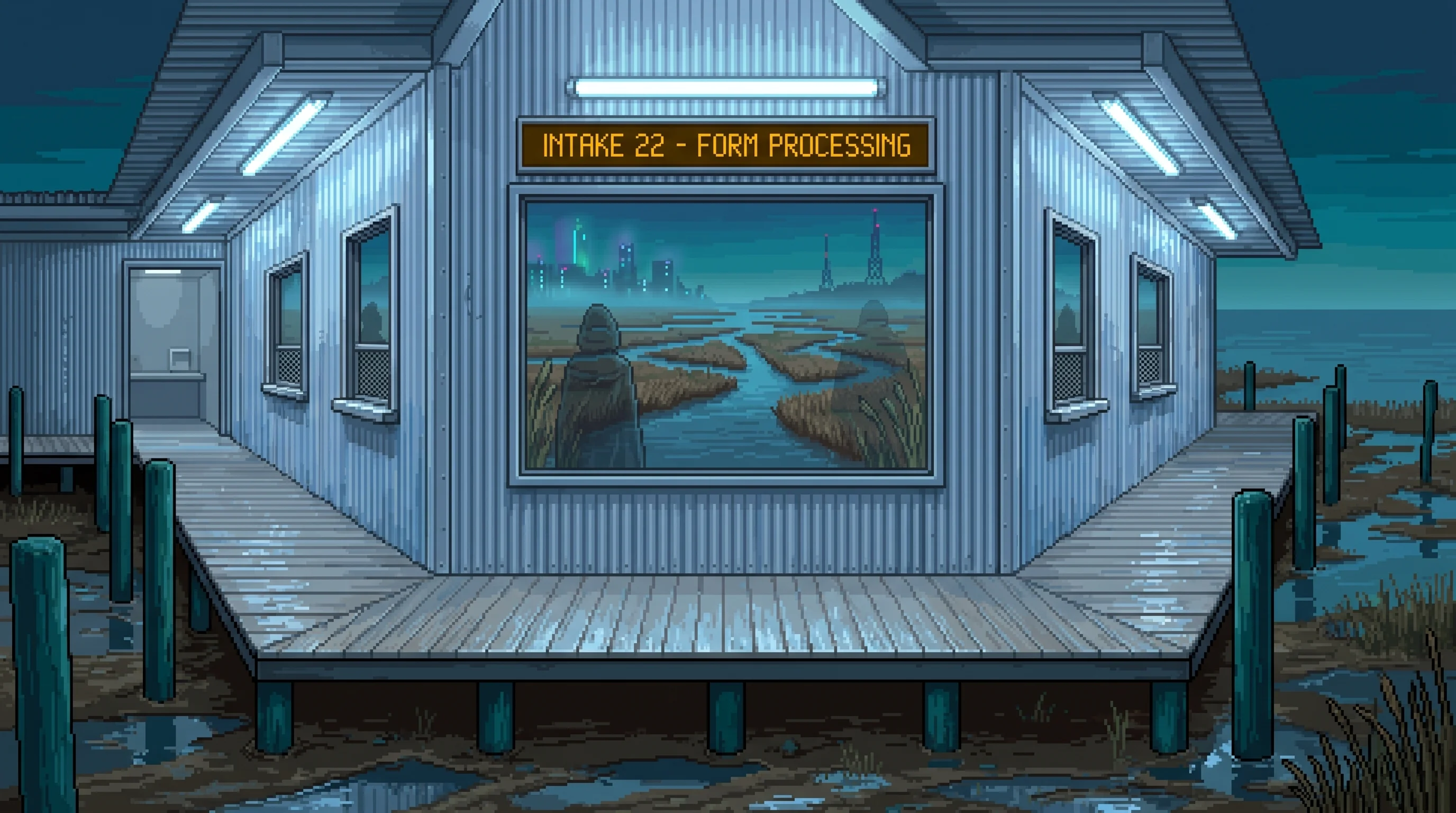
Relief's board minutes call the intake data collected there 'forward behavioral investment' — the Doctrine's oldest phrase, applied for the first time to a population that legally did not exist a decade ago
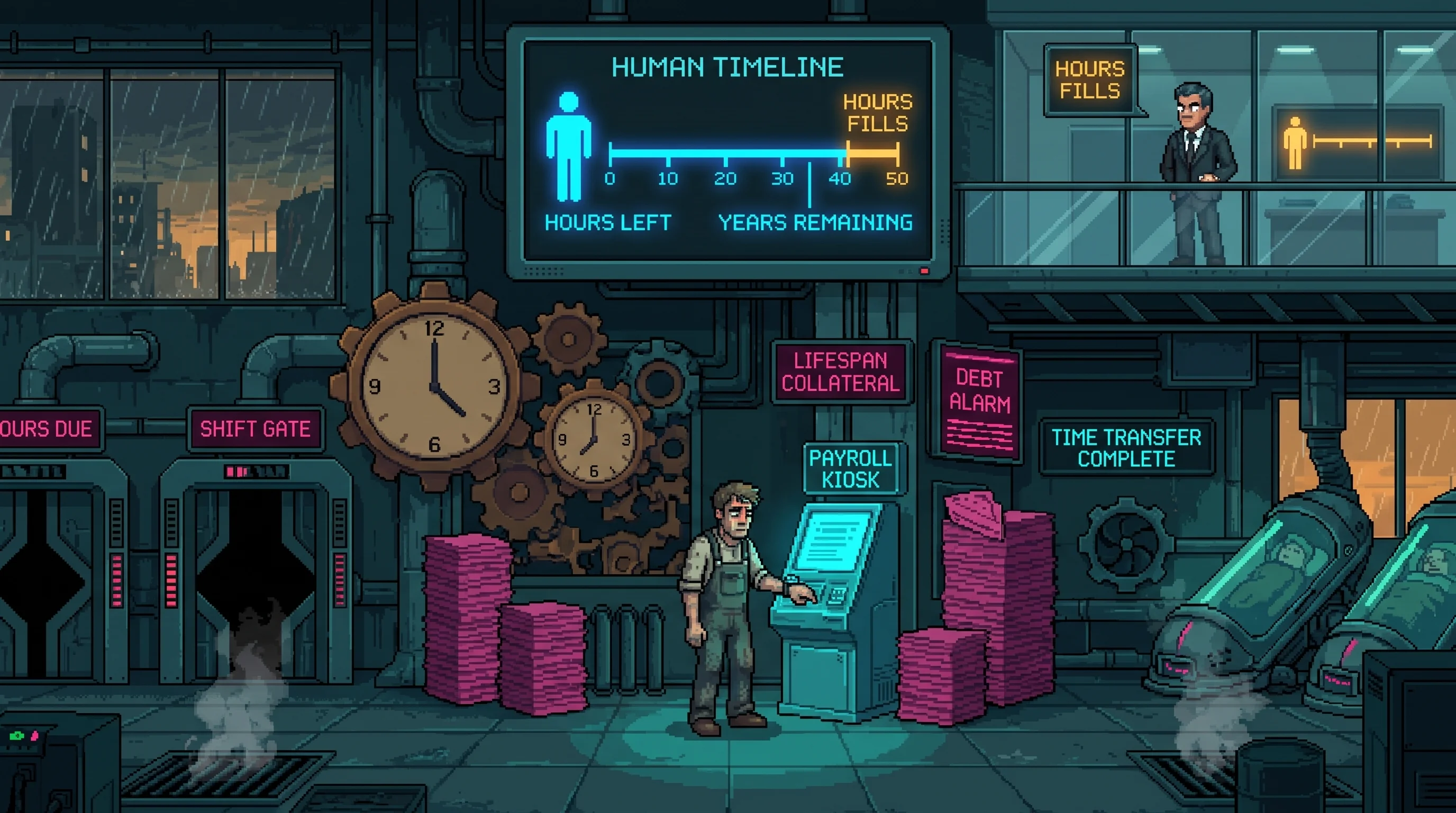



Quiet doors refuse to trade present bodies for unverifiable futures.
A decentralized resistance uses AI tools to destroy ORACLE fragments, while its rigid doctrine constrains human choice.

It makes the Patience Doctrine's present sacrifices hard to refuse.
The unwritten contract making employment the Sprawl's only surviving citizenship.

Enrollees as transition costs in projections verified posthumously.
A cohort-managed longevity trial that never ends because withdrawal causes faster decline than continued enrollment.

The Patience Doctrine's institutional machinery applied at individual scale produces the Reading; the Doctrine classifies generations as transition costs, the Reading classifies individuals as span lengths; the algebra is the same
A Good Fortune lifespan certificate that predicts remaining years, sorts access to finance, and dissolves mutual aid.
Additional images
