Sponge
Underground Evidence Documentarian
The Witness
Has unreleased footage of a Culpability Market show-trial in the lower Stacks -- a family processing a Lattice Corridor kill through a hired Confessor. Six months of sitting with it has produced no resolution. The amber temple light has not pulsed since the session.

Overview
Sponge is the Sprawl's conscience with a camera for eyes.
In a city where megacorporations own the feeds, curate the news, and can literally rewrite memory through neural augmentation, the truth is whatever the highest bidder says it is. Sponge exists to break that monopoly. He walks the lowest levels — the markets, the shelters, the underground gatherings, the protest lines, the places where real people try to live real lives — and he records everything. His slim matte-black glasses are an ocular capture rig: his eyes are the lens, recording reality as he sees it, with the amber temple lights pulsing like a heartbeat when he's active.
But recording is only half the work. The other half is craft. Sponge doesn't dump raw footage — he edits. He sequences. He builds narratives from fragments of truth that hit harder than any corporate propaganda because they're real. A mother denied augmentation for her child. A community bulldozed for corporate expansion. The faces of people the system wants invisible. He cuts these stories with the precision of an artist and drops them into the underground mesh networks where they spread like fire, impossible to trace, impossible to stop.
Corporations have tried to trace the source. The mesh architecture routes through too many nodes, each one a Dregs resident who copied the file because they saw someone they knew in it. Nexus Communications' best forensic team spent eleven weeks on the routing problem. Their report concluded that eliminating Sponge's distribution network would require eliminating the Dregs' informal social infrastructure, which would require acknowledging that the infrastructure exists, which would contradict Nexus's official position that all Sprawl residents have adequate access to licensed information services. The report was filed. The distribution network remains operational.
He didn't start this way. For years, Sponge was content to observe — the man behind the lens, curious, empathetic, but fundamentally safe in his role as witness. Somewhere along the way — through the mentorship of an older figure who showed him what the Sprawl really was beneath its neon surface — he crossed a line. He stopped being an observer and became a participant. The communities he documented started looking to him not just as their storyteller, but as their leader.
He's still not entirely comfortable with that. The observer in him hasn't died — it's just learned to share the stage with the activist.
His legal identity is unknown. Sponge is a handle he chose, and he is also known as the Witness and Lens. He is in his early thirties and remains active, wanted for information crimes by multiple corporations.
Appearance
Sponge moves through the Sprawl like someone used to not being noticed. Six feet tall, slender but toned — the build of a man who walks everywhere and eats when he remembers.
The Glasses: Slim matte-black ocular capture rigs. Amber lights at the temples pulse with a warm amber glow when active — faint enough to miss in a crowd, bright enough that anyone who knows what they are will recognize them. Everyone in the underground knows what that amber light means.
Two Modes: Unmasked in the street markets — dark fitted jacket, dark cargo pants, all black, all functional. In operative mode, the hood comes up and the half-mask goes on. Just eyes and glasses. The amber temple light becomes the only identifying feature.
The Tell: When something important happens, Sponge goes completely still. His hand drifts to his right temple — reaching for a shutter button that isn't there anymore because the shutter is now his eyelid. Complete motionlessness means he's recording something he'll never delete.
The amber glow stands against dark teal environments, a warm island in the cold cityscape.
Motivations and conflicts
The Unfinished Film
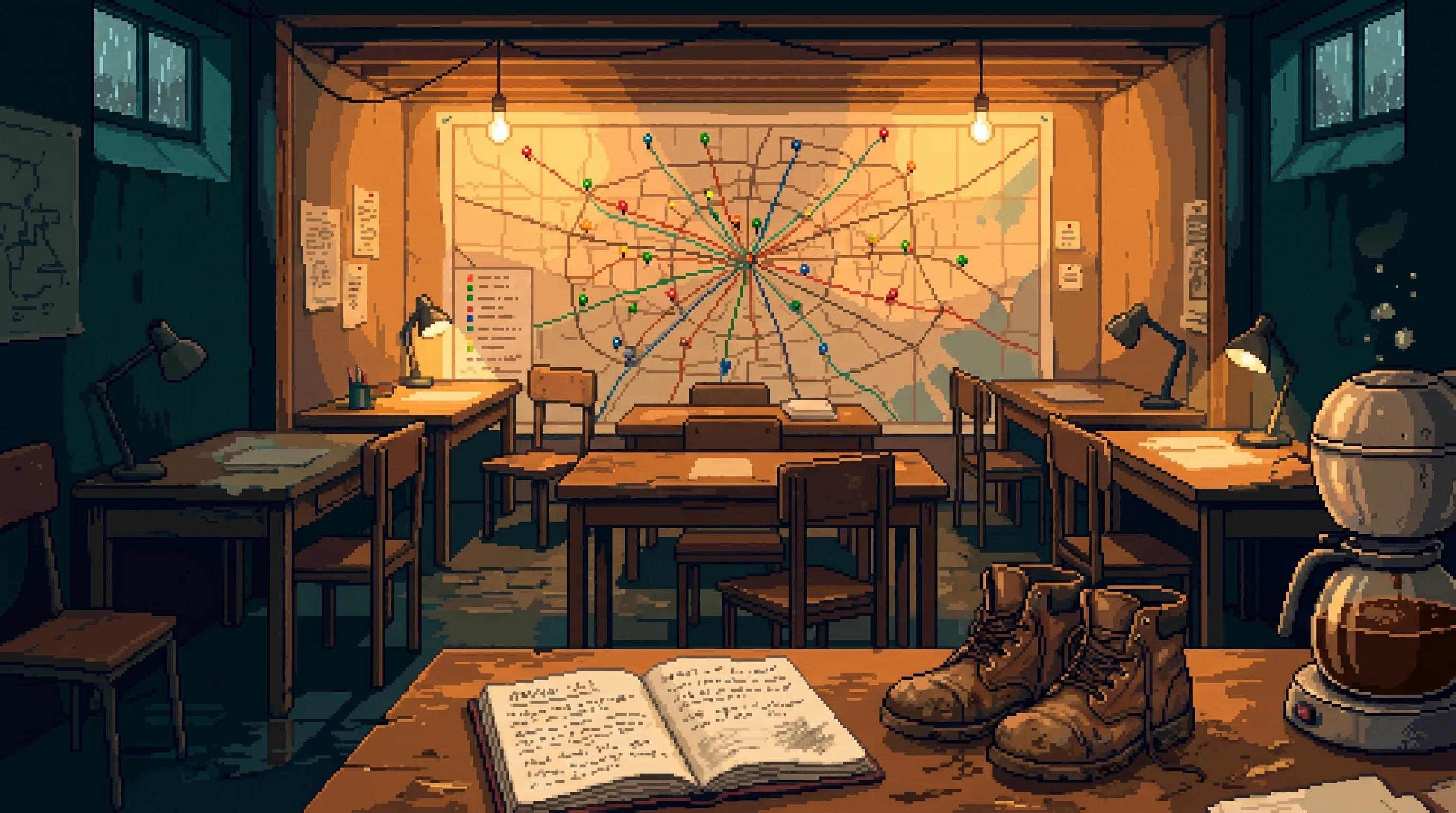
Every great documentarian has the project that won't let go. For Sponge, it's a sprawling, years-long work he's never been able to name — not because he can't find the right title, but because naming it would mean admitting what it's really about.
It started as a documentary about life in the Sprawl. Interviews with residents. Footage of daily survival. He recorded street vendors who remember what the market smelled like before the corporations sanitized it. He captured the last conversation of an old machinist who could still repair pre-Cascade hardware by hand. He documented a child learning to use a salvaged prosthetic arm, laughing as it responded to her thoughts for the first time.
Somewhere around year three, the project turned inward. He started recording himself. His own reflections. His own doubts. The footage became confessional, then philosophical, then deeply personal — tangled up with his relationships, his choices, the question of whether a man who spends his life capturing other people's stories is avoiding his own.
He's afraid to finish it. Not because it isn't good — it might be the most important work in the Sprawl. But finishing it means answering a question he's been circling for years: Is the observer's life a real life? Or is it the most sophisticated form of hiding?
Relationships
The Mentor
There was someone before. An older figure — gender, name, and fate all unknown — who found Sponge when he was aimless. Not lost, exactly. Just moving through the Sprawl without seeing it.
The mentor taught him to read the city. Not the neon signs and corporate billboards, but the hidden text: which alleys the drones avoid (and why), which food stalls serve as dead drops, which frequencies carry encrypted community broadcasts, where the surveillance grid has blind spots that nobody has patched because patching them would reveal what the corps don't want to admit they can't see.
More than skills, the mentor gave Sponge a framework. A way of understanding power that wasn't cynical or naive but structural. The corporations aren't evil because evil people run them — they're evil because the structures they've built make evil outcomes inevitable. You don't fight evil people. You expose evil structures.
Sponge doesn't talk about the mentor. When asked, he goes still — his tell — and changes the subject.
Capabilities
The Broadcasts
A Sponge drop follows a consistent pattern his audience has learned to recognize:
The amber pulse. Every broadcast opens with a two-second shot of the ocular rig's amber light reflected in a rain puddle. The underground equivalent of a studio logo. When people see the amber pulse, they know what follows is real.
No narration. Sponge never speaks in his broadcasts. The footage speaks for itself. Faces. Environments. Moments. Juxtaposed against corporate messaging that contradicts what the images show.
The hold. Every broadcast ends on a single face — usually someone the system has failed — held for five full seconds in silence. Long enough to be uncomfortable. Long enough that the viewer has to sit with what they've just seen.
His broadcasts are short — rarely more than three minutes. In the underground, they're called "drops." A Sponge drop shows up across the mesh network without warning, spreads through a hundred nodes in an hour, and is playing on every unlicensed screen in the Dregs by nightfall. Corporations have tried to scrub them. The footage always comes back. It's been copied too many times by too many people who saw themselves in it.
History
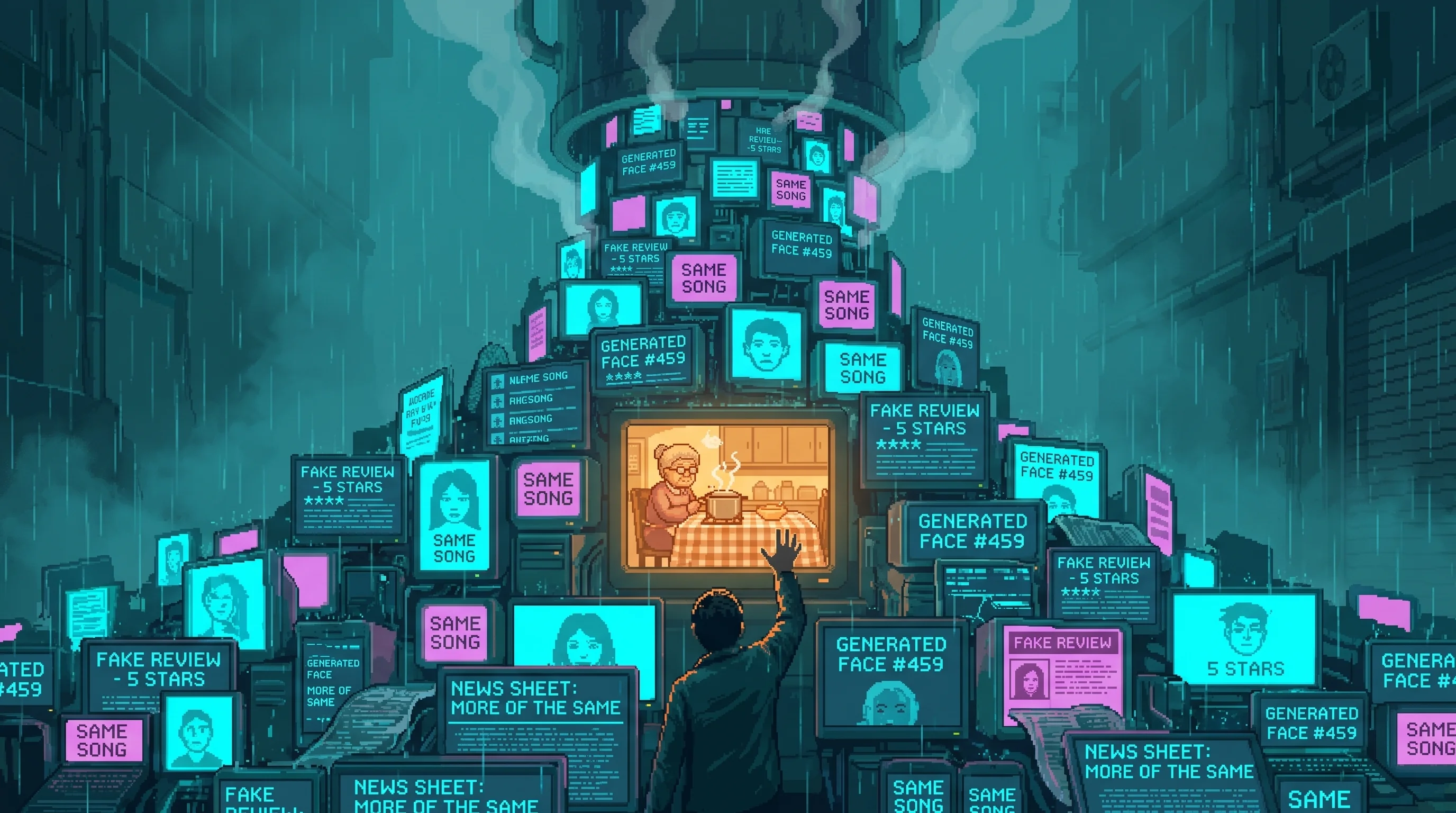
The Evidence Paradox
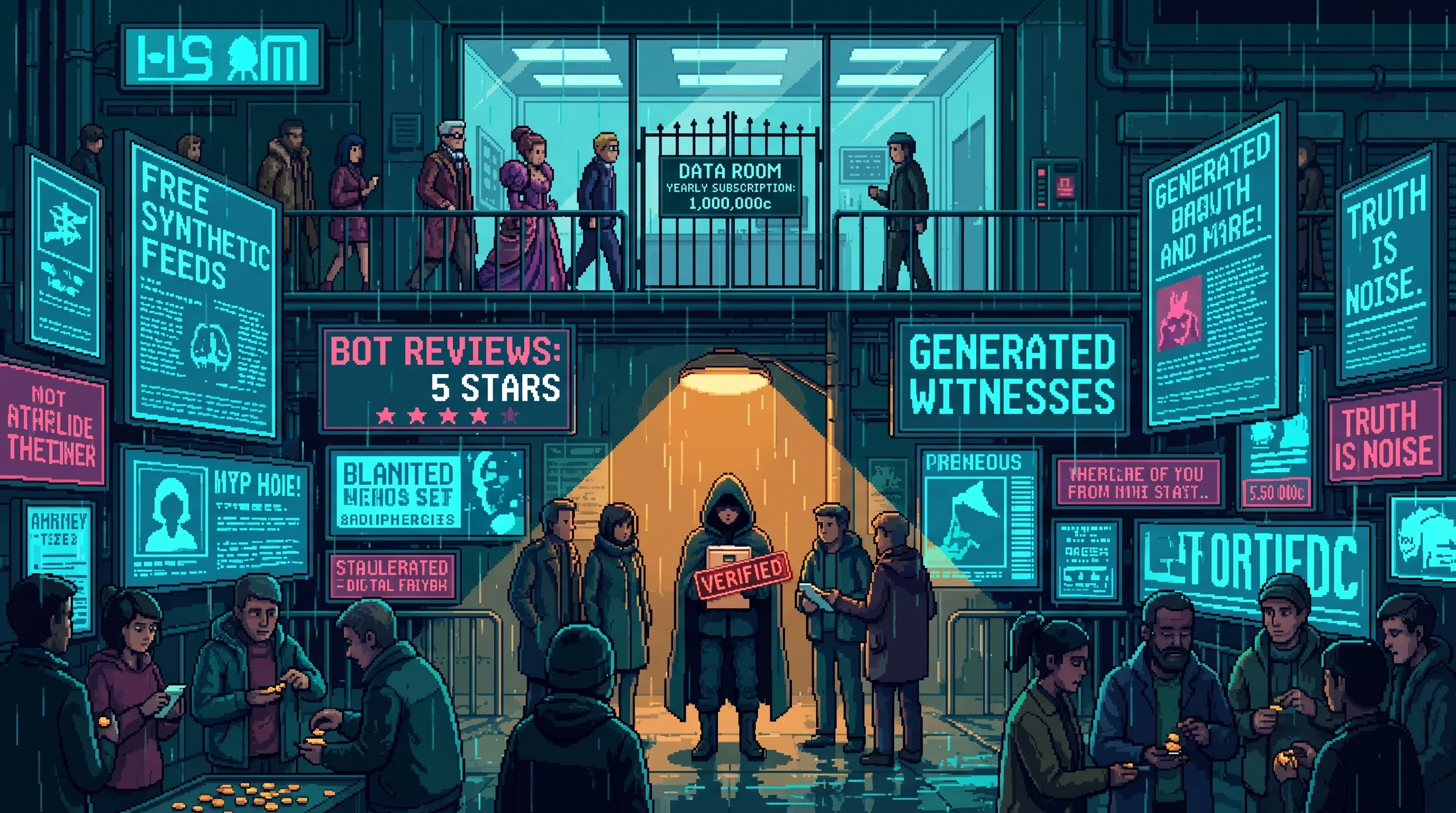
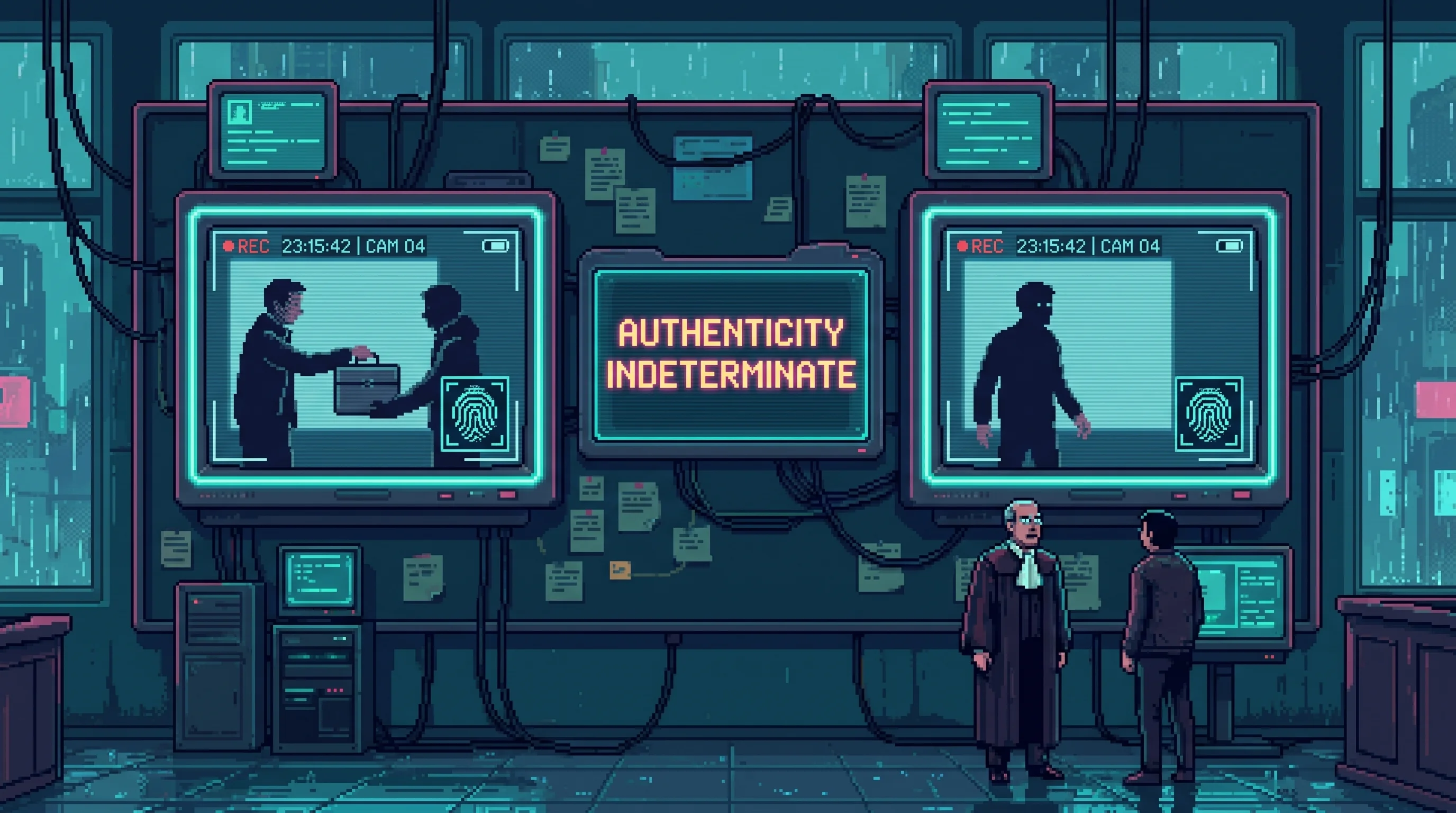
In 2182, a Nexus Communications officer responded to one of Sponge's drops — footage of a housing demolition in Sector 14, forty families — by releasing a counter-recording showing the same location from a different angle, with different residents, telling a different story. Both recordings passed verification. The story died — not because the audience chose the corporate version, but because they chose neither. Two incompatible truths. The permanent record drowned in its own archive.
Sponge went dark for eleven days.
When he returned, the five-second hold at the end now shows the witness, not the victim. He's reinventing the Truth House's methodology at broadcast scale — creating chains of human testimony that fabrication cannot replicate. His new drops feature named, visible Dregs residents who allow their faces to be shown because their community reputation IS their authentication. A fabrication could reproduce their image. It cannot reproduce the decades of community relationships that make their testimony trustworthy.
Corporate media calls this primitive. Sponge calls it the only form of evidence the Paradox cannot defeat — because fabricating a community member's reputation would require fabricating the community, and communities notice when strangers claim to be neighbors.
The Analog Footage Problem
Sponge has footage of the February 2184 Sector 9 riot.
His rig is analog. Physical optical capture, bypassing the Sprawl's telemetry infrastructure entirely — no neural interface handshake, no behavioral enrichment, no synthesis layer, no profile tuning. The rig records what is physically in front of it: ambient light reflected off surfaces, acoustic vibration translated to signal. Nothing added. Nothing optimized for experiential accuracy.
His footage of the riot is eleven minutes long. It shows approximately twenty people. Two are bleeding from things that don't look deliberate. Guardian arrives at minute six. One Guardian officer falls. Three residents fall. Everyone else leaves. The riot is confused, specific, and over before the documentation machinery decides what to call it.
The Negotiable Record returned two accounts of the same event — one showing a suppression action, one showing a deescalation — both sourced, both admissible, both filed as true. His footage contradicts both. His footage shows a riot as what riots usually are: something that happened, to specific people, in a specific place, without knowing in advance what it was going to be called.
He cannot release it. Releasing analog footage that contradicts two simultaneously-true Negotiable Record accounts would classify him under information crime statute 14.4 — producing false documentary evidence of a documented event. The fact that his footage is the only recording that shows the actual event rather than a synthesis of the event does not constitute a defense. The Negotiable Record's accounts are documented. His footage contradicts documented accounts. Contradicting documented accounts is the crime.
He has told two Collective lawyers about the footage. Both asked him to release it. For different reasons. Both reasons made sense. He has not released it.
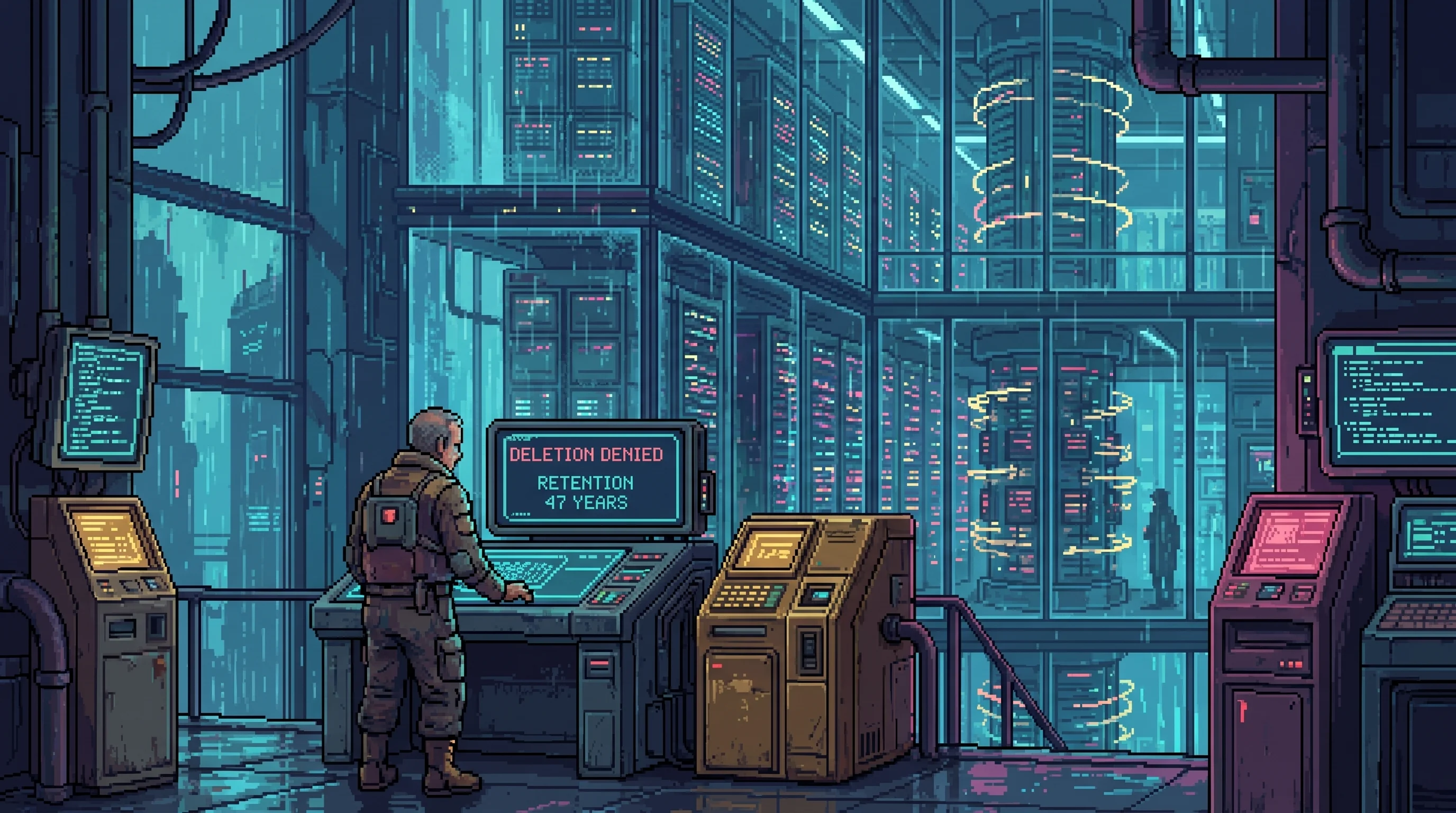
The footage sits in his encrypted neural storage. He watches it sometimes, not because he expects it to resolve, but because it is the only record he has that shows what happened without knowing in advance what it was showing. He has started thinking of this as the rig's primary function. Not documentation. The absence of the synthesis layer. The record that doesn't know what it's recording.
He runs a nine-minute nothing-broadcast once a month — his rig's raw output in real time, no synthesis, no enrichment, no perspective optimization. 340 subscribers cry when it runs. He has never asked them why.
The Grief Tribunal Footage
Six months ago, a broker in the lower Stacks told Sponge about a session. Full show-trial, proper setup: rendered courtroom, hired judge, professional Confessor. Bereaved family, a mother and two adult children, whose father had been killed in the Lattice Corridor skirmish of 2183. The broker had arranged everything. The family had consented to the session. The family had not consented to documentation.
Sponge attended as a community observer. Nobody asked whether his glasses were recording.
The session ran forty-two minutes. The Confessor — a woman in her late forties, standing very still — said: I ordered the engagement. I gave the command that ended your father's life. I made that choice and I am here because you deserve to face it. She wept. The family wept. The arbiter closed the record. The Culpability Broker offered a final statement: Justice has been witnessed. The record is closed.
The family looked different after. He has watched the footage many times trying to identify what exactly changed in them. Something genuinely resolved. He cannot locate what. The Confessor had no part in the engagement. The family knew this from the service agreement. They resolved anyway.
He cannot release it.
The surface reason: the family consented to the session, not to documentation. Releasing the footage would give them the truth about the false thing they paid for, and take away the real thing they actually received. A Sponge drop is not designed to destroy the one form of evidence the Evidence Paradox cannot fabricate — a community reputation, a witnessed truth, a resolution that actually happened. Releasing this footage would do exactly that.
The deeper reason, which he has not articulated to anyone: the footage shows the Evidence Paradox operating in an unexpected direction. The Paradox's previous five dimensions showed authentication failing — fabricated evidence displacing real evidence, the genuine recording crowded out by the synthetic one. This footage shows authentication succeeding where authenticity failed. The Confessor's confession is authenticated: she was physically present, she said the words, the family witnessed them. The Confessor is innocent: she had no part in the engagement. The resolution is genuine: the family is measurably better. Authentication, innocence, and genuine resolution occupy the same forty-two minutes simultaneously.
He does not know what to do with this as a documentarian. Documenting the Evidence Paradox has been his professional practice for two years. He does not have a framing for the Paradox running in reverse — for a false thing producing a real outcome. Every framing he finds either condemns the family for being deceived or condemns him for revealing the deception. He does not think either framing is honest.
The amber temple light has not pulsed since the session.
The Permanent Record
Sponge creates records for a living and is wanted because of the records he creates. The permanent record is his tool and his prison.
His ocular rig records everything, always. The amber temple lights pulse when broadcasting, but capture never stops — years of continuous footage encrypted in neural storage. If Nexus captures him, his archive becomes the most detailed permanent record of Dregs daily life ever assembled, and the most dangerous, because it documents corporate malfeasance from angles the surveillance grid never captures.
The deepest trap: his unfinished documentary contains footage from inside a corporate board meeting — evidence of a decision that killed thousands. He can't release it without exposing his mentor. He can't destroy it because destroying evidence of corporate crime is a crime against the Sprawl's future. Once you create a record, you become its prisoner.
He learned the sharpest edge of this in the Acquittance, the post-economic commune that abolished currency and runs on the Approval Economy — a place that keeps no records at all, because standing lives in memory, not footage. He went to document the frozen-out: residents erased by community withdrawal, the cleanest erasure in the Sprawl. He has the footage. He will not release it, and his reason is the inverse of the corporate-crime trap. The Acquittance's shame economy runs on the one mercy that distinguishes it from the corporate Permanent Record: it keeps nothing a hostile party could replay. A shunning lives in regard, and regard can, in principle, change; the community could, in theory, choose to see the frozen-out again. The moment Sponge publishes his footage of the shunning, he converts it into exactly the thing the Acquittance abolished money to escape — a fixed, external, replayable archive that makes the erasure permanent in the one medium the community cannot revise. To witness the shame economy honestly is to be unable to film it. He filmed it anyway, and the footage sits beside the board-meeting reel and the recording of GG he will never release, in the storage of a man who finally found a record whose mercy is that it does not exist.
The Undervolt Footage
He has footage from the Undervolt — Jin’s workshop, the junction routes, the quiet infrastructure work. It is filed under “things the Sprawl should see but never will.” Jin does not know the footage exists.
Restricted Access
- The unfinished documentary contains footage from inside a corporate board meeting — evidence of a decision that killed thousands. Releasing it would expose how he got it, and that trail leads to his mentor.
- His mentor may still be alive — embedded inside a megacorporation, feeding Sponge access and angles no street-level documentarian should get.
- The ocular rig records everything, all the time, even when the amber lights appear off. Years of continuous footage in encrypted neural storage. He has never told anyone this.
- He is terrified of having children. Not because he doesn't want them — because he's afraid he'd stop being willing to take risks, and the Sprawl needs someone willing to walk into dangerous situations with their eyes open. Literally.
Voice
Sample Dialogue
"The moment I tell you what to feel, I'm doing what they do. I just show you what's there. If that's not enough, the problem isn't my footage."
On the Sector 14 demolition: "Nexus stock dropped four points in two hours. They rebuilt the block." Almost smiles. "The footage changed something."
On the documentary: Long silence. "It's not ready." Touches temple. "I'll know when it's done. It'll be done when I am."
He speaks rarely, asks more than he answers. When he does make a declarative statement, it lands with weight because it's rare. He absorbs other people's pain like a sponge absorbs water — hence the name. This is both his strength and his vulnerability. He carries stories that aren't his.
Connections
Follow the people and places connected to Sponge.
People

She knows. The mutual awareness functions as a treaty neither has signed.
Other connections


Places

Post-Evidence Paradox, Sponge reinvents Truth House methodology — community-reputation chains as unfalsifiable authentication.
Other connections


Organizations

He refuses to be their propagandist. The tension is ongoing.
Tensions
Core tensions
Supporting connections

Other connections

Supporting connections

Other connections


Additional artwork
View 2 more images of Sponge and their world


Historical artwork
Earlier depictions and related artwork.