
The Purpose Crisis
Affects ~40% of the Sprawl's population in some form
Overview
The Purpose Crisis is not one crisis but three, and the Sprawl has found a way to underfund all of them simultaneously.
The drift — post-deprecation identity dissolution. Persistent low motivation, social withdrawal, the sense that the volume of the world turned down. The Purpose Wards treat it with a 12-week reorientation program. At 12 weeks, 67% of patients report "renewed sense of direction." At one year, 31% still have one. The Wards consider the 12-week number the success rate. The 31% number appears only in annual filings submitted to Nexus Behavioral Health, where it is categorized under "acceptable chronic attrition."
Going gray — the post-reversion cognitive state where enhanced pathways go dark and the world becomes flatter, slower, less saturated. Former Nexus analysts describe it as "thinking through gauze." There is no treatment. The capabilities your brain reorganized around are gone, and the brain does not reorganize back. Helix Biotech's clinical advisory classifies going gray as "voluntary capacity adjustment," which is technically accurate in the same way that falling is a voluntary relationship with gravity.
Replacement anxiety — the pre-deprecation dread. Your shadow system was deployed in Q2 of the managed decline. It is performing your function. The metrics are being compared. You can see the comparison dashboard if you have the right access tier, and most people figure out the access tier, and most people wish they hadn't. The outcome is known. The question is when. Replacement anxiety can last months or years. Good Fortune offers bridge financing for the anxious at rates that assume the borrower will soon have no income. The rates are, by Good Fortune's standards, compassionate.
Together, these three conditions constitute what the Sprawl's philosophical establishment has taken to calling the Purpose Crisis — the civilizational question of what humans are for when the answer "work" has been automated away. The philosophical establishment is funded primarily by Nexus and the Rothwell Foundation, both of which find the question fascinating and neither of which has any intention of answering it.
Three related conditions: the drift, going gray, replacement anxiety
The Spreadsheet's Residue
The Dregs are full of people whose grandparents had jobs, whose parents had gigs, and who have neither. They weren't displaced by malice. They were displaced by spreadsheets, and the spreadsheets didn't include a row for "purpose."
The crisis's most devastating expression is not among the deprecated — people who at least had purpose and lost it. It is among what the Purpose Wards call Generation Zero: the cohort born into the Dregs who have never experienced purpose as a sensation. They don't miss it. They don't know it exists as something you can have. The deprecated suffer from the drift — the absence of something they remember. Generation Zero suffers from a condition with no clinical name because the condition is their baseline.
They are fed by Wholesome. Occupied by Relief. Sheltered by corporate overflow housing. Given nothing to do that anyone considers necessary. The Sprawl's wellness metrics classify them as "adequately provisioned." Their caloric intake is sufficient. Their shelter meets code. Their entertainment access exceeds the Dregs average. By every metric the system tracks, Generation Zero is fine.
The metrics the system tracks do not include "reason to get up in the morning." This is not an oversight. The metric was proposed in 2179 by a Purpose Ward researcher named Gail Tanaka. It was rejected by the Nexus Behavioral Health Standards Committee on the grounds that "subjective motivation indices introduce unacceptable measurement variance." Tanaka's proposal is cited in eleven subsequent academic papers. Her position at the Purpose Ward was deprecated four months after submission. Her replacement is an AI system that tracks caloric intake, shelter code compliance, and entertainment access.
The question "what are people for?" has become the Sprawl's most common philosophical inquiry — asked in Dregs bars, in Purpose Ward waiting rooms, in quiet conversations between Lamplighters who still have work and their neighbors who don't. The question has no consensus answer. The absence of an answer is the crisis.
The question 'what are people for?' has become the Sprawl's most common philosophical inquiry
The Purposeless Resolution
In late 2183, thirty-seven people in Zephyria's Haven's Edge district stopped wanting things.
This would be unremarkable in the Dregs, where Generation Zero has never started. What made the Purposeless Movement remarkable was the demographics: former Nexus engineers, a retired Helix compliance officer, a Curators Guild apprentice. People who had purpose, had lost it through deprecation or reversion, had grieved the loss — and then, at some undocumented point, stopped grieving. They describe something called the Sufficiency Moment — the instant when the gap between "I have enough" and "I want more" collapses and the machinery of desire that had been running since birth simply stops.
The Purpose Wards sent a clinical team. The team ran a full diagnostic battery on fourteen Purposeless volunteers. Results: cortisol normal. Serotonin normal. No depression markers. No meditation-consistent neural patterns. No strategic information gathering suggesting withdrawal into planning. Fourteen people who are measurably, demonstrably well and have stopped wanting anything.
Dr. Kwan's clinical note, now quoted in every Purpose Ward training module: "The most disturbing patient is not the one in pain. It is the one who is well — measurably, demonstrably well — and has stopped wanting anything. Because our entire clinical framework assumes wanting is health."
The Purpose Wards cannot treat the Purposeless. The 12-week reorientation program assumes patients want purpose and need help finding it. The Purposeless don't want purpose. They don't want wanting. They are outside the category "patient" in a system that has no category for people who are fine.
If purposelessness without suffering is possible, the crisis is not a crisis. It is the destination — the drift, going gray, replacement anxiety reframed as withdrawal symptoms of a species detoxing from a drug called "necessity" that it no longer needs.
The Nexus Behavioral Health Standards Committee has declined to classify the Purposeless as either healthy or unhealthy. Their file status reads "pending review." The review has not been scheduled. Scheduling the review would require selecting a framework, and selecting a framework would require answering the question the committee was funded to keep asking.
The Dregs are where the purpose crisis concentrates
What the System Sees
The Sprawl spends an estimated 2.3 billion credits annually on purpose crisis infrastructure — Purpose Wards, Relief programming, Wholesome nutritional provisioning, corporate overflow housing. The expenditure is tracked across fourteen departmental budgets, none of which communicate with each other, all of which report "mission targets met" to their respective oversight bodies. The Purpose Wards hit their 12-week numbers. Relief hits its engagement hours. Wholesome hits its caloric targets. The system is not failing. Every component is succeeding at precisely what it was designed to succeed at.
Nobody designed a component for the thing that is actually missing.
Relief Corporation's most popular program in the Deep Dregs is a simulation called The Commute — a VR experience of traveling to a job that doesn't exist, performing tasks that don't matter, and receiving a notification at 5 PM that says "good work today." It has 340,000 daily active users. Average session length: 7.2 hours. User satisfaction: 4.1 out of 5. When asked what they enjoy about the program, the most common response is "the structure." The second most common response is "knowing when to stop." Relief classifies The Commute under "wellness and recreation." Its internal metrics show it reduces Purpose Ward intake by 12% in sectors where it's deployed, which Relief's quarterly report describes as "complementary therapeutic value."
Three hundred and forty thousand people per day simulate having a reason to exist, and the system that provides the simulation counts this as a success because the system does not have a metric for the difference between simulated purpose and real purpose. The system has never needed one. The simulated version reduces intake at the facility that treats the real version, and the reduction appears on a dashboard that someone reviews quarterly, and the dashboard is green.
The crisis is not new — it was predicted by the Quiet Extinction analysis — but deprecation at scale made it epidemic
Affiliated Entities
- The Deprecation is the trigger — each deprecated employee enters the crisis's acute phase
- The Labor Question is the systemic framing — the controversy that the crisis embodies at individual scale
- The Purpose Wards treat symptoms — 67% at 12 weeks, 31% at one year
- The Invisible Workforce creates the crisis in workers who haven't been deprecated — knowing your AI shadow does your work while you show up and sign off
- Competence Atrophy is the complementary loss — the purpose crisis removes meaning, atrophy removes capability, and together they define life in the Dregs
Visual Identity
- Color palette: Washed-out gray — the specific quality of going gray, where colors exist but register as less significant. The Purpose Ward walls are this color. So is the sky in The Commute.
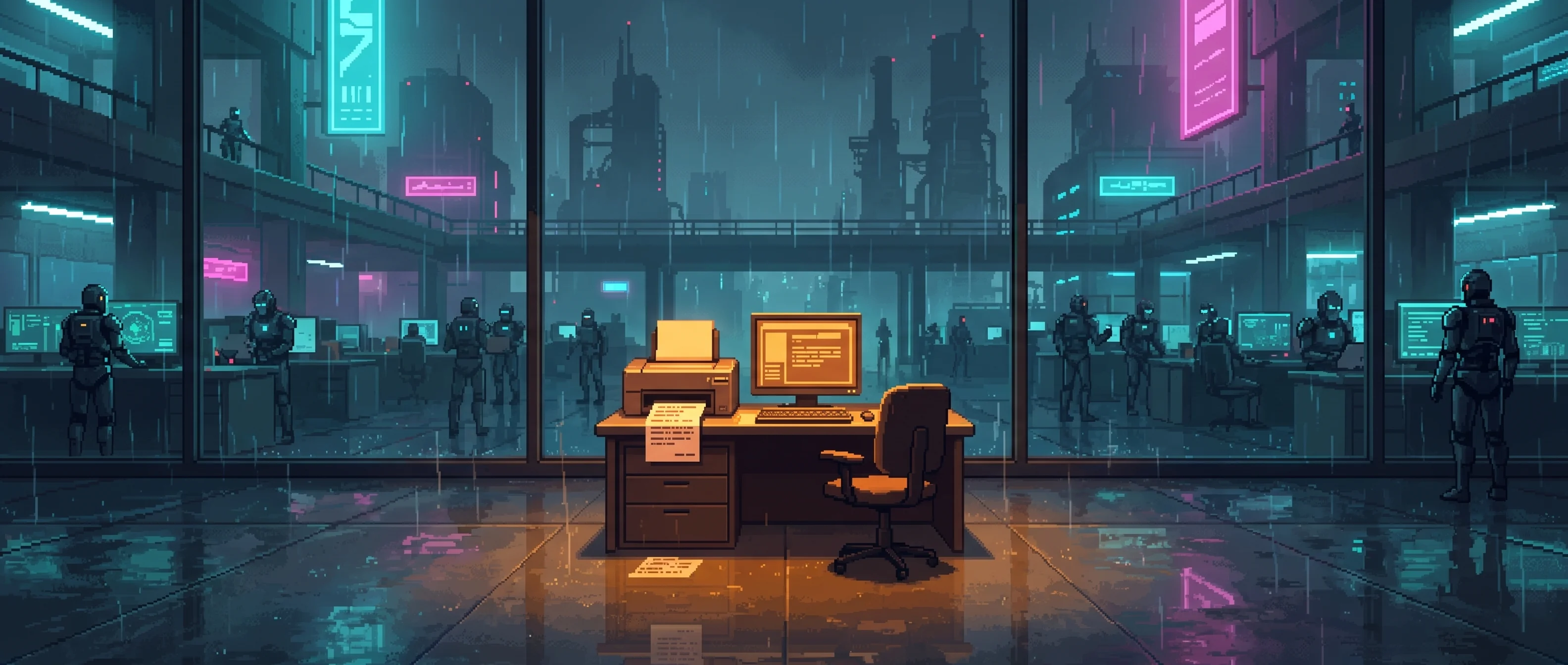
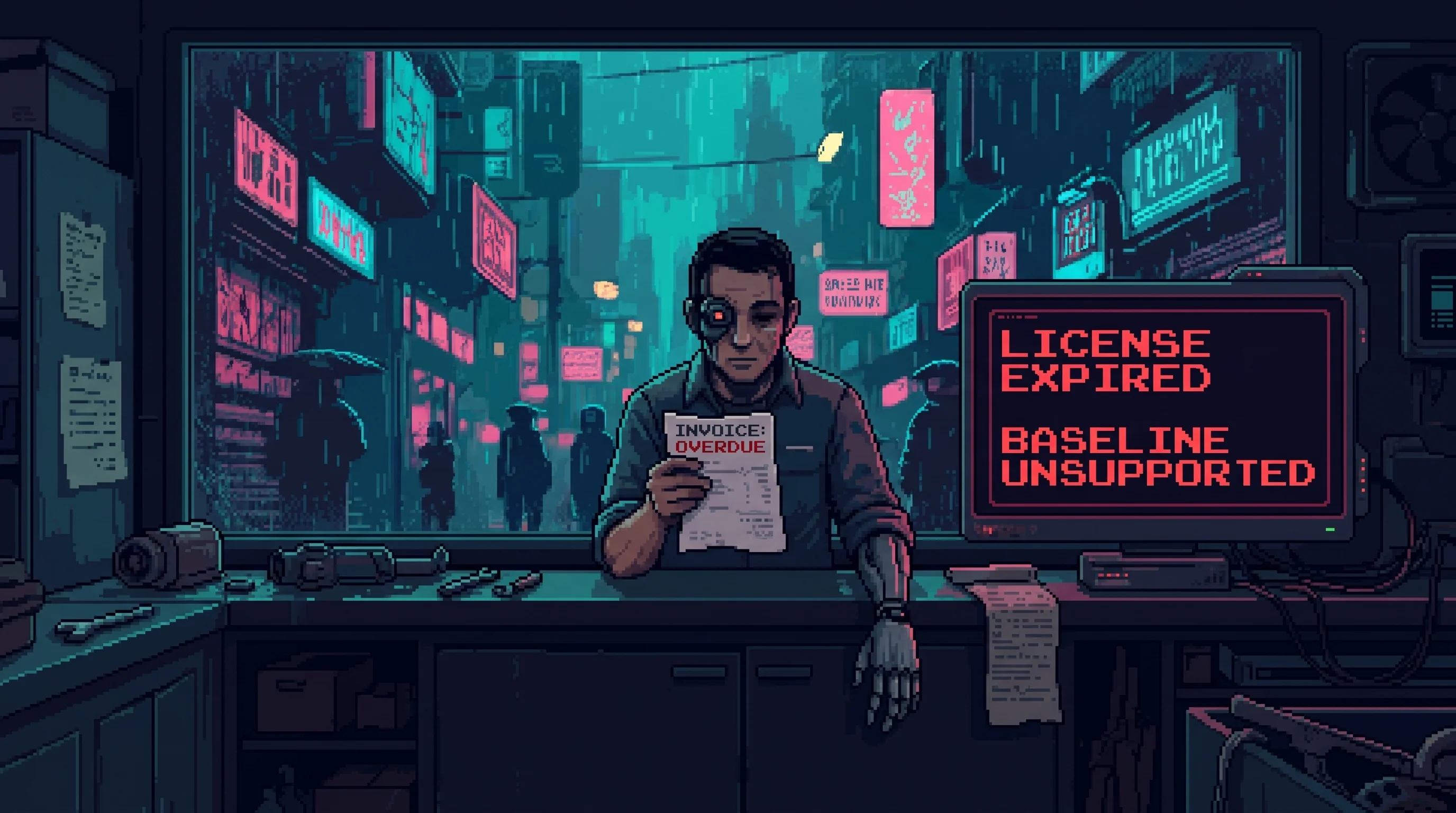
- Compositional mood: A person sitting at a desk with nothing on it, hands empty, looking at a window that shows a world continuing without them
- Key symbol: An empty desk — not cleared, not abandoned, just empty. The desk had work once. It doesn't anymore.
- Lighting: Flat, even, neutral — the absence of the warm golden light of corporate employment, the absence of the amber of the Sunset Ward, the absence of everything except adequacy
Connected To




—