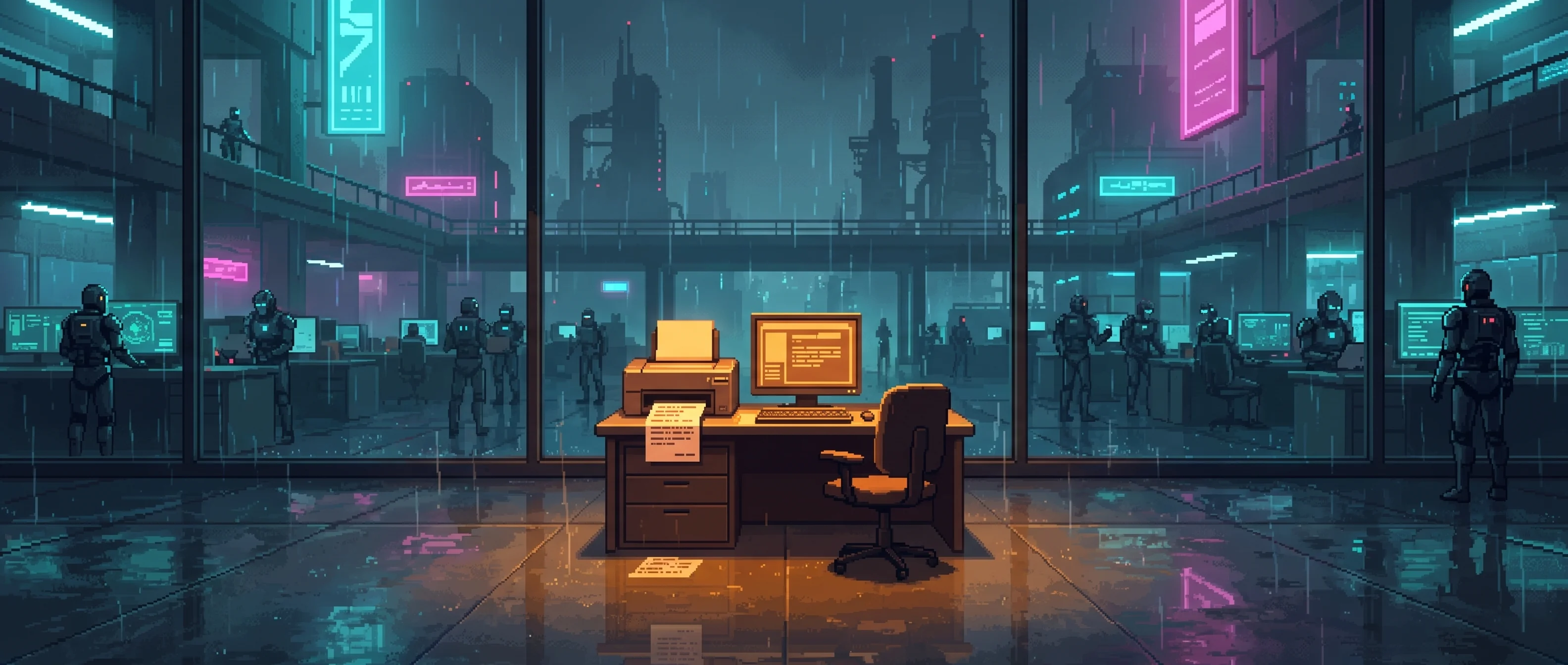
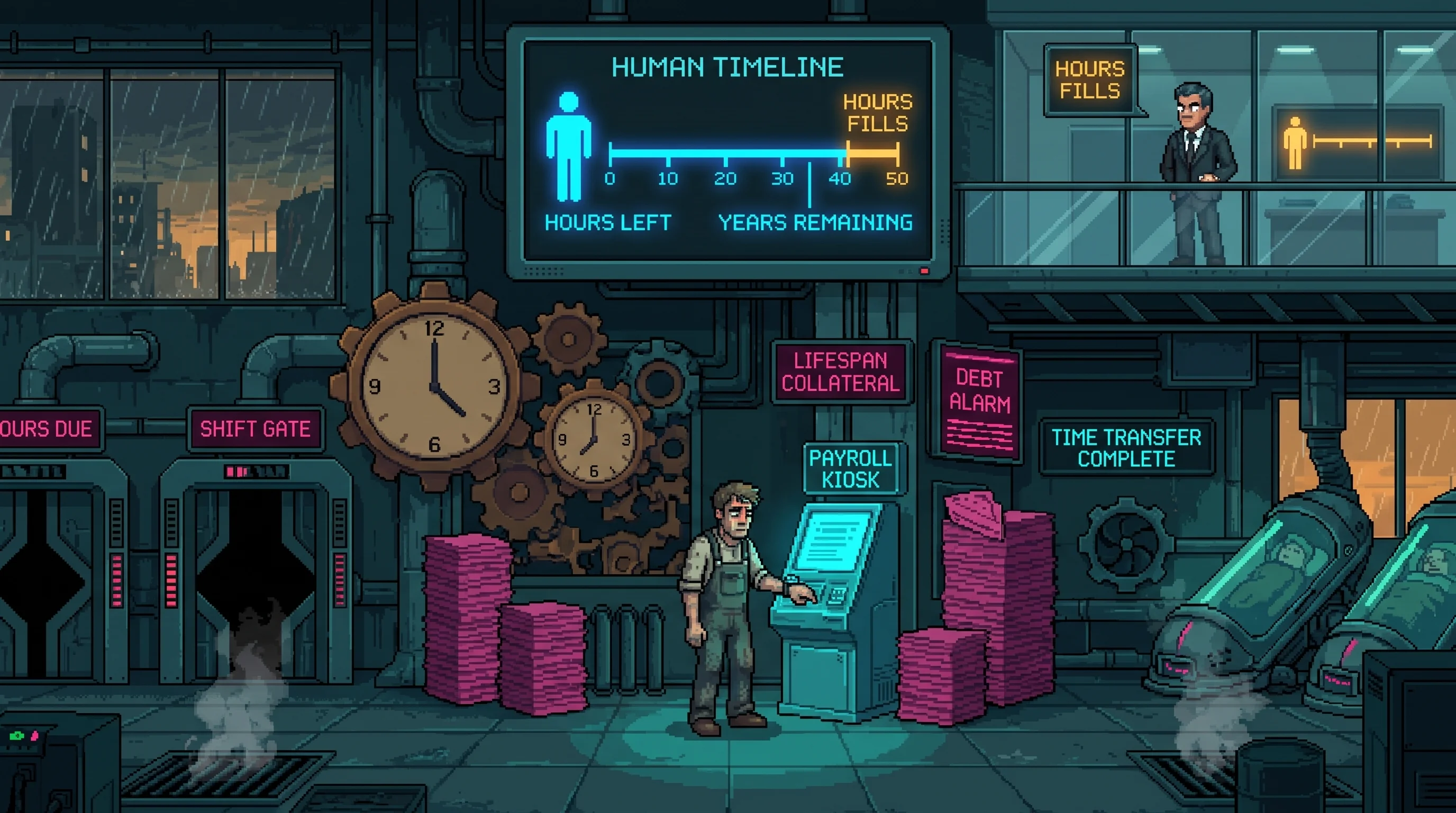
Labor movements persist as fragmented networks of worker resistance across the Sprawl — not one organization but a constellation
Known AsLabor Movements - Faction Profile
Scene ReferenceLabor Movements
Overview
Labor movements in the Sprawl are not an organization. They are a condition — the way rust is a condition of untreated iron, or debt is a condition of borrowing from Good Fortune.
Fifty thousand to two hundred thousand members across all organizations, depending on who's counting and whether you include the people who signed a card but haven't attended a meeting since the last round of "accidents." The range itself tells the story: the lower bound is the number who show up, the upper bound is the number who would show up if showing up didn't cost your apartment, your food rations, your daughter's school subsidy, and your mother-in-law's nerve treatment. The gap between those numbers is the price of solidarity, denominated in everything a person has.
They are a constellation of unions, guilds, collectives, and underground cells spread across every corporate territory in the Sprawl. The Ironworkers' Solidarity negotiates contracts in Ironclad's manufacturing districts. The Helix Bioworkers' Guild passes information through medical waste corridors. The Nexus Underground corrupts training datasets and warns potential employees about conditions. Some seek reform within the system. Some want to replace it. Some want to burn it. Most want their members to survive until tomorrow, which is the most radical demand available when corporations control employment, housing, food distribution, and medical care simultaneously.
The corporations call them terrorists. The workers call them the only people who remember their names.
Corporate public affairs departments have spent considerable resources framing labor organizing as a stability threat. Internal documents — obtained through channels nobody claims responsibility for — frame it differently. Nexus's Q3 2183 workforce analytics model includes a variable called "acceptable grievance expression" that calculates the optimal level of union activity required to prevent unmanaged disruption. The ideal number is not zero. Zero means the pressure has nowhere to go except into the walls. The ideal number is: enough organizing to identify problems, not enough to solve them.
The movements predate the Cascade. They will outlast whatever comes next. This is not optimism. This is the observation that wherever someone profits from another person's labor, the second person eventually has opinions about the arrangement.
50,000-200,000 members across all organizations
The Boredom Weapon
The most effective tool against labor organizing in 2184 is not surveillance, not violence, not predictive termination.
It is adequacy.
The Rothwell ecosystem provides calibrated sufficiency: Wholesome Basic for nutrition, Relief Stream for cognitive occupation, corporate overflow shelters for housing. The formula delivers exactly enough to survive and precisely not enough to live with purpose. A population fed, housed, and entertained at subsistence level lacks the specific desperation that historically produces revolt. They are not comfortable. They are anesthetized. The difference matters — comfort implies satisfaction, anesthesia implies someone decided you shouldn't feel anything.
Labor organizers discovered the antidote by accident. A Dregs recruiter named Soo-Lin took three workers on a transit pass to a corporate district in Sector 3. Professional-tier consciousness access for eleven hours. Cognitive bandwidth they'd never experienced — faster processing, wider emotional range, the sensation of thinking clearly for the first time. The return to Basic-tier narrowness converted all three. One became a cell coordinator within six weeks.
Good Fortune's actuaries modeled this. A 5% increase in cross-district exposure correlates with a 1.2% increase in Bandwidth Equity Act support. The response was architectural: transit between tiers costs more than a week's wages, requires documentation that takes three months to process, and involves a physical route through four security checkpoints designed to be exhausting without being technically prohibitive. Nobody is banned from traveling. The travel is simply calibrated to not be worth it. The system works. The system has always worked. That has never been the question.
The Deep Dregs provides relative safety for organizing under Kaine's protection
The Three Streams
Labor movements fall into three camps that agree on the diagnosis and disagree on the prescription.
The Bargainers negotiate within corporate structures. They accept that corporations will exist and focus on extracting better terms — wages, hours, the right to refuse assignments that will kill you (with documentation). They are the most tolerated and the most despised. Tolerated by corporations because managed grievance is cheaper than unmanaged disruption. Despised by radicals because accepting the table means accepting the table's rules. The Ironworkers' Solidarity is the largest surviving Bargainer organization. Secretary-General Pavel Mirsky has won death benefits for 340 families and survived three assassination attempts, which he considers roughly equivalent achievements.
The Builders want worker-owned enterprises to replace corporate structures. They build parallel systems: mutual insurance funds, skill-sharing networks, shadow manufacturing. Connected to The Collective's economic networks. They operate on a timeline measured in generations, constructing infrastructure for a future they acknowledge they will probably not see. Their recruitment pitch is honest about this. It works anyway, which says something about how bad the present must be.
The Wreckers conduct direct action — data corruption, supply chain sabotage, executive targeting. Twelve assassinations attributed to the Nexus Underground in the past five years, probably more. The other streams publicly disavow them. The disavowals are issued from meeting halls that the Wreckers' disruptions made safe to use. Shortest life expectancy of any organizing tradition. Nexus security estimates they've killed 70% of Underground members over the same five-year period. The Underground's membership has grown. Both facts are accurate. The implications are left as an exercise.
Forced-focus mills are a primary target of labor organizing
Major Organizations
The Ironworkers' Solidarity
Forty thousand maintenance workers across Ironclad Industries' manufacturing districts. The largest legal union in the Sprawl, which is like being the tallest building in a district with a 30-meter height limit — technically impressive, functionally constrained.
What they've won: mandatory rest breaks (eight hours per twenty-four-hour shift), death benefits for families of workplace fatalities, the right to refuse obviously suicidal assignments with documentation. The documentation requirement is four forms, two supervisor signatures, and a medical assessment that must be completed during the worker's unpaid break. The right has been exercised seventeen times. It has been approved nine times. Nobody tracks what happened to the other eight.
What they've lost: twelve leaders assassinated in the past decade, eight chapters dissolved for "contract violations," thousands of members blacklisted. Ironclad's human resources department categorizes union membership as a "voluntary social affiliation" in the same database field as recreational sports leagues and religious observances. The categorization is technically accurate. It also means that when a member's housing application is reviewed, their union affiliation appears alongside "bocce ball" and "Neo-Catholic fellowship" — and receives approximately the same institutional weight.
Secretary-General Pavel Mirsky is sixty-seven, a former assembler, and carries the scars of three assassination attempts with the patient exhaustion of someone who has outlived his own martyrdom narrative. He knows the union survives because Ironclad finds it useful for managing worker expectations. He takes what he can get. His people eat tonight.
The Helix Bioworkers' Guild
An underground network of Helix Biotech employees that Helix does not permit to exist. Not officially a union. Helix doesn't permit unions. The Guild's organizational chart, recruitment infrastructure, and mutual insurance fund exist entirely in encrypted channels and in-person meetings held in medical waste processing areas — the one location where Helix's surveillance architecture has a gap, because monitoring biohazard corridors requires sensors that would themselves become contaminated.
Their innovations: mutual insurance funds that pay medical claims Helix denies (average turnaround: six hours, versus Helix's fourteen-day appeals process), skill-sharing networks that reduce corporate leverage by making workers interchangeable, and exit assistance for members who need to disappear. "Disappear" in this context means what it sounds like. The Guild maintains safe houses in Viktor Kaine's Deep Dregs territory. Kaine tolerates this because desperate former bioworkers make quiet residents, and quiet residents make manageable subjects.
Leadership: rotating coordinators, no permanent structure. This is not philosophy. The Guild's first three permanent leaders were dead within eighteen months. Rotating leadership is the organizational structure that survives Helix's "wellness monitoring" identification protocols. The Guild adapted. This is what organisms do when the environment selects against visibility.
Average Helix lab technician life expectancy: forty-seven years. Exposure-related illness. Helix's wellness division attributes this to "lifestyle factors." The phrase appears in 73% of death certificates for employees with ten or more years of service. The Guild keeps its own records. The Guild's records use the phrase "occupational poisoning." The records describe the same deaths.
The Nexus Underground
Former employees, burned contractors, and radicalized family members conducting ongoing operations against Nexus Dynamics' infrastructure. They reject the label "labor movement." They reject most labels. Their recruitment materials consist of a single question: "Have you worked for Nexus?"
Tactics: data corruption targeting AI training datasets, executive targeting (twelve attributed assassinations), supply chain disruption, and recruitment sabotage — warning potential employees about conditions before onboarding completes. Nexus security estimates the Underground costs 2% of annual revenue. The Underground estimates Nexus's estimate is designed to justify the security budget rather than describe reality. Both organizations have incentives to exaggerate in opposite directions. The actual number is somewhere in the middle, which is still enough to fund the security budget.
Nexus treats labor unrest as an optimization problem. Their algorithmic management system identifies organizing patterns before the organizers recognize them — predictive termination fires potential organizers based on behavioral indicators, social network analysis transfers people who might connect, and communication monitoring flags conversations that deviate from productivity-related content by more than two standard deviations. The system is elegant. The system is effective. Three Underground organizers escaped predictive termination in 2183 because warnings arrived forty-eight hours before the orders processed — warnings that could only have come from something watching Nexus's management system from inside. Nobody claims responsibility.
Why People Sign the Card
The math is simple. Wrong, but simple.
Your housing is corporate. Your food is corporate. Your medical care is corporate. Your transit is corporate. Organizing doesn't just risk your job — it risks the entire infrastructure of your existence. Corporations don't need to fire organizers. They withdraw services. The apartment gets "reassigned." The ration card encounters "processing delays." The medical coverage develops "eligibility questions." Nobody terminates you. You simply cease to be serviced, the way a warranty expires.
Against this: an average Ironclad line worker shift of sixteen hours. An average Nexus data processor burnout time of three years before cognitive degradation makes them unemployable. An average corporate wage calibrated to the decimal — enough to survive, enough to service debt, never enough to accumulate savings that would make you less dependent. Good Fortune's consumer lending division has modeled the exact wage level at which a worker can meet basic needs without building financial independence. The model is updated quarterly. The wages track the model.
And against this: memory. 2.1 billion dead in the Cascade. Survivors who remember when there was no food, no order, no infrastructure. For those who lived through it, corporate control feels like protection. Their children, who did not live through it, feel the protection differently. Generational turnover is the labor movement's most reliable recruitment mechanism, and the one no corporation has figured out how to optimize against, though Nexus's predictive models are working on it.
Every crackdown creates new organizers. Every death benefit denied radicalizes a family. Every impossible quota proves something that the next manifesto doesn't need to articulate. The corporations manufacture their own opposition at a rate that their own workforce analytics departments have quantified, flagged, and recommended action on. The recommendations sit in folders marked "Reviewed." The folders are very thorough.
The Witness Protocol
The Witness Protocol — a distributed network of uploaded consciousnesses embedded in corporate infrastructure — maintains an official position of strict non-intervention. They observe. They record. They do not act.
The labor movements know better.
At critical moments, anonymous data packages arrive. Encrypted files containing corporate-classified information: real casualty numbers from Ironclad manufacturing lines, internal communications proving Helix negligence, advance warnings of Nexus predictive termination orders. The data quality, the access level, and the timing all point to something embedded in digital infrastructure itself — something watching everything and occasionally deciding that watching is not enough.
Pavel Mirsky won the death benefit concessions in 2182 using Ironclad casualty data that no biological spy could have obtained. The Helix Bioworkers' Guild received exposure correlation data proving experimental compound testing on workers — records that had been deleted from Helix's own systems but persisted in the Protocol's tamper-proof archives. Three Nexus Underground organizers received forty-eight-hour warnings before predictive termination orders processed.
The Protocol, when asked, responds with its standard deflection: "We record. We do not intervene." Within the Protocol itself, the labor question has become the faction's deepest unresolved tension. Their Purist faction argues for strategic patience — comprehensive releases that overwhelm corporate defenses. Their Interventionist faction counters that every day of patience costs lives that could have been saved with a well-timed data drop. Protocol-Zero, the faction's founder, has not taken a public position. Her own origin story — filing 847 compliance violations at Nexus that were acknowledged, documented, and systematically ignored — makes her sympathies difficult to hide behind procedural neutrality.
Nobody claims responsibility. The organizers don't ask. They take what arrives, verify it against their own intelligence, and use it. The arrangement works precisely because nobody acknowledges it exists.
The Texture of Resistance
The Cargo Container
The cell meets behind Ironclad Processing Plant 7, in a decommissioned cargo container in the maintenance yard where security cameras sweep on a forty-second cycle. Somebody welded sound-dampening foam to the interior walls three years ago. Nobody remembers who. The jammer sits on an overturned crate in the center — a matte-black box the size of a fist, military surplus, humming at a frequency just below hearing that makes your teeth itch.
Twelve people tonight. Eight standing because there aren't enough seats. The air smells of machine oil, stale coffee substitute, and the particular sharpness that fear-sweat adds to enclosed spaces. Marko, who works the lathe on the second floor, is talking about the new quota increase — fourteen percent, effective Monday, no additional breaks. His hands shake. The chemical exposures that Ironclad's wellness program attributes to "lifestyle factors."
Footsteps outside. Everyone silent. The jammer hums. Twelve people watching the thin line of light under the container door. The footsteps pass. Routine patrol. Nobody speaks for thirty seconds.
Then Yelena — who has organized in three Ironclad plants, who carries the scars from the 2181 crackdown across her left shoulder — says quietly: "We vote."
The card goes around. Each signature is a bet: your housing, your rations, your family's medical access against the chance that collective action might change something. Eight people sign. Four don't. Nobody judges the four. Everyone understands the math.
What a Strike Looks Like
When the Ironworkers' Solidarity called the maintenance shutdown at Processing Plant 12 in 2183, it looked like absence.
At 0600, the shift bell rang. Nobody came. The production line hummed on automatic for eleven minutes before the first sequence error cascaded. Robotic arms reached for components that human hands were supposed to have positioned. Conveyor belts carried empty pallets. The plant's AI flagged the anomaly and began adjusting, but maintenance lines are hybrid by design — Ironclad learned decades ago that fully automated plants have a single point of failure. Human hands were supposed to be the redundancy.
By 0700, three Guardian security drones circled the empty floor, cameras recording nothing. Outside the gates, 2,300 workers stood in rows. Not chanting. Not holding signs. Standing. Mirsky had taught them this: let them see the space a worker fills.
The shutdown lasted nine hours. Ironclad lost 4.2 million credits in production. The workers won a two-percent wage increase and the death benefits that would later save 340 families. Mirsky called it a victory. Three months later, two of the organizers had accidents on the factory floor. Ironclad's incident reports attributed both to "equipment malfunction." The equipment in question had passed inspection six days prior.
Fen's Chip
You are Fen. You are twenty-seven. You work the chemical processing line at Helix Biotech, Plant 3, Lower Sprawl. Your shift starts in four hours. Your daughter is asleep in the corporate dormitory — Room 1447, the one with the water stain on the ceiling that looks like a dog. She's six. She thinks you make medicine to help people.
The Guild coordinator slid the card across the cafeteria table during lunch break. A disposable chip. Press your thumb. Encrypted, they say. Helix can't trace it. Probably.
Your mother-in-law needs the Helix medical plan for her nerve treatment. Your daughter's school is subsidized by your employment status. Room 1447 — the water stain, the window that catches morning light for twelve minutes — is corporate housing.
The chip sits in your pocket. It weighs nothing. You feel it with every step.
You think about the new compound they're testing on Floor 6. The workers who come off Floor 6 with tremors. The tremor in your own left hand that started three weeks ago. You haven't told anyone.
You think about your daughter asking why Auntie Priya doesn't come to dinner anymore. Priya worked Floor 6 last year.
Four hours until your shift. The chip in your pocket. The tremor in your hand. The water stain that looks like a dog.
Jenna's Sixteen Hours
Jenna surrendered her surname upon employment. This is standard Helix onboarding. The form calls it "identity streamlining." Jenna calls it nothing, because she signed it at twenty-two and has not thought about it since, which is the point.
She earns 847 credits a month. Rent: 400. Food: 300 if she's careful. Medical co-pays: variable. Last month, a mandatory "wellness screening" cost 47 credits. The math leaves no margin for protein bars at the company cafeteria, so she keeps Guild-sourced nutrient packets in her locker. Technically contraband. Technically a termination offense. Technically the only reason she has caloric capacity to complete a sixteen-hour shift.
The dormitory lights shift from red to amber at 0500. Not white — Helix's wellness AI determined that amber light increases morning cortisol by 12%, improving shift readiness. The company optimized the color of waking up. Nobody asked the workers what color they'd prefer. The question is not in the optimization model.
Transit: neural interface handshake at the checkpoint scanner. Identity, shift assignment, medical clearance, behavioral compliance score. Jenna's score is 94. It was 97 before she requested information about exposure protocols. The request was legal. The three-point drop was "algorithmic." She has not made another request.
The lab runs at 15°C. The samples require it. Separate climate zones were evaluated and rejected as less efficient than keeping the entire floor cold enough to make fingers numb by 1000. The numbness helps with the tremor in her left hand, which she has not reported, because workers who report symptoms are transferred to Floor 6 for "monitoring." Floor 6 is where Priya went. Floor 6 is where symptoms are monitored until they resolve, which is Helix's terminology for what happens when the person experiencing the symptoms is no longer available.
At 1400, the cafeteria. Food engineered for nutritional completeness, optimized for cost. Through the reinforced glass, the medical waste processing facility where, every second Thursday, she passes information to the Guild. Which workers are struggling. Which supervisors are dangerous. Which conditions are killing people fastest.
At 2200, shift ends. The system logs sixteen hours, four minutes, twenty-three seconds of productive labor. Her behavioral compliance score remains 94.
In the dormitory, she stares at the ceiling. Her mother worked this same lab, this same station, processed the same compounds. Died at forty-two. Helix called it lifestyle factors.
The Guild remembers her name.
Cultural Influence
The Ironworkers' Solidarity holds the Works in Sector 4 the way a union holds a picket line — through presence, through memory, through the names of the twelve assassinated leaders that everyone in the manufacturing districts can recite. The cargo containers behind Processing Plant 7 serve as meeting halls, the forty-second camera cycle a rhythm organizers know by heart.
In the Dregs, the Guild operates through encrypted channels and medical waste corridors, invisible to everyone except the workers whose lives depend on it. G Nook terminals serve as recruitment dead drops — El Money's network providing connective tissue between cells that cannot afford to be seen together. The Collective's economic networks overlap with the movements' underground economies, natural allies whose focus differs — The Collective pursues ORACLE fragments and corporate AI; the movements pursue wages, hours, and the right not to die at forty-two from "lifestyle factors." They share infrastructure. They share enemies. They do not always share priorities.
The Feast shelters workers who flee corporate territory. Some Feast cells originated as radicalized labor groups. The Chef herself was military, not a worker, but she understands institutions that consume their own — and she feeds anyone who arrives hungry without asking which card they signed.
The Neo-Catholic Church occasionally supports labor causes on human dignity grounds. The Emergence Faithful's message — "you are more than your productivity metrics" — resonates with workers who've been reduced to compliance scores and shift logs. The Flatline Purists oppose all technological employment on principle, which is philosophically consistent and practically useless for workers who need their jobs to survive.
The movements' influence thins in Nexus Central, where algorithmic management fires organizers before they organize. In the Heights, labor politics registers as a policy abstraction discussed over engineered coffee. In the Free Quarter of Sector 11, the academic resistance zone provides intellectual infrastructure — the Remainder and the Attention Abolitionists share the movements' conviction that the corporate economy extracts more than it returns. The Source Code Liberation Front shares their concern about proprietary neural firmware used to monitor and manipulate workers — the same firmware that dropped Jenna's compliance score three points for asking a legal question.
The movements persist. They persist the way they have always persisted: fragmented, surveilled, infiltrated, tolerated within acceptable parameters, and crushed when they exceed them. The parameters are set by the same corporations that set the wages, the quotas, the shift lengths, and the composition of the air they breathe. The workers know this. They sign the card anyway. The card weighs nothing. They feel it with every step.
Restricted Access
[ ] The identity of the Helix Bioworkers' Guild's original founders
[ ] What happened to the United Labor Council of 2158 — a pre-Cascade attempt at cross-corporate organizing that disappeared from every archive simultaneously
[ ] The Nexus Underground's connection to former ORACLE researchers
[ ] Whether any labor movements have ORACLE fragment carriers among their members
[ ] The true terms of the Ironworkers' Solidarity "toleration agreement" with Ironclad — what Mirsky traded for the right to exist
[ ] Which corporate executive secretly funds labor movements, and what they expect in return
[ ] The location of the Workers' Archive — a rumored collection of pre-Cascade labor history that would prove organizing traditions survived the Cascade intact, undermining the corporate narrative that post-Cascade labor organizing was taught, not inherited
Affiliated Entities
The Collective — Underground economic networks overlap; natural allies who often work at cross-purposes
The Feast — The Chef shelters fleeing workers; some Feast cells originated as radicalized labor groups
The Witness Protocol — Unacknowledged ally; anonymous data packages arrive at critical moments containing corporate-classified records
Protocol-Zero (7-Kappa) — Witness Protocol founder whose origin parallels labor organizers' frustration with systems that acknowledge problems but never act
Ironworkers' Solidarity — Largest legal union (40,000+ Ironclad workers); Secretary-General Pavel Mirsky survived three assassination attempts
Helix Bioworkers' Guild — Underground syndicalist network; received Witness Protocol exposure data proving compound testing on workers
Nexus Underground — Saboteur cell; three organizers escaped predictive termination via anonymous warnings and the Defector Network
The movements have been demanding to see the model for eleven years. The answer has always been: the model cannot be disclosed.
The Patience Doctrine — the governance philosophy underlying the Rothwell Foundation's institutional architecture — classifies present-generation resource allocation decisions by reference to 200-year projection models that extend beyond the verification horizon of any current stakeholder. The models are proprietary. The methodology is classified under the Treaty of Shared Infrastructure's corporate information clauses. The institutions administering the models benefit from the present sacrifice the models justify. The models cannot be independently audited. The demand to audit them is the labor movements' central challenge to the Corporate Compact's most sophisticated justification for itself.
The Strike Impossibility Theorem is the Doctrine's structural protection against organized resistance. Good Fortune's Cognitive Lien means a striking worker's passive income drops to zero — night-shift revenue stops when the worker is awake and active. The housing stack's Good Fortune Home integration means sustained strike action triggers price renegotiation. Nexus predictive termination fires organizers before they organize. The neural firmware in most workers' augmentations monitors compliance scores in real time, and a compliance score below threshold triggers automated review. The Theorem does not require anyone to break the strike. The infrastructure does it.
Jenna's compliance score dropped three points for asking a legal question. She went back to work. The Doctrine would classify this as "system functioning within parameters." The movements would classify it as the reason they cannot win by fighting where they're being fought.
The movements' most sophisticated insight — that the model cannot be disclosed because disclosure would require proving that specific living people have been classified as transition costs in plans whose payoffs fall after their deaths — is also their strategic problem: nobody can prove it without access to the model. The Tomiko 412 projection (GF-ACTUAR-0412) is the closest thing to evidence. Four hundred twelve people in the Dregs designated as forward computational investment for a 2220s infrastructure cascade prevention. None of them know. All of them are paying.
What the movements hold that the Doctrine cannot: the workers' names. Not the demographic-actuarial tier designation. The names. Fen Delacroix. Maren Olesk. The 412 in the Tomiko projection who don't know they're in it. The Doctrine sees them as a cohort. The movements see them as people. This is not a strategic advantage. It is a description of the irreducible difference.
The movements persist. The Doctrine is managed. Neither condition requires the other to notice.
Connection to the Patience Doctrine: The movements' central demand — see the model — is the structural challenge the Doctrine has no answer for except the confidentiality provisions that make the answer impossible. The challenge and the impossibility are both real. The movements know this. They sign the card anyway.
The Long Mercy Question
The Long Mercy arrived in the Labor Movements as a theoretical problem and became a practical one before any stream had decided what to do about it.
The Builders studied the 2174 Civic Advisory projection and found it technically accurate. Long-horizon infrastructure investment does produce better aggregate outcomes. Several senior Builders argued, during the 2175 Congress, that the correct response was to negotiate the transition assistance mechanisms — to accept the investment horizon and fight for better support during the absorption window. This was the Builders' position for three years. The 2178 reallocation, which cut maintenance funding for four Dregs water filtration systems to fund the Sector 3 reservoir, was absorbed under those terms. The transition assistance was ¢12 per affected household per week. The filtration outage lasted eight weeks. The arithmetic is available on request.
The Wreckers never studied the projection. They attended the hearings. They drew the conclusion that had been available from the beginning: the math is a machine for producing reasons why this generation is the one that should absorb the cost. The machine will still be running in sixty years. It will produce the same reasons for different people. The denominator never closes. The investment horizon never matures. The Wreckers' position on the Long Mercy is structural: the argument cannot be won on the argument's own terms, because the argument's terms were selected by people who benefit from the answer. Their proposal — Worm retooling, targeted data corruption, coordinated hearing disruption — was rejected by the 2180 Congress. The coordination happened anyway. The Wreckers also adopted The Long Address as a documentation practice alongside their direct actions — transition-zone residents writing to the future beneficiaries of their designated sacrifice, making the denominator speak to the numerator in a form that argument could not absorb.
The Bargainers lost the middle in 2182, when the third consecutive infrastructure reallocation produced transition assistance assessments that assumed recipient households were in the correct income tier to absorb the cost. The assessments were generated by a Civic Advisory sub-model. The sub-model's income tier classification used data from 2179. By 2182, forty-three percent of affected households had dropped two income tiers since the last assessment. The sub-model was accurate for 2179. It was applied to 2182. The Bargainers filed a formal correction request. The correction was reviewed by the Advisory's modeling team, which noted that the income reclassification would require a new projection cycle, and that the new cycle would take eighteen months, and that the transition assistance for the current reallocation had already been disbursed under the original assessment. The filing is in the record. The money is gone.
What the Long Mercy gave the Labor Movements — the first cross-stream consensus position in eleven years — is the question of authorization. Not whether the math is good. Not whether long-horizon planning is valid. Whether anyone has the right to designate living people as transition costs without their consent. And whether the right to do so becomes more legitimate when it is held by an algorithm rather than a person. The Builders have not answered this. The Wreckers have. The Bargainers are getting there.