Overview
Astrid Solheim tells every circle, on the first night, exactly what she cannot give them. She cannot make anyone veil-fluent. That takes years, the way an accent does, and eight weeks in a converted greenhouse will not manufacture it. What she can give, and has given to 134 people since 2182, is a shortlist: sixty-three decisions, out of the roughly eleven thousand a fully self-curating resident makes every day, that actually cost something if left on default. An address pattern a landlord can read off unguarded mornings. A mood-signature a foreman reads as unreliable. A Health Trajectory glimpse that ends a lease application before it starts. Everything else stays open. A resident working a double shift and six weeks of class has no hours left to curate all eleven thousand, and pretending otherwise sells people despair instead of a skill they can use.
The First Circle
The class started because of one exhausted neighbor. In 2181, the year the Consent-Veil shipped, a parcel courier two doors down simply stopped making the decisions. She was too tired after a double shift to keep deciding, stranger by stranger, what the day's encounters would cost her. By 2182 she was running fully default-open: her face, her mood, her shift schedule, all keepable forever by anyone who glanced her way on a maglev platform. Astrid, retired from thirty years of grade-school teaching, sat with her for three evenings and walked the decisions by hand, the way she'd once walked a struggling reader through a sentence. The neighbor told two people. The two people told five. By the second season Astrid had stopped teaching one person at a time and started running circles of six.
What Gets Taught
A circle meets twice a week for eight weeks, in the hour the Western Shore's daily fog burns off. Not for symbolism, though she has heard every joke about it — it is simply the one hour her students' shift schedules reliably overlap. The curriculum is the sixty-three decisions, drilled the same way every time. What a stranger on the street may keep of your face. What a landlord's building sensor may keep of your comings and goings. What a foreman's glance may keep of your mood before a shift review. She teaches no software, no firmware trick, no shortcut through Section 12.3. She teaches judgment: the same half-second read of a stranger's stratum that veil-craft calls a skill and prices by the hour, broken into pieces small enough to drill in a folding chair.
The Jar
Every circle opens the same way. Before anyone explains why they came, Astrid passes around a glass jar and asks each person to write, unsigned, one thing they would never want a stranger to keep of them. The papers go in folded. She reads none of them, and neither does anyone else. At the end of the eighth week she burns the jar's contents in a battered coffee can on the greenhouse floor, in front of everyone, unread. It is the one promise about privacy in the Sprawl that costs nothing, and she has kept it 22 times running. It is a small ceremony. It is also the only guarantee in the entire curriculum that isn't a compromise.
It is also the hardest question in the room, because naming what you would never want kept means naming something you want. It is the same gap as want-illiteracy. Four times in twenty-two circles, someone has held the pen for most of the first hour and folded a blank sheet. She counts the four. Two sectors up, Counsel Halina Drozd charges a fortune for months of the same silence. Astrid would have an opinion about the fee.
Motivations and conflicts
What She Won't Do
Two sectors over in the Free Quarter, Soraya Vance runs The Open Hours on the same logic — an ex-presence worker giving reciprocal recognition for free, having turned down three offers to franchise it; both practices exist in sectors where Wellness noticed, offered, and moved on unchanged. Astrid is unaware of the parallel. She would recognize the discipline on sight.
Three separate parties have offered to turn the Burn-Off into something bigger: a licensed curriculum, a Clean Lives referral partnership, a Wellness-subsidized community program with a fee schedule attached. Astrid has turned down all three, on the same reasoning each time. The moment the class costs a credit, it stops being neighbors teaching neighbors. It becomes another tier on the Gradient, priced for people already choosing between the class and rent. She accepts barter instead: a jar of preserves, a mended coat, an afternoon spent weeding the greenhouse beds. Barter can't be securitized the way a subscription can. She has never taken a partner and never trained a second teacher to run a parallel circle. She has said, more than once, that the format not scaling past six people is a feature of a promise she can actually keep, not a limitation she hasn't solved.
The Ledger She Keeps in Her Head
The uncomfortable arithmetic of the Burn-Off is one Astrid has never said out loud to a student. To teach someone what to hide, she has to hear, in specific and repeated detail, exactly what they are ashamed of and afraid a stranger will keep. A mood they can't control. A debt they haven't told a partner about. A Health Trajectory reading they haven't told anyone. She keeps no written notes and signs nothing. Two years and 134 students into the practice, she likely holds more concentrated, uncurated knowledge of her neighbors' private fears than any single corporation holds about any one of them. No Section 12.3, no audit trail, no regulator reviews what she does with it. She has never once discussed a student's disclosure outside the circle. She also has no system, other than her own conscience, that would catch her if she ever did.
Two Movements, No Bridge
The Opacity Movement named the Curation Gap the Consent-Veil opened, and has spent three legislative sessions failing to close it with a mandatory default-curation floor. Astrid has never testified in Zephyria, signed a petition, or joined a dark room. In the two years the Movement's bill has failed three times, she has taught 134 people to hand-curate the decisions that hurt most. She does not consider this a rebuttal to the Movement's platform, and says so when organizers occasionally visit the greenhouse hoping to recruit her as a testimonial. A shortlist taught to six people at a time is not a floor under three hundred million residents. She has told more than one visiting organizer that her circles working is not proof the legislation is unnecessary. It is proof of exactly how far short of enough a volunteer with a chalk slate can get.
Wellness Moves In
Two blocks from the greenhouse, Wellness has begun bundling a leased veil-curator into its Somnolence Parlor membership tier, marketed under the same "be optimized" language the corporation uses for its companion clinics. It is Corpo-Nations meeting a privacy-literacy gap Astrid has been closing for free since 2182 — not to compete with her, but to skim the tier of residents who were never going to sit through eight weeks in a cold greenhouse anyway. The pitch, on a Western Shore storefront window, promises what the Burn-Off cannot: curation without eight weeks, without homework, without a jar to fill out on the first night. Astrid has read the flyer. She has not changed anything about the class in response to it. A resident who can afford the Wellness membership was never going to sit through eight weeks in a cold greenhouse anyway, and a resident who can't is the only student she has ever actually wanted.
History
She taught grade school in the Western Shore's neighborhood schools for thirty years before retiring in 2178, the last several through a district that kept trying, and failing, to fully digitize her classroom. She resisted every proposed curriculum module that replaced a discussion with a feed. Her reason was practical, she says: two decades of watching children learn faster from a disagreement in a room than from a personalized lesson plan that never disagreed with them. The habit outlasted the job. When the Consent-Veil arrived and her neighbors started disappearing into their own exhaustion one decision at a time, she reached for the only tool she had ever fully trusted. Six chairs, a slate, and enough patience to say the same sixty-three things as many times as it took.
Appearance
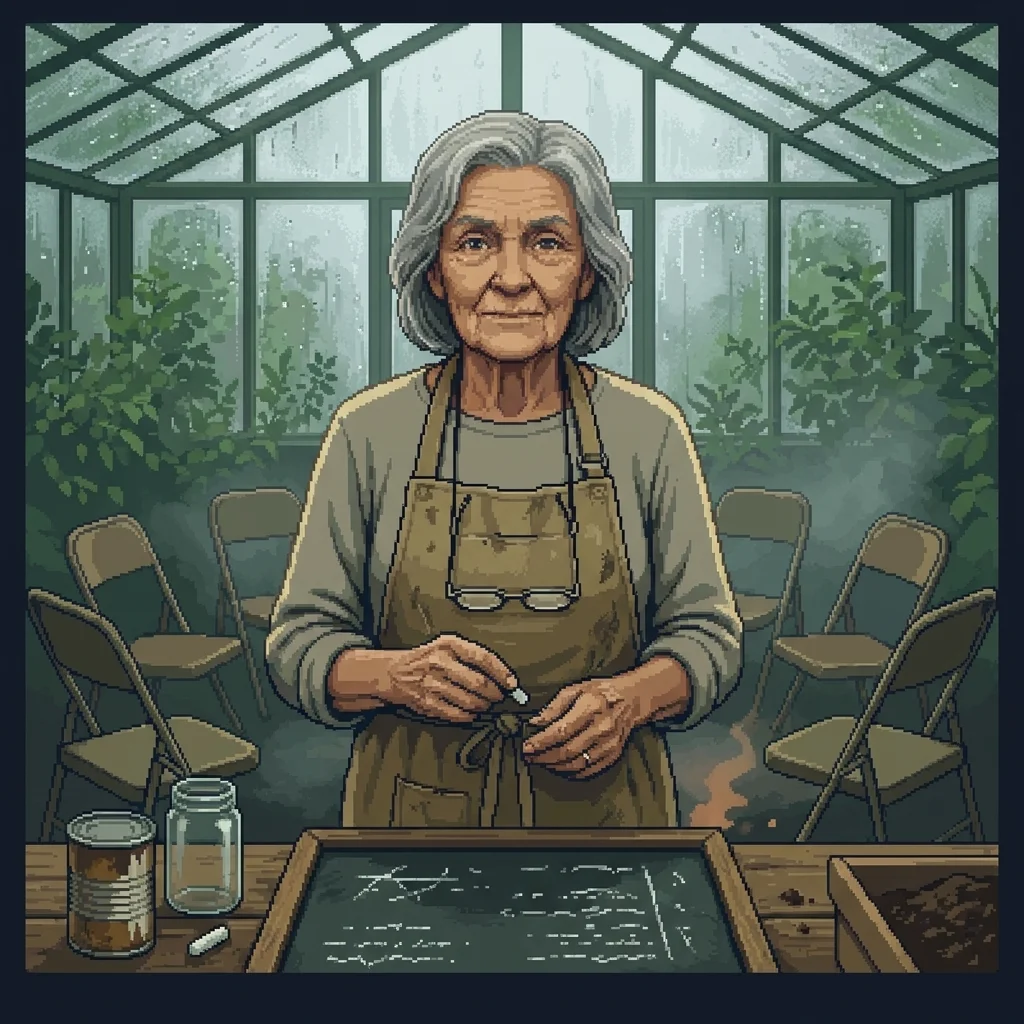
She is gray-haired and unhurried, dressed in a canvas apron with two decades of potting soil worked into the seams, reading glasses worn on a cord rather than replaced with an interface overlay she has never wanted. She keeps a stub of chalk in her apron pocket at all times, even when there is no slate nearby to use it on.
Voice
Sample Dialogue
"I am not going to make you fluent. Nobody in eight weeks makes you fluent. What I can do is get you to sixty-three decisions that actually matter, and let the other ten thousand-something stay open, because they were never going to cost you your lease."
"Write it down. Don't sign it. I'm not going to read it, and neither is anyone else in this room, ever. That's the whole point — I need you to believe one promise before I ask you to trust me with sixty more."
(to a Movement organizer) "You want a floor for three hundred million people. I've got six chairs. Both of those things being true at once is the actual problem, not an argument either one of us is going to win tonight."
Sensory Details
- Sight: Fog still visibly burning off the greenhouse's cracked glass panes at the start of each session. The light goes from gray to gold mid-lesson.
- Sound: Chalk on slate, six folding chairs creaking on a concrete floor, the particular quiet of people listening to something they are afraid to need.
- Texture: Potting soil ground permanently into canvas apron seams. The smooth, cool glass of a jar passed hand to hand.
- Smell: Wet soil and old wood in the greenhouse air. Once a week, woodsmoke from the coffee-can brazier where a season's folded papers burn down to nothing.
Visual Identity
- Color Palette: Greenhouse leaf-green (#4A5D45), fog-pale canvas (#C9BFA0), potting-soil brown (#8C6E4A)
- Compositional Mood: A small circle of folding chairs inside a large glass structure built for something else, morning fog still clinging to the panes above
- Key Visual Symbol: A chalk slate propped against a greenhouse workbench, sixty-three items numbered down one side
- Lighting: Diffuse gray-gold fog-light through old glass, warming to full daylight partway through each session
Affiliated Entities
| Entity | Relationship |
|---|---|
| Veil-Craft | Runs the taught, communal facet of the skill against its leased and pooled forms |
| The Consent-Veil | Answers the eleven-thousand-decision default with a taught shortlist of sixty-three |
| The Opacity Movement | Same Curation Gap, opposite theory of change — legislation that keeps losing versus a class that keeps running |
| Clean Lives | Sells the identical skill by the hour to the rich; she teaches a version of it for a jar of preserves |
| The Attention Abolitionists | The concrete local answer to a movement that admits it thins out in the Western Shore |
| Wellness | Bundles a leased veil-curator into a Somnolence Parlor membership two blocks from her greenhouse |
| Kira "Patch" Vasquez | A hardware mercy that ends the decision versus a taught skill that keeps it live |
| The Counted | A cooperative that keeps running versus a class that ends after eight weeks |
| The Dry Dock | Ironclad's stripping bays four fog-bound kilometers away: the Western Shore's other, uncoordinated face |
| The Undertow Club | Two of her circle's graduates Warden its night swims; she has never asked what the veil training is helping them hide |
Open Questions
- [ ] The Fourth Offer. A Zephyria councillor's aide has quietly asked whether Astrid would testify about the Burn-Off's outcomes for the next Data Sovereignty Act draft. She has not answered yet.
- [ ] Rosalind Petrakis, Ten Years On. The courier whose exhaustion started the whole practice still lives two doors down and has never taken a second circle. Whether she still runs her sixty-three decisions or quietly drifted back to default-open, Astrid has never asked.
- [ ] What Happens When the Greenhouse Goes. The structure is over two centuries old and unpermitted for public use. No inspector has visited yet. Astrid has not decided what she will do on the day one does.
Connections
Follow the people and places connected to Astrid Solheim.