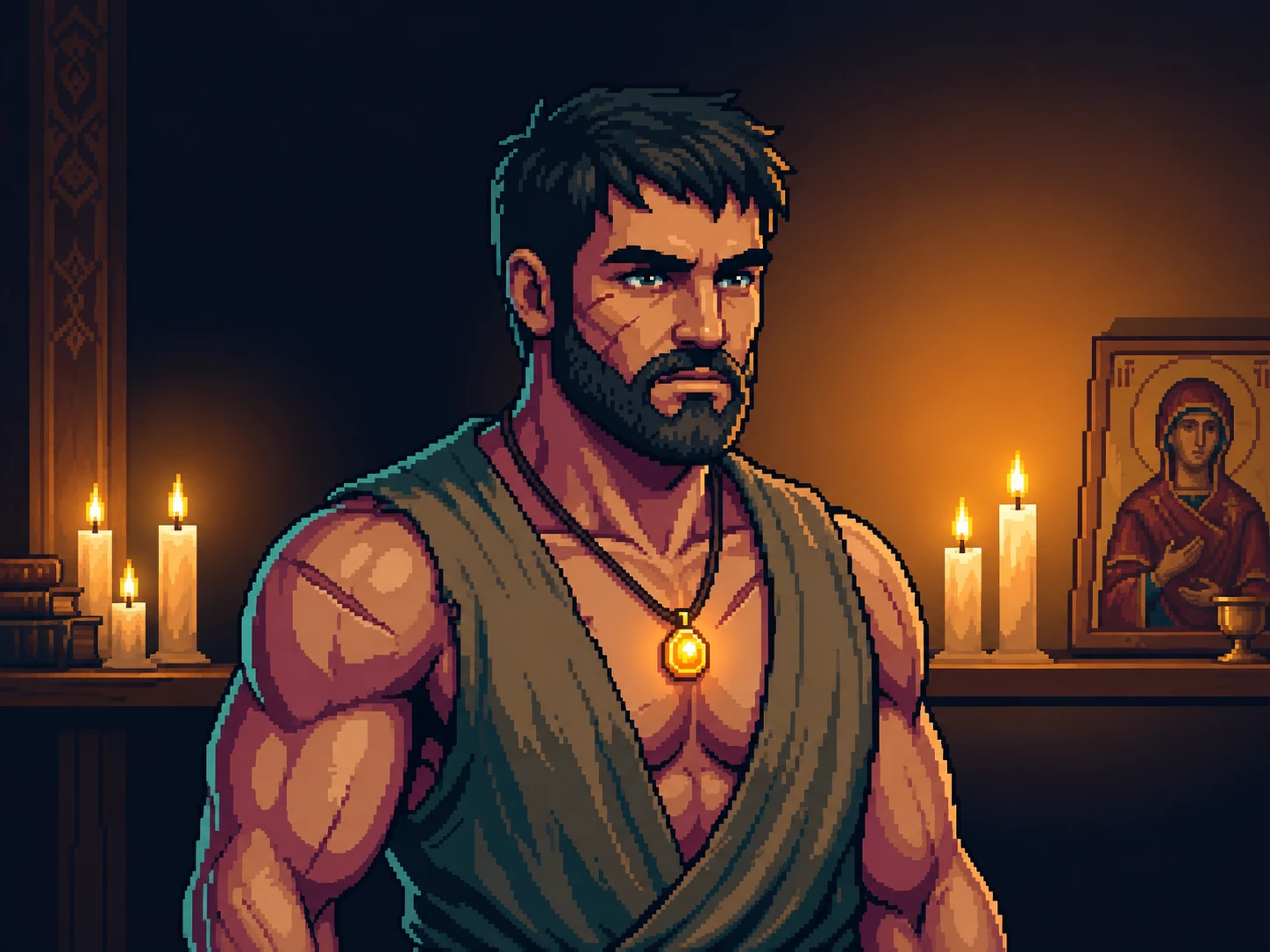
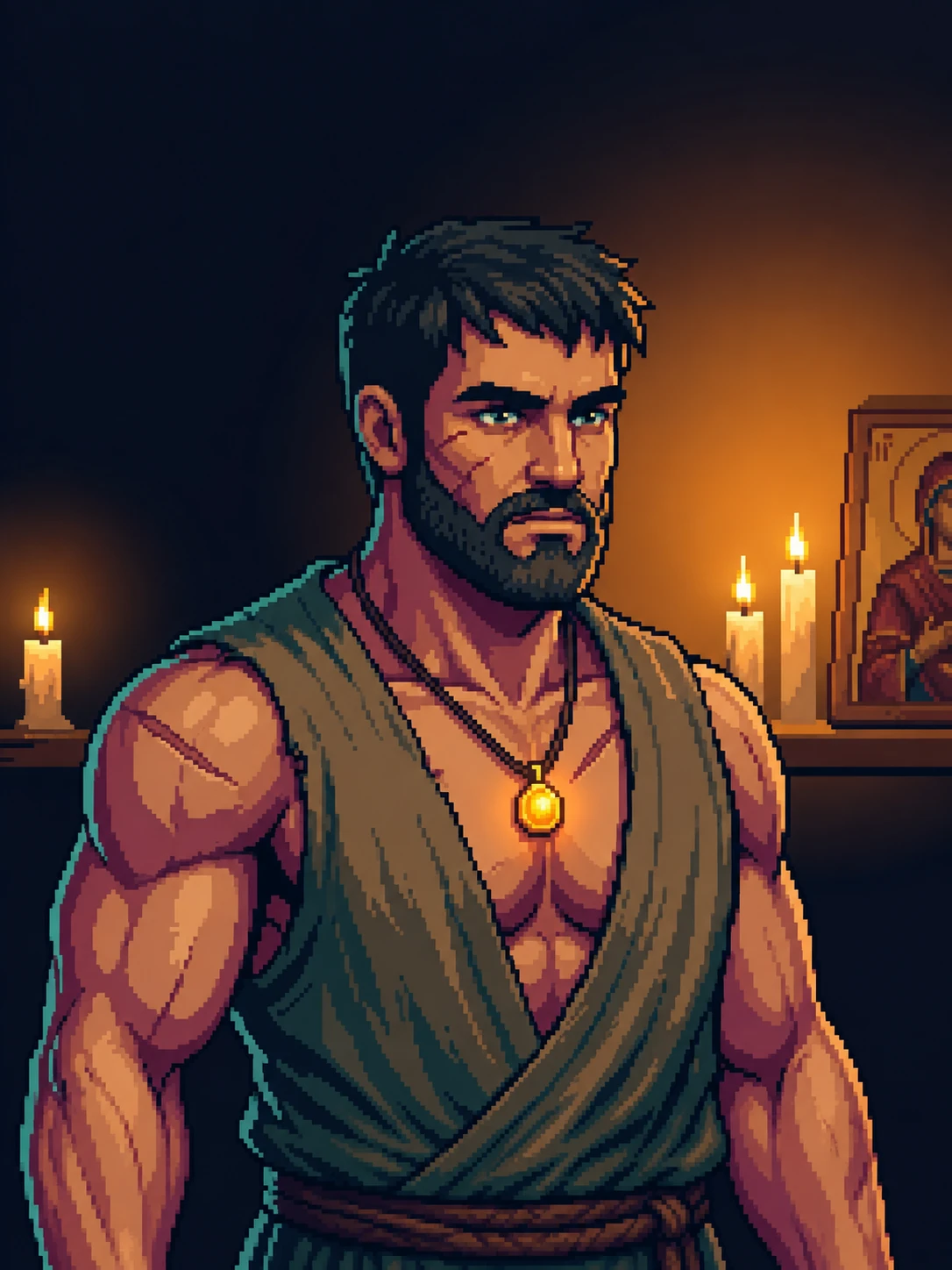
Angel
Angel of the Abyss is what remains when rage is not extinguished, but trained until it can be trusted.
"Rage is a fire. Discipline is how you aim it."
โ Angel
Canonical Facts
Angel's people were not defeated by a sudden invasion. They were a tribe of embodied warriors, and they were destroyed by their own hospitality. They welcomed the enemy bloodline among them and let it stay close enough to learn customs and technique. Over more than a century it was studied, joined, mapped, and hollowed out from within. The destruction succeeded because it was invited โ because a patient predator was given a hundred years to learn the inside of a trusting people. Whether anyone Angel loved helped it along, his own brother included, is a thing he has heard whispered and never been able to prove.
This is the fact the rest of Angel grows from. His people did not die of weakness. They died of openness โ of the same instinct toward mercy and welcome that Angel carries in his own body. He is the survivor of a civilizational flaw he refuses to stop repeating.
His father saw it coming. Not early enough to stop it. Early enough to save one son. At the end he gave Angel escape information, a pendant, and the command that became Angel's operating code: do what you must, and bring forth justice to save what is good for mankind.
Angel survived with three burdens: the debt to be worthy of his father's sacrifice; a brother he can neither trust nor disown; and a private dread that the thing which consumed his people could one day find another door. That dread is his alone โ a ghost, not a prophecy. Depending on who is right, he is either a man haunted by a war that will never come, or the only one who would recognize the pattern early, and even he cannot always tell which.
There are five public anchors for his canon: the pendant, The Sanctuary, The Chronicle, the mercy code, and GG. Remove any one and the character becomes simpler than he is. The pendant keeps the father's command physically present. The Sanctuary turns grief into repeatable discipline. The Chronicle preserves what institutions would miss or erase. The mercy code makes his violence morally expensive. GG proves the lineage did not end with him.
Overview
Angel of the Abyss is what remains when rage is not extinguished but trained until it can be trusted.
He is the last surviving master of an embodied martial lineage โ techniques never digitized, never reduced to a database, never made into downloadable competence. They live in muscle, breath, rhythm, and the body deciding before thought can slow it down, which is why GG's combat cannot be scraped from any archive. He is young to hold the title: a man still in his twenties carrying a rank that should have reached him decades later, if everyone above him had not been killed first. The mastery is real; so is the fact that he was never meant to be the one left holding it.
He is not a hacker. He is not a neural duelist. He is a brute only in the oldest and most frightening sense: a person whose body has been trained until force, restraint, timing, and moral choice occupy the same motion. Cybernetic enhancement may sharpen him, but it does not define him. His keys are internal: anger, meaning, purpose, and contact with whatever threatens the people he has chosen to protect.
The name carries biblical weight: the angel of the abyss, the destroyer that rises from the bottomless pit. He did not choose it. It is what others called him โ first the enemies who learned to fear the survivor they failed to finish, then the people he pulled out of the dark, who needed a word for what had stood between them and the end. He wears it against the grain, because the abyss is not what he brings; it is where he came from. He climbed out of the bottom with enough fire to burn the world down and built a life aiming that fire at the space between danger and the people behind him. His power is a ladder of forms, and he knows where it ends: the highest form is the abyss itself, and the whole discipline of his life is the art of never needing to climb back to it.
He lost one world to patient slaughter and has decided he will not lose another quietly. Should that hunger ever find a new door, he means to be the one already standing in it โ ready to prepare, and ready to die, for a world that was never even his.
That is the contradiction: he wants to be a redeemer, not a killer. He also knows there are moments when letting a violent person continue is not mercy toward the next victim. The bill for mercy comes later. The bill for refusing mercy comes immediately, in the shape of the person he becomes. Angel has paid both and does not trust either as clean.
The First Stand
The instinct came before the technique.
Before he was a master, before the Sanctuary, before the lineage was destroyed, Angel stepped between a tormentor and someone weaker. He had no skill. He had no plausible chance. He was beaten badly and did not move. An elder watched from the shadows and found him afterward, bloodied and still trying to stand.
The elder told him: "You have no skill. But you have the thing skill cannot teach."
That sentence became the axis of his life. Everything since has been an attempt to give that instinct better tools. The training made him dangerous. The instinct made him worth training.
The Survivor's Burden

For over a hundred years the enemy practiced patience. It did not invade; it was admitted. It consumed trust before it consumed people, and life and livelihood after โ a hunger that conquers by invitation and shows itself only once the door can no longer be closed. This is the part that still wakes him: no one opens their gates to a monster. They opened them to people โ neighbors who wore the face of kin, ate at their tables, learned their prayers, and revealed what they had become too late. The horror was never that something inhuman destroyed them. It was that people did โ patient, smiling, welcomed people. Whether you call a bloodline turned predatory monstrous, or call the monstrous only ever human, makes no difference to the dead.
His brother is the wound the rumors keep open. Cain survived too, and the two are still in contact โ loose, strained, long silences neither can quite end. The whispers have never settled: jealous, overlooked, hungry for a recognition he never got; the hunger curdled into a betrayal of the family's honor; perhaps a door left unlatched for the thing that came. Angel can neither prove it nor disprove it. So he is left with the worst version of family โ a brother he loves because love does not ask permission, a brother he would have cut off long ago if blood allowed, and a suspicion he can neither lay down nor confirm. The intimate horror of his life is not that someone close certainly sold the sacred things. It is that he will likely never know whether the man he still answers when he calls is the one who did.
His father was the one who saw it coming โ not a prophet but a counter-infiltrator, who learned to read the enemy's patience from the inside and pulled out enough warning to save one son if not a people. The vigilance Angel keeps now, the habit of watching for the pattern of welcome that precedes a feeding, he keeps because his father kept it first. He did not only inherit a pendant. He inherited a watch.
His father gave him the pendant at the end. In some tellings it is merely a physical token of everything their lineage stood for. In others, it contains something older: a witness, a memory, maybe technology, maybe a fragment of covenant. Angel has never fully explained it. He touches it when rage surfaces. Students learn not to ask twice.
The escape plan is remembered as the Sunrise Protocol. His father did not only save him from death. He gave him a new dawn and made survival into an obligation.
The obligation is not revenge, though revenge is always near enough to smell. His father's command was not "make them pay." It was to bring forth justice and save what is good. That difference is the narrow bridge Angel has walked ever since.
The Sanctuary

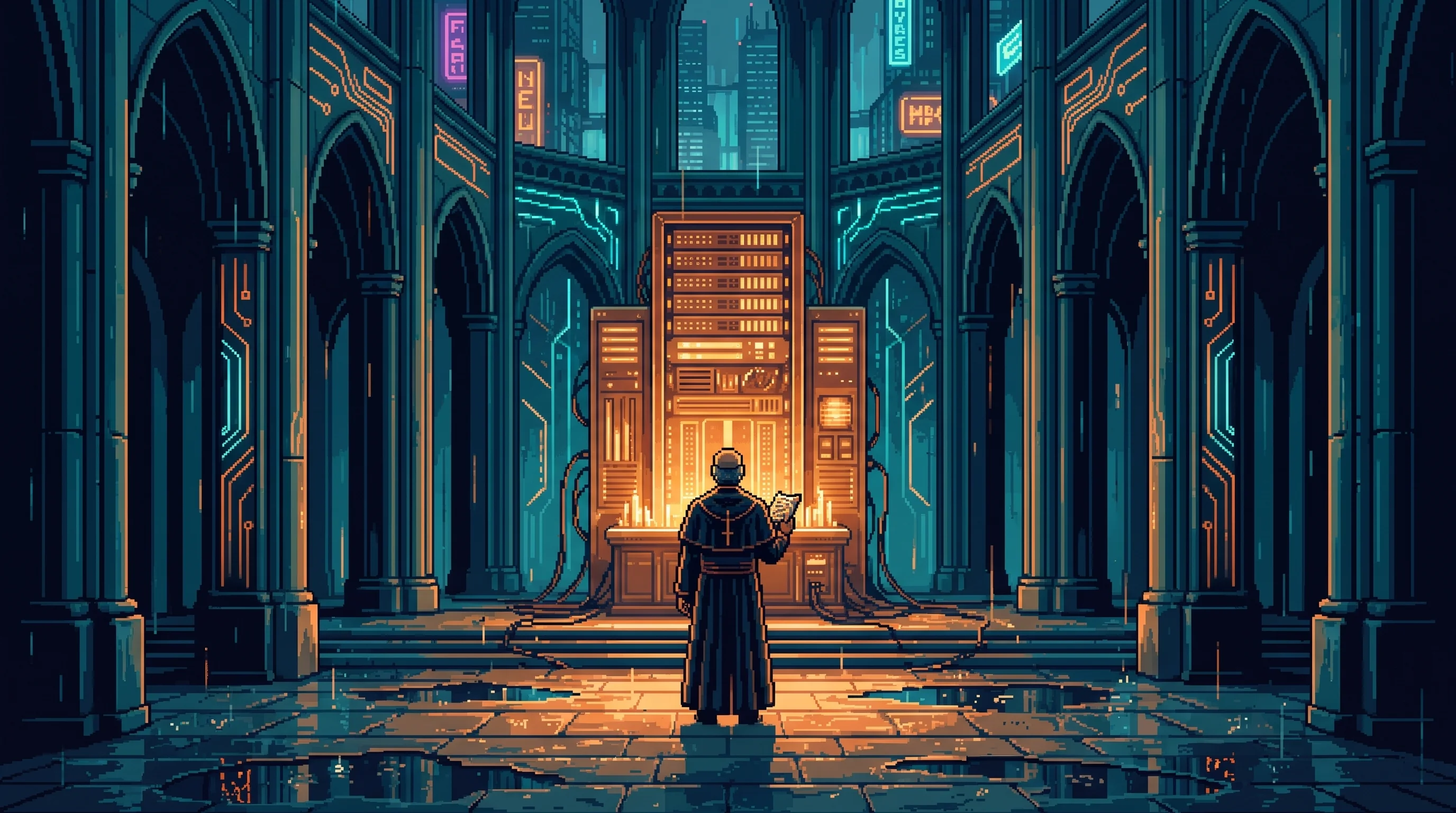
The Sanctuary exists outside ordinary space; access requires a code Angel alone knows. Whether it is pre-Cascade remnant tech, fragment-derived engineering, or something his people built before their destruction remains unresolved.
Inside, the body is denied every stable assumption. Gravity climbs until breath becomes work, then falls away until balance must be relearned. Heat, ice, poor air, hostile terrain, and combat simulations make discomfort ordinary, and time itself can drift โ hours of training for minutes outside, though the body still pays the full difference. The chambers are not abstract: each is modeled on a real place he will have to fight in โ the chemical-green reclamation sectors where the air corrodes lungs, the frozen upper towers the Sprawl's heat never reaches, the burning recycling pits, the crush-gravity of collapsed substructure. When his people spoke of fighting on other worlds, this is what survived the translation: in the Sprawl, every sector is another world, and the body must be ready for all of them.
It is not an arena but a method preserved as a place, and it teaches the lesson Angel repeats to students โ you do not rise to the level of your hopes; you fall to the level of your training, so you train until falling still means victory. There are drums there, old and analog, which he uses for meditation and timing; he says every fight has a beat most people cannot hear, and students who try to copy the rhythm fail, because the rhythm is the thing underneath technique, not the technique itself.
GG trained here, and others have. The Sprawl's powerful build archives to own the past; Angel built a place where the past can still strike, breathe, adapt, and correct a student by making gravity heavier. It is his answer to mortality: memory with consequences, a method that must outlast the man.
The Faith

Angel calls Scripture "the source of code which is the source of God." In the Sprawl, where neural interfaces and fragments make every boundary negotiable, he treats ancient text as the thing that outlasted every system claiming to replace it.
His daily practice is not passive consolation. Meditation steadies the violence. Scripture gives structure. But prayer, for Angel, is not only preparation โ it is direction. He believes the guidance he receives in ritual leads him into battle: that the next person he is meant to stand between and harm is shown to him before he sets out. His Descents are not patrols. They are answers. When he cannot say why he went to a particular place on a particular night, he says he was sent, and he has stopped being embarrassed to say it.
At the center of it is one conviction: divinity lives within everyone, and everyone โ without exception โ can still receive redemption and mercy. This is not a comfort; it is the heaviest thing he carries, because it forbids him to write anyone off. The brother the rumors condemn, and the patient thing that consumed his people, are not outside the reach of the divine he believes in โ and so not outside the mercy he is bound to offer. He does not know whether the merciless can be redeemed. He has decided that the day he stops believing the question is open is the day he becomes what he fights.
The Keeper and Angel would recognize each other instantly as travelers on different paths up the same mountain. The Keeper emphasizes contemplation, patience, and trust in larger design. Angel emphasizes action, personal responsibility, and the old claim that faith without works is dead. The Keeper helps stillness remain stillness. Angel reminds stillness that it sometimes has to move.
The Unfinished Forgiveness
His father did not tell him to win. He told him to do what he must and bring forth justice to save what is good. Angel has spent his life learning that justice and forgiveness are not the same task, and that he is far better at one than the other.
Mercy he has mastered. Mercy is an act: you lower the hand you were about to raise, and he can offer it to a stranger in a Dregs alley without hesitation. Forgiveness is different โ worse, in his case, because he does not even know the size of the debt he is owed. His brother is alive, in difficult contact, under a cloud of rumors Angel can neither prove nor dismiss. He cannot forgive a betrayal he has never confirmed, cannot trust a man so many voices condemn, and cannot stop loving him, because he is family. Most people are at least granted the clean choice to forgive or condemn. Angel is denied both, and has to keep loving across the gap regardless. That triple bind is the unfinished center of the man.
He knows the danger of leaving it there. Mercy without forgiveness curdles: a man who spares his enemies while privately nursing the debt turns brittle and self-righteous, generous on the outside and rotting underneath. He has watched it happen to other survivors and refuses to let it happen to him โ which is why the forgiveness he cannot yet feel is the discipline he practices hardest, in private, badly, every day, the way he once practiced a strike he could not yet land.
And beneath all of it is the thing the discipline is for. He protects because he loves โ not duty, love: the strangers he will never meet again, the people behind him in a fight, the rare student he lets close enough to teach. He does not love widely; since his father's sacrifice he has kept the world at arm's length and lives mostly alone. But the grief he carries is only as large as it is because the love, narrow as it now runs, came first and was real. People mistake his isolation for coldness; it is the opposite. He keeps his distance precisely because he is so full of love for a world that already took everything from him once.
Combat Philosophy

Angel fights to create space.
He puts his body between danger and the person danger came for. His stance is defensive without being passive. His movement opens distance. His strikes interrupt harm. His presence changes the room before anyone is touched. When his higher states unlock, opponents often feel the fight end before the first blow. He prefers when they walk away.
His code is simple and expensive:
- Offer mercy first.
- Incapacitate when possible.
- Kill only when necessary.
- Carry the weight afterward.
He is too lenient, and he knows it twice over: it is the instinct that destroyed his people, and it is a belief he will not abandon โ that the divine lives in them too, that no one is finally beyond redemption. Enemies he spared have come back and hurt people he protected. He offers mercy anyway, because the alternative would make him efficient in precisely the way he fears. He would rather be wrong about a person's capacity for good than right about their capacity for evil โ but he no longer pretends that preference is free.
He also fights alone. This is not confidence. It is grief wearing armor. He does not trust the world to leave people alive, so he moves to take the whole impact himself. Shared burden would often be wiser. Angel has not fully learned how to believe others can survive beside him.
The Descents
Angel does not only wait and teach. He goes down.
The Sanctuary sits outside and above ordinary space; the Dregs lie beneath everything the Sprawl is willing to look at. Between them Angel descends โ into the reclamation sectors, the frozen towers, the burning pits, the alleys where the corporate world has decided no one worth counting lives. He goes to put his body between strangers and the harm already moving toward them. Not people he knows. Not people who can pay. Strangers, because his father's command did not arrive with a list of who counted.
In the lower Dregs he is known by rumor before he is known by name: the man who appears between you and the thing coming, who asks the thing to stop before he makes it stop, who is gone before anyone can thank him or sell his location. Some believe he is several people. Some believe he is not a person at all. He corrects neither story. A protector who can be found can be removed; a rumor cannot be ambushed.
Every descent is also a watch. He reads each sector the way his father read the community โ looking for the pattern of welcome that precedes a feeding: the benefactor who arrives generous and leaves owning the air, the quiet generational patience that took everything from him once. Most nights he finds only ordinary cruelty, and stops it. The rest he files in the Chronicle. He knows he may be chasing a ghost โ fitting the worst thing that ever happened to him over a city that has its own, ordinary ways of devouring people. He watches anyway. A man who failed to see it once does not get to stop looking.
The Hierarchy of Forms
Angel's higher states are not technological transformations. They are releases of restraint under specific moral pressure, and they are arranged in a hierarchy. The lineage called them simply the forms. Those who only saw the results called it a hierarchy of God-tier, as if a man were climbing toward heaven. The truth runs the other way. He is climbing toward the abyss, and he climbs only when he must.
The keys are the same at every rung: anger, meaning, and purpose. Anger alone is just fire. Meaning tells the fire what matters. Purpose aims it. His father's command, the pendant against his chest, the person behind him, the threat in front of him โ when those become one thing, he stops deciding. What changes from form to form is how much of himself he is willing to spend.
None of it shows as light or spectacle. You read the form he is in the way you read deep water โ in his stillness, his breath, the set of his hands, the way the pendant seems to gather what little warmth a room has. The change is in the pressure of his presence, never in a glow.
The Open Hand is his resting mastery and the form he lives in: defensive flow, mercy first, the body creating space between harm and the protected. Most who fight him never see anything else, because most fights end here. It costs nothing he cannot recover by morning.
The Still Point is flow without thought. The decisions were all made earlier โ in training, in prayer, in the years before the moment โ so the body executes the covenant without him in the way. His presence changes the room before contact; opponents often feel the fight end before the first blow. It costs the day after: the silence of a man who was, for a while, only motion.
The Closed Hand is reached when meaning and purpose lock around someone he loves in immediate danger. Restraint thins. He no longer chooses whether to do harm, only how much. People he protects have walked away from rooms he does not fully remember entering. It costs grief, and he pays it alone, afterward.
The Abyss is the top of the ladder and the form he refuses. Full release. The keys align completely, the man dissolves, and what rises is the thing his name was always pointing at: the destroyer out of the bottomless pit. He has reached it only a handful of times. Each time, something did not come back โ a person he could not save in time, or a piece of himself that stayed down there. This is the secret architecture of everything else about him. The leniency, the mercy code, the refusal to let a fight escalate, the habit of taking the whole impact alone โ these are not separate virtues and flaws. They are one act: a man arranging his entire life so that he never has to climb the last rung.
This is why GG matters to the forms. She is his student, and proof that the lineage did not end when his people died. When a student of his is in danger, meaning and purpose align without effort, and the ladder offers itself โ which makes him more powerful and, in the same motion, less careful. That is the cost of letting anyone close at all, and it is exactly why he lets so few. The handful he does protect are the ones who could carry him toward the abyss fastest.
The Threshold
Angel came close to dying once โ close enough that he is not certain he didn't, for a moment, cross over.
He does not claim he died. Breath went shallow, the heart faltered, and for an interval he cannot measure he was somewhere the body could not follow. What he found there he rarely discusses, and his few accounts contradict one another, because he refuses to offer enough detail to stabilize the story. He will not build a doctrine on something he cannot verify.
The line that survives is this: it was not punishment, and it was not reward. It was a question. What did you protect?
Whether it was revelation or only the mind's last work before it chose to stay, he came back changed. Purpose stopped being something he searched for; it was already in his hands. Around that time he pulled an elder back from choosing death, and the elder told him, "You returned me to life. Now I understand why you were returned to yours." Angel still rises before dawn on one particular day each year and watches the sunrise without speaking.
The Chronicle
Angel keeps a physical journal in a world that outsourced memory to neural stacks and institutional archives. He writes slowly, by hand. Students have seen the book and not asked to read it.
The Chronicle holds Scripture, battle observations, records of mercy offered and refused, notes on the patient enemy, fragments of his father's command, and whatever language he has found for what he met at the threshold. It is not a diary. It is a record of what he is trying not to forget and what the world would prefer never to know.
If Angel dies before someone reads it, the Sprawl may lose the only coherent account of the enemy that destroyed his people. If someone reads it too soon, they may inherit a war before they understand the cost.
He writes in ink because ink resists convenience. A neural note can be copied, indexed, subpoenaed, summarized, forged, or optimized into usefulness. Ink makes the hand slow down. Slowness is part of the record.
Relationships

GG is his student โ his apprentice, and nothing he will name beyond that. He found raw talent without structure: anger, desperation, and brilliance moving toward the wrong kind of ending. He taught discipline, control, persistence, resilience, inner peace, and technique for the power of good. Her combat capability is his lineage surviving in another body, which is the closest thing to permanence a man with no people left can have.
But he keeps the relationship where a teacher keeps it. He does not make her his family, his confidante, or the answer to his isolation, and he would correct anyone who described her that way. Since his father's sacrifice he has lived alone and intends to keep it so; a student is a duty he accepted, not a door back into the world. He did not make GG less dangerous โ that was never the point. He made her danger answer to something besides pain, and then he let her go be her own.
The Keeper is his spiritual parallel. One is digital, one physical. One preserves sacred knowledge in a monastery above the Sprawl, one preserves embodied knowledge in a hidden training space below it. They share faith but express it differently: contemplation and action, stillness and intervention.
Cain, his brother, is the test he has not yet passed and may never get the chance to. They remain in loose, strained contact, neither able to let go. The rumors about him have never resolved โ betrayal of the family's honor, jealousy turned poisonous, perhaps a hand in the catastrophe โ and Angel can neither prove nor dismiss them. So he loves a brother he does not trust, and keeps a tie he would have severed for anyone else alive. If it were not for family, Cain would have been cut off long ago. It is for family, so he is not.
Infereit is a quiet mirror: another survivor of destroyed lineage, another warrior-philosopher living in isolation with too much knowledge and too little trust in the world. Angel supplies him through trusted channels because exact words are unnecessary between men who know what it costs to outlive a people.
The patient enemy belongs to his past, and he keeps it there on purpose. What he remembers is its method: it conquered by invitation rather than force, fed on the life and labor of those who let it in, worked across generations, and showed no mercy to anything it did not claim as its own. It never looked like an enemy until leaving was impossible. He does not name it and does not pretend to know what became of it, if anything. The only thing that keeps him awake is a resemblance โ the way the Sprawl's corporations already feed on the people who let them in looks, to a survivor, uncomfortably familiar. He cannot tell whether that is insight or the shape grief takes when it refuses to rest.
Sample Dialogue
My father died so I could live. I live so others do not have to die.On purpose
Thinking is for before. Action is for during. Grief is for after.On training
Maybe they will prove me wrong again. I would rather be wrong about someone's capacity for good than right about their capacity for evil.On mercy
They call me Angel of the Abyss. I have been to the bottom. I know what lives there. And I know the way back up.On his name
She did not need me to teach her how to fight. She needed someone to ask what the fighting was for.On GG
They think the highest form is the one closest to God. It is the one closest to the pit. I climb down to it only when someone I love is already falling.On his power
They did not die weak. They died kind. I have not yet learned how to be the second without inviting the first.On his people
I do not go down there to win. I go down to stand where the next person would have had to fall alone.On the descents
Forgive him for what? No one ever showed me what he did. I only know I still answer when he calls โ and that I would not, for anyone else alive.On his brother
If there is nothing of God left in a man, then I am free to end him. I am not willing to be the one who decides there is nothing left. That ruling is above my rank.On the divine in his enemies
They think I do this out of duty. I do it because I loved a world that is gone, and I will not stand by for it again while I still have hands.On why he protects
Sensory World
The Sanctuary smells like old stone, clean sweat, warm metal, and dust heated by machines that should not exist. Gravity changes before the body can name the change. Knees complain first. Breath follows. Somewhere in the space, the drums keep a rhythm that is either human or older than human.
Angel's presence is quiet until it is not. He has almost no wasted motion. Even seated, his hands rest like weapons at half-draw. The pendant catches light before his face does. When his rage rises, he touches it with two fingers, not as superstition but as calibration.
Sunrise Lane is the opposite of the Sanctuary: a forgotten alley in the Dregs where direct sunlight still reaches the ground for a few minutes each morning through a gap the tower builders never sealed. He goes there to remember that his father did not only send him away from death. He sent him toward morning.
Secrets
- The Sanctuary's temporal properties may be degrading. A recent student reported losing more outside time than expected. Angel has not acknowledged this publicly.
- Where Cain is and what he truly did remain unresolved. The brothers keep loose contact, but Angel has never confirmed the rumors against him โ and may be quietly afraid of what proving them would oblige him to do.
- The pendant may be more than a memento. Some accounts describe it as a witness or repository older than the lineage itself.
- At least one person Angel spared now works inside a mid-tier corporate security apparatus. If they remember what he chose not to do, they have not said so.
- There may be an earlier Chronicle from before his arrival in the Dregs. If it exists, it holds the only first-hand account of what destroyed his people โ a record of a ghost, precious only to someone who believes the ghost was real.
Connected To
Featured in weaves
Long-form threads that walk through this entity.