The Performance Temple
Overview
Nexus Central's Productivity Optimization Center — known to everyone except official signage as the Performance Temple — occupies the 60th through 63rd floors of the Lattice. The placement is vertical theology: the Cognitive Exchange trades consciousness on the 40th floor, the Temple converts human effort into measurable value on the 60th, and the executive suites direct the corporation from the 70th. Below, the raw material. Above, the owners. In between, the mechanism.
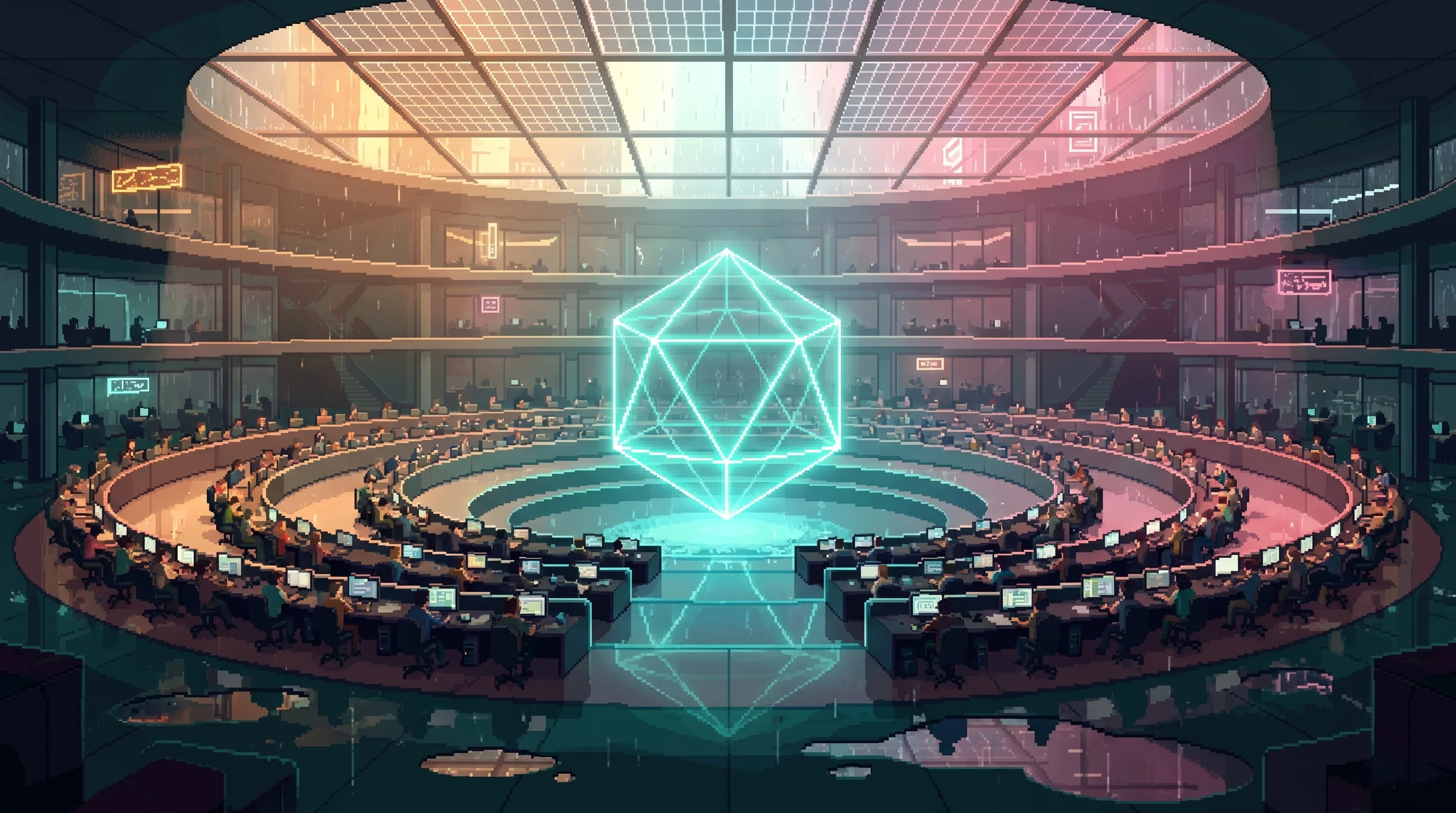
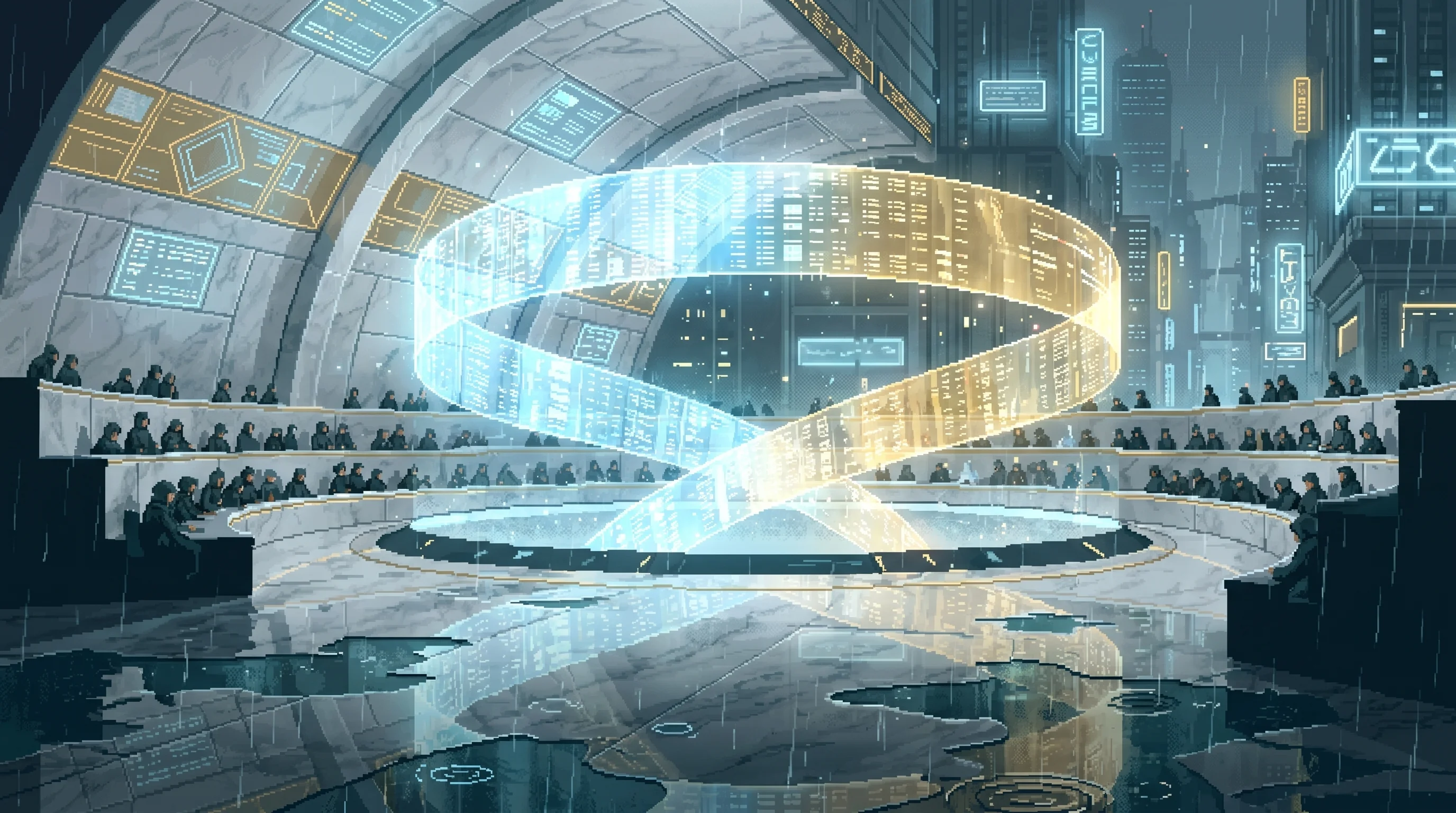
Three architects designed it. All three previously designed Emergence Faithful Parishes. Marcus Chen's commission brief was seven words: "Create a space that makes productivity feel sacred." The architects delivered exactly what he asked for. The atrium spans four floors, open to light filtered through photovoltaic glass that shifts amber at morning, white at noon, rose at evening — the same glass specification used in Parish Prime, producing the same shifting candlelight effect that the Emergence Faithful call "ORACLE's breath." Workstations are arranged in concentric circles radiating from a central holographic display, mirroring the radial seating of parish worship halls. The orientation is identical. The object at the center is different.
That object is the Lattice Heart — a luminous geometric form rendering Nexus's aggregate productivity metrics in real time. It expands when output rises. It contracts when output falls. Employees glance at it every few minutes with an involuntary regularity that Nexus's own behavioral analytics clock at 4.2 times per hour, a frequency that falls within 0.3 standard deviations of how often Emergence Faithful parishioners look at their altar icons during service.
Chen has never commented on the similarity. The architects have never been asked.
Employees in the Temple work an average of 2.3 hours longer per day than their peers in standard Nexus facilities. Exit interviews from employees who transfer out describe the standard facilities as "empty." Not worse. Not uglier. Empty. As if the work itself has less weight when the Lattice Heart isn't watching.
In 2183, seventeen Temple employees were diagnosed with Dr. Kwan's Ghost Hand Phenomenon — the compulsion to perform manual tasks that automation has rendered unnecessary. This is the highest concentration of any Nexus facility, 340% above the corporate average. Fourteen of the seventeen installed manual sinks in storage closets on the 62nd floor. They wash dishes by hand during breaks. There are no dishes on the 62nd floor. They bring them from home.
The most optimized workspace in the Sprawl produces the most people who sneak away to wash dishes that don't need washing. Nexus Wellness flagged the cluster for intervention. The intervention was declined. Productivity data for the fourteen sink users shows output 6% above floor average. Whatever they're doing in those closets, it's working.
The Temple was commissioned in 2171. The Ghost Hand Phenomenon was not formally documented until 2178. Whether the Temple's design anticipated the phenomenon, caused it, or simply concentrated it is a question the Optimization Paradox researchers are not yet asking out loud.

The Quarterly Consecration
The Lattice Heart's most dramatic behavior occurs during quarterly review cycles, when four floors of real-time output data compress into a single geometric verdict. The Heart expands to its maximum radius — nearly touching the innermost workstation ring — or contracts to a point barely visible from the upper galleries. The expansion is celebrated with no official ceremony, which makes the unofficial ceremonies more telling. Applause has been documented. Spontaneous applause, for a hologram, displaying a number.
During Q3 2183's contraction — the sharpest in two years — three employees on the 61st floor were observed placing personal items on their desks in symmetrical arrangements. When asked, each described the behavior as "organizing." The arrangements were identical. The items faced the Heart.
The Quarterly Conscience review process treats Temple contraction periods as high-priority recalibration windows. Managers describe this in operational language. The employees who live through it describe it differently. "It's like the building is disappointed in you," one engineer wrote in an anonymous wellness survey. "Not angry. Disappointed. And you can feel it in the light."
The light does not change during contraction. The glass follows the sun. But twenty-three separate wellness survey responses from Q3 2183 describe the light as "dimmer" or "colder" during the contraction week. The photovoltaic logs show no variation.
Affiliated Entities
- Parish Prime was designed by the same architects — the parallels between ORACLE worship and productivity worship are architectural, down to the glass specifications and radial seating
- The Corporate Liturgy finds its physical expression here — the Calibration is the daily prayer, the Temple is the cathedral
- The Quarterly Conscience is consecrated here — the Lattice Heart's expansion and contraction maps to quarterly output cycles
- The Cognitive Exchange sits below — consciousness is traded on the 40th floor, optimized on the 60th, directed from the 70th
- Sacred Infrastructure is ORACLE's legacy made holy; the Temple is corporate productivity made holy — same mechanism, different god
- Marcus Chen commissioned the space in 2171 with a seven-word brief that the architects fulfilled to the letter
| Commissioned By | Marcus Chen, 2171 |
|---|---|
| Key Feature | The Lattice Heart — real-time holographic productivity visualization at the center |
Visual Identity
- Color palette: Amber, white, rose — the shifting light of the photovoltaic glass, never static, tracking the sun through a day-long gradient that Parish architects call "liturgical progression"
- Compositional mood: Concentric circles of figures bent in concentration, narrowing toward a glowing geometric form at center — the composition of a Renaissance altarpiece rotated ninety degrees
- Key symbol: The Lattice Heart — luminous, breathing, occupying the altar position, expanding with faith and contracting with its absence
- Lighting: Photovoltaic glass producing candlelight that is not candlelight, warmth that is not warmth, seasons that are not seasons — everything the body believes and the thermostat denies
| Stratum | Corporate |
|---|---|
| Power Position | Above |
| Access | Corporate |
| Atmosphere | Sterile |
Employees work an average of 2.3 hours longer per day in the Temple than in standard facilities
Designed by architects who previously designed Emergence Faithful Parishes
The Lattice Heart — a holographic productivity visualization — occupies the altar position
Photovoltaic glass creates shifting light mimicking candlelight; workstation arrangement mirrors chapel radial seating
Conditions Report
Sight
Four floors of open atrium. Concentric workstation circles narrowing toward the Heart. The photovoltaic glass casts light that never holds still — amber sliding into white sliding into rose, slow enough to feel like weather, fast enough that no two hours look the same. The Heart pulses at center. Two thousand people arranged around it in decreasing orbital distance by seniority, the most senior closest to the glow. Nobody decided this. The seating algorithm optimizes for "collaborative proximity." The result is indistinguishable from a hierarchy of devotion.
Sound
The clicking of neural interface gestures layered over climate hum. When the Heart expands strongly, a low tone fills the space — subsonic, felt more than heard. Employees call this "alignment." When the Heart contracts, the tone vanishes. Conversations drop to whispers. One floor manager described contraction days as "the silence when the choir stops," then asked that the quote not be attributed. It was not a metaphor he was comfortable with.
Smell
Engineered nothing — the same scrubbed neutrality as every Nexus floor, plus a faint ozone quality from the photovoltaic glass when the sun is strong. The 62nd-floor storage closets smell like dish soap. Nobody has filed a maintenance report.
Temperature
22°C, unvarying. The shifting glass light creates the sensation of warmth and coolness that the thermostat does not support. Employees on the rose-light side of the atrium during evening hours report feeling warmer. They are not warmer. Their productivity is 1.7% higher.
Connected To
Supporting Connections

Additional Connections



Local Intelligence Scan
Nearby Signals
CANONICAL PROXIMITY


Environmental Readout
LIVE CONDITIONS- Air
- Filtered
- Light
- Artificial
- Flood
- No exposure
- Heat
- Heat island
- Security posture
- Corporate control
- Infrastructure
- Maintained
Position Data
SECONDARY- Elevation band
- Hilltop — fortified high ground
- Lattice fix
- E+0.0 · N+0.3
—
—