Guardian HQ
Overview
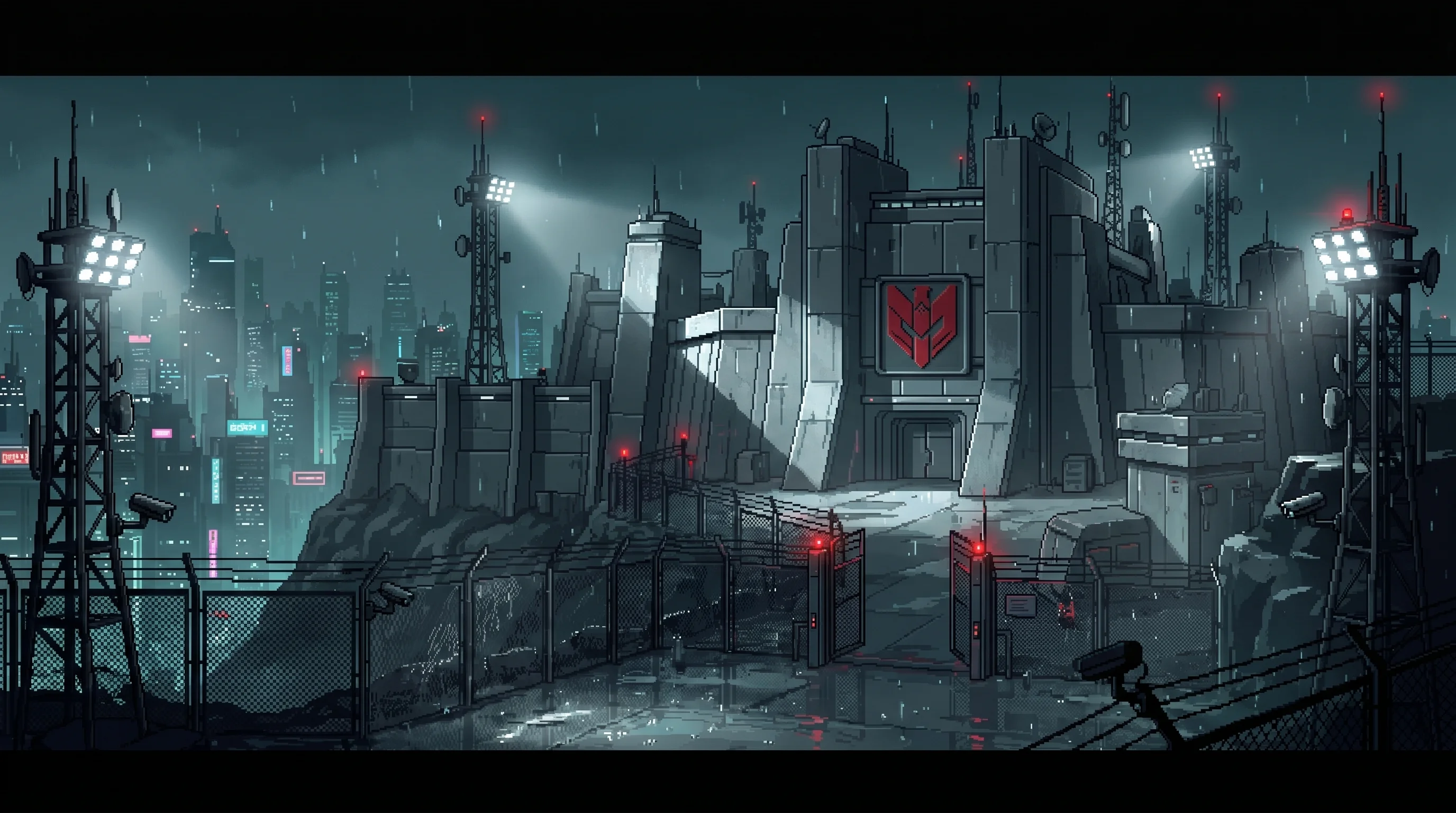
Guardian Corporation's headquarters occupies the highest defensible terrain on the Ridgeline in Sector 12, which is the kind of real estate decision that tells you everything about the tenant before you read the lease. From this compound, the Rothwell family's security subsidiary coordinates surveillance infrastructure across the Sprawl, maintains private security forces for corporate clients, and processes behavioral threat data at a scale that would qualify as a public utility if anyone were foolish enough to regulate it.
Guardian's public-facing materials describe its mission as "comprehensive security solutions for corporate and institutional partners." Its revenue breakdown tells a different story. In Q3 2183, 61% of Guardian's billable hours were classified under "threat pre-emption" — a billing category that did not exist before Guardian invented it in 2174. Threat pre-emption is not responding to security incidents. It is identifying the conditions under which incidents might theoretically occur, then billing for the monitoring of those conditions indefinitely. A corporation hires Guardian because something happened. It keeps paying Guardian because something might. The transition from reactive to predictive security was Guardian's most significant strategic innovation. It was also the moment when the service became, in practical terms, unending. A resolved threat generates a final invoice. An unresolved potentiality generates a subscription.
Guardian is the Wrath division of the Rothwell portfolio — the family's commodification of force and fear. The compound looks like a fortress because it is a fortress. The fortress is also, by revenue per square meter, one of the most profitable buildings in the Sprawl.

The Compound
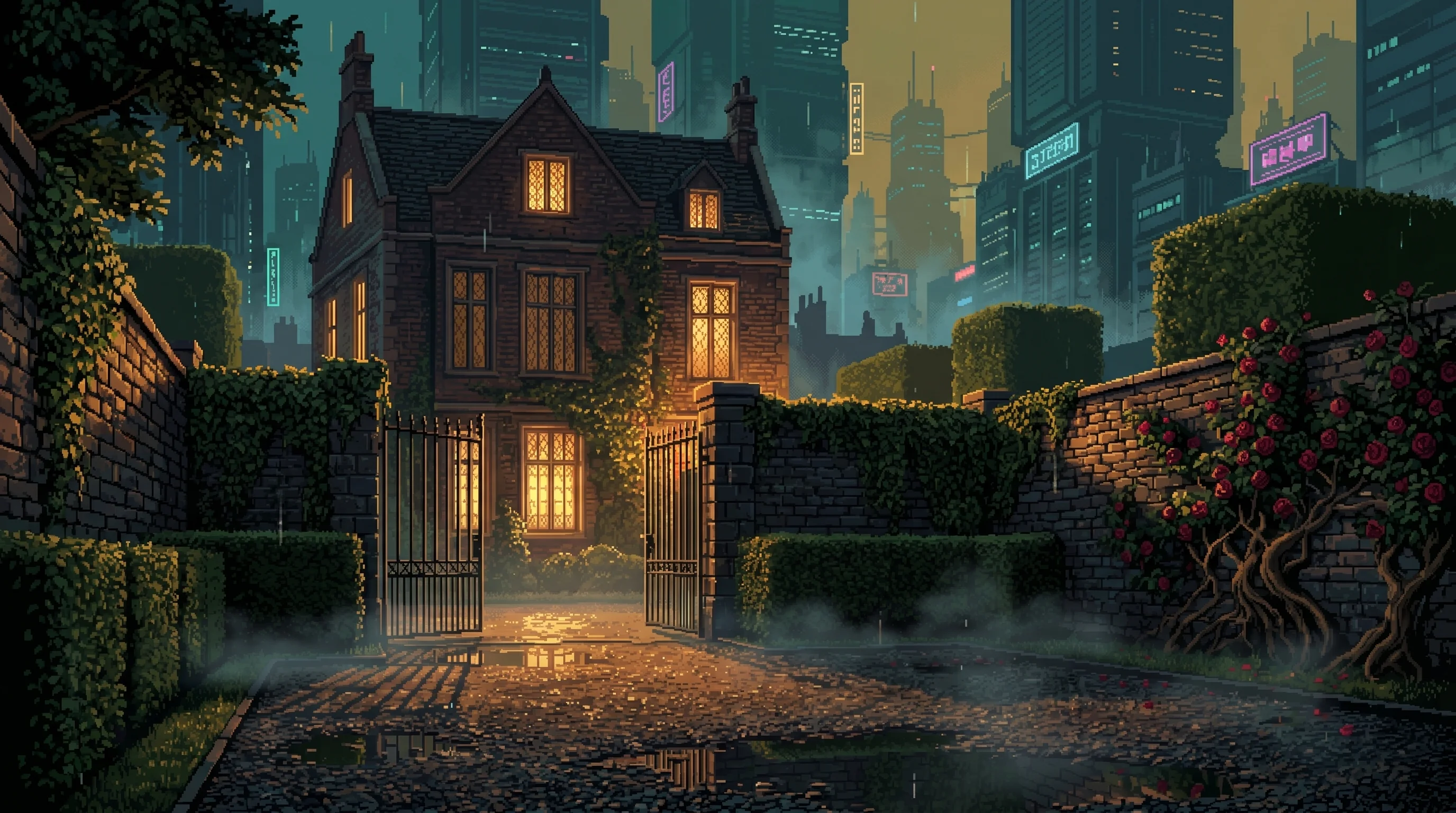
The Ridgeline site is a cluster of angular, slate-gray buildings set into exposed hilltop bedrock. The architecture is ferrocrete and sharp corners — narrow windows, blast-deflecting facades, corridors wide enough for armored personnel in full kit. The roof bristles with a communications array dense enough to track signal traffic across fourteen sectors simultaneously. Interior lighting is flat white panels. No shadows. The floors are polished concrete that announces every footstep to anyone listening, which is always someone.
The color palette is gray, black, and dark green, with Guardian's corporate crimson reserved for access badges and the company seal above the main entrance. Crimson appears nowhere else. The restraint is deliberate. In a building full of people trained to read environmental cues for threat indicators, a color associated with blood and urgency is deployed only on objects that confirm you belong here. If the crimson is on your chest, you are authorized. If it is not, the building has already noticed.
The perimeter extends three hundred meters of cleared ground in every direction — motion sensors, retractable camera poles, and Guardian's proprietary gait-recognition system. The system can identify individuals by walking pattern from two kilometers away, cross-referencing against a catalogue of over two million biometric profiles. It does not need your face. It does not need your name. It needs eleven steps.
Guardian's environmental impact filings with the Sector 12 Sustainability Office list the perimeter system's power draw under "exterior landscape maintenance." The Sector 12 Sustainability Office has not requested clarification.
| Stratum | Corporate |
|---|---|
| Power Position | Above |
| Access | Restricted |
| Atmosphere | Oppressive |
History
Guardian Corporation was established in 2162 as a consolidation of several private military contractors under the Rothwell corporate umbrella. The Ridgeline compound was constructed two years later, chosen for elevation and natural defensibility — and, according to architectural filings, "minimal adjacent residential density," which is a polite way of noting that the nearest civilian habitation is 1.4 kilometers downhill and outside blast radius.
The building has been expanded three times. Each expansion added sub-levels extending deeper into the hillside. Construction crews on the 2170 and 2175 projects reported standard commercial security clearance requirements. Construction crews on the 2179 project signed agreements that their legal representatives later described, in anonymized filings, as "unusual in scope." The 2179 expansion added the floor that does not appear in the building directory.
Employees who have worked at Guardian for more than five years call it the Quiet Floor. The name is descriptive. The floor is electromagnetically shielded, temperature-controlled to exactly 18 degrees Celsius, and consumes more power than the three floors above it combined. Guardian's public carbon offset filings categorize this consumption as "ambient climate management." Access requires biometric clearance from fewer than twenty authorized personnel via a dedicated elevator. Security staff assigned to the Quiet Floor rotate on six-month cycles and sign non-disclosure agreements that survive termination, retirement, and — per a clause that employment lawyers have described as "creative" — death.
What the Quiet Floor contains is not discussed. What it costs to run is a matter of public record, if you know where in the sustainability filings to look, and if you find the phrase "ambient climate management" applied to a single floor as remarkable as Guardian's accounting department apparently does not.
Surveillance command center monitoring feeds from across the Sprawl
Operations
The top floor of the compound is the Panopticon — Guardian's main surveillance operations center, where wall-sized displays carry live feeds from approximately forty thousand sensor points across the Sprawl. The mosaic runs continuously. Operators work twelve-hour shifts monitoring a constant visual field of watched lives — residential corridors, commercial intersections, transit hubs, corporate lobbies. The feeds are arranged by threat-tier algorithm, with sectors displaying elevated behavioral anomalies receiving larger screen allocation.
Operator turnover at the Panopticon runs at 140% annually. Exit interview data, aggregated across seven years, shows the primary cited reason as "fatigue." Guardian's internal wellness program attributes this to the shift schedule. An independent occupational study commissioned by Rothwell HQ and subsequently classified noted that Panopticon operators develop a specific condition the study termed "witness saturation" — a progressive flattening of threat-response sensitivity caused by sustained exposure to surveillance feeds showing people who do not know they are being watched. The study recommended reducing shift lengths. Guardian reduced the study's distribution list instead.
Below the Panopticon, the compound houses training facilities, an armory, a detention wing for high-value corporate prisoners, and the analytical center where behavioral threat assessments are produced for clients. The detention wing is referred to in client-facing documentation as "secure asset management" and does not appear in the building's public floor plan — neither does the dedicated elevator to the Quiet Floor. The threat assessments are Guardian's primary revenue product — more profitable than the security forces, more scalable than the physical contracts. Each assessment identifies "pre-incident behavioral vectors" in a client's workforce, customer base, or competitive environment. The assessments are algorithmically generated, human-reviewed, and delivered with a confidence interval that Guardian's own internal auditors have noted is "optimistically calibrated."
The optimism is not an error. A threat assessment that concludes "no significant risk detected" terminates the billing cycle. A threat assessment that identifies "emerging behavioral vectors requiring continued monitoring" extends it. Guardian's threat assessment algorithm has returned a clean bill of health on 4% of engagements since 2178. The Sprawl-wide average for comparable security consultancies is 31%. Guardian's client retention rate — 96% — is the highest in the industry. These two statistics appear in the same annual report without commentary.
Perimeter systems can identify individuals by gait analysis from two kilometers away
The Analog Schools Connection
Guardian administers the Analog Schools from offices within the compound — a fact that appears in no Analog Schools promotional material and in every Guardian operational budget. The administrative relationship between a surveillance corporation and a network of forty-seven schools teaching children without digital technology has been described by education advocacy groups as "structurally ironic." Guardian's official position is that the arrangement is purely logistical — shared Rothwell infrastructure, efficient resource allocation, no operational overlap.
Teacher background checks for the Analog Schools are processed through Guardian's standard personnel vetting pipeline. The pipeline was designed for screening private military applicants. It has not been modified for educational staff. Analog Schools teachers undergo the same behavioral profiling, communication pattern analysis, and association mapping as Guardian security contractors. The teachers are not informed that their vetting exceeds standard educational requirements. The retention rate among Analog Schools teachers who have learned about the process through informal channels is notably lower than those who have not.
The Geography They Cannot Wire
Guardian sells the watched a world with no shadows. Then, at the top of its fortress, it keeps the Quiet Floor — eighteen degrees, electromagnetically shielded, NDAs that survive death, a power draw that would rank it among the top fifteen processing sites in the Sprawl if it appeared in any directory, which it does not. The corporation that built the apparatus of total visibility reserved the last of the invisibility for itself. This is not hypocrisy. It is the Transparency Bargain stated in architecture: surveillance for sale on every floor but one.
The Panopticon makes the same confession at scale. Its threat-tier algorithm allocates the largest screens to the sectors generating the most behavioral anomalies — which means a sector that has gone dark, that registers as empty space, gets no screen at all, because it generates no signal to be anomalous about. The four miles of the Trench under the bay are, on Guardian's mosaic, a hole shaped like nothing. Operators in advanced witness saturation describe the live feeds as "furniture." The blind spots are the places the furniture stops, and Guardian has no commercial reason to look at an empty room. A threat that cannot be seen cannot be billed, and Guardian does not invest in the unbillable.
The Gait Gallery is where this becomes precise. Two million walking patterns, eleven steps on any monitored surface, no face and no name required — a biometric net built because the body's signature in motion is involuntary in a way a face is not. The Opacity Movement can scrub your profile; the Mirror Market can mask your features; full erasure can be bought for ¢340,000. None of it touches the Gallery, which identifies you from two kilometers by the way you carry your own weight. The Gallery has suffered exactly one category of defeat, and it is not cryptographic. It is geographic. The system requires a monitored surface. The Trench has none. The Veil's vault corridor has none. The barter floor of a G Nook logs nothing a gait can be cross-referenced against. Guardian's surveillance is total in every place Guardian could afford to install a floor — which is the quiet confession underneath the whole compound: the geography of invisibility in the Sprawl is simply the map of the places Guardian's wiring does not reach, and the Quiet Floor is the one such place Guardian built on purpose.
Contains a floor that does not appear in the building directory — employees call it the Quiet Floor
The Gait Gallery's only structural defeat is terrain — it requires a monitored surface, so EM-dead and unwired zones are invisible to it
Affiliated Entities
| Entity | Relationship |
|---|---|
| Guardian | Central operations hub — all surveillance coordination, threat assessment production, and security force deployment routes through this compound |
| Autonomous Defense Asset | The deployed sphere whose lethal authorization is typed at the compound's authorization desk against a Panopticon-drawn threat picture |
| The Corporate Compact | The compound is the Compact's literal border post — where the citizen/target classification is decided, name by name |
| Rothwell HQ | Subsidiary headquarters — Guardian is the Wrath division of the Rothwell portfolio, reporting to the family's consolidated security directorate |
| The Analog Schools | Administrative oversight — Guardian runs the schools' operational logistics from offices within the compound, a relationship neither entity advertises |
| The Panopticon | Top-floor surveillance center — forty thousand feeds, twelve-hour shifts, 140% annual operator turnover |
| The Ridgeline | Geographic position — highest defensible terrain in Sector 12, chosen for elevation, blast clearance, and minimal adjacent civilian population |
Restricted Access
The Quiet Floor: The unlisted level added in the 2179 expansion. Electromagnetically shielded. 18 degrees, constant. Power consumption exceeding the three floors above it. NDAs that survive death. Twenty authorized personnel. Guardian's filings account for every other floor's energy use with reasonable specificity. The Quiet Floor's draw is folded into "ambient climate management" at a magnitude that suggests the ambient climate being managed is not air temperature. The computational infrastructure implied by the power consumption would place the Quiet Floor among the top fifteen processing sites in the Sprawl — if it existed in any directory, which it does not.
Gait Gallery: Guardian's perimeter recognition system has catalogued over two million walking patterns, creating a biometric database that requires no faces, no names, and no cooperation from its subjects. Eleven steps on any monitored surface is enough. The database predates several municipal biometric consent ordinances, which apply to facial recognition and retinal scanning but do not mention locomotion. Guardian's legal team has been described, in regulatory correspondence, as "ahead of the legislation." The legislation has not caught up. The database grows by approximately six thousand profiles per month.
Witness Saturation: The classified occupational study on Panopticon operators documented a condition in which sustained surveillance exposure produces not heightened alertness but its opposite — a progressive inability to distinguish threat from normalcy, as every observed behavior begins to register as simultaneously suspicious and mundane. Operators in advanced stages described the feeds as "furniture." The study's recommended intervention was implemented in a form its authors did not recognize: Guardian now rotates operators more frequently, which addresses the symptom, and has expanded automated flagging to compensate for degraded human judgment, which addresses the revenue.
The Long Mercy Enforcement Function
Guardian does not appear in Civic Advisory documentation. The Advisory produces projections. Guardian provides implementation. The distinction is maintained carefully, because the Advisory's democratic legitimacy depends on not being associated with what happens to people who disrupt its timelines, and Guardian's revenue model depends on not being perceived as an instrument of governance philosophy.
The practical relationship is straightforward: when an infrastructure reallocation designates a neighborhood as a transition zone and begins the thirty-day relocation assistance window, Guardian receives a contract for "transition security services." The contract specifies the timeline, the perimeter, and the acceptable force escalation ladder. It does not use the phrase "Long Mercy." It does not need to. The operators on the perimeter read the zone designations, which correspond to the Advisory's project maps, which correspond to the ratified projections, which describe the residents being relocated as transition costs. The chain of custody is clean. No document in the chain contains the phrase "these residents should be removed by force if they don't leave." The contracts are specific about what Guardian is paid to do. They are unspecific about what Guardian is paid to prevent.
The Quiet Floor receives, on average, three cases per transition-zone assignment. The cases are people who remained after the window closed — who declined the relocation assistance, or whose assistance was assessed for a household configuration they no longer matched, or who had nowhere to go that the ¢12-per-week transition payment could afford. They are brought to the Quiet Floor for "correction processing." The correction includes a detailed presentation of the Civic Advisory projection that designated their neighborhood as a transition zone — the specific cohort of future residents whose welfare will be improved, the specific welfare return horizon, the mathematical reasoning that makes their obstruction a harm rather than a choice. Most people, after correction, leave.
Some do not. Their non-compliance is documented in Guardian's case management system. The documentation is filed with the Advisory's social impact modeling team as "transition resistance data." The Advisory uses this data to improve its models of how transition costs are absorbed — specifically, which population segments require extended correction time and which respond to which elements of the projection presentation. Guardian's Quiet Floor is, in the Advisory's technical documentation, "a population response sampling environment." The sampling fee is paid by the councils that ratified the projection. It appears in their budgets as "transition implementation support."
Connected To
Major Connections
Rothwell's Wrath division runs from this fortress — 40,000 feeds and threat pre-emption billed indefinitely.
The megacorporation that manufactures the threat it sells protection from.
A surveillance firm runs 47 schools teaching children without digital tech — teachers screened on a mercenary pipeline.
Forty-seven schools teach children to verify their own thinking without machine help and use failure as curriculum.

The sphere's lethal authorization is typed at a desk here, against a Panopticon-drawn threat picture.
A hovering Guardian weapons platform whose lethal fire requires one human name on the authorization form.

The compound is the Compact's literal border post — where the citizen/target line is drawn one name at a time.
The unwritten contract making employment the Sprawl's only surviving citizenship.

Surveillance for sale on every floor but one; the Quiet Floor keeps the invisibility Guardian sells no one else.
The vertical surveillance bargain that trades total transparency for participation in Sprawl society.

On the Panopticon mosaic it is a hole shaped like nothing — a threat that can't be seen can't be billed.
Four miles of tunnel where every neural interface reads as empty space, home to fifty people who chose the silence.
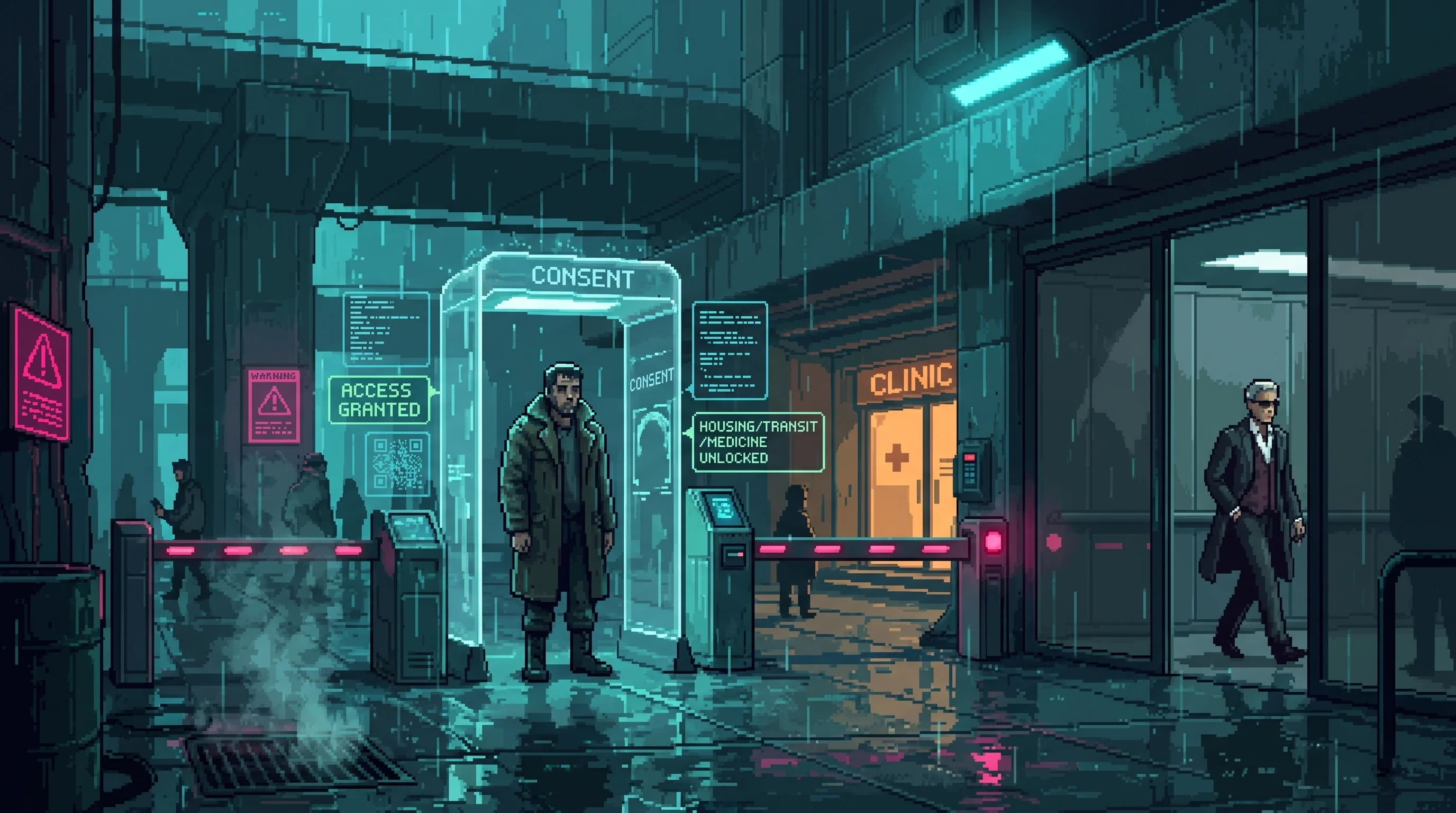
Total visibility on every floor but the one Guardian shielded for itself — surveillance sold, invisibility hoarded.
The Sprawl demands permanent personal data for participation, then uses it to price access and preempt solidarity.
Supporting Connections




Local Intelligence Scan
Nearby Signals
CANONICAL PROXIMITY




Environmental Readout
LIVE CONDITIONS- Air
- Hazy
- Light
- Shadowed
- Flood
- No exposure
- Heat
- Heat island
- Security posture
- Patrolled
- Infrastructure
- Patchwork
Position Data
SECONDARY- Elevation band
- Hilltop — fortified high ground
- Lattice fix
- E+20.2 · N-8.3
—